INTRODUCTION
Breast cancer is the most common cancer among urban women in India.Reference Dhillon, Yeole, Dikshit, Kurkure and Bray1 The majority of patients present with advanced disease, and mastectomy followed by adjuvant radiation is the standard treatment schedule that is practiced. Large meta-analyses have shown the benefit of post-mastectomy radiotherapy in terms of improvement in local control and overall survival.Reference Truong, Woodward and Buchholz2–Reference Kunkler, Canney and van Tienhoven6 Adjuvant radiation to the chest wall is commonly achieved with tangential beams, which pass through the anterior part of the thoracic cavity, thereby increasing the risk to adjacent organs such as lungs and the heart. Therefore, there was a need for newer techniques such as intensity-modulated radiotherapy (IMRT). This technique was developed to deliver uniform dose to the target volume while sparing the organs at risk.Reference Harsolia, Kestin and Grills7–Reference Cavey, Bayouth, Endres, Pena, Colman and Hatch12
It has long been assumed that breathing does not significantly affect dose distribution within the target volume with tangential beam radiotherapy to the chest wall. However, its impact on dose distribution within the chest wall with IMRT is not clearly known. The use of multiple beam segments in IMRT increases the potential for dose variation within the target and organs at risk with respiration.
Although respiratory motion is only a small component that contributes to the uncertainties in thoracic irradiation, it has various effects on radiation therapy for breast cancer. It limits image acquisition, radiation planning and its delivery. Various studies have documented dosimetric errors using multi leaf collimator (MLC)-based IMRT treatment, summing up to 20% within the field and even higher at the edge of the field.Reference Kubo and Wang13, Reference Keall, Kini, Vedam and Mohan14 However, much of the fluence variations tend to average out over a typical course of 25 fractions.Reference Yu, Jaffray and Wong15 This was demonstrated by taking into account only one-dimensional movement; therefore, fractionation cannot be entirely relied upon. It is postulated that the magnitude of chest wall movement and tidal volume correlate with the target under coverage with IMRT and reflect on over-dosage to organs at risk.
Respiratory motion management techniques are propagated in the practice of IMRT to the chest wall. However, it is not easy to establish it in the Indian scenario. Therefore, there was a need for predictors that indicate the chance of significant dose variations in IMRT with breathing.
Hypothesis: The impact of breathing on IMRT to the chest wall in patients receiving post-mastectomy radiotherapy is significantly more than three-dimensional (3D) tangential radiotherapy – that is, target coverage decreases with respiration.
MATERIALS AND METHODS
Patients with breast cancer were enrolled into an institution review board-approved study to quantify the impact of breathing on post-mastectomy radiotherapy using both standard 3D tangential fields and IMRT.
Jaegar’s MasterScreen Pulomonary Function Tests (PFT) is an instrument used to document respiratory parameters such as breathing frequency, tidal volume, vital capacity, forced expiratory volume, etc. It also gives the patient a visual feedback of her respiratory pattern, which helps in breath-hold training (in inspiratory and expiratory phases), as shown in Figure 1a and 1b. Patients with a minimum breath-hold time of 15 seconds (time taken for a computed tomography (CT) Thorax) were recruited for this study. Their tidal volume and breathing frequency were noted. Chest expansion with normal respiration was measured using a measuring tape.
(a and b) The visual feedback of a patient trained to hold breath for atleast 15 seconds in inspiration and expiration, respectively, using Jaegar’s Pulomonary Function Tests (PFT).

All patients underwent a ‘free breathing’ (FB) CT simulation using PET-CT Seimens Biograph scanner at 3-mm-thick intervals. At simulation, 2-mm lead balls were used to mark the three CT centres on the body as per usual protocol, as well as two new centres on either side of the breast board in the same axial plane. The lead balls on the breast board were taken as the reference points to overlap inspiratory and expiratory CT scans, as these points do not move with respiration. Patients continued to be in the same position while two additional CT scans during ‘normal inspiration’ (NI) and ‘normal expiration’ (NE) were acquired. These breath-hold positions represent the extremes of normal breathing that could be encountered during radiotherapy.
After the CT datasets were obtained, the images were transferred to the Eclipse planning system (External beam planning v10.0.42; Varian Medical system, Palo, Alto, CA, USA) for contouring and IMRT treatment planning. The chest wall, lungs and heart were contoured for the FB-, NI- and NE-CT datasets.
The free breathing CT scan was used as the reference study for specifying the beam arrangement for both the standard 3D tangential plan and the dynamic MLC-IMRT plan. The 3D tangential planning was carried out using PLATO RTS Version 2.7.7. Four co-planar opposed tangential beams of 6/15 MV, appropriate wedges, collimator angles and beam weights were used to generate a plan rendering 50 Gy in 25 fractions to the chest wall (target). The dose was normalised to target the isocentre. For IMRT planning, five to seven co-planar 6 MV beams on the ipsilateral thorax were used. Planning objectives were target coverage of V95>95%, combined lungs V20<20% and Heart V25<10%. Beam segments were optimised to generate a plan rendering a dose of 50 Gy in 25 fractions to the target.
To simulate normal breathing, the treatment plan constructed using FB-CT was copied and applied to NI and NE scans, matching the isocentre with respect to the marker on the breast board. No changes were made to the initial treatment plan. The cumulative dose-volume histograms with IMRT and 3D tangents for the target, lungs and heart for the three different CT sets were calculated. The target volume receiving 95% of prescribed dose taking breathing into account with IMRT and 3D tangents plan were calculated and compared.
This study was undertaken to understand the variations in the target with breathing in both IMRT and 3D tangent plans. A reduction of target V95 by more than 5% was considered as significant. A sample size of 10 will have a one-sided 95% probability of 2·89, and this is not greatly reduced by increasing the sample size to 15 or 20. Therefore, a sample size of 10 was chosen.
Baseline analysis included calculation of descriptive statistics such as mean, standard deviation and median quantiles for both respiratory parameters (breathing frequency, tidal volume and chest expansion) and dosimetric variables of IMRT and 3D tangents such as Target V95 (volume of the target receiving 95% of dose), D2/Dmax (dose received by 2% of volume/Dosemaximum), D98/Dmin (dose received by 98% of volume/ Doseminimum); Lung V20 (volume of total lungs receiving 20 Gy or more); and Heart V25(volume of the heart reciving 25 Gy or more). One sample t-test was used to compare IMRT to the 3D tangential radiotherapy technique. In order to assess the effect of breathing on the two techniques, the mean target coverage (V95) on FB scan was compared with the mean target coverage on NI and NE scans separately using the paired t-test. All differences between the two groups’ two-tailed alpha values <0·05 were considered significant. Pearson’s correlation test using SPSS (version 17) was carried out to assess whether target coverage decreases in the various breathing phases (NI and NE scans) with an increase in tidal volume.
RESULTS
Ten of 13 patients fulfilled the spirometric requirement for breath-hold and were recruited to our study. The mean respiratory rate was 20·3 breaths/minute, mean tidal volume was 0·66 litres and the mean chest wall expansion was 0·67 cm (Table 1).
Magnitude of respiratory motion among the study population

A one-sample t-test comparing IMRT with 3D tangential therapy on FB scan revealed that the IMRT was significantly superior in terms of better target coverage (p=0·04), without considering the effect of breathing motion. However, it was found that mean target coverage fell by more than 5% with breathing in IMRT plans when compared with 3D tangential plans, although the significance could not be elicited (Table 2). Comparison of means between the target coverage (V95) for IMRT and 3D conformal tangents in free breathing versus NI/NE phases carried out showed a statistically significant change in target coverage with respiration for IMRT. These values were not significant for 3D conformal tangents plan (Table 3).
Comparison of FB, NI and NE scan target coverage (V95), maximum dose and minimum dose in IMRT versus 3D tangential RT

Abbreviations: FB, free breathing; NI, normal inspiration; NE, normal expiration; IMRT, intensity-modulated radiotherapy.
Comparison of target coverage means between FB scan and NI/NE scan for both IMRT and 3D tangential therapy

Abbreviations: FB, free breathing; NI, normal inspiration; NE, normal expiration; IMRT, intensity-modulated radiotherapy.
Not only was there an undercoverage of the target with breathing in IMRT plans compared with 3D tangential therapy plans, there was also an increase in D2 (statistically significant) and a decrease in D98 (statistically not significant). The minimal clinical target volume dose was decreased by 20–25% with breathing in IMRT when compared with 10–12% in 3D tangents.
The one-sample t-test comparing IMRT to 3D tangential therapy on FB scan also showed that the IMRT was significantly superior in terms of reduced dose to organs at risk such as lungs (p=0·03) and the heart (p=0·05). However, the estimation of dose received by these organs with breathing revealed variation. The mean combined lung volume receiving 20 Gy in IMRT-FB plan was 9·53%, whereas in 3D FB plan it was 11·91%. In addition, the volume in percentage receiving the tolerance dose was fairly constant for each breathing position both in IMRT and in the 3D tangents plan (Table 4). Four of the 10 patients had left-sided breast cancer, and their mean cardiac volume receiving dose of 25 Gy (V25) in FB, NI and NE were 5·37, 7·95 and 3·65%, respectively, with the IMRT plan, while in the 3D tangents plan they were 9·82, 11·5 and 10·4, respectively (Table 4). The volume of heart receiving 25 Gy crossed the tolerance limit of 10% with breathing in the 3D tangents plan.
Comparison of FB, NI and NE scan lung dose (V20) and heart dose (V25) in IMRT versus 3D tangential RT

Abbreviations: FB, free breathing; NI, normal inspiration; NE, normal expiration; IMRT, intensity-modulated radiotherapy.
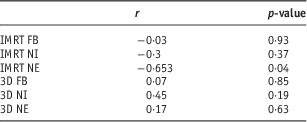
There was a significant correlation with higher patient tidal volume and decreased target coverage in NI (r of −0·3) and NE scans (r of −0·653) for IMRT plans. This correlation was not seen with 3D plans (Table 5). No correlation with chest wall expansion and chest wall coverage was noticed.
Correlation between tidal volume and target coverage (V95)
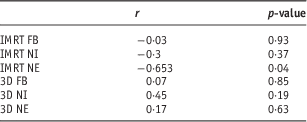
Abbreviations: IMRT, intensity-modulated radiotherapy; FB, free breathing; NI, normal inspiration; NE, normal expiration.
The target under coverage occurs predominantly in the superior and anterior aspect of the target with breathing in the IMRT technique (Figure 2).
(a and b) The 95% isodose colour wash in axial and sagittal sections at the level of the carina and head of humerus, respectively, on normal inspiration (NI) scan with the intensity-modulated radiotherapy (IMRT) plan.
DISCUSSION
Thoracic organs move substantially with normal breathing. From the literature, we know that the mean amplitude of chest wall movement with respiration is 0·8–10 mm.Reference Saliou, Giraud, Simon, Fournier-Bidoz, Fourquet and Dendale16 The chest expansion of our study patients ranged between 0·5 and 1·2 cm with breathing. This motion is capable of causing inadvertent variations in target dose coverage, especially with the IMRT technique in which a beam typically comprises several dynamic segments causing interplay between target volume motion and mechanical motion. Frazier et al. studied the impact of breathing motion on whole-breast radiotherapy and found that the dose delivered to breasts using tangents or the sMLC-IMRT (Step and shoot) technique is relatively insensitive to breathing motion during normal breathing.Reference Frazier, Vicini and Sharpe17 George et al. quantified the effect of respiration on dynamic IMRT breast planning and demonstrated that the planned and expected dose distribution differed (difference increased with respiratory motion), dose heterogeneity increased within the planning target volume and dose to organs at risk (lungs and heart) increased.Reference George, Keall and Kini18
This study attempted to determine how breathing affects post-mastectomy radiotherapy for two different techniques: a 3D tangential technique and a dynamic MLC-IMRT technique. We found that there was dosimetrically significant reduction in target coverage with breathing in IMRT plans of more than 5% when compared with 3D tangent plans. This effect was amplified in patients with larger tidal volume. This was not surprising as dosimetric errors summing up to 20% within the field (in low-dose gradients) and even higher in the edge of the field (high-dose gradient region) is expected with breathing in IMRT.Reference Kubo and Wang13, Reference Keall, Kini, Vedam and Mohan14 With our technique of dynamic MLC-IMRT, it was found that breathing motion resulted in significant dose inhomogeneity within the target with higher dose maximum and lower dose minimum, and the minimal clinical target volume dose (D98) was decreased by 20–25%.
It was demonstrated that, although the planned dose to lungs on FB scan was lesser with IMRT, it varied more with breathing. However, it did not cross the tolerance limit in either of the techniques studied. Analysis of the heart doses revealed that patients with left-sided breast cancer received higher dose with 3D tangents than with IMRT (9·82 versus 5·37%), and it crossed the tolerance limit of 10% with breathing. Our observations support the suggestion by George et al.Reference George, Keall and Kini18 for whole-breast radiotherapy.
Various studies have suggested that IMRT results in increased conformity index in the target with sparing of lungs and the heart, especially in left-sided breast irradiation.Reference Rudat, Alaradi and Mohamed11, Reference Cavey, Bayouth, Endres, Pena, Colman and Hatch12, Reference Koshy, Zhang, Naqvi, Liu and Mohiuddin19 Our study also adds to the finding that IMRT is a better technique for heart-sparing when compared with the 3D tangents technique in left-sided breast cancer, even when breathing motion is taken into account. At the same time, it has been shown by Tezcanli et al. that the exposed heart dose does cross the tolerance limit for the left ventricle, right ventricle and left anterior descending artery with inspiration in some patients (three out of 10 breast cancer patient after breast conservation surgery/mastectomy), even with the use of IMRT.Reference Tezcanli, Goksel and Yildiz20 Thus, it can be concluded that IMRT planning for left-sided breast cancer patients without breath-control technique is not capable of compensating for the whole intra-fraction heart and its components’ volumes as well as dose changes with breathing.
The effect of breathing on IMRT treatment can be exaggerated by the fact that treatment time is longer (8 minutes) compared with 3D tangents (40 seconds of beam-on time). Taking the mean respiratory rate of the 10 patients studied, of 20·3 breaths/minute, the predicted number of breathing cycles per treatment fraction will be 162 with IMRT and 14 with 3D tangents. Thus, we can infer that even small changes in target coverage and dose to organs at risk with respiration can adversely affect an IMRT plan when compared with 3D tangents.
CONCLUSIONS
Dosimetric coverage of the target chest wall is sensitive to breathing for the IMRT technique, especially in patients with large tidal volume. Dose inhomogeneity increases greatly within the target volume with breathing in IMRT. Although it is possible to reduce the planned lung dose with IMRT, it varies with breathing. IMRT technique is capable of reducing heart dose, especially in left-sided breast cancer patients, even when taking breathing into account. Therefore, it is important to consider the respiratory parameters of a patient before choosing the technique of post-mastectomy radiotherapy.
Acknowledgements
The authors are grateful to the Departments of Radiology and Pulmonary Medicine, Christian Medical College, Vellore, for their support during the study.
Financial support
This research received no specific grant from any funding agency, commercial or not-for-profit sectors. This research received grant from institutional review board
Conflicts of Interest
None.
Ethical Standards
The authors assert that all procedures contributing to this work comply with the ethical standards of the relevant national guidelines on human experimentation ‘Impact of breathing on post-mastectomy radiotherapy: a dosimetric comparison between intensity-modulated radiotherapy and 3d tangential radiotherapy’ and with the Helsinki Declaration of 1975, as revised in 2008, and has been approved by the institutional committees (Institutional Review Board, Christian Medical College, Vellore).