INTRODUCTION
Toral-Granda (Reference Toral-Granda2006) classified sea cucumbers in categories of low, medium and high, according to their commercial value. For example, sandfish Holothuria scabra Jaeger, Reference Jaeger1833, golden sandfish H. scabra versicolor Conand, 1986 and Stichopus japonicus Selenka, 1867 have high commercial value worldwide.
Nearly 1400 species of holothurians have been identified to date (Pawson, Reference Pawson2007). Subsequently, six orders were appropriated as holothurians (Pawson, Reference Pawson and Parker1982; Smiley, Reference Smiley, Harrison and Chia1994). Until 1940, 17 species of sea cucumber included in the orders Apodida, Aspidochirotida and Dendrochirotida have been recorded from Iranian waters of the Persian Gulf (Heding, Reference Heding1940).
Beche-de-mer is processed from sea cucumbers belonging to the families Holothuroidae and Stichopodidae. They have a worldwide distribution as found in the Indo-West Pacific region including the Islands of the Western Indian Ocean, Mascarene Islands, East Africa and Madagascar, Red Sea, South-east Arabia, the Persian Gulf, west coast of India and Pakistan, Maldives and the Lakshadweep, Sri lanka, Bay of Bengal, the east Indies, North Australia, the Philippines, China, Southern Japan, South Pacific Islands and the Hawaiian Islands (James et al., Reference James and James1994). Sandfish is highly valued sea cucumber, as A-grade beche-de-mer processed from those (Agudo, Reference Agudo2006). In Iran, the sandfish, H. scabra is the most exploited sea cucumber species which is harvested at Qeshm Island because of the high demand from Indian and Bangladeshi traders (Afkhami et al., Reference Afkhami, Ehsanpour, Khazaali, Kamrani, Mokhlesi and Darvish Bastami2012).
Few studies on the identification of holothurians in the Persian Gulf have been conducted. All are limited to the same considerations as Heding (Reference Heding1940), Price (Reference Price1981, Reference Price1982), Shakouri et al. (Reference Shakouri, Aminirad, Nabavi, Kochanian, Savari and Safahiye2009a, Reference Shakouri, Nabavi, Kochanian, Savari, Safahieh and Aminradb), Dabbagh (Reference Dabbagh2011), Dabbagh & Kamrani (Reference Dabbagh and Kamrani2011) and Dabbagh & Keshavarz (Reference Dabbagh and Keshavarz2011). Moreover, Price (Reference Price1981, Reference Price1982, Reference Price1983) focused only on fauna (Holothuroidea) of the western Persian Gulf. Thus far, H. scabra has been unknown in the Persian Gulf region. This report is the first to document this highly valued commercial sea cucumber in the Persian Gulf.
MATERIALS AND METHODS
The specimens were collected by snorkelling to a depth of 5 m from the muddy substrate of Qeshm Island. They were then deposited at the Persian Gulf Molluscs Research Station (PGMRS), Hormozgan Province, Bandar-e Lengeh, Iran. Before identification, the specimens were anaesthetized by magnesium chloride at a concentration of 5% to the extent of the tentacles. Ossicles in three positions, including dorsal and ventral body wall, tentacles and tube feet, were examined to identify the sea cucumber. Household bleach was initially used to remove the ossicles from the tissues (Samyn et al., Reference Samyn, Vandenspiegel and Massin2006). Finally, the precipitated ossicles were examined with a microscope at 40× magnification. Identification was accomplished by valid keys of Cherbonnier (Reference Cherbonnier1988) and Samyn (Reference Samyn2003).
RESULTS
SYSTEMATICS
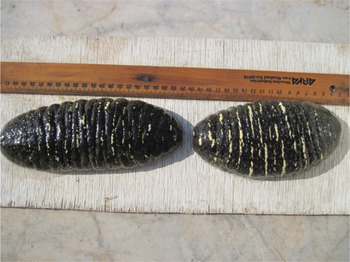
Holothuria (Metriatyla) scabra Jaeger, Reference Jaeger1833, adult individual: a dorsal view.

Holothuria (Metriatyla) scabra Jaeger, Reference Jaeger1833: 23; Cherbonnier, Reference Cherbonnier1952: 504; Macnae & Kalk, Reference Macnae and Kalk1962: 105, 112, 119; Rowe, Reference Rowe1969: 160, 161; Daniel & Halder, Reference Daniel and Halder1974: 429; Cherbonnier, Reference Cherbonnier1988: 135, 136, 137; Branch et al., Reference Branch, Griffiths, Branch and Beckley1999: 204; Marshall et al., Reference Marshall, Milledge and Afonso2001: 45, 46; Massin, Reference Massin1999: 30; Massin et al., Reference Massin, Mercier and Hamel2000: 77; Samyn, Reference Samyn2000: 15; Lane et al., Reference Lane, Marsh, VandenSpiegel and Rowe2000: 489; Samyn & Vanden Berghe, Reference Samyn and Vanden Berghe2000: 24; Hamel et al., Reference Hamel, Conand, Pawson and Mercier2001: 129–223; Kithakeni & Ndaro, Reference Kithakeni and Ndaro2002; Samyn, Reference Samyn2003: 50, 51; Paulay, Reference Paulay2003: 582; Al-Rashdi et al., Reference Al-Rashdi, Al-Busaidi and Al-Rassadi2007: 17; Massin et al., Reference Massin, Uthicke, Purcell, Rowe and Samyn2009: 50, 51, 52, 53.
MATERIAL EXAMINED
In 2011, specimens were taken from a muddy bed on the north coast of Qeshm Island (26°58′N 56°14′E) near the Hamoon jetty, Persian Gulf, at a depth of 5 m. The collector was A.-R. Dabbagh.
MORPHOLOGY
At rest, the specimens range from 250 mm to 400 mm in length and from 40 mm to 90 mm in width. They are grey-black ventrally with transverse white or yellow horizontal bands (Figure 1). The ventral surface is speckled with tiny dark dots. The mouth ventral is surrounded by 20 short tentacles along the well-developed tentacular ampullae towards the anus terminal. The body wall is nearly 10–15 mm thick. The one long polian vesicle is nearly 7 cm. Cuvierian tubules are absent. The calcareous ring is stout. The radial pieces are twice as broad as the interradial pieces. The anterior notch is large and deep.
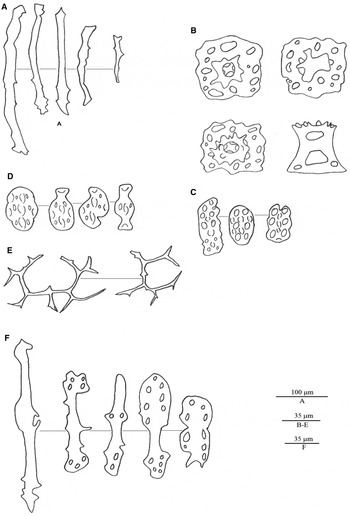
The tentacles have rods ranging from 160 to 450 µm in length (Figure 2A). The dorsal body wall has tables (Figure 2B) and buttons; the tables with discs are on average 70 µm in diameter. Discs with undulating or spiny edges are perforated by one large central hole and numerous peripheral small holes. Buttons are knobbed with 6 to 10 holes, 50–70 µm (Figure 2C). Rods are 80–120 µm in length and branched (Figure 2E). The ventral body wall has buttons (small holes) (Figure 2D) and branched rods (Figure 2E). The rods are 80–120 µm in length. The tube feet have buttons (small holes) and perforated rods; the buttons are 50 µm long; the perforated rods are 100–260 µm long (Figure 2D, F). The papilla have buttons, tables and perforated rods; the small buttons are 40–50 µm long; the tables have discs 60–70 µm in diameter; the perforated rods are 90–270 µm long.
Holothuria scabra: (A) rods from tentacles; (B) tables from dorsal body wall; (C) buttons from dorsal body wall; (D) buttons from ventral body wall and tube feet; (E) branched rods from ventral body wall and tube feet; (F) perforated rods from tube feet.

DISCUSSION
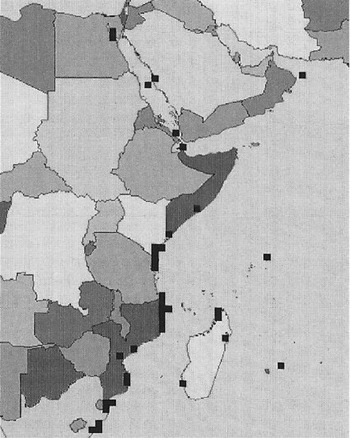
Holothuria scabra is spread in the tropical and subtropical areas of the Indo-West Pacific Ocean (IWPO) (Clark, Reference Clark1946; Rowe & Gates, Reference Rowe, Gates and Wells1995; Massin, Reference Massin1999; Hamel et al., Reference Hamel, Conand, Pawson and Mercier2001; Samyn, Reference Samyn2003; Agudo, Reference Agudo2006). However, this species has been found in the Western Indian Ocean (WIO) (James & James, Reference James and James1994; James, Reference James2001; Samyn, Reference Samyn2003; Rasolofonirina et al., Reference Rasolofonirina, Mara and Jangoux2004; Conand et al., Reference Conand, Dinhut, Quod and Roland2005; Pouget, Reference Pouget2005; Al-Rashdi et al., Reference Al-Rashdi, Al-Busaidi and Al-Rassadi2007); there is no record of it in the Persian Gulf (Figure 3) (Samyn, Reference Samyn2003; Agudo, Reference Agudo2006). Massin et al. (Reference Massin, Uthicke, Purcell, Rowe and Samyn2009) did not include H. scabra IWPO as conspecific to those of WIO. More studies of H. scabra are needed from WIO to confirm its specific relationship with IWPO.
Distribution of Holothuria scabra in the world derived from Samyn (Reference Samyn2003) showing no record in the Persian Gulf.

Tentacles 20 with modified papillae around the tentacles base; thickness of body wall is thin, around 2 mm; body flatted ventrally and arched dorsally; size small to moderate, are morphological characteristics of H. scabra (Rowe, Reference Rowe1969; Massin et al., Reference Massin, Uthicke, Purcell, Rowe and Samyn2009). Specimens found in our study and those collected by Samyn (Reference Samyn2003) have thickness of up to 15 mm, this is followed by a correlation between length–weight, as body walls in larger specimens have an increase of thickness (Pitt & Nguyen, Reference Pitt and Nguyen2004). The large specimens up to 400 mm were found in our samples collected at Qeshm Island.
Variations have been discerned in the colours of H. scabra from the Indo-Pacific and the WIO (Conand, Reference Conand1989, Reference Conand, Carpenter and Niem1998). They have a variety of colour morphs from green to grey (Uthicke & Benzie, Reference Uthicke and Benzie1999); specimens have been observed with chocolate brown dorsal sides from Bali, Indonesia and black morphs in New Caledonia (Massin et al., Reference Massin, Uthicke, Purcell, Rowe and Samyn2009).
The dorsal body in the Pacific H. scabra is grey-green with transverse greenish bands (Massin, Reference Massin1999), whereas the dorsal body in the WIO H. scabra is grey with black spots along white or yellow horizontal bands (Samyn & Vanden Berghe, Reference Samyn and Vanden Berghe2000; James, Reference James2001; Kithakeni & Ndaro, Reference Kithakeni and Ndaro2002; Samyn, Reference Samyn2003; Al-Rashdi et al., Reference Al-Rashdi, Al-Busaidi and Al-Rassadi2007; Massin et al., Reference Massin, Uthicke, Purcell, Rowe and Samyn2009).
In our specimens, the morphological aspect and ossicles were substantially similar to those described by Cherbonnier (Reference Cherbonnier1988) in specimens from Madagascar; by Massin (Reference Massin1996) in specimens from Ambon; by Massin (Reference Massin1999) in specimens from Indonesia; and by Samyn (Reference Samyn2003) in specimens from Kenya and Pemba Island, Tanzania and reviewed by Rowe (Reference Rowe1969). Among the ossicles, branched rods are observed only in our species and in species from Madagascar (Cherbonnier, Reference Cherbonnier1988), whereas perforated rods were similar to the ossicles described by Massin (Reference Massin1996, Reference Massin1999).
The presence of small holes in buttons of the ventral body and the presence of branched rods in tube feet are characteristic of ossicles in the specimens of the WIO sandfish collected by Cherbonnier (Reference Cherbonnier1988).
Holothuria scabra is found throughout seagrass beds and reef flats but rarely in coral gardens (Massin, Reference Massin1999; Kithakeni & Ndaro, Reference Kithakeni and Ndaro2002; Paulay, Reference Paulay2003; Samyn, Reference Samyn2003; Al-Rashdi et al., Reference Al-Rashdi, Al-Busaidi and Al-Rassadi2007; Massin et al., Reference Massin, Uthicke, Purcell, Rowe and Samyn2009). Data on the behaviour of H. scabra also show that this species attempts to conceal itself in the mud early in the morning. Hence, that is the best time to collect the animals. However, this species also has been observed half-buried in the mud (Macnae & Kalk, Reference Macnae and Kalk1962).
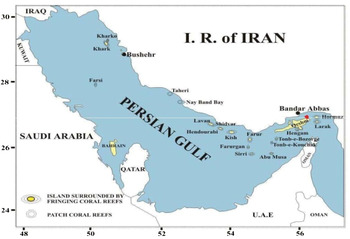
A few surveys have been accomplished throughout the Persian Gulf and Iranian waters, but highly valuable commercial species have not been reported until now (Heding, Reference Heding1940; Price, Reference Price1981; Shakouri et al., Reference Shakouri, Aminirad, Nabavi, Kochanian, Savari and Safahiye2009a, Reference Shakouri, Nabavi, Kochanian, Savari, Safahieh and Aminradb; Dabbagh, Reference Dabbagh2011; Dabbagh & Kamrani, Reference Dabbagh and Kamrani2011; Dabbagh & Keshavarz, Reference Dabbagh and Keshavarz2011; Dabbagh & Sedaghat, Reference Dabbagh and Sedaghat2012; Dabbagh et al., Reference Dabbagh and Sedaghat2012). Thus, this paper is the first to report a description of H. scabra taken from the Persian Gulf and Iranian waters (Figure 4).
The red mark shows the location of Holothuria scabra in the Persian Gulf (Qeshm Island).

In conclusion, the collected specimens provide evidence that a highly valued commercial species is present in the Persian Gulf waters.
ACKNOWLEDGEMENTS
This paper is part of a sea cucumber survey being conducted at the Persian Gulf Molluscs Research Station (PGMRS). The authors are grateful to Dr Yves Samyn for his identification of the species.