Introduction
The wheat stem sawfly, Cephus cinctus Norton (Hymenoptera: Cephidae), is the most important pest of wheat, Triticum aestivum L. (Poaceae), in the northern Great Plains of the United States of America (Morrill and Kushnak Reference Morrill and Kushnak1999; Shanower and Waters 2006). Yield losses occur in part as a result of lodging resulting from the girdling of stem bases by the stem-mining larvae. Larvae subsequently form diapause chambers in the resultant stem stubs, in which they overwinter. Larvae of two native braconid wasps, Bracon cephi (Gahan) and Bracon lissogaster Muesebeck (Hymenoptera: Braconidae), exert significant parasitism pressure on larvae of C. cinctus in wheat in some regions (Morrill Reference Morrill1997; Runyon et al. Reference Runyon, Hurley, Morrill and Weaver2001). Females of both Bracon species locate, paralyze, and then lay eggs on larvae of C. cinctus within stems; the braconid larvae develop as ectoparasitoids (Nelson and Farstad Reference Nelson and Farstad1953; Somsen and Luginbill Reference Somsen and Luginbill1956; Holmes et al. Reference Holmes, Nelson, Peterson and Farstad1963). The location of a parasitoid reflects the position of a larva when it was initially parasitized. First-generation parasitoids develop rapidly and enter a short pupal stage, adults emerge, and a complete or partial second generation follows (Nelson and Farstad Reference Nelson and Farstad1953; Somsen and Luginbill Reference Somsen and Luginbill1956). Second-generation adult parasitoids are present from the middle of August through late September (Nelson and Farstad Reference Nelson and Farstad1953), which is mostly after wheat harvest in the northern Great Plains.
The lack of late-season hosts on which second-generation Bracon species can complete development, and thereby increase in numbers, has been considered a major factor limiting their success in controlling C. cinctus (Holmes et al. Reference Holmes, Nelson, Peterson and Farstad1963; Morrill et al. Reference Morrill, Kushnak, Bruckner and Gabor1994). Holmes et al. (Reference Holmes, Nelson, Peterson and Farstad1963) observed that B. cephi rarely attacks C. cinctus successfully once it has formed overwintering chambers (this generally occurs when the moisture levels in the host plant drop below 50%, just prior to wheat harvest). Maximum rates of parasitism of C. cinctus by B. cephi in at least 600 stubs collected annually between 1953 and 1960 near Lethbridge, Alberta, Canada, was 2.5% (Holmes et al. Reference Holmes, Nelson, Peterson and Farstad1963). Here we report on results of a study designed to examine the generality of these findings by quantifying rates of parasitism of C. cinctus larvae in diapause chambers in wheat stubble after harvest during an 8-year period in Montana and North Dakota.
Materials and methods
Postharvest stub collection and processing
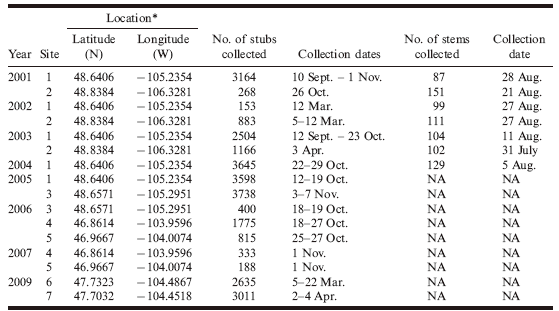
Stems that had been cut by C. cinctus to form diapause chambers (hereinafter referred to as stubs) were collected after wheat harvest in Montana (Richland, Daniels, and Valley counties) and North Dakota (Golden Valley County), United States of America (Table 1) in the fall or early in the spring before the soil warmed above 12 °C. Collections were made in one to three wheat fields per year between 2001 and 2009, except in 2008.
Location, sample sizes, and collection dates for each site and year of the study of parasitism of Cephus cinctus in North Dakota and Montana.
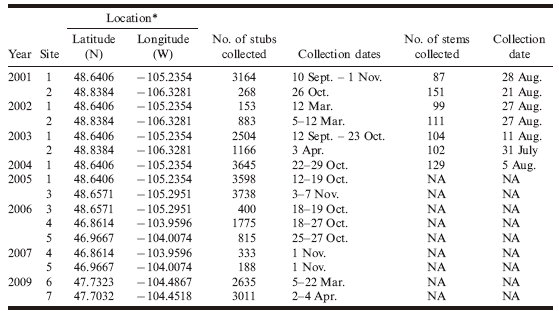
Note: Stubs were collected after harvest in fall-winter, while stems were collected prior to harvest (summer) in each year.
*Coordinates are given in decimal degrees (NAD 83).
In each sampling site-year, wheat stubble was excavated and brought to the laboratory, where stubs were separated from uncut stems, and carefully cleaned of excess soil and roots. More than 100 stubs were collected in each site-year (Table 1). Stubs were placed into sealable perforated 3.8 L plastic bags, lightly sprayed with distilled water, and placed in cold storage at 4–8 °C for a minimum of 120 days to break diapause. Samples were then removed from cold treatment and 50–100 stubs were placed upright in 454g plastic containers, covering the base of the stubs with a small amount of potting soil. Containers with stubs were placed inside sealable perforated 3.8L plastic bags (two containers per bag). These were maintained in the laboratory at 21–25 °C under fluorescent lighting with a 16L:8D cycle, keeping the soil moist by spraying daily with distilled water.
Stubs were monitored daily and emerging C. cinctus and parasitoids were quantified and removed using an aspirator until emergence ceased. Proportion parasitism was calculated as the number of Bracon spp. parasitoids divided by the total number of emergent Bracon spp. and C. cinctus individuals combined. We pooled parasitoid numbers because the two Bracon species are difficult to distinguish morphologically (Runyon et al. Reference Runyon, Hurley, Morrill and Weaver2001). Bracon cephi has previously been found to be the dominant parasitoid in eastern Montana (Meers Reference Meers2005) and thus likely dominated our samples.
Preharvest stem collection and dissection
Sites used in 2001–2004 were long-term research sites for which we also collected data on rates of C. cinctus stem infestation and parasitism. Between 87 and 151 stems were collected just prior to harvest at each site in each year (Table 1), brought back to the laboratory, and dissected to assess rates of C. cinctus infestation and parasitism. Stems that contained any evidence of C. cinctus (eggs, larvae, or characteristic feeding damage and frass) were considered infested. The presence of Bracon spp. within stems was also noted. Evidence of parasitoids included larvae of Bracon spp. feeding externally on C. cinctus, cocoons present within the stems, or the presence of characteristic exit holes. Parasitism was calculated as the number of stems containing evidence of parasitism divided by the number of stems infested by C. cinctus.
We fit general linear models using the REML (REstricted Maximum Likelihood) method in JMP version 8.0.1 (SAS Institute Inc. 1989–2011) to assess the influence of sample size (number of stubs collected) on proportion parasitism in stubs. Similar models were run to examine the influence of the proportion of stems infested by C. cinctus on the proportion of parasitized larvae in stems and stubs and the relationship between stem parasitism and stub parasitism. Proportion-parasitism data were arcsine square-root-transformed for all models.
Results
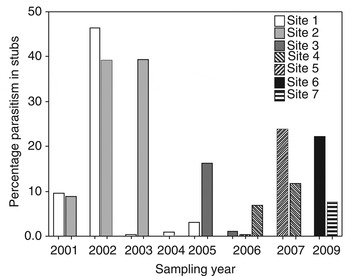
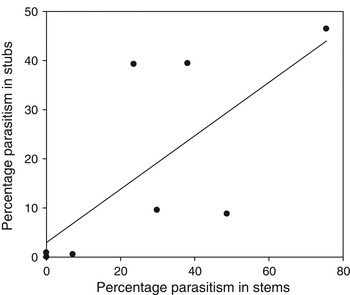
We collected over 28 000 stubs; numbers per site-year varied considerably (Table 1). Rates of parasitism were not significantly related to sample size (F 1,14 = 2.36, P = 0.1470) and varied between sites and across years (Fig. 1; range = 0.5%–46%). Rates were much higher than expected based on previous work, exceeding the previous maximum observed rate of 2.5% (Holmes et al. Reference Holmes, Nelson, Peterson and Farstad1963) in 12 of 16 site-years. Parasitism of C. cinctus larvae in stem samples was similarly variable (range =1.5%–75.5%)and was significantly positively related to that in stubs (Figure 2, R 2adj.= 0.58, F 1,6 = 10.64, P = 0.0172; y = 0.0378+0.6654x). Although parasitism of larvae in stems was positively related to levels of C. cinctus infestation (R 2adj. = 0.57, F 1,6 = 10.54, P = 0.0175; y = 0.1116+0.8289x), this was not the case for parasitism of larvae in stubs (F 1,6 = 1.15, P = 0.3248).
Percent parasitism of Cephus cinctus larvae in diapause chambers (stubs) in wheat at seven sites in North Dakota and Montana from 2001 to 2009.

Relationship of percent parasitism of C. cinctus larvae in wheat stems and diapause chambers (stubs) at long-term study sites in North Dakota and Montana from 2001 to 2004.

Discussion
Holmes et al. (Reference Holmes, Nelson, Peterson and Farstad1963) found that C. cinctus larvae generally escape parasitism once they have girdled stems to form their overwintering chambers, and observed a maximum parasitism rate of 2.5%. Morrill et al. (Reference Morrill, Kushnak, Bruckner and Gabor1994) also noted low parasitism in stubs but did not present data. Holmes et al. (Reference Holmes, Nelson, Peterson and Farstad1963) further suggested that suitable hosts are often absent late in the season, when second-generation adult parasitoids are active.
Our results suggest that the generality of those conclusions should be critically reevaluated. We found that parasitism of C. cinctus larvae in postcutting diapause chambers can be substantial, reaching a maximum of 46% (mean 14.8%), which contrasts dramatically with the maximum rate of 2.5% previously reported. Furthermore, parasitism exceeded these rates in 75% of the site-years examined in our study. Not surprisingly, we also found that parasitism rates in diapause chambers were positively related to those in wheat stems collected prior to harvest, exceeding them in three cases. Rearing hosts through until parasitoid emergence tends to underestimate parasitism relative to dissection (Day Reference Day1994) and therefore our estimates of parasitism in stubs are likely conservative.
Regional differences are unlikely to explain the differences between our results and those previously reported by Holmes et al. (Reference Holmes, Nelson, Peterson and Farstad1963), given that Cárcamo et al. (Reference Cárcamo, Herle, Beres, McLean and McGinn2011) found similarly high average rates of parasitism (10%–20%) near Lethbridge, Alberta. Instead, we suspect that the widespread adoption of no- or minimum-tillage practices across the Northern Plains reduces the negative effects of tillage on parasitoids (Runyon et al. Reference Runyon, Morrill, Weaver and Miller2002; Weaver et al. Reference Weaver, Sing, Runyon and Morrill2004). These practices leave stubs on the soil surface, where they are more vulnerable to parasitoid attack than if they have been tilled under.
Our results have two important implications. First, given that C. cinctus larvae are clearly viable hosts for the native braconids B. cephi and B. lissogaster, even after the formation of diapause chambers, total parasitism rates may be significantly underestimated if stems are sampled prior to harvest. Thus, the potential cross-generational benefits of the braconids may have been generally underappreciated. Second, the argument that a lack of late-season hosts is a major factor limiting the success of the braconids clearly warrants more careful scrutiny, given evidence that C. cinctus larvae in diapause chambers in wheat are suitable hosts. Further research along these lines will be critical to understanding the population dynamics of B. cephi and B. lissogaster and developing management strategies to conserve and augment these potentially important biological agents for controlling C. cinctus.
Acknowledgements
Kevin Delaney, Héctor Cárcamo, Robb Bennett, and an anonymous reviewer provided helpful comments on the manuscript. We additionally thank the growers who allowed us to collect stubs from their fields.