


%20--%3e%3c!DOCTYPE%20svg%20PUBLIC%20'-//W3C//DTD%20SVG%201.0//EN'%20'http://www.w3.org/TR/2001/REC-SVG-20010904/DTD/svg10.dtd'%3e%3csvg%20version='1.0'%20id='Layer_1'%20xmlns='http://www.w3.org/2000/svg'%20xmlns:xlink='http://www.w3.org/1999/xlink'%20x='0px'%20y='0px'%20width='64px'%20height='64px'%20viewBox='5.5%20-3.5%2064%2064'%20enable-background='new%205.5%20-3.5%2064%2064'%20xml:space='preserve'%3e%3cg%3e%3ccircle%20fill='%23FFFFFF'%20fill-opacity='0'%20cx='37.785'%20cy='28.501'%20r='28.836'/%3e%3cpath%20fill='%23595959'%20d='M37.441-3.5c8.951,0,16.572,3.125,22.857,9.372c3.008,3.009,5.295,6.448,6.857,10.314%20c1.561,3.867,2.344,7.971,2.344,12.314c0,4.381-0.773,8.486-2.314,12.313c-1.543,3.828-3.82,7.21-6.828,10.143%20c-3.123,3.085-6.666,5.448-10.629,7.086c-3.961,1.638-8.057,2.457-12.285,2.457s-8.276-0.808-12.143-2.429%20c-3.866-1.618-7.333-3.961-10.4-7.027c-3.067-3.066-5.4-6.524-7-10.372S5.5,32.767,5.5,28.5c0-4.229,0.809-8.295,2.428-12.2%20c1.619-3.905,3.972-7.4,7.057-10.486C21.08-0.394,28.565-3.5,37.441-3.5z%20M37.557,2.272c-7.314,0-13.467,2.553-18.458,7.657%20c-2.515,2.553-4.448,5.419-5.8,8.6c-1.354,3.181-2.029,6.505-2.029,9.972c0,3.429,0.675,6.734,2.029,9.913%20c1.353,3.183,3.285,6.021,5.8,8.516c2.514,2.496,5.351,4.399,8.515,5.715c3.161,1.314,6.476,1.971,9.943,1.971%20c3.428,0,6.75-0.665,9.973-1.999c3.219-1.335,6.121-3.257,8.713-5.771c4.99-4.876,7.484-10.99,7.484-18.344%20c0-3.543-0.648-6.895-1.943-10.057c-1.293-3.162-3.18-5.98-5.654-8.458C50.984,4.844,44.795,2.272,37.557,2.272z%20M37.156,23.187%20l-4.287,2.229c-0.458-0.951-1.019-1.619-1.685-2c-0.667-0.38-1.286-0.571-1.858-0.571c-2.856,0-4.286,1.885-4.286,5.657%20c0,1.714,0.362,3.084,1.085,4.113c0.724,1.029,1.791,1.544,3.201,1.544c1.867,0,3.181-0.915,3.944-2.743l3.942,2%20c-0.838,1.563-2,2.791-3.486,3.686c-1.484,0.896-3.123,1.343-4.914,1.343c-2.857,0-5.163-0.875-6.915-2.629%20c-1.752-1.752-2.628-4.19-2.628-7.313c0-3.048,0.886-5.466,2.657-7.257c1.771-1.79,4.009-2.686,6.715-2.686%20C32.604,18.558,35.441,20.101,37.156,23.187z%20M55.613,23.187l-4.229,2.229c-0.457-0.951-1.02-1.619-1.686-2%20c-0.668-0.38-1.307-0.571-1.914-0.571c-2.857,0-4.287,1.885-4.287,5.657c0,1.714,0.363,3.084,1.086,4.113%20c0.723,1.029,1.789,1.544,3.201,1.544c1.865,0,3.18-0.915,3.941-2.743l4,2c-0.875,1.563-2.057,2.791-3.541,3.686%20c-1.486,0.896-3.105,1.343-4.857,1.343c-2.896,0-5.209-0.875-6.941-2.629c-1.736-1.752-2.602-4.19-2.602-7.313%20c0-3.048,0.885-5.466,2.658-7.257c1.77-1.79,4.008-2.686,6.713-2.686C51.117,18.558,53.938,20.101,55.613,23.187z'/%3e%3c/g%3e%3c/svg%3e)
%20--%3e%3c!DOCTYPE%20svg%20PUBLIC%20'-//W3C//DTD%20SVG%201.0//EN'%20'http://www.w3.org/TR/2001/REC-SVG-20010904/DTD/svg10.dtd'%3e%3csvg%20version='1.0'%20id='Layer_1'%20xmlns='http://www.w3.org/2000/svg'%20xmlns:xlink='http://www.w3.org/1999/xlink'%20x='0px'%20y='0px'%20width='64px'%20height='64px'%20viewBox='5.5%20-3.5%2064%2064'%20enable-background='new%205.5%20-3.5%2064%2064'%20xml:space='preserve'%3e%3cg%3e%3ccircle%20fill='%23FFFFFF'%20fill-opacity='0'%20cx='37.637'%20cy='28.806'%20r='28.276'/%3e%3cg%3e%3cpath%20fill='%23595959'%20d='M37.443-3.5c8.988,0,16.57,3.085,22.742,9.257C66.393,11.967,69.5,19.548,69.5,28.5c0,8.991-3.049,16.476-9.145,22.456%20C53.879,57.319,46.242,60.5,37.443,60.5c-8.649,0-16.153-3.144-22.514-9.43C8.644,44.784,5.5,37.262,5.5,28.5%20c0-8.761,3.144-16.342,9.429-22.742C21.101-0.415,28.604-3.5,37.443-3.5z%20M37.557,2.272c-7.276,0-13.428,2.553-18.457,7.657%20c-5.22,5.334-7.829,11.525-7.829,18.572c0,7.086,2.59,13.22,7.77,18.398c5.181,5.182,11.352,7.771,18.514,7.771%20c7.123,0,13.334-2.607,18.629-7.828c5.029-4.838,7.543-10.952,7.543-18.343c0-7.276-2.553-13.465-7.656-18.571%20C50.967,4.824,44.795,2.272,37.557,2.272z%20M46.129,20.557v13.085h-3.656v15.542h-9.944V33.643h-3.656V20.557%20c0-0.572,0.2-1.057,0.599-1.457c0.401-0.399,0.887-0.6,1.457-0.6h13.144c0.533,0,1.01,0.2,1.428,0.6%20C45.918,19.5,46.129,19.986,46.129,20.557z%20M33.042,12.329c0-3.008,1.485-4.514,4.458-4.514s4.457,1.504,4.457,4.514%20c0,2.971-1.486,4.457-4.457,4.457S33.042,15.3,33.042,12.329z'/%3e%3c/g%3e%3c/g%3e%3c/svg%3e)
Introduction
Asymptomatic bacteriuria (ASB) is a common condition where a person is found to have a positive urine culture in the absence of symptoms referable to urinary tract infection (UTI). Reference Nicolle, Gupta and Bradley1,Reference Trautner2 Treating ASB has been shown to be of no benefit Reference Zalmanovici Trestioreanu, Lador, Sauerbrun-Cutler and Leibovici3 and potentially harmful Reference Cai, Nesi and Mazzoli4 in most patient groups. Guidelines advise against this practice Reference Nicolle, Gupta and Bradley1,Reference Nelson, Tarik Aslan and Beahm5 yet excessive treatment of ASB remains common. Reference Flokas, Andreatos, Alevizakos, Kalbasi, Onur and Mylonakis6
Guidelines instruct urine culture (UC) testing must be symptom-based. Reference Nelson, Tarik Aslan and Beahm5 However, UC are commonly sent as part of a non-specific “panculture” or “septic screen” without due regard for the patient’s specific clinical features and whether these are compatible with UTI. Reference Wald7,Reference Vaughn and Chopra8 A local audit showed that 58% of UC ordered in adult inpatients at Middlemore Hospital were not clinically indicated, a practice that occurred equally across different departments, staff, and patient groups (C. Hopkins, unpublished data, 2018]. Another local study demonstrated that clinical evaluation of patients with bacteremia strongly determined the predictive value of urine microscopy and UC. Reference Young, Beaumont, Maling and Hopkins9 This is consistent with international Reference Garcia and Spitzer10–Reference Leis, Gold, Daneman, Shojania and McGeer13 and other New Zealand Reference Shahid, Alamri and Scowcro14,Reference Blakiston and Zaman15 data that most UC in hospitals are sent without a valid clinical indication, and this is a leading cause of excessive antibiotic treatment. The downstream impact of low-value (low clinical yield) testing has led to a focus on upstream processes and diagnostic stewardship to improve the ordering of UC. Reference Claeys, Blanco, Morgan, Leekha and Sullivan16
The reasons why clinicians order low-value UC are unclear. Most qualitative studies on this topic have focused on lack of knowledge among doctors Reference Fakih, Jones and Edhayan17–Reference Andrews, Abbo, Johnson, Kuskowski, Shukla and Drekonja22 and nurses Reference Advani, Gao and Datta20,Reference Jones, Sibai, Battjes and Fakih23 of appropriate clinical indications for sending UC. However, some have also identified systems, processes, communication, pressure, and beliefs as barriers to evidence-based UC ordering. Reference Advani, Winters and Turner24–Reference Advani, Boucher and Smith26
The aim of this study was to qualitatively identify influences on UC ordering behavior among front-line clinicians at Middlemore Hospital. This included exploring both knowledge and psycho-socio-cultural influences and beliefs. Our findings will inform future diagnostic stewardship interventions.
Methods
Design and setting
We conducted a qualitative, descriptive study through structured individual and small focus group interviews with clinicians at Middlemore Hospital—a large, publicly funded, tertiary, acute hospital in Auckland, New Zealand (2019–2025). The study was approved by the Auckland Health Research Ethics Committee (AH1021).
Participants
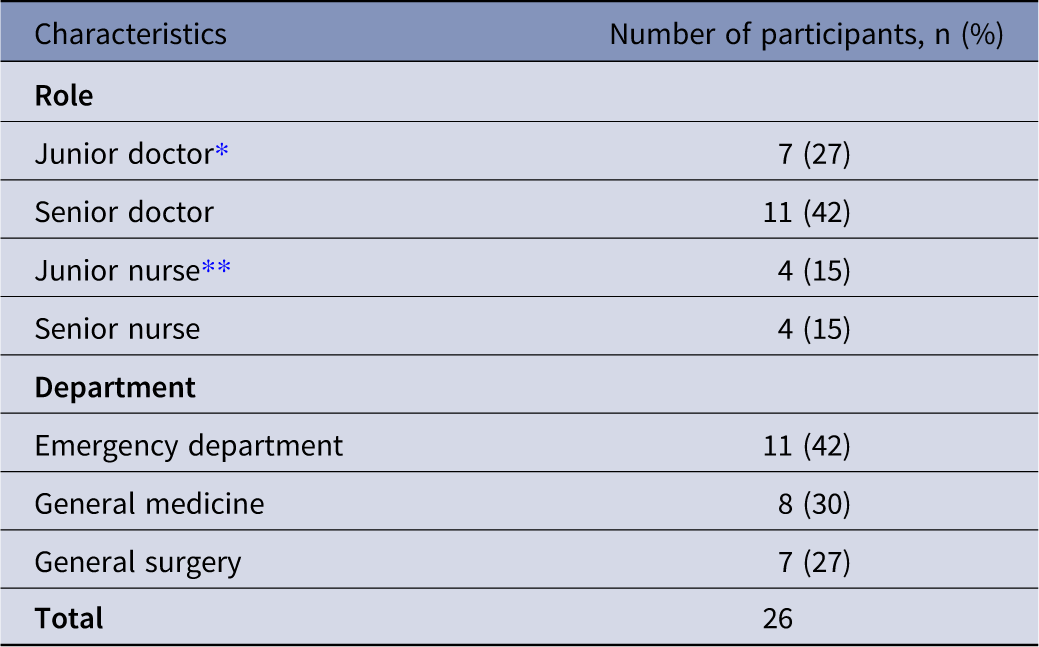
Front-line clinicians were purposively recruited to include representation of junior and senior doctors and nurses from three departments (Table 1). Recruitment occurred through advertising via email, posters, and approaching lead clinicians. Those expressing an interest were provided with a Participant Information Sheet and given time to consider whether to participate. Coffee vouchers or gift cards were provided. All participants provided written consent.
Participant characteristics

Table 1. Long description
A table titled ‘Participant characteristics’ with two columns and eight rows, including a header row. The columns are labeled ‘Characteristics’ and ‘Number of participants, n (%)’. The table is divided into two main sections: Role and Department. Under Role, the categories are Junior doctor, Senior doctor, Junior nurse, and Senior nurse. The corresponding number of participants and percentages are listed as follows: Junior doctor, 7 (27 percent); Senior doctor, 11 (42 percent); Junior nurse, 4 (15 percent); Senior nurse, 4 (15 percent). Under Department, the categories are Emergency department, General medicine, and General surgery. The corresponding number of participants and percentages are listed as follows: Emergency department, 11 (42 percent); General medicine, 8 (30 percent); General surgery, 7 (27 percent). The total number of participants is 26.
* Junior doctors are typically in their first 7 years of practice.
** Junior nurses are typically in their first 4 years of practice.
Data collection
Interview guides were designed prospectively with example open-ended questions (Supplementary Materials). Either single-session focus groups or individual interviews were conducted according to availability and preferences of participants. For focus groups, only participants from the same profession, seniority, and department were included. Two interviews were held via videoconference and the remainder in person. Interviews took 30–45 minutes. Two investigators (KPN and LB) who had training in qualitative research conducted the interviews and transcribed the audio recordings. Initial interviews in 2019–20 were not fully representative, but external factors delayed further interviews until 2025.
Data analysis
We inductively analyzed the data using reflexive thematic analysis underpinned by a constructionist philosophy appropriate for interpreting complex social phenomena. Reference Braun and Clarke27 Transcripts were read several times to familiarize ourselves with the content and then coded according to explicit and implicit remarks by CEH and TH, with a subset by CJH. Coding was performed in an open manner with no predefined codes. From the codes, we developed potential themes and then reviewed, refined, and named them in a series of team workshops. Our study team consisted of two Infectious Disease physicians, a pharmacist, a medical student, and two healthcare quality improvement professionals. The analysis workshops included reflexive interrogation of our preconceptions and positionality as insiders/outsiders in the clinical settings and professions of our participants.
Results
We generated four themes on the influences behind clinicians’ low-value UC ordering (Figure 1). The first theme centered patient factors, and the others encompassed non-patient factors. An additional theme detailed participant perspectives on potential solutions.
Visual representation of our thematic analysis describing clinicians’ rationale for why low-value urine cultures are ordered.

Theme 1: In the grey zone
Certain presentations and constitutional symptoms were clinically ambiguous and considered potentially consistent with UTI even in the absence of urinary features, so would trigger clinicians to order UC perceiving this would reduce uncertainty.
Well, in Middlemore people just arrive septic… They may be shocked. They may be febrile. They might have high inflammatory markers… hypotension. And they will have zero clinical symptoms. They will just say they’re unwell. And that could also be a UTI. (Participant (P) 22)
Inability to get an accurate history was cited as a complicating factor, particularly with delirium in older people and conditions which made communication challenging. Some participants defined confusion as a key symptom, “All the confused ones have UTIs.” (P21), while others indicated it required clinical judgment.
…we get a lot of delirious patients that they won’t give you a clear-cut history and they might not tell you about symptoms, I have had stroke patients who are mute and won’t tell you about symptoms… I don’t want the patient to deteriorate into urosepsis… you just have to go with your best clinical judgement and not a clear-cut urinary symptom. (P7)
Catheterized patients could also present diagnostic challenges and potential for premature closure or confirmation bias.
I had a guy who’d been catheterised by the GP (general practitioner) for urinary retention, quite appropriately… “urine infection”, treated by the GP which seemed plausible… then he had three or four other admissions with minor recurrent, same germ, pyuria of 20 to 30 and turned out he had prostatitis which was a late presentation, and he presented septic (P9)
Some patient presentations perceived to be in the grey zone were more relevant to specific settings. For example, abdominal pain in General Surgery patients or ambiguous blood test results such as impaired kidney function. UC were ordered with the perception they would exclude a UTI.
… if someone comes in with acute abdominal pain, we would order an MSU (Midstream Urine) to exclude a pyelonephritis or a UTI as a cause for their abdominal pain. (P23)
Theme 2: The pressure to act
Clinicians’ experience of internal and external pressure toward action could impact UC ordering. Fear of uncertainty, the expectations of others, and the demands of the healthcare system encouraged “just in case” testing.
…time pressures, not knowing the patient, difficulty or feeling that you know overnight… like it’s a silly question that you should be able to answer as a house officer, you know you might not feel it’s necessary to phone the registrar, or… that they’re really not available for what could be termed a simple decision. (P11)
Junior doctors and senior doctors, recollecting their junior days spoke about uncertainty leading them to order tests to mitigate their lack of experience and confidence. However, junior doctors and nurses also described doing what they believed were unnecessary tests simply because they were told to by their seniors. This expectation was then reinforced through peer pressure and contributed to “for completeness” being a common rationale for UC.
And you’re like, okay, so you just do it to tick your box. Yeah. So that you don’t get in trouble…. (P21)
Participants also reported that sometimes they might order UC at patient or family request. Ordering a test could fulfill a clinician’s own desire to feel like they were doing something to help.
…they’re asking for help or whatever and if you’ve got nothing to give them, you feel like that affects you as a clinician and so you want to offer them something… (P15)
Furthermore, these pressures to test were framed as a defensive practice against potential complaints or investigations by regulatory bodies.
…if you missed a pyelo (pyelonephritis) and someone got super sick… and it went as far as the HDC (Health and Disability Commissioner) and our defence was, well, we are trying to be better stewards with urine dipsticks. Nobody’s going to hear. (P1)
Theme 3: It depends on who you talk to
Knowledge and communication gaps between clinicians influenced testing behaviors in a range of ways. Differences in participant knowledge across professions, settings, and levels of seniority were evident. This extended to what participants believed about others knowledge and contribution to low-value UC.
ED participants estimated that most tests were unnecessary, while medical and surgical participants often did not perceive many unnecessary UC. In discussions about whether UC were needed before admission onto a ward, inconsistency was an underlying issue:
It’s dependent on the service you’re admitting them to, it’s dependent on who’s actually holding the phone on the other side. (P1)
Interprofessional miscommunication contributed to some unnecessary UC. Doctors perceived nurses as trying to be helpful but lacking clinical knowledge to determine or question test appropriateness, while nurses described doctors’ poor communication of testing rationale. Nurses collected the UC sample in almost all cases, but doctors seemed to expect the nurse to do the request form without knowing the indication.
It’s just written in the doctor’s plan. So, we have a mixture of nurses working, so we wouldn’t know. I mean, patient looks absolutely fine to me, but why do that MSU? (P26)
In another example, a non-culture test on urine could be intended, but a UC was sent instead.
…not infrequently, and I can give examples, I want a protein creatinine ratio, next thing you look in the system, oh an MSU is done… (P7)
Varied perceptions about the consequences of unnecessary UC also influenced testing practices. Although some participants were concerned about misdiagnosis, diagnostic delay, and downstream antibiotic use and resistance, most participants perceived financial costs to the organization as the main drawback. This led some to favor a less expensive, but also potentially unnecessary test.
When I started, the practice over here was like if they ask to do the MSU, we always send… So, after I think six months… they start saying, don’t send the MSU straight forward to the lab because it costs us money… Now we always do the dipstick first and then if it’s positive, then we send. (P17)
Alternatively, participants noted that in comparison to other diagnostics, urine tests were inexpensive, non-invasive, and easy to collect, inferring these characteristics limited motivation to reduce testing. Others believed testing was ultimately beneficial to patient care.
No harm to the patient because we’re exploring more tests for them, so I don’t think there’s a harm for them. (P16)
Theme 4: It’s just how we do things here
Hospital cultural norms and processes further encouraged low-value UC. Descriptions of how things were done revealed both dogma and inertia behind status quo practices.
ED participants identified a major reason for unnecessary UC was ED staff preemptively sending samples to the laboratory because they believed a specialty would not accept a patient without it. Fatalistic attitudes towards challenging other specialities were apparent.
You know, geriatrics, the general surgeons, actually the physicians with… anyone with chest pain, anyone with a fever insists on having one; so, I’m just practicing the path of less resistance. (P5)
Similar passivity was expressed about UC undertaken for septic symptoms, with phrases such as “the septic screen reflex,” “scattergun approach,” “knee jerk reaction,” and “a bit pointless.”
Several relatively new staff reflected on differences in practice from those at their former hospitals, indicative of cultural embeddedness.
It just seems like normal practice based on what I’ve heard from [residents]. But yeah, I’m just not used to that. In [redacted], we don’t do that much MSUs… I would say 20% to 30% more [at Middlemore]… (P24)
Inertia around testing was linked to perceived efficiency and patient flow. Examples included nurses batching samples and dipstick testing while patients were waiting in ED, opportunistically getting a sample when a patient wanted the bathroom or even sending off samples found randomly on the wards. Nurses and Health Care Assistants often sent samples in advance of the doctor seeing the patient.
… we [doctors] see it afterwards. It’s like oh, well it’s got a urine done, it’s not going to change anything, but at the time, if you don’t actually have the urine and then they get asked and you’ve got to wait another 4 or 5 hours… (P3)
The relationship between efficiency concerns and apparent complacency over low-value UC extended to why doctors didn’t cancel incorrect orders:
#9: Because my time is more expensive than an MSU. [Laughter]
#8: That’s right yes, too many other jobs to do, it’s just one step too far…
#7: And the ease of, yeah it’s been sent, its being processed just leave it be, but maybe we should change our mindset. (P9, 8 and 7)
Theme 5: Solutions to change the culture
Strategies that empowered clinicians not to test were viewed as critical to reducing unnecessary UC. Education was a favored strategy, but opinions varied on content, delivery, timing, and who needed it.
I mean it’s a learning curve, and you don’t want to take away [junior doctors] enthusiasm and independence… it’s just really more education… (P12)
I think the best way is to have more education especially for [residents] and consultants and I think you’ll definitely see better use of resources… (P14)
Given the hierarchical dynamics of medicine, participants felt it was important for key leaders to endorse guidelines or process changes. This was particularly noted in relation to overcoming interdepartmental differences in testing expectations.
The heads of departments of stuff will usually have some clout. So then when the new [residents] come on for all the specialities we can go, oh we’ll refer you to the urine guidelines thanks. (P6)
Having grassroots clinical champions drive quality improvement initiatives was also seen as pivotal for enabling cultural change. A nurse recalled this approach working for other low-value practices.
…one of the doctors was trying to get rid of IV luers if they weren’t needed, so usually everyone that comes in… gets a line, but they were starting to question that and so I think it’s important… changing the culture around [laughs] sending urine cultures. (P10)
The emphasis on culture change was further reflected in wariness toward mandatory solutions such as limiting access to UC through the laboratory or requiring clinical indications on forms. Doctor participants generally believed doctors would game the system if their clinical autonomy was restricted or workflows impeded.
… you exaggerate or you tell half a story or you, or even like you just completely lie. Like I knew many clinicians who just would write on the form…. (P15)
…there is always going to be pushback from the doctors because of how inconvenient it is. Not because of how unnecessary it is… (P20)
Nurses, however, were optimistic that mandatory clinical indications would be more efficient.
“…save time for us nurses to not go back and forth trying to find the answer for that.” (P25).
Discussion
We found that ordering low-value UC is driven by layers of influences spanning from individual clinician encounters to the wider system context: ambiguous patient presentations, internalized fears and external expectations, knowledge gaps and miscommunication, dogma, and inertia (Figure 1). Together, these influences outweigh a logical diagnostic reasoning approach, driving UC testing via diagnostic momentum and commission bias.
This study had similar findings to some prior studies. A recent study using the Capability-Opportunity-Motivation-Behaviour (COM-B) model also identified social pressures, expectations, and diagnostic uncertainty as key factors. Reference Advani, Boucher and Smith26 An earlier study only interviewed nurses but highlighted interprofessional communication, uncertainty in patient factors, perceived efficiency, and dogma of current protocols. Reference Redwood, Knobloch, Pellegrini, Ziegler, Pulia and Safdar25 Our study adds further depth, illustrating interconnections between local cultural norms, sources of pressure, and interdepartmental relationships. While improving knowledge is important, it is essential to address these social and power dynamics driving low-value UC testing.
Our findings have implications for designing diagnostic stewardship interventions to reduce low-value UC testing. Education should focus on valid symptom-based indications as well as negative consequences of over-testing (premature closure and over-prescribing driving iatrogenic harm and antimicrobial resistance). Incorporating diagnostic stewardship into medical and nursing education may equip junior staff for career-long engagement. Cognitive interventions must design choice architecture to place symptom-based indications at the forefront of test ordering to nudge front-line clinicians. Social interventions must prominently combine clinician endorsements with accessible guidelines and expected policies, which promote a consistent approach between professions and services. While restrictive interventions may be perceived negatively by some, they may help address interprofessional disagreement or miscommunication. Structural forces are more challenging to address, but a sustained effort to foster a culture of interprofessional respect and adaptive, high-value patient care across specialties is foundational.
Strengths of this study include use of rigorous qualitative research methodology; participant representation from a range of professions, departments and experience levels; and generation of knowledge that builds on comparable studies with practical applications for intervention design.
There are also limitations. Thematic analysis was not structured around the COM-B model Reference Michie, van Stralen and West28 that is well-established for behavior change research and has been used in recent similar studies. Reference Advani, Winters and Turner24,Reference Advani, Boucher and Smith26 Despite this, our themes reflect the richness of the source data and multi-faceted influences driving UC orders. Recruitment strategies may have attracted participants already aligned with diagnostic stewardship and participants may have experienced a desirability bias to express a pro-stewardship stance. However, interviews included questions about motivations in general and our analysis was sensitive to latent meanings. While we brought a range of personal and professional affiliations to support nuanced, in-depth interpretation, we did not have a nursing perspective represented on the study team. The delay in completing all interviews spanned before and after the COVID-19 pandemic and resulted in changes of team members; however, we considered the potential impacts of this in our analysis and did not identify any meaningful differences.
In conclusion, low-value UC testing is driven by both patient and non-patient factors including cognitive defaults, social pressures, structural inertia, and cultural norms. These compound to result in a tendency to over-investigate, while perception of downstream harm appears low. Diagnostic stewardship therefore requires proactive insertion of symptom-based testing at the center of clinician practice. Achieving this necessitates carefully addressing cognitive, social, and structural factors that influence front-line clinicians.
Supplementary material
The supplementary material for this article can be found at https://doi.org/10.1017/ash.2026.10848.
Acknowledgements
Nicholas Price was an earlier study team member, assisting with design and early implementation.
Financial support
Funding for participant incentives was provided via a grant from the Tupu Fund, Research Office, Te Whatu Ora Counties Manukau.
Competing interests
All authors report no conflicts of interest relevant to this article.


 Open access

