One important aspect of understanding bilingual language acquisition concerns the formulation of more accurate predictions about what linguistic constructions are represented and processed in essentially the same way by bilingual and monolingual children, which ones are likely to be represented and processed differently by these two populations, and which factors ultimately predict these differences.
The current established consensus is that the process of language acquisition in children who receive consistent and regular exposure to two languages soon after birth is remarkably similar to that of monolingual children in many respects (De Houwer, Reference De Houwer1990; Genesee, Nicholadis, & Paradis, Reference Genesee, Nicoladis and Paradis1995; Meisel, Reference Meisel, Hyltenstam and Obler1989). At the same time, there is increasing evidence that additional exposure to another language has a significant impact on the child's linguistic development in either or both of her languages. Bilingual children typically tend to have smaller vocabularies in each of their two languages than age-matched monolingual peers (Patterson & Pearson, Reference Patterson, Pearson and Goldstein2004); their phonological systems may develop separately but not completely autonomously (Paradis, Reference Paradis2001); they may mix their two languages at the level of the single word, phrase (Radford, Kupisch, Köppee, & Orberge, Reference Radford, Kupisch, Köppe and Azzaro2007), or utterance (Cantone, Reference Cantone2007). Manifestations of what is now generally regarded as cross-linguistic influence (Hulk & Müller; Reference Hulk and Müller2000; Müller & Hulk, Reference Müller and Hulk2001; Serratrice, Sorace, & Paoli, Reference Serratrice, Sorace and Paoli2004) have also been observed at the level of morphosyntax, particularly, but not exclusively, in areas in which morphosyntactic choices interface with semantics or discourse–pragmatics (Argyri & Sorace, Reference Argyri and Sorace2007; Döpke, Reference Döpke1998; Nicoladis, Reference Nicoladis2006; Serratrice, Reference Serratrice2007a; Silva-Corvalán & Montanari, Reference Silva-Corválan and Montanari2008; Yip & Matthews, 2000). As a result, bilingual children may use constructions that are either ungrammatical or semantically/pragmatically inappropriate in language A because they are transferring the use of that same construction from language B.
For example, English has two constructions to express possession: the periphrastic of-construction (e.g., “the friend of Maria”), and the attributive ’s construction (e.g., “Maria's friend”). When both the possessor and the possessum are animate, the preferred option is the attributive ’s construction (e.g., “Maria's friend” rather than “the friend of Maria”). Conversely, when both possessor and possessum are inanimate, the preference is for the of-construction (e.g., “the leg of the table” instead of “the table's leg;” Rosenbach, Reference Rosenbach2002). In languages like Italian and Spanish that only have the equivalent of the periphrastic of-construction (e.g. “l'amica di Maria,” “la amiga de Maria,” “the friend of Maria”), this semantic animacy distinction is nonexistent. In the case of a bilingual Spanish–English speaker, it is therefore possible that after routinely hearing and using of-constructions in Spanish she might start opting for the of-construction in English more often than a monolingual speaker, and in contexts in which it is not entirely semantically appropriate to do so. This is precisely what Wolford (Reference Wolford2006) reports in a study of the use of possessive constructions in Latino speakers in the United States. The Spanish–English Latino children in her study who learned to read in Spanish before English used the periphrastic of-construction to express possession in English with an animate possessor (e.g., “the book of Juan”) around 20% of the time, significantly more often than their monolingual counterparts who only used it 8% of the time. Their overextension of the of-construction to semantically inappropriate [+animate] contexts in English resulted as a transfer from Spanish where one single construction is used in both [+animate] and [−animate] contexts.
Other instances of cross-linguistic influence at the interface between syntax and other domains have been reported, inter alia, for pronominal subjects (Hacohen & Schaeffer, Reference Hacohen and Schaeffer2007; Paradis & Navarro, Reference Paradis and Navarro2003; Serratrice et al., Reference Serratrice, Sorace and Paoli2004), bare nouns in generic contexts (Serratrice, Sorace, Filiaci, & Baldo, Reference Serratrice, Sorace, Filiaci and Baldo2009), adjective placement (Nicoladis, Reference Nicoladis2006), and word order in compounds (Foroodi-Nejad & Paradis, Reference Foroodi-Nejad and Paradis2009). However, although there is now a significant body of work attesting the occurrence of cross-linguistic influence, neither the causal mechanisms nor the predictor variables of this phenomenon are yet well understood. In addition, there is emerging evidence that those aspects of language at the interface between morphosyntax and semantics/discourse pragmatics that appear to be more open to cross-linguistic influence in bilingual acquisition are also rather demanding for monolingual children. For example Serratrice (Reference Serratrice2007a) did not find any significant differences between monolingual Italian 8-year-olds and English–Italian bilingual peers in a picture verification task in which children had to choose the antecedent of a cataphoric pronoun. In a sentence like “Mentre lei sta mangiando, la nonna mostra una foto alla nipote,” “While she is eating, the grandmother shows a picture to the granddaughter,” both sets of children chose the subject of the main clause (“la nonna,” “the grandmother”) as the pragmatically inappropriate antecedent for the pronoun “lei,” “she,” significantly more often than the Italian adults. Similarly, Serratrice et al. (Reference Serratrice, Sorace, Filiaci and Baldo2009) did not report significant differences between monolingual 6- and 8-year-old English-speaking children and their bilingual English–Italian counterparts in a test on the acceptability of bare nouns in specific and generic contexts. In this study, too, regardless of language background, all children performed significantly less accurately than monolingual adults. In contrast, another recent study investigating the acceptability of null and overt pronouns in Italian monolingual children, English–Italian bilinguals and Spanish–Italian bilinguals (Sorace, Serratrice, Filiaci, & Baldo, Reference Sorace, Serratrice, Filiaci and Baldo2009) did show significant differences between monolingual and bilingual children in the age range 6–8, with English–Italian bilinguals choosing more pragmatically inappropriate overt pronouns than either monolingual Italian children or Spanish–Italian bilinguals. At the age of 8–10, however, it was the Spanish–Italian bilinguals who were significantly less accurate than their monolingual Italian peers, suggesting that these structures are demanding even for children learning two typologically similar languages.
At present we do not yet know whether bilingual children's nontarget behavior in understanding and reproducing subtle semantic/discourse–pragmatic differences is to be ascribed to the fact that they simultaneously deal with two linguistic systems, whether the typological relatedness of the languages and the directionality of transfer make a difference, whether the frequency of a linguistic construction in the input plays a role, and whether developmental factors are also involved. Linguistic representations are shaped by the processing of linguistic structure in comprehension and production; complex relationships are established over time between constructions as children encounter new ones which need to be parsed so that they can be comprehended and later used in their own production (Abbot-Smith & Behrens, Reference Abbot-Smith and Behrens2006; Lewis & Elman, Reference Lewis, Elman, Moore and Stenning2001; Reali & Christensen, Reference Reali and Christiansen2005). In the case of bilingual individuals the connection between form-meaning pairings is likely to transcend linguistic boundaries; if constructions are sufficiently syntactically and/or semantically similar there is the possibility that they may be shared across languages, at least to some extent (Hartsuiker, Pickering, & Veltkamp, Reference Hartsuiker, Pickering and Veltkamp2004). This means that the frequency with which a given form is paired with a given meaning in one or both of the two languages of a bilingual individual will have implications for how often it is processed, and eventually on the entrenchment of the mental representation that arises out of this processing (Chang, Dell, & Bock, Reference Chang, Dell and Bock2006). At the same time, the kind of linguistic representations that speakers possess, that is, how entrenched they are, will affect subsequent processing.
With respect to the present study we expected that processing would affect monolingual and bilingual children's mental representations according to a number of variables of interest: the number of languages spoken, the typological relatedness between the bilinguals’ two languages, the directionality of cross-linguistic influence, and the frequency of exposure to a given construction as a function of language of the community and age. The phenomenon investigated in this study is the interpretation of object pronouns in English and Italian. These two languages differ in interesting ways in the distribution of pronominal objects, and thus provide a good test case for the investigation of cross-linguistic influence. Before exploring in more detail how processing interacts along a number of dimensions to shape children's mental representations, we turn to an overview of the pronouns of interest, and to a brief survey of previous research on the acquisition of pronominal objects in monolingual and bilingual children.
CROSS-LINGUISTIC DIFFERENCES IN THE PRONOMINAL OBJECT SYSTEM
In their seminal work on the typology of pronominal systems Cardinaletti and Starke (Reference Cardinaletti, Starke and van Riemsdijk1999) proposed a tripartite classification of pronouns in natural languages along a continuum of structural deficiency: clitic, weak, and strong. The three classes of pronouns are not found in all languages. A major typological difference exists between Germanic languages like English, and Romance languages like Italian and Spanish, with respect to the inventory of pronominal forms. Romance languages have a morphologically reduced (deficient) series of pronouns (clitics) that are distinct from strong pronouns both in terms of morphology and syntax. Strong pronouns (1b) in essence behave syntactically like noun phrases (1a), while clitics have a special status that requires adjacency to the verb, as shown in (1c).Footnote 1
- (1)
a. Ho visto Laura.
“(I) have seen Laura.”
b. Ho visto lei.
“(I) have seen her.”
c. L'ho vista.
“(I) have seen her.”
Several other syntactic, semantic, and prosodic asymmetries exist between strong pronouns and clitics in Romance. The crucial difference that is of interest for the purposes of the current study is the following semantic/pragmatic asymmetry formulated by Cardinaletti and Starke: Semantic Asymmetry #1. “Deficient personal pronouns must have an antecedent prominent in the discourse” (Cardinaletti & Starke, Reference Cardinaletti, Starke and van Riemsdijk1999, p. 154). According to a principle of economy of representation (minimize structure), the most deficient form must be chosen wherever possible. Therefore, a clitic will always be preferred to a strong pronoun when it has a prominent antecedent in discourse, that is, when it is in a [−focus] context, as shown by the grammaticality contrast between (2a) and (2b):
- (2)
a. Ieri ho chiamato Maria e l'ho invitata a cena.
“Yesterday (I) have called Maria and (I) her have invited to dinner.”
b. *Ieri ho chiamato Maria e ho invitato lei a cena.
“Yesterday (I) have called Maria and (I) have invited her to dinner.”
The corollary is that a strong pronoun is instead required when the deficient clitic form is excluded because of contrastive stress (3a) in which the context is [+focus], in ostensive contexts (3b), in coordinated (3c) or modified structures (3d). In all the examples below the use of a clitic pronoun is not allowed.
- (3)
a. Laura ha chiamato Paolo e Maria e ha invitato lei a cena.
“Laura has called Paolo and Maria and (she) has invited her to dinner.”
b. Chi hai chiamato?
“Who have (you) called?”
Ho chiamato lei. (Accompanied by indexical gesture)
“(I) have called her.”
c. Ho chiamato lei e Laura.
“(I) have called her and Laura.”
d. Ho chiamato solo lei.
“(I) have called only her.”
In a language like English, where clitic pronouns do not exist, nonclitic pronouns are used in postverbal position irrespective of the prominence of the antecedent, of the presence of contrastive stress, ostension, coordination, or modification. Different semantic/pragmatic contexts are not served by a morphologically distinct series of pronouns in English as they are in Romance languages; in terms of word order, object pronouns in [−focus] contexts occupy the same postverbal position they have in [+focus] contexts. With specific reference to the realization of contrastive stress, English adopts a prosodic strategy whereby the focused pronoun receives higher pitch and stronger stress (Chafe, Reference Chafe and Li1976).
- (4)
a. Laura called Peter and Maria and invited HER to dinner.
In summary, the main cross-linguistic difference between Romance languages and English in the realization of pronominal objects relates to the availability of preverbal clitics in [−focus] contexts in the former but not the latter.
THE STATUS OF PRONOMINAL OBJECTS IN MONOLINGUAL AND BILINGUAL ACQUISITION
The literature on the acquisition of pronominal objects in Italian has largely focused on the emergence and mastery of clitics (Antelmi, Reference Antelmi1997; Bottari, Cipriani, Chilosi, & Pfanner, Reference Bottari, Cipriani, Chilosi and Pfanner2001; Guasti, Reference Guasti1994; Schaeffer, Reference Schaeffer2000; Tedeschi, Reference Tedeschi2006). The common finding is that before the age of 3 children are inconsistent in their use of clitics, although reported rates of omission vary substantially across studies due to different data collection methodologies. By the age of 3 Italian-speaking children will use clitics to the left of tensed verbs (e.g., “Lo voglio,” “(I) want it”), and to the right of nonfinite verb forms like infinitives (e.g., “Voglio vederla,” “(I) want to see her”) and imperatives (e.g., “Lascialo!,” “Leave it!”); systematic word order mistakes are unattested in the literature (Guasti, Reference Guasti1994).
In a naturalistic study, bilingual children acquiring Italian or French together with German or Dutch have been shown to omit clitics in Italian and French significantly more often than monolingual children, a piece of evidence that has been used to argue for the existence of cross-linguistic influence from German and Dutch, two languages where topicalized objects can be grammatically omitted (Müller & Hulk, 2000). In an elicited production task Pérez-Leroux, Pirvulescu, and Roberge (Reference Pérez-Leroux, Pirvulescu and Roberge2009) showed that English–French bilingual 3-year-olds omitted direct objects significantly more often than monolingual French-speaking peers. Unlike the children in the Müller and Hulk's study (2000), whose other language (German or Dutch) sanctions object omission in the syntax, English does not, and therefore the higher omission rate in the bilinguals cannot be ascribed to cross-linguistic influence in the sense originally proposed by Müller and Hulk (2000). Pérez-Leroux et al.'s (Reference Pérez-Leroux, Pirvulescu and Roberge2009) proposal is instead that the observed delay arises from bilingual children's inability to integrate syntactic and lexical information. Reduced exposure to French and the cross-language activation of entries during lexical access are likely to be responsible for bilingual children's protracted adoption of the default null object option.
The current evidence for English–Italian bilingual children's object omission rates does not show a difference with monolingual Italian peers; however, there is some indication that they may use postverbal strong pronouns where it would be appropriate to use a preverbal clitic (Serratrice et al., Reference Serratrice, Sorace and Paoli2004). The pragmatically inappropriate use of strong pronouns in clitic contexts has also been reported for French, another Romance language, by Paradis, Crago, and Genesee (Reference Paradis, Crago and Genesee2005/2006) in a naturalistic study of nine French–English bilingual 3-year-olds. To our knowledge there are no explicit discourse–pragmatic investigations of preschool Italian-speaking children's use of object clitics and overt pronouns, but there is evidence that older school-age children consistently use clitic pronouns in pragmatically appropriate ways to maintain reference to a previously mentioned [−focus] antecedent (Serratrice, Reference Serratrice2007b); the use of postverbal strong pronouns in this context is unattested.
In English, there is a clear asymmetry in the extent to which children before the age of 3 omit subjects and objects. Subject arguments are typically omitted more frequently than objects that are generally realized overtly, either by a determiner phrase or an accusative case-marked pronoun (Allen, Reference Allen, Sorace, Heycock and Shillcock1997; Wang, Lillo-Martin, Best, & Levitt, Reference Wang, Lillo-Martin, Best and Levitt1992). Discourse–pragmatic investigations of argument realization in English have clearly shown that by the age of 3 children use object pronouns in appropriate contexts for referent maintenance (Allen, Skarabela, & Hughes, Reference Allen, Skarabela, Hughes and Behrens2008). We are not aware of any production data on young children's use of prosodically marked object pronoun to signal contrastive focus, but there is some indication that sensitivity to prosodic cues in comprehension develops gradually, and that even by the age of 10 monolingual English-speaking children do not reliably use prosody to distinguish focus placement (Wells, Peppé, & Goulandris, Reference Wells, Peppé and Goulandris2004).
STUDY DESIGN AND PREDICTIONS
The main aim of the present study was to investigate to what extent English–Italian and Spanish–Italian bilingual children are sensitive to word order, pronoun class, and prosodic focusing compared to monolingual English- and Italian-speaking children and adults when judging the relative acceptability of pronominal objects in [−focus] and [+focus] contexts.Footnote 2 Our general prediction was that both similarities and differences would exist between bilinguals and monolinguals depending on the nature of the task (i.e., detecting ungrammaticality versus detecting pragmatic inappropriateness); the type of cue (i.e., gradient vs. categorical); the typological differences between the language combinations (i.e., one vs. two languages with clitic pronouns); the language of the community (e.g., Italian vs. English); and age (6- to 7-year-olds vs. 8- to 10-year-olds).
More specifically, we expected that, if cross-linguistic influence does occur in this domain, it is unidirectional and goes from English to Italian (i.e., overacceptance of postverbal pronouns in [−focus] contexts in Italian). However, we did also test whether the children's accuracy in judging grammatical and ungrammatical word orders and prosodic focusing in English would be affected by exposure to Italian.Footnote 3 Preverbal clitics are by far more common than postverbal pronouns in Italian; the possibility therefore exists that the sheer frequency with which the word order “pronoun + verb” occurs in Italian might lead the bilingual children to accept this word order in English also.Footnote 4 However, there is one crucial assumption that needs to be made to accept the viability of this hypothesis, and it relates to the class of pronouns in question. We propose that cross-linguistic influence must obey a principle of isomorphism, and that it can only take place when there is morphosyntactic equivalence between constructions across the two languages. In the case of interest here this morphosyntactic equivalence does not apply as strong pronouns and clitic pronouns belong to different classes. Our prediction was therefore that English–Italian bilingual children should reject the word order “pronoun + verb” in English just like their monolingual counterparts.
As for sensitivity to prosodic cues to signal contrastive focus we already know that this is an area of difficulty for English-speaking children (Crain, Ni, & Conway, Reference Crain, Ni, Conway, Clifton, Frazier and Rayner1994; Cruttenden, Reference Cruttenden1985; Wells et al., Reference Wells, Peppé and Goulandris2004). There is no comparable data for Italian, but data from European Portuguese, a Romance language where contrastive focus is marked by stress shift, indicate that 4-year-olds have difficulties relying on prosody for focus assignment (Szendroi & Costa, 2004). Therefore, our prediction was that, regardless of their monolingual or bilingual status, children would not consistently use stress in English as a reliable cue to choose the most pragmatically appropriate pronoun in [−focus] and [+focus] contexts.
Alongside the number of languages spoken (one vs. two), the language of the community (English vs. Italian), and the age of the participants (6- to 7-year-olds, 8- to 10-year-olds, adults), we also investigated whether the typological nature of the bilingual children's other language (English vs. Spanish) would make a difference in the choice between pragmatically appropriate and inappropriate pronouns. Our prediction was that the English–Italian bilingual children, whose other language (English) only allows postverbal pronouns regardless of focus context, would be more inclined than either monolingual children or Spanish–Italian bilinguals to accept postverbal pronouns in the [−focus] condition in Italian. As outlined above, in Italian and Spanish only preverbal clitics can appear in [−focus] contexts, whereas in English, postverbal pronouns are found in both [+focus] and [−focus] contexts. If typological differences play a crucial role in the way in which bilinguals interpret pronominal forms, we predicted that regular exposure and use of English, where there is no morphologically realized distinction between [±focus] contexts, might lead the English–Italian bilinguals to be less accurate in the discrimination task, and to overextend postverbal pronouns in Italian to [−focus] contexts, rather than extending clitics to English [−focus] contexts. The reason for predicting this asymmetry is that transferring the clitic option to English would affect the syntax and not just the syntax–pragmatics interface (for evidence on second language learners, see Sorace et al., Reference Sorace, Serratrice, Filiaci and Baldo2009; Tsimpli, Source, Heycock, & Filliaci, Reference Tsimpli, Sorace, Heycock and Filiaci2004; Zobl, Reference Zobl1980). Alternatively, if the accuracy with which children distinguish between the appropriateness of the two classes of pronouns is strictly dependent on the number of languages they use and the associated processing costs, then we would expect the Spanish–Italian bilinguals to perform less accurately than their Italian monolingual counterparts, and similarly to the English–Italian bilinguals.
In the [+focus] condition in Italian the pragmatically appropriate choice was the postverbal pronoun. We anticipated that both the monolinguals and the Spanish–Italians might find it more difficult to select this option for two reasons: first, because postverbal object pronouns are not in the canonical preverbal position for a pronominal form; second, because postverbal object pronouns are not very frequent in the input. Conversely, because English–Italian bilinguals have plenty of exposure to postverbal strong pronouns in English, it might be more acceptable to go for this option in Italian also.
Another related factor that we took into consideration was the issue of language of the community as a proxy to frequency of different pronominal options. Assuming that simultaneous exposure to English and Italian leads bilinguals to overextend the acceptability of postverbal pronouns in Italian to [−focus] contexts, we would expect that children who have more exposure to English should be more likely to do so than children who hear more Italian in their immediate environment. More exposure to English increases the activation of postverbal pronouns in [−focus] contexts. When processing Italian, the language in which the child receives less frequent exposure, the highly activated postverbal form will enter in competition with the more weakly activated preverbal form and will have better chances of being selected, leading to pragmatic inappropriateness. Over time, the protracted use of postverbal pronouns in [−focus] contexts would lead to a pragmatically inappropriate mental representation of the mapping between pronominal form and focus context. To test for this additional hypothesis we recruited two groups of bilingual English–Italian children: one in the United Kingdom and one in Italy. If relative frequency of exposure to object pronouns matters, we expected those children whose community language is English to choose more postverbal pronouns in [−focus] contexts in the Italian task than their bilingual counterparts living in Italy.
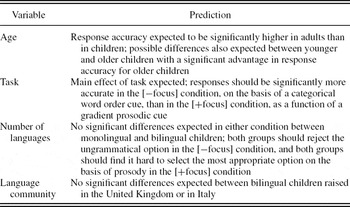
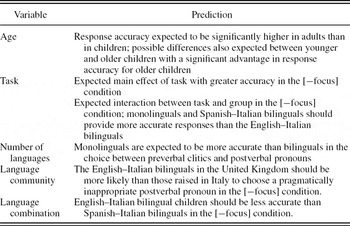
The final variable we took into consideration was age. By testing younger and older children we intended to shed some light on the developmental course in both bilingual and monolingual children. In addition to comparing the children's performance to a group of monolingual adults in both English and Italian, we also tested children in two different age ranges: 6- to 7-year-olds and 8- to 10-year-olds. Our expectation was that no significant age differences should be observed with respect to choices between grammatical and ungrammatical sentences in English where accuracy is predicted to be at ceiling. With respect to the mastery of subtle prosodic cues in English, we did not expect either bilingual or monolingual children to be adultlike by the age of 10. In Italian, where we anticipated differences between the monolingual English–Italian children and their monolingual counterparts, we had no predictions as to the role of age. The issue of convergence with the monolingual “norm” over time in bilinguals who constantly use both of their two languages is still an open question. It may well be the case that bilinguals never entirely converge with monolinguals in either of their two languages when in areas requiring very subtle discourse–pragmatic knowledge. Predictions for the English and the Italian tasks are summarized in Table 1 and Table 2.
Predictions for the English tasks

Predictions for the Italian tasks

METHODS
Participants
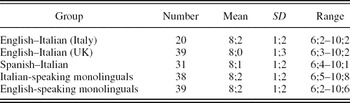
We recruited 167 children between the ages of 6 years, 2 months (6;2) and 10;10; 30 monolingual English-speaking adults, and 30 monolingual Italian-speaking adults. The children were divided into two groups of English–Italian bilingual children, one group living in the United Kingdom (N = 20) and one in Italy (N = 39), a group of Spanish–Italian bilingual children in Spain (N = 31), a group of monolingual English-speaking children in the United Kingdom (N = 39), and a group of monolingual Italian-speaking children in Italy (N = 38). The children were further divided into a younger (6;2–7;11) and an older group (8;0–10;10). No statistical age differences existed between the groups either for the younger (F < 1) or the older group (F < 1). Details for the child participants are provided in Table 3.
Mean age, standard deviation, and age range of child participants

Note: Ages are in years;months.
In Italy, the bilinguals (English–Italian) were recruited mainly among the pupils of international primary schools in which English is the medium of instruction. In the United Kingdom, we recruited through personal contacts and with the help of a Web-based Italian forum (http://www.corriere.it/solferino/severgnini). The Spanish–Italian bilinguals were recruited through personal contacts in Spain and Italy, and through the Italian School of Barcelona.Footnote 5 The following selection criteria were applied: no history of language impairment or hearing loss; bilingual children were included in the study only if they had been regularly exposed to both languages from birth and used them on a daily basis with similar competence according to teachers’ assessment and parental reports. To screen for suitable participants, bilingual families were invited to complete a questionnaire providing information about the patterns of language exposure and use throughout the children's lives. The children selected for the study were growing up in households where both languages were spoken by both parents; the majority of the parents only used their mother tongue with the children, and the children generally matched the parent's language choice when talking to them. The bilingual children in Italy had exposure to English at home through one of their parents, at school through the curriculum that was taught predominantly in English, and during visits to the United Kingdom or the United States. They heard and spoke Italian in the home, at school, and during activities outside school. In contrast, the bilinguals in the United Kingdom had access to Italian in the home through one of the parents, through other bilingual English–Italian children in some limited way, and through visits to Italy during school holidays. Similarly to the English–Italian children in Italy, the Spanish–Italian children in Barcelona attended the Italian School so they were exposed to the minority language at school in addition to the input they received at home from one of their parents, from other Italian speakers in their extended network, and from relatives and friends during school holidays in Italy.
The monolingual control groups were recruited in primary schools in northern Italy and in Scotland and, in addition to no history of language impairment or hearing loss, they had no knowledge of any other language other than Italian and English, respectively. The monolingual adults were recruited among university students in Italy and in England. The adult participants had no functional competence in a second language, although most of the Italian speakers had received some formal language instruction in English at secondary school level.
Materials and procedure
Participants were tested individually by a trained research assistant either at home or on school/university premises. The materials were presented on a 15-in. laptop computer and all responses were digitally audiorecorded for scoring purposes. Children received digitally recorded instructions in the language of the test, they had the opportunity to familiarize themselves with the cartoon characters and before the testing session they were shown and given feedback on two practice items. The English–Italian bilingual children were seen twice by different research assistants, once to perform the Italian version of the test and once to perform the English version. A minimum interval of 1 week elapsed between the two sessions. The Spanish–Italian bilinguals were only tested once in Italian.
Italian. The materials consisted of 16 experimental items and 10 fillers. Each item consisted of a short video clip showing a group of three characters in the foreground (e.g., Uncle Scrooge, Daisy, Mickey), and another pair of characters in the background (e.g., Donald Duck and Minnie). In half of the items the three characters in the foreground included one male character and two female characters, and in the other half there was one female character and two male characters. The two characters in the background were always one male and one female character. A voice over introduced the three characters in the foreground, naming them (e.g., “Guarda! Paperone, Paperina, e Topolino”/ “Look, Uncle Scrooge, Daisy, and Mickey”), then one of the characters would perform an action on one of the other two characters (i.e., Mickey hugging Daisy). The voice over would then ask a question about what had just happened, and the two characters in the background would answer one after the other. The order in which the characters answered and the pragmatic appropriateness of the answer were counterbalanced throughout the experiment.
The question could provide either a noncontrastive context ([−focus] condition as in (10)), or a contrastive context ([+focus] condition as in (11)). The pragmatically appropriate answers involved the use of either a preverbal object clitic (appropriate in the [−focus] condition in (10)) or a postverbal pronoun (appropriate in the [+focus] condition in (11)).
(10)


(11)

The participants were instructed to decide which one of the two characters could speak “better” Italian.
English. The materials in the English version of the experiment were similar to those of the Italian version and included 16 experimental items and 10 filler items. There were, however, two crucial differences between the English and the Italian materials. The first is that in the two Italian conditions the participants had to choose between two sentences that differed in terms of pragmatic acceptability. In Italian, both a postverbal strong object pronoun (1b), and a preverbal object clitic (1c) are grammatical; what makes them more or less pragmatically appropriate is the presence of an antecedent that is prominent in the discourse. In the English version of the task we manipulated word order in the [−focus] condition to create an ungrammatical sentence in which the object pronoun would appear preverbally to test whether the frequency with which (clitic) object pronouns appear in the preverbal position in Italian would affect English–Italian bilingual children's willingness to accept preverbal object pronouns in English. Our hypothesis was that they would not on account of the fact that Italian clitics belong to a different class than English pronouns, and the two pronominal forms do not comply with a principle of isomorphism, a necessary condition for cross-linguistic influence to take place.
The second difference related to the use of pronouns instead of the characters’ names in the target question in the [+focus] condition. In Italian, only the names of the characters are mentioned in the question but no pronouns are used (see (10) and (11)). If we had used pronouns we would have had to choose between strong pronouns (e.g., “Ha abbracciato lei o lui?”) or clitics (e.g., “L'ha abbracciata o l'ha abbracciato?”), and we would have run the risk of priming one or the other type of pronoun in the forced-choice task. In English, on the other hand, the correct answer to the question involved the use of a prosodically stressed pronoun opposed to the unstressed alternative (rather than a different class of pronoun altogether), and the mention of the pronoun in the question made it significantly more appropriate from a pragmatic point of view. The script for the two conditions is illustrated in (12) and (13). As in the Italian version of the task participants had to choose the character that spoke “better English.”
(12)
(13)


Results
For both the English and the Italian data we present the analyses for the adult participants separately from the children's. In the analysis of variance (ANOVAs) we treated arcsine transformed proportion of accurate responses as the dependent variable; focus context ([−focus], [+focus]) was the within-subjects variable, group (English–Italian bilinguals in the United Kingdom, English–Italian bilinguals in Italy, Spanish–Italian bilinguals, monolingual English-speaking children; monolingual Italian-speaking children) was the between-subjects variable, and the children's age in months was treated as a covariate. The results for the English and the Italian data are reported separately below. In the figures the child data are divided into a younger (6;2–7;11) and an older (8;0–10;10) group for descriptive purposes.
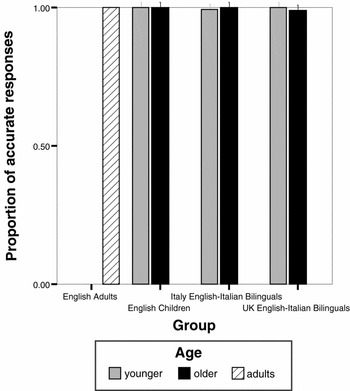
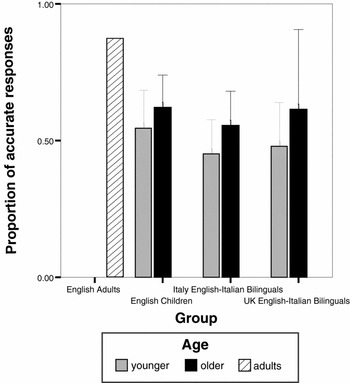
English. Figure 1 and Figure 2 report the untransformed proportion of accurate responses (= acceptance of grammatical and pragmatically adequate sentences) for the [−focus], and the [+focus] conditions, respectively.
The proportion of accurate responses in the [−focus] condition in English.

The proportion of accurate responses in the [+focus] condition in English.

The adults accurately chose the grammatical sentences in the [−focus] condition 100% of the time (M = 1.0, SD = 0.00), but they correctly opted for the stressed pronoun in the [+focus] condition only 87% of the time (M = 0.87, SD = 0.21). A repeated-measures ANOVA showed a main effect of focus context, F (1, 29) = 13.66, p < .001, partial η2 = 0.32, confirming that accuracy was greater in the choice between grammatical and ungrammatical word order in the [−focus] condition than in the choice between a pragmatically appropriate stressed pronoun and a pragmatically inappropriate unstressed pronoun in the [+focus] condition.
A mixed-design ANOVA for the child groups also showed a significant effect of focus context, F (1, 92) = 32.60, p < .001, partial η2 = 0.26, showing that, similar to the adults, the children were also more accurate in the [−focus] condition. The age covariate had a significant effect, F (1, 92) = 4.85, p < .05, partial η2 = 0.05) on the accuracy with which the children performed the task confirming that older children were more accurate than younger children. There was no significant effect for group (p > .05), suggesting that bilingual status and language of the community did not affect children's performance in a significant way. Finally, there was a significant interaction between focus context and age, F (1, 92) = 6.61, p < .01, partial η2 = 0.06. Because all the children performed at ceiling in the [−focus] context, we explored this interaction by conducting a one-tailed Pearson correlation between age and the children's accuracy scores only in the [+focus] context. The correlation was statistically significant, r (98) = .21, p < .05, suggesting that older children performed more accurately in this condition than younger children.
Discussion
As predicted, participants categorically rejected the ungrammatical “pronoun + verb” word order in the [−focus] context regardless of their age, bilingual status, and language background. In contrast to the ceiling performance in this condition, monolingual and bilingual children, as well as adults, found the choice between the two prosodically distinct options in the [+focus] condition more challenging, with performance improving gradually as a function of age. These results suggest that the nature of the task, and of the cues that participants relied on, affected their accuracy scores in a significant way, and that this was true to the same extent for monolingual children and for both groups of bilingual children regardless of language of the community. The lack of ceiling effects in the adult group in the [+focus] context is consistent with the variation found in studies of processing of pronominal forms (e.g., Belletti, Bennati, & Sorace, Reference Belletti, Bennati and Sorace2007; Tsimpli et al., Reference Tsimpli, Sorace, Heycock and Filiaci2004).
The categorical nature of word order proved to be a more reliable cue to grammaticality than the gradient prosodic cue was to pragmatic acceptability. Similar results were obtained by Szendroi and Costa (Reference Szendroi, Costa, Torrens and Escobar2006) in a truth-value judgement task with 4-year-old children speaking European Portuguese. In their study children had to pay attention to either word order or stress shift as a focus marker. Children had no problems interpreting sentences where focus was marked by word order, but they were significantly less accurate in the interpretation of sentences in which focus was signaled by stress shift. Szendroi and Costa accounted for children's greater difficulty in the interpretation of prosodically marked focus in terms of Reinhart's (Reference Reinhart1995, Reference Reinhart2004) interface theory. Whenever a constituent receives stress shift within a sentence (e.g., [infinitive phrase (IP) My neighbor is BUILDING a desk]) its focus set (e.g., IP, verb phrase (VP), verb (V) partially overlaps with other potential focus sets (e.g. IP, VP, object noun phrase (NP) in [IP My neighbor is building a DESK]), therefore reference-set computation is required in order to disambiguate the interpretation of the different focus sets. The construction of a comparison set to determine whether a given derivation is appropriate in context has an associated processing cost as it comes with a working memory load that may be beyond children's capacity. In the current task the computation of a reference set in the [+focus] condition proved to be beyond the processing abilities of both bilingual and monolingual children, and it was particularly taxing for bilingual children who may need additional processing resources to keep their two languages separate.
That age was positively correlated with accuracy also lends credit to the proposal that increased working memory capacity may play a crucial role in the computation of reference sets that are necessary for the interpretation of prosodically marked focus.
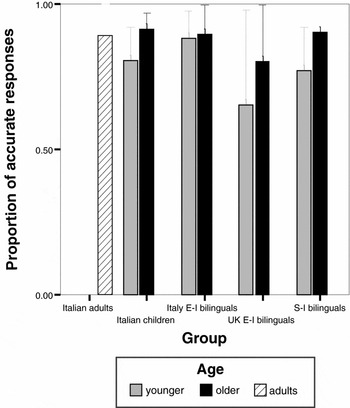
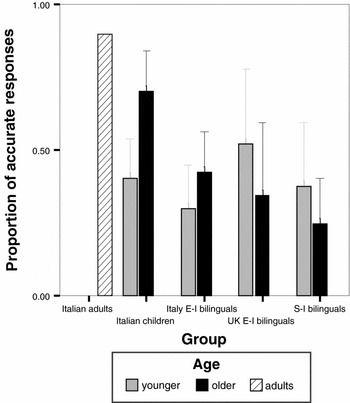
The Italian results. The untransformed proportion of accurate responses in the two focus contexts is shown in Figure 3 and Figure 4.
The proportion of accurate responses in the [−focus] condition in Italian.

The proportion of accurate responses in the [+focus] condition in Italian.

The Italian adults correctly chose a preverbal clitic pronoun in the [−focus] condition 89% of the time (M = 0.89, SD = 0.29) and a postverbal pronoun in the [+focus] condition 90% (M = 0.90, SD = 0.20), a repeated-measures ANOVA on the arcsined transformed proportions of accurate responses with focus context as the within-subjects variable clearly confirmed a lack of statistical significance between the adult participants’ accuracy in the two conditions (F < 1).
The results of a mixed-design ANOVA on the child data showed no significant effect of focus context, F (1, 118) = 2.83, p = .09, partial η2 = 0.02. Although the mean proportion of accurate responses overall was higher in the [−focus] condition (M = 0.84, SD = 0.23) than in the [+focus] condition (M = 0.42, SD = 0.33), children were not significantly more accurate in the choice of pragmatically appropriate preverbal clitics in [−focus] contexts than in the choice of discourse appropriate postverbal pronouns in [+focus] contexts. The main effects of age or group were equally not significant (ps > .05), but there were significant interactions between focus context and age, F (1, 118) = 11.04, p < .001, partial η2 = 0.08, focus context and group, F (3, 118) = 3.40, p < .05, partial η2 = 0.08, and a three-way interaction between focus context, group, and age, F (3, 118) = 5.31, p < .01, partial η2 = 0.11. To explore these interactions further we conducted two univariate ANOVAs on the arcsined transformed proportion of accurate responses, one for each of the two focus conditions with group as the between-subject variable, and children's age as a covariate. For the [−focus] context there was no significant effect of group (p > .05), and a marginally significant effect of the age covariate, F (1, 121) = 3.75, p = .05, partial η2 = 0.03, but no significant interaction between age and group suggesting that children's accuracy increased as a function of age, regardless of bilingual status and language of the community. Despite the lack of a significant difference as a function of language background, there was a clear discrepancy in the proportion of pragmatically inappropriate choices across the different groups as shown in Figure 3; younger bilingual children in the United Kingdom chose pragmatically inappropriate postverbal strong pronouns 35% of the time against 19% of the time for the Italian children, 11% for the bilinguals in Italy, and 23% for the Spanish–Italian bilinguals. In the older group, the English–Italian bilingual children in the United Kingdom chose a strong postverbal pronoun (20%) twice as often as the Italian children (9%), the Italian adults (11%), the bilinguals in Italy (10%) and the bilinguals in Spain (10%). These data suggest that children who are bilingual and whose language of the community is English are more likely than all other groups of bilingual and monolingual children to select the pragmatically inappropriate option of a postverbal strong pronoun instead of a preverbal clitic in [−focus] contexts.
In the [+focus] context, there was a main effect for group, F (3, 118) = 3.58, p < .01, partial η2 = 0.08); pairwise comparisons with Bonferroni adjustment revealed that the Italian monolingual children were significantly more accurate than the English–Italian bilinguals in Italy (p > .05), and than the Spanish–Italian bilinguals (p > .01). Age did not significantly affect accuracy scores overall (p > .05), but it did as a function of group as shown by the significant interaction between age and group, F (3, 118) = 4.89, p < .01, partial η2 = 0.11. We explored this correlation through a series of one-tailed Pearson correlations between children's accuracy scores and age in months. The only significant result was for the group of Italian monolingual children, r (38) = .60, p < .001, who improved in their pragmatically appropriate choice of a postverbal pronoun as they got older. For all the other groups there was no significant difference in their accuracy scores as a function of age (all ps > .05).
Discussion
In Italian, participants had to choose between a preverbal and a postverbal object pronoun depending on the focus context set up by a question in the experimental materials. The adults were equally accurate in both contexts showing that they could select different forms (clitic vs. full pronoun), and different word orders (pre- vs. postverbal) as required by the discourse pragmatics of the linguistic context. Although in general children were more accurate in the [−focus] context, there were no significant overall differences between the two conditions, showing that the two forms and word orders could reliably be distinguished by children also. The three-way interaction between focus context, age, and group revealed that in the [−focus] context all children, monolinguals and bilinguals, got marginally better at choosing preverbal clitics as they got older. More interestingly in terms of potential cross-linguistic influence, despite the lack of significant group differences, bilingual children in the United Kingdom chose a pragmatically inappropriate postverbal pronoun twice as often as their monolingual counterparts and the other bilingual children, an indication that routinely processing postverbal pronouns in English affected their sensitivity to the pragmatically appropriate distribution of this pronominal form. In the [+focus] context the significant interaction between age and group showed that only the Italian monolinguals became more accurate in their choice of a postverbal pronoun as they god older, an indication that the matching of a less frequent form and word order is likely to require more exposure to the language.
GENERAL DISCUSSION
The overall aim of the present study was to make a contribution to our current understanding of how different factors affect the process of language acquisition in bilingual school-age children and in their monolingual peers. We tested English–Italian bilinguals, Spanish–Italian bilinguals, monolingual Italian- and English-speaking children and adults on their sensitivity to word order, pronoun class, and prosodic focusing in two forced-choice tasks on the acceptability of pronominal objects in English and in Italian. More specifically we considered whether response accuracy in English and in Italian was affected by the following factors: the focus context in which pronouns were presented ([−focus]; [+focus]); the number of languages spoken by participants (one; two); the typological differences between two language combinations (English–Italian; Spanish–Italian), the language of the community (English; Italian), and age (6- to 10-year-olds, adults).Footnote 6
By virtue of their anaphoric status, pronouns can only be interpreted by coindexation with an appropriate antecedent in prior discourse, and as such are situated at the external interface between morphosyntax and discourse pragmatics, an area that has been identified as especially unstable in a range of bilingual populations. Linguistic constructions at the interface are also problematic for monolingual children because they call for the coordination between different syntactic options and the corresponding discourse pragmatic environments (Avrutin, Reference Avrutin1999). Particular difficulties arise with referential expressions because the choices to be made require the speaker/hearer to keep track of the discourse status of the referent and to monitor its level of accessibility to the listener (Chafe, Reference Chafe1994). In the case of bilingual speakers, these difficulties may be compounded by one or two factors that distinguish them from monolinguals: speaking two languages, and/or the typological differences between the two languages. First, regardless of the similarity between the two languages with respect to constructions at the interface (Roberts, Gullberg, & Idenfrey, Reference Roberts, Gullberg and Indefrey2008), knowing and using language A may significantly affect the way in which children process language B, simply because they have to deal simultaneously with two different sets of input and output. Even if children are learning two languages like Italian and Spanish, which are typologically more similar than Italian and English, they still have two learn two different languages. Although similar in many respects (e.g., phonology, lexicon, morphology, syntax), Italian and Spanish are nevertheless not the same language; children must constantly inhibit one language when using the other, both in comprehension and production, and inhibition is inevitably going to pose demands on their processing system. We know from the adult psycholinguistic literature that these processing costs are real and have implications for the accuracy and speed with which linguistic stimuli are processed in each language (see, e.g., the vast literature on lexical recognition in adult bilinguals, e.g., de Groot, Delmaar, & Lupker, Reference de Groot, Delmaar and Lupker2000; Dijkstra, Timmermans, & Schreifers, Reference Dijkstra, Timmermans and Schriefers2000; Dijkstra, van Jaarsveld, & ten Brinke, Reference Dijkstra, van Jaarsveld and ten Brinke1998; van Heuven, Dijkstra, & Grainger, Reference van Heuven, Dijkstra and Grainger1998; van Hell & Dijkstra, Reference van Hell and Dijkstra2002; von Studnitz & Green, Reference von Studnitz and Green2002). It is safe to assume that, due to the additional processing demands that are part and parcel of bilingual language processing, bilingual children might be less accurate and slower than monolingual children.
The tasks in this study were off-line and the behavioral data shows that the responses given by bilinguals are not always necessarily qualitatively different from those given by monolinguals. Bilinguals can obviously form mental representations that are like those of monolingual children's, on the assumption that access to stable mental representations is necessary to perform the kind of discrimination tasks that children were administered in the current study. Nevertheless, the possibility remains that the mental representations of bilinguals might be affected by the fact that they do speak two languages. If, as has been suggested for adult bilinguals in a series of priming studies (see work by Hartsuiker et al., Reference Hartsuiker, Pickering and Veltkamp2004), syntactic representations may be shared across languages and are therefore not language specific, the processing of a construction with a shared syntactic structure will affect its subsequent processing and the entrenchment of its mental representation in both languages. In essence, the use of a construction with a shared syntactic structure in language A will prime its use not only in language A, but also in language B. If not only the syntax, but the pragmatics/semantics also overlap there will be no noticeable effect of cross-linguistic influence across languages. If, however, the morphosyntactic structure is shared across the two languages (e.g., the presence of overt pronominal subjects in Italian and English), but the syntax maps onto different discourse–pragmatic domains (e.g., overt pronominal subjects are used for both [+topic shift] and [−topic shift] in English but only for [+topic shift] in Italian), then the routine processing of the shared structure in both contexts in language A might lead to the inappropriate extension of the syntax–discourse pragmatics mapping in language B (e.g., Sorace et al., Reference Sorace, Serratrice, Filiaci and Baldo2009).
The extent to which two languages will have a set of shared syntactic structures, and the extent to which these structures will map onto the same discourse-pragmatics/semantics will depend, at least partly, on their typological similarity; two Romance languages like Italian and Spanish are more likely to have a larger number of shared syntactic representations than map onto the same pragmatic/semantic information than Italian and a Germanic language like English. With specific reference to the current study our starting point was that the similarity of the mental representation of the pronominal system in Italian and Spanish, the difference between the Italian and the English pronominal systems, the overlap, and the typological distance between the languages would play a significant role, either on their own, or as an additional factor to the number of languages spoken. Speaking a language like English, where pronominal objects are always realized postverbally, is likely to prime the use of postverbal pronouns in a language like Italian where such forms do exist, but are less frequent than preverbal clitics and are restricted to [+focus] contexts. Our results show that the bilingual English–Italian children in the United Kingdom opted for the postverbal option in [−focus] contexts almost twice as often as the monolingual Italian children, and more often than all other groups of bilinguals. The choice of the pragmatically inappropriate postverbal pronoun in [−focus] contexts in Italian suggests that exposure to high-frequency postverbal pronouns in [−focus] contexts in English is indeed responsible for this effect. Moreover, our results show that it is not purely a question of language combination, but there is an effect of frequency as well as the pragmatically inappropriate choices were highest in the group of bilinguals living in the United Kingdom. The choices of the Spanish–Italian bilinguals were not affected in [−focus] contexts, suggesting that the typological relatedness of the bilinguals’ languages, in combination with language of the community, plays a more important role than the processing costs associated with dealing with two languages.
In addition, we found an interesting pattern emerging in [+focus] contexts for the older group of children. Only the monolingual Italian children significantly increased their choice of pragmatically appropriate postverbal pronouns in line with the adults’ behavior. All of the bilingual children, regardless of language combination or amount of input in Italian, still chose significantly more clitic pronouns in [+focus] contexts, thus failing to coordinate the right morphosyntactic choice with the relevant discourse–pragmatic context. The fact that younger monolingual Italian children also found the choice of postverbal pronouns in [+focus] contexts difficult suggests that this condition is one that makes more coordination demands at the interface between morphosyntax and discourse pragmatics, possibly because it does not have the same high frequency as the [−focus] contexts and because the pronoun form is in a noncanonical postverbal position for object pronouns, the vast majority of which are clitics in preverbal position. The high frequency clitic form will therefore be more highly entrenched as the realization of a pronominal object in Italian and might well be the one that children go for, disregarding the requirements of the pragmatic contexts, purely because it is the object pronoun that they normally hear and use.
A further aim of the study was to show that cross-linguistic influence of pragmatically inappropriate forms can only operate with constructions that are morphosyntactically equivalent, as has been shown for adult bilinguals elsewhere in the literature (Hartsuiker et al., Reference Hartsuiker, Pickering and Veltkamp2004; Schoonbaert, Hartsuiker, & Pickering, Reference Schoonbaert, Hartsuiker and Pickering2007). Clitics and strong pronouns belong to different classes; they cannot be considered the same from a morphosyntactic point of view, and therefore we did not expect that the preverbal word order of clitics in Italian would induce the bilingual English–Italian speakers to accept preverbal strong pronouns in English. The results of the English task confirmed that ungrammatical preverbal pronouns were categorically rejected by monolingual and bilingual children alike.
The final variable that we factored into our study was age. The rationale behind testing both younger and older children was to investigate how monolingual and bilingual children deal with a complex interface phenomenon at different points in development. The cross-sectional design of our study cannot directly address the issue of how children develop over time, but it nevertheless offers a snapshot of children's linguistic behavior at different time points. Starting with the English results first, it is clear that ungrammatical sentences were correctly rejected even by the younger children, whereas sensitivity to prosodic stress to signal focus is still at chance level for all children, regardless of language background by the age of 10. These results are not surprising considering that there is evidence elsewhere in the literature showing that a gradient prosodic cue such as emphatic stress is more difficult to exploit than a discrete categorical cue such as word order. Szendroi and Costa (Reference Szendroi, Costa, Torrens and Escobar2006), for example, clearly showed that children learning European Portuguese, a language where focus can be marked either by stress shift or word order, had no problems interpreting sentences where focus was marked by word order, but they were significantly less accurate in the interpretation of sentences in which focus was signaled by stress shift.
In the Italian data the only significant effect of age, aside from the differences with the adults, was in the [+focus] condition. The older monolingual children chose significantly more appropriate postverbal pronouns than all other groups of children. By age 10 no significant improvement had yet occurred for the bilinguals and it is an empirical question as to whether and when they will eventually converge on the levels of monolingual performance.
The findings of this study highlight the importance of considering the interaction of multiple factors in accounting for any similarities and differences between bilinguals’ and monolinguals’ linguistic behavior. Variables like the typological distance between the two languages, the language of the community, and age, all contributed to explain the pattern of behavior of two groups of English–Italian and Spanish–Italian bilingual children when compared to monolingual peers and adults. Future studies should explore multiple variables to extend the results currently available from off-line data to the investigation of on-line processing to gain a better understanding of the nature of differences and similarities in the mechanisms that underlie language comprehension and production between bilingual and monolingual children.
ACKNOWLEDGMENTS
This research was supported by the UK Economic and Social Research Council (Grant R000230782 to L.S. and A.S.). We are extremely grateful to all the participants for their time. Special thanks are due to the children, their parents, and to the staff at the International School of Milan, the American School of Milan, the Bilingual School of Monza, the Italian School in Barcelona, Bruntsfield Primary School in Edinburgh, and Giovanni Pascoli and Pilastro primary schools in Este. Their enthusiastic cooperation has been invaluable for the completion of this project. The editor and three anonymous reviewers are gratefully acknowledged for their constructive feedback on earlier versions of this manuscript.