Implications
Subclinical Salmonella infections in pigs constitute a major challenge to the pork industry because of the potential for economic loss and as major source of zoonotic strains of Salmonella related to human foodborne illness. Infected pigs carry pathogen long time in their gastrointestinal tract. Therefore, early detection of infection and treatment before their spread is the best way to handle animal illness. Since behavior is one of the most commonly used and sensitive indicators of animal welfare, identification of alterations from normal behavior can be used for recognition of Salmonella infection in pigs.
Introduction
Absence of disease has given the highest priority in the assessment of the quality of life of farm animals (Reiner et al., Reference Reiner, Hübner and Hepp2009). However, a disease-free state cannot always be ensured in modern intensive farming systems, as most infectious diseases are spread via horizontal transmission from carriers to susceptible animals that they are in close contact with (Schwartz, Reference Schwartz1991). Therefore, the best way to handle animal illness is early detection of diseases and treatment before they spread.
Behavior is one of the most commonly used indicators of illness (Weary et al., Reference Weary, Huzzey and von Keyserlingk2009). Farm animals express a wide array of behaviors such as eating, drinking and social behaviors, many of which may impact their health and welfare directly or indirectly. These can be positive (i.e. behaviors that increase in frequency or magnitude when the animal is ill, such as erratic movements of the body or head, restlessness, coughing and high level of noise) or negative indicators (i.e. behaviors that decrease in frequency or magnitude with illness such as reduced hunger and thirst, lethargy and long term changes in mobility). Behavioral changes in diseased pigs may represent a way of coping with pathogens (Ivoš et al., Reference Ivoš, Krsnik and Kovačević1981). Indeed, the expression of certain behaviors by an animal may reflect its health status and level of motivation energy, which are both influenced by genotype, adaptation processes, experiences and environmental factors, including the constructional environments (Ivoš and Krsnik, Reference Ivoš and Krsnik1979). Therefore, it can be assumed that the development of behavioral indicators can be used to help identify and detect ill health in animals (Weary et al., Reference Weary, Huzzey and von Keyserlingk2009). However, very few studies have been conducted to date on identification and prevention of different common diseases of animal analyzing their behaviors.
To gain a better understanding and assessment of animal suffering owing to infectious disease, more information regarding behavior and relationships among easily obtainable clinical parameters gained from defined model diseases is needed. Salmonellosis is an infectious disease of swine that is of concern owing to its potential to cause clinical disease in swine and because it can establish a carrier state. Carriers have been shown to shed pathogens in their feces for up to 6 weeks post-infection (p.i.) (Rostagno et al., Reference Rostagno, Eicher and Lay2011). The within-herd Salmonella spread is influenced by interactions between animals. Furthermore, carrier pigs entering the abattoir with the bacteria in their gastrointestinal tract increase the risk of contamination of raw meat and thereby creating a food safety risk to consumers (Rostagno et al., Reference Rostagno, Eicher and Lay2011). The European Food Safety Authority estimates that, across the European Union, up to 27% of human Salmonellosis cases attributed to pig meat (European Food Safety Authority (EFSA), 2011). Of many Salmonella species, S. enterica serover Typhimurium (Ivanek et al., Reference Ivanek, Snary, Cook and Gröhn2004) dominates in pigs, although S. enterica serover Enteritidis (EFSA, 2008) also occurs quite frequently in pig herds. Therefore, we selected these two strains as our model pathogens to infect growing pigs. The objective of this study was to investigate the behavioral and clinical alterations in growing pigs infected with these two common strains of Salmonella and to identify whether or not altered behavior can be used as an indicator of Salmonella infection in pigs.
Material and methods
Pigs and housing
This experiment was conducted under the approval of the Sunchon National University Animal Care and Use Committee. A total of 48 crossbred (Landrace×Large white×Duroc) growing pigs (barrows, initial BW 49.54±0.91 kg) average 14 to 15 weeks old were obtained from a high-health status farm. Animals were randomly distributed into three experimental groups composed of two replicates of eight animals each in such a way that all groups had a similar mean live weight. The experimental groups were: control, infection with S. enterica serover Typhimurium (KCCM 40253) and infection with S. enterica serover Enteritidis (KCCM 12021). The pigs in each group were reared in an environmentally controlled room in six isolated pens with slatted floors and a space allowance of 1 m2/pig. The groups were housed in separate facilities to prevent cross-contamination and allowed a 1-week adaptation period before commencing the study. Each pen was equipped with a one-sided self-feeder and a nipple drinker. An ambient temperature of 24±1.5°C was maintained in the pig houses with supplemental heat provided via overhang electric heaters. During the experimental period, pigs were given a commercial grower pellet diet ad libitum basis. The main ingredients of the diet was yellow corn, wheat bran, soybean meal, limestone, dicalcium phosphate, animal fat, molasses, salt, l-lysine (78%) and vitamin–mineral premix. No antimicrobial additive was added with the diet. The pens were illuminated by artificial light (18 h light : 6 h dark) and ventilation was provided at a volume of 10 air changes/h.
Bacteria and experimental infection
Each animal was tested twice bacteriologically (feces) before receiving the Salmonella challenge, and all were found to be negative for the bacteria. The strains of Salmonella used for infection were S. Typhimurium (KCCM 40253) and S. Enteritidis (KCCM 12021), which were provided by the Korean Culture Center of Microorganisms (KCCM, Seoul, Korea). Frozen stock cultures of S. Typhimurium and S. Enteritidis (maintained at −80°C in glycerol) were used to prepare the inocula by growth in Tryptic Soy Broth for 24 h at 37°C. The infection dose was 1×10⁸ colony forming units (cfu)/ml of the challenge strains. After 1 week of adaptation, pigs in the infected groups were orally inoculated (via a micropipette tube) with 10 ml of a suspension of either S. Typhimurium or S. Enteritidis. To facilitate inoculation, the pigs were restrained with a wire loop around the snout and ropes around the body. One person open the mouth by pressing the corner of pig’s mouth and another person inoculated the bacterial solution at the back of the oral cavity. Bacterial solution was slowly dribbled into pig’s throat in order to trigger the swallowing reflex and minimize passage of inoculants into the lungs. The pigs from the control group were not challenged, however, inoculated with 10 ml of nutrient broth (Difco, Detroit, MI, USA) and were maintained as a control for clinical and behavioral analysis for 4 weeks of the experimental period.
Clinical and bacteriological examination
To monitor p.i. performance, BW gain and feed intake of pigs were recorded at week 0, 2 and 4 of the experimental period. Body temperatures were recorded daily using a Braun ThermoScan® ear thermometer (Braun GmbH, Kronberg, Germany).
For the bacteriological analysis, three piglets were randomly selected from each pen and fresh fecal samples were collected at 12 h, 24 h, and week 1, 2, 3 and 4 p.i. directly from the rectum using disposable surgical gloves that were changed between animals to avoid cross-contamination. Samples were collected into sterile polyethylene bags via manual stimulation of the internal and external anal sphincters. The samples were then serially diluted 10-fold (1 g was diluted in 9 ml saline) in sterile saline (0.9%) and directly plated (100 μl/plate) on Salmonella-Shigella agar (incubated at 37°C for 24 h) for enumeration of enteric Salmonella pathogen. The microbial colonies were counted immediately and expressed as log10 cfu/g.
Behavior observation
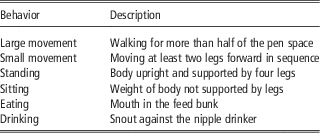
To monitor the behavioral activities, each pig was marked with a visible number on their backs and flanks for individual recognition. Behavioral data were then collected using video-recording systems (Black Box MD200; Imercury International, Gasan-dong, Seoul, Korea) mounted about 5 m above the floor of each pen so that they covered the complete living area of the pen. Each camera was capable of recording videos at a resolution of 640×480 with up to 30 frames/s. In addition, each camera was equipped with a 32GB Secure Digital High Capacity memory card (SD-K32GR6W4; Toshiba America Information Systems Inc., Irvine, CA, USA) to store the recorded data. The activity of each pig was recorded for 2 h in the morning (0900 to 1100 h) and 2 h in the evening (1600 to 1800 h) throughout the experimental period. The time interval for observation was selected to cover with the peak activity in the morning and afternoon (Van Putten, Reference Van Putten1978; Simonsen, Reference Simonsen1990; Reiner et al., Reference Reiner, Hübner and Hepp2009) and to avoid times of human intervention. The behavioral activities observed are described in Table 1.
Common exclusive behavioral categories recorded during the experiment together with their description

Statistical analyses
All data for each variable were confirmed to be normally distributed and appropriately transformed when necessary before any analysis. Bacteriological data (cfu/g) were subjected to logarithmic transformation (log10 cfu/g of sample). Statistical analyses were performed using the SAS system v. 9.1 (SAS Institute Inc., 2003, Cary, NC, USA). The effects of Salmonella infection on pig performance, fecal shedding and pig behavior were analyzed using the PROC GLM command. The pen was considered the experimental unit for analysis of animal performance and behavioral data, whereas an individual pig was the experimental unit for analysis of bacteriological data. It was assumed that each pig in a pen contributed equally to behavioral activities. Therefore, the average frequency and duration of the behavioral patterns of eight animals (in each chamber) was calculated and used for statistical analysis. Treatment means were computed with the LSMEANS and the means were compared using the PDIFF option of the SAS program. P-values<0.05 were considered to indicate statistical significance, whereas 0.05<P<0.07 was considered to indicate tendencies.
Results
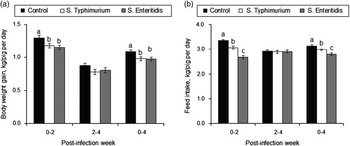
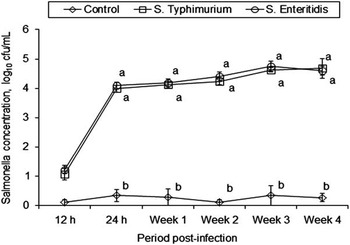
The effects of Salmonella infection on the BW gain and feed intake of growing pigs are shown in Figure 1. The BW gain of pigs was significantly reduced in response to infection with both S. Typhimurium and S. Enteritidis from week 0 to 2 and week 0 to 4 when compared with the control group (P<0.05). The feed intake was also significantly lower in both Salmonella-infected groups during week 0 to 2 and week 0 to 4 of the experimental period (P<0.05), with the lowest feeding occurring in the S. Enteritidis-infected group. None of the animals showed changes in body temperature (data not shown). Bacteriological analysis showed that (Figure 2) all animals in the control group had significantly lower numbers of fecal Salmonella (<1 log10 cfu/g) throughout the study period (P<0.05). Pigs in the S. Typhimurium and S. Enteritidis-infected groups started shedding Salmonella with their feces within 12 h p.i. (>1 log10 cfu/g), and this occurred persistently for the remainder of the study (24 h to 4 week with a concentration of 4 to 5 log10 cfu/g).
Mean BW gain (a) and feed intake (b) of growing pigs (n=8) orally inoculated with either Salmonella Typhimurium or Salmonella Enteritidis and control group. Bars at a particular time point with different letters indicate a significant difference (P<0.05).

Mean concentration of Salmonella (log10 cfu/g) in feces of Salmonella Typhimurium or Salmonella Enteritidis infected and control pigs from 12 h to 4 weeks post-infection. Bars at a particular time point with different letters indicate a significant difference (P<0.05).

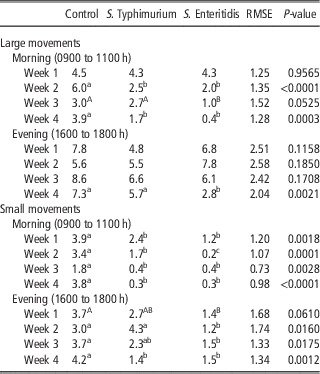
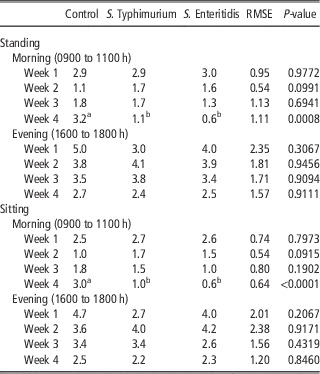
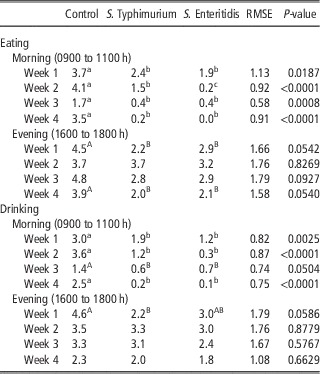
The frequencies of behavioral patterns exhibited by the pigs in each group after Salmonella infection are presented in Tables 2, 3 and 4. In the morning, large movements by pigs were significantly lower in both infected groups at week 2 and 4 when compared with the control group, whereas at week 3 it was tended to be lower in the S. Enteritidis-infected group (P<0.07). In the evening, significantly lower movement was reported in the S. Enteritidis-infected group at week 4. The morning frequency of small movements was significantly lower in pigs of both infected groups than in the control group throughout the experimental period (P<0.05). In the evening, the S. Enteritidis-infected group showed the lowest small movement at weeks 1, 2 and 3, whereas at week 4 both infected group showed significantly less small movement (P<0.05).
Effects of Salmonella Typhimurium or Salmonella Enteritidis infection on the mean frequency of large and small movement as observed in pigs (2 h) at different experimental weeksFootnote 1

RMSE=root mean square error.
1 Each value represents the mean of 7 days of behavioral frequency of eight pigs.
a,bMeans with different superscripts differ significantly at P<0.05.
A,BMeans with different superscripts were tended to differ at P<0.07.
Effects of Salmonella Typhimurium or Salmonella Enteritidis infection on the mean frequency of standing and sitting as observed in pigs (2 h) at different experimental weeksFootnote 1

RMSE=root mean square error.
1 Each value represents the mean of 7 days of behavioral frequency of eight pigs.
a,bMeans with different superscripts differ significantly at P<0.05.
Effects of Salmonella Typhimurium or Salmonella Enteritidis infection on the mean frequency of eating and drinking as observed in pigs (2 h) at different experimental weeksFootnote 1

RMSE=root mean square error.
1 Each value represents the mean of 7 days behavioral frequency of eight pigs.
a,bMeans with different superscripts differ significantly at P<0.05 or tended to differ at P<0.07.
A,BMeans with different superscripts were tended to differ at P<0.07.
The frequency of standing and sitting was significantly lower in both of the Salmonella-infected groups in the morning of week 4 relative to the control group (P<0.05). However, no differences were observed in the evening.
In the morning, the eating and drinking frequencies of Salmonella-infected groups was significantly lower than that of the control group throughout the experimental period (P<0.05). In the evening, a tendency of lower eating frequency was observed at weeks 1 and 4 in both of the Salmonella-infected groups (P<0.07). However, significant differences were only observed in the evening during week 1, when the S. Typhimurium-infected group had the lowest drinking frequency (P<0.05) among groups.
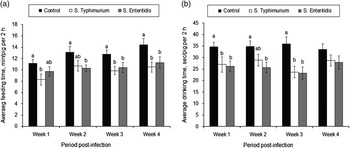
As shown in Figure 3a, pigs infected with Salmonella spent less time feeding in the morning throughout the experimental period than those in the control group (P<0.05). However, significant differences (P<0.05) in the time spent feeding in the evening were only observed during week 1 (data not shown). The pigs of both infected groups spent less time (P<0.05) drinking in the morning up to week 3 of the experiment (Figure 3b). No significant differences (P>0.05) were observed in the evening drinking duration among treatments in any of the experimental weeks (data not shown).
Average morning feeding (a) and drinking (b) time of growing pigs orally infected with Salmonella Typhimurium or Salmonella Enteritidis and control group. Each data point represents the mean±s.e. Bars at a particular time point without common letters indicate a significant difference (P<0.05).

Discussion
A model of Salmonella infection in growing pigs was employed to determine if infection of pigs with S. Typhimurium or S. Enteritidis exhibits clinical symptoms and is able to excrete with feces of infected pigs, and whether the behavior of pigs infected with either strain differed from that observed in non-infected pigs. Our results revealed that oral exposure to S. Typhimurium and S. Enteritidis led to an ~10% reduction in growth, which was likely explained by a reduction in feed intake (4% by S. Typhimurium group and 11% by S. Enteritidis group) as the level of feed intake is a basic and important factor that determines the rate of growth and body composition achieved by animals during their lifecycles (Richards, Reference Richards2003). This observation is in agreement with those of previous studies by Balaji et al. (Reference Balaji, Wright, Hill, Dritz, Knoppel and Minton2000), Turner et al. (Reference Turner, Dritz, Higgins, Herkelman and Minton2002) and Burkey et al. (Reference Burkey, Dritz, Nietfeld, Johnson and Minton2004) who reported lower feed intake and growth rate in pigs orally challenged with S. Typhimurium. However, to the best of our knowledge, no other studies of the effect of oral infection with S. Enteritidis on the growth performance of pigs have been conducted to date. The reduction in feed intake and growth rate in this and other studies of enteric disease is consistent with sickness-induced lack of appetite, which is one of the expected sickness behaviors associated with the innate immune system in host defense (Johnson, Reference Johnson2002). We did not observe any changes in body temperature of the infected pigs, which was supported by the results reported by Rostagno et al. (Reference Rostagno, Eicher and Lay2011), who concluded that infection with S. Typhimurium did not lead to development of any clinical symptoms in finishing pigs. In contrast, Balaji et al. (Reference Balaji, Wright, Hill, Dritz, Knoppel and Minton2000) reported higher body temperature in weaned pigs orally infected with 3×10⁹ cfu S. Typhimurium. A possible explanation for this may be that infection with very large numbers of Salmonella is required to initiate clinical disease (i.e. salmonellosis), and young pigs are more susceptible to Salmonella infection than older pigs (i.e. grower or finisher v. weaned pigs).
The result also demonstrate that Salmonella persists in the gastrointestinal tract of growing pigs for a long time, as indicated by it being shed in the feces from 12 h until the end of the study. These results are in agreement with those of Rostagno et al. (Reference Rostagno, Eicher and Lay2011), who reported high concentrations (4 to 5 log10 cfu/g) of Salmonella in the feces of infected pigs (14 to 15 weeks of age) from 48 h until week 4, followed by a marked reduction in weeks 5 and 6. Several studies have demonstrated that the duration and concentration of bacteria shedding are largely influenced by the infection dose and species (Gray et al., Reference Gray, Fedorka-Cray, Stabel and Ackermann1995; Volf et al., Reference Volf, Stepanova, Matiasovic, Kyrova, Sisak, Havlickova, Leva, Faldyna and Rychlik2012). The result of bacteriological examination shows that, the control group also shedding Salmonella along the whole experimental period even they were not challenged. Salmonella is a ubiquitous organism, and the gastrointestinal tract of vertebrate animals is considered to be its biological niche. Several studies have demonstrated that, despite of good hygienic condition of the original farm, the all-in/all-out system pig flow with cleaning between groups is associated with increased Salmonella seroprevalence (Stege et al., Reference Stege, Christensen, Baggesen and Nielsen1997; Bahnson et al., Reference Bahnson, Mateus-Pinella, Omran, Grass, Fransen and Fedorka-Cray2001). Besides this, pigs produced from sow herds with high Salmonella seroprevalence are at greater risk for isolation of Salmonella (Kranker et al., Reference Kranker, Dahl and Wingstrand2001). Unfortunately, we did not analyze the seroprevalence of the animals and qualitative analysis of Salmonella in feces, and therefore, we are unable to evaluate the status of the commercial farm.
Behavioral signs have long been considered indicative of illness (Hart, Reference Hart1988; Reiner et al., Reference Reiner, Hübner and Hepp2009). The behavioral measures collected in this study were used to determine to what extent Salmonella-infected pigs reacted to the infection, as well as whether differences in behavior could be used diagnostically. Since the infected and control pigs were kept under the recommended environmental conditions, it was assumed that their behaviors were only affected by the agent of infection. The results demonstrated that Salmonella infection reduced the frequency of major activities such as large movements and small movements by growing pigs when compared with the control group. In addition, the effects of S. Enteritidis were occasionally more pronounced than those of S. Typhimurium. These results are supported by the well-regarded notion of sickness behavior described by Hart (Reference Hart1988). By contrast to our result, Rostagno et al. (Reference Rostagno, Eicher and Lay2011) reported that pigs were more active than the control when finishing pigs were intranasally inoculated with 2 ml of 108 cfu/ml S. Typhimurium. A possible explanation for the reduced activity observed in our study may be the higher dose of S. Typhimurium (10 ml of 108 cfu/ml) compared with the dose level used by Rostagno et al. (Reference Rostagno, Eicher and Lay2011).
Determining how much time animals spend eating could help animal caretakers identify sick animals and improve management (Weary et al., Reference Weary, Huzzey and von Keyserlingk2009). In the present study, the reduction in feed intake was attributable to a reduction in feeding activity. Pigs in both infected groups spent less time feeding and less frequently visited the feeding areas than the control group. This may have been a response of immune system to Salmonella infections by increasing the synthesis of components of its defense mechanisms such as cytokines (Volf et al., Reference Volf, Stepanova, Matiasovic, Kyrova, Sisak, Havlickova, Leva, Faldyna and Rychlik2012), since an increase in cytokine production decreases feed intake (Johnson, Reference Johnson1997). Beside this, interactions between the bacterial strains and the mucosa of the small intestine of the infected pigs can also reduce feed intake (Krsnik et al., Reference Krsnik, Yammine, Pavičić, Balenović, Njari, Vrbanac and Valpotić1999). Interestingly, drinking frequency and time spent drinking were also much lower in the infected pigs. There is very close relationship between feed consumption and water consumption. According to Haugse et al. (Reference Haugse, Dunusson, Erickson, Johnson and Buchanan1965), pigs consumed water most frequently and for the longest period of time during or after feeding. Baranyiova and Holub (Reference Baranyiova and Holub1993) reported that, pigs with diarrheal symptom consumed 15% less water than healthy pigs. Although we did not analyze the fecal consistency score, many of the infected pigs had mild diarrheal symptoms that may also affects the drinking time and frequency. Krsnik et al. (Reference Krsnik, Yammine, Pavičić, Balenović, Njari, Vrbanac and Valpotić1999) also observed a significantly shorter eating and drinking period with diarrheal symptoms in weaned pigs intragastrically inoculated with F4ac+ or F4− non-enterotoxigenic Escherichia coli strains (1010 cfu/ml). In addition, Edwards and Gibson (Reference Edwards and Gibson2012) found that sick animals usually eat and drink less and withdraw, spending more time being inactive than normal. Similarly, Hicks et al. (Reference Hicks, Owens and Gill1989) suggested that frequencies of feeding behavior were positively related to feed intake and growth of feedlot cattle. Therefore, it is reasonable to view the frequency and duration of feeding activity as an important behavioral indicator of sickness.
Overall, infection with high doses (10 ml of 1×10⁸ cfu/ml) of S. Typhimurium or S. Enteritidis reduced the BW gain and feed intake of growing pigs without showing any changes in body temperature. The infected growing pigs shed higher concentrations of Salmonella with their feces for up to 4 weeks p.i. The growing pigs exhibited marked changes in their movement, feeding and drinking behavior in response to Salmonella infection. These changes can help identify sick animals and may be of significance for early recognition of pending disorders in their health. However, further research is required to more definitely demonstrate these effects.
Acknowledgments
The authors gratefully acknowledge the financial assistance and support of the National Research Foundation (Project no. 07-009 and project title: a study on the animal house monitoring system for disease forecasting) and MSIP (Ministry of Science, ICT and Future Planning) under the CITRC (Convergence Information Technology Research Center) support program supervised by the National IT Industry Promotion Agency (NIPA-2014-H0414-14-1008).