INTRODUCTION
Mild cognitive impairment (MCI), a transition state in aging that is associated with increased risk of incident dementia, requires the presence of subjective cognitive complaints and objective cognitive impairment (Petersen et al., Reference Petersen, Caracciolo, Brayne, Gauthier, Jelic and Fratiglioni2014), with performances typically ranging from 1 to 1.5 standard deviations below the mean on neuropsychological test scores (Albert et al., Reference Albert, DeKosky, Dickson, Dubois, Feldman, Fox and Phelps2011). Furthermore, although daily activities are persevered, instrumental activities are slightly impaired (Petersen et al., Reference Petersen, Caracciolo, Brayne, Gauthier, Jelic and Fratiglioni2014; Winblad et al., Reference Winblad, Palmer, Kivipelto, Jelic, Fratiglioni, Wahlund and Petersen2004).
Individuals with MCI may demonstrate subtle cognitive impairments in episodic (Summers & Saunders, Reference Summers and Saunders2012) and semantic memory (Wilson, Leurgans, Boyle, & Bennett, Reference Wilson, Leurgans, Boyle and Bennett2011), processing speed, attention, working memory (Summers & Saunders, Reference Summers and Saunders2012), and executive functioning (Brandt et al., Reference Brandt, Aretouli, Neijstrom, Samek, Manning, Albert and Roche Bandeen2009; Summers & Saunders, Reference Summers and Saunders2012; Traykov et al., Reference Traykov, Raoux, Latour, Gallo, Hanon, Baudic and Rigaud2007). Different MCI subtypes capture this variability; amnestic MCI (aMCI) subtype manifests subtle deterioration in memory whereas the non-amnestic (naMCI) subtype refers to individuals who manifest cognitive decline in other cognitive domains (Winblad et al., Reference Winblad, Palmer, Kivipelto, Jelic, Fratiglioni, Wahlund and Petersen2004). These conditions are further distinguished as single or multiple domains (Petersen, Reference Petersen2004). Variability in the underlying brain pathology implicated in MCI has been documented, including reduced brain volume in the hippocampus (Erten-Lyons et al., Reference Erten-Lyons, Howieson, Moore, Quinn, Sexton, Silbert and Kaye2006; Wolf et al., Reference Wolf, Hensel, Kruggel, Riedel-Heller, Arendt, Wahlund and Gertz2004), entorhinal cortex (Pennanen et al., Reference Pennanen, Kivipelto, Tuomainen, Hartikainen, Hanninen, Laakso and Soininen2004), and neurofibrillary tangles in the medial temporal lobe (Petersen et al., Reference Petersen, Parisi, Dickson, Johnson, Knopman, Boeve and Kokmen2006). Additionally, white matter pathology has also been noted in individuals with MCI (Raz & Rodrigue, Reference Raz and Rodrigue2006; Sullivan & Pfefferbaum, Reference Sullivan and Pfefferbaum2006) in frontal (Grambaite et al., Reference Grambaite, Selnes, Reinvang, Aarsland, Hessen, Gjerstad and Fladby2011; Wang et al., Reference Wang, Goldstein, Veledar, Levey, Lah, Meltzer and Mao2009) temporal, parietal areas, splenium of corpus callosum, and parahippocampal white matter (Chua, Wen, Slavin, & Sachdev, Reference Chua, Wen, Slavin and Sachdev2008).
Verbal fluency is often included in clinical and research batteries designed to identify cognitive impairments and dementia in older adults (Holtzer, Goldin, et al., Reference Holtzer, Goldin, Zimmerman, Katz, Buschke and Lipton2008). It requires individuals to generate words beginning with a specific letter (phonemic fluency) or belonging to a category (Lezak, Howieson, Loring, Hannay, & Fischer, Reference Lezak, Howieson, Loring, Hannay and Fischer2004). Category fluency draws from semantic associations, whereas phonemic fluency requires search and word retrieval based on lexical characteristics (Henry, Crawford, & Phillips, Reference Henry, Crawford and Phillips2004; Teng et al., Reference Teng, Leone-Friedman, Lee, Woo, Apostolova, Harrell and Lu2013). While both tasks draw on semantic memory (Henry et al., Reference Henry, Crawford and Phillips2004) and, therefore, the integrity of temporal lobes, category fluency relies considerably on this brain region (Martin, Wiggs, Lalonde, & Mack, Reference Martin, Wiggs, Lalonde and Mack1994; Murphy, Rich, & Troyer, Reference Murphy, Rich and Troyer2006) when compared to phonemic fluency.
Conversely, phonemic fluency poses more substantial demands on strategic search processes as it requires word identification based on the initial letter, which is not linked to existing semantic knowledge and organization (Martin et al., Reference Martin, Wiggs, Lalonde and Mack1994). Distinct cognitive processes contribute to word production in verbal fluency such as semantic memory, verbal abilities (McDowd et al., Reference McDowd, Hoffman, Rozek, Lyons, Pahwa, Burns and Kemper2011), and executive processes including initiation of word retrieval (Henry et al., Reference Henry, Crawford and Phillips2004; Monsch et al., Reference Monsch, Bondi, Butters, Paulsen, Salmon, Brugger and Swenson1994), application of strategies to identify appropriate examples, monitoring of responses given, restraint of intrusions (Henry et al., Reference Henry, Crawford and Phillips2004), and repetitive responses (Henry & Phillips, Reference Henry and Phillips2006). Verbal fluency is a multi-dimensional task that relies on sustained attention, working memory, cognitive flexibility (Diamond, Reference Diamond2013), and speed of processing (Bryan, Luszcz, & Crawford, Reference Bryan, Luszcz and Crawford1997).
Findings concerning the effect of MCI on verbal fluency have been inconsistent. With respect to overall performance, research has mainly focused on individuals with aMCI, demonstrating reduced (Malek-Ahmadi, Small, & Raj, Reference Malek-Ahmadi, Small and Raj2011; Murphy et al., Reference Murphy, Rich and Troyer2006; Price et al., Reference Price, Kinsella, Ong, Storey, Mullaly, Phillips and Perre2012), but also comparable (Traykov et al., Reference Traykov, Raoux, Latour, Gallo, Hanon, Baudic and Rigaud2007) performance compared to healthy older adults. Studies comparing performance between category and phonemic fluency reveal worse category fluency in individuals with aMCI (Murphy et al., Reference Murphy, Rich and Troyer2006), but also evidence of comparably reduced performance on both fluency measures (Brandt & Manning, Reference Brandt and Manning2009; Nutter-Upham et al., Reference Nutter-Upham, Saykin, Rabin, Roth, Wishart, Pare and Flashman2008; Weakley, Schmitter-Edgecombe, & Anderson, Reference Weakley, Schmitter-Edgecombe and Anderson2013). It has also been reported that individuals with multiple cognitive impairments exhibit performance patterns similar to AD, with category worse than letter fluency (Brandt & Manning, Reference Brandt and Manning2009; Nutter-Upham et al., Reference Nutter-Upham, Saykin, Rabin, Roth, Wishart, Pare and Flashman2008). Research in naMCI indicates poor performane on letter fuency, but comparable performance to healthy older adults in category fluency (Weakley et al., Reference Weakley, Schmitter-Edgecombe and Anderson2013), whereas others noted reduced performance on both tasks (Brand & Manning, 2009).
It is recognized, however, that differences in performance between individuals with MCI and healthy controls are relatively small, as the former often perform within normal limits (Malek-Ahmadi et al., Reference Malek-Ahmadi, Small and Raj2011; Murphy et al., Reference Murphy, Rich and Troyer2006). In light of the limited utility of total fluency scores in distinguishing MCI from normal aging (Radanovic et al., Reference Radanovic, Diniz, Mirandez, Novaretti, Flacks, Yassuda and Forlenza2009) and the distinct cognitive processes that underlie fluency tasks, it is of interest to examine whether or not within-task performance indices are sensitive to age-related disease and transition states. Different methods have been proposed to address this issue including qualitative evaluation of the words produced (i.e., “clustering” and “switching”), analysis of the time effect on performance by measuring inter-word intervals (Mayr & Kliegl, Reference Mayr and Kliegl2000), and examination of overall verbal output within smaller time units during 1 min of administration (Fernaeus & Almkvist, Reference Fernaeus and Almkvist1998).
Verbal fluency performance declines significantly over the standard 1-min test administration (Butters, Granholm, Salmon, Grant, & Wolfe, Reference Butters, Granholm, Salmon, Grant and Wolfe1987; Crowe, Reference Crowe1998; Fernaeus & Almkvist, Reference Fernaeus and Almkvist1998; Ober, Dronkers, Koss, Delis, & Friedland, Reference Ober, Dronkers, Koss, Delis and Friedland1986; Raboutet et al., Reference Raboutet, Sauzeon, Corsini, Rodrigues, Langevin and N’Kaoua2010). Fernaeous and Almkvist (1998) showed that phonemic fluency loads on two separate factors: semi-automatic and effortful retrieval. They further proposed that the distinction between these two retrieval processes is likely to extend beyond the specific testing conditions of phonemic fluency to word production in general. Consistent with the above notion, it has been suggested that a pool of readily available words exists during the initial stages of fluency tasks (Crowe, Reference Crowe1998). As time passes by and the initial pool of words is exhausted, word generation becomes more challenging requiring more effortful retrieval (Crowe, Reference Crowe1998; Raboutet et al., Reference Raboutet, Sauzeon, Corsini, Rodrigues, Langevin and N’Kaoua2010).
The above findings are consistent with Smith and Claxton’s lexical organization model (Smith & Claxton, Reference Smith and Claxton1972 cited in Crowe, Reference Crowe1998) proposing that initially individuals access the “topicon,” their long-term store, which contains commonly used and easily accessible words. When this stock is used, individuals try to retrieve words from the larger lexicon, which requires more strenuous effort (Crowe, Reference Crowe1998). This model of word production in verbal fluency has been examined in children (Hurks et al., Reference Hurks, Hendriksen, Vles, Kalff, Feron, Kroes and Jolles2004, Reference Hurks, Schrans, Meijs, Wassenberg, Feron and Jolles2010) and adult (Fernaeus & Almkvist, Reference Fernaeus and Almkvist1998) populations and, importantly, it has provided additional information about patterns of performance. Examining changes in word production during the standard 1-min test administration could provide incremental information and additional performance indices that may be sensitive to transition states such as MCI.
The current study examined the effect of time on Verbal fluency performance during the standard 1-min administration of the task in healthy older adults and in individuals with MCI. Consistent with previous research, we predicted that word generation would decrease during both fluency tasks and that MCI would be associated with reduced performance. Moreover, we aimed to determine whether MCI status moderated the time effect on verbal fluency performance. Specifically, we evaluated three possibilities. A greater effect of MCI on the initial and more automatic phase of verbal fluency would suggest that word retrieval is less efficient in this group, specifically in this early stage of the task. According to this scenario, because word generation in MCI is less efficient and more effortful in the initial phase of verbal fluency, the slope of decline compared to controls would be attenuated. Conversely, a greater effect of MCI on the latter and the more effortful process of verbal fluency (Fernaeus & Almkvist, Reference Fernaeus and Almkvist1998) would be associated with a steeper decline in word generation over time. If, however, MCI affects equally earlier and later phases of verbal fluency, the slope of decline would parallel that of normal controls.
METHODS
Participants
Participants were recruited from “Central Control of Mobility in Aging” (CCMA), a longitudinal cohort study, which is designed to identify cognitive and brain predictors of mobility decline and disability in older adults. Details concerning the study procedures have been previously described (Holtzer, Wang, & Verghese, Reference Holtzer, Wang and Verghese2014). Eligibility criteria for the study were determined through a structured telephone interview that included a medical history questionnaire, mobility assessment (Baker, Bodner, & Allman, Reference Baker, Bodner and Allman2003), and cognitive screens for dementia (Galvin et al., Reference Galvin, Roe, Powlishta, Coats, Muich, Grant and Morris2005; Lipton et al., Reference Lipton, Katz, Kuslansky, Sliwinski, Stewart, Verghese and Buschke2003). Exclusion criteria included inability to speak English, inability to ambulate, history of neurological and/or psychiatric disorder, and the presence of dementia. Moreover, individuals currently receiving hemodialysis, or anticipated medical procedures that would affect mobility were also excluded. Eligible participants were at the age 65 or older without significant loss of vision and/or hearing.
Participants were scheduled for 2 yearly study visits. On day 1, all participants underwent comprehensive neuropsychological evaluation that included the Repeatable Battery for the Assessment of Neuropsychological Status (RBANS), as well as additional tests which assessed a range of domains including Wide Range Achievement Test-4 reading subtest (WRAT-4; Wilkinson & Robertson, 2006), American National Adult Reading Test (Gladsjo, Heaton, Palmer, Taylor, & Jeste, Reference Gladsjo, Heaton, Palmer, Taylor and Jeste1999), Wechsler Test of Adult Reading (WTAR; Wechsler, Reference Wechsler2001), Digit Symbol Substitution Test (DSST; Wechsler, Reference Wechsler1981), Trail Making Test (TMT), COWAT (Spreen & Benton, Reference Spreen and Benton1977) and category fluency, Boston Naming Test (Kaplan, Goodglass, & Weintraub, 1983; Stern et al., Reference Stern, Andrews, Pittman, Sano, Tatemichi, Lantigua and Mayeux1992), and the Free and Cued Selective Reminding Test (Buschke, Reference Buschke1984). Symptoms of depression (Geriatric Depression Scale; Yesavage et al., Reference Yesavage, Brink, Rose, Lum, Huang, Adey and Leirer1982) and anxiety (Beck Anxiety Inventory; Beck & Steer Reference Beck and Steer1990) were also assessed.
Mobility and motoric evaluations were performed on day 1 as well. On day 2, participants received a structured neurological evaluation and additional mobility, psychological, and functional assessments. Cognitive status was determined at consensus clinical case conferences, attended by at least one clinical neuropsychologist and one neurologist, using procedures that have been previously described (Holtzer, Verghese, Wang, Hall, & Lipton, Reference Holtzer, Verghese, Wang, Hall and Lipton2008). MCI status was determined based on published guidelines (Albert et al., Reference Albert, DeKosky, Dickson, Dubois, Feldman, Fox and Phelps2011; Winblad et al., Reference Winblad, Palmer, Kivipelto, Jelic, Fratiglioni, Wahlund and Petersen2004) and included the following criteria: performance at 1.5 standard deviation below the mean for age and education in at least two tests in one or more cognitive domains, relatively persevered activities of daily living, and absence of dementia. Cognitive complaints were required and were assessed through structured interviews and questionnaires (Galvin et al., Reference Galvin, Roe, Powlishta, Coats, Muich, Grant and Morris2005; Katz, Reference Katz1983). Written informed consent was obtained from participants in person according to study protocols approved by the institutional review board and in accordance with the declaration of Helsinki.
Measures
COWAT & category fluency
The Control Word Oral Associated Test (COWAT; Spreen & Benton, Reference Spreen and Benton1977) was administered to all participants as part of the comprehensive neuropsychological evaluation. In category fluency, participants were required to name as many words as possible that belong to the categories of fruits, animals, and vegetables. Repetitions and perseverations were considered incorrect and were not included in the analyses. For the letter fluency test, participants were instructed to provide as many words that begin with a specified letter. The letters F, A, and S were used in the present study. Participants were instructed to avoid giving responses consisting of proper nouns or responses with different suffixes. Proper nouns, words with different endings, repetitions, and perseverations were considered incorrect and were excluded from the analyses.
Three trials were administered for phonemic (F/A/S) and category fluency (animals/vegetables/fruits). Participants were given 60 s for each trial. Different time intervals have been used in the literature to examine performance patterns within the standard 60 s administration of verbal fluency ranging from 10 to 30 seconds (Fernaeus & Almkvist, Reference Fernaeus and Almkvist1998; Hurks et al., Reference Hurks, Schrans, Meijs, Wassenberg, Feron and Jolles2010; Raboutet et al., Reference Raboutet, Sauzeon, Corsini, Rodrigues, Langevin and N’Kaoua2010; Weakley et al., Reference Weakley, Schmitter-Edgecombe and Anderson2013). In the present study, responses were recorded separately at 0–20, 21–40, and 41–60 s without altering the standard administration of the tests. The number of words produced at 0–20 s [T1], 21–40 s [T2] and 41–60 s [T3] across the three trials of each fluency task was summed and used in the analyses. Phonemic fluency was administered first followed by category fluency.
RBANS
The Repeatable Battery for the Assessment of Neuropsychological Status (RBANS) was administered to all participants. The battery consists of measures of immediate and delayed memory, attention, language, and visuospatial skills. The participants’ overall cognitive performance score was used to characterize their cognitive status. The reliability and validity of RBANS have been well established (Duff et al., Reference Duff, Humphreys Clark, O’Bryant, Mold, Schiffer and Sutker2008; Randolph, Reference Randolph2012).
Demographic measures
Demographic and health information was assessed via structured interviews. In addition, a neurologist who served as the study clinician conducted structured neurological evaluations and medication use. Based on these data, a General Health Status (GHS) summary score was determined for each participant with possible scores ranging from 0 to 10 (Holtzer, Verghese, et al., Reference Holtzer, Verghese, Wang, Hall and Lipton2008). Health conditions included: diabetes, chronic heart failure, arthritis, hypertension, depression, stroke, Parkinson disease, chronic obstructive pulmonary disease, angina, and myocardial infarction (Holtzer, Verghese, et al., Reference Holtzer, Verghese, Wang, Hall and Lipton2008). A dichotomous rating was used to indicate the presence or absence of each disease (absence-0 or presence-1).
Statistical Analysis
Linear mixed effects models (LMEMs) were used to determine the effects of group, time, and their interaction on phonemic and category fluency performance. Specifically, two separate linear mixed effects models were executed for phonemic and category fluencies. In each model, cognitive status (MCI vs. controls) served as the between-group variable. Time served as the three level repeated measures variable (T1, T2, and T3). Performance was separated into three time intervals to optimize the distinction between early automatic and later effortful retrieval processes. The total number of correct words in each of the three time intervals served as the dependent measure using T1 as a reference against which we evaluated performance at T2 and T3.
The moderating effect of MCI on the decline in word generation was tested via two-way interactions of group status and time. Cohen d (Cohen, Reference Cohen1988) was used to provide estimates of effect sizes for the main effects of group, time, and their interactions. Age, gender, education, overall fluency performance, GDS total score, BAI total score, and global health status were used as covariates in each model. Additional exploratory analyses were performed for both phonemic and category fluency using MCI subgroups as the between-group variable. These analyses were considered as exploratory due to the small sample size of each MCI subgroup. MCI group classification was based on the following criteria: individuals were classified as aMCI if they performed below expected levels on at leat two tests of memory, naMCI classification was assigned if neuropsychological performance was below expectation on at least two tests of any cognitive domain excluding memory. Mild cognitive impairment combined (MCIcom) was determined if individuals showed reduced performance on at least two cognitive domains including memory. All statistical analyses were performed using Statistical Package for Social Sciences (SPSS) 21.
RESULTS
A total of 408 community-dwelling older adults were included in the study. The mean age (76.41±6.71 years), education (14.44±3.06 years) and percent female (57.1%) were broadly representative of the population age 65 years and older from this catchment area. Summary of demographic characteristics, levels of depression, anxiety, and neuropsychological test performance stratified by MCI status is provided in Table 1. The distribution of data within each group and time intervals did not reveal evidence of restricted range or significant skewness.
Demographic characteristics and cognitive performance stratified by MCI group status

Note. MCI=mild cognitive impairment; aMCI=amnestic mild cognitive impairment; naMCI=non-amnestic mild cognitive impairment; MCIcom= mild cognitive impairment combined; RBANS= Repeatable Battery for the Assessment of Neuropsychological Status; GDS=Geriatric Depression Scale; BAI=Beck Anxiety Inventory
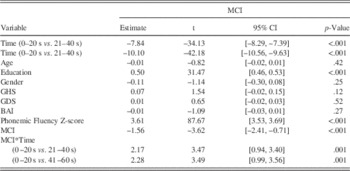
Separate LMEMs for category and phonemic fluency were used to examine the main effect of time, group status, and their interaction on verbal fluency performance. With respect to phonemic fluency, there was a significant main effect of time between T1 and T2 (beta=−7.84; p<.001; d=1.48) as well as T1 and T3 (beta=−10.10; p<.001; d=1.97) among healthy controls, indicating that performance declined over the course of the task. The main effect of MCI status on the number of words produced at T1 was significant (beta=−1.56; p<.001; d=0.28), indicating that individuals with MCI produced fewer words than healthy participants. As expected, the main effect of the total words produced was also significant (beta=3.61; p<.001; d=0.74). There was a significant time by MCI status interaction indicating that healthy older adults showed greater decline in performance from T1 to T2 (Beta= 2.17; p=.001; d=0.41), and from T1 to T3 (Beta=2.28; p=.001; d=0.45) when compared to individuals with MCI (see Table 2).
Linear mixed effects model examining the effects of time, MCI status, and their interaction on Phonemic Fluency performance

Note. Phonemic Fluency Z-score was based on the total number of words generated and was calculated using age and education corrected published local norms.
MCI=mild cognitive impairment; GHS=General Health Status; GDS=Geriatric Depression Scale; BAI=Beck Anxiety Inventory.
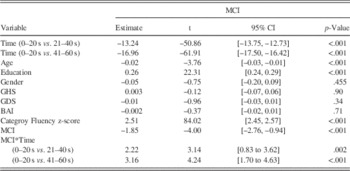
With regard to category fluency, there was a significant main effect of time between T1 and T2 (beta=−13.24; p<.001; d=2.88) as well as T1 and T3 (beta=−16.96; p<.001; d=3.71) among healthy controls indicating that performance declined over the course of the task. MCI status was associated with worse performance at T1 (beta=−1.85; p<.001; d=0.37). As expected, the main effect of total words produced was significant (beta=2.51; p<.001; d=1.30). There was a significant time by MCI status interaction indicating that, compared to individuals with MCI, healthy older adults showed greater decline in performance from T1 to T2 (Beta=2.22; p=.002; d=0.50), as well as from T1 to T3 (Beta=3.16; p<.001; d=0.71) (see Table 3).
Linear mixed effects model examining the effects of time, MCI status, and their interaction on Category Fluency performance

Note. Category Fluency Z-score was based on the total number of words generated and was calculated using age and education corrected published local norms.
MCI=mild cognitive impairment; GHS=General Health Status; GDS=Geriatric Depression Scale; BAI=Beck Anxiety Inventory.
Exploratory Analyses
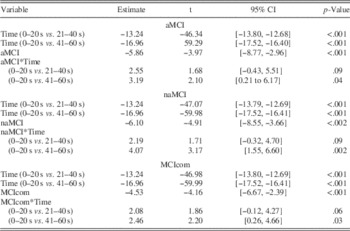
Separate LMEMs were performed with each MCI subgroup for both category and phonemic fluency. With regard to category fluency, there was a main effect of all MCI subtypes revealing that all MCI subgroups produced fewer words at T1 compared to controls (aMCI, Beta=−5.86; p<.001; naMCI, Beta=−6.10, p<.002; MCIcom, Beta=−4.53; p<.001). Time by MCI subtypes interactions revealed that there were significant effects between T1 and T3 for naMCI (Beta=4.07; p=.002), MCIcom (Beta=2.46; p=.03), as well as aMCI (Beta=3.19; p=.04; see Table 4), suggesting that, regardless of MCI subtype classification, normal controls showed greater decline in the number of words produced from T1 to T3 (see Figure 1).
(a) Trajectory by time for amnestic mild cognitive impairment and normal, (b) Trajectory by time for non-amnestic mild cognitive impairment and normal; (c) Trajectory by time for mild cognitive impairment combined type and normal. CAT=category fluency. Error bars represent standard error of the mean.

Linear mixed effects model examining the effects of time, MCI subtypes, and their interaction on Category Fluency performance

Note. MCI=mild cognitive impairment; naMCI=non-amnestic mild cognitive impairment; MCIcom=mild cognitive impairment combined.
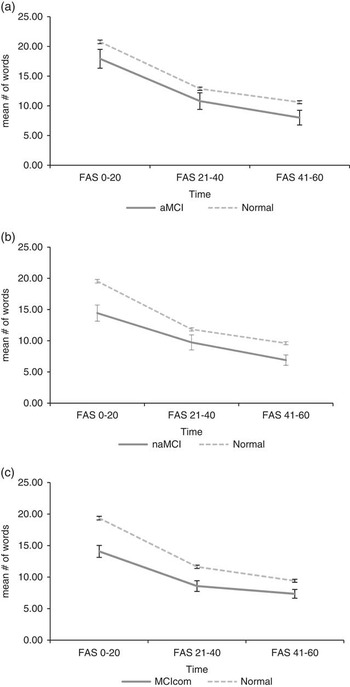
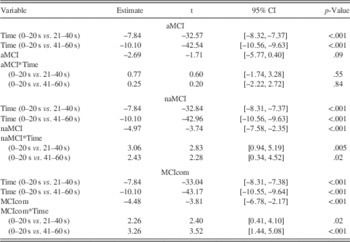
Phonemic fluency analyses revealed that there was a main effect of naMCI (Beta=−4.97; p<.001) and MCIcom status (Beta=−4.48; p<.001) but not aMCI (Beta=−2.69; p=.09), suggesting that compared to the other subtypes aMCI performed comparably to controls at T1. Time by MCI status interactions were significant only for individuals with naMCI and MCIcom both between T1 and T2 (naMCI, Beta=3.06; p=.005; MCIcom, Beta=2.26; p=.02) as well as between T1 and T3 (naMCI, Beta=2.43; p=.02; MCIcom, Beta=3.26; p<.001; see Table 5) revealing that, compared to individuals with naMCI and MCIcom, healthy older adults showed greater decline in the number of words produced at T2 and T3 (see Figure 2).
(a) Trajectory by time for amnestic mild cognitive impairment and normal, (b) Trajectory by time for non-amnestic mild cognitive impairment and normal; (c) Trajectory by time for mild cognitive impairment combined type and normal. FAS=phonemic fluency. Error bars represent standard error of the mean.

Linear mixed effects model examining the effects of time, MCI subtypes and their interaction on Phonemic Fluency performance

Note. naMCI=non-amnestic mild cognitive impairment; MCIcom=mild cognitive impairment combined.
DISCUSSION
Consistent with the previous literature, performance of normal and MCI participants declined over time both in phonemic and category fluency. Significantly more words were generated during the first time interval compared to the second and third intervals. Decline in word generation during the task has been previously reported in healthy young (Crowe, Reference Crowe1998; Raboutet et al., Reference Raboutet, Sauzeon, Corsini, Rodrigues, Langevin and N’Kaoua2010), individuals with MCI (Fernaeus & Almkvist, Reference Fernaeus and Almkvist1998), and diseased populations including older adults with dementia (Butters et al., Reference Butters, Granholm, Salmon, Grant and Wolfe1987; Ober et al., Reference Ober, Dronkers, Koss, Delis and Friedland1986). As previously discussed (Fernaeus & Almkvist, Reference Fernaeus and Almkvist1998), this finding has been interpreted as evidence that two distinct processes underlie verbal fluency performance. These include a semi-automatic retrieval process, which is present in the initial stages of the task, and effortful retrieval in later stages.
It has been suggested that production of words is maximal during the initial stages of the task (Crowe, Reference Crowe1998; Fernaeus & Almkvist, Reference Fernaeus and Almkvist1998) as individuals access their long-term store termed “topicon,” which consists of ordinary, easy to retrieve words (Smith & Claxton, Reference Smith and Claxton1972 cited in Crowe Reference Crowe1998). When this store is exhausted, the individual attempts to retrieve words from a larger pool of word store (Smith & Claxton, Reference Smith and Claxton1972 citen in Crowe, Reference Crowe1998); making the search process more time-consuming and more difficult (Crowe, Reference Crowe1998; Raboutet et al., Reference Raboutet, Sauzeon, Corsini, Rodrigues, Langevin and N’Kaoua2010).
While individuals with MCI performed within normal limits on phonemic and category fluency, examination of their performance over the course of these tasks revealed important distinctions. Specifically, individuals with MCI produced fewer words during the first time interval in both phonemic and category fluency compared to healthy controls. These findings suggest that word retrieval at earlier stages, although cognitively less demanding (Raboutet et al., Reference Raboutet, Sauzeon, Corsini, Rodrigues, Langevin and N’Kaoua2010), is compromised and, therefore, more laborious in individuals with MCI. This effect may be attributed, in part, to slowing of speed of information processing and retrieval of words from mental lexicon in the MCI group. Indeed, processing speed is impacted early in MCI and has been suggested to play a role in the transition from normal aging to MCI status (Dixon et al., Reference Dixon, Garrett, Lentz, MacDonald, Strauss and Hultsch2007).
Using the two-factor structure of Verbal Fluency performance as a conceptual framework, we examined the moderating effect of MCI status on word retrieval over time. Our results demonstrated that individuals with MCI showed attenuated decline in their performance over the one minute of administration in both fluencies compared to controls. This finding supports the notion that automatic search processes are compromised in MCI. Indeed, individuals with MCI were slower at initiating the search processes and retrieving words from memory even for easily accessible words. Hence, it appears that compared to controls, this process demanded more effort on the part of MCI participants necessitating recruitment of executive processes from the early stages of the task.
In contrast, healthy older adults were faster and more efficient at initiating search processes and retrieving words from memory as evidenced by the larger number of words they produced in the first 20 s of the task. Given the effect of MCI on semi-automatic processes, it is noted that the differences in decline between the two groups can be attributed, at least in part, to the fact that controls had more to lose due to greater efficiency in retrieving words at the initial stages of the task. Healthy older adults had to monitor and inhibit responses that had already been given from a larger number of words thus making the discrepancy between the first time interval and the subsequent two intervals greater compared to individuals with MCI.
On the other hand, performance of individuals with MCI was already less efficient and more effortful during the early stages of the task and their decline in word production was less prominent. These findings suggest that MCI affects initial semi-automatic retrieval processes of word production. Further evidence in support to this notion is attributed to the fact that our analyses controlled for total fluency scores. We also note that, if MCI had a comparable negative effect on later and more effortful retrieval processes during verbal fluency the moderation effect of MCI status on the change in word generation over time would not have been significant. It is evident, therefore, that important differences in word fluency generation that are sensitive to transition states in aging are not captured by a total score on standard phonemic and category fluency measures.
Since MCI is a heterogeneous transition state with different underlying brain pathologies, verbal fluency performance of MCI subtypes was also explored. Both naMCI and MCIcom generated fewer words in first 20-s intervals of category and phonemic fluency relative to controls. Individuals with aMCI generated fewer words in the first 20-s intervals in category but not phonemic fluency. The results are in accordance with previous reports suggesting that aMCI is the least impaired group on verbal fluency performance (Brandt & Manning, Reference Brandt and Manning2009). It has been proposed that individuals with multiple deficits in addition to memory have higher conversion to dementia of Alzheimer type (Alexopoulos, Grimmer, Perneczky, Domes, & Kurz, Reference Alexopoulos, Grimmer, Perneczky, Domes and Kurz2006; Roberts et al., Reference Roberts, Knopman, Mielke, Cha, Pankratz, Christianson and Petersen2014) and non-Alzheimer type (Roberts et al., Reference Roberts, Knopman, Mielke, Cha, Pankratz, Christianson and Petersen2014) than individuals with isolated memory deterioration (Alexopoulos et al., Reference Alexopoulos, Grimmer, Perneczky, Domes and Kurz2006; Roberts et al., Reference Roberts, Knopman, Mielke, Cha, Pankratz, Christianson and Petersen2014).
Worse performance in category fluency in aMCI is consistent with documented neuropathology in temporal lobes and its structures, in individuls with aMCI (Du et al., Reference Du, Schuff, Amend, Laakso, Hsu, Jagust and Weiner2001; Petersen et al., Reference Petersen, Parisi, Dickson, Johnson, Knopman, Boeve and Kokmen2006) and in dementia of the Alzheimer’s type (Du et al., Reference Du, Schuff, Amend, Laakso, Hsu, Jagust and Weiner2001). Poor performance in category fluency in individuals with AD is related to dysfunction of semantic network, which hampers an individual’s capacity to identify the characteristics of a concept and, consequently, the capacity to cite appropriate examples rapidly (Monsch et al., Reference Monsch, Bondi, Butters, Paulsen, Salmon, Brugger and Swenson1994). Similarly, subtle pathology in the semantic structure of aMCI individuals possibly affects the capabilty to retrieve exemplars rapidly. Phonemic fluency performance was comparable in individuals with aMCI individuals and controls. This finding maybe attributed to the fact that phonemic fluency relies more on the phonological features of words rather than on semantic networks. Given the small sample size of the MCI subtypes and exploratory nature of the analyses, these findings should be interpreted with caution.
Literature proposes that, compared to phonemic fluency, category fluency is superior in identifying individuals who subsequently develop AD (Clark et al., Reference Clark, Gatz, Zheng, Chen, McCleary and Mack2009; Fernaeus, Ostberg, Hellstrom, & Wahlund, Reference Fernaeus, Ostberg, Hellstrom and Wahlund2008). In addition, it has been suggested that performance at the initial 30 s of category fluency may be adequate to distinguish MCI with memory related impairments and AD from healthy adults (Fernaeus et al., Reference Fernaeus, Ostberg, Hellstrom and Wahlund2008). The present findings suggest that subtle impairments in phonemic fluency are also present, for at least a portion of MCI individuals who might subsequently develop AD or other dementias. In addition, distinct patterns of performance within phonemic fluency were identified among MCI subtypes when compared to healthy older adults. It is worthy of note that, on average, phonemic and category fluency was within one standard deviation in all subgroups suggesting a substantial overlap in performance as determined by normative total scores; Nonetheless, in this context, differences in the rate of word generation decline during the course of the task between healthy and MCI groups provided incremental and relevant clinical information.
It is important to consider the limitations of the current study. Recruitment of participants was restricted to relatively healthy, senior individuals who reside in the community and function relatively independently. Further research should consider the generalizability of the present findings to more diverse samples in terms of demographic and physical characteristics. Furthermore, longitudinal studies are necessary to determine whether differences in the slopes of word generation predict the incidence of transition states and dementia. Future research should further explore divergences in patterns of performance between different cognitive profiles within MCI subgroups using a larger sample.
Older age is associated with increased number of errors (McDowd et al., Reference McDowd, Hoffman, Rozek, Lyons, Pahwa, Burns and Kemper2011) and individuals with AD produce more errors than healthy older adults (Haugrud, Crossley, & Vrbancic, Reference Haugrud, Crossley and Vrbancic2011). Future studies could explore types of errors in individuals with MCI and whether these can differentiate transitional states from normal cognition. It would also be of interest to consider the effect of relevant biological markers such as amyloid burden as well as the effect of use of acetylcholinesterase inhibitors on verbal fluency trajectories. Although symptoms of depression and anxiety did not affect verbal fluency performance in the present study, mood symptoms in our sample were relatively mild. Future research should explore verbal fluency performance in a population with more severe levels of depression and anxiety.
Research can also use independent neuropsychological tests of speed of processing and executive functions to determine whether these influence the effect of MCI on verbal fluency time trajectories. Although validation for the two-factor structure of verbal fluency exists in the literature (Crowe, Reference Crowe1998; Fernaeus & Almkvist, Reference Fernaeus and Almkvist1998), independent confirmation in the current study is lacking. Furthermore, research on structural and functional brain substrates, vis-à-vis the aformentioned two-factor structure, is limited. One study examining white matter hypersensitivities and performance on phonemic fluency in individuals with a range of memory impairments showed that performance in the initial 30 s of the task correlated with white matter hypersensitivities in the frontal lobes, which likely impacted initiation of word retrieval (Fernaeus et al., Reference Fernaeus, Almkvist, Bronge, Ostberg, Winblad and Wahlund2001).
Hence, future research should identify shared and distinct structural and functional brain correlates of the proposed semi-automatic and effortful processes of verbal fluency in healthy controls and individuals in transition states to dementia. In addition, it would be of interest to further explore whether compromised automatic processes in MCI is a phenomenon that impacts performance across neuropsychological measures.
In conclusion, the present study suggests that MCI status uniquely affects early semi-automatic retrieval processes in phonemic and category fluency tasks. Consequently, the decline in word generation is attenuated in individuals with MCI compared to controls. These findings further support the notion that within task performance may provide incremental information that can be used to discriminate early neuropathological transition states such as MCI from normal aging.
Acknowledgments
This research was supported by the National Institutes on Aging (R01AG036921 and R01AG044007). The authors of the manuscript do not have any conflicts of interest that pertain to the reported work or conduct of the research.