INTRODUCTION
Neurocognitive functions, such as, language, memory, social perception, and visuospatial functions, are gradually acquired and develop during childhood. This development has been shown to be especially rapid before age 9 or 10 for most neurocognitive functions (e.g., Korkman, Kemp, & Kirk, Reference Korkman, Kemp and Kirk2001; Korkman, Lahti-Nuuttila, Laasonen, Kemp, & Holdnack, Reference Korkman, Lahti-Nuuttila, Laasonen, Kemp and Holdnack2013; Rosselli, Ardila, Navarrete, & Matute, Reference Rosselli, Ardila, Navarrete and Matute2010; Waber et al., Reference Waber, De Moor, Forbes, Almli, Botteron, Leonard and Rumsey2007), and it reflects not only the maturation of the brain but also the effect of the environment (Ardila & Rosselli, Reference Ardila and Rosselli1994; McLoyd, Reference McLoyd1998; Olson & Jacobson, Reference Olson and Jacobson2015). These contextual factors vary to a great extent within a given country and might vary even more between different cultures.
The young but growing field of pediatric cultural neuropsychology has, so far, mainly investigated differences in performance on, for instance, language, attention, and visual tasks between different U.S. ethnic groups, or investigated or established the use of normative data in specific international cultural groups. These previous studies are limited, for instance, by small sample sizes and by seldom including older children (see review by Byrd, Arentoft, Scheiner, Westerveld, & Baron, Reference Byrd, Arentoft, Scheiner, Westerveld and Baron2008). Differences found between ethnic pediatric groups have often been attributed to behavioral or background-related factors of the participants as well as to the non-representativeness of normative samples (Byrd et al., Reference Byrd, Arentoft, Scheiner, Westerveld and Baron2008; e.g., Restrepo et al., Reference Restrepo, Schwanenflugel, Blake, Neuharth-Pritchett, Cramer and Ruston2006). However, according to Byrd and colleagues, it seems that the performance patterns in pediatric cultural studies might not be similar to that of adult studies and that child cultural developmental patterns may be non-linear.
One way of approaching the clinically important field of child cultural neuropsychology is through comparison of performance in similar tasks used in different countries. Such information of cultural influence on neurocognitive task performance may expand the cross-cultural pediatric field and provide information of both theoretical and clinical importance. There is a growing clinical need for knowledge about cultural differences in comprehensively assessed neurocognitive functions (also discussed by Olson & Jacobson, Reference Olson and Jacobson2015). In the current study, we aimed at investigating how performance in areas of language, face memory, social perception, and visuospatial processing, as assessed with the NEPSY-II, differed between typically developing children from Finland, Italy, and the United States.
Cross-Cultural Studies with the NEPSY(-II)
The present study investigates data from the NEPSY-II standardizations in three countries. Previous cross-cultural studies conducted with the NEPSY-II have discussed ethical issues of translating the assessment to Afrikaans (Dalen, Jellestad, & Kamaloodien, Reference Dalen, Jellestad and Kamaloodien2007), reported differences between Russian and Romanian preschoolers on tasks of attention/executive functioning (Cheie, Veraksa, Zinchenko, Gorovaya, & Visu-Petra, Reference Cheie, Veraksa, Zinchenko, Gorovaya and Visu-Petra2015), and compared Finland-Swedish mono- and bilinguals on various NEPSY-II tasks (Karlsson et al., Reference Karlsson, Soveri, Räsänen, Kärnä, Delatte, Lagerström and Laine2015). Previous cross-cultural studies with the preceding version of the assessment tool, the NEPSY (Korkman, Kirk, & Kemp, Reference Korkman, Kirk and Kemp1997, Reference Korkman, Kirk and Kemp1998), have reported some differences in performance between monolinguals and bilinguals (Garratt & Kelly, Reference Garratt and Kelly2008; Korkman et al., Reference Korkman, Stenroos, Mickos, Westman, Ekholm and Byring2012; Mulenga, Ahonen, & Aro, Reference Mulenga, Ahonen and Aro2001; Westman, Korkman, Mickos, & Byring, Reference Westman, Korkman, Mickos and Byring2008). However, these studies were conducted comparing children from Zambia, speaking English as their second language, with the American norms, and comparing bilinguals and monolinguals within one country (Finland or Great Britain). Thus, it is still not known how performance on the NEPSY-II differs between children from different Western countries.
Neurocognitive Functions in a Cross-Cultural Perspective
Regarding specific neurocognitive functions, such as language, face memory, social perception, and visuospatial processingFootnote 1 , the pediatric cultural information is limited.
Findings of children’s cultural performance differences in language tasks are mixed. Nine- and 11-year-old Zambian children, assessed in their non-native language, performed worse on the NEPSY Language domain when compared to Americans (Mulenga et al., Reference Mulenga, Ahonen and Aro2001). Monolinguals, aged 5–7 years outperformed bilinguals on the NEPSY subtests Body Part Naming (Korkman et al., Reference Korkman, Stenroos, Mickos, Westman, Ekholm and Byring2012; Westman et al., Reference Westman, Korkman, Mickos and Byring2008), as well as Speeded Naming and Comprehension of Instructions (Garratt & Kelly, Reference Garratt and Kelly2008), which was attributed to, for instance, high verbal content of the subtests and speed-related cultural differences (Garratt & Kelly, Reference Garratt and Kelly2008; Mulenga et al., Reference Mulenga, Ahonen and Aro2001). However, no significant differences were found on the NEPSY language subtests Speeded Naming and Comprehension of Instructions (Korkman et al., Reference Korkman, Stenroos, Mickos, Westman, Ekholm and Byring2012; Westman et al., Reference Westman, Korkman, Mickos and Byring2008) or the Phonological Processing subtest (Garratt and Kelly, Reference Garratt and Kelly2008; Westman et al., Reference Westman, Korkman, Mickos and Byring2008). Also, no differences were found in a recent study of 7- and 11-year-olds on the NEPSY-II subtests Comprehension of Instructions, Phonological Processing, Speeded Naming, and Word Generation (Karlsson et al., Reference Karlsson, Soveri, Räsänen, Kärnä, Delatte, Lagerström and Laine2015). These differing previous findings may at least partly be due to age differences—it seems that some language differences tend to emerge in younger age groups rather than in older, at least when comparing children within one country. However, the study by Mulenga and colleagues (2001) reporting differences in 9- and 11-year-olds from different countries was, thus, an exception. Therefore, other methodological factors may account for the differences: The previous studies have focused on different language groups and NEPSY(-II) subtests, included children with language difficulties (Korkman et al., Reference Korkman, Stenroos, Mickos, Westman, Ekholm and Byring2012; Westman et al., Reference Westman, Korkman, Mickos and Byring2008), and used different normative data (Swedish, United States, and Finnish).
Recent pediatric cross-cultural research on face memory has mainly focused on discussing own-group bias during face recognition tasks in children (e.g., De Heering, De Liedekerke, Deboni, & Rossion, Reference De Heering, De Liedekerke, Deboni and Rossion2010). In addition, one study reported no significant differences between mono- and bilingual 6- to 7-year-olds on the NEPSY Memory for Faces subtest (Garratt & Kelly, Reference Garratt and Kelly2008), but studies comparing this ability between different cultures with a larger age span are lacking. In keeping with previous face recognition studies, previous cross-cultural emotion recognition studies have focused on investigating the in-group advantage (i.e., one tends to recognize better emotions of one’s own cultural group) (e.g., Elfenbein & Ambady, Reference Elfenbein and Ambady2002, Reference Elfenbein and Ambady2003). Regarding theory of mind, another aspect of social perception, cross-cultural studies seem to indicate that performance on false belief, and other tasks of theory of mind ability is similar in different cultures, at least when comparing North American, European, or Australian children to South American, Oceanian, or Asian children (e.g., Callaghan et al., Reference Callaghan, Rochat, Lillard, Claux, Odden, Itakura and Singh2005; Oh & Lewis, Reference Oh and Lewis2008; Sabbagh, Xu, Carlson, Moses, & Lee, Reference Sabbagh, Xu, Carlson, Moses and Lee2006; Shahaeian, Peterson, Slaughter, & Wellman, Reference Shahaeian, Peterson, Slaughter and Wellman2011).
Concerning visuospatial functions, contrary to previous belief, non-verbal visual tasks seem to be culture dependent (Rosselli & Ardila, Reference Rosselli and Ardila2003). In fact, studies have reported some differences between cultural groups on visual and constructional tasks in children (for a review, see Rosselli & Ardila, Reference Rosselli and Ardila2003). More specifically, Zambians performed better than Americans, and bilinguals outperformed monolinguals on the NEPSY Design Copying subtest, which was attributed to differences in school practices and cultural differences in habits of using visual information and materials (Garratt & Kelly, Reference Garratt and Kelly2008; Mulenga et al., Reference Mulenga, Ahonen and Aro2001). However, no significant difference was found for the NEPSY Arrows subtest (Garratt & Kelly, Reference Garratt and Kelly2008).
In all, the few previous cross-cultural pediatric neuropsychological studies have generally pointed toward differences in performance on at least some neurocognitive tasks. However, more comprehensive studies are still lacking.
Aims
The aim of the present study was to cross-sectionally compare the development of neurocognitive functions in 3- to 15-year-old children from three countries: Finland, Italy, and the United States. The differences between the countries in performance on 10 subtests from the NEPSY-II domains Language, Memory/Learning, Social Perception, and Visuospatial Processing were explored. We hypothesized that, in all countries, there would be development of the neurocognitive functions with increasing age, as reported in previous studies across countries and languages (e.g., Korkman et al., Reference Korkman, Lahti-Nuuttila, Laasonen, Kemp and Holdnack2013; Rosselli et al., Reference Rosselli, Ardila, Navarrete and Matute2010), but that this development would be non-linear, as suggested by Byrd and colleagues (2008). No previous studies comparing the present cultural and language groups and few multi-country pediatric neurocognitive studies were found, but based on previous pediatric cross-cultural studies, we generally hypothesized that there would be some differences in visuospatial tasks, but no differences in theory of mind or face memory tasks between the cultural groups. Due to limited and contradictory previous findings, we were not able to form any hypothesis regarding language and emotion recognition performance.
METHODS
Participants
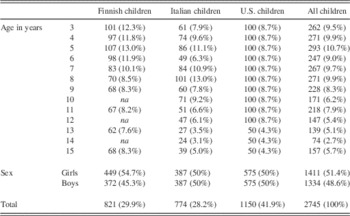
The 2745 participants (Finnish N=821; Italian N=774; United States N=1150) were drawn from the Finnish, Italian, and U.S. standardization samples of the NEPSY-II (Korkman, Kirk, & Kemp, Reference Korkman, Kirk and Kemp2007a, Reference Korkman, Kirk and Kemp2007b, Reference Korkman, Kirk and Kemp2008a, Reference Korkman, Kirk and Kemp2008b, Reference Korkman, Kirk and Kemp2011; Urgesi, Campanella, & Fabbro, Reference Urgesi, Campanella and Fabbro2011). The children were 3–15 years old and had no significant developmental/neurological disorders as reported by parents. The children from each country spoke Finnish, Italian, or English, respectively. Demographic information of the age groups of each country can be found in Table 1.
Demographics for the three countries per age group and sex

Note. For the Finnish standardization, 10-, 12-, and 14-year-olds were not assessed. The percentages for the age and sex variables should be read across columns. The total percentages should be read across the row. The data are standardization data from the NEPSY. Second Edition (NEPSY-II). U.S. data: Copyright © 2007 NCS Pearson, Inc. Reproduced with permission. All rights reserved.
The NEPSY-II standardizations included assessments of 923 Finnish, 800 Italian, and 1200 American children aged 3 to 15 (Finland) or 16 (Italy and the United States) years. The 16-year-olds assessed in the Italian and U.S. standardizations were excluded from the analyses to ensure that the upper age limit was the same throughout the data. The Finnish children aged 3 to 9, and 11, 13, and 15 years (M=7.47; SD=3.64) were assessed within 3 months before or after their birthday (10-, 12-, and 14-year-olds were not included in the standardization). Children whose first language was not Finnish (n=12), children who had a neuropsychological deficit (n=80), and children who fell outside the age categories of the standardization (n=13) were excluded from the analyses. Thus, the present Finnish sample consisted of 821 children. The 774 children of 3–15 years participating (M=8.07; SD=3.37) in the Italian standardization of the NEPSY-II were assessed during the given year between birthdays. This was also true for the 1150 children aged 3 to 15 (M=8.35; SD=3.47) of the American NEPSY-II standardization.
Material
The NEPSY-II is a developmental neuropsychological assessment, consisting of approximately 30 subtests divided into 6 domains: Attention/Executive Functioning, Language, Memory/Learning, Sensorimotor, Social Perception, and Visuospatial Processing. In the present study, selected subtests from most domains were used (the Attention/Executive Functioning and Sensorimotor domains were excluded due to criteria presented below). Even though several NEPSY-II subtests were presented to all children during the standardization process, some were given to only certain age groups. To assess neurocognitive development comprehensively, and to add a developmental aspect to the analyses, we included the subtests that were given to all 3–15 or 5- to 15-year-old children.
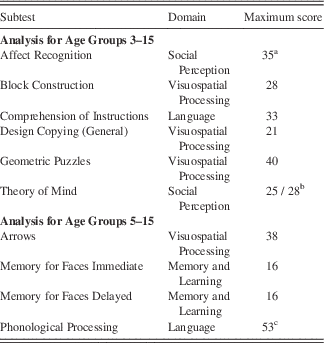
There were some differences between the three NEPSY-II versions conducted in different cultures with regard to included or re-normed subtests as well as subtest scoring procedures, presentation, and age range. Therefore, subtests were included in the present study if (1) the subtest was included in and normed for the NEPSY-II in all three countries, (2) the subtest construction and tasks were comparable between the countries, and (3) the subtest was presented in a similar way to all age groups within the age ranges 3–15 years or 5–15 years. The subtests included in both age groups are shown in Table 2, including maximum scores for the three countries and the domain of the subtest.
Subtests included in the study, the NEPSY-II domain of the subtests, and the maximum score of the subtests, separately for subtests given to 3- to 15- and 5- to 15-year-olds

Note. The data are standardization data from the NEPSY, Second Edition (NEPSY-II). U.S. data: Copyright ©2007 NCS Pearson, Inc. Reproduced with permission. All rights reserved.
a The original maximum score of the Affect Recognition subtest was 45 in the Finnish data. This score was converted to 35 by changing the scoring of the last items of the subtest.
b The maximum score for the Theory of Mind subtest was 25 in the Finnish and Italian standardizations, and 28 in the U.S. version. When scores were converted to percent of maximum, these differences were eliminated.
c The original score of the Phonological Processing subtest was 45 in the U.S. data. This score was converted to 53 by adding 4, 6, or 8 points to the sum scores of the 5- to 15-year-old participants. As this was not feasible for the 3- to 4-year-olds, this subtest was included in the analysis with the 5- to 15-year-olds. See text for further explanation.
Procedure
The data were collected during the years 2005–2006 (United States), 2006–2007 (Finland), and 2007–2009 (Italy). All children were assessed individually by trained professionals in each country. Parents consented to the assessment. The assessment procedures were approved by the Committee for Research Ethics at Åbo Akademi University (Finnish data), the Scientific Institute Eugenio Medea (Italian data), and Pearson (U.S. data). The ethical principles of the Helsinki Declaration were followed during data collection in all countries. The data collection procedures differed somewhat between the countries. For more information regarding the standardization procedures, see the assessment manuals (Korkman et al., Reference Korkman, Kirk and Kemp2007b, Reference Korkman, Kirk and Kemp2008b, Reference Korkman, Kirk and Kemp2011).
Data Preparation
Before analyses, the data were prepared to be comparable between the countries. Missing data on the subtest or item level for individual participants (i.e., if an individual child did not participate in or complete a task) was replaced using Expectation Maximization (EM) estimation, for each country separately. Most subtest scores were comparable between countries, with maximum scores and administration rules (i.e., starting and finishing points, or discontinuation and reverse rules) being considered comparable in all three country versions, with some exceptions. For the subtest Affect Recognition, the Finnish version had a maximum score of 45, while this score was 35 in the other two countries: The 10 last items were scored with 0–2 points in the Finnish data, while they were scored with 0–1 points in the other data. Thus, as the Finnish data were provided as item scores, these items were converted to be comparable with the other countries.
The maximum score of the Phonological Processing subtest was 45 in the U.S. data whereas it was 53 in the Finnish and Italian data. The subtest tasks were similar between the countries, with only eight of the first and thus easiest tasks of the European versions missing from the U.S. version. Most 5- to 15-year-old U.S. children performed above the reverse rule, that is, they received a total score of at least 10. Five children had a total score below this reverse rule point. We added the following scores to the U.S. children’s total Phonological Processing score: 8 points were added if the child had a total score of 8 or above; 6 points were added if the child had a total score of 4; and 4 points were added if the child had a total score of 0. This way the maximum score of the Phonological Processing subtest was 53 in all countries. As several of the U.S. 3- to 4-year-olds performed below the reverse rule point, we were not able to reliably add scores to their performance and these age groups were excluded from the analyses.
For the Theory of Mind subtest, the maximum score was 25 in the Finnish and Italian data, whereas it was 28 in the U.S. data, as some items in the verbal task were scored differently in the U.S. data as compared to the European data (with 0–3 vs. 0–2, or 0–2 vs. 0–1 points), and as there was a difference in number of items in the contextual task. As the Italian and U.S. data were provided as subtest scores, the subtest could not be converted on the item level. Thus, percent of maximum score was used to account for this discrepancy.
Additionally, based on visual inspection, the distribution of the Affect Recognition subtest scores in the U.S. data was bimodal. This was not corrected for in the analyses. To make all subtest scores comparable, raw scores of the subtests were converted to percent of maximum score for all subtests.
Data of all subtests administered to all 3- to 15-year-olds and 5- to 15-year-olds, respectively, were first entered into multivariate analyses of variance (MANOVAs), followed by separate univariate analyses of variance (ANOVAs) for each subtest score. Age, country, and sex were entered as between-subject factors to control for age-related development of task performance in relation to children’s country and to test for differences between girls and boys. Thus, the main effects of age, country, and sex and the interaction between age and country were considered and reported. Then, for each age group (e.g., 3-year-olds, 4-year-olds, etc.), separate Bonferroni-corrected (α=.05 / 3=.017) pairwise comparisons of the NEPSY-II scores between the countries were performed to more closely investigate the differences in performance between the countries for each age group and subtest. Effect sizes (d’s) were calculated for the pairwise comparisons between countries. When determining d, the estimate of standard deviation was calculated as square root of (SSerror+SSsex+SSage+SScountry×age)/(dferror+dfsex+ dfage+dfcountry×age), and as square root of (SSerror+SSsex)/(dferror+dfsex), as well, since the equality of variances was assumed and when taking the age variation into account, the estimate of standard deviation was almost certainly inflated.
RESULTS
Before analyses, bivariate correlations with all included subtests were conducted separately for each country. All subtests correlated significantly with each other at the .001-level in all countries. Correlation tables for the NEPSY-II can be found in the Italian and U.S. assessment manuals (Korkman et al., 2007b, Reference Korkman, Kirk and Kemp2011). All correlations between the subtests were of comparable sizes in all countries, including the Finnish data.
As expected, age was significantly and strongly related to neurocognitive performance in both multivariate analyses (For the 3- to 15-year-olds: Wilk’s Λ=.06; p<.001; η p 2 =.37. For the 5- to 15-year olds: Wilk’s Λ=.22; p<.001; η p 2=.32), as were the country variable (For the 3- to 15-year-olds: Wilk’s Λ=.62; p<.001; η p 2=.22. For the 5- to 15-year-olds: Wilk’s Λ=.95; p<.001; η p 2=.02), and the country and age interaction (For the 3- to 15-year-olds: Wilk’s Λ=.68; p<.001; η p 2=.06. For the 5- to 15-year olds: Wilk’s Λ=.88; p<.001; η p 2=.03). Sex was also significantly related to neurocognition in the MANOVAs (For the 3- to 15-year-olds: Wilk’s Λ=.95; p<.001; η p 2=.05. For the 5- to 15-year olds: Wilk’s Λ=.95; p<.001; η p 2=.05).
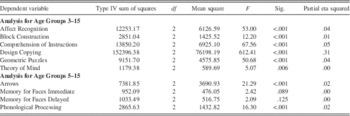
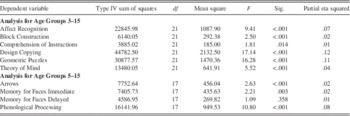
The ANOVA results of the country variable main effect and of the country and age interaction are presented in Tables 3 and 4, respectively. These were significant for most subtests included in the analyses. As expected, age was significant for all subtests (all ps<.001; η p 2=.29–.79). Sex was significant for most of the subtests (ps<.001; η p 2=.01–.03), the exceptions being Geometric Puzzles (3–15 years; p=.711; η p 2=.00) and Phonological Processing (5–15 years; p=.367; η p 2=.00). For most subtests with significant sex effects, girls outperformed boys, except for the Block Construction and Arrows subtests, where boys outperformed girls.
Results for the country variable of the separate ANOVAs, presented in accordance with the two MANOVAs for the separate age groups

Note. The data are standardization data from the NEPSY, Second Edition (NEPSY-II). U.S. data: Copyright ©2007 NCS Pearson, Inc. Reproduced with permission. All rights reserved.
Results for the country and age interaction of the separate ANOVAs, presented in accordance with the two MANOVAs for the separate age groups

Note. The data are standardization data from the NEPSY, Second Edition (NEPSY-II). U.S. data: Copyright ©2007 NCS Pearson, Inc. Reproduced with permission. All rights reserved.
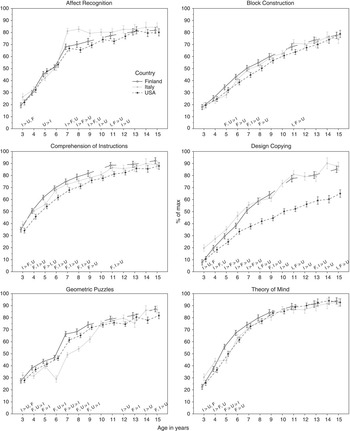
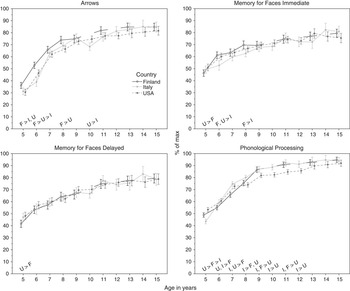
The significant results of the Bonferroni-corrected pairwise comparisons can be found in Figures 1 (3- to 15-year-olds) and 2 (5- to 15-year-olds), where significant between-country comparisons are highlighted below the corresponding age-group points. As shown in Figures 1 and 2, the performance on all subtests improved with increasing age across countries, but differences between the three countries appeared at specific ages for most subtests. For the Memory for Faces subtests, there were few significant differences between the countries, as shown by non-significant main effect of country (Memory for Faces Immediate and Delayed) and interaction between country and age in the main analysis (Memory for Faces Delayed) (Tables 3 and 4), as well as by mostly non-significant pair-wise comparisons in the post hoc analyses (Figure 2). The effect sizes d are presented in the Supplementary Table.
Finnish, Italian, and U.S. children’s performance on the NEPSY-II subtests given to the 3- to 15-year-olds. Subtest mean scores are percent of maximum score. Pairwise comparisons (Bonferroni corrected) for the country×age interactions are denoted above the age groups, when statistically significant (p≤.05). Error bars denote 95 % confidence interval for estimated marginal means. The data points of the three countries are slightly aligned next to each other, for clearer visibility. F=Finnish children, I=Italian children, U=U.S. children. The data is standardization data from the NEPSY, Second Edition (NEPSY-II). U.S. data: Copyright © 2007 NCS Pearson, Inc. Reproduced with permission. All rights reserved.

Finnish, Italian, and U.S. children’s performance on the NEPSY-II subtests given to the 5- to 15-year-olds. Subtest mean scores are percent of maximum score. Pairwise comparisons (Bonferroni corrected) for the country×age interactions are denoted above the age groups, when statistically significant (p≤.05). Error bars denote 95% confidence interval for estimated marginal means. The data points of the three countries are slightly aligned next to each other, for clearer visibility. F=Finnish children, I=Italian children, U=U.S. children. The data is standardization data from the NEPSY, Second Edition (NEPSY-II). U.S. data: Copyright © 2007 NCS Pearson, Inc. Reproduced with permission. All rights reserved.

DISCUSSION
The present study investigated the similarities and differences in the performance on comparably structured versions of a neurocognitive assessment among Finnish, Italian, and U.S. 3- to 15-year-old children. Our findings suggest differences in the development of most neurocognitive functions. In the absence of previous multi-country studies of neurocognitive development, our findings may be considered constituting new information regarding cultural performance on neurocognitive tasks in children. They also highlight the importance of creating norms for different cultural groups and have implications for clinicians working in cultural settings as well as for researchers. First, we discuss the findings of the present study. Then, as a general discussion, we present some possible explanations for the results.
Differences in Neurocognitive Performance
We identified five main findings in the present study. First, performance on all neurocognitive functions improved with age in all three countries assessed. Second, we found some significant over all differences between the countries. Third, the results revealed different spurts and decelerations between the countries and fourth, the differences seemed to even out in adolescence. Fifth, for some subtests, there were no or few significant differences between the countries.
Age-related differences
The present study confirmed the hypothesis that performance on all neurocognitive functions would improve with age in all three countries assessed. This is consistent with previous studies showing age-related improvements in cognitive functioning for children from different language and culture groups (e.g., Korkman et al., Reference Korkman, Lahti-Nuuttila, Laasonen, Kemp and Holdnack2013; Rosselli, Ardila, Bateman, & Guzmán, Reference Rosselli, Ardila, Bateman and Guzmán2001)Footnote 2 . While cognitive functioning improved with age in all three countries, the level of performance differed significantly between the countries for several of the assessed age groups, as discussed below.
Overall differences in subtest performance
The results revealed over-all differences in performance between the countries, for some subtests. The hypothesis that some visuospatial performance differences would emerge was confirmed. When looking at the separate countries, performance on tasks requiring visuospatial, constructional, and fine motor abilities (as here indicated by drawing copies of geometrical figures and building with blocks) was generally lower for the U.S. children compared to the European children, which was in line with a previous study showing better performance on the NEPSY Design Copying subtest in Zambian children as compared to U.S. norms (Mulenga et al., Reference Mulenga, Ahonen and Aro2001). A similar finding occurred for the U.S. children on some linguistic tasks. Performance on visuospatial tasks was generally higher for the Finnish children, whereas, in comparison, phonological processing performance was lower for the younger age groups in the Finnish data. In addition, Italian children showed an advantage on measures of emotion recognition ability and figure copying compared to children in the other countries.
These results suggest that neither verbal nor visual tasks are culturally independent (as also discussed by, for instance, Rosselli & Ardila, Reference Rosselli and Ardila2003). Thus, they underline the fact that different norms are needed for different cultural groups. However, it should be noted that for most of these subtests, significant differences between the countries did not occur in all age groups.
Different developmental curves
In addition to overall differences in task performance between the countries, there were different developmental spurts or decelerations between the countries for some age groups in all subtests (for the Memory for Faces (Delayed) subtest, only between ages 5 and 6). This was in line with the suggestion by Byrd and colleagues (2008) and with the hypothesis of cultural neurocognitive development following a non-linear course. The development of neurocognitive functions seems to differ between the three countries, and hence we conclude that there seem to be somewhat different developmental trends of these functions in different cultures.
Younger vs. older children
In general, there were more significant pairwise differences in the younger age groups than in the older, indicating that the differences between the countries leveled out in adolescence. For instance, the Arrows subtest showed significant differences between countries at ages 5, 6, 8, and 10, only. After that, the development of the ability to estimate direction of lines developed in a similar way across the assessed countries. A similar pattern (at different ages) may be observed for most other subtests. However, the subtests Design Copying and Geometric Puzzles were exceptions, showing significant differences in performance between the countries for children as old as 15 years. In the previous study by Korkman and colleagues (2013), the Design Copying and Geometric Puzzles subtests showed medium-to-large effect sizes in pairwise comparisons between some consecutive age groups after age 9 and also peaked and were mastered late. Thus, it seems that these visuospatial functions develop well into adolescence, and that this development differs between different countries.
The Theory of Mind subtest showed significant differences in the younger age groups, which was contradictory to some previous studies indicating that children from different cultures perform similarly on different theory of mind tasks (e.g., Callaghan et al., Reference Callaghan, Rochat, Lillard, Claux, Odden, Itakura and Singh2005; Sabbagh et al., Reference Sabbagh, Xu, Carlson, Moses and Lee2006; Shahaeian et al., Reference Shahaeian, Peterson, Slaughter and Wellman2011). Thus, our hypothesis was not confirmed. However, even if the overall theory of mind development was similar, different theory of mind abilities seem to develop in a different order in different cultural groups, owing to differing parenting styles, cultural environments, and values (e.g., Shahaeian et al., Reference Shahaeian, Peterson, Slaughter and Wellman2011; Shahaeian, Nielsen, Peterson, & Slaughter, Reference Shahaeian, Nielsen, Peterson and Slaughter2014). The present Theory of Mind subtest consisted of a variety of tasks, including false belief, bluff and double bluff, understanding figurative language, and recognizing mental states (Korkman et al., Reference Korkman, Kirk and Kemp2007b). Perhaps mastery of these tasks develops in a differing order in different cultural groups of younger children.
Additionally, performance on tasks of theory of mind is related to other neurocognitive functions, such as executive functions (e.g., Devine & Hughes, Reference Devine and Hughes2014; Sabbagh et al., Reference Sabbagh, Xu, Carlson, Moses and Lee2006; Shahaeian, Henry, Razmjoee, Teymoori, & Wang, Reference Shahaeian, Henry, Razmjoee, Teymoori and Wang2015). Perhaps cultural developmental differences in other neurocognitive functions, such as the language differences found in the present study, explain some of the present differences in theory of mind performance. In fact, the strongest correlations of the Theory of Mind subtest can be found with subtests from the Language domain, or with other subtests with a linguistic component (Korkman et al., Reference Korkman, Kirk and Kemp2007b, Reference Korkman, Kirk and Kemp2011).
Non-significant findings
The Memory for Faces Delayed subtest failed to show significant differences in the country and age interaction and the Memory for Faces Immediate subtest was significantly related to cultures and age in the ANOVA, but showed few significant pairwise differences. Thus, our hypothesis was confirmed and the finding was in line with a previous study reporting no significant differences on this task between 6- and 7-year-old mono- and bilinguals (Garratt & Kelly, Reference Garratt and Kelly2008). The present study, thus, broadens this finding to comprise a larger age span and new cultural groups. Leaning on the assumption that the present sample was fairly big and representative, the present results suggest that the Memory for Faces subtests are fairly robust and insensitive to at least the cultures assessed in the present study. This may indicate that face memory ability might be a separate cognitive function, possibly not as affected by schooling and background factors as the other neurocognitive tasks.
General Discussion
This is the first study assessing cultural differences in several areas of neurocognitive performance in children with a wide age range. In keeping with studies with adults (e.g., Fernandez & Marcopulos, Reference Fernández and Marcopulos2008) and children (Garratt & Kelly, Reference Garratt and Kelly2008; Mulenga et al., Reference Mulenga, Ahonen and Aro2001; Westman et al., Reference Westman, Korkman, Mickos and Byring2008), the current findings indicate that some language and visual tasks seem to be sensitive to cultures and languages, even if exceptions also have been reported (e.g., Karlsson et al., Reference Karlsson, Soveri, Räsänen, Kärnä, Delatte, Lagerström and Laine2015). The previous NEPSY studies have reported these differences when studying developing countries or specific linguistic minority groups. The present study suggests that differences occur also when comparing three Western countries. Therefore, we conclude that separate norms are needed for different cultural groups. Furthermore, several general reasons for the observed differences in neurocognitive performance may be considered.
Cultural differences
It is possible that the differences are due to actual cultural differences. There are differences in, for instance, political, religious, and health care systems, and thus assumingly also in values and beliefs among the countries, even if Finland, Italy, and the United States are all Western countries. These differences may be reflected in different aspects of the assessment situations, as well (Ardila, Reference Ardila2005; Olson & Jacobson, Reference Olson and Jacobson2015).
Furthermore, the possible general impact of language differences must be considered, as Finnish, Italian, and English all belong to different language families. These language differences might lead to different development of language abilities and they might also modulate the task difficulty for specific languages, as previously suggested by Rosselli and colleagues (2001). It was not possible to separate language from other cultural effects within the scope of the present study. Thus, further disentangling language effects from other cultural effects on performance on a variety of tasks across childhood will be an important topic for future studies.
The cultural heritage of each of the countries may also account for the observed differences. The U.S. population is quite diverse with large populations of individuals from European, Asian, Hispanic, and African heritages, and does not represent a singular, cultural group. Therefore, it may be difficult to conclude that scores in the United States represent a specific cultural or even linguistic experience but rather represent a broader multicultural background.
Educational differences
The significant differences found in the present study may also be attributed to differences in the educational systems between the countries (see also Shuttleworth-Edwards et al., Reference Shuttleworth-Edwards, Kemp, Rust, Muirhead, Hartman and Radloff2004). Different neurocognitive functions have, for instance, shown to be related to reading, spelling, math, or other academic achievement, across languages (e.g., Ardila & Rosselli, Reference Ardila and Rosselli1994; Grissmer, Grimm, Aiyer, Murrah, & Steele, Reference Grissmer, Grimm, Aiyer, Murrah and Steele2010; Landerl et al., Reference Landerl, Ramus, Moll, Lyytinen, Leppänen, Lohvansuu and Schulte-Körne2012; Moll et al., Reference Moll, Ramus, Bartling, Bruder, Kunze, Neuhoff and Landerl2014). The significant differences found between the countries may, thus, be due to different educational emphasis and practices (see also Cheie et al., Reference Cheie, Veraksa, Zinchenko, Gorovaya and Visu-Petra2015), other emotional or motivational differences, or pedagogical factors.
In addition to general educational differences, differing school start age may also explain some of the results. With some intra-country variations, in general, U.S. children start school around age 5, Italians around age 6, and Finnish children around age 7. In the present study, a possible school-start-related difference might be observed for the Phonological Processing subtest. In line with previous reports (e.g., Bentin, Hammer, & Cahan, Reference Bentin, Hammer and Cahan1991; Korkman, Barron-Linnankoski, & Lahti-Nuuttila, Reference Korkman, Barron-Linnankoski and Lahti-Nuuttila1999; Morrison, Smith, & Dow-Ehrensberger, Reference Morrison, Smith and Dow-Ehrensberger1995), the children showed improvement on the task after starting school.
Differing day care and kindergarten systems between the countries may also influence the development of neurocognitive abilities. For instance, attending preschool has been shown to be positively related to later cognitive skills and educational achievement (Burger, Reference Burger2010). It is possible that differing social interaction possibilities and day care procedures and systems between the countries have influenced the differences found in the present study.
Over all, the present finding that the differences seemed to level out in adolescence may indicate that not only neurological development in general, but also exposure to education and culture may lead to neurocognitive skills evening out and reaching the same stage in all three countries. Therefore, one may assume that the differences in the early education (day care, school start age, and education during first grades) between the countries have an impact on the neurocognitive development, but that these developmental differences even out the longer the children are educated. Thus, not only may neurocognitive functions impact academic performance, as discussed above; this relationship may in fact be bidirectional.
Background factors
Other background-related differences may also have influenced the present results. We know from previous studies that parental education, socio-economic factors, and other background variables influence children’s performance on neurocognitive and educational tasks (e.g., Ardila & Rosselli, Reference Ardila and Rosselli1994; McLoyd, Reference McLoyd1998; Olson & Jacobson, Reference Olson and Jacobson2015). Previous differences on the Trail Making Test in adults have been attributed to differences between the cultural samples (Fernandez & Marcopulos, Reference Fernández and Marcopulos2008). Ardila and Rosselli (Reference Ardila and Rosselli1994) also reported that, for children’s performance on some neurocognitive tasks, socioeconomic differences disappeared with increasing age and schooling. If some of the differences observed in the present study were due to socioeconomic differences, it is possible that age and schooling effects led them to diminish at an older age. Due to different data collection procedures, we were not able to include measures of the socio-economic status in the analyses, which is a limitation of the present study. However, in all three countries, data were collected to represent children of different socioeconomic backgrounds, and thus, children with different parental education levels were present in all three country groups.
Relating to children’s socio-economic background, another interesting area of future research is the role of differences in the cultural and family values. For example, a relationship between the socio-cultural background of the child and social perception has been established (e.g., Gavrilov, Rotem, Ofek, & Geva, Reference Gavrilov, Rotem, Ofek and Geva2012). Thus, it is possible that such background factors influence performance in other neurocognitive tasks, and could, therefore, explain some of the cultural differences found in the present study. We were not able to investigate this within the framework of the present study, but it will be an important area of future research.
Assessment differences
Differences in assessment construction, procedures, or translations may also have had an impact on the findings in the present study. Different age groups attending the assessments is one possible explanation: The Finnish assessments were conducted within 3 months before or after the child’s birthday, whereas the Italian and American assessments were conducted throughout the year (from birthday to birthday). In addition, there might also have been differences in the cultural aspects of the assessment situation, which might have influenced the results (Ardila, Reference Ardila2005).
General observations
The fact that the country differences seemed to level out in adolescence was interesting, considering that cross-cultural differences in neurocognitive task performance have been reported in a variety of cognitive tasks in adults, especially among different ethnic groups in the United States (e.g., Manly et al., Reference Manly, Jacobs, Sano, Bell, Merchant, Small and Stern1998; see also, for instance, Brickman, Cabo, & Manly, Reference Brickman, Cabo and Manly2006; Boone, Victor, Wen, Razani, & Pontón, Reference Boone, Victor, Wen, Razani and Pontón2007; Manly, Reference Manly2008; Veliu & Leatham, 2016). It seems, indeed, that cultural differences in pediatric neurocognitive performance differ from adults, as previously suggested by Byrd and colleagues (2008). Perhaps the discrepancy between the present findings and adult studies may be explained by differences in background factors. Ethnic neurocognitive differences in adults have been attributed to, for instance, education, acculturation, literacy, socialization, and test-wiseness (for reviews, see Brickman et al., Reference Brickman, Cabo and Manly2006; Olson & Jacobson, Reference Olson and Jacobson2015), or to socio-political events and other historical factors (Ojeda, Aretouli, Peña, & Schretlen, Reference Ojeda, Aretouli, Peña and Schretlen2016). With the societal changes during the past decades, adults of today may have been exposed to different influential background factors than the children of today.
Also, perhaps the current compulsory schooling in childhood leads to children from Western countries performing more similarly, whereas it is possible that performance differences between cultural groups increase in adulthood depending on earlier cultural and educational influences during adolescence and adulthood. In addition, several previous cross-cultural studies have investigated cultural differences in middle-aged or elderly adults or across adulthood (e.g., Manly et al., Reference Manly, Jacobs, Sano, Bell, Merchant, Small and Stern1998; Veliu & Leathem, Reference Veliu and Leathem2016). Outlining the cross-cultural developmental trajectory of neurocognition in adolescents and young adults will, thus, be an important topic for future research.
Finally, performance speed differs between adult cultural groups (e.g., Agranovich, Panter, Puente, & Touradji, Reference Agranovich, Panter, Puente and Touradji2011). Performance speed was not assessed for the subtests reported in the present study, even if a time limit was applied for the items in two of the tasks (Block Construction and Geometric Puzzles), and for presenting task stimuli to the child in other tasks (Memory for Faces, and Affect Recognition, partly). Thus, it is possible that there could have been differences in speed rather than accuracy in the older children between the countries.
It is important to note that included in the present study are subtests that were comparable between the three language versions of the NEPSY-II. Several subtests were excluded from the study due to them not being included in all three country versions of the NEPSY-II, or having different, incomparable scoring procedures or maximum number of scores. Therefore, as a general observation, it should be noted that assessment materials used across the world may differ between country versions. As such, for research and clinical applicability of reported studies outside of the immediate population studied, reports of studies should always include information regarding which language/country assessment version was used in the study, as well as the subtests used, the maximum score of these, and the demographics (not the least the language) of the study participants.
Also, percentages of maximum raw scores were used in the present study, whereas standardized scores are used when clinically assessing children with the NEPSY-II. Therefore, clinical standardized scores cannot be directly compared to the figures and numbers presented in the present study and the scores of the subtests presented here cannot be directly compared to each other. However, the effect sizes presented in the Supplementary Table indicate the clinical utility of the findings. Additionally, it should be noted that, for most subtests, differences in neurocognitive performance did not occur for all age groups. Thus, clinicians working in multicultural settings should be aware of the possibility of cultural differences on the tasks, but these cannot be taken for granted for any age group. For some subtests, there were some unexpected changes in the developmental curve, such as for Italian 6-year-olds on the Geometric Puzzles subtest, which can reflect observation errors and were not considered to reflect actual developmental curve differences.
CONCLUSIONS AND IMPLICATIONS
The present study aimed to meet the need for more comprehensive cross-cultural pediatric neuropsychology studies by comparing the cross-sectionally assessed development of neurocognitive performance among 3- to 15-year-old children from Finland, Italy, and the United States. For assessment of neurocognitive abilities, we used selected comparable subtests from the NEPSY-II, which has been translated for and standardized in the three countries. The results showed significant differences between most assessed neurocognitive functions. In addition, we found that (1) performance on all neurocognitive functions improved with age in all three countries assessed; (2) performance on some subtests was higher or lower in one country compared to the others; (3) different spurts and decelerations occurred in the three countries; (4) the differences between the countries seemed to even out in adolescence; and (5) for some subtests, there were no or few significant differences between the countries. The differences may be related to actual cultural differences, to different educational systems and school start age, to other background- or language-related factors, or to differences in assessment construction, procedures, or translation.
These findings have implications for pediatric neuropsychologists conducting cross-cultural assessments across the world. Different country versions and translations of assessments may differ and may not be completely comparable. Thus, results of assessments of especially younger children with materials normed in a cultural group other than the child’s own should only be viewed as indicative, whereas the NEPSY-II may be a fairly robust assessment when assessing different cultural groups of older children. More specifically, the graphs in Figures 1 and 2 suggest which NEPSY-II subtests may be especially prone to cultural sensitivity (such as the Geometric Puzzles subtest, showing significant differences between most assessed age groups) and which ones may be more robust (such as the Memory for Faces subtests, showing few significant differences between cultures).
The strength (effect size) of these differences, presented in the Supplementary Table, further indicates for which age groups the differences between the countries on the different subtests were especially strong (an effect size d of 0.3 indicates a difference equivalent to one NEPSY-II Scaled Score, and an effect size of 0.7 indicates a difference of two Scaled Scores). The results also suggest that (1) normative data should be collected for different cultural groups; (2) cross-cultural aspects should be taken into account in future research; and (3) information on the language version of the used assessments should be indicated in studies. Furthermore, future studies are needed to outline and examine the underlying factors possibly influencing cross-cultural pediatric neurocognitive performance.
ACKNOWLEDGMENTS
In memory of Professor Marit Korkman, who initiated the project and who was greatly involved in the early stages of the manuscript preparation. The authors thank all participating children and families. The Finnish standardization assessments of the NEPSY-II were conducted by Psykologien Kustannus, Helsinki, Finland and the Italian standardization was conducted by the Scientific Institute (IRCCS) Eugenio Medea, Italy and published by Giunti OS, Organizzazioni Speciali, Firenze, Italy. The U.S. standardization assessments were carried out by Pearson (Standardization data from the NEPSY, Second Edition (NEPSY-II), Copyright © 2007 NCS Pearson, Inc. Used with permission. All rights reserved.). “NEPSY” is a trademark, in the United States and/or other countries, of Pearson Education, Inc. or its affiliate(s). The study was supported by grants to the first author from the Victoriastiftelsen Foundation and the Finnish Cultural Foundation. Disclosure: Dr. Kemp is an author of the NEPSY-II, Dr. Urgesi is an author of the Italian NEPSY-II, and Dr. Holdnack is a Senior Director with Pearson. Dr. Laasonen, Mr. Lahti-Nuuttila, and Ms. Rosenqvist do not have any conflicts of interest to declare.
Supplementary Material
To view supplementary material for this article, please visit https://doi.org/10.1017/S1355617716001193