Introduction
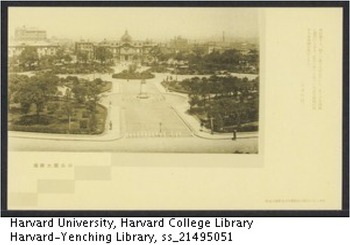
When Manchukuo (CH: Wei Manzhouguo; JP: Manchūkoku), the client state of Japan, was established in 1932 in Manchuria (nowadays Northeast China), Japanese urban planners in Manchukuo's central government embarked on the construction of a new capital with fervor. At the center of their landscape design for the aptly named Shinkyō (CH: Xinjing 新京, literally “New Capital”)Footnote 1 lay a huge rotary circle, called the Daidō hiroba 大同広場 (hereafter Hiroba). Daidō was the first era name of Manchukuo, and the Hiroba's title can be translated as the “Plaza of Great Unity.” It spanned an impressive 1,000 meters in its circumference, and served as the grand center of a collection of governmental buildings, including the Manchurian Central Bank, the Capital Police Bureau, and the Municipal Bureau, amongst others. Moreover, it provided a man-made green space in the center of the new city, where Japanese poplar trees and Chinese green willows were encircled by flowers and shrubs of local origins. Boulevards extended from the center of the Hiroba, running into six directions (Kurihara Reference Kurihara1982, p.90). The Manchukuo government also took the Hiroba as a geodetic datum for the whole of Manchukuo, further emphasizing it as the heart of the Manchukuo empire. It quickly became a national symbol of Manchukuo and of Japan's positive transformation of Northeast China.
In this article, by examining the visions of Japanese urban planners and other residents of Shinkyō, both Japanese and Chinese, I show that this monumental space of the Hiroba was a contested site where the top-down attempt to build a totalitarian state encountered challenges from both Chinese and Japanese subjects. The challenges of the official interpretation of the Hiroba and redefinitions of this plaza in their own terms by Chinese and Japanese residents and visitors present a richer picture of Japan's empire-building in Northeast China. Their redefinitions evinced a limited reception of Japan's attempt of building a total empire in Northeast China and instead advocated for individual freedom represented by a call for a modern cultured lifestyle. Further, such voices cannot be easily summarized in a binary framework of resistance versus domination or forced collaboration versus imperial hegemony. The Chinese residents' reactions to the Hiroba also originated from a local context that should not be simply dismissed as an expression of nationalism. My examination of the visions and understandings of the Hiroba by three groups – Japanese architects, Japanese visitors, and Chinese residents of Shinkyō – provide a more dynamic picture of Manchukuo society under Japan's hegemony, revealing complicated relations with the empire that cannot be boiled down to “oppositions, contrasts or antagonism”Footnote 2 (Fig. 1).
Daidō Hiroba 10 years ago and present (1942), Image cited from Naikaku jōhōbu (1989), Shashin shūhō. Tōkyō: Ōzorasha.

Existing scholarship on architecture and spatial transformation often focuses on how political regimes use monumental sites as expressions of power. In her study of political ceremonies in Republican China, Henrietta Harrison observes that “citizens who in the early Republic had made themselves visible through their participation in organizations and associations were now transformed into the ‘masses’ whose political will was utterly subordinate to the party” (Harrison Reference Harrison2000, p. 229). Plazas became sites where the Nationalist party expanded its influence among Chinese citizens. Political regimes also use such monumental spaces to nurture a sense of nationhood amongst their citizens. The function of such sites is analogous to how the visibility of the Meiji Emperor during public ceremonies and tours played an important role in facilitating the growth of nationalism in Japan (Fujitani Reference Fujitani1996, p. 15). Studies on such monumental spaces in Japan's empire also explore how Japanese imperial officials redefined existing public space and constructed new sites, such as Shintō shrines, with the ambition of transforming the colonized into imperial subjects (Henry Reference Henry2014, pp. 29–41). Louise Young, Koshizawa Akira, and Bill Sewell highlight that Japanese construction of the landscape of Shinkyō was an attempt to demonstrate the political power of Japan's empire, to realize utopian ideals that could not be fulfilled in Japan, and to create a vision of modernity in Asia that differed from European counterparts (Sewell Reference Sewell2019, pp. 87–88; Young Reference Young1998, p. 241).
To date, the research on Shinkyō's monumental space has largely focused on the designs of Japanese architects and bureaucrats, presenting a top-down vision of using such sites to transform societies and to perpetuate imperial governance over the subjects of the empire. As Lefebvre points out in his research, such actors, including “scientists, planners, urbanists, technocratic subdividers and social engineers,” only belonged to “a certain type of artist with a scientific bent – all of whom identify what is lived and what is perceived with what is conceived” (Lefebvre Reference Lefebvre1991, p. 38). Yet, the perception of users of a given space rarely conflates with the architects' conception of such space. The meaning of public space is not only shaped by the designers but also by its users. If we ignore the complexities of how users of any given space actually understood it, we see nothing but a portrait of its planners' ambitions and hear nothing but the centrality of state power. To follow only the visions of the imperial architects’ risks reproducing a monopoly over the local society that Japan's empire intended but never realized in historical research.
How people lived, experienced, and interpreted a political space, such as the Hiroba, is as important as the ideas behind its construction, especially for our understanding of the reality rather than the image of Japan's empire in Manchuria. Recent scholarship on Japan's urban transformation in its empire has introduced the theory of “contact zones” to understand how Japan's empire-building shaped or failed to shape the local society (Uchida Reference Uchida2011, pp. 15–16). Incorporating both the users and builders of such public space, as Todd Henry shows in his research, challenges the former understanding of public space as a physical extension of state power and shows how a variety of actors redefined such sites to challenge Japanese colonial rule (Henry Reference Henry2014, p. 12). In their discussions of Japanese imperialism in Korea, Henry and Uchida shed light on the importance of bringing in the users of public spaces (Lefebvre Reference Lefebvre1991, p. 56), illustrating that the way they lived in cities adds a new dimension to the operations and limitations of Japan's hegemony, as expressed through the construction of such spaces.
My study of the Daidō Hiroba also contributes to our current studies of Japan's empire-building in Northeast China in the Manchukuo era. Studies on Manchukuo, especially Japan's role in the Manchukuo era, have touched on many aspects, illustrating the political collaboration between Japanese and Chinese bureaucrats, the Japanese incorporation of Chinese ideals to enhance its hegemonic status, the involvement of Japanese architects and technical experts in the transformation of Manchuria's environment, and the suffering, resistance, or collaboration of non-Japanese subjects (e.g., Matsusaka Reference Matsusaka2001; Mitter Reference Mitter2000; O'dwyer Reference O'Dwyer2015; Park Reference Park2005; Wolff Reference Wolff1999; Young Reference Young1998). Rather than focusing on Japanese architects and the political intentions behind the erection of public spaces in Shinkyō, represented by the Hiroba, I bring their voices into dialogue with other Japanese and Chinese visitors and residents in Shinkyō, unveiling the unevenness in the reception of Japan's empire-building and challenging stereotypical depictions of imperial Japanese and national Chinese.
But the existence of complex reactions within each group should not lead us to conflate interpretation with authorship, or freedom of expression with the limitations of imperial subjecthood. Despite the vocal criticism voiced by Japanese travelers, or the re-interpretations by Chinese residents, none of these groups had enough power to transform the Hiroba according to their preference. They merely read it, applying critique or praise in efforts to integrate the Hiroba into their cognitive landscape. Ultimately, the Hiroba's physical space remained under the control of the Manchukuo government, and the participation of residents and travelers in producing social space remained limited to the discursive sphere.
A cross-examination of writings on the Daidō Hiroba in Chinese and Japanese sources, including newspapers, journal articles, visual materials, travelogues, and literature, presents a variety of responses toward Japan's top-down transformation of the urban landscape of Shinkyō. My bilingual and multidisciplinary archival approach illustrates the complicatedness within Manchukuo society that has not been fully explored before. Yet, the use of Chinese language materials does not guarantee an even recovery of the Chinese voices. Both Qilin and Datongbao, two prominent popular mass media in Shinkyō went through the official censorship of the Manchukuo government, making it hard for any anti-Japanese voices to be directly published.
The analysis below is in three parts: the first examines the emergence of the Hiroba, illustrating how Japanese urban planners in Shinkyō conceived of the construction of a huge plaza as the heart of the new empire. The second investigates challenges to the political significance of the Hiroba by three prominent Japanese visitors to Shinkyō: Hasegawa Nyozekan 長谷川如是閑 (1875–1969), Komatsu Hōzō 小松鳳三 (d.u.), and Haruyama Yukio 春山行夫 (1902–1994). The third discusses Chinese reactions to the Hiroba, which took two main trajectories. On the one hand, there was enthusiastic praise for the Japanese imperial project by Xian Ruiheng 線瑞亨 (d.u.), a journalist from Guangzhou, where a collaborationist regime had been established. On the other hand, Chinese residents in Shinkyō, from accounts published in local media outlets, embraced the Hiroba not as a political monument but as part of their newly discovered urban life in Shinkyō. Chinese residents accepted the existence of the Hiroba in part because they perceived it as belonging to and supplementing a “traditional” landscape with a Daoist tomb as its center. The discontent of Japanese visitors over Shinkyō's lack of cultural life co-existed with the approval of Chinese residents, who re-interpreted the Hiroba as part of a cultural landscape familiar to them.
The conceived space: the Hiroba as a political symbol
Soon after the establishment of Manchukuo, Japanese urban planners from three institutions undertook the task of building the new capital. The institutions directly related to the urban planning of Shinkyō were the Capital Construction Bureau (Kokuto kenchiku kyoku), the Mantetsu Economic Research Association (Mantetsu keizai chōsa kai),Footnote 3 and the Kwantung Army (Kantō gun). The latter two participated in the capital planning indirectly by sending representatives to the Capital Construction Council (Kokuto kenchiku shijun iinkai), a consulting organ within the Capital Construction Bureau. Four chief planners represented the interests of the above-mentioned institutions: Komibuchi Chō 小味淵肇 (1899–?), a staff member of Mantetsu; Sano Toshikata 佐野利器 (1880–1956), a professor of urban planning invited to Manchuria by the Kwantung Army; Mizoe Satsuki 溝江五月 (1894–?) and his superior Kondō Yasukichi 近藤安吉 (1887–?), both officials in the Manchukuo government.
The Hiroba was the first and most prominent site built in the new capital. Its main characteristic was its immensity, with an inner diameter of 200 meters and an outer span of 300 meters when it was completed in 1937 (Aiga Reference Aiga1944, p. 168). Its size and design, in many senses, reflected what Sano Toshikata believed to be the geographic characteristics of Manchukuo and Manchuria at large. Looking down from a height of around 1500 meters on his flight to Manchuria, Sano would later comment that Shinkyō was “really flat, without any forests or rivers,” and “covered with earth.” He was further taken by the size of Manchuria, which was almost twice that of Japan (Sano Reference Sano1933). For planners like Sano, a giant plaza several hundred meters wide echoed the vastness of both Manchukuo and its capital.
The Hiroba's design also mirrored that of the Dai Hiroba 大広場 in Dalian, previously named the Nicolas Circle while the city was under the Russian rule, after Tsar Nicholas II (Yang Reference Yang1933, p. 226). Carola Hein argues that Japanese urban planners, on visiting Dalian, confronted “earlier large-scale interventions by Russian planners, which feature especially a central round place” (Freestone Reference Freestone1998, p. 353). In size and style, the Hiroba resembled the Dai Hiroba. The latter was about 200 meters in diameter and its circular border hosted a series of governmental buildings, including the Dairen Civic Bureau (Dairen shiyakusho) and the Dairen Police Bureau (Dairen keisatsusho). Similarly, the Hiroba was enclosed by governmental buildings, including the First and Second Governmental Office of Manchukuo (Manshūkoku seifu dai ichi chōsha, dai ni chōsha), as well as financial institutions such as the Manchukuo Central Bank (Manshū chūō ginkō sōkō) (Kurihara Reference Kurihara1982, p. 90). Like the Dai Hiroba, the Hiroba also formed the nexus of the transportation system, from which main boulevards radiated out in all directions into the city (Fig. 2).
Dai Hiroba in Dalian. Kaigakenkyukai (1932), Dairen Hasshu [FFhan(B)]. Harvard-Yenching Library Manchukuo.

However, the Hiroba was more than a larger-scale replica of the Dai Hiroba. It represented a new trend of rotary plazas conceptualized as “civic centers,” a concept which developed and spread during the early twentieth century as part of the City Beautiful Movement of North America. This movement's activists defined civic centers as collections of architecture surrounding a rotary plaza and argued that such centers formed the core of any community, city, or town, which they believed would enable “public enjoyment of the beautiful features of the city.” Moreover, they contended that the enjoyment of those beauties together by more people would lead to the cultivation of extensive social morality. A civic center represented the presence of the state, lording over the town like “the government ought to do”; yet, through its physical architecture, the government “speaks not to the eye alone, nor to the head alone, nor to the heart alone; but unitedly, to senses, brain, and sentiment” (Wilson Reference Wilson1989, pp. 92–94).
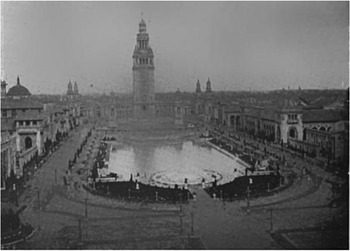
The first such civic center in North America was the Court of Honor in Chicago, built for the Colombian Exhibition in 1893. The Court consisted of “architecture and water, great buildings on a single scale grouped around a lagoon” coupled with “massive sculptural embellishments entirely subordinate to the main features.” Here, “the lagoon was flanked by the greatest buildings of the Fair, which with their differing architecture and varying size, including the huge Manufactures building and its dominating roof, nevertheless were constructed on a single scale and represented a marvelous harmony.” Although the Court was not ringed by governmental buildings, it was meant to demonstrate the strength of the United States, and to be “a model for the guidance of all cities” (Zuebin Reference Zuebin1903) (Fig. 3).
Court of Honor in World Fair in 1893, Image cited from Zuebin (Reference Zuebin1903), “‘The White City’ And After,” Chautauquan 38, December.

As enthusiastic observers of international architectural trends, this new style of “civic centers” captured the attention of Japanese planners in Manchuria. When building the capital, these planners sought to assert the spirit and the existence of the new Manchukuo state in Shinkyō's residents through constructing the Hiroba as a “civic center.” Doing so, the planners argued, could not only “highlight the elegance of the city” (Oka Reference Oka1932), but also “demonstrate the spirit of nation-founding” (Yumoto Reference Yumoto1932, p. 6), thereby putting Shinkyō on par with famous cities like New York and Washington D.C. (Nakazawa Reference Nakazawa1932, p. 33). Moreover, green space in the Hiroba would create a hybrid landscape that embedded man-made elements with the beauty of the natural world. This aesthetic pursuit, first elaborated by Howard in Britain through his writing on the concept of “garden cities,” was later borrowed by Japanese architects, who translated it into their language as “den'en toshi” (Howard, 2003).
On the Hiroba's completion, it was made into a demonstrative and disciplinary space to project Manchukuo's strength to domestic and foreign audiences. It frequently featured in Japan-sponsored English magazines such as Hsinking and Shashin shūhō (Manshūteikoku seifu 1937; Naikaku jōhōbu 1989), which prominently displayed the evolution of its appearance from a vast, bare plain to a well-designed green space surrounded by impressive official architectures, highlighting Japan's role in the splendid development of Manchukuo. Other than publishing images of the Hiroba to represent Shinkyō's magnificent transformation, Manchukuo politicians and their Japanese supporters held numerous events on the site to celebrate the progress of the new nation. In a 1935 documentary, The New Manchuria, a Paradise (Rakudo shin Manshū), shot by the Manchukuo Film Association, the Hiroba was seen hosting a group of foreigners.Footnote 4 Similarly, in 1942, on the 10th anniversary of Manchukuo's founding, a grand ceremony was also held in the Hiroba to “display the reality of Manchukuo to the foreign nations” (Kokubu et al. Reference Kokubu1979).
Moreover, the Hiroba was also intended to be a disciplinary space. At its center stood a structure named the “The Tower of Following the Way of the Heaven and Pacifying the People” (Junten anmin tō 順天安民塔). Adopting the Confucian concept of “junten anmin,” and encouraging Manchukuo residents to participate in political ceremonies held in the Hiroba, the state made implicit attempts to re-make local residents into Manchukuo subjects. Rather than emphasizing the political rights of individuals, the presence of the tower and the Hiroba defined people as a collective, subject to the protection and the agendas of the new Manchukuo state.
Japanese architects and officials envisioned the Hiroba as a space of governmentality and disciplinary control, intending to transform Manchukuo residents into loyal nationals and imperial subjects through the transformation of the urban landscape of Shinkyō. Either as a “civic center” or a monumental symbolic place, the Hiroba was built to serve the purpose of Japan's empire-building in Manchuria as a site to host political gatherings and to advocate the strength of Japanese hegemony. Moreover, through the construction of this giant Hiroba in the center of Shinkyō, Japanese architects also aspired to erect a modern landscape for international audience, demonstrating Japan as a modern empire that was both capable and powerful to shoulder the task of civilizing Northeast China.
Perceived space: Hiroba's meanings to others
Japanese perceptions of the Hiroba: a hindrance to individual freedom
Every Japanese visitor had their own impression of Shinkyō. Japanese bureaucrats who rushed to Manchuria for new job opportunities in the Manchukuo government found it promising and comfortable, such that, in 1934, 10.5 percent of all the bureaucrats in Shinkyō, who numbered a total of about 269 people, were Japanese (a figure which included Koreans) (Chōsen oyobi Manshū sha 1934, p. 92). As one of them commented, the “immigration of bureaucrats was a real success” (Kanda Reference Kanda1936, p. 84). These Japanese bureaucrats found living in Manchuria comfortable because of their relatively high salary, as they received their salary in Manchurian silver, but purchased goods at prices set to Japan's gold standard (e.g., Gottschang Reference Gottschang2004; Okabe Reference Okabe2007; Yu Reference Yu2002, pp. 250–54). As the relative value of Manchukuo silver against Japanese gold rose from 2:1 to 1:1 in 1932, with the same amount of salary, Japanese bureaucrats in Manchukuo doubled their purchasing power compared to their counterparts in the home islands (Tokio Reference Tokio1933, p. 103).
This newfound wealth contributed to Japanese bureaucrats' perception of Shinkyō as a city rich in potential, and they sang lavish praise of this new capital. Even though its wintry environment caused one to be “chilled to the bones” (Cha Reference Cha1933, p. 43), Shinkyō still impressed them with its burgeoning vitality. These bureaucrats experienced a city “enveloped by an atmosphere of construction – an atmosphere of liveliness, newness, and active spirit,” built with “modern and new” architecture, and equipped with facilities, such as “channels and thoroughfares” that were also “built grandly” (Saitō Reference Saitō1934, 192–93). They described Shinkyō's atmosphere as one that “only a new city had,” and predicted its growth as “one of the newest and grandest metropolises” (Matsui Reference Matsui1934, 90–91). In their view, the road connecting the Hiroba, called the Street of Great Unity (Daidō daigai) became a symbol of modern aesthetic beauty, with “such a strong will, going south in a straight line, dispersing any disturbances, forcefully and intently…it [had] the special beauty of a modern city” (Mochizuki Reference Mochizuki1941, p. 189).
In contrast to praises in the foregoing vein, many other Japanese visitors found that the persistence of construction in Shinkyō, especially around the Hiroba, made the city undesirable and short on liveliness. From various angles, these critics described Shinkyō's landscape as announcing the dominance of totalitarianism, state power, an infringement on individual rights, and a hindrance to the enjoyment of a desirable lifestyle. Hasegawa Nyozekan, one such detractor, observed that the Hiroba's construction deprived Shinkyō of necessary residential quarters. Hasegawa was a famous social critic and a journalist of repute in Shōwa Japan (1926–1989). Educated in private schools and Chūō University, he had spent most of his adolescence and adulthood in Tokyo. This brought him under the influence of the social movements that swept Japan, leading him to denounce the status quo and the nation-state from the perspectives of anti-metaphysics and Anglo-Saxon empiricism (Barshay Reference Barshay1988, p. 128). Specifically, he valued the experiences of individual human beings and questioned the purposes of national construction projects. He saw newly constructed spaces like the Hiroba as embodying national power and political discipline, which effectively deprived individuals of their rights to pursue a modern and cultured lifestyle (Hasegawa Reference Hasegawa1935).
However, the dwelling areas that gradually appeared in Shinkyō, as some people commented, resembled worker's districts in Britain. Indeed, [Shinkyō] could not avoid giving the sense that it had been insufficiently magnanimous in utilizing the vast nature of its endowment. [Urban planners] devoted their energy to building the giant architecture in the center, and lacked interest in the dwelling areas, which represented the life of residents. This cannot be described as modern urban planning. In the new urban planning, the dwelling areas are sites that take shape at the intersection of the urban culture and its neighboring natural environment. In their ideal form, they could be used as a substitute for a park. For the sake of the spirits of the city residents and the soundness of their bodies, the builders of Shinkyō should not forget the necessity to bring out the special [quality of the] landscape in this part of the city.
Rather than devoting attention to the Hiroba as the symbolic center of the city, Hasegawa directed his readers to the lackluster state of the residential areas in Shinkyō. The latter, Hasegawa argued, should be the central focus of any urban planning, for the purpose of a city was not to demonstrate political power but to facilitate and accommodate the lifestyle of its residents. To him, Shinkyō's urban planning presented a landscape of asymmetrical planning, where the narrow bleakness of its dwelling areas stood in the shadow of the grand Hiroba. Instead, Hasegawa advocated incorporating the “garden city” ideal into the construction of Shinkyō's residential zones (Hasegawa Reference Hasegawa1935). “Garden cities” emphasized the organic combination of natural sceneries and the built environment, aiming to create residential zones which offered their residents both psychological and physical rest.
Komatsu Hōzō, a Japanese journalist, also shared Hasegawa's criticism of how Shinkyō's urban construction over-emphasized the city's symbolic space and ignored the needs of its residents' everyday lives. In an op-ed published in Chōsen oyobi Manshū, a journal based in Keijō, Korea, Komatsu depicted central buildings, including the Hiroba, as symbols of totalitarianism and of governmental discipline. He read Shinkyō as a text of myriad symbols: the miniature plaza in front of the Shinkyō train station represented the dominance of Mantetsu and of the Manchukuo government, while the bombers and fighters that scarred above the plaza displayed the omnipresence of the Japanese army. Against these symbols of power, the ordinary people, like those who pulled horse carts around the plaza, appeared small before the giant plaza and what Komatsu deemed “unnecessarily” wide boulevards. Their diminishment, in his view, spoke to how little their everyday concerns and necessities had factored into Shinkyō's urban planning. Living in such a city, the majority ended up being “mindless and possessed with a narrow world view, centering on the acquisition of even a small amount of money.” It was hard for a visitor or migrant to live in Shinkyō, Komatsu lamented. Despite the progress of massive construction projects, few public works took the needs of individuals into account, while residential areas in Shinkyō remained limited and expensive. Compared to Dalian, Fengtian, Keijō, and even Tokyo, rental prices in Shinkyō were startlingly high. In Dalian, where Mantetsu's headquarter used to be, the rent for every tatami-wide unit of space was 1 yen 40 sen, while in Fengtian, a booming Chinese city, it was 1 yen 60 sen. In Shinkyō, however, rent was as high as 2 yen 70 sen, about 30 sen more than in Tokyo, and three or four times more expensive than Keijō. Besides the prohibitive price, the condition of most housing in Shinkyō was far from comfortable (Komatsu Reference Komatsu1934, pp. 66–67).
Given Komatsu's criticism of the urban landscape in front of the Shinkyō station created by this plaza, it seems likely that he would also have disapproved of constructing the Hiroba, given its size and its disregard of local lifestyles, and that he would have similarly regarded it as a symbol of totalitarianism (Komatsu Reference Komatsu1934, pp. 66–67). Unlike Japanese urban planners, who emphasized the significance of state power and Shinkyō's international status as a city on par with European and American capitals, Hasegawa and Komatsu considered cities as places where residents' interests took center stage in planning. They criticized the emphasis on Shinkyō's political meaning, which the Manchukuo government aspired to express through urban construction, advocating instead the creation of a city that represented residents' voices and met their needs.
Haruyama Yukio, when visiting Manchuria in 1939 as a member of the “Japanese Journalists’ Investigation Team to Manchukuo” (Haruyama Reference Haruyama1941), echoed Hasegawa and Komatsu in his critique of monumental construction embodied in the Hiroba, which he called “the Arc d'Harmonie of Shinkyō,” for it represented the harmonious relationships amongst all residents of Manchukuo (Haruyama Reference Haruyama1941, p. 55). Haruyama saw the Hiroba as a physical expression of the Manchukuo government's political ideals, especially that of “harmony among the five groups” (gozoku kyōwa), for the Hiroba allowed people of different ethnicities to gather as imperial subjects of Manchukuo. However, such impressive plazas did not save Haruyama from deep disappointment with Shinkyō. He found the new capital bereft of facilities to maintain and promote a cultured lifestyle. It lacked places offering nocturnal entertainments, or facilities such as “big theaters, restaurants, or public buildings.” He further bemoaned the absence of bookstores in Shinkyō, or sites to access the stimulation of foreign newspapers, magazines, or books. In short, Haruyama was disillusioned with this new capital, which he found “lacking in attractiveness” and “culturally desolate” (Haruyama Reference Haruyama1941, p. 56). He described urban space in Shinkyō as dominated by “spiritualism” (seishin shugi), finding it “abstracted from some ideology” and consequently “over[looking] the aspect of humanity.” Whatever culture was represented in Shinkyō's urban space, whether its own or that of the Manchukuo state, Haruyama argued that it had no roots in the everyday lives of its residents (Haruyama Reference Haruyama1941, pp. 58–60).
If I write in this way, it appears that my stance possibily misses the point of how Shinkyō is to be viewed. It is because Shinkyō is not attached with any modern, cultured lifestyle; rather, in Shinkyō, a spiritualism – which seems to deny the modern, cultured life – somehow flows [around]. Besides, this spiritualism, if anything, has but one form, which differs from [that of] our modern cultured life. But, in itself, it does not inhere in a specific type of atmosphere or life environment. It is abstracted from some ideology and appears to have overlooked the aspect of humanity. Dimly, this was what I felt.
But for people like me, who already possess a well-formed concept of culture or living environment… [Shinkyō] makes me realize that my feeling this way is heretical. This feeling [of being a heretic] is such that I consciously blame myself in a harsh manner.
Haruyama, along with Hasegawa and Komatsu, found Shinkyō's urban space suffocating; he saw himself and like-minded critics as “heretics” in an empire expanding its territorial reach and political power, with little concern for individual pursuits. Indeed, when visiting Shinkyō, many Japanese visitors and recent settlers avoided the Hiroba and sought for activities that could provide them with entertainment. Inoue Tomoichirō 井上友一郎 (1909–1997) spent most of his time during his short visit to the city patronizing bars, cafes, department stores, and parks. There, he sought out exotic experiences, such as encounters with Russian hostesses, and purchased goods with a reduced rate of consumption tax (Inoue Reference Inoue1941, pp. 216, 220, 231, 235, 239). The same applied to Mochizuki Yuriko 望月百合子 (1900–2001), a recent arrival to Shinkyō whose diaries brimmed with records of mundane affairs, such as shopping in alleyways populated with Chinese stores, which gave better prices than their high-end Japanese counterparts. When taking breaks, she preferred to visit some of the newly constructed parks (Mochizuki Reference Mochizuki1941, pp. 190–93). The Hiroba, in these records, seemed to remain separate from the daily lives of even Shinkyō's Japanese residents.
Although travel pamphlets and agencies spotlighted the Hiroba as a must-see for visitors to Shinkyō, the plaza played little part in the everyday lives of Shinkyō's common residents and visitors. While Hasegawa, Komatsu, and Haruyama, when visiting Shinkyō, affirmed the Hiroba effectively representing the political authority and disciplinary power of the new Manchukuo state, they did not find it attractive. Instead, they considered the construction of national symbolic space as contrary to individuals' rights and pursuits. The Hiroba's monumental space, they felt, deprived Shinkyō's residents' capacity to enjoy life in this new capital. A contemporary Japanese scholar, Nishizawa Yasuhiko, when visiting Changchun (previous Shinkyō) recently, points out that the Hiroba's sheer size also makes individuals appear insignificant and intimidates those who encounter it (Nishizawa Reference Nishizawa2006, p. 115).
These Japanese critiques of the Hiroba illustrate a challenge to the totalitarian vision of Japan's empire-building. Despite Japanese architects' intention to transform individuals into imperial subjects via on-site activities and through the visibility of the Hiroba, Japanese visitors, especially intellectuals, did not embrace this imperial agenda of building a total empire that subjected all individuals into subjects. They voiced an indirect critique of Japan's empire through criticism over the construction of the giant Hiroba, pointing out how the Hiroba encroached on individual freedom and deprived the residents – who should be the real owners of Shinkyō – of a chance to enjoy a cultured lifestyle. Their voices show that even in the height of Japan's hegemony in East Asia, the imperial government was not all mighty but faced disapproval from its citizens.
Chinese interpretations of the Hiroba: praise, rejection, and reinterpretation
Symbols of the nation
In contrast to visitors from Japan, some Chinese guests raved about the newness of Shinkyō's urban vista, centered on the Hiroba. Xian Ruiheng, a journalist with the Mingsheng Post (Minsheng ribao she 民聲日報社) in Guangzhou, traveled to Shinkyō in 1942 to participate in the Press Congress of East Asian Journalists (Dongya caoguzhe dahui).Footnote 5 In his travelogue, From Guangzhou to Manzhou (Cong Guangzhou dao Manzhou) (Xian Reference Xian1943, preface), he depicted the Hiroba as welcoming and charming, opining that it displayed Manchukuo's new status as a nation-state while providing a green urban space that liberated Shinkyō from sand, mud, and chaos (Xian Reference Xian1943, p. 63).
The magnificent Hiroba – In this century, many nations have grand plazas, such as the Berlin Plaza in Germany and the Red Square in Moscow in Russia. Every time the nation has a celebration, it is held in the plaza. As Manchuria is a new nation, when it was established, plans to construct the Hiroba were drawn up. The Shinkyō of a decade ago, especially [the site of] the Hiroba… merely presented the particularities of the [environment] in the north [of China] – sand – [the whole place was] all yellow. When the wind comes, sand flies and dirt rises up; when it rains, all the streets turn muddy. The perfect description for this area [requires using] vernacular language: “Three inches of dirt even with no wind, streets of mud when it rains.” The sand in the north, spreading everywhere, is too much for one's enjoyment. But today, ten years [later], the landscape has totally changed. [The Hiroba] consists of two big circular roads made of sand and earth. Six roads open into it. The rest [of the surrounding area] is decorated with green grass, low bushes. and flowers. Its size is immense, and it is orderly. It stretches as far as the eye can see. It can host more than one hundred thousand people.
Xian's enthusiasm toward the Hiroba originated from his political support for both Manchukuo as a new regime and Japan's hegemony in Asia. As a journalist, he had been dispatched by the Wang Jingwei regime, a pro-Japanese government located in Nanjing from 1940 to 1944, to work in Guangzhou while the province was under Japanese military occupation. In 1941, with Japan's support, key figures in the Wang regime established the Chinese Association of East Asian League (Dongya lianmeng quanguo zonghui) in Nanjing to systemically promote collaboration with Japan in political, economic, military, and cultural arenas. The Press Congress of East Asian Journalists held in Shinkyō in 1942 was one amongst many cultural exchange activities that promoted Pan-Asianism and the East Asian League. According to Chinese historian Shi Yuanhua, the Wang regime's cooperation with the Japanese military to promote Pan-Asianism provided Wang with a means to consolidate his own party's rule over China, and to nurture Chinese’ loyalty toward his political party (Shi Reference Shi1984). Xian's advocacy of the Hiroba thus represented his regime's political support for Manchukuo as a new nation state, and by extension, for Japan's hegemony in China.
Xian's praise of the Hiroba did not just aim to please the Wang regime and Japanese imperial agents in China. It further reflected a trend in China proper for building plazas as new political centers. Around the time Japanese architects designed the Hiroba in Shinkyō, Republican Chinese government in Nanjing also embarked on building plazas (guangchang 廣場) in Nanjing. In November 1931, the center of Nanjing saw the erection of a plaza, the Xingzhong Guangchang 興中廣場, with an inner and outer circle similar to the Daidō Hiroba in Shinkyō. Not long after it, in August 1932, the Nanjing government erected another plaza, the Yijiangmen Guangchang 挹江門廣場, along the North Zhongshan Road (Nanjing zhengfu 1933). Both plazas in Nanjing became attention-grabbing landmarks and sites of numerous political gatherings (Zhongyang guangbo wuxian diantai guanlichu chuban 1936, 53).
The Nationalist Party used plazas in cities as new centers to organize political demonstrations that intended to display the strength of its party, to redefine citizens into political masses, and to perpetuate its “unifying vision of society” (Harrison Reference Harrison2000, pp. 227–29). In 1925, for instance, the Nationalists in Beijing organized various groups, including students, merchants, and labor unions, into an elaborate demonstration held on Tiananmen Square that voiced support for anti-Japanese demonstrations in Shanghai after the so-called May Thirtieth Affair, when Chinese residents in Shanghai started protesting against the Japanese illegal and cruel treatment of Chinese workers in their spinning factories (Strand Reference Strand1985, p. 6). During this demonstration, the Nationalists positioned themselves at the center of the plaza, with other organizations surrounding them. In Nanjing, political rallies were organized in the newly built plazas mentioned above, including one held in October 1937, when people gathered to celebrate the anniversary of Sun Yat-sen's birthday in Xinjiekou Plaza 新街口廣場 in Nanjing (Zhongguo wenyi she 1937). Another rally of note occurred in November 1937, when the Nationalists organized a gathering in the same plaza in Nanjing to condemn Japan's incursions on Chinese sovereignty (Xuezhan huabao she 1937, p. 17). Under the Japanese occupation, the temporary government in Nanjing (Zhonghua minguo weixin zhengfu) erected an anniversary tower on the Xingzhong plaza to commemorate the one-year anniversary of its rule, as a self-declaration of its own legitimacy (Zhou Reference Zhou2016). Xian Ruiheng, when visiting the Hiroba in Shinkyō, would have found the political message embedded in this urban vista familiar, as most plazas in China proper had been made into centers of political mobilization for a party or a new regime.
Xian's appraisal of the Daidō Hiroba, as this article shows, cannot simply be understood as a collaborative gesture toward Japan's hegemonic status in Manchukuo. Xian's enthusiastic appreciation of Shinkyō's Hiroba, on the one hand, bespoke his political support for Japan's empire-building in Manchuria as well as for Wang's collaboration with Japanese imperialism. On the other hand, the political use of plazas like the Hiroba in Shinkyō had already grown as a common practice in China proper where Xian came from. Not differing from the Nationalist's hosts of various political gatherings and ceremonies on plazas, Japanese architects and officials' use of the Hiroba did not surprise Xian. Xian's reaction toward the Hiroba shows that some Chinese also perceived the Hiroba as a site of governmentality and discipline as Japanese architects did, illustrating a parallel process of nation-building that took place in both China proper and Northeast China under Japan's control.
Green island
Compared to residents in China proper who were accustomed with using plazas as sites for political gatherings, Chinese residents in Shinkyō appeared to be less familiar with the idea of considering plazas as political sites. The Manchukuo government had organized a variety of political gatherings across several plazas, such as the celebration of the 2600th birthday of Emperor Jinmu in 1940, and the tenth anniversary of Manchukuo's foundation in 1942 (Kokubu et al. Reference Kokubu1979, p. 110). Some of these celebrations took place in multiple sites across Shinkyō. During one such occasion in 1934, a parade traveled from the Shinkyō station, stopped for a ceremony at the Daidō Hiroba, and visited all major streets in both Chinese and Japanese residential areas within the city (Datong baoshe 1934a).
Despite the frequency of political gatherings held in Shinkyō's plazas, almost no Chinese reporters commented on such events. Writing about the national holiday on May 2, 1942, in the popular magazine, Qilin 麒麟, Tian Sizong 田似琮 (d.u.) and his colleagues described the Hiroba as being “silent and quiet as a dream” (Tian Reference Tian1942, p. 106). The only people who appeared to be celebrating were business owners, schoolchildren, and some other Japanese residents. Insurance companies put up advertisements with the Manchukuo flag celebrating the anniversary, and most of the pedestrians seen along the Daidō Avenue were Japanese women wearing kimonos of bright colors that were decorated with gauze scarves and giant flowers. Some Japanese sang songs that praised the friendship between Japan and Manchukuo; while schoolchildren held Manchukuo flags (Li Reference Li1942, pp. 105–106). No Chinese were mentioned in these depictions.
Chinese residents' disinterest in political activities spoke of a general aversion to politics, or silent resistance toward the propaganda of the Manchukuo government. For some of them, the Hiroba was a reminder of their lost land, forced relocation, and lack of access to economic gain. When the site of the Hiroba had been designated for the plaza, Chinese residents there had been relocated with limited compensation, if any (Kōtsūbu 1941, pp. 115–16; Yang Reference Yang2000, p. 163). These residents, especially the less well-off ones, could only afford relocating to less convenient sites that lay between the lowland near the Yitong River, which often flooded in the summer,Footnote 6 or a chaotic and dangerous site that was in the north part of Shinkyō.Footnote 7 These dispossessed, pushed out of their homes for a Japanese project would surely have found it hard to appreciate the Hiroba's attractiveness, or to participate in political activities held on its ground.
Former residents were not the only group who suffered from the building of the Hiroba. The plaza was located on a well-situated site close to major transportation systems such as the railway, and its flat topography made it ideal for agricultural activities or industrial development. For Chinese merchants and residents who had lived on or intended to use this land to build homes, farm, or trade, the erection of the Hiroba shattered their dreams. Meiniang 梅娘 (1920–2013), a famous female Chinese writer of the Manchukuo era, vividly depicted the heartbreak suffered by her father on being denied a rental site in Shinkyō for his business. One imagines there were many other Chinese who had similar experiences because of being denied the use of the land where the Hiroba was located. (Meiniang 1997).
Although Chinese residents in Shinkyō showed little enthusiasm toward political gatherings on the plaza, they appreciated the green vista it provided, and enjoyed the plaza in their own way. Hu Yingwei 胡英偉 (d.u.), a reporter for the Datong Newspaper (Datong bao), expressed his enjoyment of the verdant and beautifully lit natural scenery that the plaza brought to Shinkyō as follows (Hu Reference Hu1934).
The next morning, in the dark and narrow room, I could not perceive the light [inside of my room]…. I woke up, quickly heading to my kitchen. After breakfast, I wandered back to the Datong guangchang [the Hiroba]. It was Sunday, and I felt happier than ever. At that time, the morning sun gradually arose from the east, casting golden lights all over. Trees in the neighborhood were like a green curtain, spreading all around. Cooking smoke rose up like strands of thread in the morning [air]. … Willows along the brook were so bright as to dazzle. They had already donned a dancing dress of greenery, weaving in the warm, gentle wind. How pretty it was! Sparrows kept singing with their sweet and agreeable voices. Casting [my sight] ahead, lands joined together in a light greenness with no boundary. Fragrant air from afar blew my way. Under the broad sky, violet touracos shuttled back and forth in ceaseless flights. Such a beautiful vista of nature, which I could never get tired of!…After seeing this spring scene, the feeling rose in my heart that I should not waist time…. “I should study constantly, making 120 percent efforts!” Declaring this, I returned home.
Hu found a haven of peace and beauty during his visit to the Hiroba, which he identified less as a political site and more as a resting place that liberated him from the narrow darkness of his residence's interior. The plaza's immense size allowed him a view of the distant horizon, and its openness wrapped him in a mixture of domestic and natural sensations: cooking smoke, fresh air, birdsong, and greenery. All these brought refreshment, and imbued Hu with energy to continue his labors. He was not the only one searching for nature in the newly built capital. Tian Sicong of Qilin also found the Hiroba's greenery noteworthy, commenting that the “most noticeable figures on the Hiroba are its flowers” (Tian Reference Tian1942, p. 106).
The emphasis these Chinese intellectuals placed on the Hiroba's verdant and scenic beauty reflected their nostalgia for rural scenery, shared by many recent immigrants who had come to cities in Manchukuo from the countryside. In the novella Iron Cage (Tie jian 鐵檻), a Chinese writer called Xiaosong 小松 (d.u.) depicted how a pair of lovers – “Tiger” (Huzi) and “Little Yun” (Xiaoyun) – ensnared by the new capital. The city trapped them in a chain of tragedies, turning Tiger from a promising merchant into a peddler, and his lover from a waitress into a prostitute. In Xiaosong's story, the lovers' urban existence deprived them of a decent lifestyle and removed them from nature, confining them to a dark, dirty, and crowded corner of the capital (Xiaosong 1940).
Xiaoyun and Huzi, as Xiaosong pointed out, were exemplary cases of the “predetermined fate faced by many other uneducated rural youths who left their villages for the expanding cities” (Xiaosong 2017, p. 328). Via his novella, Xiaosong detailed how cities severed their new immigrants from the beauty of the country. For those Chinese intellectuals and new immigrants who suffered from nostalgia for the scenery of their rural homes, the green nature of the Hiroba offered them a temporary home. For some authors, such as Xiaohong 萧红 (1911–1942), praising nature and dismissing urban lives also implied a rejection of Japanese imperialism. Under the slogan of “returning to the countryside” (e.g., Okada, Reference Okada2000), such authors argued that only in rural Manchuria could one rediscover a Chinese lifestyle and resist Japanese influence. The verdant scenery of the Hiroba may have rekindled their passion for finding a Chinese path through the rich nature in the countryside (Xiaosong 2017, p. 327).
Aside from intellectuals, the Hiroba's function as an oasis in the hectic city drew other Chinese residents, including day laborers. Before the construction of plazas in Shinkyō, Chinese residents in urban areas had not regarded visiting plazas or parks as entertainment, choosing to spend the bulk of their time and money on “useless chatting over tea,” “eating in restaurants,” or “visiting brothels and smoking,” while wandering in parks had once been considered “the most boring activity” (Mei Reference Mei1934). However, with the completion of multiple plazas and parks in Shinkyō, more Chinese found in them places of rest. On May 6, 1940, about 13,675 Chinese visited the Kodama Park, including manual laborers. The Chinese who visited numbered more than half of the Japanese who went there on the same day (Koshizawa Reference Koshizawa2002, p.213). After finishing their work, these laborers came to the park and lay down on the grass or on a bench with satisfaction, where they lit their pipes and enjoyed a rest despite their poverty. Small children with no clothes on also ran around in the park like (naked and unruly) birds (Mochizuki Reference Mochizuki1941, p. 191), further showing how the green islands in the city became man-made natural environments enjoyed by many Chinese of different social statuses for various reasons.
Against the expectation of Japanese architects and officials, Chinese residents of Shinkyō accepted the Hiroba as a relaxing green vista yet silently rejected the political use of this site. Instead of participating in political gatherings held with the Hiroba as the center, most Chinese residents preferred to enjoy the site in their own way, either using it as a green park or an exit from the busy urban life. This appreciation of the greenery of the Hiroba may also represent an indirect challenge of Japanese hegemony, for many Chinese literati considered the countryside as an origin of Chinese nationalism and a potential base to expel Japan from Manchuria. Between the lines of their enjoyment of the plaza lay a potentially strong resistance to Japan's control of Manchuria.
Peripherizing the Hiroba
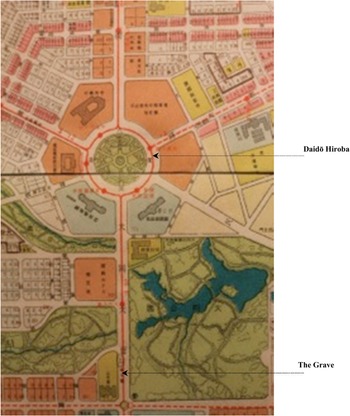
Chinese accounts of the Hiroba redefined the status and meaning of the site, toning down its political dimensions while integrating it into their own mental topography of Shinkyō, which took a famous grave called the “Grave of Filial Son” (CH: Xiaozifen 孝子坟; hereafter, the Grave) as its core. Compared to the quiet Hiroba, the Grave never lacked visitors, whose ranks included crowds of beggars waiting to beseech the better-off (Tian Reference Tian1942). From the Grave's high platform, one could see the broad Daidō Avenue and the greenness of the Hiroba at a distance about several hundred meters. The Hiroba was peripherized in the urban landscape centered on the Grave, showing that Japanese imperial actors, especially urban planners, could not claim an omnipotent existence even in the center of their newly built capital (Fig. 4).
The distance between the Grave and Daidō Hiroba. Map annotated by the author based on Shinkyō sha (1934), Saishin dai shinkyō (genzai to keikaku) meisai zenzu, Colour, 95 × 64 cm. Tokyo: Shinkyō sha, November, National Diet Library.

The Grave had long existed in Shinkyō and had been turned into a quasi-religious site by local Chinese residents. Originally, it had been the burial ground of a filial son who had died after taking care of his mother, but by the late Qing era it had acquired a gathering of believers as well as Daoist priests, who invoked the spirit of the filial son as a miracle cure for disease. All manner of Chinese people, from common residents to high officials in the Manchukuo government, constantly visited the Grave in seek of blessings or protection. When urban planners in the Bureau of Capital Construction sought to remove this Grave in order to pave a straight boulevard in the city center, local intellectuals petitioned to preserve it. They argued that the Grave represented local residents' core belief in filial piety and could help promote Japanese imperial rule amongst the Chinese community (Datong baoshe 1934b).
The Manchukuo government also attempted to use the Grave as a site of political propagandas. It orchestrated a display of amity between Japan and China by hanging up scrolls that proclaimed “The friendship between Japan and Manchukuo” (Nichi Man shinzen) and “One heart, one spirit” (dōshin dōtoku) (Jiao Reference Jiao1988, pp. 307–308). Yet many Chinese visitors, even bureaucrats in the Manchukuo government, paid such slogans little heed, instead visiting the Grave to pray for good fortune, to seek medical cure (Jiao Reference Jiao1988, 300–301), or to admire the view of the Hiroba's green vista it offered. By adopting a discourse acceptable to the Manchukuo government, which asserted the importance of filial piety and the way of enlightened rule, Chinese literati in Shinkyō successfully preserved it on their own terms. The Grave, rather than the Hiroba, embodied the sentiments of Shinkyō's Chinese residents. In the local cosmos, the Hiroba and the political power behind it remained peripheral. By decentralizing the Hiroba, Chinese residents of Shinkyō also indirectly challenged the official attempt to transform them into imperial subjects. Their appreciation of the Hiroba did not follow the official script drafted by Japanese architects and officials but re-wove the Hiroba as an ornament in their own everyday living space. The monumental space did not perpetuate the imperial officials' attempt to build a total empire but became localized as a site in the residents' daily life.
Conclusion
This examination of different voices and interpretations of the representative monumental space in Shinkyō, the Daidō Hiroba, unveils the limitedness of Japan's control over Manchukuo society and offers a view of the vitality, dynamics, and complicatedness of the responses toward Japan's empire-building in Northeast China.
For Japanese urban planners, constructing a plaza on the Hiroba's scale in the heart of Manchukuo, Japan's new client state, constituted a milestone. As Louise Young and Koshizawa Akira point out, these urban planners viewed Manchuria as a chance to achieve their goal of building a utopia, unobstructed by short-sighted detractors or rigid systems of property ownership and bureaucracy (e.g., Koshizawa Reference Koshizawa2002; Young Reference Young1998). To them, the Hiroba, from the perspective of the urban planners, was a political center that declared the domination of the new state over its subjects and Japan's hegemonic existence as a rising empire.
Yet, as the foregoing discussion has shown, this imperial definition of the urban space did not resonate with all its residents. Some of the Japanese visitors argued that the urban space should resist being defined by state power, as it ideally belonged to its residents and accommodated their individual needs for a modern lifestyle that embraced consumption and cultural entertainment. Such critics, represented by Hasegawa Nyozekan, Komatsu Hōzō, and Haruyama Yukio, disparaged the Hiroba as a representation of Japan's totalitarian power, called for the cultural enrichment of Shinkyō's residents' lives, and held that the construction of buildings like the Hiroba deprived cities of their meanings for their residents. These critiques revealed the heterogeneity of Japanese society in Manchukuo, showing tensions within this effective ruling class.
Chinese responses toward the new urban space were similarly diverse. Some, like Xian Ruiheng, embraced the Hiroba as a political site to build a national Manchukuo identity. Many others, especially local residents, treated the Hiroba as a scenic park whose affluent greenness liberated them from the greyness of urban life. Their refusal of the Hiroba's political remit both resisted the Japanese occupiers and reflected their own worldview. The proximity of the Hiroba to the Grave situated the former as a complement to their conception of the local urban cosmos, where the Grave was a key spiritual center, and the Hiroba a peripheral ornament.
These responses demonstrate that an intrusive state's wielding of power alienated rather than subjugated its targets. People under imperial rule, like Japanese subjects in the 1930s and 1940s, strove to preserve their individual lifestyles, sought personal freedom, and continued their traditional practices. Local attitudes toward the Hiroba, whether Japanese or Chinese, local dweller or visitor, indicated that empire is no homogenous entity, but one riddled with divergences and disparate temporalities. Finally, to the degree that some Japanese and Chinese actors shared common ground, the uncritical use of a national framework in historical research also creates blind spots in our understanding of Japan's empire.