INTRODUCTION
Of the 14 species of whiptail stingrays (Chondrichthyes: Dasyatidae) known to frequent the temperate coastal waters of southern African, the blue stingray, Dasyatis chrysonota is perhaps the most common (Compagno, Reference Compagno1999). The species is distributed from St Lucia on the east coast of South Africa to central Angola (Cowley & Compagno, Reference Cowley and Compagno1993) and occurs from the surf zone down to about 110 m deep. The species is easily recognized from other southern African stingrays by the irregular pale blue blotches and lines on its golden-brown triangular disc (Compagno et al., Reference Compagno, Ebert and Smale1989).
Dasyatis chrysonota was previously considered synonymous with the eastern North Atlantic D. pastinaca. However, a taxonomic re-evaluation by Cowley & Compagno (Reference Cowley and Compagno1993) concluded that Smith (Reference Smith1828) in a little known, and forgotten, description had named a new stingray from South Africa, D. chrysonota. The name D. marmorata also appears in literature accounts for South African stingrays, although this West African species does not appear to be the same.
Although batoid fish, in general, have been poorly studied in southern African waters, aspects of the biology of D. chrysonota have been investigated. Cowley (Reference Cowley1997) reported on its age and growth, while Ebert & Cowley (Reference Ebert and Cowley2003) reported on its diet. However, most of our knowledge on the reproductive biology of this species is based on anecdotal accounts (Wallace, Reference Wallace1967; van der Elst, Reference Van der Elst1981; Rossouw, Reference Rossouw1983; Compagno et al., Reference Compagno, Ebert and Smale1989). This lack of knowledge is unfortunate since D. chrysonota is a popular recreational angling species, often being caught in large numbers at fishing competitions, and is frequently taken as bycatch in inshore trawl fisheries (Cowley, Reference Cowley1990). Furthermore, many elasmobranchs, possibly including D. chrysonota, possess life history characteristics (e.g. late age at maturity and low fecundity) that make them vulnerable to over-exploitation. Therefore, given the need for critical life history information on this potentially vulnerable species, and the current paucity of information, this study aimed to examine the reproductive biology, including embryonic development, of D. chrysonota in southern African waters.
MATERIALS AND METHODS
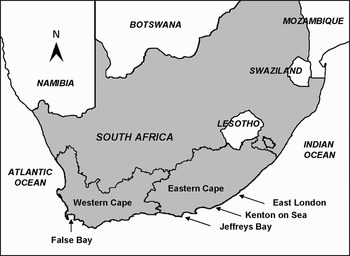
Dasyatis chrysonota were collected along the South African coastline between False Bay (34°40′S 19°00′E) and East London (33°30′S 27°50′E) from March 1987 to May 1989 (Figure 1). Specimens were obtained from inshore, nearshore, and offshore waters from shore anglers, light tackle boat anglers and trawling aboard the RV ‘Africana’, respectively. Disc width (D W) and disc length (D L), measurements were taken to the nearest millimetre (mm) with the stingray lying flat in its natural position. Weight (W) was taken to the nearest 0.1 g on a calibrated spring balance. The relationships between D W and D L, and D W and W were calculated. The relationship between D W and D L is described using the equation D L = aD wb; a and b are fitted constants (Ricker, Reference Ricker1973). To evaluate differences in the D W−D L relationships between males and females linear regression coefficients were calculated and compared using an ANCOVA. The relationship between D W and W was logarithmically transformed, and linear regressions were fitted to pairs of observations by sex using the equation W = aD wb; a and b are fitted constants. An ANCOVA was used to test for differences between regression coefficients for D W−W relationships between males and females (Ricker, Reference Ricker1973).
Map of study area.

The sex and maturity status (i.e. adult, adolescent or juvenile) were recorded. The number and proportion of adults, adolescents, and juveniles of each sex were analysed using a χ2 test with Yates correction to evaluate overall differences in sex ratios (Zar, Reference Zar1999) and within three habitats, e.g. surf zone, nearshore and offshore, as defined by Ebert & Cowley (Reference Ebert and Cowley2003) for this species. Externally, males were considered to be adult when the claspers were elongated and calcified, including the terminal cartilage elements. Adolescent individuals were those whose claspers extended beyond the posterior edge of the pelvic fins, but lacked calcification of the terminal cartilage elements. Juveniles had short, flexible claspers that did not extend beyond the posterior edge of the pelvic fins. The inner clasper length was measured and plotted as a ratio to D W. An abrupt change in the clasper length to D W ratio was considered to indicate maturity. Internally, coiling of the epididymides and gonad development were also used to confirm maturity. The testes were weighed to the nearest gram (g). The mean monthly values for the gonadosomatic index (GSI), using adults only, were calculated: GSI = gonad weight/total body weight * 100. This index was used to assess whether any seasonal peak changes in the reproductive condition of adult males occurred during the year. Mature females were determined by the presence of highly vascularized, large yellow oocytes, fully developed uteri with associated trophonemata, an oviducal gland that was distinctly differentiated from the uterus, whether the posterior portion of the uterus was pendulous or the uterus contained developing eggs or embryos. The number of embryos or uterine eggs, if present, was counted and plotted against D W to assess possible changes in fecundity associated with size. Adolescent individuals had smaller ovaries, with some differentiation, but lacked mature oocytes. The oviducal gland was undeveloped and the uteri were narrow and constricted. Juveniles lacked any differentiation of the ovaries, and the oviducal gland was not differentiated from the uterus. Mean monthly values for the hepatosomatic index (HSI), using adult males and females only were calculated: HSI = liver weight/total body weight * 100. This index was used to assess changes in the reproductive condition of adults. Disc width at 50% maturity (D W50) was calculated for each sex by means of a logistic regression (Roa et al., Reference Roa, Ernst and Tapia1999). Embryos at six different development stages were examined and described.
RESULTS
A total of 357 specimens (153 males and 204 females) were collected during the study. The overall female:male (F:M) sex ratio was 1:0.75, significantly different from the expected 1:1 ratio (χ2 = 7.0, df = 1, P < 0.05). A comparison of maturity status showed no significant difference in the sex ratio of adults and juveniles (P > 0.05), but a significant difference in the sex ratio of adolescents 1:0.21 (χ2 = 20.07, df = 1, P < 0.05) was observed.
Comparison of sex ratios within each of three habitats revealed a significant difference in favour of adult females to adult males in the surf and nearshore zones, but no significant difference in the offshore zone. In the surf zone adult females had a sex ratio of 1:0.57 that was significantly different (χ2 = 5.38, df = 1, P < 0.05) from the expected 1:1 ratio. No adult males were captured in the nearshore zone during the study, but 52 adult females were caught. Relatively few adults were caught in the offshore zone with females (N = 11) only slightly outnumbering males (N = 6), with no significant difference observed (P > 0.05) between the sexes. Surf zone adolescent females (N = 14) showed a significant difference in the sex ratio from males (N = 3) 1:21 (χ2 = 5.88, df = 1, P < 0.05). No adolescent males were caught in the nearshore or offshore zones during the study. Juveniles were rare in the surf and nearshore zones as only a single female and male were caught in the surf zone and just five females, no males, were caught in the nearshore zone. Juveniles were most abundant in the offshore zone, however, within this habitat no significant difference was observed from the expected 1:1 sex ratio between females and males (P > 0.05).
The relationships between D W and D L and between D W and W for males were described by the following equations: D L = 0.9134(D W) −2.2994 (r 2 = 0.97) and W = (2 × 10−05) D 3.2285W (r 2 = 0.98) respectively, while the same relationships for females were: D W and D L and between D W and W were described by the following equations, D L = 0.9406(D W)−2.5732 (r 2 = 0.98) and W = (2 × 10−05) D W3.2194 (r 2 = 0.99), respectively. Comparison of the D W and D L relationship between males and females showed no significant difference (P > 0.05). The D W and W relationship between sexes also revealed no significant difference (P > 0.05).
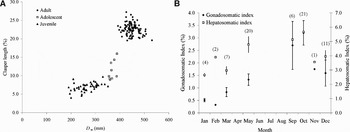
Males ranged from 190 to 531 mm D W with 97 of 153 (63.4%) determined to be mature. The smallest mature individual measured 392 mm D W, while the largest immature individual measured 388 mm D W. Clasper length increased rapidly between approximately 350 and 400 mm D W (Figure 2A), and continued to increase to approximately 450 mm D W. Beyond 450 mm D W the clasper length ratio relative to D W decreased slightly. First maturity was determined to occur at about 73.8% of maximum width (D Wmax) and D W50 was estimated at 395 mm D W. Males were collected in all months except April, June, July and August. The mean monthly GSI values for adult males showed an increase between May and October followed by successively decreasing values until February (Figure 2B). Males with ripe running sperm were encountered between January and April, a period during which the lowest GSI values were recorded. Males examined during May did not contain sperm indicating that copulation occurred prior to this time. The mean monthly HSI values appeared to trend upwards between January and October (Figure 2B). After peaking in October, the monthly values declined steadily to January.
(A) Relationship between clasper length, expressed as a % D w, and D w (mm); (B) mean monthly changes in male gonadosomatic and hepatosomatic indices. Bars represent±1 standard error. Number in parentheses represents sample size.

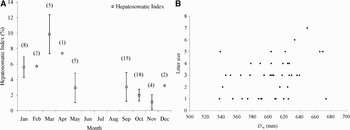
Females ranged from 184 to 711 mm D W with 120 of 204 (58.8%) determined to be mature. The smallest mature individual measured 500 mm D W, while the largest immature individual measured 522 mm D W. First maturity occurred at 70.3% D Wmax and D W50 was estimated at 505 mm D W. The mean monthly HSI values peaked in March followed by a steep decline in April and May (Figure 3A). Although no samples were collected between June and August the monthly values continued to decline from September reaching a low in November. Between November and March the monthly values trended upwards.
(A) Mean monthly changes in female hepatosomatic index. Bars represent ±1 standard error. Number in parentheses represents sample size; (B) litter size relative to D w (mm).

The number of mature ovarian oocytes ranged from 2 to 20 with a mean diameter of the largest oocytes ranging from 2 to 13 mm. Forty-five (37.5%) adult females examined carried either developing embryos or uterine eggs. Overall, litter size combining uterine eggs and embryos ranged from 1 to 7 (mean±SD = 2.8±1.6). The mean number of uterine eggs per individual for 32 adult females was slightly higher at 3.1 (±1.3) while the mean litter size of 13 females carrying embryos was lower at 2.1 (±1.9). The litter size to D W relationship did not show a correlation (r 2 = 0.21) of increasing litter size with increasing maternal size (Figure 3B). A total of 27 embryos were removed from 13 gravid females, of which only 13 embryos, eight males and five females, could be sexed. The largest embryo, observed in mid-October, had a D W of 172 mm, and the smallest free-swimming neonate, caught in late September, had a D W of 184 mm.
One instance of courtship behaviour was observed in March 1986 by a diver (Dr M. Griffiths, formerly Department of Ichthyology and Fisheries Sciences, Rhodes University, Grahamstown, South Africa) while diving beyond the breaker zone off Kenton-on-Sea (33°41′S 26°41′E), Eastern Cape, South Africa. A large female was observed lying on the bottom with four to five smaller D. chrysonota biting on the pectoral and pelvic fins of the female. After prodding by the diver all of the smaller stingrays swam off and distinct biting scars were observed on the female. Similar bite marks were observed on another adult female caught in January in the surf near Jeffreys Bay (34°00′S 24° 56′E), Eastern Cape, South Africa.
A total of 32 adult females were found to contain 1–6 uterine egg capsules. These thin walled, brownish amber egg capsules were oval shaped, with a length of approximately 25–40 mm and a width of 20–30 mm. The yellow coloured ova inside the egg capsules measured 12–18 mm and were extremely flaccid. At the earliest stages of gestation the uterus was fairly thick walled with poorly developed trophonemata. However, just prior to parturition the uterine wall was thin and extended with highly vascularized and enlarged trophonemata.
Embryos at six different development stages, ranging from 13 to 172 mm D W, are described. All embryos were removed from females collected in the Eastern Cape between October and November; the date each adult was captured is given in parentheses. The development descriptions are as follows:
Stage 1: 13 mm D W (21 October)—the unencapsulated embryo was slightly more elongate than wide, yellowish white in colour, with transparent poorly formed pectoral fins. Numerous highly vascularized external filaments protruded from the gill arches. A yolk sac with a diameter of approximately 9 mm was still attached.
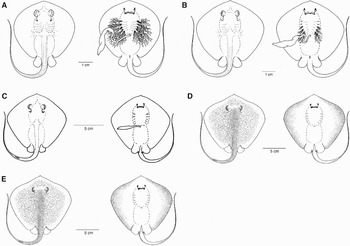
Stage 2: 44 mm D W (18 October)—the pale yellow embryo had no apparent pigment markings. The branchial region was highly vascularized with external gill filaments still present. The diameter of the yolk sac was approximately 4.5 mm (Figure 4A).
Stage 3: 49 mm D W (22 October)—the posterior region of the tail was darkly pigmented. Small gill openings were present on the outer margins of the gill arches, while the external branchial filaments were absent. The yolk sac had a maximum diameter of 5 mm (Figure 4B).
Stage 4: 72 mm D W (7 November)—the upper and lower caudal folds were present on the dark pigmented tail. A small soft caudal spine, still well sheathed was present. Teeth were present on both the upper and lower jaws. The yolk sac had a maximum diameter of 3.0–4.5 mm (Figure 4C).
Stage 5: 134 mm D W (22 October)—the dorsal surface of the disc was well pigmented with a pattern resembling that of an adult. The dorsal coloration was light brown and grey with the characteristic sea blue base colour absent. The ventral pectoral margins were dark. The caudal spine was clearly visible, but still sheathed and the upper and lower caudal folds were well formed. The yolk sac was absorbed with only a slight umbilicus protruding from the abdomen (Figure 4D).
Stage 6: 172 mm D W (15 October)—the dorsal coloration resembled that of an adult. The caudal spine with serrations was no longer sheathed. The yolk sac was not visible, leaving only a small umbilical scar that is evident on neonates. The uterus was filled with yellowish, soup-like histotroph, in which the embryos bathed for nutrition. This embryo represented a full-term foetus and compared favourably with the size of young of the year specimens (Figure 4E).
(A) Dorsal and ventral view of a 44 mm D wDasyatis chrysonota embryo; (B) dorsal and ventral view of a 49 mm D wDasyatis chrysonota embryo; (C) dorsal and ventral view of a 72 mm D wDasyatis chrysonota embryo; (D) dorsal and ventral view of a 134 mm D wDasyatis chrysonota embryo; (E) dorsal and ventral view of a 172 mm D wDasyatis chrysonota embryo.

DISCUSSION
Dasyatids, contrary to most skates (rajids), exhibit sexual dimorphism with females maturing and growing to a larger size, and older age, relative to males (Cowley, Reference Cowley1997; Davis et al., Reference Davis, Cailliet and Ebert2007; Smith et al., Reference Smith, Cailliet and Melendez2007; Ebert et al., Reference Ebert, Compagno and Cowley2008). Reasons for the size differences are unclear, but may be related to differences in reproductive modes between the suborders Myliobatoidei and Rajoidei. The myliobatoids are viviparous in their reproductive mode whereas the rajids are oviparous. Musick & Ellis (Reference Musick, Ellis and Hamlett2005) argued that oviparity in elasmobranchs was an adaptation in smaller species to increase fecundity. They supported their assertion by pointing out that small oviparous species when compared to similar sized viviparous species were far more fecund (Musick & Ellis, Reference Musick, Ellis and Hamlett2005), with rajids averaging 58.9 eggs/year compared to 5.5 pups/year in the myliobatiforms. However, while an oviparous reproductive mode may produce more egg cases annually, the egg cases are more vulnerable to predation and other environmental perturbations as the embryos develop in situ (Cox & Koob, Reference Cox and Koob1993; Lucifora & Garcia, Reference Lucifora and Garcia2004).
Sexual maturity is atttained in males at a smaller size and at an earlier age than females. Male D. chrysonota reach first maturity at about 392 mm D W and 50% maturity at about 395 mm D W. These widths correspond to an age at first and 50% maturity of approximately four plus years (Cowley, Reference Cowley1997). Females by comparison reach first and 50% maturity at 500 D W and 505 D W mm, respectively, sizes that correspond to an age of about seven years (Cowley, Reference Cowley1997). The similar sized Dasyatis dipterura from the Pacific coast of central Mexico by comparison was found to reach maturity at a median age of 5–8 years for males and 8–11 years for females. The only previous information on size at maturity for D. chrysonota was provided by Wallace (Reference Wallace1967), based on a small sample size, who reported maturity at 450 and 584 D W mm for males and females, respectively.
The reproductive cycle of male D. chrysonota indicates that sperm production peaks from September through to December; a time period corresponding to the austral spring season. However, evidence of mating behaviour was observed in January and March, during the austral summer. Other dasyatids showing a similar spring summer active period include Dasyatis sayi and D. sabina from the central east coast of Florida, USA (Snelson et al., Reference Snelson, Williams and Schmid1988, Reference Snelson, Williams and Schmid1989). Interestingly, the HSI values for D. chrysonota also appear to change in conjunction with the GSI levels throughout the year. How these apparent synchronous changes are related is unclear and is an area that requires further investigation.
The HSI in females showed a seasonal variation that may coincide with reproductive activity. Maximum HSI occurred from January through to April, and appeared to decline through the birthing season reaching a low in November. Similarly, Rossouw (Reference Rossouw1987) showed that in Rhinobatus annulatus, a sympatric species with D. chrysonota, that a seasonal change in HSI was due largely to the accumulation of lipids in the liver. He found that maximum HSI occurred in mature specimens during the peak breeding season and that low lipid levels, in gravid females, tended to correspond with embryos approaching term development. If the low HSI levels indeed reflect a liver with low lipid content, the low index found in gravid females with embryos approaching term development may be the result of the energetic demands of the developing embryos. This area of research requires further investigation.
Fecundity among dasyatid rays is typically low, often averaging less than six embryos per litter (Snelson et al., Reference Snelson, Williams and Schmid1988; Capapé, Reference Capapé1993; Villavicencio-Garayzar et al., Reference Villavicencio-Garayzar, Hoffmann and Melendez1994; Musick & Ellis, Reference Musick, Ellis and Hamlett2005; White & Dharmardi, Reference White and Dharmadi2007). Dasyatis chrysonota like other members of this family have a relatively low fecundity, ranging from 1 to 7, with an average of 2–3 embryos per litter. Other studies on dasyatid rays have noted that fecundity can be difficult to estimate because of the propensity of these batoids to abort their young due to capture stress and elevation of the specimen from the water (Struhsaker, Reference Struhsaker1969; Thorson et al., Reference Thorson, Langhammer and Oetinger1983; Snelson et al., Reference Snelson, Williams and Schmid1988; Smith et al., Reference Smith, Cailliet and Melendez2007). Therefore, it is possible that maximum fecundity in this, and other dasyatids, is slightly underestimated (Smith et al., Reference Smith, Cailliet and Melendez2007).
Although it has been well documented in some elasmobranch species that a strong maternal size to litter size relationship exists (Ripley, Reference Ripley1946; Olsen, Reference Olsen1954; Babel, Reference Babel1967; Pratt, Reference Pratt1979; Rossouw, 1983; Ebert & Ebert, Reference Ebert and Ebert2005), no relationship was shown for D. chrysonota. Reasons for this are unclear, but may be related to uterus capacity. It has been hypothesized that the disc-shaped batoid morphology appears to restrict the coelomic space and thus restricts uterine capacity (Musick & Ellis, Reference Musick, Ellis and Hamlett2005). Similarly, Martin & Cailliet (Reference Martin and Cailliet1988) proposed that in Myliobatis californica litter size is ultimately limited by space, which in turn is determined by the size of the female.
Courtship and mating behaviour of viviparous batoids in the wild is relatively rare (Tricas, Reference Tricas1980; McCourt & Kerstitch, Reference McCourt and Kerstitch1980; Chapman et al., Reference Chapman, Corcoran, Harnvey, Malan and Shivji2003). Although copulation in the wild was not observed for D. chrysonota, courtship or pre-mating behaviour similar to that described for Aetobatis narinari (Tricas, Reference Tricas1980) was observed. Furthermore, Kajiura et al. (Reference Kajiura, Sebastián and Tricas2000) observed in D. sabina that dermal bite wounds served as an indicator of mating, with peak activity coinciding with ovulation.
Dasyatis chrysonota appears to have an annual reproductive cycle with birth following a nine month gestation period. Ovulation appears to start soon after parturition as encased uterine eggs were first observed during the summer (January), and continue throughout and into late autumn (May). Although no adult specimens were collected during the winter months (June, July and August) some individuals were found to contain encased embryos in early spring (September). Mature females with large ovarian eggs, ranging from 8–14 mm diameter, were observed from late spring into summer (between November and January). Considering that no males exhibited ripe running sperm after April, it is felt that ovulation and hence fertilization occurs between January and April followed by a slowing or cessation in growth during the winter months. Snelson et al. (Reference Snelson, Williams and Schmid1989) suggested that fertilization in D. sayi occurred shortly after ovulation, but that zygote development is arrested for a lengthy period of time. This seems plausible since the uterine eggs of viviparous batoids are encased at least until the early stages of embryonic development. It appears therefore that D. chrysonota may have a slowing of growth or an arrested zygote developmental stage resulting from the offshore winter migration (Cowley, Reference Cowley1990) of this species, during which time females have a higher energy demand. An offshore winter migratory pattern is consistent with the findings in other studies on stingray reproductive cycles (Babel, Reference Babel1967; Snelson et al., Reference Snelson, Williams and Schmid1988). A slowing or cessation of embryonic growth during the winter followed by rapid growth during the early spring (late September and October), and the timing of parturition which appears to occur throughout the spring months (between October and December) supports a nine month gestation period. Examination of mature females from the winter months, along with histological studies, in future studies should confirm the reproductive seasonality by refining the timing of ovulation and hence the precise gestation period.
The reproductive success of D. chrysonota, as with most dasyatids, is low based on average fecundity and their active reproductive life span. A single female D. chrysonota for example, assuming an average annual fecundity of 2.8 and a seven year active reproductive span (Cowley, Reference Cowley1997), may produce only 19.6 young during her lifetime. Two similar sized stingrays, D. dipterura and Pteroplatytrygon violacea, have widely differing reproductive life spans. Dasyatis dipterura, from the Pacific coast of Mexico, has an annual fecundity of between 1 and 4 years and an active reproductive life span of up to 20 years (Smith et al., Reference Smith, Cailliet and Melendez2007). By comparison, P. violacea has an annual litter size of 1–13, but with an active reproductive life span of five years (Ebert, Reference Ebert2003; Mollet et al., Reference Mollet, Ezcurra and O'Sullivan2002). Furthermore, female D. chrysonota have a low k coefficient at 0.07 (Cowley, Reference Cowley1997), which make them extremely vulnerable to overexploitation (Musick, Reference Musick and Musick1999). Therefore, given the k-select life history characteristics of D. chrysonota, its vulnerability to both shore angling and demersal trawl fisheries, and the lack of a comprehensive chondrichthyan management plan in southern Africa a precautionary approach to the management strategy of this species is advised.
ACKNOWLEDGEMENTS
We thank L.J.V. Compagno and C. Hunter (Iziko Museums of Cape Town), T. Hecht (Department of Ichthyology and Fisheries Sciences, Rhodes University), A.I.L. Payne (Cefas), A. Bardenhorst, B. Rose, (now with Irvin and Johnson), P.F. Simms (Marine and Coastal Management), and Simon Brown and C.S. Rinewalt (Pacific Shark Research Center, Moss Landing Marine Laboratories) for their advice, assistance and help during this project. Many other people have contributed to this project over the years and we wish to express our sincere appreciation for their help and support. The authors acknowledge funding for this project through postgraduate bursaries from the National Research Foundation Council (formerly known as the Foundation for Research Development), South African Network for Coastal and Oceanographic Research, and the Shark Research Center of the South African Museum. D.A.E. thanks NOAA/NMFS for their support of the National Shark Research Consortium and Pacific Shark Research Center for support during the final phase of this project.