Methodology validation processes for seeds of Brazilian forest species require technological and scientific knowledge. However, the fragmentation of the information on the same species and the very basic reporting of data, often only giving the number of germinated seeds, make the official conversion of methods into rules difficult. The inclusion of forest species in official analysis rules has always been outdated in relation to cultivated species, as reported by Rogers (Reference Rogers1967) in a brief history of the inclusion of shrub and tree species in the official American, Canadian and European rules.
The rules for analysis of Brazilian seeds (Ministério da Agricultura e Reforma Agrária, 2009) cover a small number of forest species which do not include native Brazilian species. Part of this scenario is due to the fact that the marginal usage of ‘forest seeds’ did not put any pressure on commercialization and aspects related to the quality of the seeds. National and international issues about environmental impact have stimulated the demand for seeds of forest species, as have the sectors that commercialize this product and demand guarantees related to quality and identity.
In order to make the inclusion of germination test methodologies for Brazilian forest species viable, the Ministry of Agriculture (MAPA), in a partnership with the National Council for Scientific and Technological Development (CNPq/ MAPA/ SDA process: 578207/2008-7) and supported by the Research Foundation of the state of Minas Gerais (FAPEMIG Process: APQ-02 844/09), recommended the execution of two complementary projects developed by the Federal University of Uberlândia, Uberlândia, Minas Gerais, Brazil. The validation of methodologies for germination tests on up to 100 Brazilian forest species was proposed, including information related to seed disinfection, methods for overcoming dormancy and evaluation of criteria for normal and abnormal seedlings, supplemented with images and count days.
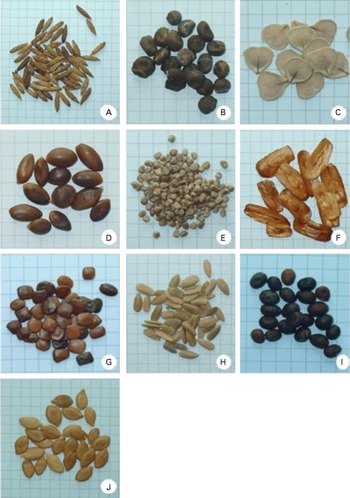
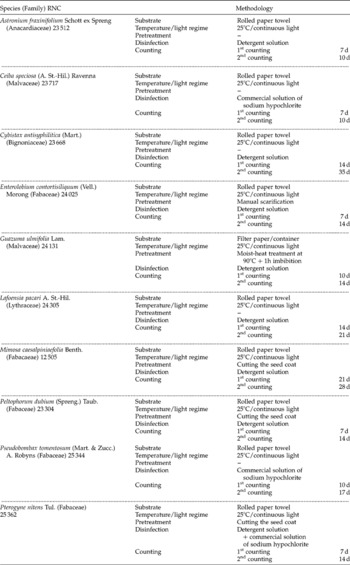
Species of different Brazilian biomes were chosen in the first group (Caatinga, Savanna, Atlantic Forest and Wetlands; Fig. 1). At least three lots of seeds of distinct physiological quality were collected from each of the species (Astronium fraxinifolium, Ceiba speciosa, Cybistax antisyphilitica, Enterolobium contortisiliquum, Guazuma ulmifolia, Lafoensia pacari, Mimosa caesalpiniaefolia, Peltophorum dubium, Pseudobombax tomentosum and Pterogyne nitens). The differences in quality were the result of differences in origin, collection year, and degree of fruit and seed maturity, among other things. Seeds from each of the lots were tested and retested after ample bibliographic research of the substrates, germination temperature, pretreatments and parameters that would be most suitable for the evaluation of the quality of the seeds of the species (Table 1).
Seeds of Astronium fraxinifolium Schott ex Spreng (A), Ceiba speciosa (B), Cybistax antisyphilitica (Mart.) Mart. (C), Enterolobium contortisiliquum (Vell.) Morong (D), Guazuma ulmifolia Lam. (E), Lafoensia pacari A. St.-Hil. (F), Mimosa caesalpiniaefolia Benth. (G), Peltophorum dubium (Spreng.) Taub. (H), Pseudobombax tomentosum (C. Martius & Zuccanini) Robyns (I) and Pterogyne nitens Tul. (J). Scale: background grid, 0.5 cm × 0.5 cm. (A colour version of this figure can be found online at http://journals.cambridge.org/ssr).

Methodologies for germination test, including substrate type, temperature, pretreatment, seed disinfection and count days

RNC, National Registry of Cultivars.
Seeds from each of the lots were sent to at least six research laboratories, officially recognized by MAPA, and designated as executors, so that the proposed methodology for each species could be tested. The methodology validation germination tests were carried out by researchers and technicians from laboratories at Official Agricultural Laboratory of the state of Goiás (LASO/LANAGRO/GO), Mato Grosso (LASO/INDEA/MT), Minas Gerais (LASO/LANAGRO/MG), Pará (LASO/LANAGRO/PA) Paraná (LASO/CLASPAR/PR), Pernambuco (LASO/LANAGRO/PE), Rio Grande do Sul (LASO/LANAGRO/RS) and São Paulo (LASO/CATI/SP); Brazilian Agricultural Research Corporation (EMBRAPA)/Maize & Sorghum (CNPMS/MG), Genetic Resources & Biotechnology (CENARGEN/DF) and Temperate Agriculture (CPACT/RS); Agricultural Research Foundation of the state of Rio Grande do Sul (FEPAGRO/RS); Laboratory of Seed Analysis of Federal University of Lavras, Minas Gerais (LAS/UFLA/MG); Laboratory of Seed Analysis of Ijuí, Rio Grande do Sul (LAS/UNIJUI/RS); Forestry Science and Research Institute of São Paulo, São Paulo (IPEF/SP).
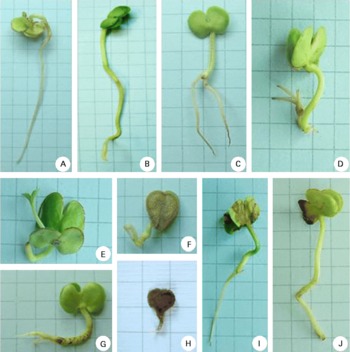
The moisture content and the 1000 seed weight (variation coefficient below 4%) were determined before shipment of the lots. The laboratories participating in the project received a general protocol with instructions about the execution of the tests and, together with the seeds, specific protocols for the particular species to be analysed, including the germination test methodology, randomization of the plots, seedling images (Fig. 2) and evaluation (see supplementary Table S1, available online only at http://journals.cambridge.org).
Abnormalities in seedlings of Cybistax antisyphilitica (Mart.) Mart.: (A) bent and pigmented hypocotyl; (B) main root with thickening on the extremity; (C) atrophied main root, fungal contamination of the collar region and the extremities of secondary roots, and pigmented hypocotyl; (D) atrophied main root and fungal contamination of the collar region and the extremities of secondary roots; (E) atrophied main root with a necrotic extremity, absence of secondary roots and contaminated cotyledon insertion region; (F) curved and thickened main root and absence of secondary roots; (G) underdeveloped main root and thickened and pigmented hypocotyl; (H) primary infection; (I) main root with contaminated extremity, bending in the collar region and infection present in over 50% of the cotyledons; (J) contaminated main root, absence of secondary roots and pigmented hypocotyl. Scale: background grid, 0.5 cm × 0.5 cm. (A colour version of this figure can be found online at http://journals.cambridge.org/ssr).

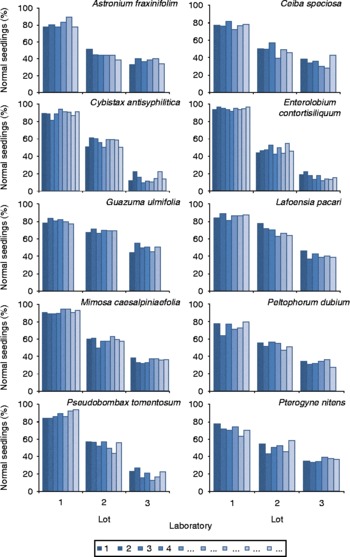
After the execution of the protocols, the laboratories sent the analysis cards with the collected data so that they could be analysed graphically (Fig. 3) and statistically (Table 2). The statistical analysis of the data was based on ISO 5725 (accuracy [trueness and precision] of measurement methods and results) and on the validation manual of the International Seed Testing Association (ISTA, 2007). The assumptions of normality of the residuals of the model and variation homogeneity were initially tested, for each species, by the Shapiro–Wilk and Levene tests, respectively. An exploratory analysis eliminated discrepant values (box–plot test) and the variation analysis model was applied. From these projects, official analytical methods were established for germination tests for the seeds of Astronium fraxinifolium, Ceiba speciosa, Cybistax antisyphilitica, Enterolobium contortisiliquum, Guazuma ulmifolia, Lafoensia pacari, Mimosa caesalpiniaefolia, Peltophorum dubium, Pseudobombax tomentosum and Pterogyne nitens (Normative instruction No. 44 published in the MAPA official diary on 23 December 2010, http://www.in.gov.br/imprensa/visualiza/index.jsp?jornal = 1&pagina = 2&data = 24/12/2010).
Mean percentage of normal seedlings per lot and laboratory, obtained in the implementation of a validation methodology for testing the quality of seeds of Astronium fraxinifolium, Ceiba speciosa, Cybistax antisyphilitica, Enterolobium contortisiliquum, Guazuma ulmifolia, Lafoensia pacari, Mimosa caesalpiniaefolia, Peltophorum dubium, Pseudobombax tomentosum and Pterogyne nitens. (A colour version of this figure can be found online at http://journals.cambridge.org/ssr).

Summary of the analysis of variance including the assumptions of the model of the validation process of methods for germination tests of native Brazilian forest species

1 MS, mean square; W, F: statistics for the Shapiro–Wilk test for residual normality and the Levene test for variance homogeneity; ns, no significant difference; **P < 0.01 for Snedecor's F test.
Acknowledgements
Financial support by Ministry of Agriculture/National Council for Scientific and Technological Development (MAPA/CNPq) and Research Foundation of the State of Minas Gerais (FAPEMIG) are greatly acknowledged.