Introduction
Drug-induced parkinsonism (DIP) is common and generally attributed to dopamine receptor blocking agents. Though the literature is scant and at times controversial with regard to reports of lithium-induced parkinsonism (LIP), the entity exists and should be considered when evaluating elderly patients with parkisonian symptomtology and a history of chronic lithium use. We describe a case of LIP that was treated for several years as idiopathic Parkinson's disease (PD), but eventually was diagnosed correctly and reversed with the assistance of DaTscan SPECT imaging (DaTscan).
Case presentation
A 65-year-old Caucasian woman with a 6-year history of PD, bipolar disorder for the last 40 years, and cognitive decline was referred by an outside provider for a multidisciplinary assessment at the PD Comprehensive Care Clinic (PDCCC) at Emory University. At the time of the psychiatric evaluation, she was experiencing worsening gait, weakness, confusion, and forgetfulness. Examination demonstrated masked face, mild to moderate postural/kinetic tremor in the upper extremity (L > R), slight resting tremors in both legs and arms, and moderate neck and limb rigidity. She also had moderate to severe bradykinesia (L > R), slow gait with freezing, and a stooped posture with decreased arm swing. Medications included carbidopa-levodopa 25/100 mg five times a day, lithium 600 mg twice daily (BID), donepezil 10 mg daily, and memantine 10 mg BID. Her previous provider stopped risperidone 11 months prior to our evaluation due to worsening PD-like features; however, the discontinuation did not improve her symptomatology. Family history was negative for PD and any other movement disorders.
Her Unified Parkinson's Disease Rating Scale (UPDRS) motor score was 52, resulting in an increased carbidopa-levodopa dose, which led to visual hallucinations and increased confusion. Her Montreal – Cognitive Assessment (MoCA) score was 10/25 (patient was unable to perform the visuospatial section due to motor limitations). Complete neuropsychological evaluation suggested a differential diagnosis of Dementia with Lewy Bodies (DLB) and vascular dementia.
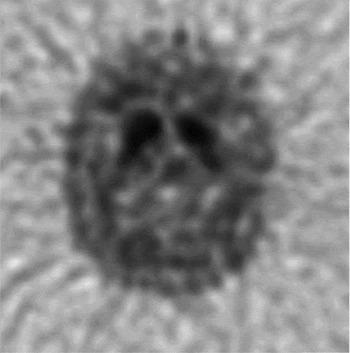
To clarify the diagnosis, a brain DaTscan was performed. A DaTscan is an imaging tool used to assess presynaptic dopamine uptake within the brain. In our patient's case, the DaTscan revealed normal striatal uptake (Figure 1). Imaging questioned the etiology of her motor symptoms, ruled out DLB and idiopathic PD, and brought to the forefront the possibility of drug-induced motor manifestations. Our team initially considered her diagnosis as DIP secondary to her previous risperidone use; however, her last antipsychotic dose was 11 months prior to her presentation to the PDCCC.
Brain DaTscan. 123I-Ioflupane radioactive striatal uptake within normal limits.

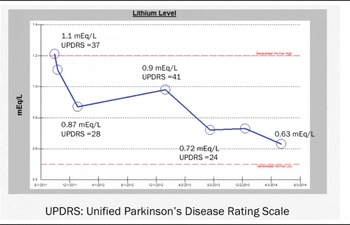
Despite a 40-year history of bipolar disorder, the patient had remained stable on lithium with occasional irritability. Previous trials of mood stabilizers and augmentation agents (aripiprazole, lamotrigine, valproic acid, isocarboxazid, tranylcypromine, and fluphenazine) failed due to adverse effects. Her last manic episode occurred two years earlier, and her last inpatient psychiatric hospitalization was 14 years prior to our evaluation. Considering the possibility of LIP along with the brain DaTscan results, our team lowered her daily lithium dosage gradually to 450 mg per day; however, her subsequent mood deterioration required adjustment of lithium to 300 mg BID. Carbidopa-levodopa was discontinued, and lithium levels dropped from 1.1 mEq/L (600 mg of lithium BID) to 0.63 mEq/L (300 mg BID of lithium). The lower serum lithium level resulted in improvements in her parkisonian symptoms (See Table 1), without significant decompensation of her mood disorder. Her posture and tremors improved and the freezing of gait disappeared. Overall, her UPDRS motor score decreased from 52 to 24, and her cognition improved on the MoCA from 10/25 to 19/25. She reported no confusion but still complained of short-term memory problems. She was more alert and had a brighter affect. Sleep also improved and there were no signs of psychosis. A two-year PDCCC follow-up revealed her motor and mood symptoms remained stable on a lower lithium dosing regiment along with close follow-up with psychiatry providers.
Lithium level and UPDRS (motor) over time

Discussion
The pathophysiological mechanism behind LIP is unclear (Walevski and Radwan, Reference Walevski and Radwan1986). One hypothesis suggests that lithium reduces the number of dopamine receptors in the striatum or in the limbic system (Engel, Reference Engel and Berggren1980). Others either postulate lithium's anticholinergic profile allows for an increase in central cholinergic activity (Dallocchio and Mazzarello, Reference Dallocchio and Mazzarello2002), or that patient's developing a drug-induced movement disorders may have a preexisting lesion to the basal ganglia (Gadallah et al., Reference Gadallah, Feinstein and Massry1988).
Our patient was initially diagnosed with idiopathic PD due to her classic motor presentation including freezing of gait, which is rarely present in DIP. A normal DaTscan assisted in differentiating LIP from degenerative parkinsonism and reversal of symptoms with drug withdrawal confirmed the correct diagnosis. This case emphasizes the challenges related to the treatment of geriatric patients with bipolar disorder who have clear reliance on mood stabilizers. Her past history of adverse effects with other mood stabilizers and poor response to various antipsychotics limited treatment options, which resulted in additional risks for worsening motor symptoms. Her mood was stable on lithium, thus the desire to continue the medication was warranted but monitoring of the adverse events including LIP was necessary.
Our case also highlights the usefulness of the DaTscan, which is impactful in the diagnosis and clinical management of parkisonian patients with diagnostic uncertainty (Kupsch et al., Reference Kupsch2012). For our team, imaging was used to steer the diagnosis towards a drug-induced etiology; however, earlier use of the DATscan may have helped avoid her dopamine-induced psychosis. In general, bipolar patients with a history of chronic lithium intake should be regularly evaluated for LIP symptomatology. The limitation of this case presentation is the fact that we were not the long-term provider prior to her referral for multidisciplinary care. Details of disease course and treatment options could have been more accurately explored had we been the continuous provider.
Previous cases of LIP within the literature have been reported with or without frank lithium toxicity and have had diverse presentations. There are cases without signs of toxicity, where all motor symptoms resolved after reduction or discontinuation of lithium (Reches et al., Reference Reches, Tietler and Lavy1981). Another report outlines where parkisonism did not completely resolve despite a decrease of lithium plasma levels from 3.7 mmol/L to 0.7 mmol/L. (Dallocchio and Mazzarello, Reference Dallocchio and Mazzarello2002). Other cases have shown postmortem histological findings of chronic lithium intoxication, but no evidence of the degenerative conditions typical of PD (Lecamwasam et al., Reference Lecamwasam, Synek, Moyles and Ghose1994). The varied presentations are likely due to individual genetic predispositions to store lithium inside neurons (Bell et al., Reference Bell, Cole, Eccleston and Ferrier1993; Dallocchio and Mazzarello, Reference Dallocchio and Mazzarello2002).
The majority of the LIP literature consists of elderly patients (age 60–79) who have been on chronic lithium therapy (Bondon-Guitton et al., Reference Bondon-Guitton, Perez-Lloret, Bagheri, Brefel, Rascol and Montastruc2011). Older patients are known to have a more permeable blood–brain barrier and decreased renal clearance; hence, serum lithium levels can appear therapeutic but brain lithium levels may be much higher. Furthermore, pharmokinectic drug–drug interactions such as with diuretics can precipitate lithium levels to rise. Risk factors for LIP include duration of lithium therapy, serum lithium levels, and patient age (Shopsin and Gershon, Reference Shopsin and Gershon1975). Such correlations may warrant lower serum lithium levels to be considered therapeutic when considering a geriatric patient population. Keeping these variables in mind can aid clinicians into reaching an early LIP diagnosis and allow for appropriate and expedited management. Additionally, comprehensive care clinics afford multidisciplinary evaluation and treatment of complicated disorders that present with motor and neuropsychiatric manifestations. Such a unified approach supports the achievement of better outcomes in parkinsonism.
Conflict of interest
None.
Authors’ roles
AP Hermida saw the patient and wrote the paper. AU Janjua wrote the paper and was involved in data collection. OM Glass assisted in writing the paper. C Vaughan saw the patient and assisted in writing the paper. F Goldstein saw the patient and assisted writing the paper. LM Trotti saw the patient and assisted in writing the paper. SA Factor saw the patient and assisted in writing the paper.
Acknowledgments
The Merrie Boone Comprehensive Care Clinic for Parkinson's receives support from the Dan and Merrie Boone Foundation and the National Parkinson Foundation.