The family Porcellanidae Haworth, 1825 includes crab-shaped anomuran crustaceans commonly known as porcelain crabs. They are globally distributed in temperate and tropical marine habitats and comprise one of the most diverse families of near-shore decapod crustaceans (Haig, Reference Haig1960). Porcelain crabs number about 280 species partitioned among 30 genera (Rodriguez et al., Reference Rodriguez, Hernandez and Felder2005). One genus was known for the Argentinean Continental Shelf, represented by two species: Pachycheles laevidactilus Ortmann, 1892 and P. chubutensis Boschi, 1963 (Boschi et al., Reference Boschi, Fischbach and Iorio1992; Boschi, Reference Boschi2000). Only one species of the genus Polyonyx occurs in the western Atlantic, Polyonyx gibbesi Haig, 1956; three other ones occur in the eastern Pacific: P. confinis Haig, Reference Haig1960; P. nitidus Lockington, 1878 and P. quadraungulatus Glassell, 1935. The distribution of Polyonyx gibbesi (first called Porcellana macrocheles Gibbes, 1850) is mostly anti-tropical and also sporadically extends to tropical waters. It was previously known from Woods Hole, Massachusetts (42°N) to La Paloma, Uruguay (34°S) (Rodriguez et al., Reference Rodriguez, Hernandez and Felder2005). In the present study we document for the first time the presence of Polyonyx gibbesi in the Argentinean continental shelf and the southernmost occurrence of the genus Polyonyx on the western Atlantic coast.
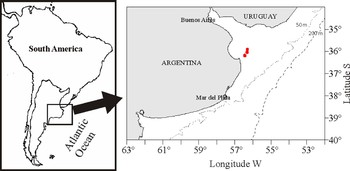
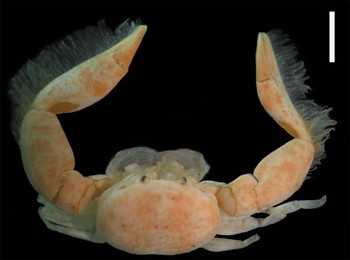
Specimens of P. gibbesi were found in the stomach contents of the narrownose smoothhound shark Mustelus schmitti (Springer, 1939) (Carcharhiniformes: Triakidae). Demersal sharks were collected during November 2008 during a research cruise (RV ‘Dr E. Holmberg’, INIDEP) (Figure 1). Sharks were captured from three different sampling sites (36°6.8′S 56°16.2′W, 36°1.5′S 56°11.8′W and 35°32.8′S 56°11.4′W) (Figure 1). Forty-four porcelain crabs were identified in the stomach contents of twenty-two sharks (Figure 2). It was possible to sex and measure 11 complete females that ranged between 5.87 and 9.82 mm carapace width and between 4.55 and 6.9 mm carapace length. Polyonyx gibbesi is a frequent alimentary prey, along with other anomuran crabs (Loxopagurus loxochelis and Pagurus exilis) and polychaetes of the families Maldanidae and Glyceridae. Although decapod crustaceans of Argentinean coastal waters have been carefully studied (Boschi et al., Reference Boschi, Fischbach and Iorio1992; Boschi, Reference Boschi2000), Polyonyx gibbesi was never collected in the region. These records extend the southern limit of the species to marine coastal waters adjacent to the mouth of the Rio de la Plata estuary.
Map showing the collection localities of Mustelus schmitti with Polyonyx gibbesi in their stomach contents.

Specimen of Polyonyx gibbesi found in the stomach contents of a narrownose smoothhound shark Mustelus schmitti during November 2008 in the Argentine Sea.

Polyonyx gibbesi was collected in warm temperate waters of the Argentine Biogeographic Province (Boschi, Reference Boschi2000). It includes coastal waters from 44°S (Patagonia) to 23°S (southern Brazil). This region is influenced by subtropical waters (Brazilian Current) and sub-Antarctic waters (Magellanic Current), influenced by the Rio de la Plata (35°S) outflow (Boltovskoy et al., Reference Boltovskoy, Gibbons, Hutchings, Binet and Boltovskoy1999; Boschi, Reference Boschi2000). This barrier was found to be intermittent for south Brazilian plankton and fish species, according to climatic variation and discharge pattern of the river (Mianzan et al., Reference Mianzan, Acha, Guerrero, Ramirez, Sorarrain, Simionato and Borus2001). During recent years, new records of decapods (Melo, Reference Melo1990; Boschi, Reference Boschi2000; Scelzo, Reference Scelzo2001; Schejter et al., Reference Schejter, Spivak and Luppi2002; Giberto & Bremec, Reference Giberto and Bremec2003), polychaetes (Bremec & Giberto, Reference Bremec and Giberto2004), cnidarians (Zamponi, Reference Zamponi2000) and fish (Figueroa et al., Reference Figueroa, Díaz de Astarloa and Cousseau2000) in Argentinean littoral waters show faunal affinity with southern Brazil. Larvae of P. gibbesi may have been transported by coastal currents passing through the zoogeographical barrier. The transport of invertebrate larvae from north to south, and within estuarine waters, could be constrained due to thermal and salinity tolerance. Although some resident species are difficult to collect due to their rarity, these findings suggest the dispersion of exotic taxa from northern areas.
The large number of porcelain crabs found in the stomach contents indicates that they probably are frequent components of the benthic community in the study area. There is no information about digestion rates and movement speed of the narrownose smoothhound shark M. schmitti, but given the low degree of digestion of porcelain crabs (some of which were undigested) (Figure 2) it is unlikely that sharks could have preyed on these crabs further northwards. Crabs of this species are usually found living inside polychaete tubes of Chaetopterus (Haig, Reference Haig1960). The absence of chaetopterids or the rest of its tubes in the same stomachs suggests that the crabs could live free or could be using an alternative host in the study area.
ACKNOWLEDGEMENTS
We thank the Instituto Nacional de Investigacion y Desarrollo Pesquero (INIDEP) for the specimens collected from the research cruises. We would like to thank Gaby Silvoni, Nancy Lenzo and Guillermina Cosulich (librarians of INIDEP) who provided most helpful documentation. This research was supported by PICT 2006-1553 and PICT 2007-02200 of CONICET. Mauro Belleggia was supported by a scholarship from CONICET. This is INIDEP contribution No. 1561.