




No CrossRef data available.
Article contents
The prescription of opioid analgesics to terminal cancer patients: Impact of physicians' general attitudes and contextual factors
Published online by Cambridge University Press: 01 December 2003
Abstract
Objective: This study aimed to examine factors associated with the prescription of opioid analgesics to terminal cancer patients, including physicians' general attitudes toward morphine and contextual factors.
Methods: A survey was conducted among a sample of French general practitioners (GPs) and oncologists. Respondents were asked to describe the last three terminally ill patients they had followed up to death.
Results: Overall, 526 GPs and oncologists (global response rate: 57%) described 1,082 cancer patients, among whom 85.4% received opioid analgesics. Among other significant predictors (patient age, cancer type, family assistance), this prescription was less frequent for female patients followed by male physicians (OR = 0.53), and more frequent for patients followed by physicians trained in palliative care (OR = 2.70). On the other hand, physicians' attitudes toward morphine were not associated with prescription of morphine and other opioid analgesics.
Significance of results: Although nonprescription of opioid analgesics is only a crude proxy measure for undertreatment of cancer pain, our findings suggest the need to develop training in palliative care in order to standardize practices among GPs and specialists. Our results also highlight the necessity to study pain assessment as an interaction between the physician and the patient, and to consider patients' and physicians' respective genders as a key variable within this interaction.
Information
- Type
- Research Article
- Information
- Copyright
- © 2003 Cambridge University Press
INTRODUCTION
Pain is one of the most common and most feared symptoms of cancer. Cancer pain may occur at any stage of the disease, but its prevalence and severity increase in the advanced stages of the condition. Cancer pain also depends on the type of tumor, the presence and location of metastases, and other psychological, emotional, and spiritual factors that may not be directly related to cancer or treatment (Daut & Cleeland, 1982; Twycross & Fairfield, 1982; Greenwald et al., 1987). In 1986, the World Health Organization (WHO) launched a program for cancer pain control that advocated the use of strong opioid analgesics for severe pain, and especially morphine, which was considered as the “gold standard” for the management of cancer pain (WHO, 1990). In spite of these efforts, the undertreatment of pain remains a critical issue in current cancer care, especially in some European countries like France and Germany (Zenz & Willweber-Strumpf, 1993; Larue et al., 1995a; Zenz et al., 1995; Soliman et al., 2001).
One important factor in this undertreatment is the attitude of physicians toward opioid analgesics. Despite published guidelines, many physicians are still unwilling to prescribe opioids, because they are worried about potential addiction, respiratory depression, and other adverse effects (Von Roenn et al., 1993). Poor assessment of cancer pain is another important factor (Cleeland et al., 1994; Larue et al., 1995a). Apart from some basic measures such as mobility or analgesic consumption, physicians have difficulties in assessing patients' pain through “objective” instruments (Ahmedzai, 1995) and must rely on patients' feeling and beliefs (McQuay et al., 1997). However, doctor–patient communication may sometimes not appropriately capture the patient's real state of pain: Contextual factors, such as patients' age, gender, and socioeconomic status, may influence the way they report pain, as well as the way physicians perceive this report (Borkan et al., 1995; Mercadante et al., 2000).
In this article, we investigated factors associated with the prescription of opioid analgesics to terminal cancer patients, by taking into account both patients' and physicians' characteristics. More precisely, we aimed to assess the predictive impact of both physicians' general attitudes towards opioids (i.e., morphine) and contextual factors related to the patients. We analyzed data from the first French national survey on physicians' knowledge, attitudes, beliefs, and practices toward palliative care, during which physicians were asked to describe at length the last three terminally ill patients they had followed up until death. This survey was carried out in 2002 by the Regional Centre for Disease Control of South-Eastern France and INSERM (National Institute for Health and Medical Research, Unit 379).
METHODS
Sampling
The survey was carried out in a stratified sample of French general practitioners (GPs) and oncologists, who are the medical professionals more likely to be involved in end-of-life care for terminal cancer patients. As the size of corresponding populations are very different (67,873 GPs vs. 664 oncologists in the whole country), oncologists were overrepresented (1.5 GP out of 100 and 2 oncologists out of 5 were proposed to participate in the survey). Potential respondents were randomly selected from the complete file of French physicians kept by the National Health Insurance Fund (NHIF).
Questionnaire
The questionnaire was developed by the South-Eastern France Palliative Care Group, which consisted of a sociologist and 10 physicians (GPs and specialists). Early versions were tested in two pilot surveys, and the final version included 202 closed-ended questions.
The questionnaire was divided in three modules. The first one addressed physicians' experiences with end-of-life care. They were asked to describe the last three terminally ill patients they had followed up until death, including gender, age, socioeconomic status of the patient, main pathology he/she was suffering from, assistance provided by relatives, place of the death, and whether the physician prescribed opioid analgesics to the patient or not.
The second module assessed respondents' attitudes toward end-of-life and palliative care. The word attitude must be understood here in its broadest meaning, including evaluative, cognitive, and conative components. One could argue that we assessed beliefs rather than attitudes because our questions are not strictly evaluative (Fishbein, 1967), but these beliefs have a strong evaluative aspect, so we labeled them attitudes. Three questions using a 5-point Likert scale (from strongly agree to strongly disagree) measured respondents' level of agreement with the following statements: “Prescribing high-dose morphine to a terminally ill patient should be considered euthanasia”; “cancer patients receiving long-term morphine analgesia end up rejecting it because of adverse effects”; “pain is an unavoidable symptom of cancer that cannot be adequately alleviated by opioids.”
The third module investigated the professional and personal background of GPs and oncologists, including gender, age, specialized training in palliative care or algology, and number of terminally ill patients they had cared for during the last 12 months.
Data Collection
We opted for a telephone survey with the Computer Assisted Telephone Interview system. We drew a random sample of 1,265 addresses from the NHIF file (1,004 GPs and 261 oncologists). Physicians received a letter that introduced the survey and guaranteed anonymity. The survey began 3 weeks later and lasted from February 12 to March 13. GPs and oncologists were contacted from Monday to Friday between 8 a.m. and 8 p.m., and they were proposed a later appointment if they were not free to respond immediately.
Statistical Analysis
The 5-point scale used in the questions about morphine was collapsed into a binary outcome (strongly agree or agree vs. neither agree nor disagree, disagree, and strongly disagree). To test the interaction between physician gender and patient gender, we also built a four-item variable: male physician–male patient, male physician–female patient, female physician–male patient, female physician–female patient.
We computed Pearson's χ2 to compare the characteristics of respondents and nonrespondents as well as the characteristics and attitudes of GPs and oncologists. With regard to deaths described by respondents, we used the same test to compare the patients who received opioid analgesics and those who did not. To control for potential confounding factors, we also built a multivariate logistic model with the stepwise selection method (entry threshold p = 0.05). Physicians' characteristics and attitudes toward morphine were initially introduced in the logistic model, together with information related to patients and circumstances of the death. We computed odds ratios (OR) at the initial stage of the stepwise procedure (univariate OR for each variable introduced separately in the model) and at the final stage (multivariate OR for selected variables).
RESULTS
Data Collected
Overall, 719 physicians (502 GPs and 217 oncologists) agreed to participate (global response rate: 57%). The response rate was higher for oncologists than for GPs (83% vs. 50%). There was no significant difference between respondents and nonrespondents for the characteristics that could be controlled from the NHIF file (gender, age, size of town). Physicians most frequently explained their refusal to be interviewed by “lack of time.”
Among the respondents, 331 GPs out of 502 and 195 oncologists out of 217 described at least one cancer patient followed up to death. Overall, these 526 physicians described 1,082 cancer patients followed up to death, and 992 (92%) of the corresponding deaths occurred during the prior 12 months, so their descriptions could be considered as reasonably reliable.
Characteristics and Attitudes of GPs and Oncologists Who Described at Least One Cancer Death
The respondents are described in Table 1. The percentage of female physicians was higher among oncologists, who were also younger than GPs. The proportion of respondents who had special training in palliative care or algology was low for both groups, especially among GPs. Eight oncologists out of 10 followed up until death more than 12 terminally ill patients during the prior 12 months, versus only 2 GPs out of 10. GPs were also more likely to agree that “the prescription of a high-dose morphine to a terminally ill patient should be considered euthanasia,” and a slightly higher proportions of GPs than oncologists (20.2% vs. 14.9%) agreed that “cancer patients receiving long-term morphine analgesia end up rejecting it because of adverse effects” but this difference was not statistically significant. Last, most respondents disagreed that “pain is an unavoidable symptom of cancer that cannot be adequately alleviated by opioids.”
Sociocultural and professional characteristics and attitudes toward morphine of GPs and oncologists who described at least one cancer deatha

Cancer Patients Followed up to Death by Responding Physicians
Overall, 85.4% of those patients received opioid analgesics. Such a prescription was more common for male and younger patients, as well as for those suffering from a gastrointestinal or colorectal cancer. When considering simultaneously patients' and physicians' genders, it appeared that male physicians were less prone to prescribe morphine to female cancer patients. Finally, patients' socioeconomic status and place of death (at home vs. at hospital) were not related to the prescription of opioid analgesics.
Factors Associated with the Prescription of Opioid Analgesics
As place of death and socioeconomic status of the patient were not related with the prescription of opioid analgesics, as shown in Table 2, they were not introduced in the logistic model. Moreover, as the relationship between this prescription and the four-item variable combining patients' and physicians' genders was statistically significant, we introduced this variable in the model, together with patient's gender and the physician's gender. The stepwise procedure selected the four-item variable, after which patient and physician genders were no longer significantly linked with the outcome variable. To lighten the presentation of results, we just kept the four-item variable combining both genders.
Cancer patients followed up to death by responding GPs and oncologists according to whether or not they received morphine

In the multivariate logistic model (Table 3), the results presented in the preceding section remained valid. The prescription of opioid analgesics was less common among female patients followed by a male physician (OR = 0.53 vs. female patients followed by a female physician). This prescription was also less frequent among patients aged 65 and over (OR = 0.48 for patients aged over 80 vs. patients aged under 65). Conversely, patients assisted by relatives were more likely to receive opioid analgesics (OR = 2.02), as well as those suffering from a gastrointestinal or colorectal cancer, rather than a lymphoma ora leukaemia (OR = 1/0.37 = 2.70).
Factors associated with prescription of morphine for cancer patients followed up to death by 526 GPs and oncologistsa

Concerning physicians' characteristics and attitudes, in univariate logistic models, oncologists and younger physicians were more prone to prescribe opioid analgesics to their terminally ill patients, but these two results were no longer statistically significant once the effect of specialized training was controlled for. Specialized training in palliative care or algology turned out to be a strong predictor of this prescription (2.70). Finally, end-of-life care experience during the prior 12 months and attitudes toward morphine were not related with the prescription of opioid analgesics.
DISCUSSION
According to our data, the prescription of opioid analgesics to terminally ill cancer patients depends on several nonclinical factors, including contextual factors such as assistance provided by patient's relatives and patient age, but also patients' and physicians' respective genders. We found indeed that the prescription of opioid analgesics was less common for female patients followed by male physicians. On the other hand, physicians' general attitudes toward morphine use were not significant predictive factors for this prescription.
Our study has several limitations. First, we lack detailed information about nonrespondents, although we know they did not differ from respondents according to age, gender, or size of town. Second, as only physicians were interviewed we did not have the patients' point of view, especially their pain ratings. Third, in a retrospective study such as ours, questions about past events cannot be too detailed, so we did not investigate physicians' assessment of pain, symptoms presented by patients, or timing and dosage for the prescription of opioid analgesics. Thus, even if physical and psychological pain are common during the terminal stages of cancer, as well as pain management with opioid analgesics, we must acknowledge that the nonprescription of such analgesics is only a crude proxy measure of cancer pain undertreatment. This is the reason why we introduced in the analysis the type of cancer, which is known to be closely related to the prevalence and intensity of pain.
Despite these limitations, our results are consistent with previous studies that included pain assessment by patients and/or physicians. More common prescription of opioid analgesics to patients suffering from a gastrointestinal cancer is consistent with the fact that corresponding patients tend to report the worst levels of pain (Larue et al., 1995a). Less frequent prescription to older patients may also reflect the fact that they are more affected by inadequate pain management (Cleeland et al., 1994), perhaps because they often present cognitive dysfunction that complicates pain assessment (Ferrell & Ferrell, 1996), or because physicians fear an increase of opioids' adverse effects with elderly patients (Vigano et al., 1998). Pain undertreatment also affects more frequently women suffering from cancer (Cleeland et al., 1994) or AIDS (Breitbart et al., 1996). With regard to this issue, the interaction we found between patients' and physicians' respective genders could reveal a propensity among male physicians to underestimate female patients' pain due to a greater reluctance among women to report pain to their male physician or a difference in the way male physicians assess women's pain. This interpretation is supported by a recent survey . &conducted in a French hospital, where male physicians rated the pain of female patients lower than that of male patients when the cause was obvious (Marquié et al., 2003). Other studies suggested that men and women neither feel nor report the same pain (Mercadante et al., 2000; Vallerand & Polomano, 2000; Sela et al., 2002). Moreover, as lay people tend to underestimate pain reported by women because they hold stereotypes associating somatization with female gender (Martin & Lemos, 2002), one may suspect that such stereotypes sometimes influence pain assessment by physicians, and especially by male physicians.
We also found a strong relation between assistance by relatives and the prescription of opioid analgesics. Such a result emphasizes the frequent involvement of the patient's family in the medical decision-making process. This result also reminds us that the target of end-of-life care is not limited to the dying patient, but also includes his/her relatives.
With regard to physicians' attitudes toward morphine, almost 10 years after the similar study conducted in France by Larue et al. (1995b), we found a persistent, though decreasing, reluctance to prescribe morphine, especially among GPs. Previous studies suggested that negative attitudes toward morphine lead to inadequate pain management (Von Roenn et al., 1993; Larue et al., 1995b; Bonn, 2000), but we did not find a significant relationship between such attitudes and the prescription of opioid analgesics. This result is consistent with social psychologists' statement that attitudes are generally poor predictors of behavior (Wicker, 1969; Fishbein & Ajzen, 1972; Atkinson et al., 1996). However, because we just observed the frequency of this prescription, we cannot exclude that negative attitudes toward morphine can lead to underdosing or delayed use. Moreover, some physicians may be reluctant to use morphine, but not its derivates (such as hydromorphone or naloxone).
IMPLICATIONS
As the strongest predictive factor for the prescription of opioid analgesics to a terminal cancer patient was physician's specialized training in palliative care or algology, our findings emphasize the need to develop information and training on end-of-life care and pain management in France, especially because many French physicians, including a significant number of GPs, take care regularly for dying patients without specific training. Physicians need to learn concrete skills, but first of all they must be convinced that the late stages of cancer are not inevitably painful (Ahmedzai, 1997).
Our findings also highlight the necessity to study pain assessment as a social interaction between the physician and the patient that is shaped by mutual expectations partly based on respective social characteristics, and improvement of which therefore requires educating both physicians and patients (Hodes, 1989; Von Roenn et al., 1993). Our results suggest that gender may be a key variable in this interaction, and further research is needed for a better understanding of this issue, and to exonerate research on cancer pain from the accusation of “androcentrism” (Im & Chee, 2001). The gender issue also suggests that training aimed at improving pain management needs to include not only knowledge about safe use of opioid analgesics, but also methods devoted to increase mutual empathy between physicians and patients (McCaffrey & Ferrell, 1997).
ACKNOWLEDGMENTS
Special thanks to the members of the South-Eastern France Palliative Care Group: M.K. Ben Diane, Dr. R. Favre, Dr. A. Galinier, Dr. H. Granier, Dr. J.M. Lapiana, Dr. Y. Obadia, Dr. H. Pégliasco, Dr. B. Planchet-Barraud, Dr. F. Ravallec, Dr. M. Rotily, and Dr. O. Priolo. This study was supported by the Departmental Centre of Private Health Professionals (grant from the Fund for improving ambulatory care), by the Assistance Publique-Hôpitaux de Marseilles (within the hospital program for clinical research), and by the Cancer Research Foundation (ARC).
References
REFERENCES
Ahmedzai, S.
(1995).
Recent clinical trials of pain control: Impact on quality of life.
European Journal of Cancer,
31,
S2–S7.Google Scholar
Ahmedzai, S.
(1997).
Pain control in patients with cancer.
European Journal of Cancer,
33,
S55–S62.Google Scholar
Atkinson, R.L.,
Atkinson, R.C.,
Smith, & E.E.,
et al.
(1996).
Introduction to Psychology.
New York:
Harcourt, Brace & Company.
Bonn, D.
(2000).
Support for euthanasia falls as care of dying patients improves.
The Lancet Oncology,
1,
13.Google Scholar
Borkan, J.,
Reis, S.,
Hermoni, & D.,
et al.
(1995).
Talking about the pain: A patient-centered study on low back pain
in primary care.
Social Science & Medicine,
40,
977–988.Google Scholar
Breitbart, W.,
McDonald, M.V.,
Rosenfeld, & B.,
et al.
(1996).
Pain in ambulatory AIDS patients. I. Pain characteristics and
medical correlates.
Pain,
68,
315–321.Google Scholar
Cleeland, C.S.,
Gonin, R.,
Hatfield, & A.K.,
et al.
(1994).
Pain and its treatment in outpatients with metastatic cancer.
New England Journal of Medicine,
330,
592–596.Google Scholar
Daut, R.L. &
Cleeland, C.S.
(1982).
The prevalence and severity of pain in cancer.
Cancer,
50,
1913–1918.Google Scholar
Ferrell, B.R. &
Ferrell, B.A. (eds.).
(1996).
Pain in the Elderly.
Seattle:
IASP Press.
Fishbein, M.
(1967).
A consideration of beliefs, and their role in attitude
measurement. In
Readings in Attitude Theory and Measurement,
Fishbein, M. (ed.).
New York:
John Wiley & Sons.
Fishbein, M. &
Ajzen, I.
(1972).
Attitudes and opinions.
Annual Review of Psychology,
23,
487–544.Google Scholar
Greenwald, H.P.,
Bonica, J.J., &
Bergner, M.
(1987).
The prevalence and severity of pain in cancer.
Cancer,
60,
2563–2569.Google Scholar
Hodes, R.
(1989).
Cancer patients' needs and concerns when using narcotic
analgesics. In
Advances in Pain Research and Therapy,
Hill, C.S. &
Fields, W.S. (eds.).
New York:
Raven Press.
Im, E.O. &
Chee, W.
(2001).
A feminist critique of research on cancer pain.
Western Journal of Nursing Research,
23,
726–752.Google Scholar
Larue, F.,
Colleau, S.M.,
Brasseur, & L.,
et al.
(1995a).
Multicentre study of cancer pain and its treatment in France.
British Medical Journal,
310,
1034–1037.Google Scholar
Larue, F.,
Colleau, S.M.,
Fontaine, & A.,
et al.
(1995b).
Oncologists and primary care physicians' attitudes toward pain
control and morphine prescribing in France.
Cancer,
76,
2181–2185.Google Scholar
Marquié, L.,
Raufaste, E.,
Lauque, & D.,
et al.
(2003).
Pain rating by patients and physicians: Evidence of systematic pain
miscalibration.
Pain,
102,
289–296.Google Scholar
Martin, R. &
Lemos, K.
(2002).
From heart attacks to melanoma: Do common sense models of
somatization influence symptom interpretation for female victims?
Health Psychology,
21,
25–32.Google Scholar
McCaffrey, M. &
Ferrell, B.R.
(1997).
Influence of professional vs. personal role on pain assessment and
use of opioids.
Journal of Continuing Education in Nursing,
28,
69–77.Google Scholar
McQuay, H.,
Moore, A., &
Justins, D.
(1997).
Treating acute pain in hospital.
British Medical Journal,
314,
1531–1535.Google Scholar
Mercadante, S.,
Casuccio, A.,
Pumo, & S.,
et al.
(2000).
Factors influencing the opioid response in advanced cancer patients
with pain followed at home: The effects of age and gender.
Supportive Care in Cancer,
8,
123–130.Google Scholar
Sela, R.A.,
Bruera, E.,
Conner-spady, & B.,
et al.
(2002).
Sensory and affective dimensions of advanced cancer pain.
Psycho-Oncology,
11,
23–34.Google Scholar
Soliman, H.M.,
Melot, C., &
Vincent, J.L.
(2001).
Sedative and analgesic practice in the intensive care unit: The
results of a European survey.
British Journal of Anaesthesia,
87,
186–192.Google Scholar
Vallerand, A.H. &
Polomano, R.C.
(2000).
The relationship of gender to pain.
Pain Management Nursing,
1,
8–15.Google Scholar
Vigano, A.,
Bruera, E., &
Suarez-Almazor, M.E.
(1998).
Age, pain intensity, and opioid dose in patients with advanced
cancer.
Cancer,
83,
1244–1250.Google Scholar
Von Roenn, J.H.,
Cleeland, C.S.,
Gonin, & R.,
et al.
(1993).
Physician attitudes and practice in cancer pain management: A
survey from the Eastern Cooperative Oncology Group.
Annals of Internal Medicine,
119,
121–126.Google Scholar
Wicker, A.W.
(1969).
Attitudes versus actions: The relationships of verbal and overt
behavioral responses to attitude objects.
Journal of Social Issues,
25,
41–78.Google Scholar
World Health Organization.
(1990).
Cancer pain relief and palliative care.
WHO Technical Report Series, No. 804.
Zenz, M. &
Willweber-Strumpf, A.
(1993).
Opiophobia and cancer pain in Europe.
Lancet,
341,
1075–1076.Google Scholar
Zenz, M.,
Zenz, T.,
Tryba, & M.,
et al.
(1995).
Severe undertreatment of cancer pain in Germany—A three
years' survey.
Journal of Pain and Symptom Management,
10,
187–191.Google Scholar
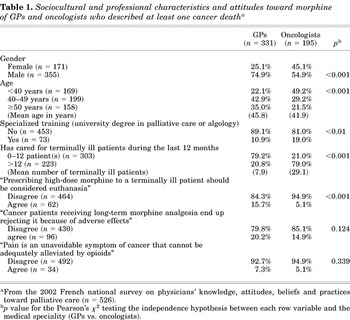
Sociocultural and professional characteristics and attitudes toward morphine of GPs and oncologists who described at least one cancer deatha
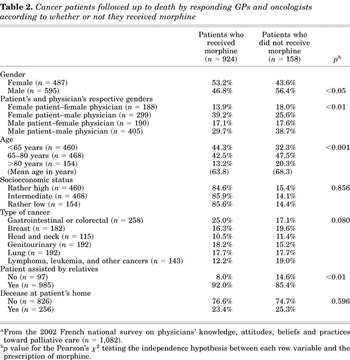
Cancer patients followed up to death by responding GPs and oncologists according to whether or not they received morphine
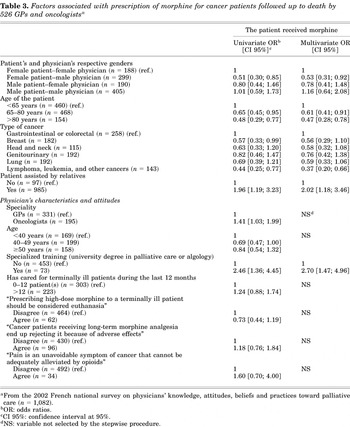
Factors associated with prescription of morphine for cancer patients followed up to death by 526 GPs and oncologistsa
 You have
Access
- 10
- Cited by