INTRODUCTION
Previous studies of the Roman agricultural economy often have not considered the very final stage of crop processing: grinding. This stage is only evidenced by the presence of rotary querns and millstones, and the importance of them to research on the management of grain and flour has been almost entirely overlooked. In a recent volume dedicated to industry and agriculture, querns were discussed only as a commodity and not as an essential component of the agricultural economy.Footnote 1 This oversight is the result of an almost total absence of surveys and syntheses of querns and millstones that convert the data into an accessible form.
The publication of the ‘Rural Settlement of Roman Britain Project’ has gone some way to addressing this problem, but querns and millstones are often not recorded by quern specialists and are commonly reported only summarily or omitted entirely from published reports. It is therefore only with detailed studies like this one, which draw on published reports, grey-literature reports, Historic Environment Records (HER) data and unpublished museum archives, that we can hope to address the glaring omission of querns and millstones from studies of the agricultural economy. Rotary querns and millstones should be considered alongside the archaeobotanical evidence and the remains of corn-driers, granaries, aisled barns and mills, in order to investigate the whole system of grain processing and how it varied both spatially and chronologically.
Excavations spanning over 150 years in the Roman town of Silchester have produced the largest assemblage of querns and millstones from the province, and this material therefore forms the basis of the case study presented here, though consideration is given to other urban centres and the methodology is applicable to other sites.
The civitas capital of Calleva Atrebatum (Silchester) was located about 15 km south of the river Thames. It began life as an oppidum during the late first century BC, when it was fortified with ditches and ramparts but was probably only sparsely populated, some of which might have been seasonal.Footnote 2 After the Claudian invasion of a.d. 43, the town was substantially developed: the Iron Age street plan was replaced with a north–south/east–west grid and public buildings such as the Forum-Basilica were constructed.Footnote 3 Defences were added to the town during the second century and the substantial town walls during the third, along with continued construction following the Roman street grid. Development continued in the fourth century, although in a less ostentatious style, and by the fifth or sixth century the town had been abandoned, leaving the greenfield site we know today.
The location of Silchester was politically significant. It was founded in a liminal position, away from well-populated areas.Footnote 4 Coin evidence suggests that it started out as part of the Southern Kingdom but came to be part of the Eastern Kingdom.Footnote 5 During the latest Iron Age and earliest Roman occupation, objects were being supplied from both within the region likely to have been controlled by the Southern Kingdom and from outside it (for example, briquetage from north Kent).Footnote 6 Did the supply of querns to the town fit with the broad-ranging supply of other material culture? Was quern supply to the town connected to the quern supply of the surrounding countryside? Studies of material culture, notably pottery, have contributed greatly to our interpretation of the relationship between town and country, including Silchester itself,Footnote 7 but querns have rarely been the focus of such research. What does the pattern of quern use in and around Silchester tell us about the relationship between town and country?
Silchester has been extensively excavated over many years, meaning that there is a considerable assemblage of querns to draw on. Most of these have been published in excavation reports; the exceptions have been previously studied and published by the author. Together, they provide the single largest collection of quern fragments from a Romano-British town and a case study that presents the opportunity to scrutinise the interaction between quern manufacturers in a major urban environment.
The region in which Silchester was located can also be described as a landscape of varied but generally marginal agricultural land, which limited the growing of suitable crops. The question of whether the occupants of Silchester could have survived on produce from this hinterland during the later Iron Age and Roman period is being addressed through archaeobotanical studies both within the town and in the wider area.Footnote 8
The querns and millstones from Silchester are used here to investigate how the grinding of grain was organised inside and outside the town. Silchester does not have the structural remains of substantial watermills, such as the Via Medici mills on the Janiculum, which Rome relied on heavily for flour, or the 16-wheeled watermill at Barbegal, which probably produced all the flour required by the residents of the Roman city of Arles.Footnote 9 However, the research presented here encompasses by far the largest number of querns and millstones from a single Romano-British urban/hinterland survey.Footnote 10 These data can be used to continue the conversation about how Britannia's civitas capitals were supplied with flour. Does our understanding of the organisation of grain processing and flour supply change if we consider the querns and millstones in addition to the archaeobotanical and structural evidence?
METHODOLOGY
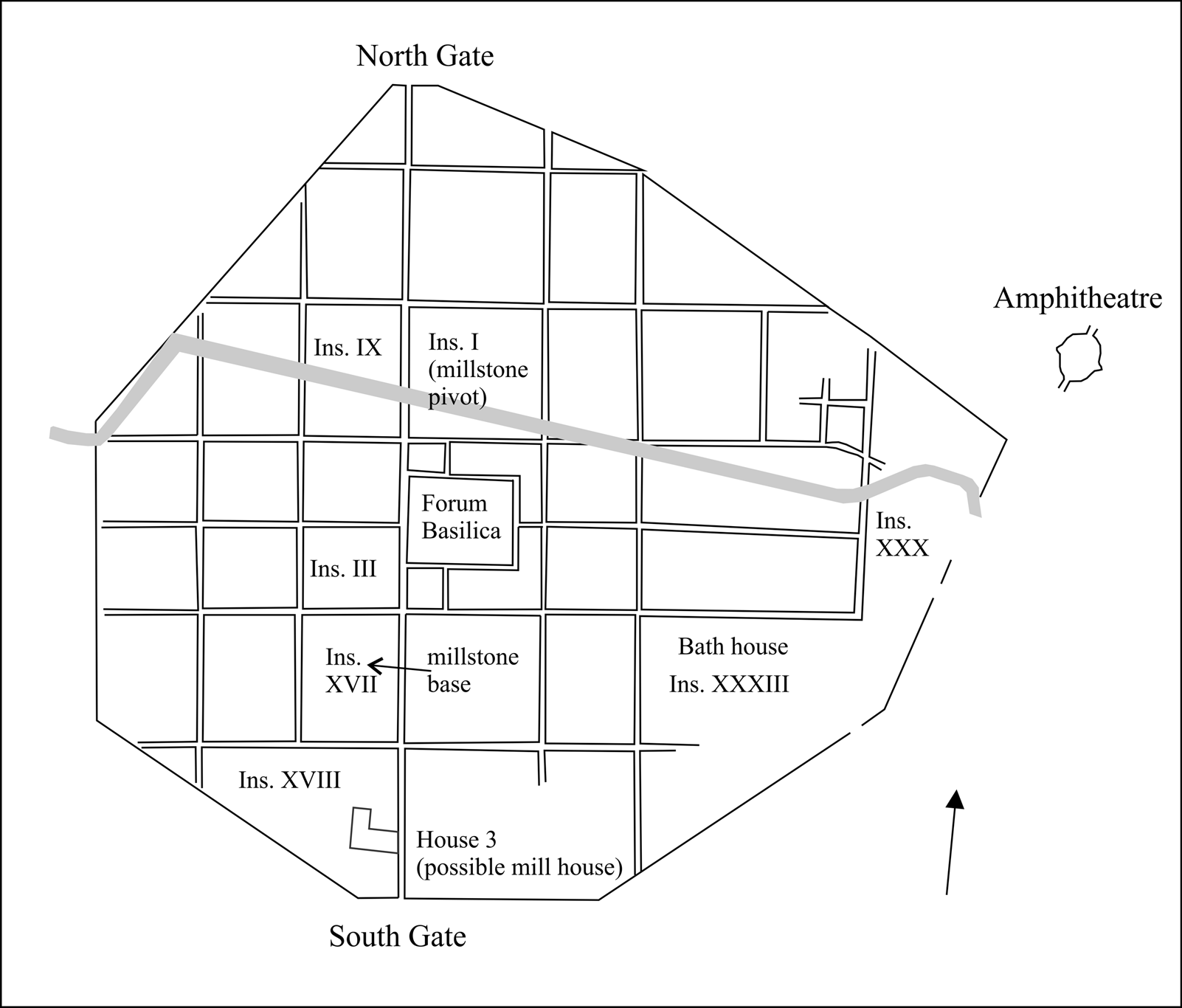
Analysis includes all the querns found in Silchester, except any which may have been found during excavations of the bath-house in Insula 33 (work there being ongoing at the time of writing). This includes finds from the following published resources (fig. 1):
1. The Antiquarian excavations (Reading Museum's Silchester collection, which may include querns recovered during excavations by Molly Cotton, George Boon or Sir Ian Richmond, although none was labelled as such);Footnote 11
2. The South Gate;Footnote 12
3. The Amphitheatre;Footnote 13
4. The North Gate;Footnote 14
5. The Forum-Basilica;Footnote 15
6. Insula IX, Insula III, Insula XXX.Footnote 16
Plan of Silchester showing areas of excavation mentioned in the text.

Calleva Atrebatum was part of a wider landscape of occupation and activity. Its residents interacted with and relied upon the resources supplied by its hinterland and, in some instances, from further afield. The project therefore also utilises data on querns and millstones from the surrounding area, with the main focus on a 20 km-diameter hinterland zone as used in similar quern surveys and in other studies of Silchester's hinterland.Footnote 17 It is difficult, of course, to establish precisely what the ‘hinterland’ of any given town was, but, by using a consistent approach to the data collection (i.e. 20 km), it is hoped that comparisons between surveys will be possible in the future.
The querns from excavations in Insula IX, Insula III and Insula XXX were provided by the University of Reading and were examined by the author. Querns from the Antiquarian excavations had already been personally examined. In all other cases for the Silchester material, publication reports were used as the basis for quantifications. All the information on the querns was entered into a database, which is held by the author.
In order to locate sites with rotary querns and millstones in the region around Silchester, data were compiled from the author's own database, the ‘Rural Settlement of Roman Britain Project’,Footnote 18 local journals, the county HER records for Berkshire, Hampshire, Oxfordshire, Buckinghamshire and Wiltshire, and unpublished material stored at the Museum of Reading.
QUANTIFICATIONS
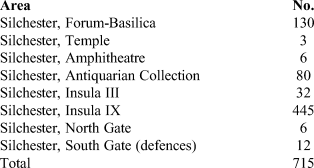
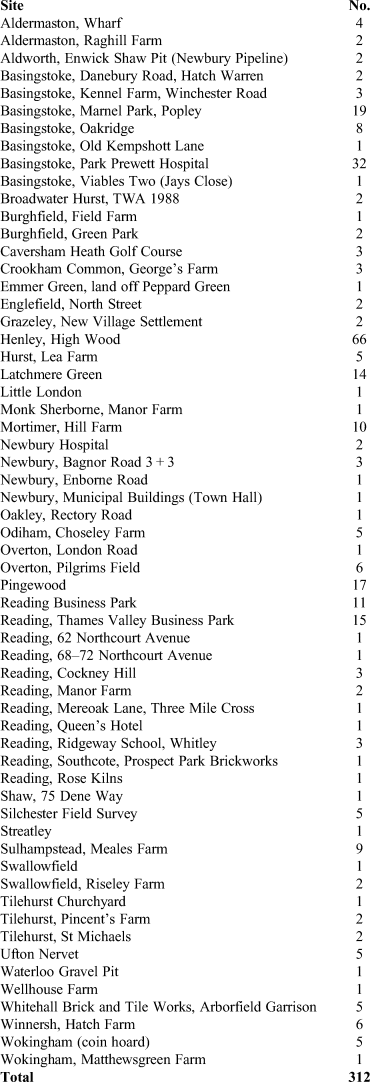
In total, 919 fragments of querns from Silchester were recorded. Using the assumption that fragments from a single context of the same lithology represent the same quern (unless obviously otherwise), these are taken to represent 715 querns (table 1). Information on a further 918 fragments representing 312 querns from 59 sites in a 20 km hinterland zone was also collated (table 2). References for all the sites listed in table 2 can be found in the online supplementary material.
NUMBERS OF QUERNS FROM EXCAVATIONS IN SILCHESTER

NUMBERS OF QUERNS/MILLSTONES FROM SITES IN A 20 KM HINTERLAND ZONE AROUND SILCHESTER

Analysis of quern data was hampered by the poor dating and lack of context information for many specimens recovered during the Antiquarian excavations, which, despite grand plans to record where objects were found, almost entirely lack spatial information.Footnote 19 In addition, the situation is particularly tragic for querns: excavations in Insula IX have demonstrated that the Antiquarian excavators of the late nineteenth and early twentieth century disregarded fragmented querns so much that not only did they not note their presence, but they frequently put them back in the ground to be refound during twenty-first-century re-excavation of their trenches.Footnote 20 These cannot contribute to chronological analysis. Additionally, querns are typically fragmented prior to deposition and are often subject to extensive reuse, meaning residuality can be high and querns can be deposited significantly later than their initial period of use. Retrieval and retention also skew numbers in a way that does not happen with more distinctive artefactual material culture because quern fragments can easily be overlooked during excavation if they are highly fragmented or degraded. Compared with other assemblages in the region, however, the mean fragment weights of the phased Silchester querns range from 157 g at the Forum-Basilica to 1,578 g at the North Gate. As the mean fragment weight of all weighed fragments in the study area is 284 g, it is apparent that the quern fragments from Insula IX (277 g) are of average weight. No greater residuality is suggested than elsewhere in the study area, but their suitability for reuse as hones etc, and the resultant residuality of all quern fragments, means there is little point in anything other than broad chronological analyses.
PART 1: QUERNS AS A COMMODITY
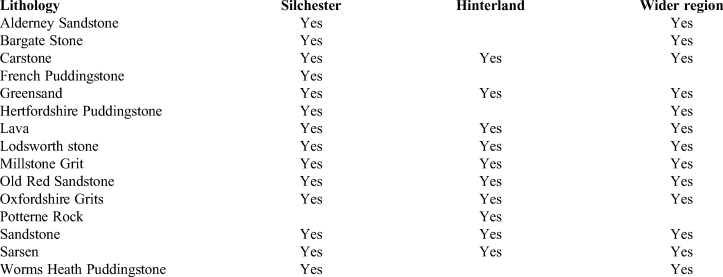
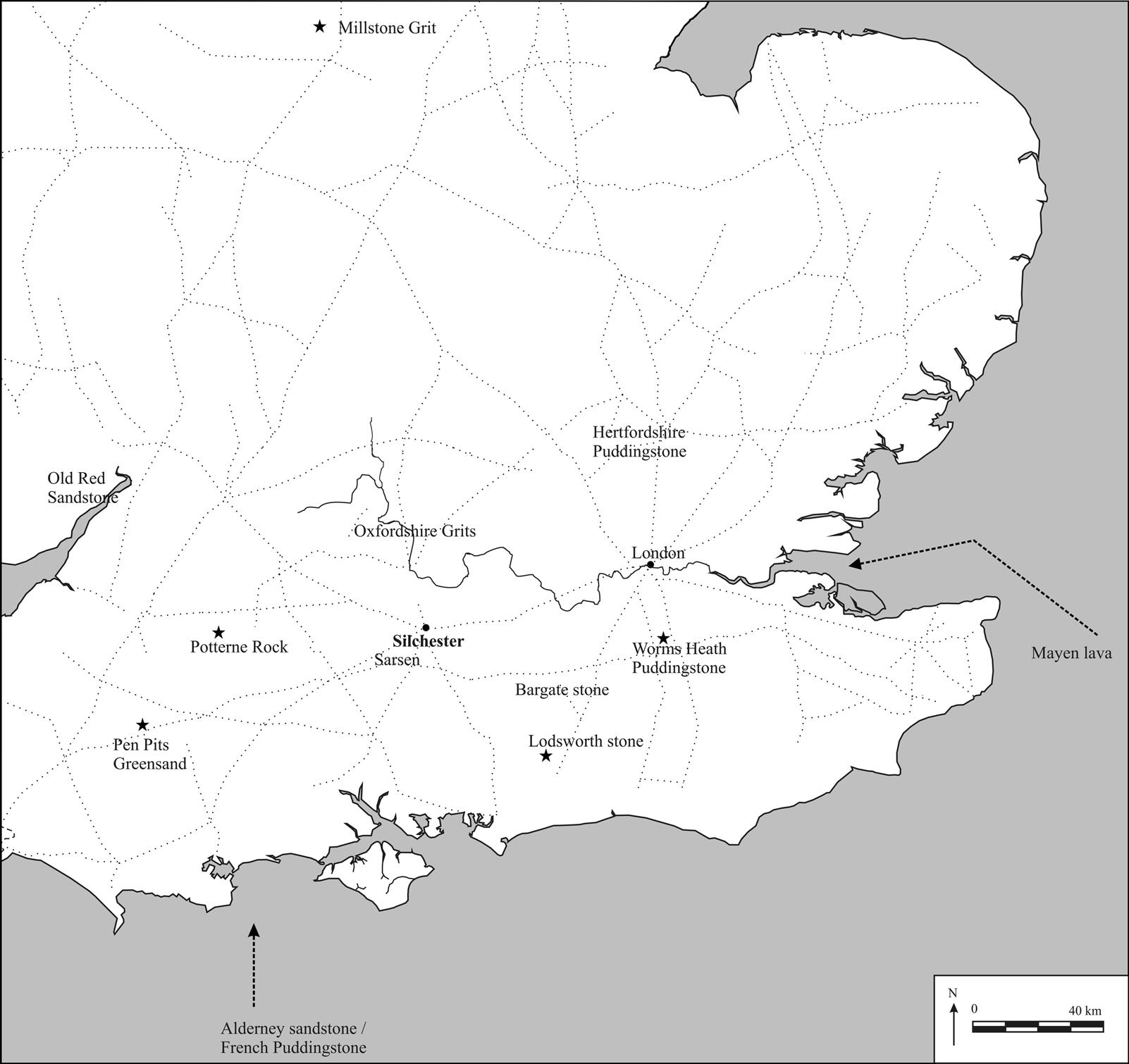
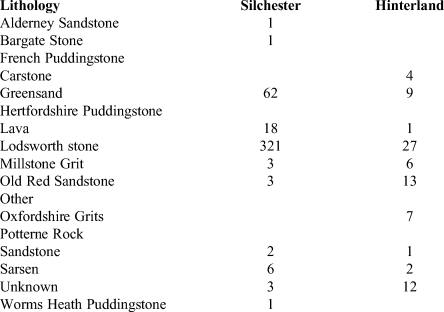
Silchester was located in a region that lacked rocks geologically appropriate for manufacture into querns and, because there were only a handful of major quern-producing quarries, all querns had to be imported to the town. This is true of most Romano-British towns in southern England, but the people of Silchester were ideally placed to obtain their querns from a particularly large range of sources due to the town's position at a major junction in the road network and its location in an area where supply from the major quern quarries overlapped. In total, 15 lithologies were used to make querns and millstones in the north Hampshire/south Berkshire region around Silchester in the Roman period (table 3; described and discussed in detail in online appendix 1 in the supplementary material). Of these, four can be considered to have been major suppliers of querns to the region. These are Lodsworth Greensand (from the south), lava (from the east), Millstone Grit (from the north) and Old Red Sandstone (from the west). There are a further five lithologies for which the source areas are known and a number of other stone types for which the area of origin can only be more broadly established. The quarries (where known) and source areas for these rocks are shown on fig. 2.
PRESENCE AND ABSENCE OF QUERN LITHOLOGIES IN AND AROUND SILCHESTER

Map showing sources of querns supplied to Silchester.

QUERN SUPPLY
Table 3 and fig. 2 illustrate how the Roman town of Silchester had access to an array of quernstones from a multitude of sources across a wide geographical area. Because of the degree of reuse and residuality to which querns are prone, it is only possible to look broadly at the changes between early Roman and late Roman use.
Latest Iron Age to early Roman
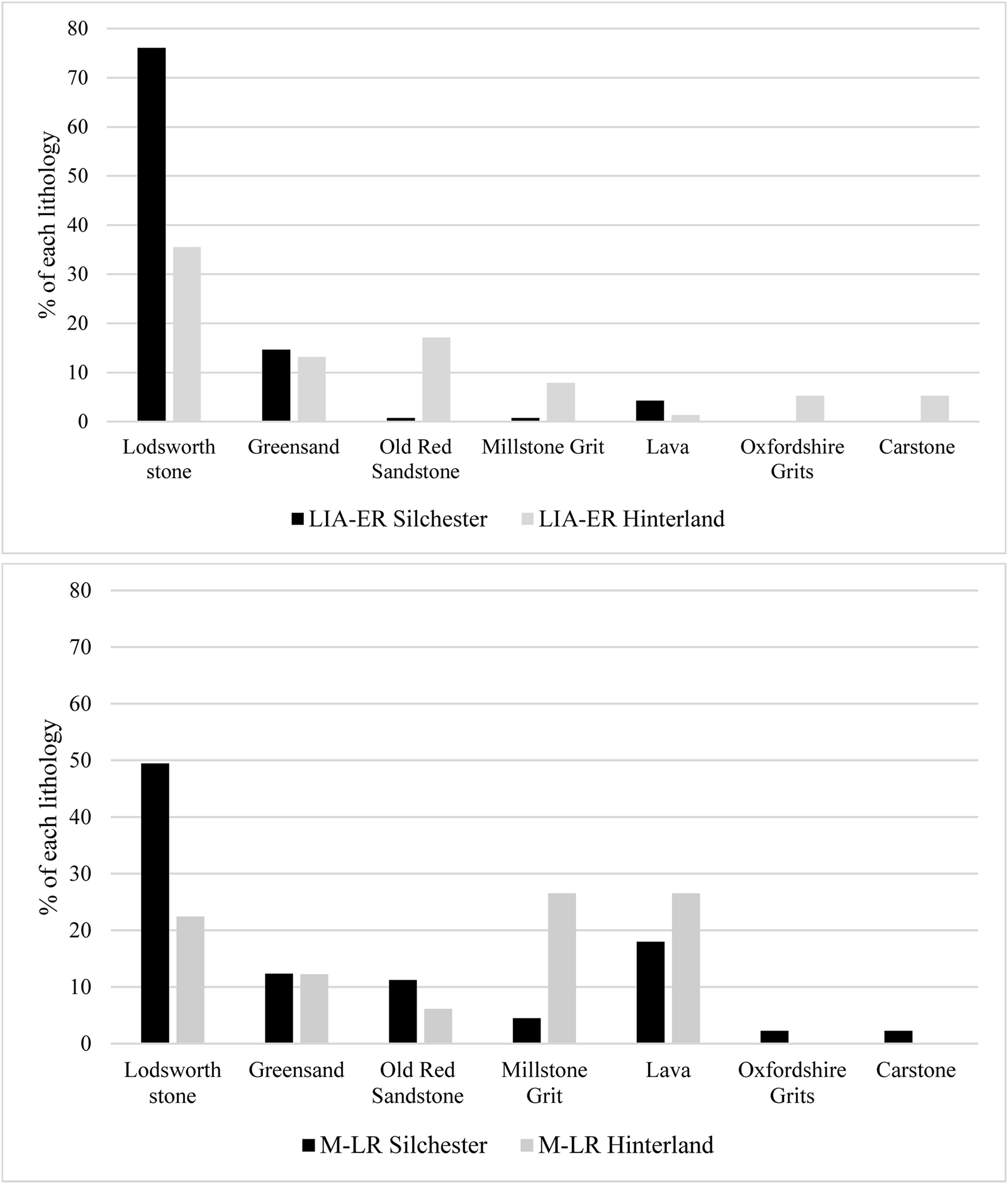
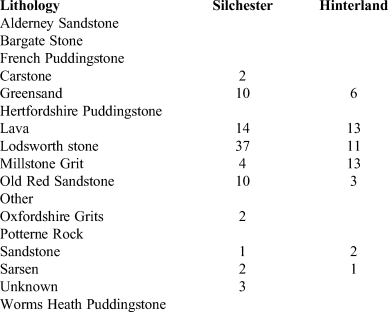
What is unmistakeably clear from an analysis of the early Roman quern lithologies is the dominance of Lodsworth Greensand as a source of querns (table 4; fig. 3). Lodsworth Greensand accounts for 87 per cent of all fragments from the town that could be assigned to Insula IX Periods 0 and 1 (c. 10 b.c. to late first century a.d.) and 76 per cent of the assemblage from all early Roman phases (i.e. Insula IX Periods 2 and 3 incorporating the second century a.d.) (table 4). No other rock types appear to have supplied significant numbers of querns to the town during this period, with other types of Greensand and lava being the only other notable lithologies.
NUMBERS OF LATE IRON AGE TO EARLY ROMAN QUERN LITHOLOGIES IN SILCHESTER AND ITS HINTERLAND

Differences in lithology use between Silchester and its hinterland.

There was much less use of querns from the quarries at Lodsworth in the town's hinterland during the same period, with these accounting for only 35 per cent of all querns. Instead, there was a greater use of querns of other types of Greensand (13 per cent) and Old Red Sandstone (17 per cent). The latter is particularly striking since only three querns (0.7 per cent) of Old Red Sandstone have been found in contexts of early Roman date in Silchester.
There are also differences in the querns from minor sources in the early Roman period. Silchester has produced very small quantities of querns of Alderney Sandstone, sarsen and Worms Heath Puddingstone. The Hertfordshire and French Puddingstone querns probably also date to this period of use, although none was recovered from closely dated contexts. In contrast, in the hinterland there is evidence for the use of querns of ferruginous sandstone or carstone (at Oakridge) and the Oxfordshire Grits (at Ufton Nervet, Kennel Farm and Marnel Park), neither of which is present amongst the Silchester assemblage at this time. These absences must be presumed to be real, since the sample size from Silchester is very large.
Clearly there are marked differences in quern use in the town and outside it, with the people of Silchester utilising querns from sources not seen in the hinterland and people living in the hinterland using querns from sources not seen in Silchester. Silchester also demonstrates a much greater reliance on querns of Lodsworth stone and a much greater consumption of querns generally.
Later Roman period
During the later Roman period there was a significant overall reduction in the importation of querns to the town, and in real terms, therefore, a fall in the numbers of querns from nearly all suppliers. There were, however, changes in provenance and relative frequency (table 5; fig. 3). Querns from the quarries at Lodsworth reduced in overall proportion but remained the most numerous at 45 per cent of the late Roman assemblages. Other types of Greensand remained at a comparable proportion to the early Roman period, but there was a significant increase in the proportion of querns that came from the Old Red Sandstone quarries to the west and of imported lava, and a very minor increase in the proportion of Millstone Grit querns. The actual number of Old Red Sandstone querns also increased (from three to ten). Some of the querns of materials common in the first half of the Roman period, such as Lodsworth stone, will almost certainly have been residual by the time they occurred in third- and fourth-century contexts. In this case, the increase in the use of other stone types may be more significant than the proportions suggest. The increase in the use of Old Red Sandstone and Millstone Grit, in particular, may relate to an increased emphasis on millstones, for which both stone types were more commonly used than Lodsworth stone. There was also a reduction in the number of quernstone lithologies present in the town, with no querns from the later Roman period of Alderney Sandstone, Bargate Stone or any of the puddingstone types.
NUMBERS OF MID- TO LATE ROMAN QUERN LITHOLOGIES IN SILCHESTER AND ITS HINTERLAND

This reduction in the use of querns from minor suppliers is visible in both the town and country. Carstone, previously popular in the hinterland, went out of use by the late Roman period, as did the Oxfordshire Grits, although two fragments of it were found in late Roman contexts at Silchester. This change in the provenance of querns is seen widely across southern Britain at this time.
The frequently poor quality of petrographic analysis in publication reports means some querns could not be assigned to a lithology, which leads to some uncertainty in the overall proportions. Nevertheless, significant differences between town and hinterland are clear (fig. 3). Firstly, whilst the use of Lodsworth stone querns decreased in both areas during the late Roman period, the proportion of querns of Lodsworth stone in the hinterland is much lower than in the town at only 22 per cent compared to 49 per cent. Instead, querns of lava and Millstone Grit were more numerous, so that there was no single dominant source in the hinterland. Most significantly, the importance of Millstone Grit querns in the hinterland is in clear contrast to the situation in the town, where Old Red Sandstone querns were more numerous both relatively (12.3 per cent versus 6.1 per cent) and in absolute numbers (ten querns versus three querns).
REGIONAL PREFERENCES
In order to understand these differences, it is worth considering the many querns from sites outside Silchester that have been only broadly phased as Roman. Plotting all these querns on maps reveals that patterns of quern use in Silchester's hinterland and the wider region were not geographically uniform (fig. 4). Querns of Old Red Sandstone, Millstone Grit and lava occur almost entirely to the north of the town, except for some Old Red Sandstone querns to the south-west and a few instances of lava querns and Millstone Grit querns in the area around Basingstoke, populated by numerous farmsteads. Querns of Lodsworth stone were widely distributed across the whole region.
Distribution of rotary querns around Silchester: (a) Lodsworth stone, (b) Old Red Sandstone, (c) Millstone Grit, (d) lava.

The combined evidence reveals a difference in quern exploitation between town and country and a pattern of use in the region that was not uniform, but how is this best explained? Querns (probably) represent a once- or twice-in-a-lifetime purchase, and sales of such items are not likely to have been especially frequent. An urban centre serving the needs of a large population might in practical terms have been a good place to access a range of customers, whilst those in need of a quern could feel comfortably reassured that a trip to the town would certainly furnish them with the required equipment. If Silchester was the primary source for querns in its hinterland, we would reasonably expect an even geographical spread of stone types around the town – this representing a standard fall-off. We might also anticipate a clear correlation between quern use in the town and outside it. However, querns of Millstone Grit, Old Red Sandstone and lava were clearly in plentiful supply, based on their frequent occurrences north, east and west of Silchester, and yet they appear to have been far less commonly used in the town and to the south of it.
If querns were not distributed from Silchester that would at least partly explain the lack of uniformity between the town and its hinterland. Such an explanation would be in keeping with analysis of the pottery, which suggests that Silchester was the destination (i.e. the consumer) of some imported pottery and not the onward distributor of these types to the hinterland.Footnote 21 Indeed, secondary distribution points for querns were certainly not always in towns, as demonstrated by the rural site of Ashton Keynes in Gloucestershire, which produced an unusually large number of querns.Footnote 22 It is likely to have served as a processing centre that received dried and threshed grain from other sites and then redistributed the processed flour, but it also played a role in distributing the querns themselves.Footnote 23
There is also a significant change in the use of querns in the area between Silchester and Basingstoke. Quern use in Silchester had its closest affinities with the region to the south of Basingstoke. In Roman Surrey, Sussex and southern Hampshire, querns of Lodsworth stone were far and away the most commonly used, as in Silchester. This is presumably a result of the proximity of the quarry and the high quality of its products, but the small area around Basingstoke demonstrates quern use more closely reflected in patterns north of Silchester. In particular, sites in this area include querns of the Oxfordshire Grits in the early period and favour querns of lava and Millstone Grit in the later period compared to the Lodsworth stone and Old Red Sandstone seen in Silchester at the same time.
As quern use in Silchester was noticeably different from that in its hinterland, we must pose the question of whether that is because it had closer affinities with other towns in the broad region and whether urban quern supply was organised very differently to rural supply. This is not easy to determine because no other towns and few settlements have had their entire quern collections systematically recorded, analysed, interpreted and published. Data are now available on querns from a number of towns in the general area, which can be used to draw some broad conclusions, but detailed surveys of entire urban assemblages will be required to ascertain whether this initial analysis is correct. Because of the lack of comparable surveys, comparison with the initial data for those sites broadly considered to be urban has been undertaken. This includes civitas capitals, defended small towns and nucleated settlements/small towns because, from the perspective of quern supply, the precise classification is not significant. This initial analysis indicates that heavy reliance on one lithology was typical at urban sites (fig. 5) and, in this regard, the pattern of use we see at Silchester is paralleled at other towns (even though the favoured stone type might be different).
Quern preferences in Roman towns.

The initial results suggest that the Roman town of Silchester sat between an area where urban quern supplies were dominated by Old Red Sandstone querns (to the north and west, for example at Wanborough and Dorchester) and one where they were dominated by Greensand querns (to the south, for example at Winchester and Neatham). Despite the affiliations of rural sites to the south of Silchester with querns from the north, Silchester's quern supply clearly stems from the south. Millstone Grit quarries were obviously not a significant supplier of querns to urban contexts in southern Roman Britain despite their common occurrence across the region around Silchester and to the north if it. In this regard, Silchester is comparable to other towns in the region.
The evidence suggests it was typical for Roman towns in this area to have a preferred supplier of querns, whilst still using querns from other sources. This main supplier was sometimes the dominant stone type of the local area, for example Old Red Sandstone was the main supplier of Dorchester and Wanborough and was also the typical stone type in use in the region around those towns. If Silchester was absorbing surpluses from the surrounding countryside as might be the case at Dorchester and Wanborough,Footnote 24 we might logically still expect a closer relationship between quern use inside and outside the town. That is not what we see. So why are querns of Old Red Sandstone, lava and Millstone Grit common north of Silchester but not in it? Why does the pattern of quern use in Silchester have such close affinities to both major towns to the south and east of it and to the general area south of it, but such a difference from the farmsteads immediately to the south?
At first glance, fig. 5 perhaps suggests that the river Thames, some 14 km north of Silchester, is part of the explanation. The river functioned as a means of transportation and aided the movement of goods both upstream and downstream. It probably also served as the northern border of the Atrebates territoryFootnote 25 and may therefore have limited as well as aided the movement of goods. However, even if it was a boundary in an official sense, it does not appear to have served as a barrier to the movement of querns. The river Thames was easily crossable by boat to the north of Silchester, being neither particularly wide nor having a consistently strong current. Querns of the Oxfordshire Grits, which are mostly to be found on the northern side of the river and upstream, are found on the southern side of the river at sites near modern Basingstoke.Footnote 26 Equally, querns of Lodsworth stone are common finds north of the river Thames.Footnote 27
DISCUSSION
The supply of querns to the town in the post-conquest period appears to be a continuation of economic or social links established during the founding of the town. As highlighted in the introduction, Silchester was founded in a liminal location both geographically and economically: away from the Thames valley and within the territory likely to have been controlled by the Southern Kingdom, but between three major power blocks.Footnote 28 The location within the Southern Kingdom appears, for the supply of querns, to have been the most important factor, with limited inroads made by other suppliers. However, whether this dominance is a reflection of economic control, with residents of the town having little say in the provenance of their querns, or the continuation of group preferences is difficult to say.
If people made their own decisions, both at an individual level and at a group level, then these choices were influenced by social or cultural norms. Perhaps people in the countryside immediately around Silchester were actively spurning querns of Lodsworth Greensand in favour of querns of other imported stones. If so, why? There was probably little difference in the functional operation of these stone types, so there must be another explanation.
Ethnographical studies have been key in our attempt to understand the social and cultural significance of querns. They reveal that cereal grinding was carried out almost exclusively by women and in a domestic setting; each woman is likely to have spent several hours each day preparing flour.Footnote 29 What is more, a quern was likely to have belonged to the woman herself, rather than the wider household group, and as such was probably a lifetime possession. She might have inherited or been gifted one when she married or set up her own household, and in some cultures this is seen as a ‘rite-of-passage’.Footnote 30 With this in mind, it is clear that querns should be regarded as highly important objects with significant social value to the women who used them. The length of time such an object remained in use, along with its personal value, suggest therefore that changes in appearance, through a new stone type or morphology, may have had more cultural significance than for other domestic tools.
Querns were not ‘on show’ like many other forms of material culture, but a very regional selection of forms developed during the Late Iron Age, nonetheless. As the Roman period progressed there was an increasingly uniform set of rotary-quern designs in southern Britain, coupled with a reduction in the number of stone types from which they were made. This change to quern production and distribution is undoubtedly an effect of the Roman conquest, whether that be some state control of quern production or individual (female) or group decisions to adopt more ‘Roman’ material culture. The choices available to women or groups reduced during the Roman period, but it would have been rarely the case that only a single design of quern or single stone type would have been available if free choice was in operation. Although a reduction in the number of quern forms available may have limited the opportunity to express social or cultural identities, a choice of stone types allowed this to continue. Even factoring in the potential effects of the residuality of quern fragments, the continued use of querns of an essentially Iron Age form and material in Silchester (in comparison to the surrounding region, which would have shared the same attitudes to stone as a resource) may suggest that the occupants of Silchester had a longer-lasting connection to the material culture of the previous era than those of the surrounding countryside.
Finally, comment needs to be made on the presence of querns of puddingstone from France and sandstone from the Channel Islands or northern France. These are best explained as being the objects of individual travellers. Elsewhere, the manufacture of a quern in Somerset out of local stone but in a foreign style suggested to the author the permanent relocation of an individual from Spain, Ireland or Scotland to northern Somerset.Footnote 31 The French querns at Silchester are evidence of the movement of individuals, but this time from Gaul to Britain. Their presence supports the argument that Gallic traders were present in the town and demonstrates that querns can, like other forms of material culture, be evidence of ethnicity.Footnote 32 It is unlikely (given the tiny numbers of French Puddingstone or Alderney Sandstone querns) that the Gallic traders brought querns to trade, however, and it is probable that a quern was part of their travelling equipment, which wore out or broke during a visit, or that it was a one-off gift to garner favour.
CONCLUSIONS
Analysis of the substantial assemblage of querns from the Roman town of Silchester has corroborated the patterns seen in assemblages from single areas of excavation in the town, notably that the Lodsworth quarries, some 57 km to the south, were the principal supplier of querns to the town, particularly during the early Roman period. This dominance hints at either state management of quern supply to the town or strong and long-lasting economic and cultural links with the region in which the Lodsworth quarries were located.
The differences in quern use between Silchester and its hinterland suggest that people living in the area around Silchester did not obtain their querns from the town but probably from other intermediate sources. Whatever the distribution mechanism, the contrasting patterns of quern use seen in the area immediately to the south of Silchester suggest that rural populations there made their choices quite independently of supply to Silchester. This deliberate and distinct decision-making in the Basingstoke area has also been observed in the continued use of Silchester ware vessels there in the later first century a.d. after it had gone out of use in the rest of the region.Footnote 33 This choice suggests a resistance to change that is in contrast to the quern usage, which indicates a rapid change not seen in Silchester, but both could result from the same desire to maintain a regional identity that was distinct from that in the town and supports previous conclusions that Silchester was not economically integrated with the countryside surrounding it.Footnote 34
By understanding querns as a commodity – where they were traded and used – it has been possible to determine that where these occasionally purchased high-value items are concerned there was a notable distinction between the way they were supplied to Silchester in comparison to its hinterland. But querns were also a tool that played an integral role in the agricultural economy, in commercial premises and in domestic settings, and, by studying the same assemblage in an alternative way, we are able to address a completely different set of aims and objectives.
PART 2: QUERNS FOR FOOD AND DRINK
Querns and millstones are primarily assumed to have been used in the grinding of grain for flour. That is because evidence of their use to grind medicines, pottery temper, pigments and metal ores such as iron, silver and lead is scant.Footnote 35 It has been suggested that rotary querns found in a ‘dye house’ in Insula X at Silchester had been used to grind the roots of the madder plant.Footnote 36 However, none of the Silchester querns is stained with the purple-brown colour seen on pottery that had contained madder dye,Footnote 37 and the idea that the circular furnaces were used for dyeing has now been discredited.Footnote 38 Querns have also been found in Roman metal-working contexts in Spain and on industrial sites in the UK, for example at the Dolaucothi gold mines and the lead-mining site at Lower Machen, where they may have been used for milling gold and lead ore, respectively.Footnote 39 However, it has been noted that querns would not necessarily have been well suited to grinding ore, and ore could be crushed effectively on suitably flat rocks.Footnote 40
It is much more likely that the vast majority of querns were used to process foodstuffs. In addition to flour, there is a very strong case for the use of querns (and millstones) in the malting process. To make ale from cereal grain, the grains must be soaked for a few days and spread out to allow them to germinate. Once the germination process has begun, it must be halted before completion by carefully drying the sprouted grain in an oven.Footnote 41 This drying could have been carried out in the same oven that was used for general grain drying and, indeed, during medieval times baking and brewing houses were often combined.Footnote 42
The dried, sprouted grains (the malt) must then be crushed. This crushing enables the starch from the endosperm and the enzymes from the aleurone layer, which have been activated by germination, to mix and convert from starch into sugars.Footnote 43 Although it has been said that grinding malt with millstones produces an inferior finished product than when the malt is simply crushed,Footnote 44 there is plenty of documentary evidence to suggest that millstones were used in this way. Querns and mills were certainly used for grinding malt to make beer in the sixteenth and seventeenth centuries, and, whilst some mills ground grains for both drink and for bread, other mills ground only grain or only malt.Footnote 45 Indeed, it was preferable not to use millstones to grind grain if they had previously been used to grind malt because the flavour of the malt tainted the flavour of the flour.Footnote 46
Malting has been identified through archaeobotanical evidence at a number of Roman sites, and at many of these there are numerous querns and millstones. The villa at Northfleet, for example, produced malt and probably ale on a large scale as indicated by abundant sprouted grains.Footnote 47 It is likely that the malt was crushed at a mill very close to the site, as evidenced by numerous millstone fragments.Footnote 48 This association between millstones and malting was also identified during the ‘Rural Settlement of Roman Britain Project’, where archaeobotanical evidence for malting was found at 16 per cent of sites with millstones, compared with 3 per cent of sites overall.Footnote 49 Whilst it is not possible to be certain that querns or millstones were used to crush malt, it does seem likely. As well as larger millstones, querns are also often found at sites where the archaeobotanical evidence demonstrates malting, for example at Roman malting houses at Stebbings Green (Essex), Weedon Hill (Buckinghamshire), Beck Row (Suffolk) and many more.Footnote 50
Malting occurred at roadside settlements to provide refreshments for travellers,Footnote 51 but beer was probably also made close to the point of consumption because of difficulties transporting it. With the Bloomberg tablets now providing evidence for brewing in Roman London,Footnote 52 it seems likely that brewing occurred in larger towns as well as at roadside settlements, and it is therefore likely that not only did brewing occur in Silchester but that some of the malt was ground using querns or millstones.
As in other periods, querns and millstones could have been used for a variety of other purposes. They could have ground oats and were well suited to the crushing of legumes, lentils, nuts and seeds from oil plants such as flax, not just for human consumption but in the production of animal feed. Whilst this is hard to identify in the archaeological record, documentary evidence for the produce of medieval mills shows that oats were the main produce in some regions, whilst other mills ground peas and beans for animal feed.Footnote 53 It is clear from archaeobotanical evidence that legumes, lentils and seeds from oil plants were grown and processed in Roman Britain. Lentils are mainly found in the assemblages of charred plant remains from major towns and military sites, and, although use on rural settlements is increasingly being recognised across central and southern England, there is little evidence for intensive use.Footnote 54 Other foodstuffs that could have been ground with querns during the Roman period include salt, acorns and fish, but, again, evidence is scant.Footnote 55 It is therefore reasonable to continue with the assumption that querns and millstones were mainly used for to prepare flour, with some used to crush malt.
GRINDING PRACTICES IN LATE IRON AGE AND ROMANO-BRITISH SILCHESTER
It is clear that both querns and millstones could be used in a range of tasks. The vast majority of British-made querns were made from sandstones. These range from fine to medium grained (such as the Lodsworth stone) through to the coarse-grained sandstones and gritstones of the Millstone Grit. It is possible that some grades were better suited to grinding particular substances or that the coarser stones were more useful for hulling than fine grinding, but we lack any experimental archaeology to offer insights into this. Alternative functions have been considered above, but the production of flour remains the most likely use for most and is considered here to be the primary function. In order to gain an understanding of how grain processing may have changed over time within the town, consideration is given here to all querns and millstones from securely dated contexts.
The latest Iron Age and earliest Roman period
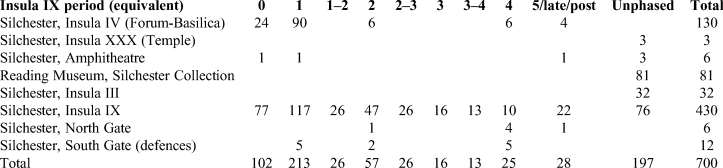
This phase includes all querns from Insula IX Periods 0 and 1 and those from elsewhere in the town equating to the same periods (table 6). Quern fragments are common finds in Late Iron Age contexts in Silchester. After pottery and metal-working moulds and crucibles, they are the most numerous finds from excavations of the Forum-Basilica.Footnote 56 In total, Period 0 (or equivalent) produced fragments from 77 querns in Insula IX and 24 fragments from the Forum-Basilica.Footnote 57 A further 117 fragments were found in Period 1 contexts in Insula IX and 90 fragments in the same phase at the Forum-Basilica. Elsewhere in the town, querns of this period have been found at the South Gate and the Amphitheatre.
QUERN NUMBERS BY INSULA IX PHASE

Rotary quern use was evidently high at this time, a fact that is supported by the archaeobotanical evidence from Insula IX, which has demonstrated that Late Iron Age Silchester was involved in crop processing, namely the dehusking of unsieved spelt spikelets.Footnote 58 Analysis of the spatial distribution of crop-processing waste suggests later stages of crop processing occurred widely in households, whilst the early stages probably occurred outside the town.Footnote 59
In the area around the Forum-Basilica, the crops were largely clean, with chaff fragments almost entirely absent from pre-conquest contexts, suggesting that crop processing did not occur in this part of town at any significant level after the conquest.Footnote 60 The high number of quern fragments found here presumably relates to the recycling of old querns from elsewhere in the town.
The waterlogged samples from this period suggest that, in addition to cereals, flax was also grown. Both seeds and capsules were frequent in Period 0 and Period 1 deposits in Insula IX and their occurrence in a range of deposit types suggests they were regularly used and/or processed within that insula.Footnote 61 The possibility that it was grown for fibres which could be used in textile manufacture should not be overlooked, and some of the by-product was certainly used for animal fodder.Footnote 62 However, it is also possible that the flax was initially grown for human consumption. Peas/beans were also grown, and some or all of these may also have been processed using rotary querns. In order to obtain linseed oil from flax seeds, for example, the seeds would have been roasted in an oven then crushed to a powder using mortars, rotary querns or millstones. The powder would typically have been soaked in water and then pressed to remove the oil. The remaining cake of pulp was then reground and sometimes mixed with other grains for use as animal fodder so that little or nothing went to waste.Footnote 63
Later first to mid-second century (Insula IX Period 2, Forum-Basilica Period 5)
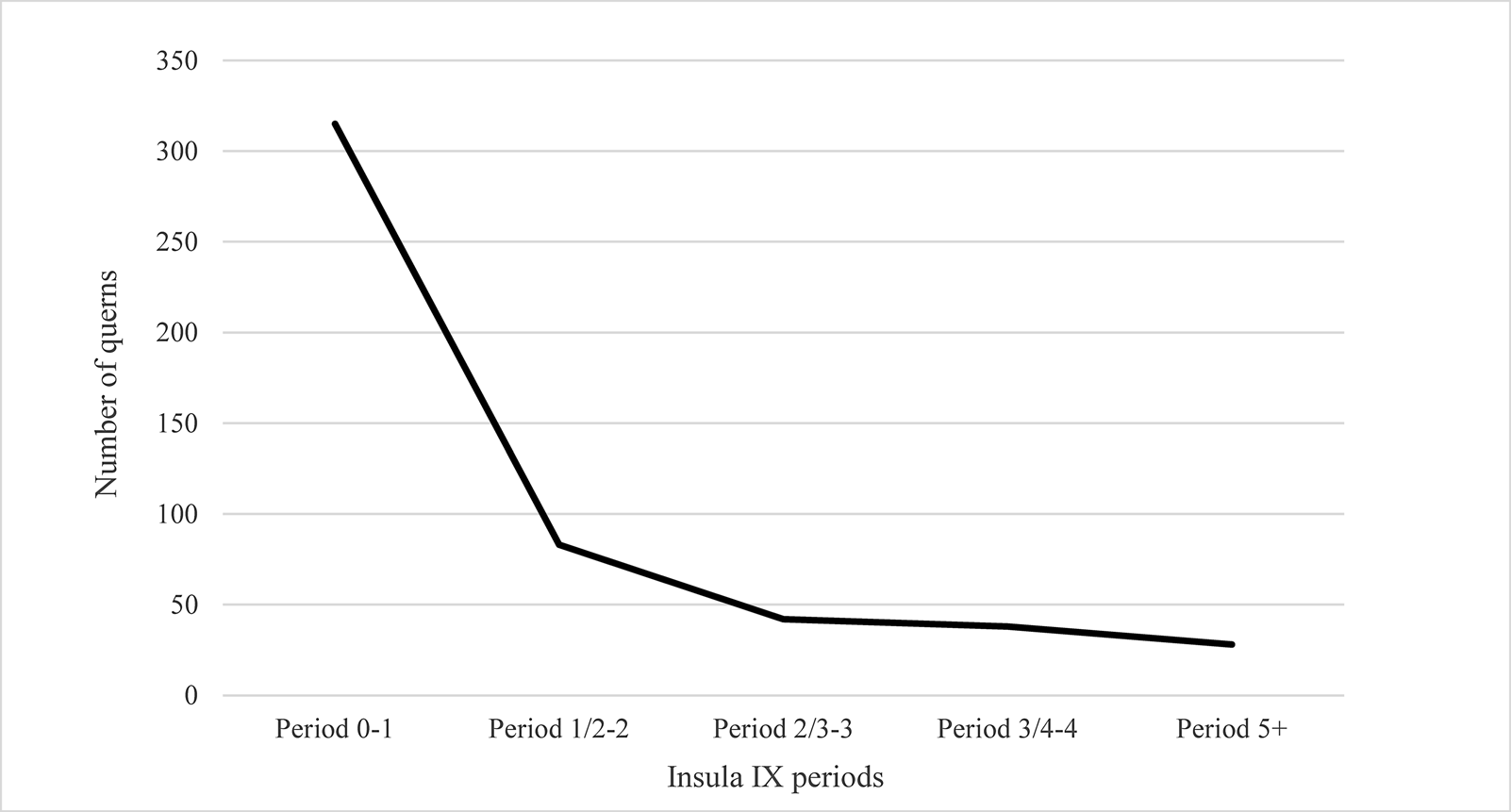
During the later first to mid-second century, the number of quern fragments being deposited in the ground decreased significantly, with 109 fragments in total from Periods 1–2, 2 and 2–3 (fig. 6). This is clearly a significantly smaller number of querns than in the latest Iron Age and early first century a.d., and suggests a fundamental modification to the way grain was ground in the city. This change is supported by the archaeobotanical evidence, which indicates that agricultural practices underwent major changes during the late first to early second century, with a reduction in the amount of spelt being grown and processed either locally or more widely and far fewer pulses and no flax.Footnote 64 In Insula IX this coincided with a significant reduction in early-stage crop processing and presumably in the associated cultivation from the late first century a.d.Footnote 65
Numbers of querns deposited over time in Silchester (based on Insula IX project phasing).

Mid-second century onwards (Insula IX Period 3+, Forum-Basilica Period 6+)
From the mid-second century onwards, quern deposition was much reduced compared with the earliest occupation, and by the later Roman period (third century onwards) this reduced further, with only 53 querns deposited in late or post-Roman contexts (not including those from Victorian contexts).
The significant reduction in the deposition of quern fragments from the second century onwards correlates well with charred plant remains becoming far less frequent in Insula IX during Periods 3–4 and the late Roman period. This indicates that crop processing no longer took place within the insula, except for some hand cleaning of grain.Footnote 66 Flax is also absent and legumes were found in only one fourth-century deposit. This environmental evidence suggests either that the processing of cereals took place elsewhere in the town or, as suggested by the quern data, that cereal grain now reached Silchester already processed.Footnote 67
The second-century decrease in evidence for domestic-level crop processing within the town also coincides with the development of specialised rural settlements, focusing on specific crops such as hay or cereals, and with the increased use of corn-driers on rural sites such as Bagnor Road, Newbury, where they are evidence for large-scale cereal processing.Footnote 68 In addition, weed analysis suggests that spelt wheat started to be cultivated on more difficult clay soils. Lisa Lodwick infers that these increases in processing technologies generated a surplus and that these surpluses went to towns.Footnote 69 For this evidence to accord well with the falling quern numbers, the grain must have been brought to Silchester for centralised grinding at an out-of-town mill, with little grain reaching the central urban environment at all.
CENTRALISATION
Millstones indicate some centralisation of the final stages of crop processing. Following Shaffrey Reference Shaffrey2015a, any quernstone over 50 cm in diameter has been classified as a millstone. Using this criterion, a total of nine millstones have been found inside Silchester (plus three ‘possibles’) as well as a millstone pivot (see fig. 1).Footnote 70 These comprise a Pompeian-style mill (in multiple fragments) and eight flat disc-type millstones measuring between 50 and 70 cm in diameter, with most measuring only 50 cm or just above.Footnote 71
Nine millstones offer good potential evidence for the existence of a mill (or mills) either inside the town or just outside it. The Pompeian-style mill evidences a slave- or animal-powered mill around the mid-first century a.d., presumably inside the town, whilst the disc millstones could have been associated with something similar inside/outside the town or a water-powered mill outside it. The Pompeian-style millstone sets the precedent for animal- or slave-powered milling, which may have continued with a conversion to disc millstones. In House 3 in Insula 18, W.H. St John Hope and George Fox recorded a set of flint rubble plinths, from 4 feet to 4 feet 6 inches in diameter and about 2 feet high, positioned 5 feet from the northern and southern walls, with 5 feet between each row.Footnote 72 They interpreted these as the bases for millstones. Their height from the ground suggests that they are more likely to have been bases for disc millstones than the Pompeian type, since the latter were already quite tall. Their diameters (121–37 cm) suggest that they were purposely much wider than the millstones so that the flour could be gathered up from the plinths, rather than from the floor.
These might be a simple form of mill comparable to the Iberian pushing mill that was mainly in use during the fourth and third centuries b.c. in Spain. Iberian rotary pushing mills comprised millstones of close to or exceeding 50 cm diameter mounted on podia of between 50 and 110 cm diameter and with heights ranging from 28 to 60 cm.Footnote 73 They were operated with the use of a horizontal lever by one or two people as they lacked sufficient space around them for the use of animal traction. Given this similarity, and the known existence of a Pompeian millstone of mid-first-century date in Silchester, it is tempting to view these smaller millstones as originating in mill properties like that seen in House 3 with a setup comparable to the Iberian pushing mills.
However, at the watermill at Ickham in Kent, the millstone assemblage incudes smaller millstones in the range of 50–60 cm and a number of querns of varying sizes.Footnote 74 The reason for the range of sizes at Ickham is not clear, but, since there is no indication that there is a chronological pattern, we can only presume that a range of sizes was employed in the mill. Thus, the small Silchester millstones, whilst perhaps hinting at animal or human power, may have been used in a watermill and brought into the town for reuse.
If a watermill (or mills) existed close to Silchester, the nearest substantial water sources are the river Loddon 5 km to the south-east and the river Kennet 5 km to the north-west. The water supply at the latter was sufficient to power a watermill in Aldermaston at the time of Domesday, and on the river Loddon there were later watermills at Stratfield Saye (7 km east) and Sherfield-on-Loddon (6 km south).Footnote 75 A watermill is also recorded in the Domesday Book at Stratfield Mortimer, some 3 km to the north-east, possibly located on the Foudry Brook.Footnote 76 Any of these watercourses could have supported a Roman watermill, now lost to more recent structures or to movements in river channels, and there are more minor watercourses nearer the Roman town that could be considered as possible sites.
An out-of-town location for a watermill supplying flour to Silchester would be in keeping with the archaeobotanical evidence, which reveals that peripheral urban sites have produced evidence of fine-sieving by-products, suggesting that crop processing occurred at edge-of-town locations.Footnote 77 Even grain for household grinding could have been obtained from a mill outside town, negating the need for grain storage inside town, although we know that clean grain was transported to some towns because burnt stores of it have been recorded in Colchester, London, Verulamium and York.Footnote 78 However, nothing similar has been identified at Silchester, nor have any grain pests been identified that would have resulted from such storage, and it is possible that bulk grain storage did not take place within Silchester during the Roman period.Footnote 79
Although the Pompeian millstone could have arrived in Silchester pre-fragmented for reuse as hones, there is nowhere nearby more likely to have had a Pompeian millstone than Silchester itself and it therefore seems highly likely that a Pompeian mill was in operation in the town. Its presence suggests that the idea of centralised milling arrived in Silchester very early but it is not necessarily evidence for the large-scale industrial bakeries seen in Pompeii. If such premises were in operation at Silchester, we might reasonably expect to have found a much higher number of fragments of such millstones. David Williams and David Peacock put forward a theory that Pompeian-style millstones were used to produce ‘Mediterranean delicacies’.Footnote 80 There may also have been added appeal in the use of the millstones themselves. As they were different from anything else in use in early Roman Britain, the stones may have been a visual link to the wider Roman world and an exotic feature of the bakery. We do not know how milling and baking were spatially organised in Silchester. The concentration of strip-buildings suggests the zonation of shops and businesses,Footnote 81 but as bakeries were selling low-value ‘convenience goods’ they would need to have been located on the main thoroughfares in order to access customers rather than being concentrated in one part of town.Footnote 82 Grinding was usually carried out in association with baking in commercial settings in the Roman world (unless waterpower was utilised), giving some clues as to the whereabouts of bakeries.Footnote 83 The scant data on the locations of millstone placements in Silchester hints at a focus along the main north–south road (fig. 1), while analysis of circular ovens in the town, possibly used for brewing or baking, found them to be concentrated in the north-west quadrant, with several close to the main thoroughfares into town from the West and North Gates.Footnote 84 Passing trade along the thoroughfares might have been drawn in by an exotic millstone feature that would have helped provide and sell alternative baked goods, like those indicated by the Silchester pastrycook's mould, interpreted as having been used for the baking of fancy cakes or sweetmeats.Footnote 85
Other than the Pompeian mill fragments, which were found in mid-first-century contexts in Insula IX, the millstones are all from the Antiquarian excavations and lack close dating. It is tempting to view the smaller millstones as contemporary with the intensive period of grain processing outlined above because of their similarity to the early Iberian mills. Analysis of the chronology of all millstones from southern Roman Britain exceeding 50 cm in size, however, has indicated that millstones are much less likely to be recovered from first- or second-century a.d. contexts (20 per cent) than third- or fourth-century ones (80 per cent) and that many of the first-century examples are from Pompeian-type mills.Footnote 86 It is therefore unlikely that any of the millstones (other than the Pompeian one) are first century a.d. in date and we can reasonably assume that they all date to the period during which rotary querns had declined significantly in use, i.e. the second century onwards.
GRAIN PROCESSING IN THE HINTERLAND
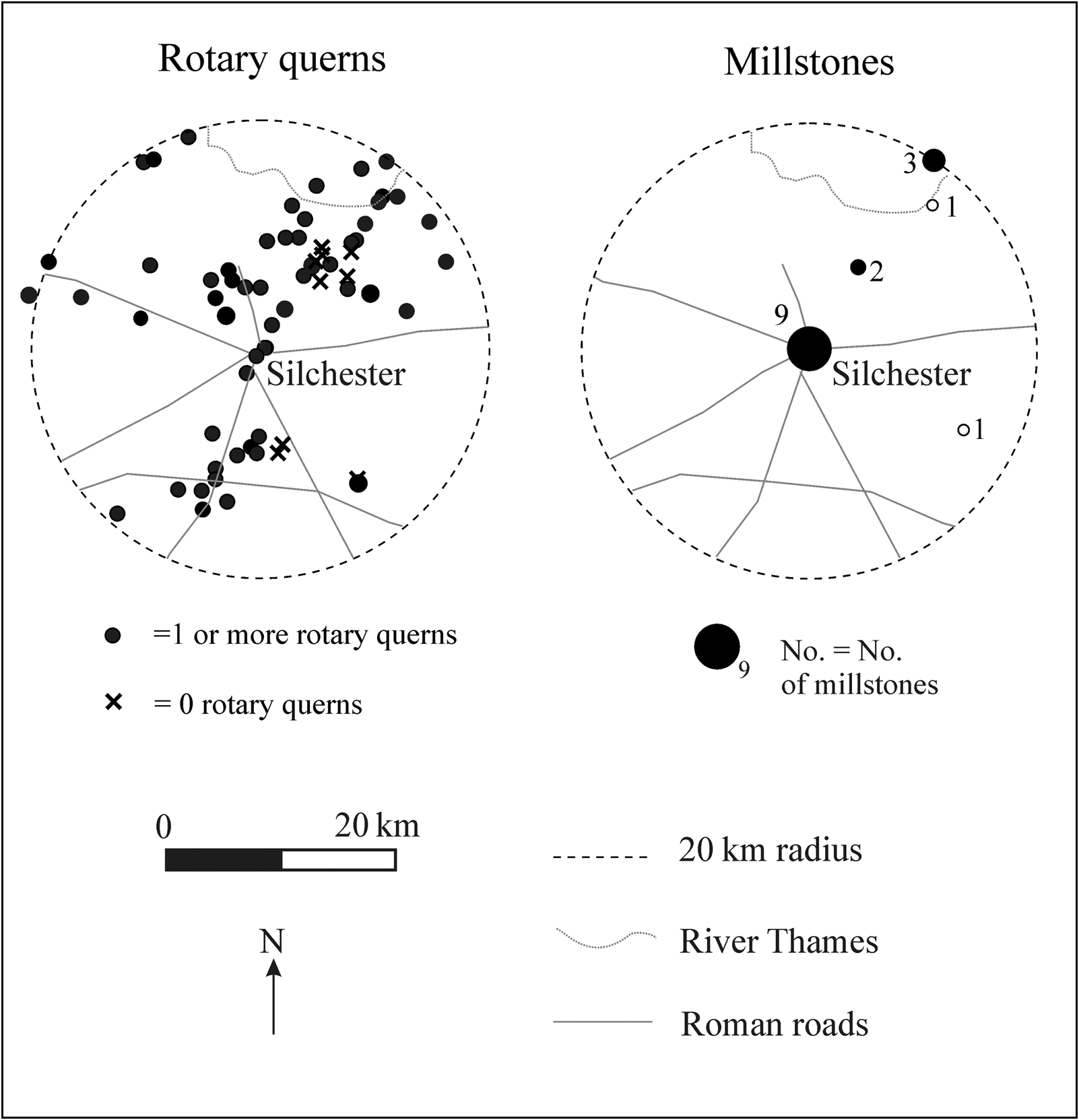
The development of Silchester during the later Iron Age and Roman periods meant associated changes in the countryside as the rural areas responded to an increased demand for grain from towns. In the mid- to later Roman period, the amount of grain being ground within Silchester at a household level was significantly reduced, whilst the presence of millstones suggests this process was partly centralised. In order to understand to what extent this centralisation catered for the needs of the town, we can examine the distribution of millstones outside it. A survey of a 20 km zone around Silchester has uncovered just four sites with evidence for centralisation in the form of millstones (fig. 7). The extent of excavation is much lower in the region around Silchester than in some other parts of the country, but these low numbers are unlikely to be just a reflection of the extent of excavation, since rotary querns have been found on many occupation sites in the hinterland surrounding Silchester (fig. 7 left). Three of the four sites with millstones are to the north of Silchester (fig. 7 right), at High Wood (three), Pingewood (two) and Reading Business Park (one), and one is to the south, at Arborfield (one).Footnote 87 Those from Pingewood are of the small variety (51 and 50.5 cm diameter), as at Silchester. Those from Reading Business Park and Arborfield are more substantial at 76 cm and 83 cm, respectively. High Wood is an intriguing site with over 60 fragments of querns and three millstones measuring 65 cm, 90 cm and >50 cm, but the nature of the site is yet to be determined.Footnote 88 The lithology of some of the fragments (Lodsworth Greensand, for example) clearly points to Roman use, but the unstratified nature of many of the quern and millstone fragments means it is possible some are of a much later date and associated with a nearby windmill. Its location north of the river Thames perhaps makes it less likely that it ground a surplus for supply to Silchester, although not impossible.
Distribution of querns and millstones in the 20 km hinterland around Silchester. Excavated sites in the study area that produced no querns or millstones are indicated with a cross (data from the ‘Rural Settlement of Roman Britain Project’).

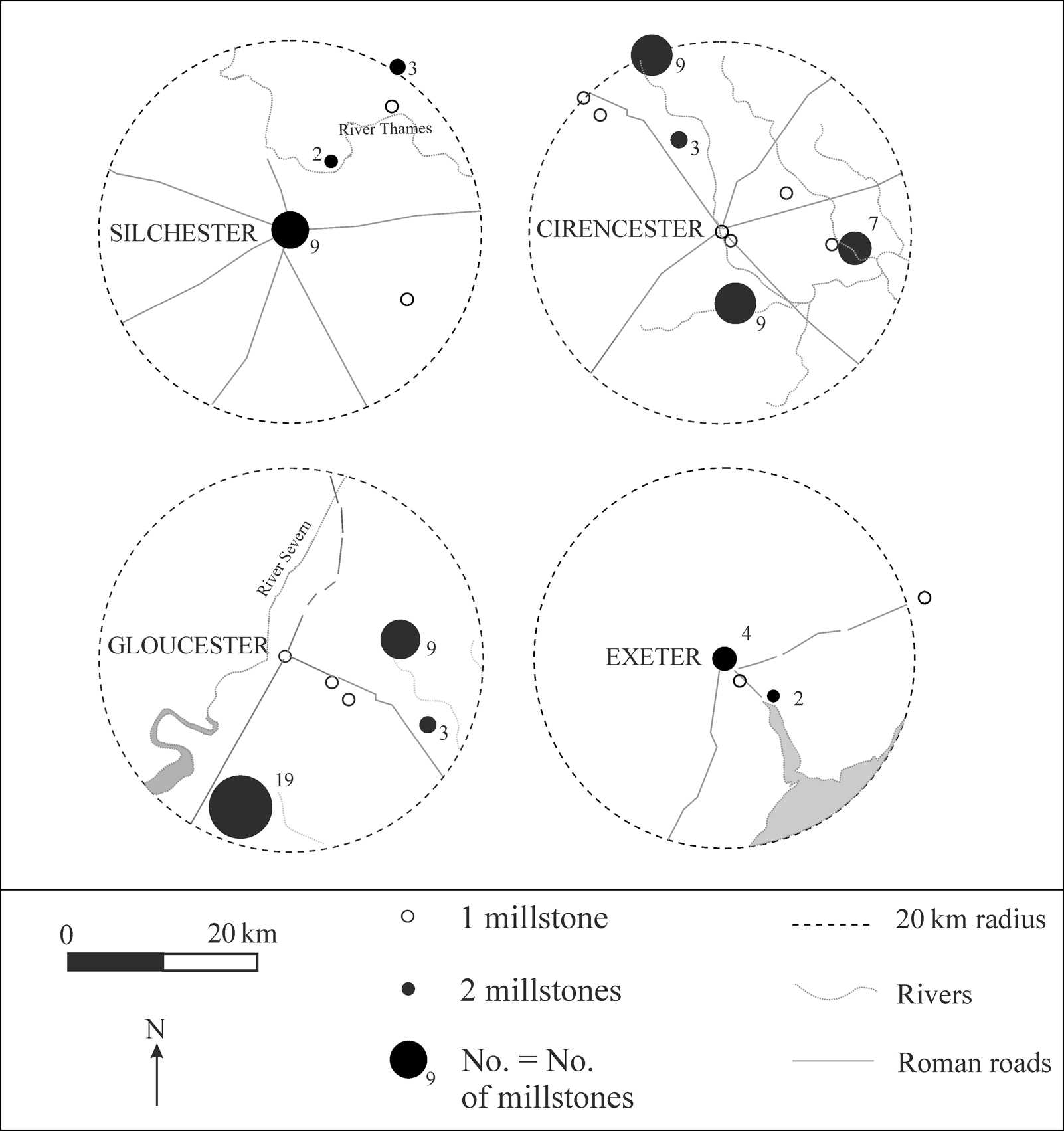
The evidence indicates a relatively low level of intensive crop processing in Silchester's hinterland. To place this into context, a comparison can be made with the regions around other Roman towns (fig. 8). The area around Roman Cirencester, for example, has revealed a very different pattern. Only a single certain millstone has been recovered from Cirencester itself and, although this low number might be in part due to the nature and extent of excavation within the town, it is correlated with the recovery of millstones from nine separate sites in a 20 km radius of the town. Of these, three produced seven or more millstones each and very high numbers of querns.Footnote 89
Occurrences of millstones in the hinterlands of Roman towns.

The same survey, whilst not specifically targeting Gloucester, revealed a similar dearth of millstones in or very close to the town (including in unpublished material in the museum) and only a single millstone from the town. Although the hinterland was not as extensively surveyed, there are at least five sites with millstones, of which three produced three, nine and 19 millstones, respectively, as well as large numbers of querns.
The dearth of millstones from Cirencester and Gloucester and the high numbers of millstones (and querns) in the surrounding countryside suggest that much of the flour for these towns was produced in the hinterland and transported into the towns.Footnote 90 Other towns have greater evidence for centralised milling. York, for example, has produced 12 millstones to date from Roman contexts and a further 13 examples of possible Roman date in residual contexts.Footnote 91 However, in the context of large numbers of millstones also found in York's hinterland, it has been suggested that some of York's requirement for flour and bread was met by mills outside the town.Footnote 92 At Exeter, although the overall number of recovered quern fragments is far lower, four millstones have been recovered from the town. Three further millstones have been found at two sites just outside the town (including a bakery site) and one at a crop-processing centre in the town's hinterland.Footnote 93 This evidence suggests a combination of centralised grinding within the city and in the town's wider supply area, perhaps for flour, combined with the production of flour, specifically for baking, very close to the city.
Although we cannot date the millstones at Silchester because their contexts were not recorded, we can reasonably suppose them mostly to have been in use during or after the second century a.d. The fall-off in the number of hand-powered querns from the second century and the likely appearance of millstones at the same time suggest a fundamental change in the organisation of grinding in the town, with a move away from grinding at a domestic household level towards a centralised system. Although the number of millstones is not large considering the number of fragments recovered from the town, the millstones are certainly evidence for a mill or mills.
Whilst there was clearly at least one mill located in close proximity to Silchester, there is scant evidence for crop-processing centres in the 20 km hinterland (especially when compared with the evidence from Corinium's hinterland). It is not certain that the mills in the town and hinterland could have catered for all of Silchester's flour and malt requirements, and it is possible that some requirements were met from a wider area. There are several sites in the wider region that were heavily involved in crop processing and may have fed into a network supplying Silchester. One possibility is the villa site at Yewden, Hambleden, to the east, where a large number of corn-drying ovens and many rotary querns point to a crop-processing specialisation, although without the investment in millstones for increased production rates.Footnote 94
Some archaeobotanical evidence suggests links with the Hampshire Downs, rather than the mid- or upper Thames valley, especially the presence of a short-grained form of spelt, flax and pea, which were more commonly grown on the Hampshire Downs.Footnote 95 The possibility that some of the grain utilised in Roman Silchester was ground at sites on the Hampshire Downs should be considered as a real possibility. East Anton and the villa and mill at Fullerton are possibilities from this region. Fullerton's mill was in operation from the third century a.d.Footnote 96 The main products being grown, and presumably ground, were spelt wheat and six-row hulled barley, but the corn-drier also produced evidence for malting.Footnote 97 The malt could have been prepared either in the mill or using rotary querns, as some of the smaller millstone fragments found at Fullerton could be from hand-operated querns.Footnote 98 As ground malt can be stored for up to a year, it is possible that this, as well or instead of flour, was being produced for onward distribution.Footnote 99
The site at East Anton produced significant evidence for the centralisation of grain processing in the form of at least 11 corn-driers and a large assemblage of querns, including at least one millstone (not described as a millstone in the report, but clearly identifiable in the plate).Footnote 100
Economic links with the regions south of Silchester are also indicated by the querns and millstones themselves, which were almost entirely sourced from the quarries at Lodsworth, West Sussex, despite rural settlements in Silchester's hinterland relying much less heavily on querns from Lodsworth.
Centralisation of crop processing also occurred at a number of roadside settlements in the wider area. Staines and Wanborough were both situated on the main roadwork connected to Silchester. Up to 79 rotary querns were found at the small town of Wanborough, Wiltshire (not all of which are included in the publication), as well as at least six millstones.Footnote 101 No evidence for a watermill was found during the excavations, but David Buckley thought that a small courtyard building might have housed a non-water-powered mill.Footnote 102 Over 150 fragments of querns have been recovered from the small town at Staines, including two probable millstones, neither of which is identified as such in the original publications.Footnote 103 The number of querns no doubt owes much to modern development in the town and a good retrieval and retention policy, but it is a clear indication for habitual crop-processing and at least some centralisation.
Millstones have been found at other small towns, like Kingscote and Springhead, and sites recently classified as defended vici such as Alcester and Kenchester, suggesting that centralisation of grain processing was commonplace in these small urban centres.Footnote 104 It seems likely that some of the resulting flour was then exported to larger towns (the coloniae, the municipia and the civitas capitals); it is certainly possible that additional supplies of flour were being sourced from outside Silchester's immediate hinterland.Footnote 105 The conclusion that grain was being ground at centralised locations and distributed elsewhere is not a new one,Footnote 106 but it is increasingly supported by the evidence. That this took place at small towns and other nucleated settlements is also likely given the agricultural emphasis of most of these sites and the likelihood that some, like the defended vici, were places where surplus crops were collected.Footnote 107
SUMMARY
We are still elucidating the supply patterns of grain to Roman towns, but it is generally accepted that towns would have been reliant on a combination of local agricultural produce and goods imported over longer distances.Footnote 108 Our understanding of the production and distribution of the resulting products – flour and malt, and then bread, ale and other products – is even less well-developed. The evidence presented here suggests that centralised grinding was a key economic component of the way small towns and other nucleated settlements were organised. At the former, the centralised grinding may, or may not, have resulted in a surplus for export elsewhere, whilst that at roadside settlements may have been in order to serve travellers with bread and ale.Footnote 109 At major towns it is not yet clear that there was a consistent organisation, but it is possible to draw some conclusions about grain processing in, and for, Silchester.
(1) Grain-processing activity did not remain constant over time. The chronological distribution of rotary quern fragments and the archaeobotanical evidence indicate a decline in both the initial stages of crop processing and the latter stages, by hand quern, from the second century a.d.
(2) The decline of hand-quern usage and the appearance of millstones indicates that a fundamental change in the organisation of grinding occurred during the second century a.d. with a move away from domestic-level grinding to a centralised system.
(3) At least some grain was ground using animal (or slave?) power, as evidenced by the Pompeian-style mill fragments and the structural plinths.
(4) The absence of major grain-storage structures and their associated pests may indicate that a mill (or mills), possibly water-powered, was located outside Silchester on one (or more) of the available watercourses.
Much remains to be done in terms of studying querns and millstones from urban assemblages, nucleated settlements and their hinterlands, and this must be carried out in conjunction with analysis of both structural remains and archaeobotanical evidence. Such detailed analyses will eventually allow us to make useful comparisons between settlements.Footnote 110 However, those towns and regions for which a comprehensive survey has been carried out suggest that the economics of grain production, supply and processing, and the production and supply of the products manufactured from these grains, were designed according to the economic and topographic landscape of each town in turn. In the case of the difference between Cirencester and Silchester, it is likely that the quality of the agricultural land was a significant factor – there being a much greater likelihood of mills in an area where more grain was being grown.
CONCLUDING COMMENTS
The aims of this paper are focused on understanding the supply of querns and the supply of flour to the Roman town of Silchester; these are two quite different things, despite the commonality of artefact. The hinterland is included because there is fundamentally no way to understand the town without looking at the countryside that surrounded it. The results of the research add considerably to both of these aims. However, some useful conclusions are also drawn about the rural communities around Silchester, in particular those to the south of it in the area around modern-day Basingstoke. In that area, the uptake of querns was different to that in Silchester and much of the rest of the region. This suggests the existence of a strong cultural and/or social identity represented by an object type that was of extreme value personally, to the (in all probability female) owner, and economically, to both the individual and also the familial and social groups in which it was utilised.
ACKNOWLEDGEMENTS
The author gratefully acknowledges the financial support of the Roman Research Trust, the Haverfield Bequest and the University of Reading's ‘Silchester Town Life Project’, without which this research would not have been possible. The research was enabled by the ‘Silchester Insula IX Project’ team, in particular Jenni Eaton, who helped locate all the querns, and Nick Pankhust, who provided phasing information. Thanks also go to Lisa Lodwick and Michael Fulford who commented on a draft of the paper. All errors and omissions remain the responsibility of the author.
SUPPLEMENTARY MATERIAL
For supplementary material for this article, please visit https://doi.org/10.1017/S0068113X21000040. The supplementary material comprises detailed information on the lithologies of the querns and millstones from Silchester (including photographs), publication details of the sites in the town's hinterland and a spreadsheet recording the material.