Introduction
The names Acanthothecis and Psorographis were first used by Clements (Reference Clements1909) to accommodate species having warty paraphysis-tips and muriform ascospores and species with transversely septate ascospores having warty paraphysis-tips, respectively. Later, Clements & Shear (Reference Clements and Shear1931) selected Acanthothecium pachygraphoides as the type species for Acanthothecis and Acanthothecium clavuliferum for Psorographis. Acanthothecium Vain, the earlier name used by Vainio (Reference Vainio1890) for the species with warty paraphysis-tips was rejected as this name had been already used for a fungal genus.
The genus Acanthothecis Clem. has been accepted by Eriksson & Hawksworth (Reference Eriksson and Hawksworth1998) in the “Outline of the Ascomycetes – 1998” while the other genera, based on A. clavulifera, have been reduced to synonymy. This treatment has also been accepted in the recent revision of the genus Acanthothecis (Staiger & Kalb Reference Staiger and Kalb1999) and the later treatments of the family Graphidaceae (Staiger Reference Staiger2002; Makhija & Adawadkar Reference Makhija and Adawadkar2003, Reference Makhija and Adawadkar2007; Archer Reference Archer2006, Reference Archer2007, Reference Archer2009).
On the basis of recent molecular and phylogenetic studies (Kalb et al. Reference Kalb, Staiger and Elix2004; Staiger et al. Reference Staiger, Kalb and Grube2006; Mangold et al. Reference Mangold, Martin and Lumbsch2008), Acanthothecis can be retained in the family Graphidaceae (including the Thelotremataceae) and is characterized by a non-carbonized exciple, periphysoids warty at the tips, hyaline trans-septate or muriform, oblong ascospores without a thick jelly-like outer spore wall, and cylindrical ascospore locules, I− or weakly I+ blue.
The closely allied genera Fissurina Fée and Hemithecium Trevis., having non-carbonized exciples, can easily be differentiated from Acanthothecis. Fissurina by the poorly developed exciple; labia completely covering the disc; periphysoids without warty tips; ovoid or globose, ± halonate, 4-locular ascospores with thickened septa and rounded cell lumina. Hemithecium by the convergent, often crenate, well developed exciple; narrow disc, generally not visible and ascospores without halo, more than 25 µm long, with lenticular cell lumina and by the absence of periphysoids.
The genus Acanthothecis Clem. is mainly distributed in tropical and subtropical regions and comprises c. 30 species world-wide (Staiger & Kalb Reference Staiger and Kalb1999; Staiger Reference Staiger2002; Archer Reference Archer2006, Reference Archer2007, Reference Archer2009) with four species from India (Staiger Reference Staiger2002; Makhija & Adawadkar Reference Makhija and Adawadkar2003, Reference Makhija and Adawadkar2007) viz. A. collateralis Makhija & Adaw., A.consocians (Nyl.) Staiger & Kalb, A. dialeuca (Kremp.) Staiger & Kalb, and A. nivalis Makhija & Adaw.
Further studies of the family Graphidaceae in India have revealed the occurrence of three additional species of Acanthothecis, none of which can be referred to the known species of this genus, and these are consequently described below. A key for the identification of seven species of Acanthothecis now known from India is also provided.
Materials and Methods
More than 2000 specimens of Graphidaceae collected from South-western Ghats, Eastern Himalaya, Western Himalaya and the Andaman and Nicobar Islands of India by various lichenologists from Agharkar Research Institute and deposited in Ajrekar Mycological Herbarium (AMH) were examined. In addition more than 200 types and non-type specimens of the members of Graphidaceae from BM, BSI, GLAM, H and G have also been studied. The specimens of Acanthothecis were identified by comparison with the types and the protologues or with the descriptions and the photographs of earlier known species in the most recent treatments (e.g. Staiger & Kalb Reference Staiger and Kalb1999; Staiger Reference Staiger2002; Archer Reference Archer2006, Reference Archer2007, Reference Archer2009; Makhija & Adawadkar Reference Makhija and Adawadkar2003, Reference Makhija and Adawadkar2007, etc.).
Sections of thalli and ascomata were mounted in water, 10% KOH (K), Lugol's solution (I) and lactophenol cotton-blue (LPCB). All measurements were made on material mounted in water. Chemical constituents were determined by thin-layer chromatography using standardized methods (Culberson & Kristinsson Reference Culberson and Kristinsson1970; Culberson Reference Culberson1972; White & James Reference White and James1985) using the solvent systems toluene-dioxane-acetic acid (180:45:5) and toluene-ethylacetate-formic acid (139:83:8). The specimens were also examined under UV light (365 nm). The specimens have been deposited in the Ajrekar Mycological Herbarium (AMH).
The Species
Acanthothecis archeri sp. nov
Acanthothecis subclavulifera similis species nova sed ascosporis muriformibus differt.
Typus: India, Andaman Islands, North Andaman, Diglipur range, Sitapur, 28 January 1986, P. K. Sethy & P. G. Patwardhan, 86.156 (AMH—holotypus).
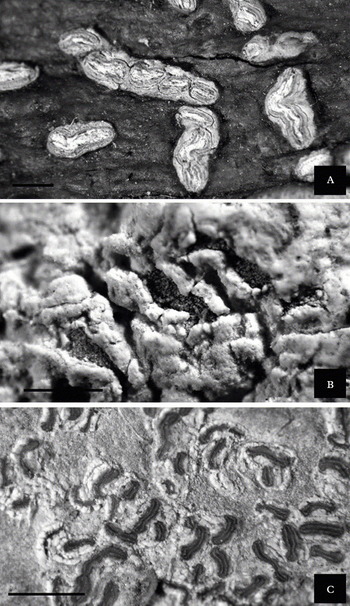
Acanthothecis species, habitus. A, Acanthothecis archeri (86.156—holotype, AMH); B, A. celata (80.145—holotype, AMH); C, A. coccinea (78.315—holotype, AMH). Scales: 1 mm.

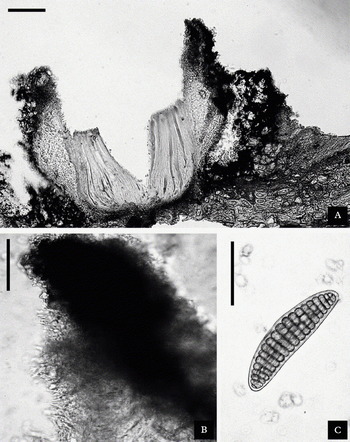
Acanthothecis archeri (86.156—holotype, AMH). A, section of ascocarp; B, exciple showing periphysoids; C, ascospores. Scales: A = 100 µm; B = 10 µm; C = 50 µm.

Thallus corticolous, yellowish to reddish brown, irregularly cracked, thick, rough, slightly shiny, epruinose, delimited by black hypothallus.
Ascomata numerous, creamy, farinose, lirelline, 0·3–10 mm long, simple, curved, straight to irregular, raised from the thallus, thalline margin thick, ends round. Disc slit-like, yellowish to creamy pruinose when dry, brownish when wet. Exciple reddish brown, not striate, present at the base, convergent, swollen at the apical region, covered with a thalline margin up to half of the proper exciple, with distinct orange-yellow 10–12 µm thick pseudocortex. Hymenium hyaline, not inspersed, 150–162 µm high, I−, KI−. Hypothecium hyaline, indistinct. Paraphyses simple, long, up to 2·5 µm thick, warty at the tips. Periphysoids short, indistinctly warty at the tips. Asci 4–6-spored. Ascospores muriform, hyaline, 75–120 × 22–37 µm, I+ weakly blue.
Chemistry. No lichen compounds detected.
Remarks. This new species closely resembles A. subclavulifera Staiger & Kalb with respect to its external morphology, but A. subclavulifera has a striate exciple, trans-septate ascospores and protocetraric acid. Acanthothecis clavulifera (Vain.) Staiger & Kalb, a species from Brazil, also resembles A. archeri in its external morphology and exciple without striae but A. clavulifera has trans-septate ascospores and protocetraric acid.
Acanthothecis dialeuca (Kremp.) Staiger & Kalb (≡Graphis incondita Nyl.), a species from the Andaman Islands of India, appears to be somewhat close to A. archeri, sharing some characters such as ascomatal structure, and muriform ascospores. However, A. dialeuca has very small ascospores and has stictic and constictic acids. Another species with large muriform ascospores (65–95 × 13–18µm), Acanthothecis tetraphora (Nyl.) Staiger & Kalb, differs in having norstictic, connorstictic acids and lichexanthone in the thallus.
Acanthothecis obscura Staiger & Kalb, with no lichen substances, differs from the present new species in having a carbonized exciple, inspersed hymenium and smaller ascopsores of 35–50 × 9–12 µm.
Acanthothecis archeri grows on the exposed tree trunks in tropical rain forests of the Andaman and Nicrobar Islands and the moist deciduous forests of Karnataka.
Additional specimens examined (all AMH). India:Andaman Islands: North Andaman, Mayabandar, Tugapur Range, Pathar Tikri, rain forest, 1985, M. B. Nagarkar & P. G. Patwardhan, 85.2590. Karnataka State: Anagudi, Kumtha-Sirsi road, 1977, P. G. Patwardhan & C. R. Kulkarni, 77118; Hebri, 1982, P. G. Patwardhan & M. B. Nagarkar, 82.649. Nicobar Islands: Kamorta Islands, 1987, P. K. Sethy & P. G. Patwardhan, 87.354.
Acanthothecis celata sp. nov
Similis A. albescens sed acida deficiens differt.
Typus: India, Karnataka State, Peercode to Hiriadka, c. 200 ft. alt., 27 January 1980, P. G. Patwardhan, 80.145 (AMH—holotypus).
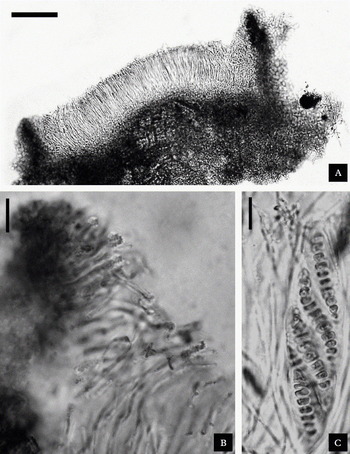
Acanthothecis celata (80.145—holotype, AMH). A, section of ascocarp; B, exciple showing periphysoids; C, ascospores. Scales: A = 100 µm; B & C = 10 µm.

Thallus snowy white, granulose, farinose, finely cracked, delimited by a thin hypothallus.
Ascomata immersed, completely hidden in the thallus, visible only when moistened, irregular, concolorous with the thallus, whitish powdery with moderately thick thalline margin, 0·5–1·5 mm long, 0·2–0·3 mm broad. Disc not visible, covered with dense white pruina, reddish brown to blackish red when wet. Exciple not carbonized, not striate. Hymenium hyaline, 125–145 µm tall, not inspersed, I−, KI−. Hypothecium distinct, light yellow, 10–12·5 µm thick. Paraphyses branched at the tips. Periphysoids short, indistinctly warty at the tips. Asci 4–8-spored. Ascospores hyaline, 8–10-trans-septate, elongate, tapering at the ends, 35–43 × 7–10 µm, I−, KI−.
Chemistry. No lichen substances detected.
Remarks. Acanthothecis celata is distinguished by its snow white coloured, granular-farinose, thick thallus, completely hidden ascomata (visible only when wet) with a reddish brown to blackish red disc covered by dense white pruina, and trans-septate ascospores.
The most closely related species seems to be Acanthothecis albescens (Vain.) Staiger & Kalb, which has ascospores of a similar size (36–45 × 6–7 µm), but differs in having stictic acid in the thallus.
Acanthothecis mirabilis Staiger & Kalb and A. sanguinoloba (Redinger) Staiger & Kalb, with small, transversely septate ascospores, however, have conspicuous ascomata, striate exciples and isohypocrelline pigment.
Acanthothecis celata is a lowland species collected from evergreen forest.
Additional specimen examined. India: Karnataka State: Peercode to Hiriadka, c. 200 ft., 1980, P.G. Patwardhan, 80.143 (AMH).
Acanthothecis coccinea sp. nov
Similis A. collateralis sed ascosporae minoribus differt.
Typus: India, Meghalaya, Moflong, 11 December 1978, M.B. Nagarkar, 78.315 (AMH—holotypus).
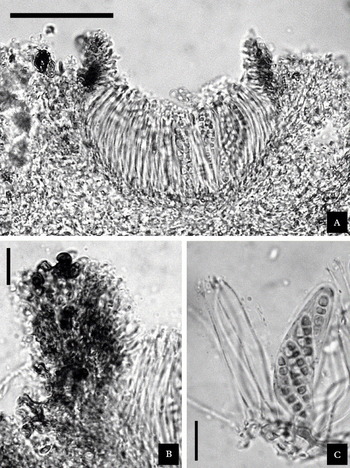
Acanthothecis coccinea (78.315—holotype, AMH). A, section of ascocarp; B, exciple showing periphysoids; C, ascospores. Scales: A = 50 µm; B & C = 10 µm.

Thallus corticolous, pale white with greyish tinge, irregularly cracked, powdery, studded with numerous colourless crystals.
Ascomata numerous, concolorous with the thallus, lirelline, c. 0·5–1mm long, mostly simple, to branched, immersed to slightly raised, arranged irregularly in groups, ends rounded. Disc narrow, slit-like, pale white when dry, bright scarlet red when wet, pruinose. Exciple brown, not striate, present at the base, convergent, poorly developed. Hymenium hyaline, inspersed, 37–62 µm high, I−, KI−. Hypothecium hyaline, indistinct. Paraphyses simple, long, thin, warty at the tips. Periphysoids distinct, up to 10 µm long, with indistinct warty tips. Asci 8-spored. Ascospores 3-trans-septate, 12–14 × 3–4 µm, I−, KI−.
Chemistry. Norstictic acid detected.
Remarks. Acanthothecis coccinea is characterized by the nearly immersed, pale, short lirellae with a narrow, bright rust red disc, 3-trans-septate ascospores and by the presence of norstictic acid. Acanthothecis collateralis Makhija & Adaw., a species from India, has similar ascomatal structure, but has 2–5 lirellae placed side by side (more or less parallel to each other), larger ascomata and larger ascospores, 16–21 × 3–4 µm. Acanthothecis farinosa ad int. (Staiger & Kalb Reference Staiger and Kalb1999: 115) differs from our new species in having 6–9 celled, larger (20–25 × 5–7 µm), I+ blue, ascospores.
Acanthothecis aurantiaca (Müll. Arg.) Staiger & Kalb, a species from Jamaica, is similar in most morphological characters, but has connorstictic and stictic acids in addition to norstictic acid and much larger ascospores (30–53 × 6–8 µm). Acanthothecis gracilis Staiger & Kalb, is similar in thallus colour, texture, short lirellae, non striate exciple, and chemistry, but differs from A. coccinea in having clear, non-inspersed hymenium, and submuriform ascospores, 20–32 × 6–8 µm.
Acanthothecis intertexta (Müll. Arg.) Staiger & Kalb can be differentiated from the present new species in having trans-septate, larger ascospores of 30–40 × 5–7 µm.
Acanthothecis coccinea has been collected only once from the subtropical forest of Moflong, situated at an altitude of c. 1300–2000 m, in Meghalaya, receiving abundant rainfall.
Acanthothecis nivalis Makhija & Adaw
Mycotaxon 88: 139 (2003); type: India, Andaman Islands, North Andaman, Mayabandar Range, Kaichi Nala, in moist deciduous forest, 30 January 1985, M. B. Nagarkar & P. K. Sethy 85.2804 (AMH—holotypus!).
Remarks. Acanthothecis nivalis has earlier been recorded from the Andaman Islands of India (Makhija & Adawadkar, Reference Makhija and Adawadkar2003) and has now been found on the mainland in the montane evergreen forests of the Nilgiri Hills, Western Ghats (South India), at an elevation of c. 1000 m.
Additional specimens examined. India: Tamil Nadu: Nilgiri hills, Gudalur, 1973, M. B. Nagarkar & A. V. Prabhu, 73.345, 73.346, 73.356, 73.360 (AMH).
Key to Indian Acanthothecis species
1 Ascospores trans-septate ... 2
Ascospores muriform ... 6
2(1) Lichen substances absent ... 3
Lichen substances present ... 4
3(2) Thallus snowy white, granulose, farinose; ascomata immersed, completely hidden in the thallus; disc visible only at higher magnifications; ascospores 8–10-trans-septate, 35–43 × 7–10 µm; India (Karnataka) ... A. celata
Thallus pale white, effuse; ascomata indistinct, whitish, lirelline, branched, slightly raised, thin; disc narrow, light brown; ascospores 5–6-trans-septate, 14–20 × 3–4 µm; India (Andaman Islands, Assam) ... A. consocians
4(2) Norstictic acid absent; ascomata white, mealy, raised, 2–8 mm long; disc visible only when wet appears brown; periphysoids with 24–32 µm long, warty tips; asci 8–spored; 4–7-trans-septate, 8–16 × 3–4 µm; thallus K−, P+ yellow; psoromic acid present; India (Andaman Islands and Tamil Nadu) ... A. nivalis
Norstictic acid present. ... ... 5
5(4) Thallus creamy, off-white, smooth; ascomata blackish, distinct, immersed to raised, disc narrow, reddish brown to black; exciple blackish brown to carbonized at the tips; periphysoids short, with slightly elongate warty tips; ascospores 3-trans-septate, 16–21 × 3–4 µm; thallus K+ yellow to red; India (Andaman Islands) ... ... A. collateralis
Thallus white with greyish tinge; ascomata immersed to slightly raised, irregularly arranged in groups, 0·5–1 mm long; disc narrow, slit like, bright red (wet); exciple brown; periphysoids distinct, up to 10 µm long, with warty tips; ascospores 3–trans-septate, 12–14 × 3–4 µm; thallus K+ yellow to red; India (Meghalaya) ... A. coccinea
6(1) Lichen substances present; thallus brownish; ascomata 2–5 mm long; ascospores muriform, asci 6–8-spored; ascospores 22–37 × 9–14 µm; thallus K+ yellow, P+ orange; stictic, constictic acids present; India (Andaman Islands) and Malaysia ... ... A dialeuca
Lichen substances absent; thallus yellowish to reddish brown; ascomata creamy, meally, lirelline, 0·3–10 mm long; asci 4–6-spored; ascospores 75–120 × 22–37 µm; India (Andaman Islands, Karnataka, and Nicobar Islands) ... A. archeri
We are grateful to the Department of Science and Technology (DST), and Ministry of Environment and Forest, Government of India, New Delhi for financial support.