INTRODUCTION
The ancient Mesoamerican art of writing is one of the most important cultural expressions of the indigenous peoples of Mexico. Pictography had a very long history before the arrival of the Spaniards in the sixteenth century. Iconography, style, and technique adapted to the cultural diversity of Mesoamerica while at the same time creating a shared artistic heritage. After the Spanish Conquest, most pictographic books (referred to as codices today) were destroyed. A few others found their way into European collections, together with other exotica from newly discovered or conquered far-away places (Impey and MacGregor Reference Impey and MacGregor1985). As a result, all but one of the surviving pre-Hispanic manuscripts are today in European collections (Jansen and Pérez Jiménez Reference Jansen and Pérez Jiménez2004). The reinvention of Mexican pictography as an object of curiosity during the Colonial period guaranteed the physical survival of a few precious copies but came at the cost of an abrupt and systematic loss of contact with the communities of origin. While the pictographic tradition continued in New Spain only to wane completely after Mexican independence, many indigenous peoples today are unaware of this important aspect of their own heritage.
Many modern scholars are also seemingly unaware of this loss and there still is a strong tendency to consider the codices and their depictions as a testament to a lost world (institutions, beliefs, peoples) that can be reconstructed only partially through scattered information. What sources are indeed viable for the study of pictography is a major methodological issue. While Smith (Reference Smith1973) and Caso (Reference Caso1977) demonstrated in detail the physical and historical reality of a group of pictographic documents dealing with genealogies in the Mixtec region of Oaxaca, based on archival research and modern Mixtec language, Kubler (Reference Kubler1970) famously maintained that an unbridgeable disjunction separates different time periods in Mesoamerican history and their respective iconographic and representational systems. Other scholars (Jansen et al. Reference Jansen, Loo, Manning and Hartmann1988) have proposed not to discard sources produced after the decline of pictography, but rather to use them critically to reconstruct cultural, religious, or behavioral patterns traceable over a long period of time.
The present essay is primarily concerned with methodological issues in the analysis of Mesoamerican pictography. It addresses the construction of interpretative authority in scholarly efforts by switching the focus from sources to the process of knowledge production. Rather than considering pictography as an illustration of contents provided by an external source of information, or as an expression of historical, cosmological, or mythical facts, I consider the medium as a generator of knowledge on the same level of alphabetic and oral texts. The so-called “direct historical approach,” that is, the use of later sources to explain archaeological data from earlier periods, has been fruitfully applied to various aspects of Mesoamerican culture, especially religion from the late pre-Conquest and early colonial periods (Nicholson Reference Nicholson, Ekholm and Bernal1971, Reference Nicholson and Bernal1973). I build on research of this kind by applying a comparative approach that encompasses Mesoamerican cultures from ancient times to the present and through different media. At the same time, the investigation is limited to a specific set of features: representations that bespeak transformation or coming into contact with spirits and divine beings. I ask how this transformation occurs rather than what one transforms into.
The difficulty in systematizing the pantheon of Mesoamerican deities and their multiple manifestations has been a problem since the time of the Conquest, when friars remarked on the seemingly endless number of gods and places of worship among native peoples (López Austin Reference López Austin1983:75). In ancient codices, deities and deity impersonators are depicted interchangeably, making them, more often than not, difficult to distinguish from one another (Mikulska Reference Mikulska Dabrowska2008:309–311). Rather than trying to untangle the identities of gods in the Mesoamerican pantheon, I consider the process by which humans interact with the divine as an intrinsic aspect of the nature of divinity. The process expressed in written texts, painted pictures, and uttered words discussed in this paper refer to ceremonial contexts. However, I do not consider this context a priori, but rather describe how a ceremony is enforced by adopted representational strategies (Bauman Reference Bauman1975). This is not to say that other aspects do not contribute to the creation or enactment of a ceremonial event, but I try to analyze how words and images speak of something else and become a means of access to another world or out-of-ordinary experience.
If all ceremonial actions can be said to have a contextual and emergent qualities, they are also, paradoxically, never really improvised; rather verbal and pictorial language reiterate previously established and executed formal expressions. The present is addressed by conjuring up past actions and signs, the currency and authority of which are reified by repetition and stylization, at times to the point of unintelligibility. Rather than a loss of content, however, obscure languages ensure that doubts and self-reflexivity are constantly exerted on ritual practice (Severi Reference Severi2002). Efficacy does indeed need to be tested, making the ground for “belief” more of a series of practices on how rituals have to be carried out (e.g., prayers recited) rather than a fixed and dogmatic stance on the nature of the world, spirits, and afterlife (Keane Reference Keane2008). Since the way of carrying out a ceremony is the only means by which the objective of the ceremony is attained, modality is meaning.
Ritual performances are carried out and embodied by what anthropologists usually refer to as a “religious specialist,” a figure designated in a society as an intermediary between the human and spiritual world. The term is admittedly very vague and should be taken more properly as a heuristic device: by looking at the ways so-called priests are represented or represent[ed] themselves and their ascribed powers in painted, written, and recited texts, we may be able to reach a working definition of a Mesoamerican religious figure, whatever we may want to call it. Sounds, words, and pigments are an expression of the immaterial spiritual world defined by materiality. Their essentially mediated position implies that crossing between levels of significance is not a mere act of translation of an external and unchangeable referential meaning. Rather, the very act of semiotic conversion gives the opportunity to reflect on the notion, limits, and powers ascribed to priesthood itself and religious experience at large in any given social and cultural context (Keane Reference Keane2013).
THE CULTURAL ENCOUNTER: THE PRIMEROS MEMORIALES AND FLORENTINE CODEX
As noted earlier, the history of the Americas and many forms of indigenous cultural expressions is fraught by the tragedy of the Conquest and its aftermath. While I maintain that, ultimately, cultural continuity characterizes the past and present of Mesoamerican religiosity, it seems fitting to begin the analysis with images and texts dealing directly with Mesoamerican religion but produced after the Spanish invasion. These sources open a path that connects the past and the present, as well as the European and Mesoamerican approaches to the understanding of native religion.
Two famous manuscripts in particular, the so-called Primeros Memoriales and Florentine Codex, are considered among the most important sources for Mesoamerican, specifically Nahua, religion at the time of the Conquest. Redacted over a long period of time (ca. 1540–1580) under the supervision of the Franciscan friar Sahagún, they aimed at gathering and systematizing religious customs, beliefs, and history of the Nahua and Mexica peoples of central Mexico, in order to inform a European audience. Although the encyclopedic format adopted is firmly rooted in the Western classical tradition, Sahagún has been hailed as a “pioneer ethnographer” for the methodology he employed in the recollection of the information (López Austin Reference López Austin and Edmonson1974). Sahagún (Reference Sahagún, Anderson and Dibble1982:53–56) himself briefly explains his methodology in the prologue to Book 2 of the Florentine Codex, in which he mentions that he gathered the information by consulting with elderly and knowledgeable people (mostly in Tepepulco, in the modern state of Hidalgo, where he first conducted his evangelical work, and then in Tlatelolco, where he continued it), and relying also on ancient pictographic documents. While his religious biases are easily recognizable today, the lingering consequences of his precocious ethnographic method are more difficult to discern.
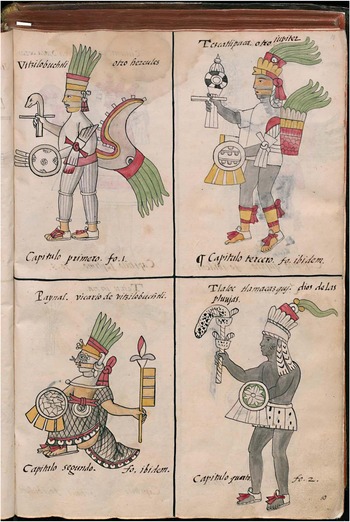
A case in point is constituted by the depiction of deities. According to information provided by Sahagún regarding the way information was initially gathered, images and texts were conceived at the same time, both prompted by the same questions (López Austin Reference López Austin and Edmonson1974:123; Quiñones Keber Reference Quiñones Keber, de Alva, Nicholson and Keber1988:260–261). While he recognized the importance of pictures and pictography in traditional native culture, Sahagun's method led to the unprecedented representation of isolated gods, without any calendrical or ritual association. In pre-Hispanic manuscripts, on the other hand, every image is part of a larger arrangement of attributes and symbols, on which meaning largely depends (Quiñones Keber Reference Quiñones Keber, Sullivan, Nicholson, Anderson, Dibble and Ruwet1997:19). The systematic recollection of information about a god as an isolated singularity, stripped of its relation to a wider context in what may seem at first a methodic and ethnographic approach, results in framing Mesoamerican worldview as a Greco-Roman pantheon (Olivier Reference Olivier2010). In the Florentine Codex, the paganization is made explicit by the use of Roman gods’ names to clarify the character of some deities. In Figure 1, for example, Huitzilopochtli is identified as “otro Hercules,” “another Hercules,” and Tezcatlipoca as “otro Jupiter,” “another Jupiter.”
Mesoamerican gods in the Florentine Codex:bk. I, f. 10r. ©Biblioteca Medicea Laurenziana, Florence (http://teca.bmlonline.it).

Yet, a few other elements defy the univocality of a mythological pantheon. Tlaloc in Figure 1 does not show his known iconographic attributes (goggled eyes, fanged teeth, and blue color) but he is rather represented as a “Tlaloc tlamacazqui,” “Tlaloc priest,” according to the Nahuatl gloss. Although the Spanish translation indicates that he is the Rain God (“dios de las pluvias”), the word tlamacazqui refers to a priest or minister of a cult dedicated to a specific god. In fact, in this image of the Florentine Codex, the tlamacazqui has the black body paint characteristic of Mesoamerican religious figures. The military attire of shields and spears sported by the Tlaloc tlamacazqui, as well as the majority of the characters in the deity sections of Florentine Codex and Primeros Memoriales further points to the fact that they are indeed human impersonators, rather than gods themselves (Nicholson Reference Nicholson, de Alva, Nicholson and Keber1998:229–230). The ethnographic systematization and the Classic European canons simplify what was a fluid situation, in which the impersonator could be easily equated with the divinity.
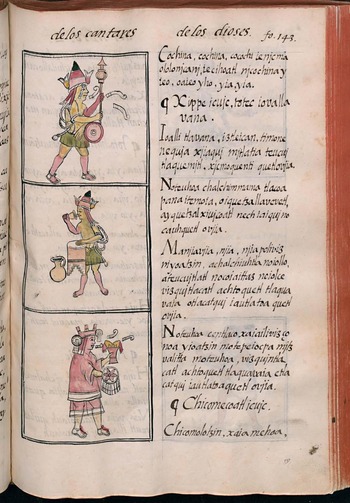
This becomes clearer in the later reuse of the deity images of Xipe and Chicomecoatl (Figure 2) in the appendix of Book 2 of the Florentine Codex (Sahagún Reference Sahagún, Anderson and Dibble1981b:f. 143r). Overall, this section of the Florentine Codex has very few illustrations: most of the left column was intentionally left blank, without even a translation of the corresponding Nahuatl text, a collection of sacred chants. According to the prologue to Book 2 written by Sahagún (Reference Sahagún, Anderson and Dibble1982:20, 58), these were too obscure to warrant a translation. The chant to Xipe is as follows:
Xipe and Chicomecoatl in the Florentine Codex:bk. I, f. 143r. ©Biblioteca Medicea Laurenziana, Florence (http://teca.bmlonline.it).


This chant, known in two variants in the Primeros Memoriales and Florentine Codex, has been translated several times (Garibay Reference Garibay Kintana1958:175–185; Sahagún Reference Sahagún, Anderson and Dibble1981b:213, Reference Sahagún1997:146–147; Seler Reference Seler1904b:1071–1078). Our translation proposes a few changes. First, the epithet attributed to Xipe, “yovallavana,” is usually translated as the “night drinker.” The corresponding illustration in the Florentine Codex does indeed show Xipe in the second image drinking from a cup. However, I believe that although drinking may refer to an intoxicating beverage, such as pulque, a fermented-agave drink, the term “yovalla” should be better understood as the visionary effect (and purpose) of the drink and of the act of drinking itself, and not as a reference to the night or a nightly activity. Andrews and Hassig (Ruiz de Alarcón et al. Reference Ruiz de Alarcón, Andrews and Hassig1987:262) have proposed a similar translation for the term Yohuallahuantzin, as the deep state of trance.
Furthermore, chalchimmama is translated as “he who holds a precious shield,” rather than “precious water.” The following quetzallavuevuetl we translate as “precious drum,” while previous translations identified it as the quetzal ahuehuetl, “precious cypress tree.” In both cases we opted for a closer adherence to what is depicted in the pictures, where Xipe is, in fact, holding a chimalli (shield) in the upper image, and playing an upright drum (huehuetl in Nahuatl) in the image below. Also, yioatzin, usually understood to be “tender” or “green” maize, was replaced with “purple” maize, a specific variant of corn, yoa- referring to “dark” or “night.”
The two images of Xipe accompanying the cuicatl follow their prototype in Volume I (Figure 1), with some notable exceptions. Their postures are more dynamic: in the top image, Xipe has speech or song volutes coming out of his mouth; in the one below, he is playing and drinking, while a jar container lies on the floor. These are fitting additions to accompany a text that purportedly reproduces a chant, a performance. We are left to wonder, then: is this a depiction of a god or a performer? This ambiguity becomes even deeper given that the god, priest, or impersonator is seen performing a ritual and singing a song that should be more specifically chanted to him, rather than by him. No clue is given on where the chant and dance may be taking place, because no participant or temple is shown, rather the image is witness to the effect of the chanting: still and mute while on display in the pantheon (Figure 1), it becomes alive because of the power of the accompanying chant. Both text and images, engaged in an act of mutual interpretation, do not explain one another, but rather point to the constitutive elements of the performance. The song, the music, the dance, and the image of the god, all these elements together, are the god. While the depiction itself does not cease to be only an illustration, it expresses a paradigmatic relationship with the accompanying text. The efficacy of the ceremony does not lie in the clear enunciation or communication of a content matter, but rather in the correct realization of a performance.
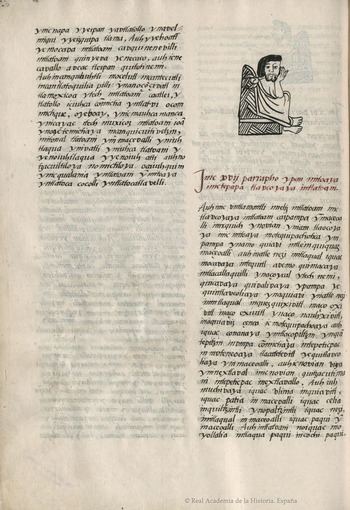
The sacred chants reproduced in the appendix of Book 2 of the Florentine Codex were taken from the corresponding section of the Primeros Memoriales (ff. 237v–282r, para. 14), where they appear with some explanations on their meaning, eventually omitted in the Florentine Codex. Another section that similarly deals with recited texts appears in both manuscripts, specifically, the admonitions given by the rulers to their people. Although the texts in the two works are not exactly the same, both the Primeros Memoriales (Sahagún Reference Sahagún1997:paras. 15–17) and Book 6 of the Florentine Codex reproduce what scholars have come to identify as huehuetlahtolli, “words of the elders” (León-Portilla Reference León-Portilla1993; Sullivan Reference Sullivan and Edmonson1974). The corresponding illustrations in both manuscripts also share a particularly interesting feature: the lack of color and evident reliance on European models, especially engravings. Figure 3 shows a tlatoani (Nahua ruler), seated on a straw-mat with a backrest, the seat of power in ancient central Mexico, and wearing a characteristic tilma, a cape adjusted on the shoulder with a knot. What is not characteristic is his three-quarter position and the head resting on the palm of his hand. I believe these elements refer to the figure known as Man of Sorrows (Figure 4), a devotional image particularly popular in the late Middle Ages and European Renaissance. This is not a copy, though; rather the Nahua artist has incorporated and reutilized European models to produce a new image, whose content is fully Mesoamerican. The Nahuatlization of a Christo-European iconographic type derives from the print medium, which served as stylistic reference. The further placement of the figure on top of the page also bespeaks an illustrative use of the image, similar to European book illustrations, in which pictures are placed as markers at the beginning of a paragraph.
The compassion of the ruler. Primeros Memoriales, Códices Matritenses de la Real Academia, Madrid, f. 65v. Image ©Real Academia de la Historia, Madrid.

Jacob Binck, Man of Sorrows, mid-sixteenth century. ©Rijksmuseum, Amsterdam (http://hdl.handle.net/10934/RM0001.collect.31317).

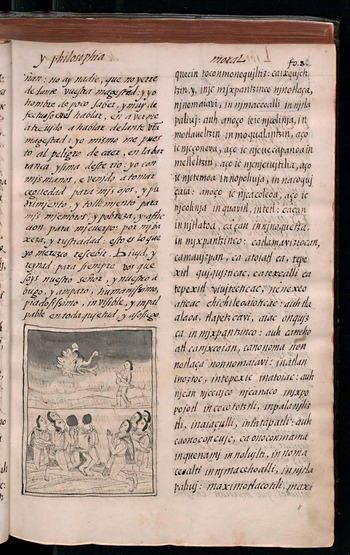
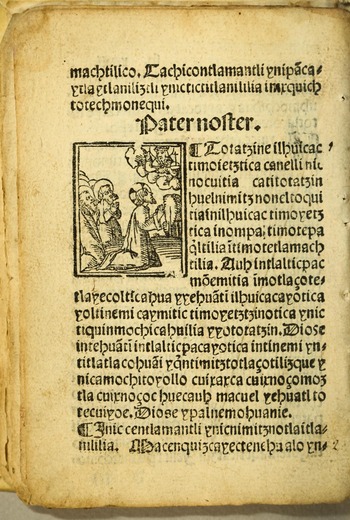
As in the case of the images, the text of Book 6 of the Florentine Codex is indebted to a European format. Dedicated to the discourses of the elders, it begins with a number of prayers to Tezcatlipoca, referred to as the “principal god,” followed by a confession (Florentine Codex:bk. 6, ff. 1r–27v). This, together with the following expiatory texts, sets the tone for the rest of the book as a doctrinal presentation of the huehuetlahtolli that relies on a European and Christian conception of the book, with its peculiar modes of expression and ways of constructing authority. Magaloni (Reference Magaloni Kerpel, Wolf and Connors2012:73) rightly recognized this when she suggested that the use of the grey scale, rather than color, in the images throughout Book 6 derives from an explicit adherence to book illustrations. The question remains, however: for what reasons or intentions did the artists employ this technique only in Book 6 and not in other parts of the Florentine Codex? Figure 5 shows a double illustration: a group of kneeling men in the bottom part directs their gaze upward. The object of their attention is seemingly a monstrous creature floating in the sky in the top vignette. There, a lone man stands with his arms crossed in a sign of respect directed to the same being. Although Tezcatlipoca appears in his full attire in the pantheon presented at the beginning of Book 1 (Figure 1, upper right), the image in Figure 5 is completely unrecognizable. Its bifurcated tongue suggests a diabolical creature. The overall composition is also very different from the illustrations accompanying the chant of Xipe (Figure 2). Not only is the Mesoamerican god unrecognizable, he is also separated from the worshippers, only reachable through the intermediary role of a “middle man,” most likely a priest. The hierarchical arrangement of this composition finds counterparts in book illustrations that were produced and circulated in Mexico in the second half of the sixteenth century. Figure 6, for example, depicts the apostles praying to God following the lead of Jesus. God is far in the sky, and the apostles are only partially visible, while the figure of Jesus as the chosen intermediary takes central stage. As in the previous case, the reference to Christian imagery is indirect and not explicit. What is evident, on the other hand, is the European typology of image making, grounded in a Christian religious outlook.
Prayer to Tezcatlipoca in the Florentine Codex:bk. 2, f. 8r. ©Biblioteca Medicea Laurenziana, Florence (http://teca.bmlonline.it).

Pater Noster, Pedro de Gante, Doctrina Cristiana en lengua mexicana, f. 27v. ©John Carter Brown Library, Brown University, Providence (http://primeroslibros.org/).

By adopting strikingly different visual references, the Nahua artists made clear that there are two types of religious images with distinct formal and iconographic features and cultural ancestries. They convey different ways of materializing the sacred world and religious experience in pictures and words. Black-and-white images based on European engravings accompany the discourses of the ancient, the so-called huehuetlahtolli, sermon-like speeches, in both Primeros Memoriales and Florentine Codex. The more obscure and esoteric chants (cuicatl sg.; cuicameh pl.) dedicated to the gods of the Mexica pantheon either have no illustrations, as in the case of the Primeros Memoriales, or a different type of image, as in the appendix of Book 2 in the Florentine Codex. It is generally assumed that huehuetlahtolli and cuicatl are two distinct genres within Mesoamerican oral literature (León-Portilla Reference León-Portilla1983). In the colonial context of book production, the more prosaic discourses of the elders seem to have found a counterpart in the doctrinal genre employed by the friars (Dibble Reference Dibble and Edmonson1974), while the obscure cuicatl, relegated to an appendix, were left without a translation and only scantily illustrated. At the same time, it is rather quite telling that within the framework of the doctrinal book and its illustrations, Tezcatlipoca, presented as a sort of Paternoster in Figure 6, is distorted and monstrous. He remains physically unreachable and no elements related to songs or music are seen in the image. Xipe (Figure 2), on the other hand, is present, alive, singing, and dancing. I previously argued that the cuicatl written next to him made him so. Once the image came near a powerful chant, it turned into something else, even without any larger pictorial context. Word and image, albeit separated by the colonial alphabetic imposition, were still wholly dependent on one another to create purpose and meaning, even within the confines of a European encyclopedia that meant to record Nahua culture at the very moment that it was being destroyed.
PRIESTLY REPRESENTATIONS IN THE ANCIENT MANUSCRIPTS
As mentioned previously, only a few pictographic manuscripts survived the violence of the Spanish Conquest. Seven of them, usually referred to as Borgia Group, Teoamoxtli, or Books of Wisdom (Jansen and Pérez Jiménez Reference Jansen and Pérez Jiménez2004) share a religious and divinatory content matter, based on the Mesoamerican 260-day calendar (Jansen Reference Jansen2012). The interpretative paradigm based on divination, as established by Nowotny (Reference Nowotny1961), highlights the polysemic and intrinsically ambiguous nature of the pictographic and divinatory image. Each picture can be better described as a cluster of signs that the diviner had to read and interpret anew at each occasion (Quiñones Keber Reference Quiñones Keber and Keber2002; Reyes Reference Reyes García1997). The aforementioned images in the Primeros Memoriales and Florentine Codex, though in some instances based on pre-Hispanic prototypes and iconography, lose this fundamental quality and wane inexorably to the role of illustrations corollary to a fixed alphabetic text.
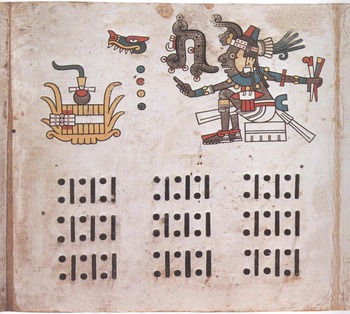
Among the different sections of religious codices, there are a few exceptions to the overall divinatory partition based on the 260-day calendar. I will focus on those parts that do not follow a strict divinatory genre, but rather develop a ritual narrative (Nowotny Reference Nowotny1961:244–275), because priests, gods or god impersonators are there displayed and seemingly perform in a manner comparable to the characters in the Sahagúntine images just discussed. Pages in the so-called Codex Tezcatlipoca (Codex Fejérváry-Mayer, pp. 5–22) and the Codex Tlamanalli (or Codex Cospi, pp. 21–31) share a similar format. In Figure 7, a seated god (or priest) in the upper portion of the page is depicted in profile, directing his attention toward an offering of bundled sticks and a burning hule (rubber ball). In the lower part of the page, Mesoamerican numerals represented with dots and bars are arranged in a specific figural composition. Since Nowotny (Reference Nowotny1961:272–275), we know that these pages have to be interpreted as instructions to create a mesa, ritual offerings laid out for different purposes (propitiation of hunting, agriculture, warfare, etc.). The god represented is the one that has to be addressed and to whom the ceremony has to be dedicated. Anders et al. (Reference Anders, Jansen and Pérez Jiménez1994a:195–219) and van der Loo (Reference van der Loo, Boone and Mignolo1994) have consequently proposed to read these specific sections in a manner that is evocative rather than divinatory, as a form of prayer or invocation.
Mesa for Pahtecatl Yoaltecuhtli in the Codex Tezcatlipoca, p. 14. ©Akademische Druck- und Verlagsanstalt.

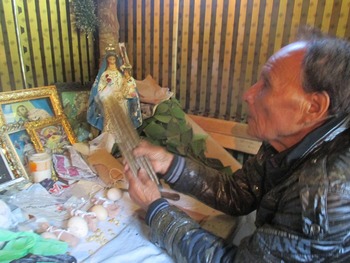
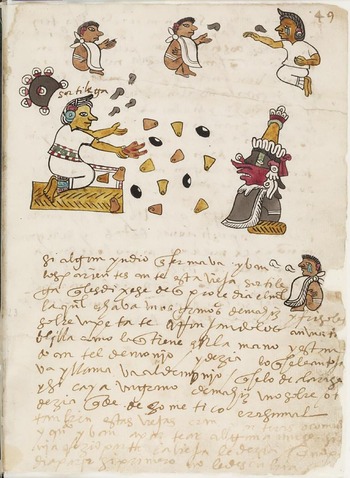
Modern-day divinations (also called cuentas, “counts”) are often carried out before a specific offering is ordered. In the small hamlet of Cerro Palmera, close to San José Tenango, Huautla, don Isauro Guerrero made a cuenta for me on May 25, 2015. He threw corn kernels on a table covered in a white cloth and made a prognostication based on the layout of the kernels, while at the same time invocating Catholic saints. Eventually, he prepared the offering he deemed appropriate that I had to place under my bed (Figure 8). Two cognate illustrations in the colonial codices Tudela and Magliabechi depict the same scene. In Figure 9, a female priest sits on a petate (a straw mat) talking or praying, while throwing kernels in the air on a white cloth depicted just behind her. In front of her is an image of Ehecatl-Quetzalcoatl and below is a person, presumably the client, who is talking and crying. Comparing these images, it is noticeable that in the pre-Hispanic manuscript (Figure 7), the kernels and table are not present or depicted naturalistically, but rather the codex itself becomes a mesa, whose stuccoed surface mimics the white cloth, while the dot-and-line numerals signify both number and position of the kernels, bundles, candles, etc. Not only has the codex transformed into a mesa, but also the god himself, identifiable with some characteristic features of Pahtecatl and Yoaltecuhtli (Anders et al. Reference Anders, Jansen and Pérez Jiménez1994a:218; Seler Reference Seler1901–1902:73), has taken an active role. He is holding a maguey spine and a bone, sacrificial tools, in his right arm, while his left index finger is pointing to the bundle of burning ocote (pinewood) sticks. Is he requiring self-sacrifice or is he about to perform ritual bloodletting himself? Is he ordering the burning of sticks or has he just set up such an offering? The ambiguity in the representation is similar to the case of Xipe in the Florentine Codex (Figure 2), where the priest becomes the god by singing the chant to himself. In both cases, the god, priest, or impersonator is performing an act that had to be performed for him.
Isauro Guerrero performing a cuenta, May 19th, 2015, Cerro Palmera, San José Tenango, Mexico. Photo by Santiago Cortés Martínez.

Codex Tudela, f. 49. Image ©Museo de América, Madrid.

Patton (Reference Patton2009) has discussed a similar situation in a series of Greek vases that depict gods carrying out libation rituals that were supposed to be performed to them. According to her interpretation, this seemingly paradoxical situation turns the otherwise pragmatic relationship of giving an offering in order to obtain a favor (do ut des) into a purposeless self-referential act. The god becomes the generator of the cult that is given to him, with no other outcome other than the ceremony itself. Patton (Reference Patton2009:13) calls this specific type of depictions “divine reflexivity,” explaining that in such instances the painted image does not prescribe a ritual, but rather depicts an idealized moment of the ritual realization. The depiction of the god becomes then a form of self-expression: the divine realm is at once the objective and the source of all ceremonial actions, including the human one (Patton Reference Patton2009:174).
The god-priest of Figure 7 shows another specific iconographic feature that suggests self-reflexivity. His yellow and grey facial paint is replicated in the small head he carries on his forehead. Both heads are also associated with a grey and smoky volute. In the larger head, it is coming out of the mouth (indicating speaking or chanting); in the other case, it appears as if the volute emanates out of both heads, replicating the curl of the larger volute in front of the smaller head. The smaller head is a replica of the larger head that carries it and from both emanate the same grey speech scroll. A picture containing a smaller version or copy of itself is a rhetorical and stylistic device known as mise en abyme, literally “into the abyss” (Dällenbach Reference Dällenbach1989). The most common experience of mise en abyme happens perhaps when a person stands between two mirrors, thus creating an infinite reflection of their own image. In the literary realm, a well-known example of mise en abyme is found in Cervantes’ Quixote in which a character in the novel appears to read the Quixote text itself. Finally, in the famous painting Las Meninas by Diego Velázquez, the artist depicted himself in the act of painting the picture, while the back of the canvas he is working on occupies a large portion of the left part of the painted picture. The trope of the mise en abyme has the rather destabilizing effect of creating an infinitely regressive image, in which the reader/viewer is being read and viewed at the same time in an endless and recursive fashion. The work, be it a novel or painting, appears to generate itself. Subject and object interchange in such a way that one's placement in the narrative flow is confused and identity questioned. The interchangeability of object and subject has also the effect of nullifying the boundaries between external or referential reality and internal or enclosed fiction.
The use of the mise en abyme also has the effect of generating reproducibility or portability of the object or image caught in the trope. The recurrence of certain features dictates their significance. Ordinary interpretative logic would have that recurrence is the result of significance, that is, something is repeated because is important, but the recursive nature of the mise en abyme is such that iterability antecedes meaning. In our case, the iconography of the god-priest is syncretic or ambiguous, mixing as it does the attributes of Patehcatl and Yoaltecuhtli, but there can be no mistake, because the exact replication does not leave any doubts about the original intention. Iterability generates the prototype upon which interpretative authority rests. Self-referentiality is typical of the reflexive nature of divinity according to Patton (Reference Patton2009:176). There is no need of an external myth to explain why the gods are carrying out the ceremony the way they do. They simply do it. As modern scholars, we often fall victim of this mistake and only look for external sources, such as so-called “myths” and “legends,” disregarding the process by which a source does indeed function as such.
The iconographic cluster indicated by the Nahuatl couplet yoalli ehecatl, literally “night and wind,” meaning “invisible and unpalpable” (León-Portilla Reference León-Portilla1993:396), appears in the first texts of Book 6 of the Florentine Codex as an attribute of Tezcatlipoca (Figure 5). In the Codex Tezcatlipoca (Figure 7), the god generates this self-referential quality with his mouth and head. In the image in the Codex Tudela (Figure 9), the night sky is represented at the back of the priestess, glossed as “sortilega,” meaning “fortune teller” or “sorcerer.” In this case, the tlacuilo (painter) has separated the attribute of the speech and turned it into a generic, and derogatory, quality of the ritual that is taking place. In the former case, the ceremoniality of the act is embedded in the power of the word, while in the later (and Colonial) version the image, the constituent iconographic parts are broken down, becoming less evocative and more descriptive. In the chant to Xipe from the Florentine Codex discussed above, “night” is also embedded as an adjectival and intrinsic quality of Xipe as drinker.
The unpalpable and invisible speech of Pahtecatl Yoaltecuhtli is a central aspect of a section of the so-called Codex Borgia, aptly renamed Codex Yoalli Ehecatl, “Book of Night and Wind,” by Jansen and Pérez Jiménez (Reference Jansen and Pérez Jiménez2004:270). This codex contains an extended series of ritual activities (Codex Borgia, pp. 29–46), long understood to have narrative rather than mantic contents (Nowotny Reference Nowotny1961:244). This change is further highlighted by the 90-degree turn in the disposition of the section of the codex that stretches through the two sides of the manuscript at the end of the obverse and the beginning of the reverse. In other words, the reader is forced to follow the linear progression of the narrative and turn the whole book around, handling it rather differently from the manner of mantic reading, in which the diviner could easily select the parts that he or she needed to address.
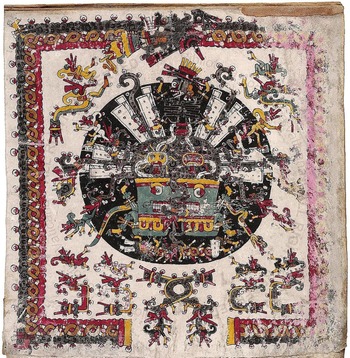
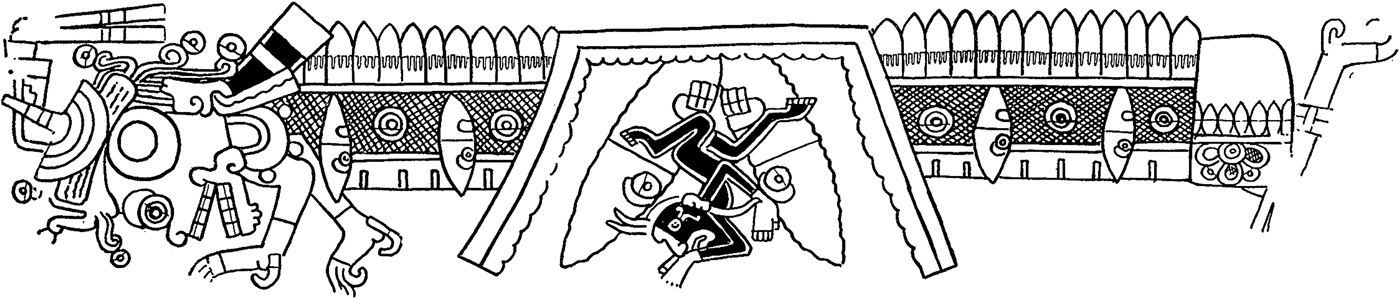
Iconographic elements identifiable with the Nahuatl expression “yoalli ehecatl” (night-wind) reappear throughout this section, serving a seemingly-decorative function. Most pages are framed by the outstretched body of Cihuacoatl (Anders et al. Reference Anders, Jansen and García1993:192), whose outer part is painted in grey with the eye-star symbol of the night (Figure 10). The frames are often broken, pierced through by a character painted black and flying in a somewhat disarticulated manner (Figure 11). This character is at the same time the protagonist, the observer, and the agent of the scenes, rituals, and different scenarios he is seen flying through. While his attributes are somewhat mutable, he has been identified with Quetzalcoatl, or a priest consecrated to Quetzalcoatl, since Seler (Reference Seler1904a:vol. II, p. 1). In the first two pages of the section, two Quetzalcoatl priests, recognizable by the red buccal mask, come out of intertwined night-wind serpents and break through the frame leading into the next page (Figure 10). Each vision serpent generates a spirit, in a reverse situation from the case of Codex Tezcatlipoca (Figure 7), in which the vision was a creation of the god-priest. The circularity established between the priest and the chant as both generator and generated by one another reminds one of the same logical process of the mise en abyme, an endless regression in which referentiality (how one defines oneself) is more important than the reference (who one is).
Codex Yoalli Ehecatl, Plate 29. Image ©Biblioteca Apostolica Vaticana.

Quetzalcoatl priest flying through the body/frame of Cihuacoatl. Codex Yoalli Ehecatl, p. 32. Drawing by Iván Rivera after Nowotny Reference Nowotny1961:Plate 14.

Literary critics and art historians have tended to interpret mise en abyme as a way to express the “disenchantment of the world” (Stoichita Reference Stoichita1997), the rise of the so-called “period eye” and modern thinking (Belting Reference Belting1994), or the existential angst of modern times (Malina Reference Malina2002). The strong ritual underpinning of the images in the Mesoamerican religious manuscripts impose a different interpretation. Self-reflexivity is not a prerogative of modernity, after all. Painting and literature throughout human history were and are open to constant reinterpretation (Powell Reference Powell2008). Taussig (Reference Taussig1993) revived the concept of “mimesis” as a universal human instinct and capacity to replicate and make copies (i.e. representing) of the world in order to objectify it and make sense of it. In some instances, the objective of mimetic activities (verbal or visual) may be to control certain dangerous phenomena, while in others, it is a way to conjure up spirits and bring them into the physical world (Taussig Reference Taussig1993:13, 105). In either case, the act of self-mimesis or self-representation generates awareness on the subject that he or she is, also and at the same time, an object in the represented world (Taussig Reference Taussig1993:111). If this causes anxiety in the modern reader, in a ritual context it can become an open path, subjectively undertaken by the participant audience in order to establish a personal belief (Severi Reference Severi2000). Contemporary Mesoamerican chants show just that.
MAZATEC CHANTS
The Mazatec people of northern Oaxaca have been known since the 1950s to anthropologists and general outsiders because of their ceremonies involving the use of psychoactive plants (Feinberg Reference Feinberg2003). The recordings of the so-called veladas, night vigils, of María Sabina, a Mazatec curandera (healer) by American mycologist expert Wasson (Wasson et al. Reference Wasson, Cowan, Cowan and Rhodes1974) turned this humble but powerful woman into one of the most famous characters of modern Mexico, both inside and outside of the country (Estrada Reference Estrada1981). Nonetheless, and despite the publication of the recordings together with a full transcription and translation of the recited texts in both Spanish and English (Wasson et al. Reference Wasson, Cowan, Cowan and Rhodes1974), the remarkable knowledge of María Sabina has not been given the attention it deserves. Taking these chants as a point of departure, my current research has delved more into what is, in fact, a much larger tradition of ceremonial speaking and chanting associated with curing rituals and the use of sacred plants.
Mazatec ceremonies take place at night in the curandero/a’s house, with the purpose of helping someone afflicted with a health or personal problem. More people than the sole curandero/a and patient, such as members of either family, are usually also in attendance. The whole ceremony, which lasts between two and five hours, entails different kind of activities. Limpias, cleansing rituals with the use of plants, flowers, and tobacco, accompany the lighting of candles and burning of copal (incense). Chanting occurs intermittently, alternating with prayers, casual chatting, and silence. Every curandero/a has their own style of conducting the ceremony and singing in remarkably different ways. On the night of August 24, 2014, Marina Mendoza of Boca del Río, San Antonio Eloxochitlan, performed this chant. This was the only time she chanted during a three-hour ceremony I attended.
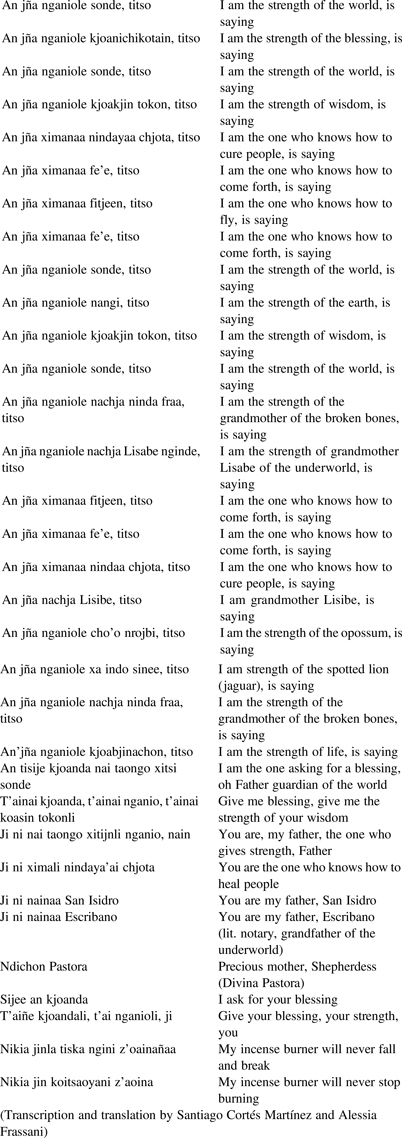
This brief chant follows a structure similar to María Sabina's (Wasson and Wasson Reference Wasson and Wasson1957; Wasson et al. Reference Wasson, Cowan, Cowan and Rhodes1974). Both curanderas claim superhuman powers (the strength of the world, the ability to fly, etc.) and to be different spirits (the guardians of the underworld, etc.) by stating it in a sentence that begins in first person. In some cases, such as the one illustrated here, however, the sentence closes with the verb tso or titso, meaning “says,” or “is saying” with the subject of the verb (he or she) implicit. Munn (Reference Munn and Harner1973:89) interprets this as “[w]e say, man says, language says, being and existence say.” While I ultimately agree with this interpretation, I think that the rhetorical strategies employed by the curanderas need to be explained. What are the implications of the simultaneous use of the first and third person? Marina is literally saying that someone says: “I am the strength of the world, I am the strength of the opossum, etc.” The person uttering those words, however, is herself. Although it may be claimed that she is repeating what she is hearing in her vision, at present, in the ceremony, she is the one saying those words. Using a direct quotation to reproduce the words uttered, Marina turns the “I” in the embedded sentence to a co-referential to the subject of the main clause “says,” which, although without an explicit subject, can be identified with herself. This trope allows the speaker and audience to engage in a sort of role-playing (Urban Reference Urban, Lee and Urban1989:35), as the narrator moves from the third impersonal voice to the first person. Urban (Reference Urban, Lee and Urban1989:36) further explains that the preferred use of anaphora, or the co-referentiality between the subjects of two clauses, “creates an awareness that the discourse of another has been assumed.” The “I” is not only an indexical pronoun but moves in a continuum from a complete relational stance (the present speaker) to a fixed preposition, such as: “[t]here are people capable of transforming themselves into jaguars, spirits, etc.” The speaker is then fluctuating from being simply themselves to being the narrator of the event, to finally going back to the initial quoted preposition, such as: “I am the spotted tiger.” This final/initial statement is not communicated in a doctrinal or dogmatic manner, but rather as an embodied experience, subjectively transmitted to the audience. Furthermore, Marina is clearly not stating that she is hearing those words, but she is saying that someone is saying those words (Munn Reference Munn and Harner1973:110). She is never a passive observer nor is she merely copying or repeating what she sees in another world, but rather she is creating a coherent and concrete (audible) world out of the perceived signs of her vision. As it has been claimed in the case of the Cuna, the chanter is a director of the drama that unfolds in the spirit world at the same time that the chant is being intoned (Taussig Reference Taussig1993:110). Similarly to the flying Quetzalcoatl priest in Codex Yoalli Ehecatl, Marina never ceases to be herself and present herself to the audience, while also making her subjective experience shared through the chant.
The second song was performed by Leonardo Morales on July 29, 2014 in the locality of Barrio Mixteco, Huautla. The ceremony lasted about five hours and Leonardo not only sang and prayed several times, but also whistled and talked a non-existent language (glossolalia).

This second chant is rather different from Marina's and María Sabina's. While both women claimed to have larger powers and become animal and supernatural beings, no such claim was ever made by Leonardo. There is seemingly no content expressed or developed, but he is rather plainly stating over and over again that he has a chant and he is singing it. The song's contents then refer to the uttered words and to the act of uttering itself. The impersonality of the utterance, which was suggested in Marina's chant by the use of the anaphoric “I,” becomes here the central theme developed by Leonardo. Consequently, the text is full of deixis, that is, terms that can only be understood within a relational context: you, here, at this moment. These elements demonstrate that the ceremonial context is an emergent process and not a sociological or cosmological given (Hanks Reference Hanks2006). What that context seems to be, as it is only suggested by the deictic terms and not explicitly enunciated, is that he is at that moment in the presence of the Father or the Virgin, because he addressing them directly. Leonardo is not explicit about what he sees, nor is he describing it, but he is rather stating the power of the chant, and of language, at the moment that is being uttered. The chant exists in itself, seemingly without an agent causing it, as an ultimate form of self-reflexivity. Using the rhetorical and ontological trope of the mise en abyme, he is singing about himself singing. Caught in a labyrinth of his own construction, he disappears in it, and is pure singing, and the Father and the Mother exist. This is similar to the case of Codex Tezcatlipoca on page 14 (Figure 7), in which a non-prescriptive image simply depict a god and chant, built into one another.
The figure of the myse en abyme brings the narrator inside the story with the effect of depersonalizing the narration in a sort of never-ending back-and-forth between points of view. Relation and participation are more effective in establishing a tradition than a predetermined set of external doctrinal referents. In this light, I can also understand Leonardo's glossolalia (also employed by María Sabina): a chant is a process of the creation of language itself, what would be called within the Western philosophical experience, logos (Munn Reference Munn and Harner1973).
DISCUSSION AND CONCLUSIONS
This long excursus through many centuries of Mesoamerican ceremonial chants and their representations show that continuity can be found not only in content but also in the way performers (priests, god-impersonators, curanderos/as, etc.) transform themselves by way of adopting several comparable strategies of self/representation. The focus on form rather than the contents of traditional knowledge also helps us explore from a different point of view the “núcleo duro,” “hard core,” (López Austin Reference López Austin, Broda and Báez-Jorge2001) of Mesoamerican values. Despite the dramatic losses suffered in the aftermath of the Conquest and the imposition of a foreign belief system, Mesoamerican peoples still largely maintain the same way of preserving, transmitting, and transforming sacred knowledge. In other words, it is not so much a matter of religion or belief system per se, as much as a form of appropriating, incorporating, and conceiving such a system.
Ancient manuscripts and modern chants show a remarkable similarity in the way the subject constructs their own identity and experience. Words and images never fail to comment upon the situation that is being constructed, described, and lived through. In the ancient teoamoxtli, this is more evident in those parts where the mantic genre leads the way to a ritual narrative. I have purposefully left out of the discussion all issues related to continuity in contents, such as deities and their ascribed attributes and characteristics, to focus on modality and ways of creating meaning. As established at the beginning of this article, this is precisely where the Sahagúntine experiment found its limit.
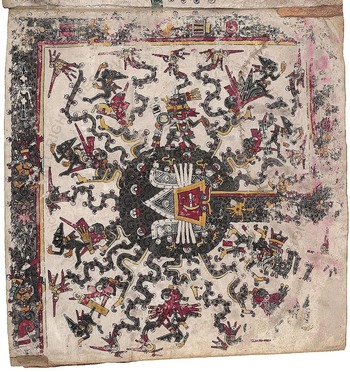
Both Primeros Memoriales and the Florentine Codex are essential sources for understanding Mesoamerican culture at the time of contact thanks to the profuse use of images accompanying the text. It is not of secondary importance, though, that the Nahua artists, the true creators of Sahagún's indigenous texts and images, were caught in a painful and cruel game of investigating and relating the world of their parents and grandparents to those very same people who were purposefully destroying and demonizing that world. The Greco-Roman systematization of the Mexican pantheon (Figures 1 and 2), in which every deity appears with their own set of attributes and the corollary of a related mythology, is useful to modern scholars to decipher pre-contact iconography, providing a sort of Rosetta Stone for outside readers and the missionaries for whom Sahagún intended it as an aid to understand the Nahua world. Looking closer, though, images such as those in Codex Yoalli Ehecatl (pp. 39–47) and Codex Tezcatlipoca present a much more complex picture. In Figure 12, for example, the tlamacazqui (priest), the protagonist of the story, wears the attributes of both Tezcatlipoca and Quetzalcoatl, two gods that, according to many colonial sources, are not only separate, but even antagonistic. According to the Histoire du Mechique, for example, Quetzalcoatl, the legendary ruler of Tula, was defeated by Tezcatlipoca, a deceiving trickster (Garibay Reference Garibay Kintana1979:111–116). Codex Ciuacoatl (or Codex Borbonicus, p. 22) shows Quetzalcoatl and Tezcatlipoca as representatives of day and light versus night and obscurity, respectively (Anders et al. Reference Anders, Jansen and García1992:188). Only the visionary experience allows for the two to be fused together, laying bare an apparent contradiction without further explanation. In the incantations collected by Ruiz de Alarcón, for example, the curer often identifies with Quetzalcoatl, but at the same time claims attributes typical of Tezcatlipoca (Anders et al. Reference Anders, Jansen and García1993:188; Ruiz de Alarcón et al. Reference Ruiz de Alarcón, Andrews and Hassig1987:75):

In the same scene in the codex (Figure 12), Xolotl, a nahual or spirit companion of Quetzalcoatl, is also present, doubling the identity of the main character. While the myth may say one thing, pictures and chants say otherwise. This situation contradicts the well-known concept of “symbolic efficacy” (Lévi-Strauss Reference Lévi-Strauss1963:186–205), according to which the words of a chant exert a psychological power on a patient because they refer to a myth or larger cosmology shared by both curandero/a and client. Exegetical practice, the constant work of rereading and reinterpreting traditional texts, is an essential component of ritual and religion worldwide. It is not only the knowledgeable priest who intervenes in the remaking of the cosmological narratives, though. The lay participant can also enter into the discourse by filling the gaps left by an obscure language, creating thusly their own belief (Severi Reference Severi2000). Cosmological and ceremonial knowledge is not an abstract a priori, but a lived experience, actively absorbed by participants who are also in the position of casting doubts and asking themselves questions on the veracity of the experience itself (Severi Reference Severi2002). In this light, I can also more easily understand the endurance of Mesoamerican ceremonial practices not only in the wake of the total destruction of the calmecac (religious schools), sacred books, and priestly class of the official Mexica religion at the time of the Conquest, but also against the still-ongoing persecution of native religion.
Codex Yoalli Ehectal, Plate 36. Image ©Biblioteca Apostolica Vaticana, Vatican City.

When approaching the complex images found in pre-Hispanic and colonial codices, as scholars we should not shy away from the contradictions, explaining them as mistakes made by unaware copyists. Accounting for ambiguity enables us to reconstruct the process of signification. It is rather common to interpret Aztec ceremonies as reenactments of cosmological myths (see, for example, Hill Boone Reference Hill Boone2007:171–210). This approach does not take fully into consideration that the forms and means by which religious knowledge is attained and transmitted are constantly and explicitly transformed by the embodying gods/priests. As outsiders looking into the Mesoamerican world, scholars need cultural points of reference, but they should never be taken as fixed and unchangeable, thus forgetting the agency (reasons, experiences, doubts, objectives, etc.) of those who live in that world.
The Nahua painters of Sahagún seemed to have done exactly that when they switched from color to monochrome in illustrating their work. The short and obscure cuicatl of Xipe in the appendix of Book 2 of the Florentine Codex, similar to the incantations collected by Ruiz de Alarcón (Ruiz de Alarcón et al. Reference Ruiz de Alarcón, Andrews and Hassig1987), functions as a sort of prompt for longer improvised performances, whose ceremonial context is only minimally suggested by the colorful dancing and playing Xipe (Figure 2). In black-and-white illustrations, on the other hand, the Christian optic is conveyed by the sorrowful man (Figure 3) and in the hierarchical, distant, and unrecognizable relationship of Tezcatlipoca to his followers (Figure 5). Monochrome illustrations in Sahagún's work typically accompany very long texts, which claim to be verbatim reproductions of a recited text. The text is frozen, not performed: the gods have left this world and the new religion is one in which the god is distant and unreachable; the saintly man is in sorrow: God has also abandoned him, as it is indeed the case in the human parable of Christ during the Passion. The monochrome, based on engraved illustrations, serves to say that the Christian way of constructing doctrinal truth is incapable of conveying Mesoamerican divinity. The impossibility of a resolution between Mesoamerican and Christian conception of the sacred is what is expressed in the Sahagúntine illustrations.
The missionary intellectual experiment that led to creation of the Primeros Memoriales and Florentine Codex remained within the confines of New Spain's conventos. They demonstrate the limits of the cultural encounter between the two traditions, expressed self-consciously by the Nahua artists in the making of their work. It was up to the Mesoamerican peoples and their communities to reconstruct the breach left by the foreign invasion and weave into the Mesoamerican tradition Christian concepts and values. The results are evident, for example, in the annual festivals carried out to propitiate rain and crops throughout modern Mexico and Guatemala, tied to the celebration of saints and their feast days. No mention of it is to be found in either versions of the veintena calendar in the Sahagúntine texts. The missionary's intention was to freeze the Mesoamerican conception of time at the moment of its declared death. As modern heirs of the ethnographic method, scholars should be careful not to repeat the same mistake.
Finally, while many modern curanderos are not aware of the existence of codices in European collections, books are always present in their ceremonies. Marina called the guardian of the underworld by his first name, Escribano, the one who produces official documents; Leonardo refers to god as “the one who reads”; María Sabina refers to books several times in her chants, mentioning again notaries (escribanos) and pencils (Wasson et al. Reference Wasson, Cowan, Cowan and Rhodes1974:156). The acts of writing and reading are one inseparable process of creating knowledge. The book itself is white and pure (Wasson et al. Reference Wasson, Cowan, Cowan and Rhodes1974:134), like the altars at curanderos’ houses, called ya'mixa tse, “white pure tables,” in Mazatec. This sacred source of knowledge, constantly re/inscribed every time is invoked, finds its place among the gods (Jesus, Mary, etc.) in the sky and glory (Wasson et al. Reference Wasson, Cowan, Cowan and Rhodes1974:136). It seems then simply the right thing to do to reintroduce the workings of modern curanderos’ knowledge into the ancient books.
RESUMEN
Los datos etnográficos procedentes del México moderno nos informan acerca del arte mesoamericano antiguo, no solamente en términos de contenido, sino también de formas expresivas. En el caso específico de la pictografía, sabemos que ésta daba pie para una performance en la cual recitación, enunciación y contexto directamente afectaban el significado del enunciado. Mientras que normalmente se utiliza la pictografía para ilustrar el contenido de ciertos aspectos de la cultura mesoamericana, la manera en la cual el contenido es codificado y decodificado es también fundamental en el lenguaje pictográfico. En este ensayo, se pretenden reconstruir formas perdurables de la religiosidad mesoamericana a través de la comparación entre imágenes de códices elaborados antes y después de la colonización y cantos mazatecos contemporáneos, centrándose en la figura del especialista religioso (sacerdote o sacerdotisa). Durante las ceremonias y en los cantos, ellos encarnan una experiencia estática que los pone en comunicación directa con la divinidad, a través de una transformación cognitiva que se materializa en palabras, textos y pinturas.
ACKNOWLEDGMENTS
The research leading to the results presented here forms part of the project “Time in Intercultural Context,” directed by Prof. Dr. Maarten E.R.G.N. Jansen (Faculty of Archaeology, Leiden University, The Netherlands), and has received funding from the European Union's Seventh Framework Program (FP7/2007–2013) under grant agreement n° 295434. I would like to thank Prof. Dr. Maarten Jansen and my colleagues in the research group for helpful comments on a previous version of this paper. I also want to extend my gratitude to Santiago Cortés Martínez for researching with me the world of Mazatec curanderos. Lastly, I thank professor Eloise Quiñones Keber for her support and help with the manuscript.