Statement of Research Significance
Research Question(s) or Topic(s): Our investigation provides evidence that social determinants of health, such as access to education, housing, and health care, are significantly associated with preinjury measures of pediatric acquired brain injury. Main Findings: Children in lower deprivation areas demonstrated higher performance on preinjury measures of acquired brain injury. Study Contributions: These findings add to the established connection between social determinants of health and neuropsychological performance, provide evidence for the clinical utility of Area Deprivation Index, and highlight the importance of incorporating social determinants of health into preinjury functioning estimations more broadly. Overall, neuropsychologists are encouraged to consider a patient’s social context into the interpretation of their preinjury functioning and subsequent recommendations.
Introduction
Pediatric acquired brain injuries (ABIs) are a significant cause of disability affecting long-term behavioral, cognitive, social, and physical functioning (Chevignard et al., Reference Chevignard, Soo, Galvin, Catroppa and Eren2012). Neuropsychologists conduct pediatric ABI evaluations in inpatient, rehabilitation, multidisciplinary, and outpatient settings to understand post-injury emotional, behavioral, and cognitive functioning, track recovery, and provide intervention strategies (Watson & Gracey, Reference Watson, Gracey, Jim and Cole2019). Typically, an initial evaluation occurs after a child’s injury; therefore, preinjury functioning is assessed via parent report and measures typically resistant to decline following an injury, such as word reading (Davis et al., Reference Davis, Bernat and Reynolds2018; Orme et al., Reference Orme, Johnstone, Hanks and Novack2004).
Neuropsychologists also consider emotional, behavioral, and cognitive functioning within social contexts to understand preinjury functioning (Bronfenbrenner & Ceci, Reference Bronfenbrenner and Ceci1994). Social determinants of health (SDOH) are individual and system-level factors, including access to education, economic stability, and health care, that are known to affect health and quality of life (Healthy People, 2030, 2024). SDOH are intertwined with a child’s social contexts and subsequent development and affect recovery for children with ABI. For example, children from low socioeconomic (SES) neighborhoods have increased risk for poor outcomes following injury, including increased medical complications and mortality (Kelly et al., Reference Kelly, Patel, Salwi, Lovvorn and Naftel2022). SDOH affect access to postinjury follow-up care; families with reduced access to insurance, transportation, or financial resources may be less likely to return for follow-up care (Lundine et al., Reference Lundine, Ciccia, Koterba and Guernon2022).
As emerging research demonstrates how SDOH affects clinical outcomes, there is opportunity to understand the relationship between SDOH and neuropsychological assessment performances. Following ABI, pediatric neuropsychologists are tasked with estimating preinjury functioning, which is recommended to include consideration of individual and demographic SDOH factors like SES and region where raised (as reviewed in Davis et al., Reference Davis, Bernat and Reynolds2018). By understanding how SDOH influences neuropsychological assessment, neuropsychologists make informed decisions about which methods to utilize and integrate in clinical impressions. For example, children in lower-resourced areas tend to exhibit lower academic achievement, including reading (Noble et al., Reference Noble, Farah and McCandliss2006; Sirin, Reference Sirin2005); however, word reading continues to be used as a preinjury functioning measure (Davis et al., Reference Davis, Bernat and Reynolds2018). We sought to understand the association of SDOH with preinjury measures to critically examine our preinjury estimation methods and optimally inform clinical decision making.
We retrospectively obtained a diverse clinical sample of pediatric patients who sustained an ABI and underwent a targeted neuropsychological evaluation during inpatient admission at a metropolitan level 1 pediatric trauma center in the Midwest. Study measures included were chosen for the clinical purpose to objectively assess the pre-injury functioning of children and supplement clinical interview or record review. While inpatient, children completed the Wide Range Achievement Test (WRAT; Wilkinson & Robertson, Reference Wilkinson and Robertson2006) Word Reading subtest and the child’s caregiver completed the Adaptive Behavioral Assessment System-3rd edition (ABAS-III; Harrison & Oakland, Reference Harrison and Oakland2015) based on preadmission functioning. We investigated the association between these measures with a validated SDOH measure: the Area Deprivation Index (ADI; Messer et al., Reference Messer, Laraia, Kaufman, Eyster, Holzman, Culhane, Elo, Burke and OCampo2006). We hypothesized that children in low deprivation areas would exhibit higher overall ratings of preinjury functioning on caregiver report and word reading.
Materials and methods
This study was approved by the Medical College of Wisconsin Institutional Review Board and completed in accordance with the Helsinki declaration. Data collection was completed via retrospective chart review. The full sample included children admitted to Children’s Wisconsin with an ABI (N = 434; September 2018 to March 2023) who had an inpatient neuropsychology evaluation. Individuals were included in this study if they completed WRAT-Reading in English or the ABAS-III (in English or Spanish). A home address in the electronic medical record (EMR) was used to determine ADI. The study inclusion criteria were intentional to reflect the range of patients typically seen in the hospital catchment area.
The Area Deprivation Index (ADI; Messer et al., Reference Messer, Laraia, Kaufman, Eyster, Holzman, Culhane, Elo, Burke and OCampo2006) is a measure of area deprivation that utilizes a composite of 17 variables derived from the American Community Survey (ACS; aggregated between 2016 and 2020) on the domains of income, education, employment, and housing quality in census blocks nationwide. Census blocks are smaller geographical units within cities or counties that contain between 600 and 3,000 people, with an optimal size of 1500. The ADI uses census tracts to compare neighborhoods nationally (described by percentile ranks where higher percentile indicates higher disparity). Neighborhoods are ranked by socioeconomic disadvantage on a scale of 1–100. For more information visit https://www.neighborhoodatlas.medicine.wisc.edu/.
The Adaptive Behavior Assessment System – 3rd Edition (ABAS-III; Harrison & Oakland, Reference Harrison and Oakland2015) is a standardized caregiver-report measure of their child’s adaptive functioning. The ABAS-III includes 10 subscales: communication, functional academics/functional pre-academics, self-direction, leisure, social, community use, home living, health & safety, self-care, and work. The subscales are combined into three indices (conceptual, social, and practical skills) and an overall general adaptive composite score (GAC) represented as standard scores (mean of 100 and SD of 15). Caregivers completed the ABAS-III based on their child’s preinjury/preadmission functioning. We used the GAC as a pre-injury functioning measure.
The Wide Range Achievement Test Word Reading Subtest (WRAT-Reading; Wilkinson & Robertson, Reference Wilkinson and Robertson2017) is a standardized assessment of single-word reading skills. WRAT-Reading scores are scaled as standard scores (mean of 100 and SD of 15). Data from WRAT-Reading versions 3, 4, and 5 were within this sample given clinical practice at the time of the evaluation. Frequencies were WRAT-III N = 1, WRAT-4 N = 61, and WRAT-5 N = 126. A t-test revealed no significant differences among reading scores [t(155) = .85, p = .40] between WRAT versions (4 vs. 5).
We considered two measures of SDOH, the ADI and the child opportunity index (COI). These measures were highly correlated in this sample (r = −.87, p < .001); therefore, we chose the ADI, as it has been more recently updated (e.g., ADI data aggregated between 2016 and 2020, COI data updated in 2015). We performed two linear regressions to determine the association between 1) ADI vs. WRAT-Reading and 2) ADI vs. ABAS-III GAC. We determined significance by a p-value of <.05. R 2 and adjusted R 2 were used as measures of effect size (0.01 = small effect, 0.09 = medium effect, and 0.25 = large effect; Cohen, Reference Cohen1988).
Results
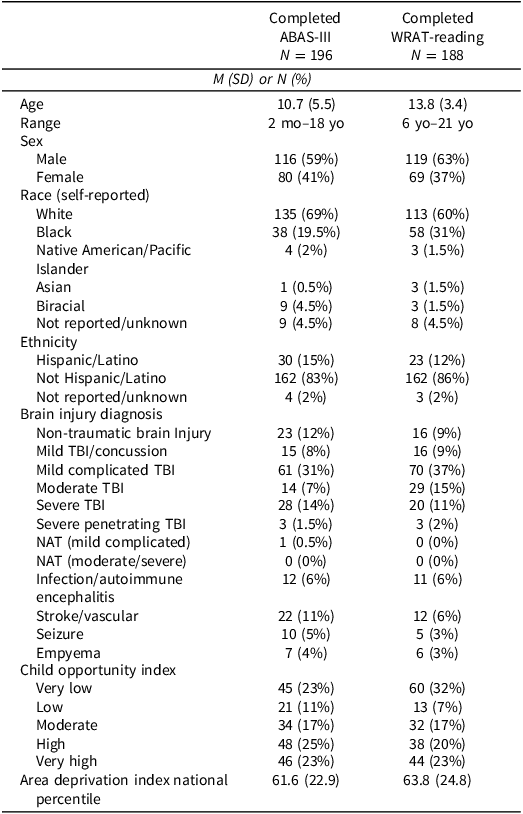
From the total available sample (N = 434), charts from N = 196 of children [59% male, M age = 10.7 (5.5)] included the ABAS-III, and charts from N = 188 children [63% male, M age = 13.8 (3.4)] included the WRAT-Reading subtest. Patients 5 and older more likely completed WRAT-Reading [t(432) = −12.9, p < .001] due to measure age restrictions. Caregivers of white patients more likely completed the ABAS-III [X2(5) = 30.2, p < .001]. No other differences among age, sex, race, or ethnicity were found for those who did and did not complete the measures. ADI national percentile was not associated with whether a patient was able to complete the WRAT-Reading [t(429) = 2.6, p = .06], though this value trended towards significance. Caregivers living in higher deprivation areas [t(429) = .46, p = < .001, M(SD) = 70.2 (23.5)] were less likely to have completed the ABAS-III than caregivers living in lower deprivation areas [M(SD) = 61.6 (22.9)]. The ABAS-III and WRAT-Reading were weakly correlated in this sample (r = .17, p = .09). Demographic information, injury type, and average ADI are in Table 1.
Demographic information, injury type, and COI and ADI for the samples.

Table 1 Long description
The table presents demographic information, injury type, and COI and ADI for samples of children who completed ABAS-III and WRAT-Reading assessments. It includes data for 196 children who completed the ABAS-III and 188 children who completed the WRAT-Reading subtest. The table is organized into several categories: Age, Sex, Race, Ethnicity, Brain Injury Diagnosis, Child Opportunity Index, and Area Deprivation Index National Percentile. Each category lists the number and percentage of children fitting specific criteria. For example, under Age, the ABAS-III group has an average age of 10.7 years with a range from 2 months to 18 years, while the WRAT-Reading group has an average age of 13.8 years with a range from 6 to 21 years. The table also includes detailed breakdowns by sex, race, ethnicity, and various types of brain injuries. Notable trends include a higher percentage of males in both groups and a significant representation of white children in the ABAS-III group. The table highlights the diversity in injury types and the distribution across different child opportunity and area deprivation indices.
Note: ABAS-III = adaptive behavioral assessment- 3rd edition, WRAT-Reading = wide range of achievement reading subtest (multiple editions), TBI = traumatic brain injury, NAT = non-accidental trauma, mo = month old, yo = year old.
ADI significantly predicted [F(1, 186) = 32.3, p < .001] and explained 15% of the variance (R 2 = .15, Adjusted R 2 = .14, medium effect) in WRAT-Reading scores. Children in higher deprivation areas demonstrated worse performance on WRAT-Reading (B = −.25, SE = .04, β = −.38, t = −5.7, p < .001). ADI significantly predicted [ABAS-III; F(1, 192) = 16.7, p < .001] and explained 8% of the variance for ABAS-III caregiver ratings (R 2 = .08, Adjusted R 2 = .08, small effect). Children in higher deprivation areas demonstrated lower caregiver preinjury adaptive functioning ratings (B = −.18, SE = .04, β = −.28, t = −41, p <.001). See Figure 1.
Discussion
Understanding preinjury functioning is integral to neuropsychological assessment of children with ABI, as it aids in understanding injury-related decline and the influence of environmental and social contexts. We investigated the association between the ADI and widely used preinjury functioning measures including the ABAS-III and WRAT-Reading in a diverse clinical sample. We found that children with ABI from lower deprivation areas exhibited higher preinjury scores on the ABAS-III and WRAT-Reading than children from higher deprivation areas. Area deprivation had a medium effect on word reading scores and a small effect on adaptive functioning ratings, indicating that a child’s reading scores are more impacted by their area deprivation than caregiver ratings. Our findings add to and expand upon the previously established connection between SDOH and neuropsychological performance, provide evidence for the clinical utility of ADI, and highlight the importance of incorporating SDOH into preinjury functioning estimations more broadly.
These findings add to the long-described connection between SDOH and children’s cognitive functioning. Previous studies demonstrated that SES is associated with phonological decoding and reading skills (Noble et al., Reference Noble, Farah and McCandliss2006), maternal education is associated with fMRI functional connectivity between attention systems and reading-related regions (Greenwood et al., Reference Greenwood, Dudley, Hutton, DiFrancesco, Farah and Horowitz-Kraus2021), and SES is associated with cognitive and academic achievement (Kramer et al., Reference Kramer, Allen and Gergen1995; Sirin, Reference Sirin2005). In fact, our findings map on closely with previous research demonstrating that SES accounts for 20% of the variance in childhood IQ (Gottfried et al., Reference Gottfried, Gottfried, Bathurst, Guerin, Parramore, Bornstein and Bradley2003), as we found that ADI accounted for 18% of the variance in word reading. Our findings expand upon the connection between SDOH and neuropsychological assessment by investigating this relationship in a novel population: children with ABI. These findings have significant implications for children with ABI as high preinjury functioning is a protective factor for recovery from injury (Moran et al., Reference Moran, Babikian, Del Piero, Ellis, Kernan, Newman, Giza, Mink, Johnson, Babbitt and Asarnow2016). For example, children with low SES are at increased risk for poor outcomes following a brain injury, including increased mortality, hospital length of stays, and inpatient costs (Kelly et al., Reference Kelly, Patel, Salwi, Lovvorn and Naftel2022).
This investigation is the first step in understanding the association of the ADI with reading and adaptive functioning. The ADI has multiple strengths; it aggregates multiple indicators of SDOH (e.g., income, education, employment); is empirically validated (Messer et al., Reference Messer, Laraia, Kaufman, Eyster, Holzman, Culhane, Elo, Burke and OCampo2006); readily accessible online and regularly updated; and allows for nationwide comparison, thus adding context to a patient’s deprivation level, unlike other SDOH proxies such as household income. Moreover, other strategies to assess SDOH or SES proxies (e.g., parent education, household income, school ratings/quality, transportation access, insurance) may not be available to clinicians or known. To more systematically understand the utility of the ADI over other SDOH proxies, future research could use aggregate (e.g., ADI) or individual SDOH measures (e.g., parental education, income, health insurance) to compare the predictive power of these measures and their association with preinjury pediatric ABI measures.
The ADI has primarily been used as a research tool; by associating the ADI with adaptive functioning and word reading, we are taking steps towards understanding the clinical utility of the ADI. For example, there has been a push to incorporate demographic information and a patient’s history (e.g., see Davis et al., Reference Davis, Bernat and Reynolds2018) when estimating preinjury functioning. Our research provides evidence that integrating ADI into clinical assessment provides important information for the interpretation of preinjury functioning for children with ABI. Interested clinicians can efficiently calculate ADI using their patient’s address and utilizing instructions on the website (https://www.neighborhoodatlas.medicine.wisc.edu/). Clinicians can also gather and incorporate contextual factors from record review and clinical interview including factors related to SDOH, caregiver report measures, and estimates of preinjury functioning to provide interpretation, injury recovery predictions, and recommendations. For example, the clinician could collect information about a child’s school environment, education quality, home environment, and access to enriching activities and use these as pieces of evidence along with the child’s preinjury performance for a holistic picture of the child’s preinjury functioning. The clinician could use this information to make attainable recommendations with focus on the highest areas of need to optimize recovery.
As future research bolsters evidence for including SDOH in our understanding of preinjury functioning, next steps may include incorporating the ADI, or other measures of SDOH, more systematically into a patient’s EMR. Having a readily available metric of SDOH in medical records can be particularly useful when other methods of collecting this information (e.g., caregiver report) are not available. Encouragingly, ADI can be easily incorporated into the EMR, as it is based on a patient’s address which is almost always available in the EMR.
Our sample included a diverse group of children across age, race, SDOH, and injury types; however, there are limitations. Data was only available via retrospective chart review; thus, the complete clinical sample was not represented. Some pre-injury variables such as pre-injury diagnoses and intellectual functioning were not able to be included in sample description. Moreover, ADI level may have changed from the time period between hospitalization and data extraction, though most ADIs were extracted within a year of the patients’ hospitalizations. We found systematically missing data where caregivers living in areas of higher deprivation were less likely to complete the ABAS-III. This may be because within the clinical inpatient setting, caregivers may not have been present bedside and/or could not be reached via other means during their child’s hospitalization to complete the ABAS-III. Caregivers may have limited ability to leave work or may not have access to childcare, transportation, or a telephone. Alternatively, the ABAS-III may not have been available in the caregiver’s primary language. This bias suggests that we are likely underestimating the impact of ADI on ABAS-III ratings, given that our data showed higher deprivation predicts lower ABAS-III scores. Future research using a prospective approach may be more robust in capturing a wider range of children who are admitted for an ABI.
Future research could also investigate the intersection between race, SDOH, and preinjury measures. Most of our patient population came from southeastern Wisconsin, particularly the city of Milwaukee, which has significant racial divides due to a history of segregating policies resulting in disproportionately more Black and non-Hispanic children living in high deprivation areas (Levine, Reference Levine2020). This demographic breakdown may not generalize to other regions; therefore, future research should investigate this association in other regions to determine the stability of these findings.
When investigating the impact of SDOH on measures of preinjury functioning for children with ABI, we found that children in low deprivation areas demonstrated higher performance on preinjury measures. This finding highlights the need to include measures of SDOH more systematically in our understanding of a patient’s preinjury functioning and use this knowledge to tailor recommendations and treatment. By investigating the connection between the ADI and widely used preinjury measures, we gain more knowledge regarding the association between SDOH and neuropsychological performance and provide evidence to incorporate SDOH factors more systematically in a clinical setting. Taking a holistic approach to neuropsychological assessment will allow clinicians to improve their understanding of a patient, inform treatment planning, consider barriers to care, and improve outcomes following pediatric ABI.
Scatter plot of the WRAT-Reading and ABAS-III GAC with ADI National Percentile. This figure is a scatter plot that represents the relationships among the WRAT-Reading scores (top graph) and ABAS-III GAC scores (bottom graph) with the Area Deprivation Index. The y-axis represents ADI National Percentiles and the x-axis represents standard scores on the WRAT-Reading (regression equation y = 119 – 0.60x) and ABAS-III GAC (regression equation y = 104 – 0.45x). For both graphs, the blue dots represent each patients’ data point, and the black line represents the regression equation.

Figure1 Long description
A scatter plot with two graphs. The top graph shows the relationship between WRAT-Reading scores and ADI National Percentile. The x-axis represents WRAT-Reading scores, and the y-axis represents ADI National Percentile. The bottom graph shows the relationship between ABAS-III GAC scores and ADI National Percentile. The x-axis represents ABAS-III GAC scores, and the y-axis represents ADI National Percentile. Each graph contains dozens of blue dots representing individual data points and a black line representing the regression equation. The regression equation for the top graph is y = 119 - 0.60x, and for the bottom graph, it is y = 104 - 0.45x. The data points show a negative correlation in both graphs.
Acknowledgements
None.
Funding statement
There are no competing interests or sources of financial support to disclose.
Competing interests
None.