INTRODUCTION
Phyllostomidae are the most diverse bat family in the Neotropics (Gardner Reference GARDNER and Gardner2007), showing high diversity both in terms of species richness and in ecological functions. These animals play crucial roles in maintaining ecosystem services such as seed dispersal, plant pollination and control of invertebrate populations. In addition, this family can be used as a good bioindicator of the impacts of habitat fragmentation and disturbance on animal communities (Fenton et al. Reference FENTON, ACHARYA, AUDET, HICKEY, MERRIMAN, OBRIST, SYME and ADKINS1992; but see Cunto & Bernard Reference CUNTO and BERNARD2012). Nevertheless, studies documenting variation in bat communities and habitat structure during the successional process are rare, especially in tropical dry forests (TDFs sensu Sanchez-Azofeifa et al. Reference SANCHEZ-AZOFEIFA, QUESADA, RODRIGUEZ, NASSAR, STONER, CASTILLO, GARVIN, ZENT, CALVO-ALVARADO, KALACSKA, FAJARDO, GAMON and CUEVAS-REYES2005) (Castro-Luna et al. Reference CASTRO-LUNA, SOSA and CASTILLO-CAMPOS2007, Mancina et al. Reference MANCINA, GARCÍA-RIVERA and CAPOTE2007, Medellín et al. Reference MEDELLÍN, EQUIHUA and AMIN2000; but see Avila-Cabadilla et al. Reference AVILA-CABADILLA, STONER, HENRY and AÑORVE2009). Changes in plant species composition and forest structure affect bats’ food supply and their movement capacity and thus have direct impacts on the maintenance of their ecological functions in forest regeneration (Meyer & Kalko Reference MEYER and KALKO2008).
There are only a few studies of bat assemblages in Neotropical TDFs (but see Avila-Cabadilla et al. Reference AVILA-CABADILLA, STONER, HENRY and AÑORVE2009, Stoner Reference STONER2005). Indeed, most of our knowledge about these organisms in the tropics comes from wet forests and likely has limited application to TDFs due to their particular characteristics. The marked seasonality of TDFs strongly influences patterns of plant reproduction (Bullock Reference BULLOCK, Bullock, Mooney and Medina1995, Pezzini et al. Reference PEZZINI, BRANDÃO, RANIERI, ESPÍRITO-SANTO, JACOBI and FERNANDES2008), thus limiting the availability of flowers and fruits to several animal groups, including bats. Furthermore, the synchronous production of leaves, limited to about 6 mo y−1 (Murphy & Lugo Reference MURPHY and LUGO1986, Pezzini et al. Reference PEZZINI, BRANDÃO, RANIERI, ESPÍRITO-SANTO, JACOBI and FERNANDES2008), has an indirect influence on the chiropterofauna because it affects the abundance of insects available as a food source for many insectivorous bats. For instance, in a study conducted in two dry forests in Costa Rica and Mexico, Stoner (Reference STONER2005) found significant differences in the species diversity of frugivorous and nectarivorous bats during different periods of the year and suggested that this variation was due to fluctuations in resource availability.
The aim of this study was to investigate the spatiotemporal variation in phyllostomid bat richness and abundance, and in the composition and structure of their trophic guilds, over a successional gradient in a TDF in south-eastern Brazil. Specifically, we tested the following hypotheses: (1) Abundance and richness of bats increases over a successional gradient due to greater structural complexity of the habitat. We predict that the proportion of frugivorous and insectivorous bats will be higher than other guilds in late-successional stages due to the greater structural complexity found in areas in advanced stages of TDF succession. (2) Abundance and richness of bats is higher during the wet season than during the dry season due to greater resource availability. We predict that frugivorous bats will be more abundant in wet months due to the higher availability of fleshy fruits in these months.
METHODS
Study area
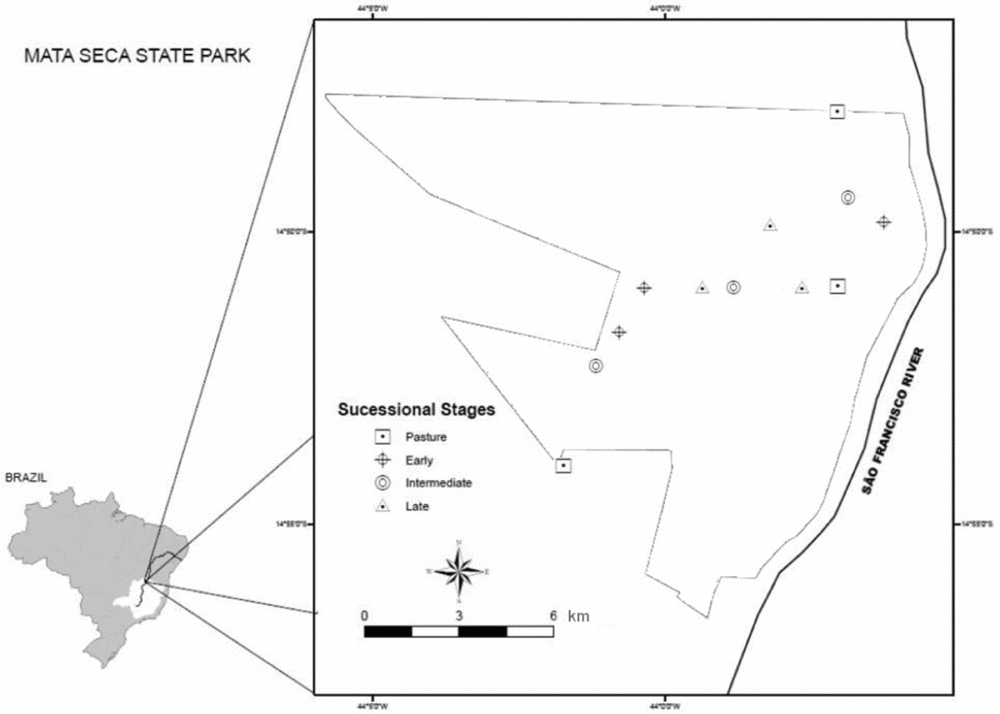
The study was conducted in and around the Mata Seca State Park (MSSP), a conservation area with restricted use (equivalent to IUCN categories Ia and Ib), with an area of 15466 ha, located in the northern part of the state of Minas Gerais, south-eastern Brazil (Figure 1). According to Köppen's classification (Peel et al. Reference PEEL, FINLAYSON and MCMAHON2007), the predominant climate of the region is Aw (tropical savannah), characterized by a pronounced dry season from April to September, and a rainy season from October to March. In this climate type, there is at least one month with precipitation below 60 mm, and the mean temperature of the coldest month is above 18 ºC. In the study area, the mean annual temperature is 24 ºC, and the mean annual precipitation is 871 mm (Antunes Reference ANTUNES1994). During this study, deviations from historical monthly mean temperature were observed for some months, and the monthly precipitation ranged from 0 to 262 mm.
Location and boundaries of the Mata Seca State Park in northern Minas Gerais, southeastern Brazil, and the 12 sampling areas used in this study.

The typical vegetation of the park is seasonally dry deciduous forest on flat and nutrient-rich soils (IEF 2000). These areas are dominated by trees that lose up to 90–95% of their leaves during the dry season (Pezzini et al. Reference PEZZINI, BRANDÃO, RANIERI, ESPÍRITO-SANTO, JACOBI and FERNANDES2008). The MSSP has a land-use history of extensive livestock grazing from free-ranging cattle and horses, combined with plantations of corn, beans and tomatoes in two central plots of 80 ha each, as well as the selective extraction of timber (Madeira et al. Reference MADEIRA, ESPÍRITO-SANTO, NETO, NUNES, ARTURO SÁNCHEZ AZOFEIFA, WILSON FERNANDES and QUESADA2009). Approximately 15% of the total area of the park is composed of abandoned pastures in the early stages of succession, with the rest composed of either mature or secondary forests (IEF 2000).
For this study, four successional stages were selected determined by time of abandonment after deforestation (Madeira et al. Reference MADEIRA, ESPÍRITO-SANTO, NETO, NUNES, ARTURO SÁNCHEZ AZOFEIFA, WILSON FERNANDES and QUESADA2009): (1) pasture areas were characterized by the presence of several species of grass used for livestock (0–1 y since abandonment); (2) early stages were comprised of herbaceous or shrub plants as the main component and contained sparse patches of taller woody vegetation forming a discontinuous canopy with a maximum height of 4–6 m (7–9 y since abandonment); (3) intermediate stages were characterized by the presence of two vertical strata: the first composed of fast-growing deciduous trees with a height of 10–20 m forming a closed canopy, and the second stratum composed of a high diversity of lianas and adult trees belonging to shade-tolerant species and juvenile trees (15–25 y since abandonment); and (4) late-successional stages comprised three vertical strata: the first with trees of 15–30 m in height forming a closed canopy, the second with the presence of juvenile trees of different species and sizes, and the third stratum composed of understorey herb and shrub species (>50 y since abandonment; Madeira et al. Reference MADEIRA, ESPÍRITO-SANTO, NETO, NUNES, ARTURO SÁNCHEZ AZOFEIFA, WILSON FERNANDES and QUESADA2009). In each stage, three different areas were selected for sampling for a total of 12 sites in the MSSP and surrounding areas (Figure 1).
Animal capture
The study included eight samplings performed within 2 y; four during the rainy season (R; February, April, December of 2008, March of 2009) and four during the dry season (D; May, September of 2007 and August, October of 2008). Sampling was always performed on nights with a new or crescent moon to minimize the effects of lunar phobia (Morrison Reference MORRISON1978). We captured bats using ten 12 × 2.5-m mist-nets per night in the selected area and arranged along potential flight routes. The nets were opened at dusk, remained open for 5 h and were monitored every 30 min. In every sampling period, each of the 12 areas was sampled for one night.
The captured animals were processed recording the sex, age class, reproductive stage and forearm length, and were identified in the field using dichotomous keys and taxonomic descriptions (Gregorin & Taddei Reference GREGORIN and TADDEI2002, Medellín et al. Reference MEDELLÍN, ARITA and SÁNCHEZ1997, Reis et al. Reference REIS, PERACCHI, PEDRO and LIMA2007, Timm & LaVal Reference TIMM and LAVAL1998). Afterwards, bats were marked with an individually numbered forearm metallic ring and released at the site of capture. Each individual was assigned to one of the following guilds: frugivorous, insectivorous, nectarivorous, omnivorous, haematophagous and carnivorous, based on their principal diet item described in Brazil (Reis et al. Reference REIS, PERACCHI, PEDRO and LIMA2007). We used the classification of Gardner (Reference GARDNER and Gardner2007) for bat families, subfamilies and genera.
Statistical analyses
Total sampling effort was represented by mist-net hours and calculated by multiplying the number of sampling days by the hours of exposure and by the number of nets per day (96 d × 5 h × 10 nets). To verify whether this sampling effort was sufficient to sample the bat assemblage of the study sites, cumulative-species curves were constructed for each of the successional stages using the observed richness (Mao Tao). The richness estimator Jack-knife 1 was used to assess the completeness: (S(obs)/S(est)) × 100, where S(obs) is the observed richness and S(est) is the estimated richness by Jack-knife 1. For all analyses we used the software EstimateS version 8.
To investigate the effects of successional gradient and season (dry and wet) on the abundance and richness of bats, we used generalized linear models (GLM). Successional stage, season, and their interaction were considered the explanatory variables. Abundance and richness of bats were pooled by season and used as dependent variables in separate models. To evaluate variation within each season, similar models were constructed substituting season for sampling month. In this case, the abundance and richness of bats in each month were considered as dependent variables. The minimum adequate models were obtained by the exclusion of the non-significant variables from the full models. Models were then subjected to residual analyses to determine the adjustment of the error distribution and then compared with a null model. Models with statistically significant differences were subjected to a contrast analysis, pooling the qualitative terms that were not significant (amalgamation; Crawley Reference CRAWLEY2007). All models to test abundance and richness were adjusted to a quasi-Poisson error distribution.
In the analysis regarding the spatiotemporal variation in the abundance of each guild, the abundance data of each bat species was grouped by guild and converted to proportions as follows: to compare the variation between successional stages, the abundance of bats in each guild was divided by the total abundance of the stage; to compare the variation between months, the abundance of bats in each guild was divided by the total abundance of bats captured per sample; and finally, to compare the variation among the dry and wet seasons, the abundance of bats in each guild was divided by the total abundance of bats captured per season. For these analyses, generalized linear models (GLM) were again constructed, with the proportion of bats in each guild as the response variable and the season and the successional stage as the explanatory variables. As previously described, models also were constructed by substituting the seasons for sampling months as the explanatory variable. All of these models were adjusted to quasi-binomial error distribution. All of the GLMs were constructed and analysed using R software, version 2.6.
The structure of the bat assemblage was compared between successional stages and periods using a non-parametric test of significance between groups – one-way ANOSIM (Clarke Reference CLARKE1993). This type of analysis is similar to an ANOVA, but compares groups based on a distance measure, in our case the Bray–Curtis dissimilarity index, with the distances converted to rank (Clarke Reference CLARKE1993). These analyses were conducted with the software PAST (Hammer et al. Reference HAMMER, HARPER and RYAN2001). The results of all analyses were considered significant when P < 0.05.
All statistical analyses were conducted using only bats from the family Phyllostomidae, since they are more susceptible to capture using mist-nets. All the other families captured in this study were used only to construct the complete list of bats of MSSP (Appendix 1).
RESULTS
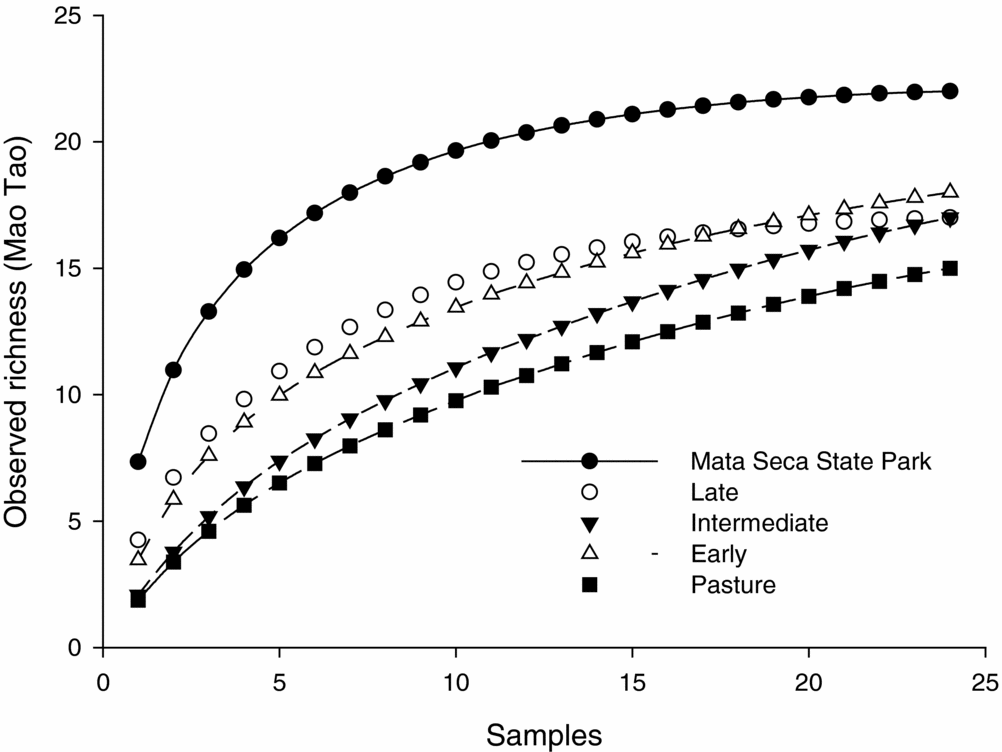
A total sampling effort of 4800 mist-net h was performed, and 537 individuals were captured (plus 29 recaptures), belonging to four families and 22 species (96% of estimated richness; Appendix 1). The cumulative species curve reached a plateau for the bat assemblage when we considered all successional stages sampled in MSSP. When analysed separately, only areas of late succession reached stabilization (95% S(est); Figure 2). For the intermediate- and early-successional stages and the pasture areas, 71%, 79% and 72% of the estimated richness was sampled, respectively.
Cumulative curves of bat species captured in a tropical dry forest in south-eastern Brazil, at Mata Seca State Park and for each successional stage separately. Curves were based on observed richness (Mao Tao).
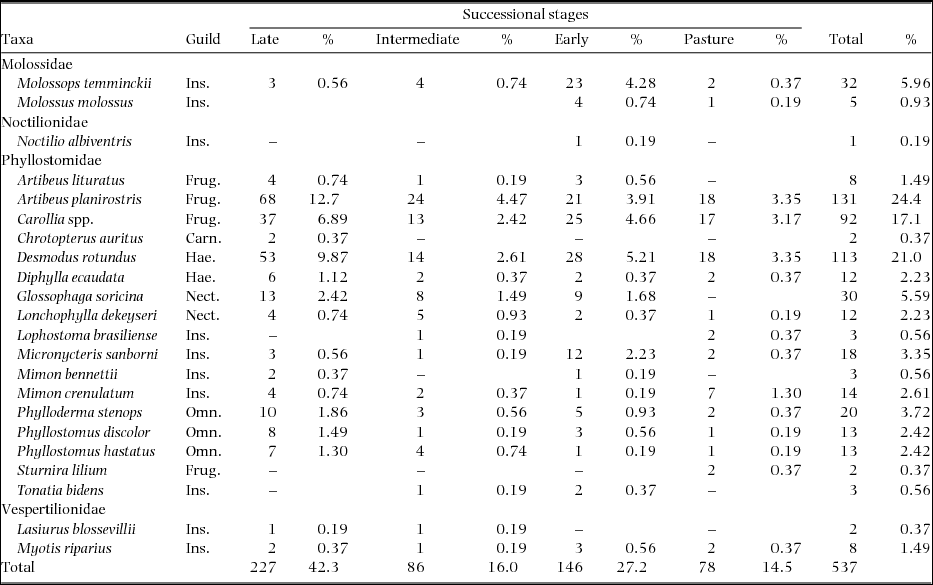
The most abundant species were Artibeus planirostris (131 individuals), Desmodus rotundus (113) and Carollia spp. (92), together corresponding for almost 63% of the total sample size (Appendix 1). These species were also the best-represented species in late and intermediate stages and pasture areas. In the late-successional stage, 227 individuals distributed among 17 species were captured. Chrotopterus auritus was the only species exclusive to this habitat, represented by two specimens. We sampled 86 bats in the intermediate stage, also belonging to 17 species but none of them was exclusive to this stage. In the early stage, there was an abundance of 146 individuals distributed among 18 species. The dominant species differed from other stages, and D. rotundus (28), Carollia spp. (25) and Molossops temminckii (23), were the most abundant. One individual of Noctilio albiventris was exclusively found in this stage. In the pasture area, we captured 78 individuals belonging to 15 species; Sturnira lilium, was captured only in this stage and was represented by two individuals (Appendix 1).
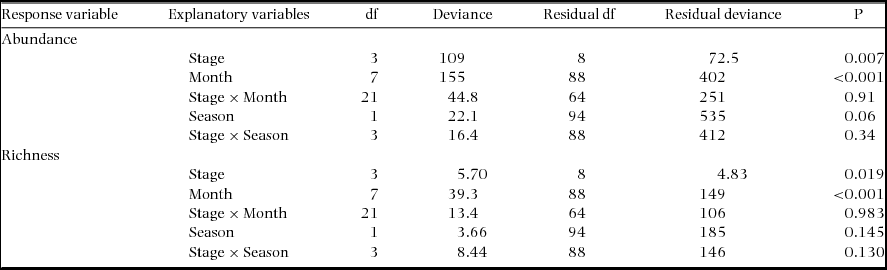
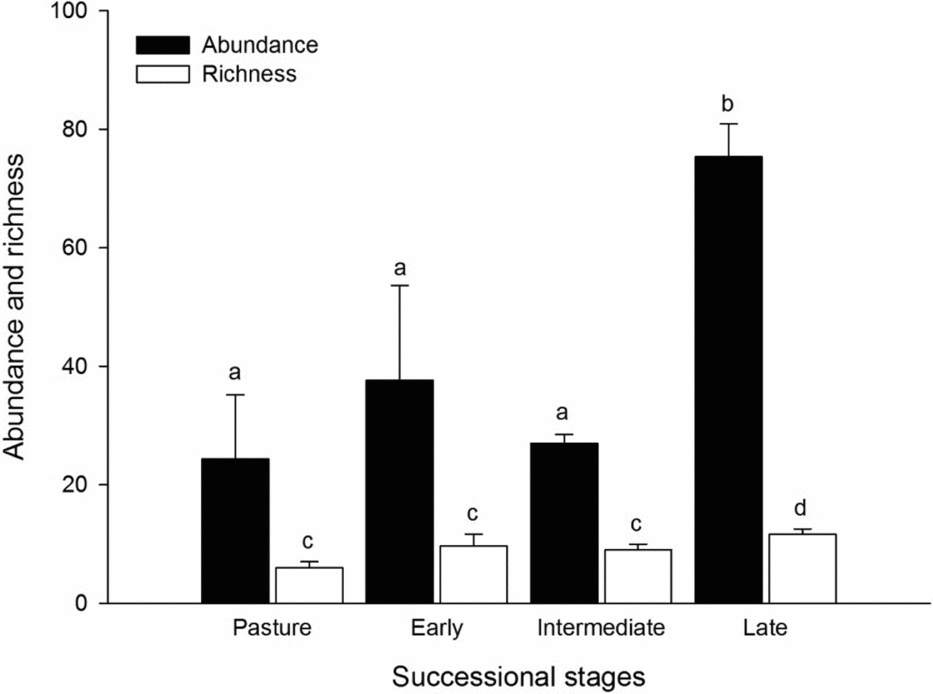
The abundance and richness of bats differed statistically among the successional stages (Table 1), being greater in the late-successional areas (Figure 3). The pasture areas, early and intermediate stages had the lowest abundance and richness values and were not statistically different from each other (Figure 3). Despite some differences in species composition, the ANOSIM analyses did not indicate statistical differences in the general structure of the bat assemblages between successional stages (P = 0.129).
Complete general linear models (GLM) constructed to test the effects of successional stage, season and sampling month on the abundance and richness of bats in a tropical dry forest in south-eastern Brazil. A quasi-Poisson error distribution was used in all models.
Bat abundance and richness in 12 areas in four successional stages in a tropical dry forest in south-eastern Brazil. Different letters on bars indicate significant differences between successional stage for abundance and richness, respectively (average ± SE).
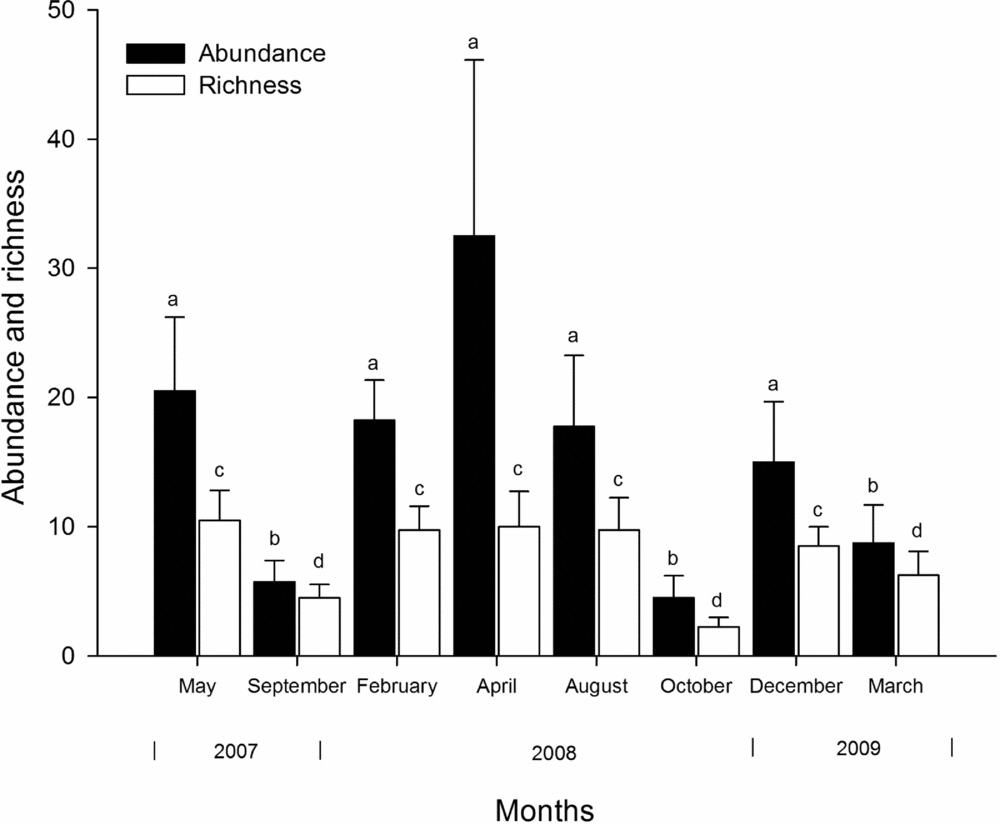
Bat species richness and abundance varied between sampling months (Figure 4, Table 1). In general, there was a lower abundance of bats in dry months, with a significantly smaller number of captures at the end of the dry season (September and October) (Figure 4). At the beginning (May) and the middle (August) of the dry season, the abundance of bats did not differ from that observed during the rainy season. A great variation in the number of captures was observed during the wet months. In March 2009, the abundance of bats was particularly low, whereas the opposite was observed in April 2008, the month with the highest number of captures in this study. Bat richness was also statistically lower at the end of the dry season (Figure 4) with little variation in the other months, even during the rainy season. In March 2009, we also recorded a low richness despite being a rainy month. When the months were pooled by season, the abundance and richness did not vary between the dry and wet seasons (Table 1). We did not detect temporal variation in bat composition through the ANOSIM analysis (P = 0.801).
Abundance and richness of bats during the eight sampling months in a tropical dry forest in south-eastern Brazil. Different letters on bars indicate significant differences between months for abundance and richness, respectively (average ± SE).
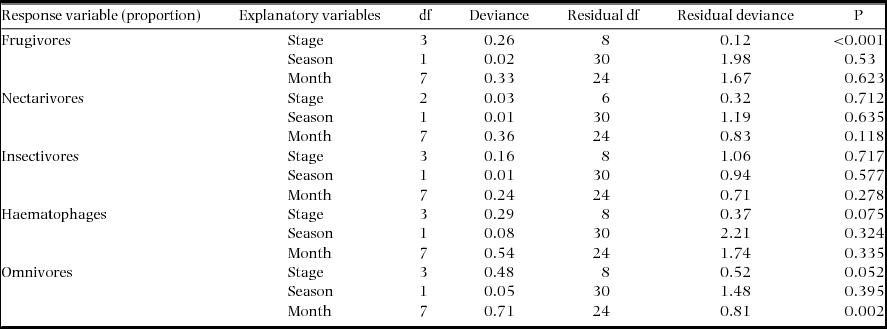
Regarding the trophic guilds of phyllostomid species, frugivorous bats were the most abundant (233 captures), followed by the haematophagous species (125), omnivores (46), nectarivores (42), insectivores (41) and carnivores (2). The latter category was excluded from the analysis because of the low number of captures. Only the proportion of frugivorous species varied significantly between successional stages, with a larger proportion of captures in the late stage.
Omnivorous bats varied significantly between sampling months, with the largest number of captures in August and December 2008. There was no difference in the proportion of bats in each trophic guild between the wet and dry seasons (Table 2).
Complete general linear models (GLM) constructed to test the effects of successional stage, season and month of sampling on the proportion of bat captures per trophic guild in a tropical dry forest in south-eastern Brazil. A quasi-binomial error distribution was used in all models.
DISCUSSION
Bat assemblage characteristics
The species richness observed in the MSSP (22 species) is within the range observed in most studies in other TDF areas using mist net sampling, but is lower than that found by Stoner (Reference STONER2005) in a TDF in Costa Rica (47 species). Avila-Cabadilla et al. (Reference AVILA-CABADILLA, STONER, HENRY and AÑORVE2009) also reported 22 bat species in TDF along the western coastal region in Jalisco, Mexico. In other regions of Brazil, bat richness in seasonal areas of cerrado and caatinga (Brazilian vegetation types like savannas and dry forests, respectively) varies around 20 species in most studies (Falcão et al. Reference FALCÃO, REBÊLO and TALAMONI2003, Gregorin et al. Reference GREGORIN, CARMIGNOTTO and PERCEQUILLO2008, Zortéa & Alho Reference ZORTÉA and ALHO2008). However, the richness of bats recorded in tropical wet forests in Brazil is higher, generally greater than 40 species (Bernard Reference BERNARD2002, Bernard & Fenton Reference BERNARD and FENTON2007).
The high capture of Phyllostomidae is typical in the Neotropics because this is the most diverse family and the most susceptible to capture with mist nets. The dominance of at least one of the three most captured species in this study (A. planirostris, C. perspicillata and D. rotundus) also has been reported for other Brazilian biomes (Aguiar & Marinho-Filho Reference AGUIAR and MARINHO-FILHO2004, Bernard & Fenton Reference BERNARD and FENTON2007, Gregorin et al. Reference GREGORIN, CARMIGNOTTO and PERCEQUILLO2008, Zortéa & Alho Reference ZORTÉA and ALHO2008). The occurrence of a few dominant and many rare species is common in studies conducted on Neotropical bats (Fleming Reference FLEMING1986). Moreover, the high feeding plasticity and tolerance to disturbances observed for A. planirostris and C. perspicillata (Reis et al. Reference REIS, PERACCHI, PEDRO and LIMA2007) could determine the abundance of these species in MSSP because they use fruits of many species and several orders of insects for food in this area (L. A. D. Falcão, unpubl. data). In the case of D. rotundus, the presence of cattle and horses in the park and in adjacent areas during the period of the study could have contributed to the establishment and maintenance of a large population of this haematophagous species. Zortéa & Alho (Reference ZORTÉA and ALHO2008) also found a high abundance of this species in a cerrado area, which was attributed to the presence of cattle and adequate refuge areas for this species, such as caverns and rock crevices, which also are found in MSSP.
Successional differences
The stabilization of the cumulative species curve for MSSP indicates that the capture effort was sufficient to sample most of the species in the region. However, when analysed per stage, only the late-successional areas showed a plateau in species accumulation, with a higher estimated richness than the other stages. Nevertheless, the actual number of species collected in all stages was similar, with the exception of pasture areas. In their study of a palm-stand site, Moreno & Halffter (Reference MORENO and HALFFTER2000) showed that areas which are simpler in terms of vegetation structure are more susceptible to ‘tourist’ bat species that are present at the landscape scale but use these habitats occasionally. Thus, we believe that in heterogeneous areas with more complex mature habitats immersed within the landscape, sites in early stages of succession will show the same pattern without a clear tendency of richness stabilization due to these tourist species.
Differences in estimated number of species in both the average abundance and richness between stages could be related to their contrasting forest structures. Madeira et al. (Reference MADEIRA, ESPÍRITO-SANTO, NETO, NUNES, ARTURO SÁNCHEZ AZOFEIFA, WILSON FERNANDES and QUESADA2009) detected a marked increase (76.8 times) in the Holdridge Complexity Index from the early to the late stage in the same study area. This index is based on richness, basal area, density and height of plants, and is used as a measure of community complex. Thus, differences in the number of vertical strata and the density and richness of trees and lianas can alter the probability of capture for some species, particularly rare ones (Willig et al. Reference WILLIG, PRESLEY, BLOCH, HICE, YANOVIAK, DÍAZ, CHAUCA, PACHECO and WEAVER2007). The greater structural complexity observed in the late-sucessional stage at the MSSP would offer a higher amount and variety of resources relative to the earlier stages, thus supporting a greater abundance and richness of bat species. Similar results were found by Avila-Cabadilla et al. (Reference AVILA-CABADILLA, STONER, HENRY and AÑORVE2009) in a TDF in Mexico, where bat richness also increased over successional stages.
In our study, areas of early succession had a high abundance of bats, similar to results reported by some other authors (Avila-Cabadilla et al. Reference AVILA-CABADILLA, STONER, HENRY and AÑORVE2009, Castro-Luna et al. Reference CASTRO-LUNA, SOSA and CASTILLO-CAMPOS2007). This pattern may be found because early stages possess more open vegetation and can be used as flying routes between shelter and foraging areas for many transient species. It is likely that the lower capture observed at the intermediate stage is related to the high density of lianas in those areas (Madeira et al. Reference MADEIRA, ESPÍRITO-SANTO, NETO, NUNES, ARTURO SÁNCHEZ AZOFEIFA, WILSON FERNANDES and QUESADA2009), which could obstruct the flight of some bat species. The lower abundance and richness of bats found in pasture areas also were recorded in a similar study conducted in a TDF in Chamela, Mexico (Avila-Cabadilla et al. Reference AVILA-CABADILLA, STONER, HENRY and AÑORVE2009), and is probably related to the low structural complexity and resource scarcity. In addition, bats may avoid these non-forested areas to prevent predation risk (Henry et al. Reference HENRY, PONS and COSSON2007), and because they can detect mist nets in open areas more easily.
We did not verify differences between the four successional stages based on composition and structure of the bat assemblages. Although areas in late-successional stages in TDF can be considered more stable in terms of resource availability (shelter and food) (Avila-Cabadilla et al. Reference AVILA-CABADILLA, STONER, HENRY and AÑORVE2009), for bats, early stages of succession would be more frequently utilized by transient species, those which use these areas as flying routes (Moreno & Halffter Reference MORENO and HALFFTER2000). Moreover, other habitat characteristics, such as landscape complexity, distance to conserved areas, and matrix structure should be more important for the occurrence of a species in a given area (Avila-Cabadilla et al. Reference AVILA-CABADILLA, SANCHEZ-AZOFEIFA, STONER, ALVAREZ-AÑORVE, QUESADA and PORTILLO-QUINTERO2012, Bernard & Fenton Reference BERNARD and FENTON2003, Reference BERNARD and FENTON2007).
In the present study, only the abundance of frugivorous bats varied significantly between stages, being more abundant in the late stage of succession. Other studies in tropical moist and humid forests show that pioneer species are an important resource for some frugivorous bat species, such as those of the genera Artibeus and Carollia (Aguiar & Marinho-Filho Reference AGUIAR and MARINHO-FILHO2007, Bernard Reference BERNARD2002) and, for this reason, frugivorous species can be more abundant in early-successional stages. However, in TDFs these successional stages are usually dominated by plants with anemochoric and autochoric dispersal syndromes (Vieira & Scariot Reference VIEIRA and SCARIOT2006), which do not produce food resources for frugivorous bat species. It already has been shown for the MSSP that areas of late-successional stages have more species with zoochoric dispersal syndromes than other stages (Pezzini et al. Reference PEZZINI, BRANDÃO, RANIERI, ESPÍRITO-SANTO, JACOBI and FERNANDES2008). This result corroborates that of Avila-Cabadilla et al. (Reference AVILA-CABADILLA, STONER, HENRY and AÑORVE2009) in a TDF in Mexico, where late-successional habitats also provided more feeding resources for frugivorous bats compared with other stages.
Temporal variation
Bat abundance and richness were lower at the end of the dry season, during the peak of resource scarcity in the study region. In TDFs, plant growth and reproduction are strongly affected by water availability and thus tend to grow more and reproduce in the wet season (Murphy & Lugo Reference MURPHY and LUGO1986). Specifically in MSSP the zoochorous species have a fruiting peak during the wet season, unlike anemochorous species (Pezzini et al. Reference PEZZINI, BRANDÃO, RANIERI, ESPÍRITO-SANTO, JACOBI and FERNANDES2008). Similarly, Neves et al. (in press), found a higher abundance and richness of herbivorous insects at the beginning of the wet season in MSSP. Temporal variation in the diversity of bats associated with resource availability also has been reported for other studies (Avilla-Cabadilla et al. Reference AVILA-CABADILLA, STONER, HENRY and AÑORVE2009, Pereira et al. Reference PEREIRA, MARQUES and PALMEIRIM2010, Stoner Reference STONER2005). The study area is characterized by a mosaic of different vegetation types, which suggests that one mechanism to deal with lower resource availability at this site could be migration to adjacent areas, such as riparian habitats. This mechanism to deal with seasonal resource scarcity has been documented in other studies of dry forest (Stoner Reference STONER2001, Reference STONER2005). However, the low abundance of bats during one wet month (March 2009) in the present study indicates that strong variation occurs even within the rainy season. Particularly, February 2009 was abnormally dry (48.5 mm) with an average temperature below the historical mean (21 ºC) (historical means for February are 94.2 mm and 24.6 ºC). It is possible that the lower water availability and temperature reduced the amount of insects, flowers and fruits in March, thus reducing the availability of resources for bats and causing a lower capture rate in that month. Thus, temporal comparisons in bat diversity must take into account strong monthly and interannual variation in weather conditions frequently observed in the semi-arid region of Brazil, where TDFs are mostly located.
Only omnivorous bats varied statistically between the sampled months, being higher in August and December 2008. It was expected that omnivorous bats would respond less to the temporal variation in resources, given that their feeding plasticity is the greatest among the guilds analysed. The variation in the abundance of omnivorous bats did not show a clear pattern and it is possible that, for this guild, other factors affected their capture. The group-foraging behaviour of Phyllostomus discolor (Sazima & Sazima Reference SAZIMA and SAZIMA1977) could be one of the causes of a large number of captures in a single sampling night during some periods and thus affecting our results.
This paper reports the first study in Brazil to examine the effects of ecological succession on bat assemblages in a TDF. Our results indicated that mature forest shows higher abundance and richness of bats, probably due to the higher structural complexity observed in this habitat. Our results also suggest the use of early successional areas as flying routes by bats can lead to failure to detect differences in bat composition among successional gradients. One way to ameliorate this effect and to better evaluate differences among bat assemblages among successional gradients is for future studies to assimilate landscape-level analyses into their studies and to have larger sample sites of the different successional gradients separated by larger distances.
ACKNOWLEDGEMENTS
This work was supported by Fundação de Amparo à Pesquisa de Minas Gerais-FAPEMIG (CRA-2288/07 and CRA APQ-3042-5.03/07), and the Inter-American Institute for Global Change Research (IAI-CRN II-021). We gratefully acknowledge FAPEMIG for a research scholarship to L.O. Leite and M. M. Espírito-Santo. This study was in partial fulfilment of requirements for the Master degree at Universidade Estadual de Montes Claros. We are especially grateful to Marcell Pinheiro and Flávia Araújo for assistance in the field, and the staff of the State Forestry Institute (IEF) for logistical support. We also thank Carlos Magno Santos Clemente for producing the map of the study area.
List of species, guilds, total abundance (n) and relative abundance (%) of bats captured in late, intermediate, early and pasture sucessional stages in Mata Seca State Park, South-Eastern Brazil. Frug: Frugivores; Ins: insectivores; Nec: nectarivores; Omn: omnivores; Hae: haematophagous; Carn: carnivores. Nomenclature follows Gardner (Reference GARDNER and Gardner2007).