Introduction
Gerontology has seen a shift from the conception that older adults are primarily recipients of support to widespread acknowledgement that midlife and older adults are also important providers of support. Within families, more support flows down the generations than up (Cheal Reference Cheal1983; Grundy Reference Grundy2005; Kohli et al. Reference Kohli, Künemund, Motel, Szydlik, Arber and Attias-Donfut2000). Research has repeatedly shown that the receipt of social support has benefits for people's mental and physical health (Berkman et al. Reference Berkman, Glass, Brissette and Seeman2000; Uchino Reference Uchino2004), but the effects of support giving on wellbeing have only recently begun to receive attention (e.g. Brown et al. Reference Brown, Nesse, Vinokur and Smith2003; Davey and Eggebeen Reference Davey and Eggebeen1998; Liang, Krause and Bennett Reference Liang, Krause and Bennett2001; Silverstein, Chen and Heller Reference Silverstein, Chen and Heller1996). This paper examines the adage that ‘virtue is its own reward’, by focusing on the support given to family members and its implications for the loneliness of middle-aged and older adults. Loneliness is generally defined as a subjective and negative state that occurs when the number or quality of personal relationships falls short of the level desired or expected (De Jong Gierveld Reference De Jong1987; De Jong Gierveld, Van Tilburg and Dykstra Reference De Jong, Van Tilburg, Dykstra, Vangelisti and Perlman2006; Perlman and Peplau Reference Perlman, Peplau, Duck and Gilmour1981). By focusing on support giving, we draw attention to people's active efforts to develop and maintain meaningful relationships with others. The analysis distinguishes support given up the family lineage (to parents), down the family lineage (to children), and horizontally (between siblings).
Several socio-demographic changes form the background for our research questions. The architecture of families has changed under the influence of changing fertility and mortality patterns (Bengtson Reference Bengtson2001). First, because couples are having fewer children, families have become narrower horizontally, i.e. there has been a decline in relationships between members of the same generation, as between brothers, sisters and cousins. Visualised as family trees, ‘beanpole’ families have become more prevalent. A second and related change over a century or more has been the vertical expansion of extant families. Families are made up of several generations, and because of increases in the lifespan, older family members are living longer than in the past. This means increasingly that three, four or even five generations are alive at the same time. Another consequence of the extension of the lifespan is that family ties have unprecedented durations. It is not uncommon for a parent and child to be alive together for 50 or 60 years.
Occupying a middle position in a three- or four-generation family has become a normal experience in midlife and early old-age (Dykstra and Komter Reference Dykstra, Komter, Dykstra, Kalmijn, Komter, Knijn, Liefbroer and Mulder2006; Matthews and Sun Reference Matthews and Sun2006). As a consequence, it is not unlikely that adults aged in the fifties, sixties and seventies are involved in giving support to multiple generations. The first research question focuses on the number of generations in which family members are supported and its relationship with loneliness: is there an association and what is its nature? Because different theoretical frameworks produce opposite predictions, it is not immediately evident what kind of an association to expect. From the ‘exchange’ theoretical perspective, giving support involves costs (Emerson Reference Emerson1976; Homans Reference Homans1961; Thibault and Kelley Reference Thibault and Kelley1959). Spending time, effort and goods on others can be a source of stress. People incur these costs in return for having received favours in the past or because they expect to gain from providing help. Presumably, the more generations supported, the greater the costs involved. Following this reasoning, we anticipate a positive association between the number of generations supported and loneliness (Hypothesis 1). Popular notions of the burdens experienced by people in the ‘sandwich generation’ with obligations towards younger and older family members are consistent with the exchange perspective (Brody Reference Brody1981; Miller Reference Miller1981), but are not supported by the empirical evidence, which shows little or no negative effects of performing the multiple roles of parental care-giver, spouse and parent on various measures of wellbeing (Penning Reference Penning1998; Spitze et al. Reference Spitze, Logan, Joseph and Lee1994).
‘Altruism theory’ in contrast holds that giving support is not a pure cost but also brings rewards (Axelrod Reference Axelrod1984; Batson Reference Batson, Gilbert, Fiske and Lindzey1998; Becker Reference Becker1976). Contributing to the wellbeing of others has positive repercussions for one's wellbeing. The act of giving is respected and esteemed, and there are benefits in the sense of being valued by and being important to others (Batson Reference Batson, Gilbert, Fiske and Lindzey1998). Evidence of the favourable effects on physical and mental health of volunteering are in line with this perspective (Luoh and Herzog Reference Luoh and Herzog2002; Musick and Wilson Reference Muscik and Wilson2003; Van Willigen Reference Van Willigen2000). Applying altruism theory to this research problem, we predict a negative association between the number of generations supported and loneliness (Hypothesis 2). An underlying assumption is that the more generations supported, the greater the protection against loneliness.
In addition to considering the number of generations, we believe that the direction of support should be considered. The second research question is: does the association between support giving and loneliness vary, depending on whether support is up, down or across the family lineage? The notion of normative solidarity (Bengtson and Roberts Reference Bengtson and Roberts1991; George Reference George, Pillemer and Wolf1986; Rossi and Rossi Reference Rossi and Rossi1990), which can be regarded as a specification of the general notion of altruism, provides reasons to believe that the benefits of giving vary by type of relationship. The normative obligation to provide support is weaker for genetically more distant family members. Norms are also weaker for ascendent than descendent kin. The strongest kinship norm is the obligation toward children, followed by that toward parents (Rossi and Rossi Reference Rossi and Rossi1990). Presumably then, the greatest benefits are derived from providing support to children, whereas the provision of support to siblings is least gratifying, and the benefits from giving to parents lie in between. Tailoring these ideas to loneliness, we predict that the strongest protection comes from giving support to children, that intermediate protection arises from giving support to parents, whereas the weakest protection comes from giving support to siblings (Hypothesis 3).
Previous research on support giving and wellbeing has given little consideration to differences by relationship type and has had other limitations. Some studies have focused on the relationship between parents and their adult children (Davey and Eggebeen Reference Davey and Eggebeen1998; Silverstein, Chen and Heller Reference Silverstein, Chen and Heller1996); some have aggregated all members of the support network (Liang, Krause and Bennett Reference Liang, Krause and Bennett2001; Väänänen et al. Reference Väänänen, Buunk, Kivimäki, Pentii and Vahtera2005); and some have separately examined kin and non-kin; but none have differentiated further the support givers (Brown, Consedine and Magai Reference Brown, Consedine and Magai2005; Felton and Berry Reference Felton and Berry1992). By considering support exchanges with children, parents and siblings, we acknowledge that the effects of support giving on wellbeing can be moderated by kinship-obligation norms.
Lastly, we suggest that the balance of support exchanges should be considered. The third research question is: does the association between support giving and loneliness vary with the balance of the exchanges? This implies that giving support must be examined in relation to the receipt of support. Once again the conceptual literature leads to contradictory predictions. According to the utilitarian principles of exchange theory, over-benefiting (receiving more than one gives) is desirable, whereas under-benefiting is to be avoided. According to ‘equity theory’, however, receiving more support than one gives leads to distress and guilt (Walster, Walster and Berscheid Reference Walster, Walster and Berscheid1978). Over-benefiting is not only a violation of the norm of reciprocity but may also lead to dependency (Gouldner Reference Gouldner1960; Sahlins Reference Sahlins1972). Under-benefiting, or receiving less than one gives, is a source of distress because people feel exploited and unfairly treated. From an equity perspective, a balanced exchange promotes wellbeing. If we assume that the balance of support is an indicator of the content and quality of relationships, we can apply exchange and equity theory to derive predictions about the level of loneliness. Both exchange theory and equity theory predict that under-benefiting exchanges with parents, children or siblings are associated with greater loneliness (Hypothesis 4). From exchange theory, over-benefiting exchanges with parents, children or siblings are associated with less loneliness (Hypothesis 5a), but equity theory predicts greater loneliness under this condition (Hypothesis 5b).
Previous research on loneliness has not looked at giving support in conjunction with the balance of support, but rather has examined the effects of reciprocity per se and has produced mixed findings. In one of the earliest studies of the reciprocity of support exchanges, Rook (Reference Rook1987) found that over-benefiting was associated with less loneliness. Van Tilburg, Van Sonderen and Ormel (Reference Van Tilburg, Van Sonderen and Ormel1991) compared and contrasted different measures of reciprocity (including Rook's), and found that over-benefiting generally contributed to greater loneliness, under-benefiting sometimes contributed to more and sometimes to less loneliness, whereas balanced exchanges sometimes contributed to greater loneliness. The findings appear to vary with the way in which reciprocity is measured.
To arrive at a better understanding of the mechanisms underlying the impact of social support on wellbeing, researchers have recently suggested separating the effects of giving support, receiving support and reciprocating support. In a study of depression that considered negative interaction and anticipated support, no effects of support giving were observed, but receiving support and over-benefiting increased depression and under-benefiting decreased depression (Liang, Krause and Bennett Reference Liang, Krause and Bennett2001). Different findings emerged from a study of morbidity (Brown, Consedine and Magai Reference Brown, Consedine and Magai2005): giving support associated with better health, whereas receiving support and reciprocity showed no associations with health. Though differences in the outcomes of interest and the way in which reciprocity was measured might account for the inconsistent findings, we argue (as earlier) that the influence of relationship type merits further consideration, and that the balance of the exchanges matters more in certain relationships than others. More specifically, we suggest that balance matters more when the culturally-prescribed norm, that help should be provided, is weak. Following this logic, we predict that the positive effects on loneliness of under-benefiting or over-benefiting are greatest in giving support to siblings, moderate in giving support to parents, and least in giving support to children (Hypothesis 6). As described earlier, we predict positive effects on loneliness for under-benefiting, whereas the direction of the effects of over-benefiting cannot be specified, given that exchange and equity theory lead to contrary predictions.
To test the hypotheses, a large, nationally-representative data set on family solidarity in The Netherlands was used. The analyses are restricted to respondents who had three generations of family members (parents, siblings and children). The restriction avoids confounding the effects on loneliness of the opportunity to give support (having the respective family members) and the actual giving of support (cf. Brown, Consedine and Magai Reference Brown, Consedine and Magai2005). Furthermore, we added controls for age, gender, partner status, educational attainment, employment status, kin-network size, the number of friends, and the health factors that are known predictors of loneliness (De Jong Gierveld Reference De Jong1998; De Jong Gierveld, Van Tilburg and Dykstra Reference De Jong, Van Tilburg, Dykstra, Vangelisti and Perlman2006; Wenger et al. Reference Wenger, Davies, Shahtahmasebi and Scott1996). By controlling for these characteristics, the unique effects of giving, receiving and reciprocated support have been isolated (cf. Brown et al. Reference Brown, Nesse, Vinokur and Smith2003; Brown, Consedine and Magai Reference Brown, Consedine and Magai2005; Davey and Eggebeen Reference Davey and Eggebeen1998; Väänänen et al. Reference Väänänen, Buunk, Kivimäki, Pentii and Vahtera2005).
Methods
The data were drawn from the main sample of The Netherlands Kinship Panel Study (NKPS) (Dykstra et al. Reference Dykstra, Kalmijn, Knijn, Komter, Liefbroer and Mulder2005). A random sample of addresses of private residences in The Netherlands was used; the addresses were from the entire country, not specific regions. Residents of care-institutions, penitentiaries, homes for the elderly, and holiday homes were excluded. The face-to-face interviews using laptop computers with 8,161 men and women took place between October 2002 and January 2004. The age range of the achieved sample was between 18 and 79 years. At the end of the interview, the respondents were given a self-completion questionnaire that mostly pertained to subjective issues (attitudes, norms and values, wellbeing, loneliness): 92 per cent were collected or returned. The overall response rate of the NKPS study was 45 per cent, and it was lowest in the most urban regions, which arose from both a lower contact rate and a lower likelihood of consent. Response rates in The Netherlands tend to be lower than in other western industrialised countries (De Leeuw and De Heer Reference De Leeuw, De Heer, Groves, Dillman, Eltinge and Little2002). To test the hypotheses, we selected the respondents aged 45–79 years in a middle-generation position; that is, who had one or more non-coresident parents, one or more non-coresident siblings, and one or more non-coresident children. Only biological and adoptive family ties were considered. The size of the sub-sample was 727 (17% of the 45–79 year-olds in the NKPS sample).
Measures and instruments
Loneliness
To assess the level of loneliness, we used the De Jong Gierveld loneliness scale that has five positive and six negative items (De Jong Gierveld and Kamphuis Reference De Jong and Kamphuis1985; De Jong Gierveld and Van Tilburg Reference De Jong and Van Tilburg1999). The positive items assess feelings of ‘belongingness’, whereas the negative items assess feelings of social loss or disappointment. An example of a negatively formulated scale item is: ‘I experience a sense of emptiness around me’. An example of a positively formulated item is: ‘I can rely on my friends whenever I need them’. The loneliness scale ranges from ‘0’ (not lonely) to ‘11’ (extremely lonely). The scale has been used in several surveys and has proved to be a reliable and valid instrument (Pinquart and Sörensen Reference Pinquart and Sörensen2001).
Support exchanges
We used information on supportive exchanges with the following non-coresident family members: mother, father, a maximum of two randomly-selected biological or adopted children aged 15 or more years, and a maximum of two biological or adopted siblings aged 15 or more years. Exchanges pertained to financial, emotional and instrumental support. The items were:
1. During the last three months, have you given help to […] with housework, such as preparing meals, cleaning, fetching groceries, doing the laundry?
2. During the last three months, have you given help to […] with practical matters such as chores in and around the house, lending things, personal transport, moving things?
3. Have you given […] valuable objects or a substantial amount of money during the past 12 months? Please include any monthly transfers.
4. Have you shown an interest in the personal life of […]?
5. Have you given counsel or advice to […] during the last three months?
Given that we are interested in the act of giving, we refrain in this paper from an examination of different kinds of support. Consistent with prior research, aggregate measures were used (Brown et al. Reference Brown, Nesse, Vinokur and Smith2003; Brown, Consedine and Magai Reference Brown, Consedine and Magai2005): giving support to children, i.e. a younger generation (no/yes), giving support to brothers or sisters, i.e. the same generation (no/yes), and giving support to father or mother, i.e. an older generation (no/yes). A parallel set of five questions was asked about receiving support from the family member […], which provided a set of indicators about receiving support from the older generation (no/yes), from siblings (no/yes), and from the younger generation (no/yes). This sequence was followed with the question: ‘Giving and receiving is an important aspect of relationships. How would you describe your relation with […], do both of you give about the same amount, do you give more than the other, or does the other give more than you?’ The response categories were: ‘respondent gives more’, ‘both give about the same’, and ‘the other gives more’. The answer to this question was used to characterise the support-giving relationship as: balanced, over-benefiting (the respondent receives more), or under-benefiting (the respondent gives more).
Background characteristics were included as controls. Partner status was determined by asking: ‘Do you have a partner (spouse) at the moment, that is to say, someone with whom you have had a relationship for at least three months?’ Respondents were assigned ‘0’ if they were single, and ‘1’ if partnered. Information about educational attainment was elicited by the question: ‘What is the highest level of education that you pursued?’, with answers ranging from ‘1’ for did not complete elementary school, to ‘10’ for post-graduate education. Employment status was indicated by the response to the question: ‘Do you currently have a paid job? (a few hours a week count)’. Self-rated health was delineated as follows: ‘I will now ask some questions about your health; how is your health in general?’ The response categories ranged from ‘1’ for ‘very poor’ to ‘5’ for ‘excellent’. Kin-network size was the number of living biological and adoptive children, grandchildren, siblings, parents and grandparents. The number of friends was collected by the question: ‘Please name the friends, acquaintances, colleagues, neighbours or other people you meet through a club or society or otherwise with whom you are in touch regularly and who are important to you’. A maximum of five names could be listed.
Procedure
The associations between family support giving and loneliness were analysed using linear regression. Controlling for background characteristics, the number of generations supported, and the direction of family support-giving were included in separate analyses. Analyses of variance with multiple classification analysis were carried out to establish whether there were non-linear associations between the balance of support in different types of family relationships and loneliness. The analyses were carried out separately for support exchanges with parents, siblings and children, with the background characteristics as covariates.
Results
Descriptive analyses
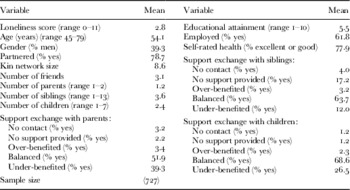
As Table 1 shows, the mean loneliness score for respondents in the middle generation was 2.8: this mean is below the cut-off of 3.0 that is generally used to distinguish ‘lonely’ from ‘not lonely’ people in self-completion surveys (De Jong Gierveld and Van Tilburg Reference De Jong and Van Tilburg1999). On the whole, the 45–79 year-olds in the analysis sample were ‘not lonely’. The mean age of the middle-generation respondents was 54.1 years, and close to 40 per cent were men. Given that the respondents were relatively young, it is not surprising that close to 80 per cent had a partner, that over 60 per cent were active in the labour force, and that close to 80 per cent rated their health as ‘excellent’ or ‘good’. The mean number of living (and non-coresident) parents was 1.2, whereas the average number of living (and non-coresident) brothers and sisters was 3.6, and the number of living (and non-coresident) children was on average 2.4.
Descriptive characteristics of the sample, 45–79 year-olds, The Netherlands 2002–04

Notes: ‘Over-benefited’ means that the family member gives more than the respondent does. ‘Under-benefited’ means that the respondent gives more than the family member does.
Source: Netherlands Kinship Panel Study (see Dykstra et al. Reference Dykstra, Kalmijn, Knijn, Komter, Liefbroer and Mulder2005).
In the respondents' family networks, supportive relationships were the rule rather than the exception. The respondents were most likely to provide support to one or more children (98%), followed by support to parents (95%), and to one or more siblings (79%). If support was provided, by far the majority reported balanced exchanges. The relationships with children were most often balanced (69%), followed by those with siblings (64%) and with parents (52%). Unbalanced relationships tended to be under-benefiting, i.e. the respondent reported giving more than they received. Under-benefiting was most characteristic of relationships with parents (39%), least characteristic of relationships with siblings (12%), and found in 27 per cent of relationships with children.
Multivariate analyses
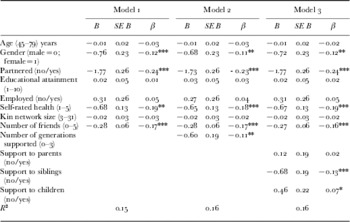
Model 1 shows the associations between loneliness and the background characteristics (see Table 2). Levels of loneliness did not vary by educational attainment, employment status or the size of the kin network. Women were lonelier than men, the partnered were less lonely than the single, and the number of friends inversely associated with loneliness. Model 2 found an inverse relationship between loneliness and the number of generations with supported members, which is consistent with Hypothesis 2, not Hypothesis 1. Model 3 answered the question of whether the direction of giving support matters for loneliness. Providing support up the family lineage did not associate with loneliness, providing support across the family lineage inversely associated with loneliness, and providing support down the family lineage positively associated with loneliness. These findings are contrary to Hypothesis 3, which suggested that the strongest protection against loneliness would lie in support giving to children, and that the weakest protection would come from giving support to siblings.
Linear regression models of generational family support as predictors of loneliness

Notes: Sample size 726. Significance levels: * p<0.05, ** p<0.01, *** p<0.001.
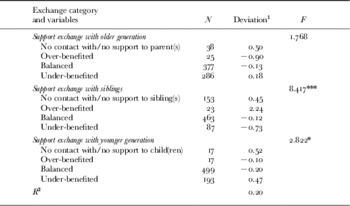
Whereas Model 3 compared providers and non-providers of family support, the multiple classification analysis of variance differentiated the providers. More specifically, the balance of their supportive exchanges from the provider's perspective was used as an independent variable with three categories: (a) over-benefiting, (b) balanced, and (c) under-benefiting. As the top panel of Table 3 shows, the balance of support in relationships with parents was not associated significantly with loneliness. The middle and bottom panels of Table 3 present the equivalent results for supportive exchanges with siblings and children, and show significant but different results. Whereas over-benefiting in sibling relationships was associated with substantially higher levels of loneliness (the mean score rose from 2.8 to 5.0), in relationships with children, over-benefiting was associated with slightly less loneliness (the mean score dropped from 2.8 to 2.7). Under-benefiting in sibling relationships was associated with less loneliness (a mean loneliness score of 2.1), but in relationships with children, under-benefiting was associated with greater loneliness (a mean loneliness score of 3.2).
Multiple classification analysis of balance of support in different types of family exchange relationships as predictors of loneliness

Notes: 1. Deviation from the grand mean (2.8). Sample size 726. The covariates were: age (not significant (ns)), gender (male=0, female=1) (p<0.001), partnered (no/yes) (p<0.001), educational attainment (1–10) (ns), employed (no/yes) (ns), self-rated health (p<0.001), kin network size (ns), number of friends (p<0.001).
Significance levels: * p<0.05, ** p<0.01, *** p<0.001.
The results do not unequivocally favour Hypotheses 4 or 5a and 5b. The finding that under-benefiting in relationships with children was associated with greater loneliness is consistent with Hypothesis 4. The negative association between loneliness and under-benefiting in sibling relationships is, however, contrary to Hypothesis 4. Hypothesis 5a was supported by the finding that over-benefiting in relationships with children was associated with less loneliness (but the association was weak). The finding that over-benefiting in sibling relationships was associated with very high loneliness is consistent with Hypothesis 5b. The effects of over- and under-benefiting on loneliness varied by relationship type, but not entirely in the way predicted by Hypothesis 6. The finding that the negative impact on loneliness was greatest for under-benefiting in sibling relationships is consistent with Hypothesis 6. Contrary to Hypothesis 6, however, it was not found that under- or over-benefiting in relationships with parents produced greater effects than in relationships with children.
Discussion
The veracity of the adage that ‘virtue is its own reward’ has been tested for a sample of adults ‘in the middle generation’ who have living parents, siblings and adult children, and so are potentially involved in supporting members of three family generations. The first question was whether there would be an association between the number of generations supported and wellbeing, as measured by reports of loneliness. The findings were consistent with the predictions of altruism theory, namely that giving brings rewards, rather than exchange theory, which emphasises the costs involved in giving support. Those who provided support up, across and down the family lineage tended to be least lonely.
The second research question was whether the direction of support mattered. Given the principle of altruism, we expected that providing support to children, parents and siblings would, in descending order, provide protection against loneliness, but the results were otherwise. The provision of support up the family lineage made no difference to loneliness; the provision of support down the family lineage was associated with higher levels of loneliness; whereas the provision of support across the family lineage was associated with a lower level of loneliness. For methodological reasons, caution is advised in the interpretation of these findings. The proportions of respondents not involved in giving support to older and younger generations were very small and the estimates might be unstable.
Thirdly, we asked whether the association between giving support and loneliness varied with the balance of the exchanges. The majority of family relationships were described as ‘balanced’ by the respondents, between two and three per cent were described as ‘over-benefiting’, and approximately one-quarter were described as ‘under-benefiting’. The finding that respondents more often reported being under-benefited than over-benefited might be attributed, at least in part, to a self-centred bias. Research has repeatedly shown that people tend to over-estimate their contributions in relationships and to downplay those of others (Marsden Reference Marsden1990).
Those engaged in balanced exchanges with parents, siblings and children were generally the least lonely, but exceptions to this general pattern were found. The results for the relationships with children and siblings underscored the importance of distinguishing over- and under-benefiting, rather than examining imbalance per se, as the equity perspective would suggest is sufficient. The effects of over-benefiting were the opposite of those from under-benefiting, and differed between the two relationship types. Over-benefiting from sibling relationships was associated with high levels of loneliness, whereas in relationships with children it was associated with slightly below-average loneliness. Some caution is advised regarding the effects of being over-benefited, given that few respondents reported such relationships. Those who gave more to siblings than they received generally had low levels of loneliness. The opposite was found for those who gave their children more than they received. In the relationships with parents, the balance of the exchanges made no difference to loneliness.
The findings suggest that to understand the consequences for loneliness of imbalanced support exchanges, it is crucial to consider the type of family relationship. Middle-generation adults who gave more to their siblings than they received did not suffer from feelings of social isolation and stress, as the exchange perspective predicts. On the contrary, it appears that non-reciprocated giving in sibling ties is a token of friendship, and marks the special qualities of the bond (Komter and Vollebergh Reference Komter and Vollebergh1997), in which altruism seems to be the governing principle. The high levels of loneliness among those who received more from their siblings than they gave emphasises the importance of fairness in sibling relationships (Voorpostel Reference Voorpostel2007). The finding that under-benefiting from relationships with children was associated with relatively high levels of loneliness is in marked contrast and contrary to our expectation that, given the strong kinship norm to provide support to offspring, under-benefiting from relationships with children would be least consequential for loneliness. It is not immediately evident how to account for this unexpected finding. Apparently, when parents' support is not reciprocated, the imbalance is a source of disappointment. From previous studies, we know that many parents are pained when their children's lives do not conform to parental expectations (Ryff, Schmutte and Lee Reference Ryff, Schmutte, Lee, Ryff and Seltzer1996; Umberson Reference Umberson1992).
The large sample size and the detailed information on support exchanges in different types of family ties made the Netherlands Kinship Panel Study (NKPS) ideal for this analysis, but nevertheless the data have weaknesses. There was a low response rate and selective non-response. Young adults and men were generally under-represented in the sample, but fortunately for this analysis, middle-generation adults were well represented. A second limitation is that the data are cross-sectional. Although the NKPS is a longitudinal study, at present only the first wave of data has been gathered. The absence of longitudinal information means that we cannot be confident about the mechanisms underlying the associations. When longitudinal data become available, we will be in a better position to determine whether supportive exchanges have consequences for loneliness, or whether lonely people engage in different kinds of support from those given to or received by people who are not lonely.
It should also be noted that the information about supportive exchanges was from a single source, the primary NKPS respondent. We relied on that person's evaluation of the balance of exchanges in his or her family relationships, being mindful of the observation that, ‘if men define situations as real [actuality] they are real in their consequences’ (Thomas and Thomas Reference Thomas and Thomas1929: 572). Information from children, siblings and parents on the relationship with the primary respondent is available in the NKPS and will permit further investigation of reciprocity in relationships. A study of the discrepancies in parents' and children's reports of inter-generational support is currently being carried out at our institute.
The study focused on the provision of support, rather than caring, and the measures tapped the kinds of help that do not involve large investments of time, effort and money. The analyses were also restricted to help exchanges among family members living in different households. As a result, we do not know how many of the support givers in our sample might be defined as ‘carers’ who spend large amounts of time each week looking after or helping a dependent sick, handicapped or elderly person (Arber and Ginn Reference Arber and Ginn1990). We are aware, however, that the number of middle-generation adults involved in the care of both younger and older family generations is consistently over-estimated (Agree Reference Agree2003; Dykstra and Komter Reference Dykstra, Komter, Dykstra, Kalmijn, Komter, Knijn, Liefbroer and Mulder2006; Rosenthal Reference Rosenthal, Gee and Gutman2000). They are not as many as public debates would have us believe.
Acknowledgements
The data for this study were drawn from the Netherlands Kinship Panel Study, which is supported by the ‘Major Investments Fund’ of The Netherlands Organisation for Scientific Research (Grant 480-10-009). Financial and institutional support for the NKPS also comes from the Netherlands Interdisciplinary Demographic Institute (NIDI), the Faculty of Social Sciences at Utrecht University, the Faculty of Social and Behavioral Sciences at the University of Amsterdam, and the Faculty of Social Science at Tilburg University. Earlier versions of this paper were presented at the symposium, ‘Participation, integration or isolation and segregation’, during the meeting of the International Sociological Association RC-11, London, September 7–9, 2004, at a symposium, ‘Do differences in generational structure make a difference?’, and at the 2004 annual meeting of the Gerontological Society of America in Washington DC (November 19–23).