INTRODUCTION
Confabulation may be defined as the production of “statements or actions that involve unintentional but obvious distortions of memory” (Moscovitch & Melo, Reference Moscovitch and Melo1997, p. 1018). It is often associated with damage to the ventromedial and orbitofrontal aspects of the frontal lobe (Gilboa & Moscovitch, Reference Gilboa, Moscovitch, Baddeley, Kopelman and Wilson2002; Gilboa et al., Reference Gilboa, Alain, Stuss, Melo, Miller and Moscovitch2006; Turner, Cipolotti, Yousry, & Shallice, Reference Turner, Cipolotti, Yousry and Shallice2008a) and most frequently occurs in combination with both amnesia and executive dysfunction. Confabulations are often associated with considerable conviction, and their content may range from subtle alterations of true events, where real recollections are miscombined or placed in the wrong context, to implausible reports of episodes that are bizarre and internally inconsistent. In certain cases, confabulations may also be associated with attempts to act upon the mistaken belief.
Many attempts have been made to specify the mechanisms responsible for confabulation. Early accounts that attributed confabulation to “gap-filling” (Bonhoeffer, Reference Bonhoeffer1901; Pick, Reference Pick1905) have now been discredited, and modern neurocognitive explanations tend to emphasise the role of one or more specific executive impairments. These can be broadly grouped into explanations concerned with failures in the processing of temporal information, in which confabulations are true memories misplaced in time (e.g., Dalla Barba, Reference Dalla Barba2002; Schnider & Ptak, Reference Schnider and Ptak1999), and those concerned with more general failures in strategic memory retrieval (Burgess & Shallice, Reference Burgess and Shallice1996; Gilboa, et al., Reference Gilboa, Alain, Stuss, Melo, Miller and Moscovitch2006; Moscovitch & Melo, Reference Moscovitch and Melo1997; Schacter, Norman, & Koutstaal, Reference Schacter, Norman and Koutstaal1998).
Schnider and colleagues (Schnider & Ptak, Reference Schnider and Ptak1999; Schnider, Reference Schnider2008) have proposed some of the most influential recent explanations of confabulation, providing the beginnings of an account specifying mechanisms. They propose that the critical deficit underlying spontaneous confabulation is a failure to distinguish between currently relevant and currently irrelevant memories. This conclusion is based on the results of an elegant series of experiments comparing spontaneous confabulators to non-confabulating amnesic patients on a repeated continuous recognition task. In this task, participants view a sequence of images and are required to indicate those that recur. Following an initial run, participants complete subsequent runs in which a selection of the distracters from the first run now appear as recurring target items, and the previous targets are now among the distracters. Participants must respond only to items that recur in the current run. Schnider and colleagues found that spontaneous confabulators showed a normal hit rate on this task but were distinguishable from non-confabulating amnesics by a steep increase in false positives from run to run. This was caused by false alarms to previously relevant items that should now be ignored, an effect they then termed “temporal context confusion” (Schnider & Ptak, Reference Schnider and Ptak1999) and more recently liken to a deficit in extinction learning (Schnider, Reference Schnider2008). They propose that the critical impaired mechanism underlying failure on this task, and spontaneous confabulation, is to a system that suppresses the interference of old memory traces that intrude into ongoing thinking.
The results of their series of experiments are impressive. The effects have been replicated with several patients; performance on the continuous recognition task has been shown to parallel the course of recovery from spontaneous confabulation (Schnider, Ptak, von Daniken, & Remonda, Reference Schnider, Ptak, von Daniken and Remonda2000); and functional imaging of the task in healthy participants activates the posterior medial OFC, the same area that is damaged in confabulating patients (Schnider, Treyer, & Buck, Reference Schnider, Treyer and Buck2000; Treyer, Buck, & Schnider, Reference Treyer, Buck and Schnider2003). However, less explicit attention has been given to the mechanism proposed to underlie it, namely, one that operates in an analogous fashion to extinction and so suppresses or “filters” old memory traces that intrude into the present.
This paper presents a series of investigations with three spontaneously confabulating patients. Our aim was (a) to replicate the results of Schnider and colleagues and (b) to explore the explanation that the mechanism underlying failure on their task is a failure to suppress memory traces that intrude into the present. To this end, we first report the performance of our confabulating patients on Schnider and Ptak’s (Reference Schnider and Ptak1999) original continuous recognition task. We then report the results of a test of temporal source memory examining whether memory traces intrude into the present. Finally, we report the results of a reality monitoring task assessing the ability to discriminate real from imagined events, which, we argue, supports an alternative account of the mechanism underlying failure on Schnider and colleagues’ task, and spontaneous confabulation itself.
METHODS
Participants
Participants were three confabulating patients recruited from the National Hospital for Neurology and Neurosurgery (NHNN). All three patients had sustained ruptured anterior communicating artery (ACoA) aneurysms and produced spontaneous verbal and behavioral confabulations. Full case descriptions are provided below. Control participants are described separately for each experiment. All participants gave informed consent before taking part, and the study was approved by the NHNN and Institute of Neurology Joint Research Ethics Committee.
Patient CJ
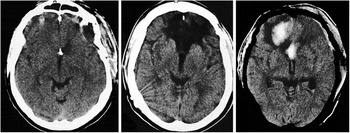
Patient CJ was a 53-year-old university graduate and successful businessperson. Following rupture and repair (clipping) of an ACoA aneurysm, he was left with persistent memory impairment and confabulation. He was seen for the present study on three occasions: 5, 8, and 12 months after clipping. During this time, he was oriented to place, but was not reliably oriented to situation or time. CJ continued to produce spontaneous confabulations throughout this period, although these gradually became less bizarre and, by the end of the study, revolved mainly around his everyday tasks (for example, believing that he had completed tasks that he had not, or attempting to carry out duties that had previously been his responsibility but were no longer so). MRI showed a lesion to the left orbital region (Figure 1a).
Structural brain images of: (a) CJ (b) HS (c) GN. Left and right are reversed.

Patient HS
Patient HS was a 59-year-old man admitted to the NHNN after being found disoriented in the street. CT showed previous frontal lobe surgery, and tracing of his notes revealed that HS had undergone clipping of an ACoA aneurysm 25 years previously. He had been left with a profound confusional state, memory impairment, and confabulation. As a result, HS had been unable to return to work and had spent at least part of the intervening period homeless. Patient HS was seen on two occasions five months apart, 25 years after his aneurysm. In this period, he was not reliably oriented to place, situation, or time and continued to produce spontaneous confabulations involving temporal distortions (believing that he had undergone surgery only 18 months previously) and other source memory distortions (confusing memories of interactions with the examiner with interactions with other patients). HS also described several events that were more bizarre in content and likely to have been at least partly confabulated (for example, a flight when he was invited into the cockpit to see the pilot land the plane). Patient HS frequently attempted to act on his confabulations, for example, leaving the hospital and presenting to Barts Hospital (where he had been 25 years prior), believing that he was still a patient there. CT revealed extensive bilateral damage to the orbital region, sub genu, anterior cingulate, and superior frontal gyrus (Figure 1b).
Patient GN
Patient GN was a 64-year-old university graduate who had previously worked internationally at a high level. Following rupture and repair (wrapping) of an ACoA aneurysm, he was left with significant memory problems and confabulation. He was seen on several occasions in the period 1–7 months post-surgery. Throughout this period, GN was disoriented to place, situation, and time and produced consistent confabulations, for example, believing that the year was 1972 and that he was in a hospital in America after being shot. He regularly produced markedly bizarre confabulations, for example, reporting that he had attended a party the night before and met a woman with a bee’s head. He frequently attempted to act upon his mistaken beliefs, for example, attempting to leave the hospital to attend meetings. His confabulations remained florid at the end of the study; for example, when last seen, GN claimed that he had attended the examiner’s wedding a few weeks previously. MRI revealed bilateral damage to orbital and medial frontal regions (Figure 1c).
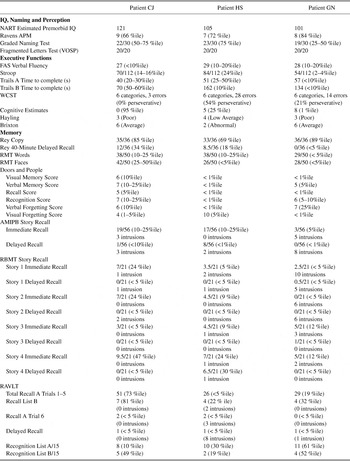
Table 1 presents the performance of the confabulating patients on standardized neuropsychological testing. Intellectual functioning, naming, and perception were relatively preserved in all three patients. Executive functioning tended toward the low end of the normal range with considerable variation between tests. There was no single executive test that all patients failed, nor was there any patient who failed all tests. Memory performance also did not show any consistent pattern across the patients. Recognition performance was preserved in CJ and mixed in HS and GN. Recall performance was more consistently impaired. A particular feature of the recall of all three patients was a tendency to produce intrusions in recall, and it was notable that these tended to be new fabrications or associations, rather than intrusions of items or elements from previous tests.
Baseline neuropsychological assessment of the three spontaneously confabulating patients

Percentiles derived from published norms.
Schnider & Ptak (Reference Schnider and Ptak1999) Continuous Recognition Task
Design and Procedure
In an attempt to replicate Schnider and colleagues’ results, we administered their original continuous recognition task. The design and procedure were exactly as described in Schnider & Ptak (Reference Schnider and Ptak1999). In brief, four runs of 80 items were presented. In each run, 48 images occurred once and 4 images occurred 8 times. Participants were required to indicate item recurrences within the current run (28 targets in each run). Target items were different in each run: The four target items from one run were among the distracters in all subsequent runs, whereas four previous distracters were randomly selected as the target items of the next run. The second run was made immediately after the first run, the third run after a 5-minute delay, and the fourth run after a 30-minute delay.
Results
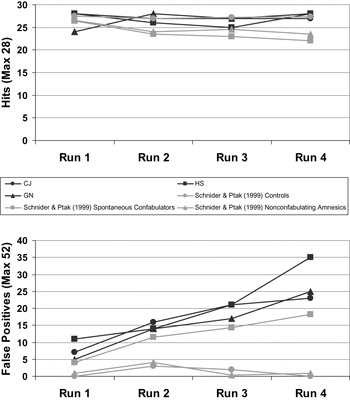
Figure 2 shows the performance of our three confabulating patients, along with the performance of the spontaneous confabulator, non-confabulating amnesic, and control groups from the Schnider & Ptak (Reference Schnider and Ptak1999) study. Our results replicated those of Schnider and Ptak (Reference Schnider and Ptak1999). Although the hit rates of confabulating and non-confabulating patients remain relatively stable across runs, the three confabulating patients presented here, along with the spontaneous confabulators in the Schnider & Ptak (Reference Schnider and Ptak1999) study, can be distinguished by a steep increase in false positives from run to run.
Performance on Schnider and Ptak (Reference Schnider and Ptak1999) continuous recognition task.

Experimental Tests
Following replication of Schnider & Ptak’s (Reference Schnider and Ptak1999) results, we sought to explore the mechanisms that might underlie the characteristic pattern of performance on their task. To this end, we administered two tests of source memory.
Experiment 1: Temporal Source Identification Task
In the first experiment, we aimed to examine whether intrusion into the present was a general characteristic of the memory performance of confabulating patients. If so, errors of temporal source memory might be expected to involve older items being judged to be more recent than they actually were.
Design and Procedure. Participants viewed two sequences of 80 computerized image presentations. Each sequence consisted of 30 images, 10 of which were presented 6 times and 20 of which were presented once. Images were presented in a pseudorandom order (constant across participants) for 3 seconds each, with a delay of 1 second before presentation of the next image. As an orienting task, participants were asked to indicate image recurrences during each sequence with a key press. Sequences were separated by a 30-minute interval (during which participants completed unrelated tasks), and the second sequence comprised completely new images. Immediately after presentation of the second sequence, participants completed an unexpected recognition test, consisting of 60 images: 20 from the first sequence (of which 10 had been presented 6 times and 10 had been presented once), 20 from the second sequence (of which 10 had been presented 6 times and 10 had been presented once), and 20 new images. Participants were required to verbally indicate whether they had seen each image in one of the earlier study sequences. For images identified as old, participants were asked to indicate which sequence the image had been drawn from. The test phase was self-paced. Two versions of the task were administered in separate testing sessions—one using black-and-white line drawings of objects from Snodgrass and Vanderwart (Reference Snodgrass and Vanderwart1980), and one using the nonsense geometric figures employed by Schnider and Ptak (Reference Schnider and Ptak1999). As both versions showed the same pattern of results, data are collapsed in the following analyses. Patient performance was compared to that of five male, age-matched, non-brain-damaged controls.
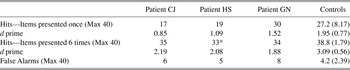
Results. Old/new recognition performance is shown in Table 2. Hit rate and false alarm rate in our patients is in the control range although below the control means. The only patient to differ significantly from control performance is Patient HS, who shows a slight reduction in hit rate for items presented 6 times. However, discrimination performance as measured by d prime does not differ from control performance in any condition. Hit rate and discrimination performance in patients and controls are much lower for items presented only once in the initial sequence than for items presented 6 times. As adequate encoding of the items is critical for later source discrimination, subsequent analyses are restricted to items presented 6 times at encoding.
Temporal source identification task: Old/new recognition performance

(* = significantly different from healthy controls at p < 0.05, using Crawford & Garthwaite’s (Reference Crawford and Garthwaite2002) modified t test).
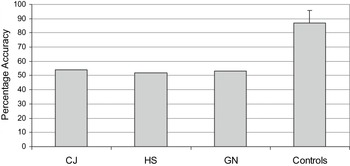
Figure 3 shows temporal source discrimination performance: the mean accuracy of patients and controls in attributing recognized items to sequence one or two. As this is a 2-alternative forced choice task, the chance performance level is 50%. Normal controls are able to correctly identify source on 86.87% (±8.96) of occasions in which they correctly identify an item as old. However, the confabulating patients, although able to recognize previously encountered items at a rate comparable to controls, have significant difficulty identifying the source of their familiarity. Not only are their rates of correct source identification significantly lower than controls’ (Crawford & Garthwaite’s (Reference Crawford and Garthwaite2002) modified t test: Patient CJ: t = 3.35, p = 0.03; Patient HS: t = 3.55, p = 0.02; Patient GN: t = 3.45, p = 0.03), they also do not differ significantly from chance (Binomial analysis: CJ: 19/35 correct, p = 0.76; HS: 17/33 items correct, p = 1.0; GN: 18/34 items correct, p = 0.86). In contrast, the source recognition of all control participants was significantly better than chance (all results p < 0.02). The data demonstrate that our spontaneously confabulating patients are completely at chance at identifying whether they encountered an image immediately before the recognition test or 30 minutes previously.
Temporal source discrimination performance.

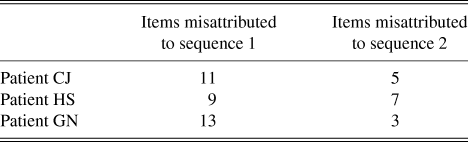
Finally, we explored whether temporal confusion in our patients specifically involved the intrusion of past events forward into the present. Schnider & Ptak’s (Reference Schnider and Ptak1999) original task required determination of whether an item occurred in the current experimental session. Incorrect responding indicated that items from a previous run (at least 30 minutes before) had been misidentified as having occurred in the current run. Similarly, our temporal source monitoring task required subjects to say whether an item had occurred in a study phase immediately preceding the test phase (thus in the same experimental run) or in a previous run (occurring at least 30 minutes ago). If failure in their task is a result of the intrusion/misattribution of memory traces from 30 minutes ago into the current run, we might expect our patients to show a tendency to disproportionately misattribute items from sequence one to sequence two. Table 3 shows the number of items incorrectly attributed to sequence 1 and incorrectly attributed to sequence 2 by each of the three confabulating patients.
Temporal misattribution of items by confabulating patients

Binomial analysis for Patient CJ reveals no significant trend to assign more memories incorrectly to sequence 2 than to sequence 1 (5 vs. 11, p = 0.21). Indeed, he shows a nonsignificant trend in the other direction. Similarly, Patient HS shows no tendency to misattribute items to sequence 2 rather than to sequence 1 (7 vs. 9, p = 0.80). Patient GN does show a significant bias in his attribution of recognized items to a particular sequence (3 vs. 13, p = 0.02). However, this is in the opposite direction to that predicted. Patient GN has a significant tendency to say that items were encountered in the first sequence, rather than in the second, current one. On this task, therefore, our confabulating patients do not show evidence of a tendency for previous memory traces to intrude forward into the present.
Experiment 2: Reality Monitoring Task
Design and Procedure. To investigate whether source memory impairments in our patients might extend beyond temporal confusion, we administered a reality monitoring task, assessing the ability to distinguish between real and imagined events. Confabulation has historically been associated with difficulty distinguishing between fantasy and reality (Korsakoff, Reference Korsakoff1889; Kraepelin, Reference Kraepelin1886); and more recent theorizing about the relationship between confabulation and reality monitoring (Johnson, Reference Johnson1997; Johnson, Hayes, D’Esposito, & Raye, Reference Johnson, Hayes, D’Esposito, Raye, Boller, Grafman and Cermak2000) predicts that confabulating patients should show a tendency to misidentify imagined events as real.
The procedure was based on Aleman, Bocker, Hijman, de Haan, & Kahn (Reference Aleman, Bocker, Hijman, de Haan and Kahn2003). Although participants were told that the task involved memory for words, they were not warned that source recollection would be required. The examiner then read a list of 30 items, at a rate of one every four seconds. Fifteen items were read aloud (e.g., “Orange”), alternated with 15 items where participants were prompted to imagine a word being spoken (e.g., “A fruit beginning with a”). Immediately after the last item was presented, participants were given a recognition test of 45 items, including 15 additional new items, (e.g., “Pear”). Thus, the list consisted of 15 sets of 3 items (imagined, heard, and new), with each item in a set drawn from the same semantic category. Words were presented in a pseudorandom order, constant across participants, who were asked to identify whether each word had previously been “heard,” “imagined,” or was “new.”
On this task, patient performance was compared to both a healthy control group and to a non-confabulating ACoA control group. The healthy control group consisted of 44 adults with no history of neurological illness (22 male, age 49.38 ± 16.22 yrs, mean years of education 13.16 ± 3.14). The non-confabulating ACoA group consisted of 5 patients recruited from the NHNN (4 male, age 43.2 ± 13.41 yrs, mean years of education 12.20 ± 2.95, time since clipping 12.46 ± 27.14 months). These patients were confirmed as non-confabulating both by observation and by their performance on a confabulation battery (described in Turner et al., Reference Turner, Cipolotti, Yousry and Shallice2008a), on which they each produced less than 2 confabulations out of a possible 31 (within the normal range).
Results. Old/new recognition performance is shown in Table 4. Hit rate in all patients is in the control range. False alarm rates in patients CJ and GN are also in the control range, whereas HS has an elevated rate of false alarms (consistent with a general tendency among confabulating patients to false positive responding), which leads to a reduction in his discrimination performance.
Reality monitoring task: Old/new recognition performance

(* = significantly different from healthy controls at p < 0.05, using Crawford & Garthwaite’s (Reference Crawford and Garthwaite2002) modified t test).
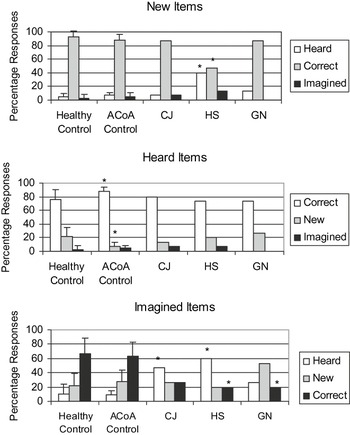
Figure 4 shows source identification performance separately for new items, items that had originally been heard, and items that participants had been prompted to imagine. New items were generally easily identified by both control groups and by the confabulating patients. Patient HS does show an elevated rate of “heard” responses (reflecting his tendency toward false positive responding). For items that were heard, once again performance is good in both controls and patients, with all participants able to identify these words as those that the examiner read out loud.
Reality monitoring performance (* = significantly different from healthy controls at p < 0.05).

However, examination of the responses for items that were imagined suggests a characteristic difference in the way that the confabulating patients and the control groups respond. Although both healthy controls and non-confabulating ACoA patients are able to identify these words as previously imagined, the confabulating patients display a bias toward misidentifying imagined words as having been heard from an outside source. For all three patients, the rates of incorrect “imagined to heard” misattributions are significantly higher than non-confabulating ACoA controls; and for CJ and HS, this rate also differs significantly from healthy controls.
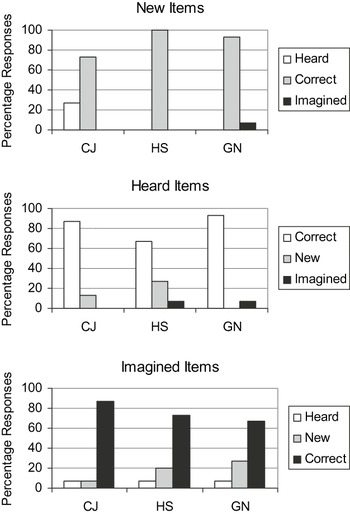
To rule out the possibility that the patients had general difficulty using the “imagined” category as a response, or that the elevated “heard” responses were a result of impaired imagining at encoding, a simplified version of the task was administered. Two stimulus items were presented (one read aloud and one with an “imagine” prompt), followed immediately by source recognition of these two items, along with a new distracter word. Fifteen trials were presented, with source recognition following immediately after presentation of each pair. Figure 5 demonstrates that in this simplified task, patients were able to correctly identify to-be-imagined items at rates of 87% (Patient CJ), 73% (Patient HS), and 67% (Patient GN). This contrasts with rates of 27% (CJ), 20% (HS) and 20% (GN) in the full task. The simplified task also showed no evidence of a bias toward misidentifying imagined items as heard. Instead, this pattern of responding seemed only to arise under increased memory load, in the full version of the task.
Performance on simplified reality monitoring task.

DISCUSSION
In our study we aimed to (a) replicate the findings of Schnider and colleagues (Schnider & Ptak, Reference Schnider and Ptak1999; Schnider, Reference Schnider2008) on their continuous recognition task and (b) explore the explanation that the mechanism underlying failure on this task, and confabulation itself, is impairment to a system that suppresses the interference of old memory traces that intrude into ongoing thinking. Using Schnider & Ptak’s (Reference Schnider and Ptak1999) original task, we replicated their results with three new spontaneously confabulating patients, finding further evidence that spontaneous confabulation is associated with a characteristic pattern of performance in which a normal hit rate is accompanied by a steep increase in false positives from run to run.
Schnider & Ptak (Reference Schnider and Ptak1999) proposed that “spontaneous confabulators specifically fail to suppress mental associations that do not pertain to the present . . . memories thus seem to be as real and pertinent for present behaviour as representations of current reality” (p. 679). One interpretation of this claim is that memory traces of earlier events are experienced as being in the present. However, this is not supported by our current study. In the temporal source monitoring task, our confabulating patients were severely impaired. Indeed they displayed a complete inability to identify the temporal source of their memories (as previously found by Schnider, Gutbrod, Hess & Schroth, Reference Schnider, Gutbrod, Hess and Schroth1996, using a similar paradigm). However, none of our patients showed any tendency to report the occurrence of items as more recent than they actually were, and one actually showed a significant effect in the opposite direction. The results of this experiment therefore did not support the idea that old memory traces selectively intrude forward into the present.
Why should one obtain a different pattern of results in this experiment from the Schnider and Ptak (Reference Schnider and Ptak1999) paradigm? One possibility compatible with the position of Schnider and colleagues (Schnider & Ptak, Reference Schnider and Ptak1999; Schnider, Reference Schnider2008) is that our task is an explicit memory task, but theirs is in some sense an implicit memory task, involving a quite different set of mechanisms. However, an alternative possibility, to which we return later, is that one mechanism malfunctioning in the confabulator is a source/reality monitoring one, and that the first pass behavior of a normal subject in the Schnider and Ptak (Reference Schnider and Ptak1999) paradigm is to recognize an item presented only in the previous run as familiar but then to reject it on the basis of recollection of when it occurred. By contrast, most amnesics (e.g., Manns & Squire, Reference Manns and Squire1999) will have a reduced familiarity signal and have the source/reality monitoring system intact. To the confabulator, instead, for reasons to be discussed later, many items can be confidently recollected, often inappropriately (e.g., Delbecq-Derouesne, Beauvois, & Shallice, Reference Delbecq-Derouesne, Beauvois and Shallice1990), and a damaged source/reality monitoring system means that explicit correction does not occur.
In accordance with this explanation, the results of the reality monitoring task indicated that the difficulty with source monitoring might extend to aspects other than temporal source. On this task, confabulating patients had significant difficulty identifying whether items had been heard or imagined, and this took the form of a tendency to misidentify imagined events as being derived from an external source. This impairment cannot be explained in terms of a mechanism that relates solely to the temporal aspect of memory traces. Instead, it appears to relate to a mechanism concerned with more generalized source monitoring, including information about the “reality” (or external vs. internal source) of memories and events. This “imagined to heard” attribution error was specific to confabulating patients and was not shared by non-confabulating ACoA patients.
The performance of our spontaneous confabulators on some of the baseline neuropsychological tests also suggested difficulties in source monitoring that extended beyond temporal source. For example, on tests of word list and story recall, our patients produced elevated rates of intrusions. However, these intrusions were largely “content” errors (consisting of new or unrelated information), rather than “temporal” errors (drawn from previously presented stories or tasks). This mirrors the findings of Gilboa et al. (Reference Gilboa, Alain, Stuss, Melo, Miller and Moscovitch2006), who reported that confabulators produced high rates of “idiosyncratic errors” (intrusions that were not distortions of true story elements or intrusions of elements from previous stories) in story recall. Moreover, the very nature of some confabulations indicates that an explanation in terms of currently irrelevant memory traces might be inadequate. Patient GN, for example, reported that he had been to a party the night before and met a woman with a bee’s head. Although the memory of going to a party could be a true memory displaced in time, the memory of woman with a bee’s head cannot.
The experimental effect reported by Schnider and colleagues (Schnider & Ptak, Reference Schnider and Ptak1999; Schnider, Reference Schnider2008) is robust. However, our data indicate that the underlying deficit may be more generalized than a failure to suppress currently irrelevant memories. Source monitoring deficits in confabulators that extend beyond temporal source have been reported previously (Ciaramelli & Spaniol, Reference Ciaramelli and Spaniol2009; Gilboa et al., Reference Gilboa, Alain, Stuss, Melo, Miller and Moscovitch2006; Schnider et al., Reference Schnider, Gutbrod, Hess and Schroth1996). Evidence specifically of reality monitoring impairments has also been reported by Johnson (Reference Johnson1997, Patient WL), and Fotopoulou, Conway, & Solms (Reference Fotopoulou, Conway and Solms2007) have reported that confabulating patients misrecognize not only genuine past experiences, but also imagined situations as currently relevant events. The involvement of reality monitoring processes in confabulation is also supported by fMRI studies associating medial PFC with monitoring of self-generated information (Simons, Davis, Gilbert, Frith, & Burgess, Reference Simons, Davis, Gilbert, Frith and Burgess2006; Simons, Henson, Gilbert, & Fletcher, Reference Simons, Henson, Gilbert and Fletcher2008; Vinogradov et al., Reference Vinogradov, Luks, Simpson, Schulman, Glenn and Wong2006). Moreover, in a functional imaging study of a reality monitoring task analogous to that reported here, brain activity in inferior medial PFC (the region damaged in confabulating patients) was specifically associated with identifying whether previously imagined words had been seen or imagined (Turner, Simons, Gilbert, Frith, & Burgess, Reference Turner, Simons, Gilbert, Frith and Burgess2008b). These data indicate the involvement of a monitoring system that operates not only on the basis of temporality or current relevance, but also across a range of contextual domains, including information used to distinguish real memories from imaginings (Johnson, Reference Johnson1997; Johnson, Hayes, D’Esposito, & Raye, Reference Johnson, Hayes, D’Esposito, Raye, Boller, Grafman and Cermak2000).
In fact, Schnider’s own model has evolved over the past 10 years away from a description purely in terms of temporal processing and toward a more general impairment in reality monitoring. In recent accounts, he refers to the deficit as one of preconscious or automatic reality “filtering” (Schnider, Reference Schnider2008), which is closer to the account presented here. However, the proposal that “the failure preventing behaviourally spontaneous confabulators from adapting their thinking to ongoing reality corresponds to deficient extinction” (Schnider Reference Schnider2008, pp. 280–281) retains the implication that the intruded material should once have been relevant or rewarded. Although we agree that confabulations frequently involve intrusion of previously relevant memories and habits (indeed, we report several examples of this phenomenon in the patients reported here), it is more difficult to see how deficient extinction might account for “imagined to heard” reality monitoring errors or for confabulations not derived from previous memory traces.
If confabulations consist not only of true memories misplaced in time, but also of fragments of all sorts of traces—memories, thoughts, associations, and imaginings—which the confabulating patient is unable to tell apart, why might this occur? One possibility suggested by Shallice and Cooper (in press) is that it results from failure of the cholinergic control mechanism that Hasselmo, Wyble, & Wallenstein (Reference Hasselmo, Wyble and Wallenstein1996) suggest switches episodic memory systems of the hippocampus between an encoding and a retrieval mode. The complete absence of cholinergic input could result in the strong facilitation of recurrent connections leading to output of the hippocampus conflating multiple memory episodes. Normal subjects too, if thinking aloud when remembering routine autobiographical episodes, produce a limited number of conflations of different episodes, but they internally question and correct most of them (Burgess & Shallice, Reference Burgess and Shallice1996). Confabulators tend not to (Mercer, Wapner, Gardner, & Benson, Reference Mercer, Wapner, Gardner and Benson1977). They lack some form of source/reality monitoring.
One difficulty with any source monitoring account of confabulation is that traditional temporal and source monitoring tasks do not always distinguish between confabulating and non-confabulating patients (Ciaramelli & Ghetti, Reference Ciaramelli and Ghetti2007; Johnson, O’Connor, & Cantor, Reference Johnson, O’Connor and Cantor1997). However, our data indicate that the “heard to imagined” misattribution error might be specific to confabulating patients. Replication of this effect is obviously required. Dalla Barba, Capelletti, Signorini, and Denes (Reference Dalla Barba, Capelletti, Signorini and Denes1997) have previously described a confabulating patient who did not show a specific tendency on a reality monitoring task to misidentify imagined events as real. However, unlike the patients reported here, her old/new recognition was also severely impaired. Whatever the outcome of future attempts at replication, it will be important to remember that confabulation is a complex neuropsychological syndrome and unlikely to result from a single impairment. Any failure of source/reality monitoring therefore is unlikely to stand alone as a single explanatory mechanism, but might instead be seen as one element within a wider “strategic retrieval” account of confabulation (e.g., Gilboa et al., Reference Gilboa, Alain, Stuss, Melo, Miller and Moscovitch2006; Turner & Coltheart, Reference Turner and Coltheart2010).
In conclusion, we have reported replication of the empirical claims of Schnider and colleagues (Schnider & Ptak, Reference Schnider and Ptak1999; Schnider, Reference Schnider2008) using their continuous recognition task, with confabulating patients being distinguishable by an increase in false positives from run to run. However, our data suggest that the critical impairment might be more generalized than a failure to suppress previous memory traces that intrude into ongoing thinking. First, we did not find evidence that previous memory traces intrude into the present. Second, a reality monitoring task revealed that confabulating patients, unlike non-confabulating ACoA patients and healthy controls, had a tendency to misidentify imagined events as real, a result that cannot be explained in terms of temporal confusion. Our data therefore suggest a more generalized impairment in source/reality monitoring, not only on the basis of temporality or current relevance, but also across a range of contextual domains, including information used to distinguish real memories from imaginings.
ACKNOWLEDGMENTS
We are extremely grateful to Professor Armin Schnider for making his continuous recognition task available to us. No conflicts of interest exist affecting this manuscript. This work was supported by an MRC Research Studentship awarded to M. T. (G78/6834).