

Introduction
Dairy goat production is a relevant sector in several areas of the European Mediterranean countries owing to the capability of this type of livestock to turn low quality forage into products of a high feeding value. In Spain, dairy goat production has been traditionally associated with extensive or semi-extensive production systems where grazing plays a key role, enhancing the use of pastures unsuitable for crop cultivation, such as shrublands, mountainous or semi-desert regions. However, in the last years a rapid intensification of the sector has been produced, as a consequence of different drivers such as the poor quality and scarcity of pastures, the use of breeds with a high productive potential, the lack of shepherds or the need to reduce seasonality in meat and milk production. This process has been clearly observed in Andalusia, a leading goat’s milk production region in Spain and European Union, where extensive systems that predominated during the 1990s have been displaced by intensive or semi-intensive systems becoming 47% of the farms in Andalusia nowadays (Castel et al., Reference Castel, Mena, Ruiz, Camúñez-Ruiz and Sánchez-Rodríguez2011).
This intensification of dairy goat production systems enhances the dependence of animal feeding on grain concentrates. Moreover, the scarceness and low quality of pastures in Mediterranean areas during severe periods, more likely in the future according to climate change projections (Giorgi and Lionello, Reference Giorgi and Lionello2008) also force breeders to include expensive cereal-based concentrates in dairy goat diets. In this scenario the use of unconventional feedstuffs such as agriculture and food industry by-products could be a suitable option in order to decrease production costs, while reducing the environmental impacts associated with livestock products and also to food industry by-products accumulation.
The aim of the present study was to explore through life cycle assessment the whole-farm environmental impacts of replacing a typical dairy goat diet in south Spain with two alternative diets including silages made with tomato wastes from horticulture or olive oil by-products.
Modelling framework
To carry out this LCA-based study, we used a modelling framework comprising experimental data for enteric methane (CH4) emissions, animal productivity and excretion, and different sub-models involved in the farm system and associated production chain. Among these, a model to calculate greenhouse gas (GHG) and N emissions from solid waste composting (Pardo et al., Reference Pardo, Moral and del Prado2013) was utilized in order to describe the emissions associated with the baseline scenario for food by-products management, and also to the storage of goat manure in the farm.
Diets considered/experimental data
In all, three diets were formulated to supply the requirements of lactating Murciano-Granadina goats involved in the experiment. A control diet (CO) composed of alfalfa hay (30%), oat hay (20%), oat grain (20%), soybean meal (10%), maize grain (10%) and sugar-beet pulp (10%) was used. The alternative diets were formulated by replacing the oat hay in the CO with greenhouse tomato wastes silage (TS) or olive oil by-products silage (OS).
TS contained 70% tomato waste, 20% wheat straw and 10% barley flour. OS contained 50% olive leaves, 25% olive cake (from olive oil extraction process) and 25% barley flour, of fresh matter. During the experimental period a range of parameters were monitored including: feed intake, milk yield, enteric CH4 emissions, urine and faeces.
Life cycle assessment methodology
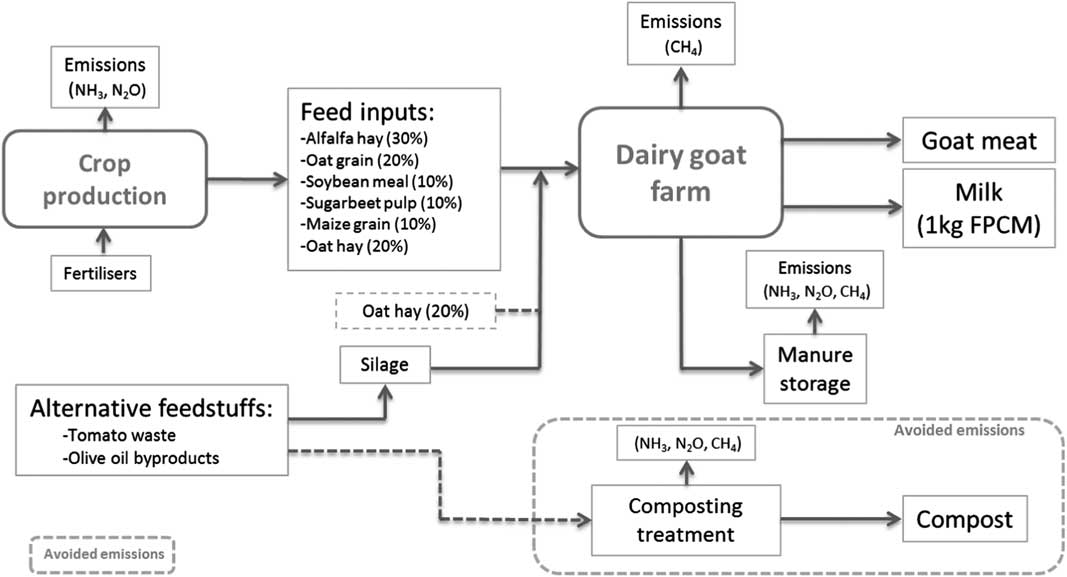
The study followed the methodology described in the international standards (ISO, 2006). The functional unit is 1 kg of fat and protein corrected milk (FPCM). Economic allocation was used to divide emissions between milk and meat produced in the farm. A ‘cradle to gate’ approach was considered, involving all the input and output related to goat milk production (figure 1). Data registered during diets experiment was used to describe feed inputs, milk yield, CH4 emissions and manure production for the three scenarios compared. Additional data to describe farm activities, such as energy consumption, bedding material, productivity levels and replacement rates were modelled according to data collected from a typical dairy goat intensive farm in Andalusia. Data for describing crop cultivation stage for the production of the feed ingredients was also collected from available literature and databases (Ecoinvent v. 2.2), (EcoInvent Centre 2009).
In accordance with European policies that promote the use of organic waste for land fertilization, and penalize dumping (Directive 1999/31/CE), composting was assumed as the baseline management option for the food industry by-products considered in the study (i.e. tomato wastes and olive oil by-products). Emissions and energy linked to compost production, the substitution of mineral fertilizers and potential C sequestration were accounted according to the results from the model.
The CML baseline 2000 method was chosen for impact assessment. A total of four impact categories were selected among the so-called ‘baseline impact categories’: abiotic depletion, acidification potential, eutrophication potential and global warming potential (GWP). In addition, cumulative energy demand was also selected as an energy flow indicator of the energy use throughout the life cycle of the product. SimaPro 7.3.3 LCA software was used for the calculations .
Modelling framework for dairy goat production system.

Results
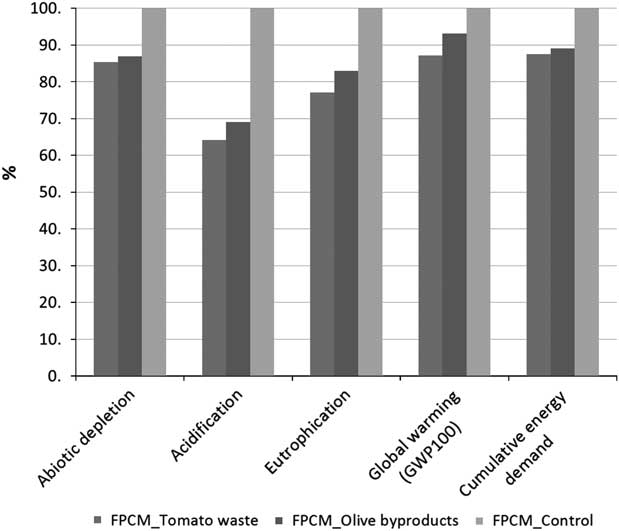
Figure 2 summarizes the results for the different impact categories of the production of 1 kg of goat FPCM with the three respective diets compared in the study. The results vary depending on the impact category, but in all the cases potential reductions among 10% to 30% are observed through the introduction of the respective food industry by-products.
Main LCA results for the three dairy goat diets analysed (tomato wastes silage, olive oil by-products and conventional). Functional unit: 1 kg of goat FCPM.

For GWP the values ranged from 1.9 to 2.2 kg CO2-eq/kg of FPCM. Biogenic methane (CH4) has the most important contribution in this category (34% to 38%), being enteric fermentation process the main source of this substance. Nitrous oxide (N2O), primarily associated with fertilizing during crop cultivation stage is the second source of GWP (25% to 29%), followed by carbon dioxide (CO2) (25% to 26%) emitted as a consequence of combustion of fossil fuels, which are related with the energy consumption during operations at farm and cultivation stages.
The reduction of GHG emissions accounted through the introduction of alternative feedstuffs analysed in this study is mainly attributed to a decrease in N2O emissions (and to a lesser extent on CO2) during cultivation stage, obtained through the displacement of some crops included in the conventional diet. The decrease in CH4 enteric emissions per kg of FPCM has also relevance in the scenario with TS.
According to the results shown in Figure 2, important impact reductions are observed in the categories of eutrophication and acidification when alternative diets are applied. These environmental burdens are very sensitive to nitrogen and phosphorous emissions associated with the fertilisers used during crop cultivation, being the main reason for the reduction observed. Furthermore, emissions of NH3 from composting are also avoided when the respective food by-products are used for animal feed, as there is no need for waste treatment, thus contributing to reduce among 2% to 5% of the impact in the mentioned categories.
Conclusions
In this study we explored the whole-farm environmental impacts of replacing a typical dairy goat diet in south Spain with one including TS or OS. We investigated the effect of different dietary strategies on total GHG emissions (including embodied emissions from feed production) and productivity. To carry out this LCA-based study, we used a modelling framework comprising experimental data for enteric CH4, animal productivity and excretion, and different interlinked sub-models. Preliminary results suggest that the new dietary strategies tested offer promising overall GHG reductions, in relation to N2O emissions (from feed production stages) and enteric CH4 (in the case of tomato wastes) without productivity being compromised. These findings must be taken with caution as food industry by-products could have alternative and competing uses, other than feed, such as energy production and soil organic amendment. Assumptions made and categories evaluated should be considered carefully in a decision making process.
Acknowledgements
The authors would like to thank the Spanish National R+D+i Plan (AGL2012-37815-C05-04 and AGL2011-27218) and European Commission FP7-SOLID (ref. 266367). BC3 is sponsored by the Basque Government. This work has been produced within the context of the REMEDIA network (http://redremedia.wordpress.com/).
Further information
The LiveM International Livestock Modelling and Research Colloquium was hosted by the Basque Centre for Climate Change (BC3) at the Maritime Museum in Bilbao, Spain between 14 and 16 October 2014. LiveM is the livestock and grassland modelling theme of the EU knowledge hub Modelling European Agriculture with Climate Change for Food Security (MACSUR). The MACSUR project is a pilot knowledge hub started by FACCE-JPI in 2012. It provides an opportunity to explore the role and potential of multi-disciplinary networking structures to address complex regional and global issues. More information on MACSUR and the LiveM theme can be found at www.macsur.eu, with PDFs of slides from conference presentations available through the conference website (http://www.livem2014bilbao.com/).