Introduction
Nowadays, Rhynchophorus ferrugineus (Olivier) (Coleoptera, Curculionidae) is considered the main pest of palms in the Middle East and the Mediterranean Basin (Faleiro, Reference Faleiro2006; Llácer & Jacas, Reference Llácer and Jacas2010), and it may become a serious pest in America (European and Mediterranean Plant Protection Organization, 2009). This species is a concealed tissue borer that lives inside the palm. Adults often remain and extensively reproduce within the same host until the larvae have destroyed the growing tip of the palm, causing the palm to die. Rhynchophorus ferrugineus feeds on soft tissues of most Palmaceae, and the Canary Islands Date Palm, Phoenix canariensis Hort. ex Chabaud, a species widely used as ornamental, is its preferred host in the Mediterranean Basin (Dembilio et al., Reference Dembilio, Jacas and Llácer2009). One of the main handicaps for the efficient control of R. ferrugineus is its cryptic habits. Current control methods are mainly based on the application of large quantities of insecticides designed to limit the infestation in treated palms. These procedures have been improved during the latest decade to enhance efficacy and to reduce application costs and toxicity to non-target organisms (Faleiro, Reference Faleiro2006; Llácer et al., Reference Llácer, Martínez de Altube and Jacas2009, Reference Llácer, Negre and Jacas2012; Dembilio et al., Reference Dembilio, Llácer, Martínez de Altube and Jacas2010a,Reference Dembilio, Quesada-Moraga, Santiago-Álvarez and Jacasb). Mass trapping is also widely used against this pest (Abbas et al., Reference Abbas, Hanounik, Shahdad and Al-Bagham2006; Faleiro & Kumar, Reference Faleiro and Kumar2008). Another useful procedure for pest control, the Sterile Insect Technique (Lance & McInnis, Reference Lance, McInnis, Dyck, Hendrichs and Robinson2005), has been tested against R. ferrugineus. Chemosterilization (Rahalkar et al., Reference Rahalkar, Harwalkar and Rananavare1975), gamma (Ramachandran, Reference Ramachandram1991) and X-ray radiation (Rahalkar et al., Reference Rahalkar, Harwalkar, Rananavare, Shantaram and Ayengar1973) proved successful in the laboratory to reduce egg hatching when sterilized males were allowed to mate with untreated females. Field studies were also carried out with promising results (Ranavara et al., Reference Ranavara, Harwalkar and Rahalkar1975; Rahalkar et al., Reference Rahalkar, Harwalkar, Rananvare, Kurgan, Abrham and Koya1977). More recently, gamma-sterilized males have been used in different studies on the basic biology of R. ferrugineus (Gothi et al., Reference Gothi, Hire, Vijayalakshimi and Dongre2007; Al-Ayedh & Rassol, Reference Al-Ayedh and Rasool2009; Prabhu et al., Reference Prabhu, Dongre and Patil2010). These studies point that gamma-irradiation of males induces permanent sterility and has no influence on mating behaviour, one of the requisites for the successful application of the SIT (Lance & McInnis, Reference Lance, McInnis, Dyck, Hendrichs and Robinson2005). Even if the polygamy of R. ferrugineus females and the extremely high cost of this technique makes the SIT hardly sustainable at this moment, gamma-irradiation of males has features that could make it a useful tool to control this pest.
Although few studies have been conducted on the natural enemies of R. ferrugineus or other Rhynchophorus species (Murphy & Briscoe, Reference Murphy and Briscoe1999; Faleiro, Reference Faleiro2006), biological control is another interesting strategy against this pest. Entomopathogenic nematodes (EPNs) are safe for non-target vertebrates and for the environment and have proved effective against R. ferrugineus (Abbas et al., Reference Abbas, Hanounik, Mousa and Mansour2001a,Reference Abbas, Saleh and Akilb; Saleh & Alheji, Reference Saleh and Alheji2003; Elawad et al., Reference Elawad, Mousa, Shahdad, Alawaash and Alamiri2007; Llácer et al., Reference Llácer, Martínez de Altube and Jacas2009; Dembilio et al., Reference Dembilio, Llácer, Martínez de Altube and Jacas2010a). In addition to EPNs, entomopathogenic fungi (EPF) can also provide an excellent alternative to chemical control. EPFs infect the host by direct contact and by horizontal transmission from infected insects or cadavers to healthy insects (Lacey et al., Reference Lacey, Kirk, Millar, Mereadier and Vidal1999; Quesada-Moraga et al., Reference Quesada-Moraga, Santos-Quiros, Valverde-Garcia and Santiago-Álvarez2004). These unique characters make EPFs especially important for the control of concealed insects as R. ferrugineus. Different strains of Metarhizium anisopliae (Metschnikoff) Sokorin (Ascomycota: Clavicipitaceae) and Beauveria bassiana (Balsamo) Vuillemin (Ascomycota: Clavicipitaceae) have been tested against R. ferrugineus (Gindin et al., Reference Gindin, Levski, Glazer and Soroker2006; El-Sufty et al., Reference El-Sufty, Al-Awash, Al-Bgham, Shahdad and Al-Bathra2009; Sewify et al., Reference Sewify, Belal and Al-Awash2009; Dembilio et al., Reference Dembilio, Quesada-Moraga, Santiago-Álvarez and Jacas2010b). Recently, El-Sufty et al. (Reference El-Sufty, Al-Awash, Al-Bgham, Shahdad and Al-Bathra2009) successfully reduced the incidence of R. ferrugineus under field conditions in Egypt using an indigenous isolate of B. bassiana, as did Dembilio et al. (Reference Dembilio, Quesada-Moraga, Santiago-Álvarez and Jacas2010b) in Spain under semi-field conditions (efficacies around 85%). The latter authors demonstrated for the B. bassiana strain CECT-20752 that fungus-challenged males were able to transmit the disease to healthy females in the laboratory and this infection resulted in a subsequent reduction in fecundity and egg hatching. At the moment, it is necessary to find methods to apply B. bassiana in field so that it results effective in controlling the pest. Therefore, we decided to investigate the potential of using gamma-irradiated males to spread the disease, as suggested for other pests of economic importance (Vickers et al., Reference Vickers, Furlong, White and Pell2004; Novelo-Rincón et al., Reference Novelo-Rincón, Montoya, Hernández-Ortiz, Liedo and Toledo2009). To achieve this goal, we have studied the reproductive biology of R. ferrugineus adult females obtained from P. canariensis-fed immature stages and specifically the possible occurrence of parthenogenesis, the effects of gamma irradiation on the mating success and performance of R. ferrugineus males. Further, we have studied the efficacy of gamma-sterilized males to disperse B. bassiana under controlled conditions. These studies should pave the way for developing sound biological control strategies against R. ferrugineus based on the use of sterile males to vector EPFs.
Materials and methods
The assays reported in this study were carried out at the Instituto Valenciano de Investigaciones Agrarias (IVIA, Montcada, Spain). Laboratory trials took place in a climatic cabinet at 25 ± 2 °C and 80 ± 10% RH and a photoperiod of 16:8 L:D. Semi-field trials were performed in a double mesh security enclosure protected from the rain by a plastic roof and containing 24 independent cages (4 × 3×3 m) under natural light and temperature conditions during August (mean temperature 25.0 ± 0.3 °C; max, 28.8 °C; min., 21.9 °C) and October (mean temperature 15.4 ± 0.4 °C; max, 21.4 °C; min., 12.2 °C) 2010.
Experimental insects
Adult weevils used in this study were obtained from cocoons collected in naturally infested P. canariensis palms around the city of Valencia, Spain. These cocoons were individually placed in 100-ml, plastic containers with perforated lids and incubated until adult emergence. Newly emerged adults were sexed and individually transferred to new containers as above. Filter paper and thin slices of red apple cultivar ‘Starking delicious’ were provided as food source and replaced weekly. Adults were maintained under these conditions (referred to as ‘standard containers’ henceforth) in a climatic cabinet until they were used in the assays. Unless otherwise stated, the same method and conditions apply to insects used in our laboratory experiments.
Gamma irradiation
One-day-old R. ferrugineus males were exposed in groups of six to a dose of 15 or 25 Gy of gamma rays using a Gammacell 220 SN 57R (Cobalt source) irradiator located in the nearby Medfly Mass Rearing Facility at Caudete de las Fuentes, Spain.
Laboratory trials
Female reproductive biology
Newly emerged females were individually introduced into a Petri dish (9 cm diameter and 2 cm height) either alone or with a five-day-old male and left undisturbed for 30 min. Afterwards, females were placed individually in 100-ml standard containers. Filter paper and thin slices of red apple cultivar ‘Starking delicious’ were provided as food source and oviposition substrate. Eggs were collected daily for 30 days using a fine paintbrush and transferred to a Petri dish (5 cm in diameter and 1.4 cm height) on artificial diet (Martin & Cabello, Reference Martín and Cabello2006) where egg hatching was scored five days later. Fifteen replicates (females) per treatment were considered and these results were compared by ANOVA.
Adult longevity
Longevities of untreated females, untreated males, and 15 and 25 Gy gamma-irradiated males were assessed. One-day-old adults (either irradiated or not) were individually placed in standard containers and maintained until they died. Two assays, including 17 replicates per treatment each, were considered. Longevity was analysed by ANOVA (P < 0.05) and, if necessary, means were separated using Duncan's test.
Mating success of irradiated males
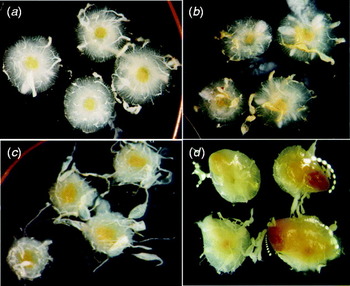
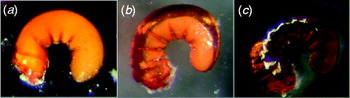
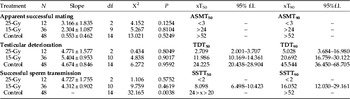
Sixty one-day-old weevils per treatment (same treatments as for longevity) were individualized in standard containers. On a weekly basis for the first eight weeks, and then every four weeks until week 28, and every eight weeks from weeks 28 to 52, three adult males per treatment were selected (provided that there were survivors) and used in our experiments. Individualized males were allowed to mate with a 15-day-old female in a Petri dish (9 cm diameter and 2 cm height) for 30 min and the number of couples that were actually observed mating (apparent successful mating) was recorded. Subsequently, males were weighted and their hind tibia length measured as indicative of their expected fitness (Leather, Reference Leather1988) (three females from the same age group were also measured). These results were subjected to ANOVA (P < 0.05) and, when necessary, means were separated using Duncan's test. Immediately after the measuring, males were dissected in a saline solution to check the appearance of the free lobes of their two-bilobed testes (Aslam, Reference Aslam1961). Testicular deterioration was rated according to their appearance: a rating of 100 was assigned when the four testicular lobes were turgid and sparkling, 66.7 when lobes showed lack of turgidity, 33.3 when the four lobes were shrivelled, and 0 when lobes showed protuberances (fig. 1). Mated females were preserved in 70% ethanol for two weeks to allow sperm in their sclerotized spermathecal capsules to coalesce. Then, successful sperm transmission was rated according to the following scale: a rating of 0 was assigned to spermathecae containing no sperm, 50 to those containing a sperm mass around half of the spermathecal volume, and 100 to those nearly full of sperm (fig. 2). The percentage of apparent successful matings, as well as testicular deterioration and successful sperm transmission, were transformed into probits and the corresponding probit lines fitted (Polo Plus, LeOra Software Inc., Berkeley, CA, USA) to estimate how fast irradiated males lost competitiveness relative to control ones. A chi-square test was used to estimate the goodness-of-fit. Based on these lines, times to 50% and 90% (i) apparent successful mating (ASMT50 and ASMT90), (ii) testicular deterioration (TDT50 and TDT90) and (iii) successful sperm transmission (SSTT50 and SSTT90) were determined.
Appearance of R. ferrugineus testes: (a) all two-bilobed testes are turgid and sparkling, (b) two lobes show lack of turgidity, (c) all two-bilobed testes are shrivelled, and (d) all two-bilobed testes show protuberances.

Sperm mass in R. ferrugineus sclerotized spermatheca: (a) spermatheca nearly full of sperm, (b) spermatheca containing a sperm mass around half of its volume, and (c) empty spermatheca.

Reproductive capacity of irradiated males
Fecundity and egg hatching of females mated with untreated or 15-Gy gamma-irradiated males of different ages (4, 10, 16, 22 and 28-day-old) were assessed. Six males per treatment and age were selected and allowed to mate with a 15-day-old female as above. This age was used based on results from the Females Reproductive Biology assay. Subsequently, females were transferred to a standard container. Eggs were collected daily and egg hatching was assessed as before for 15 days. Males were kept in separate standard containers; and, when they reached the age 42 days, the same procedure was repeated for eight untreated and eight 15-Gy irradiated males to assess their re-mating success. Means were compared by ANOVA (P < 0.05) and separated using Duncan's test.
Semi-field trials
Two semi-field assays were carried out to study R. ferrugineus infestation in palms caused by untreated females that had been previously in contact with one of the following four different sorts of males: (i) untreated males (control), (ii) 15-Gy gamma-irradiated males (γ), (iii) B. bassiana-challenged males (Bb) and (iv) 15-Gy gamma-irradiated and B. bassiana-challenged males (γ+Bb). These assays took place in August and October 2010. Four-year-old potted P. canariensis palms obtained from an officially inspected nursery (European Union, 2007) and, therefore, presumed to be free of R. ferrugineus were used in these assays. The stipe of these palms was 0.50 m high and 0.45 m wide. These plants were watered twice per week. The B. bassiana strain used was isolated from an infected pupa originally collected in a date palm grove in Spain and is deposited in the Spanish Collection of Culture Types with the accession number CECT-20752 (Dembilio et al., Reference Dembilio, Quesada-Moraga, Santiago-Álvarez and Jacas2010b). Suspensions were prepared as described by these authors and kept in 4 °C dark storage before use. Two-day-old R. ferrugineus males (either irradiated at age 1 or not) were immersed individually for 90 s in a conidial 0.02%-Tween 80 (Tween® 80, synthesis grade, Scharlau Chemie S.A., Sentmenat, Spain) aqueous suspension adjusted to a final concentration of 1.30 × 10⁸ and 1.14 × 10⁸ conidia ml–1 in the first and second trials, respectively. For each treatment (control, γ, Bb and γ+Bb), three and four palms (=replicates) were considered in the first and second trials, respectively. Palms were individually exposed in separate cages to three three-day-old couples of R. ferrugineus, either irradiated and/or B. bassiana-challenged or not. Before release, for each treatment, males and females were allowed to mate in a plastic box (20 × 10 × 8 cm) for 24 h. Ten days after release, when found, adults were removed from the cage. Those recovered from the B. bassiana treatments (Bb and γ+Bb) were individually transferred to a standard container where filter paper and apple pieces were replaced once per week for three weeks. In case of death, the weevil was surface sterilized with 1% sodium hypochlorite followed by three rinses with sterile distilled water, placed on a sterile moistened filter paper in an individual sterile Petri dish sealed with Parafilm-M© and kept at room temperature to ascertain the presence of B. bassiana. One month after release, palms were carefully dissected and checked for the presence of R. ferrugineus. The number of live immature stages per palm was subjected to a 2-way ANOVA. Because of the high relationship observed between temperature and R. ferrugineus oviposition, development and survival (Dembilio & Jacas Reference Dembilio and Jacas2011; Dembilio et al., Reference Dembilio, Tapia, Téllez and Jacas2012), mean temperature during the assay was considered as a factor. Efficacies (Abbott, Reference Abbott1925) were calculated for those treatments exhibiting significant differences when compared to control.
Results
Laboratory trials
Females reproductive biology
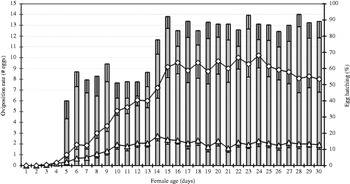
Pre-oviposition time was not significantly different for virgin and mated females (5.5 ± 0.4 days). Although fecundity showed a great variation among individuals (from 13 to 84 and from 43 to 243 eggs for virgin and mated females, respectively), females exposed to a male laid significantly more eggs than virgin females (138. 5 vs. 48.1 eggs per female) (table 1). Likewise, egg hatching of mated females (69.0 ± 9.9%) and daily oviposition rate (5.6 ± 0.7 eggs per female and day) were higher than those of unmated females (no egg hatching and 2.0 ± 0.2 eggs per female and day). On the other hand, three mated females (20% of total females tested) produced no fertile eggs and their fecundity was similar to that of virgin females (table 1). When these three females were excluded from the counts, fecundity of mated females increased to 161.5 eggs, egg hatching to 86.3 ± 3.5% and the daily oviposition rate to 6.8 ± 1.0 eggs per female and day (table 1). A sharp increase in the daily rate of oviposition from day 5 to 15 could be observed in mated females (fig. 3). Afterwards, their daily fecundity remained fairly constant, around 9–10 eggs per day, whereas that of unmated females stayed around two eggs. Egg hatching of mated females followed the same trend (fig. 3).
Daily oviposition rate (eggs per female per day: lines) and percentage egg hatching (eggs per female per day: bars) of male-exposed (grey bars and white squares) and virgin (white triangles) females of R. ferrugineus. No egg hatching was registered for virgin females. Only negative error bars are presented to avoid confusion.

Preoviposition time (days), fecundity (number of eggs female−1) and egg hatching (%) during the first 30 days of newly emerged females individually introduced into a Petri dish either alone (virgin females) or with a five-day-old male for the first 30 min (male-exposed females). In all cases, figures shown represent mean ±SE, and minimum and maximum values in parenthesis.

n, number
* data subjected to the log(x) transformation prior to ANOVA.
Adult longevity
Untreated males had the longest longevity (244.7 ± 16.1 days) and were followed by untreated females (197.2 ± 17.6 days), 15-Gy-treated males (118.6 ± 13.0 days) and finally 25-Gy-treated males (21.8 ± 3.6 days) (table 2).
Longevity (days; mean ± SE) of R. ferrugineus adults: untreated females and males, and gamma-irradiated males.

Column headings followed by the same letter are not significantly different.
Mating success of irradiated males
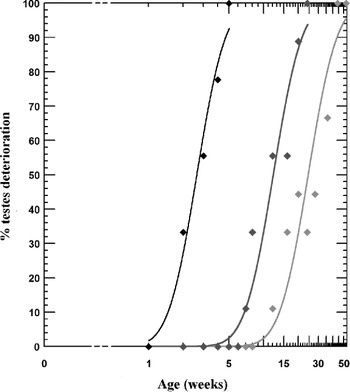
Hind tibia length was the same for control insects (6.10 ± 0.05 mm) irrespective of age (F = 1.52; df = 15, 92; P = 0.1197) and sex (F = 0.21; df = 1, 92; P = 0.6449). Similarly, body weight was independent of age (F = 1.54; df = 15, 92; P = 0.1111) but significantly changed with sex (F = 9.30; df = 1, 92; P = 0.0032) and resulted in 1.14 ± 0.04 and 1.00 ± 0.003 g for females and males, respectively. When tibia length and weight of control and irradiated males were compared, no differences were obtained for the 16 ages and the three doses considered (P ≥ 0.4283 in all cases). However, the higher the dose, the sooner testes lost turgidity (table 3). In this case, the three curves obtained for testicular deterioration (TD) (fig. 4) could be satisfactorily forced to parallelism (chi-square: 0.35; df = 2; P = 0.840) and the relative potency of 15-Gy irradiation was 2.012 and that of 25-Gy, 8.942 (testicular deterioration time 90, TDT90, for control males = 45.5 weeks). In the case of successful sperm transmission (SST), from the three categories established to classify spermathecae (fig. 2), only two, empty and almost full spermatehcae, were actually observed. In any case, SST followed the same trend as TD, (successful sperm transmission time 90, SSTT90 < 2 weeks for 25-Gy irradiated males and SSTT90 > 52 weeks for control), probit analysis could be satisfactorily applied to 15-Gy gamma-irradiated males only (table 3). Interestingly, the percentage of apparent successful matings sharply decreased along time for 25-Gy irradiated males (no apparent successful mating at age four weeks) but remained almost the same for control and 15-Gy irradiated males until week 24, when the last survivors from the 15-Gy treatment were tested (table 3).
Probit curves for the deterioration time (in weeks) of testes of control (light grey), 15-Gy (dark grey) and 25-Gy (black) gamma-irradiated males of R. ferrugineus.

Probit lines adjusted to different parameters measuring mating success of R. ferrugineus couples (ASM, percentage apparent successful mating; TD, percentage testicular deterioration; SST, percentage successful sperm transmission) with different gamma-irradiation treatments (control, 15 Gy and 25 Gy gamma-irradiated males) along time. Time is expressed in weeks.

Reproductive capacity of irradiated males
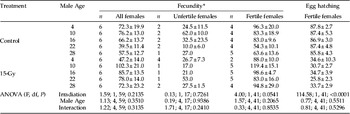
There were no significant differences in the fecundity of females, regardless of the age and the irradiation status of males that they mated with (table 4). However, egg hatching was significantly reduced by male irradiation (87.0 ± 1.7 versus 31.4 ± 1.7% for control and 15 Gy-gamma irradiated males, respectively). To ascertain whether this reduction was due to the effects of irradiation on sperm quality or on male sexual competiveness, we further analysed fecundity in fertile and unfertile couples separately. The number of unfertile couples was the same irrespective of the irradiation status of males (30%) and the fecundity of unfertile (29.9 ± 4.6 eggs per female) and fertile couples (86.8 ± 5.5 eggs per female) did not depend on the irradiation status of males. Therefore, possible effects of irradiation on male sexual competiveness could be discarded. Further, egg hatching did not decrease when control males were allowed to mate with a second female but significantly declined for irradiated males (85.9 ± 2.8% vs. 6.1 ± 0.5% for control and irradiated males, respectively; F=806.34; df = 1, 15; P < 0.0001). Remarkably, fecundity did not change in this case either (F=0.87; df = 1, 15, P=0.3660).
Mean fecundity (mean, number of eggs ± SE) and percentage egg hatching of 15-day-old R. ferrugineus females during the 15 days following copulation with either control or 15-Gy gamma-irradiated males of different ages (days).

* data subjected to the log(x) transformation prior to ANOVA.
Semi-field trials
Ten days after release, 44.8 ± 5.5% males and 24.3 ± 4.0% females could be recovered from infested palms. During the subsequent three weeks, 51.0 ± 9.4% males and 38.3 ± 15.3% females from the fungus-challenged treatments showed post-mortem endogenous hyphal growth of B. bassiana.
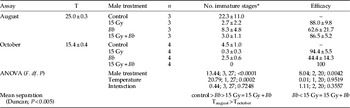
Both male treatment and temperature affected the number of R. ferrugineus immature stages found in P. canariensis palms, but the interaction between these two factors was not significant (table 5). The number of R. ferrugineus immature stages found was highest when females mated with untreated males (control). Lowest values were obtained for combinations including irradiated males and intermediate values when males had been fungus-challenged only (table 5). According to these values, highest efficacies were obtained for irradiated males, either fungus challenged (86.5–100%) or not (88.0–94.4%), which were significantly higher than those observed for fungus-challenged only males (44.4–62.6%). In this case, temperature did not affect results and efficacies where the same in August and October.
Mean number of live immature stages of R. ferrugineus (±SE) found in P. canariensis and efficacies (%) as a function of the mean monthly temperature (T, °C) during the trial and male treatment: (i) untreated males (control), (ii) gamma-irradiated males (15 Gy), (iii) B. bassiana-challenged males (Bb), and (iv) gamma-irradiated B. bassiana-challenged males (15 Gy+Bb). Before release, three males and three untreated females per palm were allowed to mate for a day. Palm dissection took place one month after release.

* data subjected to the log (x + 1) transformation prior to analysis.
Discussion
Wattanapongsiri (Reference Wattanapongsiri1966) found that R. ferrugineus adult females were capable of laying eggs on the day after emergence. Our results prove that a minimum of two days are necessary for females to start oviposition, both virgin and mated females (table 1), and this is in agreement with results from Kaakeh (Reference Kaakeh2005). From that day on, egg laying increased until reaching a roughly constant oviposition rate at age 14 days of about two and 9–10 eggs per female and day for virgin and mated females, respectively. Higher fecundity of mated females is indicative that mating is required to promote egg production in R. ferrugineus. Remarkably, the oviposition rate of mated females was much higher than that reported in previous studies using laboratory-reared specimens (2.48 eggs per female and day: Dembilio et al., Reference Dembilio, Tapia, Téllez and Jacas2012). The high nutritional value of P. canariensis relative to that of meridic diets (Dembilio & Jacas, Reference Dembilio and Jacas2011) could be behind these differences, and this result should be taken into account when extrapolating laboratory results to field conditions. As previously reported (Wattanapongsiri, Reference Wattanapongsiri1966), fecundity in R. ferrugineus females, either mated or not, is characterized by a high variation among individuals (table 1). During the 30 days that our experiment lasted, mated females laid from 43 to 243 eggs with a mean of 138.5. Viado & Bigornia (Reference Viado and Bigornia1949) found that more than 80% of total egg production in R. ferrugineus occurred during the first three weeks of life. Therefore, our results should be a rough estimate of total fecundity, and this is in agreement with results from other authors (Butani, Reference Butani1975; Kranz et al., Reference Kranz, Schmutterer and Koc1982; Avand-Faghih, Reference Avand-Faghih1996). However, higher fecundities, up to 800 eggs per female, have also been reported (Lepesme, Reference Lepesme1947; Wattanapongsiri, Reference Wattanapongsiri1966).
The 30 minute mating time used in our assays, the same as Al-Ayedh & Rasool (Reference Al-Ayedh and Rasool2009), resulted in about 80% of total females exposed to control males laying fertile eggs. Egg hatching for these females was higher than 85% in all our assays, and these values are a bit higher than those reported in similar studies (around 75%: Dembilio et al., Reference Dembilio, Quesada-Moraga, Santiago-Álvarez and Jacas2010b; Llácer et al., Reference Llácer, Dembilio and Jacas2010). This percentage, though, was nil for virgin females, and this means that R. ferrugineus cannot reproduce parthenogenetically (fig. 3 and table 1). This fact, together with longevity and mating success of sterile males relative to wild insects, are critical points for the success of SIT but also for the purpose of using irradiated males for dissemination of B. bassiana infective propagules among wild population.
An earlier study by Rahalkar et al. (Reference Rahalkar, Harwalkar, Rananavare, Shantaram and Ayengar1973) reported that treatment of newly emerged sugarcane-reared R. ferrugineus males at a dose of 15 Gy resulted in 90% sterility in males with no adverse effect on survival, whereas higher doses increased sterility at the expense of reducing survival. Because immature nutrition, radiation dose and their interaction significantly affect male lifespan and the hatchability of eggs resulting of mating with wild females (Al-Ayedh & Rasool, Reference Al-Ayedh and Rasool2010), we decided to include in our study 15 Gy as well as 25 Gy, the lowest dose used by these authors in a study with gamma-irradiated males under variable relative humidity (Al-Ayedh & Rasool, Reference Al-Ayedh and Rasool2009). The short longevity (table 2) and fast effect on testes (table 3 and fig. 4) observed at 25 Gy made us discard this dose in subsequent assays. Short longevity might be related to damage in the dividing regenerative cells of the mid-gut, which are particularly sensitive to radiation (Mohamed, Reference Mohamed2010). In fact, necrotic segments of intestine were frequently observed during dissection of 25-Gy irradiated males. Likewise, the accelerated deterioration of testes in gamma-irradiated males could be related to injury in testicular tissues. Al-Waneen et al. (Reference Al-Waneen, Al-Kalifah and Al-Ayedh2009) observed damaged spermatic tubules, lysed spermatic cysts and the breakage at the junction of spermatic tubes and vas efferens that disconnected the normal passage of sperm in irradiated R. ferrugineus males. Although 15-Gy irradiated males had their testes damaged and, as a consequence, successful sperm transmission decreased faster than in control males (table 3), the percentage of apparent successful matings remained almost the same as for control males during the 24 weeks that 15-Gy irradiated male survivors could be tested. The longevity of 15-Gy irradiated males was considerably longer than that reported by other authors using different food sources (Rahalkar et al., Reference Rahalkar, Harwalkar, Rananavare, Shantaram and Ayengar1973; Prabhu & Patil, Reference Prabhu and Patil2009; Al-Ayedh & Rasool, Reference Al-Ayedh and Rasool2010) and, once again, this may be related to the high nutritional value of P. canariensis relative to other food sources (Dembilio & Jacas, 2010). Although 15-Gy irradiated males lived about half the time that untreated males did (120 vs. 245 days; table 2), this lifespan would be enough to ensure that irradiated males, if infected with EPF, had the time enough to transmit the infective fungus propagules to wild females and their descendants, as well as to disperse and act themselves as an inoculum source after death (Dembilio et al., Reference Dembilio, Quesada-Moraga, Santiago-Álvarez and Jacas2010b). This hypothesis could be proved later during the semi-field trials (table 5).
Fecundity of fertile females mated with 15-Gy gamma-irradiated males did not change relative to control (86.8 eggs; table 4). However, egg hatching in couples where males had been irradiated was lower than in control (31.4% vs. 87.0%; table 4), and this value decreased even more after a second mating (6.1% vs. 85.9%). The higher egg viability for irradiated males on the first mating was predictable because mature spermatozoa present at the time of irradiation are radioresistant (Rahalkar et al., Reference Rahalkar, Harwalkar and Rananavare1975). In any case, this reduction undoubtedly contributed to the results obtained in the semi-field trials where infestation in control palms was always the highest (table 5). However, infestation significantly changed during the two semi-field assays included in our study. The number of immature stages found during the first assay (August 2010) was similar to that found in an assay carried out in summer 2009 using the same infestation method (22.8 ± 5.0 specimens; mean temperature 23.7 °C) (Llácer et al., Reference Llácer, Dembilio and Jacas2010). Temperature affects oviposition, development and immature survival of R. ferrugineus (Dembilio & Jacas, Reference Dembilio and Jacas2011; Dembilio et al., Reference Dembilio, Tapia, Téllez and Jacas2012), and therefore it could explain the lower number of immature stages found in October relative to August. Anyway, the significance of the differences observed among treatments was the same in both semi-field trials (table 5). Highest efficacies were obtained for treatments with irradiated males, irrespective of whether the males had been fungus-challenged or not. However, even in these cases, infestation occurred. This result was expected because, as mentioned before, egg hatching in combinations where males had been irradiated was not nil. Furthermore, the larvae obtained from these couples are not expected to suffer any differential mortality from control ones. However, those obtained from fungus-challenged treatments are (Dembilio et al., Reference Dembilio, Quesada-Moraga, Santiago-Álvarez and Jacas2010b). Unfortunately, the destructive sampling used in our assays did not allow us to keep the immature stages found in the palms alive to check whether they were infected by B. bassiana. Nevertheless, we could see that almost 40% of the females recovered from fungus-challenged couples were actually infected and died from this infection. This horizontal transmission had already been reported by Dembilio et al. (Reference Dembilio, Quesada-Moraga, Santiago-Álvarez and Jacas2010b), and these authors also reported lethal effects on the offspring. Therefore, our assays probably underestimated the efficacy of the combinations where B. bassiana was involved (Bb and γ+Bb). A continuous monitoring of the insects emerging from the palms could allow a proper estimation of this effect. This result should be taken into account in future experiments aimed at measuring the efficacy of this type of treatments.
Our results suggest that R. ferrugineus infestation in palms could be reduced by the release of gamma-irradiated B. bassiana-challenged males in the field. This reduction would be caused by the joint effect of the low offspring production of females mated with irradiated males and the transmission of B. bassiana from fungus-challenged males. Therefore, the inoculation of B. bassiana on gamma irradiated males could considerably improve the results obtained in the field using sterilized males only (Rahalkaret al. 1977; Krishnakumar & Maheswari, Reference Krishnakumar, Maheswari, Vreysen, Robinson and Hendrichs2007) thanks to the added effect of the EPF. Because R. ferrugineus is polygamous and highly gregarious (Wattanapongsiri, Reference Wattanapongsiri1966), the combined effects of irradiation and B. bassiana infection could be obtained in numerous specimens from a relative low number of treated males. Fungal application by releasing infected males has been already attempted against other pest insects, among them coleopterans such as sap and bark beetles (Dowd & Vega Reference Dowd and Vega2003; Kreutz et al., Reference Kreutz, Zimmermann and Vaupel2004), with successful results. This auto-dissemination methodology was even tested in the field against R. ferrugineus. The number of trap-captured adults decreased when the release of fungus-infected males was combined with the application of B. bassiana conidiospores by dusting on date palms (Sewify et al., Reference Sewify, Belal and Al-Awash2009). This result is especially important if we keep in mind that adult R. ferrugineus often remain and extensively reproduce within the same host. However, this behaviour that could hamper the efficacy of this method does not seem to actually do it.
In summary, our results show that the release of irradiated males infected with a suitable strain of B. bassiana should be considered as a practical way to improve the biological control of R. ferrugineus with EPF.
Acknowledgments
The authors thank J.R. Faleiro (Goa, India) for critical review of the manuscript. Special thanks are extended to E. Quesada-Moraga (University of Cordoba) for the suspensions of B. bassiana strain, R. Argilés (TRAGSA) for the gamma radiation application, and the palm nurserymen association ASFPLANT for providing the palms used in our assays. This research was partially funded by the Spanish Ministerio de Ciencia e Innovación (MICINN project TRT2006-00016-C07-05) and the Valencian Conselleria d'Agricultura, Pesca i Alimentació (IVIA project 5611). E. Llácer was recipient of a postdoctoral fellowship from the MCINN (Juan de la Cierva program, co-funded by the European Social Fund).