


INTRODUCTION
On 23 October 1911, just twenty days after Italian troops landed in Tripoli, a massive revolt surprised the colonial soldiers in the Shara al-Shatt oasis, just outside the city. The Italians had come to LibyaFootnote 1 certain of easy victory, convinced that the native population would rise up against the Turks. As a result of the revolt, the Italians in Tripoli suddenly realized that they had wrongly evaluated the colonial venture: after they had landed, the Arabs formed a coalition with the Turks and organized a common resistance to Italian occupation. Italian soldiers, caught off guard, reacted with brutality. An unspecified number of Arabs were shot in the hours following the revolt.Footnote 2 Giovanni Giolitti, Italy’s Prime Minister, ordered the immediate deportation to Italy of all “arrested rioters”.Footnote 3 This deportation, which might have seemed like an exceptional measure connected to the gravity of the situation, marked the start of an enduring period of deportations and transportations of Libyans to Italy, which lasted until the end of the Italian colonial occupation of Libya in 1943. In fact, the forced removal of Libyans was not merely a corollary of the Italian colonizer’s repressive measures, but an integral part of the colonial punitive system. In particular, the deportation of Libyans who had not been tried and the transportation of convicts became standard practice in managing the colony from 1911 to the 1930s.Footnote 4
The deportation of Libyans was not the first case of Italian repressive practice in its colonial possessions. Italian colonialism developed firstly in Eastern Africa, with the invasion of Eritrea (1890–1941) and Somalia (1892–1941), thereafter in North Africa, with the military occupation of Libya (1911–1943). Finally, with the conquest of Ethiopia in 1935, the Fascist regime proclaimed the birth of the Italian Empire, which collapsed a few years later, during World War II.Footnote 5 Between 1886 and 1892, when Italy took its first steps in Eritrea, military authorities ordered the transfer to Italy of a hundred people of different origins.Footnote 6 In 1937, deportation measures struck again against natives from Italian East Africa. As part of the harsh repression that followed the attack on Viceroy Rodolfo Graziani, Governor in Ethiopia, the colonial government ordered the confinement in Italy of some 400 Ethiopians.Footnote 7
Both in terms of the number of subjects involved and its long duration, the transfer of Libyans to Italy was the most significant deportation of colonial subjects in Italian colonial history. The reasons why the colonial authorities resorted to deportation in Libya more often than in the case of other Italian possessions still need to be clarified. In general, this issue is connected to the prison systems in each colony and, in particular, to the question of whether there were sites suitable to confine subjects considered harmful for the colony’s security. In Eritrea, Nocra performed this role, with Eritrean subjects previously deported to Italy also being transferred to this prison-island. As I will explain later, Italian authorities made little use of the other option open to their counterparts in other empires, namely intercolonial deportation/transportation, i.e. the possibility to transport Libyan convicts to, say, Nocra in Eritrea.
The Italian case is largely out of step with the policy regarding deportation and transportation enacted by the other European colonial powers. The history of Italian deportation and transportation chiefly concerns colonial subjects, who were transferred from colonies to the metropole. The other colonial powers in most cases resorted to penal transportation in order to remove metropolitan convicts, transferring them from the metropole to the colonies. For the most part, colonized subjects were transported to other colonial possessions.Footnote 8 The only exceptions to this were found in the French Empire. Indeed, following anti-imperial revolts, some Algerians were transferred to southern France in the nineteenth century.Footnote 9 The internment of Algerians in France decreased and finally ended when the French army succeeded in repressing the revolts. As I will explain later, the nexus between the control over the colony and the transfer of Libyans is also the key to understanding the forced removal of colonial subjects to Italy. Nevertheless, unlike the French deportations, the coerced transfers of Libyans to Italy lasted the entire colonial period, from 1911 to 1943.
This article addresses in what way the Italian case may be considered peculiar. Specifically, it analyses the practices of deportation and transportation from Libya to Italy within the imperial landscape of the twentieth century. Even if exceptional, the analysis of the Italian case integrates the study of the general theme of this volume, namely punitive relocations from a colonial perspective, and from a double viewpoint. On the one hand, it was left to the colonial “periphery” to decide whether to transfer Libyan subjects to Italy. On the other, the choice of whether to confine the majority of the prisoners in the south of Italy also originated from the “colonial” view of the southern regions, as I will explain later.
The first part of this article presents a general sketch of the deportation and transportation of Libyans. Highlighting the overlapping of the penal system and military practices, here I emphasize the difficult dialogue between “centre” and “periphery” concerning security issues inside the colony. The second part focuses on the experience of the Libyans in Italy. The expulsions of the Libyans from their native soil aimed foremost to tame the resistance movements against the colonizer. But the presence of colonial subjects in Italy also entailed different outcomes to those which the Italian authorities had foreseen, including the upturning of the roles of Italians and Libyans, which subverted the colonial relationship of power.
DEPORTATION AND PENAL TRANSPORTATION WITHIN THE ITALIAN COLONIAL SYSTEM
We can divide the forced removal of Libyans to Italy into roughly three categories: collective deportations following serious military defeats for the Italian army; individual deportations of political dissidents or of supposed opponents; and transportation of convicts already detained in colonial prisons.Footnote 10
It is difficult to establish a clear-cut division between deportations as administrative measures and deportations for political reasons. The latter were implemented over the entire colonial period; they were intended to strike against “rebels” or potential “rebels”, i.e. both combatants and political figures whose presence in Libya could undermine Italian authority. Deportation was frequently ordered on the basis of very generic accusations or the mere suspicion that someone represented a potential threat. The Libyans deported for political reasons also included people acquitted by colonial courts or who had already served a term of imprisonment in Libya, but whom military authorities judged dangerous to the security of the colony.Footnote 11 The implementation of this measure has to be set in the context of Italy’s “native policy” in Libya.Footnote 12 At times, certain notables were exiled as part of the so-called chiefs policy, i.e. the alliances established between the colonial authorities and some figures within the Libyan political leadership.
The lack of lists of subjects who left Libya, and the fact that an unspecified number of people died during the crossings, makes it difficult to estimate the exact number of Libyan deportees in Italy during the colonial era. According to the Libyan Studies Centre,Footnote 13 the Italian authorities deported about 5,000–6,000 Libyans to Italy.Footnote 14 The scholar Mario Missori estimates that there were 4,000 deportees in Italy between 1911 and 1918.Footnote 15 All things considered, we can state with some confidence that, after World War I, deportation no longer involved large groups of subjects, but mainly individuals: notables or leading figures of the resistance movement.Footnote 16
The main reason for collective deportations was the attempt to clear out the territory that had been the theatre of revolts and to expel as many people as possible. This happened at the beginning of the colonial occupation, after the above-mentioned Shara al-Shatt revolt, and in 1915, after the battle of Qardabiah, during the “great Arabic revolt”, which forced the Italians to retreat to a few coastal outposts. Undoubtedly, deportation aimed to intimidate the colonial population. In particular, in 1911 and in 1912, the decision to deport did not correspond to any real individualized appraisal of the dangerousness of the subjects involved. After the military disaster in Adowa (Ethiopia) in 1896 – which was the most serious military defeat for any European army during the imperial age – the Italian government needed to hide the military difficulties that Italy was encountering in Libya from other European colonial powers.Footnote 17 After the Shara al-Shatt revolt, in order to stop the massacres of Libyans by Italian soldiers, which were a clear indication of the weakness of the colonial army, Giolitti, the prime minister, ordered deportations. The arrests were made en masse, which is why beggars, labourers, peasants, wealthy owners, and storekeepers were all captured together.Footnote 18 Old men, women, and minors were also transferred to Italian penal colonies.Footnote 19
After Giolitti had ordered the first deportation of Libyans in 1911, all other deportations were ordered by the authorities in the colony.Footnote 20 Indeed, the Minister of the Colonies distinguished between deportees for administrative reasons and deportees who could be tried according to what the military authorities charged them with. The latter were usually accused of threatening the security of the colony and were generally defined as “rebels”.Footnote 21 In 1912, the “Commission for the Prisoners of War” suggested putting all the Libyans charged with specific crimes on trial, in order to give more “legitimacy” to the deportations. The Commission highlighted all the negative effects of deportation not only for the subjects transferred to Italy, but also for those who were in Libya, because it fuelled feelings of hostility towards the Italians. However, in 1913, Italian authorities justified the suspension of their trial, maintaining that either they could be tried in a single trial for all the rebels at a later date, or they could be pardoned for fostering reconciliation in Libya. There was, in fact, an important fluidity in their legal status: although they were deported as an administrative measure, those subjects were considered prisoners of war. In fact, this group of deportees was seen as a potential bargaining chip in negotiations for a peace agreement.
Convict transportation began after the collective deportations of 1911–1912. It was the very prison rules for Libya – approved in 1913 – which established that the Libyans sentenced to penalties of more than six months’ imprisonment should be transferred to Italy. In fact, the colony lacked suitable facilities for the prisons. Indeed, as late as in 1931, the colonial government had still not built new correctional facilities, and all the spaces employed as jails were insufficient and unsuitable with regard to their “juridical, disciplinary, and sanitary needs”. According to Adalgiso Ravizza, the shortage of correctional facilities in Libya had convinced the governors in Libya to command the transportation of convicts to Italy.Footnote 22 Mariano D’Amelio, for his part, maintained that, since the most “fearsome convicts” had been transferred to Italy, the penal transportation had facilitated the management of outdoor work for the prisoners, who were put to work in the penal agricultural colonies in Libya.Footnote 23
In October 1915, the Ministry of the Colonies indicated to the colonial government that the transportation of convicts to Italy was not permitted by the Italian judicial system and was therefore “illegal”.Footnote 24 In order to curb transportation to Italy, in 1915 the Ministry of the Interior set out to study the possibility of confining the Arabs who had been assigned to the motherland within Libya. The Ministry of the Colonies began searching for a site in the colony where it could build penitentiaries and exile the “rebels”. The colonial government in Libya immediately put a stop to the search being undertaken by the Ministry of the Colonies.Footnote 25 The military authorities on the ground were well aware that control over the “fourth shore” was too weak and limited for Italy to plan new prisons and/or facilities for confinement in Libya itself.
In 1915, the Minister of the Colonies had proposed to the Minister of the Interior to transfer 600 Libyans who had deserted from the native troops to Sicily, in the province of Palermo.Footnote 26 Due to the war effort, there was a considerable shortage of labour in Sicily in that period. In particular, the minister thought that the Libyans could be assigned to agricultural work. The Minister of Agriculture was opposed to this labour exploitation: “it is also more dangerous the fact that in the colony, deportation is depicted as a slave trade for the farm work in Italy”.Footnote 27 The minister feared that the association between deportation and slavery entailed a further weakening in the international position of Italy. Therefore, Martini, who had been Governor of Eritrea from 1897 to 1907, tried to transfer the 600 Libyans to that colony and proposed employing them in the construction of railways. Due to a large number of Eritrean workers employed as askari (i.e. native soldier) in Libya, there was also a shortage of labour in Eritrea. Cerrina Feroni, governor of the colony, noted that the presence of the Libyans in Eritrea would be troublesome for their surveillance and incur costs owing to the need to build barracks in the penal colony in Assab. In conclusion, he maintained that it was easier to arrange for their accommodation in Italy.
Also, in 1915, the deportees became “captives” (ostaggi): Tassoni, Governor of Tripolitania, banned the terms “deportations”, “confinements”, and other similar words from the official records concerning the forced removal of Libyans to Italy. According to Tassoni, the term “captives” did not provoke “any resentment from the native population against the government”.Footnote 28 In fact, the Italian government actually intended to use the deportees as hostages: in 1916, the Minister of the Colonies bore down on the most prominent Libyan leaders confined in Italy to secure the release of Italian prisoners held by the enemy.Footnote 29 During World War I, Libya was a country “in the grip of anarchy”, as Giovanni Ameglio, then Governor of Tripolitania, reported in 1917. Economic conditions in the colony were disastrous, and a significant part of the Libyan population lived in destitute circumstances. From the beginning of 1914, with Turkish support, the Libyan anti-colonial resistance inflicted severe defeats on the Italian army. During the “great Arabic revolt”, as this period of hostilities in Libya was called, many Italian soldiers were taken prisoner. In August 1915, the Italian army controlled just two cities in Libya: Tripoli and Homs.
World War I was definitely the most intense and complicated period for the deportations of Libyans to Italy. The repressive measures carried out by the Italian army intensified as the siege conditions experienced by the colonizers in Libya worsened. From 1914 to 1918, deportations to Italy increased remarkably. From 1913 to 1918, most convicts were transferred to Sicily, where 2,444 Libyan “captives” arrived in its prisons and penal colonies, and 5,000 askaris were confined in the province of Syracuse.Footnote 30 During World War I, the Italian authorities ordered deportation from Libya as an administrative measure and for political reasons, the transportation of convicts who had already been incarcerated within the prisons of the colony, and even the transfer of “lunatics”, to be “treated” in psychiatric hospitals in the motherland.Footnote 31
Although the flow of deportations and transportation to Italy continually increased from 1911 to 1918, peaking during World War I, on several occasions the measure was considered counterproductive owing to its political implications in Libya. Italian authorities tried endlessly to find a balance between the need for military control of the colony and the goals of reconciliation with their Libyan counterparts. On the one hand, authorities in Italy tried to restrict the transfers to Italy, while, on the other, in Libya, military and civil governors insisted on their prolongation in order to allow them to continue applying the measure. On the whole, until the beginning of the Fascist government, the “men on the spot” prevailed and military considerations triumphed over political considerations.
The flow of convicts to the metropole was directly connected to the fact that the Italian army’s control over Libyan territory was weak. When its control over the colony and its population increased, the forced removals decreased. The turning point for this shift was the so-called pacification of Libya enacted by the Fascist government from 1922. This was the recourse to very cruel repressive practices in order to permanently crush the resistance movement. In particular, in 1930–1931, Lieutenant Governor Rodolfo Graziani and Governor Pietro Badoglio ordered the confinement of the whole nomadic and semi-nomadic population of Cyrenaica, to be held in twenty concentration camps in the Sirtica region.Footnote 32 The main goal of the camps was to interrupt the resistance movement’s support network among the population. All the camps were finally closed in 1934. Scholars estimate that the number of Libyan prisoners in the camps was around 100,000–120,000, and that during their internment the death toll was as high as 40,000 to 48,000.Footnote 33
The adoption of this brutal “scorched-earth policy” in Libya also marked the end of the policy of collective removal to Italy. During the Fascist era, only a few dozen Libyan notables were confined in Italy. The policy of exiling notables lay in between the ruthless repression carried out in Libya by the Fascist regime and the need to keep channels of negotiation open with exponents from elite Libyan circles. In particular, in 1930, the government in Cyrenaica ordered the deportation of thirty-one zawia chiefs and of Hassan Reda es-Senussi, grandson of the Chief of the Senussi brotherhood.Footnote 34 In 1927, police rules encoded the confinement (confino) of native citizens.Footnote 35 In particular, it established the confinement in a place of the colony or in a municipality in Italy of those who had been “cautioned or those who had committed or clearly shown the intention of committing acts to subvert” the rules and security of the colony.Footnote 36 It is noteworthy that the Fascist government employed the confino to banish both Libyan and Italian opponents and supposed opponents.
LIBYAN DEPORTEES IN ITALY
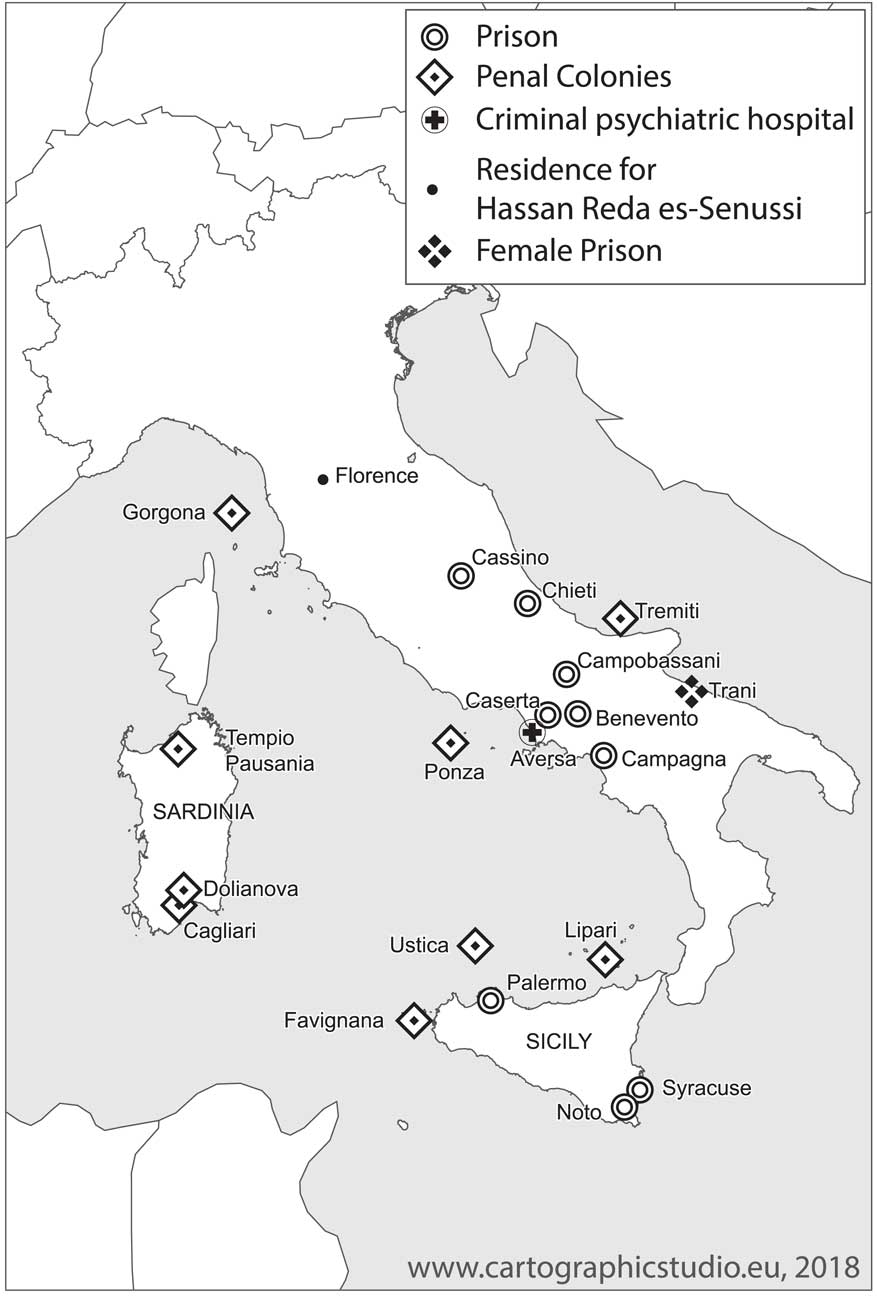
In 1911–1912, during the collective deportations that followed the Shara al-Shatt revolt, Libyans were initially transferred to penal colonies on the islands of Ustica and Tremiti, and subsequently also to the penal colonies on the islands of Favignana and Ponza, and to the military penitentiary in Gaeta. After this first phase, deportees who had already been sentenced in Libya were also transported to many other Italian prisons. Below is a map illustrating the twenty-one places to which Libyans were confined during the colonial era.
A map of the places of deportation of Libyans in Italy. Data deduced from ASDMAE, ASMAI, vol. II, folders: 112/1, 112/2, 141/1; Francesco Sulpizi and Salaheddin Hasan Sury (eds), Primo convegno sugli esiliati libici nel periodo coloniale (Rome and Tripoli, 2002); Sulpizi and Sury, Secondo convegno sugli esiliati libici; Ghezzi and Sury, Terzo convegno sugli esiliati libici.
In broad terms, the prisoners subject to administrative measures were transferred to penal colonies, as were political opponents (or supposed political opponents). The detainees already imprisoned in the colony were sent to the prisons. However, this distinction was not very clear, because some of the Libyan notables, removed for political reasons and without trial, were also sent to prison. During the collective deportations in 1911–1912, the majority of those deported from Tripoli were sent to the penal colonies on Ustica and Tremiti, and those from Benghazi, Derna, and Homs to Gaeta and Favignana.Footnote 37 The Libyans were transferred, in fact, to the colonie coatti, i.e. penal colonies, where they were subject to the domicilio coatto, an administrative measure and “preventive” tool for public order that had been in force in Italy since 1863. In this respect, their status was the same as that of the Italian “undesirables”, such as vagrants, the “indolent”, as well as political opponents. Nevertheless, for the convicts, in terms of penal regime there was no significant difference between colonie coatti and prisons.Footnote 38
As the map shows, all the places to which the Italian authorities transferred the Libyans, except for Gorgona and Florence, were located in the south of Italy. One can hypothesize that this choice was the result of the link made by the Italian authorities between southern citizens and “Arabic” citizens. As already highlighted by the literature, the policies implemented in the southern regions in the decades after Italian unification were largely influenced by an “oriental” view of the southern population, who were sometimes considered to be similar to African subjects.Footnote 39 However, before becoming the place to which Libyans were transferred, southern Italy had already been designated the favoured territory for the establishment of penal facilities. Penitentiary policy enacted by the first Italian governments located in Sicily five of Italy’s eight penal colonies.Footnote 40 Thereafter, around the end of the nineteenth century, Sardinia became the preferred site for instituting penitentiary agricultural colonies.Footnote 41 At the turn of the twentieth century, the ruling classes chose southern regions for the development of penal sites as a result of a combination of considerations: the isolation of the places selected; the intention to colonize those parts of the country that were considered “virgin” and “wild”, through penitentiary agricultural colonization; and, finally, the racialized vision of the southern populations, to which I have already referred. However, Sicily’s proximity to the Libyan coast also played a role in the decision to transfer the majority of Libyans to this region. In particular, during World War I, the Italian authorities arranged the flow of deportees as follows: they were transferred first to Syracuse and, afterwards, male adults were destined for Favignana, “insanes” for Aversa (Caserta, Campania region), minors for Noto (Syracuse), and women for the female penitentiary in Trani (Bari, Puglia region).Footnote 42
The conquest of Libya and the extensive propaganda which supported the colonial invasion contributed to developing a new national consciousness however. The colonial occupation triggered a unifying process, attenuating the regional and gender divisions that had prevailed throughout the first decades of Italian history after unification. At the same time, this process was fostered by the spread of a feeling of identity that put the Italian “race” in opposition to other “races”. Therefore, the social, cultural, and gender hierarchies turned into a colonial and racist hierarchy that opposed the “white” Italian to the “black” “Arab”.Footnote 43 As early as 1911, with the arrival of the Libyan deportees in Italy the majority of the population shared a sense of the “innate” superiority of Europeans over Africans. In most cases, the local communities refused to accept the Libyans who arrived. The sense of hostility towards them was also fuelled by the fact that the Libyan deportees were considered enemies who had massacred Italian soldiers.Footnote 44 However, on the small islands where the first Libyan prisoners were confined, a reversal of roles occurred, and the local population considered the colonized peoples deported to those penal colonies as “invaders”.
Arrival of Libyan deportees on Ustica, on board the steamship “Rumania”, 29 October 1911. The five guards in the foreground of the picture have been retouched by a pencil, under unknown circumstances. The Archive of the “Centro Studi Isola di Ustica” received the picture in this condition. Archive of the “Centro Studi e Documentazione Isola di Ustica”. Used by permission.
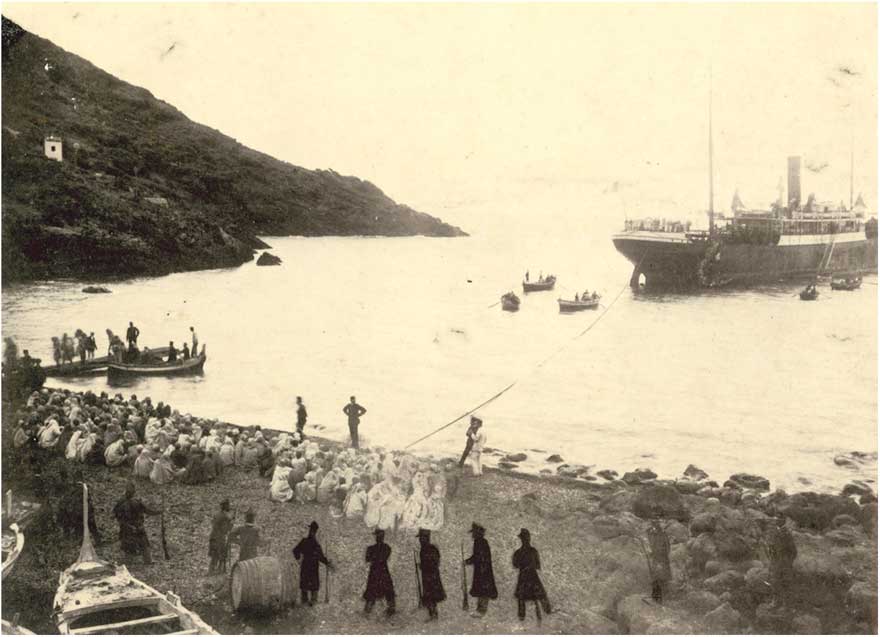
The population of Ustica, in particular, strongly opposed the arrival of the Libyans, and members of the city council resigned in protest. Certainly, the presence of Libyans in Italy often aggravated the unstable political and economic balance on the islands on which they were confined.Footnote 45 The sanitary situation was particularly critical. Those deported to Ustica, who were often carriers of cholera, died in large numbers, also due to the frigid temperatures and the overcrowding at the barracks where they lived.Footnote 46 Some infectious diseases also spread among the employees of the penal colony and the local population. The problems connected with sanitary conditions were the main reason behind the protest among Ustica’s citizens. However, the way in which they expressed their discomfort denoted a racist view of Libyan prisoners, who were described as “sickening individuals and plagued by thousands of infectious diseases”, and as “the race considered as a vehicle of infection”.Footnote 47 In the meantime, from 1911 to 1912, a large number of deportees died from disease and from the conditions of their imprisonment: in Ustica, 127 out of 900 Libyans died, which is about seventeen per cent of those who were originally transferred to that penal colony; on the islands of Tremiti, about a third of Libyans died, i.e. 437 out of 1,366 deportees.Footnote 48 In 1912, one of the physicians employed in the penal colony in Ustica asked for some of the barracks used for the Libyans to be closed, as they “must not be considered as shelters for human beings”.Footnote 49
Photographer Giuseppe Barraco, from Ustica, with a Libyan deportee. The picture depicts the “black” servant, barefoot, and the “white” master in a typical colonial pose. Archive of the “Centro Studi e Documentazione Isola di Ustica”. Used by permission.
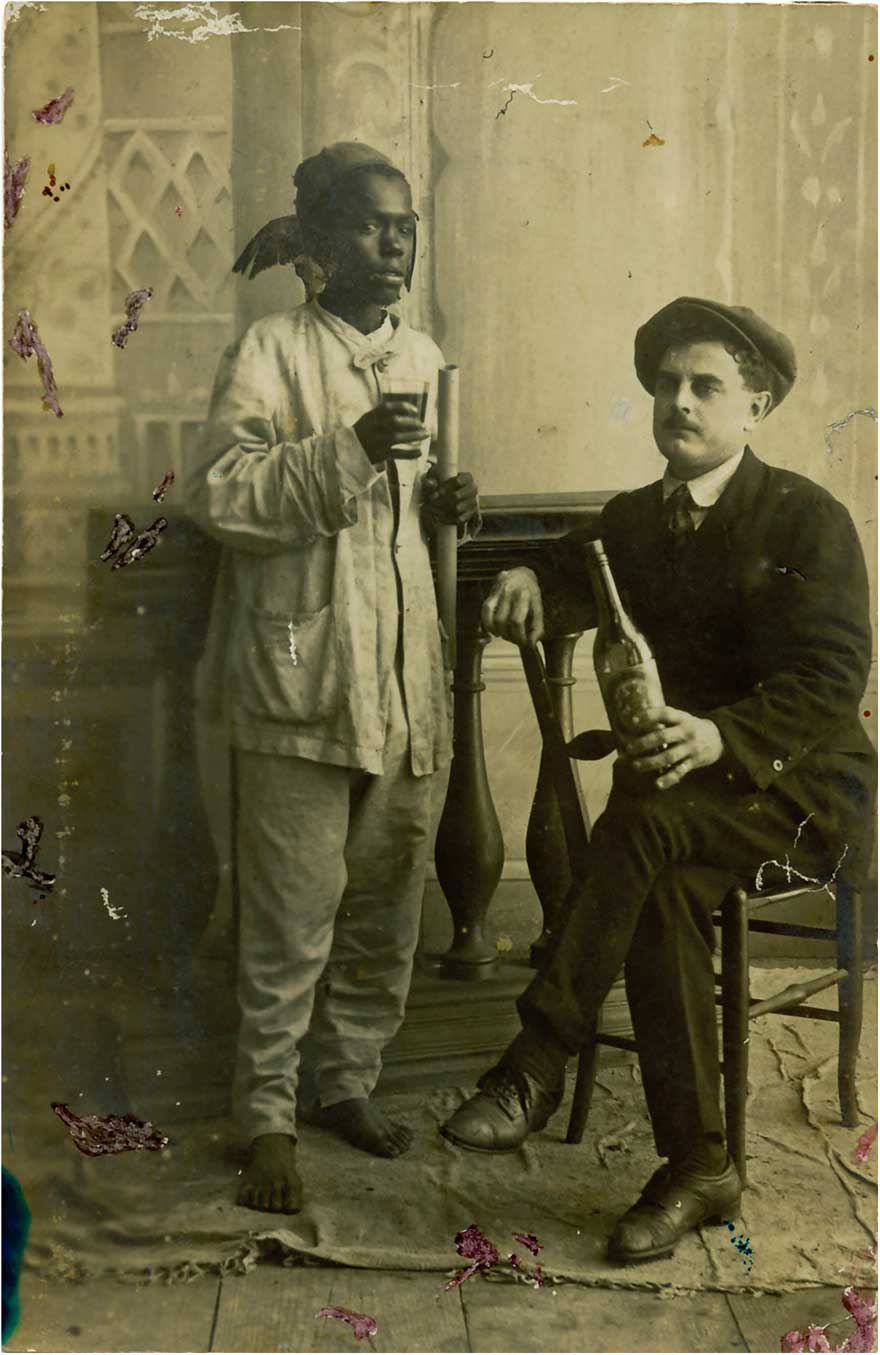
Even journalists who – circumventing government censorshipFootnote 50 – denounced the conditions under which the deportees were held in the penal colonies adopted at best an exotic language to describe the Libyans; in most cases, they were explicitly racist.Footnote 51 The language adopted by the socialist journalist Paolo Valera, a strong opponent of the colonial venture, is particularly remarkable. In 1912, he claimed, the people confined on Ponza Island were “muzzy”, “apathetic, glassy-eyed”, and showed an “idiotic” attitude.Footnote 52 However, it is in his description of women that Valera shared the commonest conceptions of colonial racism towards the colonized populations. Valera wrote:
Even here, the women who arrived and who were convoyed by the policemen and by the Carabinieri are, for the most part, ugly. Among [a group of about] fifty [females], we saw only three or four young women of a true Greek and sound beauty. One in particular aroused [great] admiration: she is blonde, diaphanous, with large, sparkling eyes a mouth made for kissing.Footnote 53
Disparaged and reduced to objects of sexual desire, the women of the colonized population were at the crossing of several tensions within colonial societies. On the one hand, their control was considered essential for their role as mothers; on the other, the colonial government tried to keep under its control the sexual relations between “white” men and “black” women, worrying that the ruling “race” might “mingle” and, therefore, be “tainted” with the colonized.Footnote 54
At the beginning of the twentieth century, this racist gaze was also fuelled by “scientific” discourse on human “races” based on the theses of the Positivist School. Colonial expansion had opened up a huge terrain for examination, classification, and investigation by criminal anthropologists. Libyans in Italy were the “other” at home: Africa within Italy’s national boundaries. Their presence aroused the interest of physicians, criminologists, and anthropologists. It offered a priceless opportunity to study the deportees’ physical traits, in order to observe the “characteristics” of the Libyan population and their supposed inclination to crime. In the Libyan colony, in 1912, a service for the identification and registration of detainees by means of photographs and dactyloscopy (i.e. fingerprint identification) was established.Footnote 55 Its purpose was to acquire “knowledge of the population of the new colony, knowledge that will be useful both from a scientific and from a practical standpoint”.Footnote 56
In 1915, Emanuele Mirabella, who was in charge of the health service in the penal colony in Favignana (and who had been a physician at the criminal psychiatric hospital in Aversa), examined the Libyans there. He carried out a study in order to compare their characteristics with those of ordinary Italian citizens and criminals. He highlighted “the degenerative features typical of this new population” and concluded that Libyans were inferior also to Italian criminals. After his study, Mirabella wrote a book about Libyan deportees in Favignana.Footnote 57 He dedicated the book to Enrico Ferri, one of the most prominent exponents of Italian criminal anthropology.
In that same year, about 5,000 Libyans were moved to Sicily. They were askaris, whom the Italian authorities transferred to the island along with their families in order to avoid them joining the resistance movement. Umberto Grabbi, an expert on exotic diseases and professor at the University of Messina, and Nello Piccioni of the National Museum of Anthropology and Ethnology in Florence studied this large group of Libyans, who had been relocated to two small villages in Sicily, namely Floridia and Canicattini Bagni (Syracuse).Footnote 58
Starting from World War I, a number of “lunatics” were also transferred by the Italian authorities.Footnote 59 Clearly, their transfer to Italy had no punitive goal, nor was it intended to prevent the formation of rebel groups, as was the case with the deportations, the subject of the present study. Moreover, their internment in Italy reflected the interest in the mental illness of the natives expressed by the Italian government from 1912 onwards.Footnote 60 What deserves to be highlighted, instead, is that deportees, askaris, and “lunatics” were relevant for criminologists and anthropologists in the same way, according to a view that subsumed them within the same category, based on their “racial” identity. Since there was no mental asylum in Libya, the “lunatics” were interned in the criminal psychiatric hospital in Aversa. Mohamed ben Mohamed Behera, from Benghazi, was one of them. He arrived in Aversa on 26 June 1914 and died within a year, on 18 June 1915. During his internment, his brother, who was being confined in Favignana during the same period, wrote many letters to the director of the hospital in Aversa asking after Behera’s health.Footnote 61 His supposed mental illness was connected to his sexual behaviour. The police in Benghazi had reported that Behera had exhibited “inappropriate” sexual behaviour – he had approached male minors, a female Jewish minor, and a Maltese girl.Footnote 62 As we have already observed, the sexual behaviour of both colonizers and the colonized was a “minefield” for colonial relationships.Footnote 63 Even within Italy, the terrain of sexuality endangered Italian dominion over North African people.
Certainly, the deportation of Libyans to Italy was a demonstration of strength over the colonized. At the same time, the presence of the colonized in the motherland in some respects overturned the “colonial situation”,Footnote 64 undermining the relationship of power between Italians and North Africans. In particular, in Italy social relationships between the colonizers and the colonized were governed by rules different from the set of social norms in force in the colony. In particular, in Italy the social norms that established colonial relations and the hierarchy of colonizers over the colonized risked being subverted. This had the potential to undermine Italian prestige. And this was what happened in at least some situations involving relations between “black” men and “white” women. The presence of askaris in Sicily caused conflict with the local population. Indeed, the main reason why the Italian authorities decided to transfer Libyan soldiers with their families was because askaris had established “overly intimate” relationships with Sicilian women.Footnote 65
During the Fascist period, Italian authorities had greater regard for the Libyan notables exiled in Italy. One can plausibly hypothesize that the Fascist government in Libya tried to secure itself potential interlocutors within Arab elite circles with whom it could establish a dialogue after military operations ceased. The main difference between exile and deportation concerned the living conditions guaranteed to the two groups of Arabs transferred to Italy. The Libyan exiles enjoyed “favourable” treatment, which made their stay in Italy less burdensome than that of the majority of the other deportees. In particular, during their exile in Ustica, the zawia chiefs received a daily food allowance of five lire. Hassan Reda es-Senussi’s exile was even more “comfortable”. This notable had made a deal with the Italian government in 1929 and had accepted the colonizer’s peace terms. Despite these negotiations, Graziani ordered his confinement in Italy, though he allowed him to move together with his wife, his daughter, and two “servants”. Furthermore, the Italian government provided a remarkable allowance to Hassan, amounting to some 4,000 lire per month.Footnote 66
The story of Hassan Reda es-Senussi in Italy exemplifies how the presence of natives in Italy might break the colonial order. He was exiled to Ustica in September 1930 and then, in June 1931, transferred to the Tremiti islands, owing to his “excessive familiarity” with many families in Ustica. In particular, a “distinguished person” from the island did not hesitate to promise his daughter to the Libyan notable, after he had asked to marry her – “even if he knew that Hassan was married with children” – but only on condition that es-Senussi provide a dowry of half a million lire. In the small Tremiti archipelago, some inhabitants who knew about his economic resources conned him, convincing him to spend more than he owned. In 1934, when Marshal Italo Balbo (Governor of Libya at the time) was trying to weave political alliances on Italy’s “fourth shore” after the cessation of military operations, Hassan declared himself willing to negotiate with the Grand Senussi on behalf of the Italian government. In that same year, Hassan moved to Florence, where he died two years later.Footnote 67 On account of his political influence, Hassan was in the “grey area” between natives and colonizers. More generally, his experience in Italy had explicitly revealed the incompatibility of his status with the colonial hierarchy.
CONCLUSION
Italy’s recourse to collective deportation was symptomatic of its weakness: the military authorities in the colony needed to expel “enemies” or potential “enemies” in order to reduce the threat posed by the resistance movement. This was what happened in particular from 1911 until World War I.Footnote 68 During the Fascist era, collective deportations ended and the regime chose to confine the nomadic and semi-nomadic populations of Cyrenaica in concentration camps in the Libyan desert. Italy deported Libyans to the motherland and not to its other colonial possessions. This was due to a combination of factors. Firstly, Italy did not have a large colonial empire with a choice of convict destinations. Secondly, Libya was much closer to Italy than to Italy’s other possessions in East Africa. Thirdly, the “colonial” view of certain parts of Italy prevalent among the political authorities, and in particular concerning southern regions and the prison-islands, influenced the decision to designate Italy the favoured territory for the establishment of penal facilities. Lastly, throughout the Liberal period, Italian officials were opposed to the transfer of Libyans from one colony to another (as was the case with the removal of the askaris from Libya to Eritrea) and to their confinement within Libya.
Within the Italian colonial system, the deportation and transportation of convicts had exclusively punitive or preventive goals. Italy did not deport colonized peoples for labour purposes. On the contrary, the Italian authorities made every effort to dispel the association between punishment and labour exploitation. This concern arose from the weak political equilibrium that characterized the development of Italy’s colonial venture, owing to the confrontation with other colonial powers but also to opposition within the colonial territories.
The peculiarity of the Italian case can also be analysed within a more general framework, which takes into consideration the imperial landscape in the nineteenth and twentieth centuries. The weakness of Italy as a colonial power arose from its position as a latecomer in the European imperial context. Italy did not embark on its colonial venture until the other main colonial powers had already become well established. In particular, in the final decades of the nineteenth century, when Italy took its first steps in acquiring its first colonial possession, Eritrea, slavery had already been abolished in most European colonies in Africa and Asia. Furthermore, Italy had no recent history of involvement in slavery.Footnote 69 All of these factors contribute to explaining the lack of connection between deportation, transportation, and forced labour in the Italian case.
With regard to the encounter between Italians and Libyans, this occasioned one of the first cases of “interracial” relationships in contemporary Italy. Italians saw Libyans through the lens of the colonial and racial hierarchy. The relationship between Libyans and Italians was marked by “new” codes in comparison with those that had been in force for centuries in the Mediterranean area and that had been characterized by uninterrupted encounters and exchanges between the two populations. Perhaps the most interesting feature of the presence of Libyan deportees in Italy concerns the manner in which the encounter with Italian society disrupted the social norms that were supposed to govern colonial relationships. This gave rise to a number of new social dynamics. Above all, it shows clearly that the history of these movements connects Libya and Italy within one and the same framework. As the case of deportation again highlights, it is impractical to elaborate a historical analysis based on any rigid division between the colony and the motherland. As Sanjay Subrahmanyam would put it, it is much more fruitful to consider the histories of the two shores of the Mediterranean as “connected histories”, where the connectedness does not erase regional, social, and cultural differences, but instead emerges from it.Footnote 70



