1 Introduction
As a serious challenge for any theory of syntactic structure, ‘pied-piping’ has enjoyed a great deal of attention from theory-builders since it was first identified and named (Ross Reference Ross1967), so we know informally how it works both in English and in a number of other languages. A typical example is (1), where which is said to ‘pied-pipe’ the preposition phrase in which into a position which is normal for which but not for a preposition phrase.

Even the ‘pied-piping’ terminology is widely agreed, though not universal. On the other hand, in spite of widespread agreement on the facts, our theories of syntax are as divided on pied-piping as on other matters, and the dominant HPSG theory based on feature-percolation (Pollard & Sag Reference Pollard and Sag1994) has been challenged recently by both Optimality and Minimalist alternatives (Broadwell Reference Broadwell1999, Cable Reference Cable2012). The main differences between the alternatives lies in their theoretical assumptions about the apparatus needed for syntax, and in the special apparatus that they introduce for pied-piping, rather than in their ability to handle the data. But what unites them is the phrase-structure apparatus that they all assume for linguistic structure.
This paper assumes a very different theoretical foundation, Word Grammar (abbreviated to WG; see Hudson Reference Hudson1984, Reference Hudson1990, Reference Hudson1998, Reference Hudson2007, Reference Hudson2010; Gisborne Reference Gisborne2010; Duran-Eppler Reference Duran-Eppler2011), and shows how it can be applied to pied-piping.Footnote [2] WG is a version of cognitive linguistics, which includes the controversial theoretical assumption that we use the same mental apparatus for learning and processing language structure as for ordinary everyday cognition. This assumption has been expressed in various ways: ‘Knowledge of language is knowledge’ (Goldberg Reference Goldberg1995: 5); ‘a broader goal: to derive linguistic structure from the application of domain-general processes’ (Bybee Reference Bybee2010: 1); ‘Language is not an autonomous cognitive faculty’ (Croft & Cruse Reference Croft and Cruse2004: 1); ‘The formal structures of language are studied not as if they were autonomous, but as reflections of general conceptual organisation, categorisation principles, processing mechanisms, and experiential and environmental influences’ (Geeraerts & Cuyckens Reference Geeraerts and Cuyckens2007: 3).
In short, the hypothesis on which WG and these other theories rest is that the full range of ordinary cognition is available for language, and that this is sufficient for any language learner or user. Pied-piping is a particularly good testing ground for this hypothesis because it appears to be such a peculiarly ‘linguistic’ pattern, as far removed from everyday cognition as syntax can be. In spite of this apparent particularity, it will be argued below that pied-piping actually requires no more mental resources than general cognition, and indeed that there are quite simple non-linguistic analogues which use the same resources in much the same way.
Apart from the cognitive orientation, however, WG also assumes dependency structure, which is just as controversial within cognitive linguistics as it is in mainstream American and European linguistics. For instance, in (1) above, this theory does not recognise in which as a preposition phrase; instead, it just recognises a dependency from in to which, and another from found to in. The term phrase can still be used for a word plus all the words that depend on it; but this is just an informal term which plays no role in the formal theory. In particular, there are no generalisations about particular kinds of phrases such as noun phrases or preposition phrases because all such generalisations can be expressed at least as well in terms of their head words such as nouns and prepositions. Once again, the challenge of pied-piping is special because the apparatus of phrase structure plays such an important part in other analyses.
The paper starts by building on the insights of earlier work (Section 2), followed by a review of the data on English pied-piping (Section 3). Section 4 introduces the theoretical apparatus needed for pied-piping, which Sections 5 and 6 apply to English. Finally, Section 7 offers a functional explanation for pied-piping in English and in other languages.
2 Insights from other approaches
Most discussions of pied-piping in English limit themselves to the pattern found with wh-words – in particular, relative and interrogative words, with little discussion of exclamatives or comparatives – and this paper has the same focus. What these examples have in common is the possibility of a special word order, in which a dependent wh-word determines the position of the word on which it depends, rather than the other way round as in more typical dependency pairs; in phrasal terms, the position of the phrase is determined by the dependent wh-word rather than by the phrase’s head word. In these cases, the wh-word is said to ‘pied-pipe’ the other word (an allusion to the fairy story of the Pied Piper of Hamlyn). For instance, take the following examples of interrogative clauses (Huddleston Reference Huddleston2002: 910):

2.1 Challenges
In (2) above, the interrogative determiner which stands, as expected, at the start of the clause, but so does the whole of the phrase in which drawer. This is not expected, and the only reason for this phrase being in this position is that it contains the word which; but crucially, the head of the phrase is in,Footnote [3] not which, so exceptionally the whole phrase takes its position from a non-head word inside it. The same is true of the other two examples.
It could be objected that preposition phrases can be freely topicalised, with or without a wh-pronoun:

But this explanation clearly fails for questions, and fails even more spectacularly for relative clauses such as (6).

Here pied-piping is the only possible explanation for the position of in which, there being no grammatical alternative without a wh-pronoun:

The main theoretical challenge of pied-piping, therefore, is the mismatch between linear position and dominance: in terms of dominance, the head of in which drawer is the preposition in; but it is the wh-word which, not in, that determines the linear position of the whole phrase. This conflicts with the very general principle that a phrase’s position is typically determined by its head word. For instance, the phrases very big and about linguistics can both modify the noun book, but their position before or after book is determined by their respective heads, giving very big book about linguistics, but not *about linguistics book very big.
Another theoretical challenge is to explain why pied-piping applies to words such as our wh-words, and only to these; so pied-piping is not available for the relative that (as in the chair that I sat on but not *the chair on that I sat). The obvious peculiarity of the wh-words is their dual function. For example, in the book which I bought, the relative pronoun is both a subordinator, marking the start of a subordinate clause, and also a pronoun functioning as the object of bought, just like the it of I bought it. In contrast, that is a subordinator, but not a pronoun. Similarly, an interrogative wh-word combines the role of an indefinite, non-anaphoric pronoun with that of marking its clause as interrogative, with the added possibility of subordinating the latter as in I wonder what happened, where what is internally linked to happened but also externally linked to wonder. The second challenge, therefore, is to explain how the dual functioning of wh-type words relates to pied-piping.
2.2 Theory
Until recently the most popular explanation for the mismatch between linear position and dominance has been feature-percolation, in which the ‘WH’ feature (actually, either QUE or REL) of the wh-word passes up to the node representing the entire phrase (Cable Reference Cable2010; Hoffmann Reference Hoffmann2011: 242). This is an attractively simple explanation for the word-order mismatch, especially given the important role played by feature-passing in the HPSG treatment of other phenomena. On the other hand, this analysis also has major costs, not least of which is the fact that feature-percolation from a non-head to its containing phrase exists solely for the sake of pied-piping.Footnote [4]
Another cost is in the semantics of the percolated feature. REL and QUE are defined not only by their position, but also by their meaning; so REL provides an index for the relative pronoun which binds it to an antecedent noun (Pollard & Sag Reference Pollard and Sag1994: 208–214). But if this index is percolated up to the pied-piped phrase, the semantics fails. For example, in (6) above the drawer is the antecedent of which, and not of in which. This is even clearer in an example like (8):

Here the drawer is the antecedent of whose, but the pied-piped phrase is whose key, referring to the key, not the drawer. Such examples show that the semantics is out of step with the word order: even though whose shares its position with key, it does not share its semantics. Consequently, pied-piping must find some way to separate the semantic consequences of wh-words from their consequences for word order.
A similar objection to feature-percolation comes from syntax. The features of the WH-word include those like number which are relevant to agreement, but (given a phrase-structure analysis) the pied-piped phrase may have different features from its WH-word. Examples (9) and (10) illustrate the problem (Cable Reference Cable2010).

Example (9) shows that who is singular, but whose sisters (where whose presumably contains who) is clearly plural; but this is impossible if all the features of whose are projected onto whose sisters.
In contrast with the analyses based on feature-percolation, recent Minimalist analyses find other ways to explain the special word order of pied-piped structures. One analysis assumes an operator which affects word order but has no effect on meaning (Cable Reference Cable2010). This operator is invisible in languages like English, but in a minority of languages it is visible, and it is these languages that provide the evidence for the operator’s existence. The weak point of this analysis is that the evidence requires controversial assumptions about universal grammar; without universal grammar, the overt existence of an operator in one language does not prove its existence in all languages. Another Minimalist analysis also presents pied-piping as strictly a matter of word order, without any other implications for meaning or special elements (such as an operator) in syntactic structure (Heck Reference Heck2009). For this analysis, the challenge is to find a way to tweak the structure and the usual movement rules so that they move the entire phrase along with the wh-phrase that it contains. Once again the explanation is undermined by its dependence on theory-internal assumptions about structure and rules. However, both analyses assume that pied-piping is merely a matter of word order, with no implications for either the meaning or the syntax of the pied-piped structure; I shall adopt and develop this assumption below.Footnote [5] The strict distinction between word order and the rest of phrase structure is of course reminiscent of the ID/LP split in the GPSG literature, in which ‘immediate dominance’ was separated from ‘linear precedence’ (Gazdar & Pullum Reference Gazdar, Pullum, Moorttgat, van der Hulst and Hoekstra1981).
Alongside the formal analyses in the PSG or Minimalist traditions, there is an important contribution that applies Optimality Theory (Broadwell Reference Broadwell1999, Reference Broadwell, Butt and Holloway King2006). We consider the relevant data in Section 7.2, but the important insight to be noted here is the idea that syntactic patterns, including pied-piping, are due to independent but interacting constraints, such as the requirement that wh-words should stand at the start of the clause. It is a short step from this kind of analysis to one which links these constraints to functional benefits for speakers and hearers, and which raises questions about why pied-piping exists in so many languages. We address these questions in Section 7.1.
To summarise this brief survey, earlier analyses have contributed some important insights to our understanding of pied-piping:
-
∙ Pied-piping is primarily a matter of word order, completely separated from other structural issues such as classification and meaning.
-
∙ But there must be some structural connection between the wh-word (the ‘piper’) and the node representing the entire pied-piped phrase (the ‘pipee’), whether this is described in terms of a percolated feature or an invisible operator or by some other means.
-
∙ The structural analysis may enable a functional explanation for the existence of pied-piping.
-
∙ The analysis must differentiate different types of wh-constructions (or different kinds of wh-word), as well as providing a single unifying explanation for their similarities.
We now consider in more detail the descriptive facts of pied-piping in English.
3 The limits of pied-piping
3.1 Constructional differences
The syntactic limitations on pied-piping vary from construction to construction; for instance, they allow much more freedom in relative clauses than in interrogative clauses. The following examples (from Huddleston, Pullum & Peterson Reference Huddleston, Pullum and Peterson2002: 1040) illustrate the freedom found in relative clauses, and especially in non-restrictive relative clauses:

In contrast, free relatives hardly allow prepositional pied-piping at all:

But prepositional piping in relative clauses is not the only kind of pied-piping, and different kinds have different limits. A full account of pied-piping needs to accommodate the following, all of which are discussed below:
-
∙ prepositional pied-piping in interrogatives
-
∙ how as degree modifier (e.g. how big a car, how fast)
-
∙ wh-determiners: what, which, whose
-
∙ complex pied-piping combining a mix of types
-
∙ free relatives
These distinctions might seem to require phrase structure because they are normally described in terms of different clause types (interrogative clause, etc.), but since each clause type allows a different range of wh-pronouns, the distinctions could be made equally well in terms of word classes, as in dependency structure: interrogative pronoun, relative pronoun, and so on through finer subdivisions. In these terms, free-relative pronouns hardly allow any prepositional pied-piping, whereas other wh-relative pronouns allow it freely.
3.2 Recursive pied-piping in relative clauses
The freedom of pied-piping in relative clauses can also be seen in Ross’s famous made-up examples (Ross Reference Ross1967):

Admittedly Ross himself claims that (21) and (23) are different from the others, and ungrammatical, but the differences are hard for others to see (Hoffmann Reference Hoffmann2011: 89).
The easiest generalisation for relative clauses is that, as far as the grammar is concerned, the pipee may be not only the piper’s ‘parent’ (the word on which it depends directly, as which depends on in) but almost any of its ‘ancestors’, where ‘ancestor’ is a recursive generalisation of ‘parent’ (just as in ordinary kinship terminology). The exception is finite verbs, which seem to be absolutely impossible as pipees. A plausible example would be (25).

It is true that even some of the earlier examples are hard to process, and might be considered impossible because of that; but (25) feels different, and its badness can’t be explained just in terms of processing difficulty because it is probably easier than some of the earlier examples. It seems, therefore, that the grammar allows pied-piping to apply recursively across nouns and prepositions until it is blocked by a finite verb.
3.3 Restrictions on pied-piping in relative clauses
On the other hand, alongside this great potential freedom for recursive pied-piping, there are severe lexical limitations (Johansson & Geisler Reference Johansson, Geisler and Renouf1998). In principle, pied-piping is an alternative to stranding, but this choice is actually only available in half the cases studied by Johansson and Geisler. In some of the other cases, the only permitted option was stranding, while in others it was pied-piping. They report that pied-piping is obligatory with some antecedent nouns (e.g. way, extent, point, sense, degree, time, moment) and some prepositions (e.g. beyond, during, underneath):
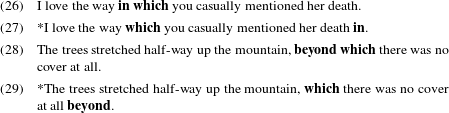
In contrast, stranding is obligatory with phrasal verbs (e.g. look after) and other idioms (e.g. get rid of) where the preposition does not have its normal meaning:

These two sets of constraints are rather different. The stranding-only cases are easy to explain in terms of processing, because they inevitably mislead the hearer/reader by inviting a default interpretation of the preposition which later has to be abandoned, producing a ‘garden-path’ effect; for instance, an incremental reading of this is the book after which invites the reader to construe after which as a time adverbial. In contrast, the piping-only cases look like constructional patterns which are learned item by item, and hardly generalise beyond these items (Hoffmann Reference Hoffmann2011: 270): so we learn way in which and beyond which as fixed phrases, and this is how they evolved in the pool of usage. Moreover, the possibility of stranding must be controlled lexically by the preposition rather than the wh-word because the restriction on BEYOND or DURING applies regardless of the choice of relativiser, including THAT or zero:

It may be significant that these prepositions are also unstrandable in passives:

These facts suggest that the grammatical entry for each preposition may show both whether it can be pied-piped and also whether it can be stranded – two grammatical configurations that can easily be accommodated in the local network for the preposition concerned.
3.4 Social constraints on pied-piping
Previous studies have produced statistical evidence to support the impression that, in English, pied-piping is more academic or formal than its alternative, preposition stranding (Hoffmann Reference Hoffmann, Trousdale and Gisborne2008, 2011). As we might expect, private conversations and correspondence strongly favour stranding over pied-piping, in contrast with more formal varieties where the balance is reversed. One corpus analysis reports a strong formality effect in wh-relative clauses, with stranding more popular in less formal texts and an even stronger preference for stranding regardless of formality in wh-interrogative clauses (Hoffmann Reference Hoffmann2011: 155). Another analysis found that wh-questions with prepositional pied-piping ‘chiefly occur in academic prose and news. They are rare in fiction and virtually non-existent in conversation’ (Biber et al. Reference Biber, Johansson, Leech, Conrad and Finegan1999: 106). Moreover, children start to use prepositional pied-piping in their writing much later than stranding (Perera Reference Perera1984: 237), and even reject it initially as ungrammatical and only gradually learn it from adult usage (McDaniel, McKee & Bernstein Reference McDaniel, McKee and Bernstein1998). In short, stranding is very much the favoured alternative in ordinary, non-academic English.
This comparison is possible in English because we have a free choice between the two patterns, as in (41) and (42)–(44):

In languages which forbid stranding, of course, there is no choice so it is much harder to assess formality. But why should pied-piping in relative clauses be more formal? There are at least three possible answers:
-
∙ Because which is more formal (Biber et al. Reference Biber, Johansson, Leech, Conrad and Finegan1999: 610), and only which allows pied-piping. (It will be noticed that (41)–(44) appear to be in decreasing order of formality, so the formality of the first two may be due simply to the choice of which, with no extra effect from the pied-piping.) This explanation is supported by reports that, when the relativiser is a wh-word rather than that or zero, pied-piping is actually more common than stranding (Johansson & Geisler Reference Johansson, Geisler and Renouf1998).
-
∙ Because pied-piping itself is associated historically with the languages of formal learning (Latin and French).
-
∙ Because stranding is inherently easier and more appropriate for casual conversation.
We return to these options in the later discussion of functional motivation for pied-piping.
3.5 Prepositional pied-piping in interrogatives
As reported above, corpus studies of informal conversation find very little pied-piping in interrogatives, but unlike the social restriction on relative clauses, this cannot be explained in terms of the formality of the wh-word itself. After all, our common interrogative words such as who, what or how are socially neutral because there is no alternative. The only possible explanation for the social limitation on pied-piping in interrogatives, therefore, is that the pied-piping pattern itself is socially restricted. It is unclear why interrogatives are so different from relatives, but one possible explanation lies in the challenges for processing: a relative pronoun is definite, so its referent is already known whereas an interrogative pronoun has an indefinite, unknown, referent which is harder to keep in memory. Consequently it is less important for the pronoun to be initial in a relative clause than in an interrogative (Trotta Reference Trotta2001: 55). Another more speculative explanation lies in the distant history of our wh-words, which were originally only interrogative (and used without pied-piping) but were coerced into relative pronouns under the formal influence of Latin, where pied-piping was the only option. It is possible that our modern usage still reflects the patterns of Old English.
But even when pied-piping does occur in interrogatives, the syntactic structure itself also seems much more limited than for relatives (Horvath Reference Horvath, Everaert and van Riemsdijk2006: 579). It is doubtful whether recursion is possible at all in interrogatives:

The simplest general conclusion about interrogative clauses – i.e., in dependency terms, interrogative wh-words – is that they only allow one-step pied-piping, rather than the recursive pied-piping found in relative clauses; in other words, the pipee of the wh-word is always also the parent preposition.
However, this claim misses an important exception: what could be called ‘quiz-show questions’ such as (47) which are syntactically unlimited.

Huddleston accepts this example without comment, but it seems very unlikely in ordinary conversation, while being very easy to imagine in a quiz show. Similar examples are easy to find on the internet (e.g. on the ‘pubquizreference’ site):

However even in this specialised genre the syntax is clearly not easy to control, as can be seen in the following internet examples where pied-piping is combined with stranding of the same preposition:

Examples like these show how difficult pied-piping is to process.Footnote [6]
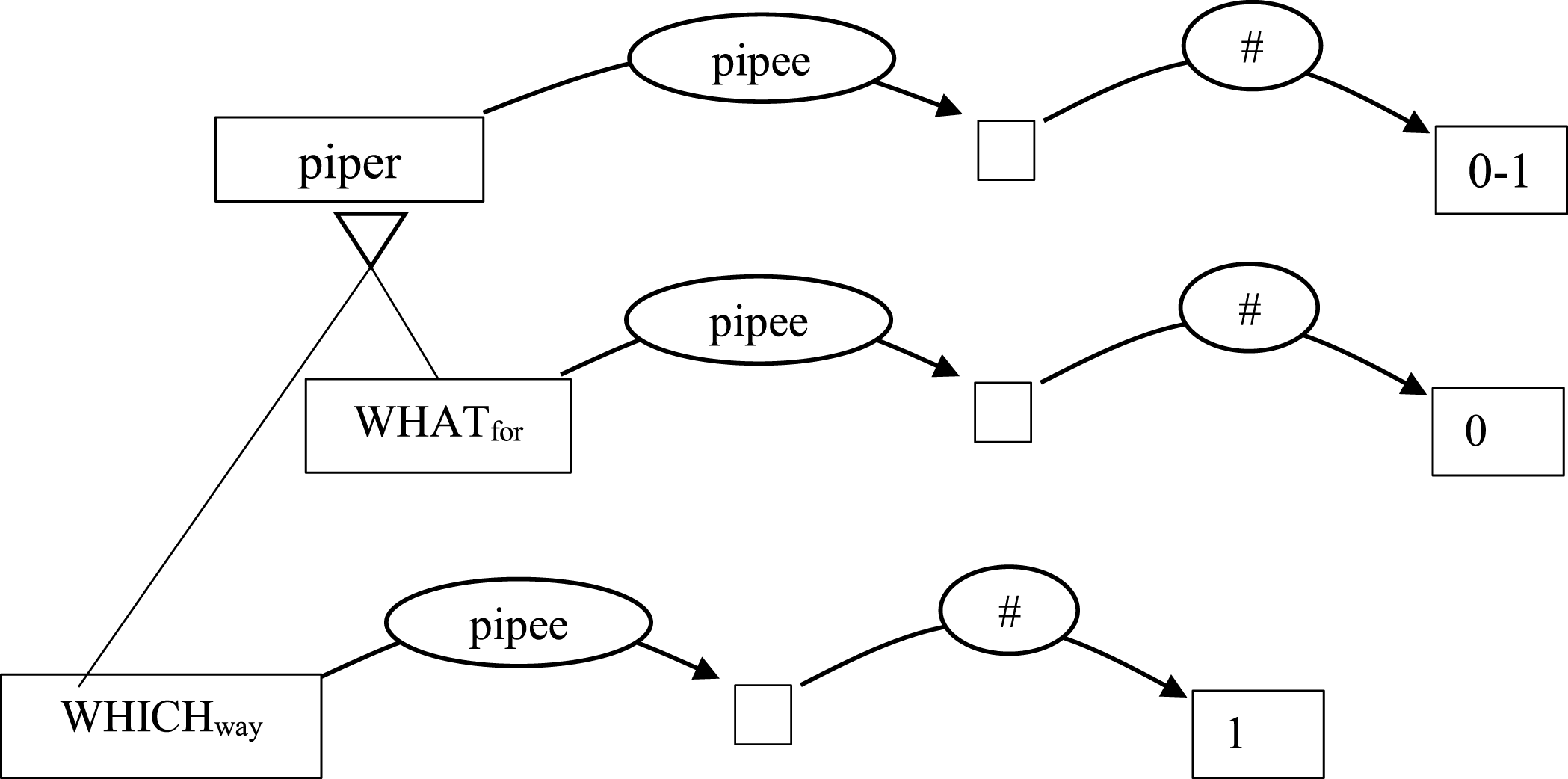
Alongside the general syntactic restrictions on pied-piping in interrogatives, we must also recognise that even this limited pied-piping is lexically restricted, just like the pied-piping found in relative clauses (Huddleston Reference Huddleston2002: 913). An obvious example is the combination what … for, meaning ‘why’ (or more accurately, ‘with what purpose in mind’):

Here pied-piping is absolutely impossible, even in quiz shows:

The same ban on pied-piping applies to a few other idiomatic combinations such as what … like; and as with relative clauses, some preposition
 $+$
wh
 $+$
noun combinations (e.g. in what way) have to be pied-piped:

Once again, these lexical restrictions suggest an analysis which includes a large number of lexically specific constructions alongside some rather weak generalisations.
This completes the discussion of prepositional pied-piping, so it will be helpful to stand back from the detail to review this construction. The most obvious point to make is that this kind of pied-piping has the effect of separating the wh-word from its preferred position at the start of the clause; so instead of starting with, say, what the clause starts with in what. Another effect is to shift material from the end of the clause to the beginning. We shall consider possible functional explanations for the pied-piping in Section 7.1.
3.6 How as degree modifier
We now consider ‘phrase-initial’ pied-piping, in which the wh-word comes first in its phrase, starting with the ‘wh-word’ how:

These examples count as pied-piping because the wh-word determines the position of its phrase without being the head of this phrase. But unlike prepositional pied-piping, the pied-piping is part of a more general pattern which has nothing to do with relative or interrogative clauses. As a degree modifier, how behaves like so, too, as, this and that because, when modifying an adjective the latter must modify a following
 $a$
(which, in turn, needs its usual singular noun):

As these examples show, most of these modifiers have the additional property of projecting their valency upwards; so in (64), for example, it is so that lexically licenses the that clause, but this depends on house, rather than on so. One analysis describes the noun phrase’s root word as the ‘surrogate’ of the degree modifier (Rosta Reference Rosta, Sugayama and Hudson2005), a term that I shall use later. This isn’t just a matter of word order, but of meaning. For example, in as big as X, the parameter of comparison is simply size, whereas as big a girl as X builds ‘girl’ into the parameter, so that any standard of comparison must also be a girl. This is why (67) is sensible but (68) is anomalous.

In short, degree modifiers license a dependency for a noun higher up the dependency chain.
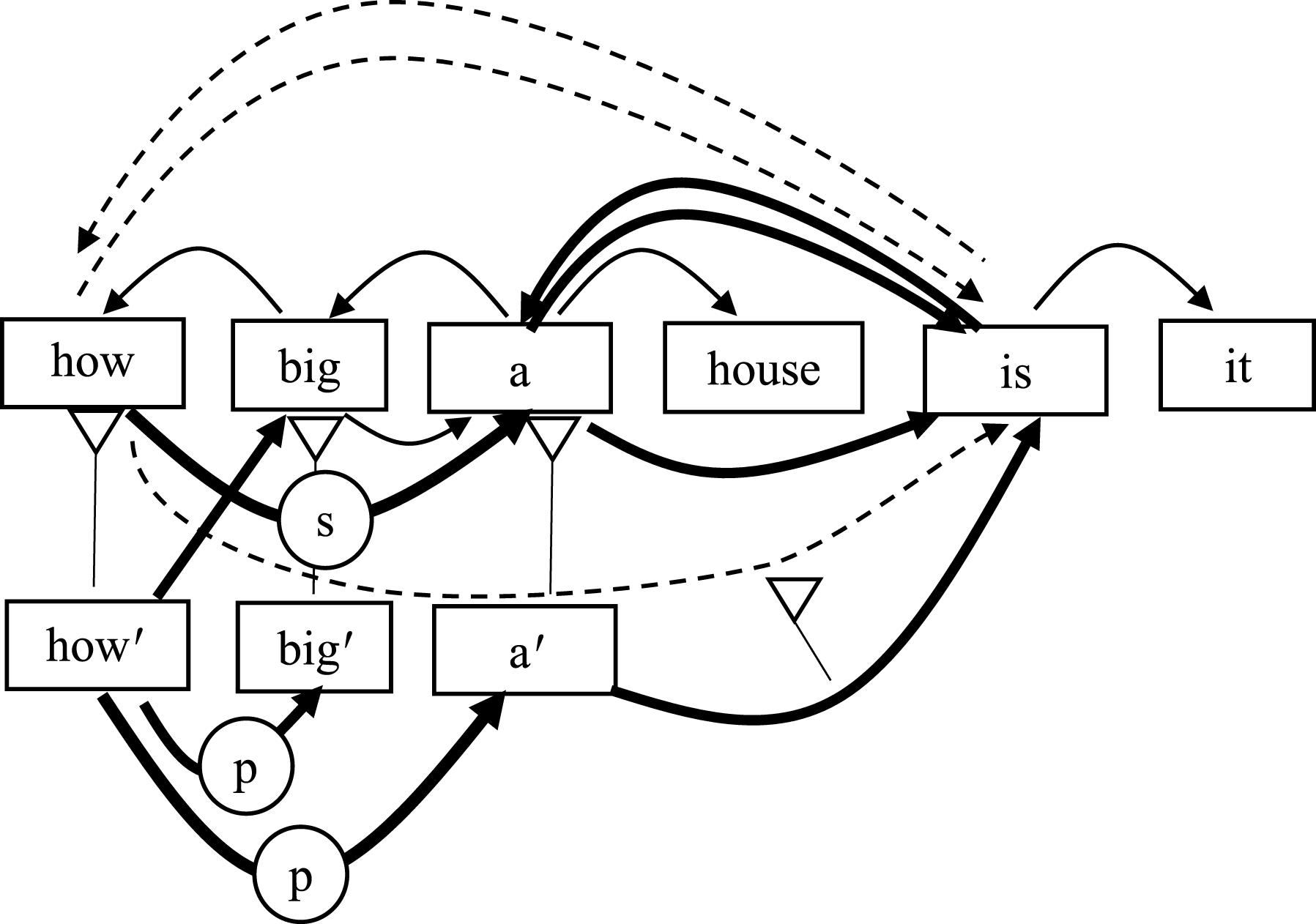
This analysis provides an explanation for the pied-piping found with the degree modifier how: like any other wh-word, how licenses a finite verb as its complement, but this verb depends on the higher noun, so the verb takes the higher noun as its landmark. This analysis explains why how big or how big a house are ‘clause-initial’ in (62) and (63) above, but it does not explain why these phrases can take their position in a higher clause, as in (69) and (70), where how big a house (plus its clause) functions as object or subject of a higher verb:

This external positioning of the subordinate clause is handled in our analysis by the ‘pipee’ relation, so this relation must also be available for how. We shall see below that this will help to explain why how can be combined with prepositional pied-piping, as in In how big a house do they live?
3.7 Wh-determiners
Like how, the wh-determiners what, which and whose occur on the left of their phrase, but unlike how, they qualify as head of this phrase; or at least they do if we accept the DP-like analysis favoured by WG (Hudson Reference Hudson2004). Given this analysis, there is no more need for pied-piping in (71) than in (72).

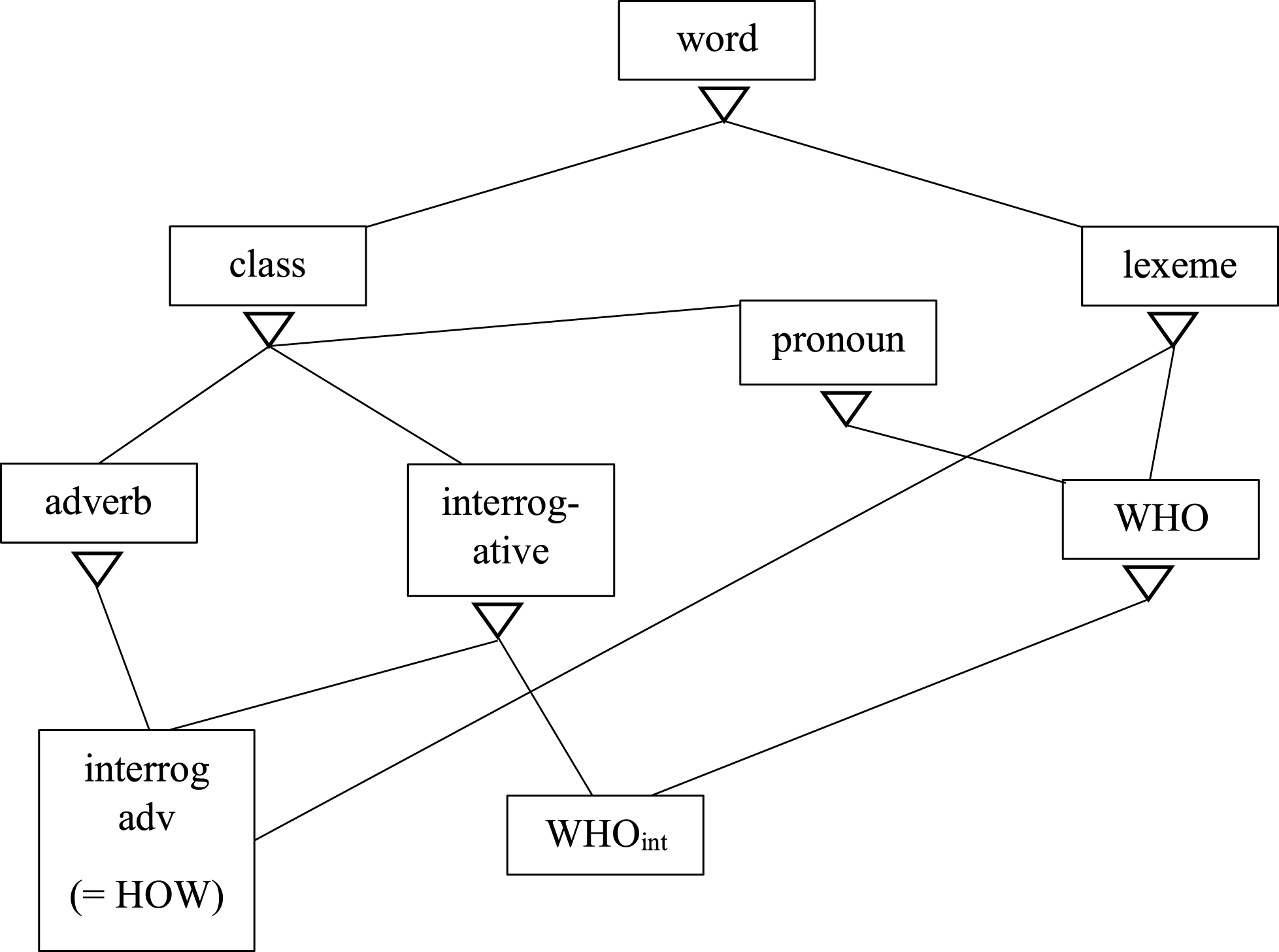
But whose is rather different from the other wh-determiners because a very persuasive analysis (Rosta Reference Rosta1997) takes whose as two syntactic words, who
 $+Z$
, realised by a single word-form in the morphology.Footnote
[7]
In that analysis,
 $Z$
is the determiner and the head, just as it is in at least one analysis of John’s or everyone else’s (Hudson Reference Hudson, Börjars, Denison and Scott2013a), so even a simple example such as (73) involves pied-piping, with who as a dependent and
 $Z$
as the pipee as indicated in (74).

Consequently, we must recognise the who of who Z as a pied piper.
In contrast with prepositional pied-piping, the result of the phrase-initial pied-piping in how big or whose car is that the wh-word stands at the start of the clause, rather than being delayed by the pied-piped material, so we should not expect the same functional explanations to apply to both.
4 Towards a cognitive analysis
What mental apparatus is needed to handle the complexities of English pied-piping? The claim of cognitive theories such as WG is that ordinary cognition provides all that is needed, so the next step is to provide an audit of relevant apparatus which is readily available in ordinary cognition. Four items seem particularly relevant to pied-piping, so this section will introduce them, and later sections will explain how they apply to pied-piping. They are listed below:
-
∙ Networks
-
∙ Node creation
-
∙ Default inheritance
-
∙ Landmarks
4.1 Networks
The idea that knowledge forms a network is uncontroversial. It is supported not only by everyday experience of associations but also by solid evidence from priming experiments which show that activation (manifested in mental accessibility) spills over to ‘neighbouring’ concepts in a way that can only be explained if the concepts concerned are directly linked in a network. Consequently cognitive theories of language often present language as a network of objects such as constructions or attribute-value matrices.
However, the ‘network notion’ takes this idea even further, by explaining all the properties of one concept as nothing but its links to other concepts (Reisberg Reference Reisberg2007). In this view, concepts are atoms without any internal structure or content, rather than complex ‘boxes’ of information (such as constructions or lexical entries); so the atom labelled ‘dog’ is defined by its relation to other atoms such as ‘bark’, ‘mammal’, ‘pet’, ‘kennel’, ‘size’ and so on, and is also part of the definition of each of these other atoms. Almost everything can be learned, and there is no danger of an infinite regress in definitions that themselves need to be defined.
The networks in question here are not neural networks, the physical networks of interconnected neurons of the brain, but symbolic networks, which exist at a higher level of abstraction. In a symbolic network, each node corresponds to a single concept which may be represented, at the neural level, by a complex pattern of activation links among a number of nodes. In other words, the representations exist in our minds, as mental networks; but of course they rest, ultimately, on the physical networks of our brains.
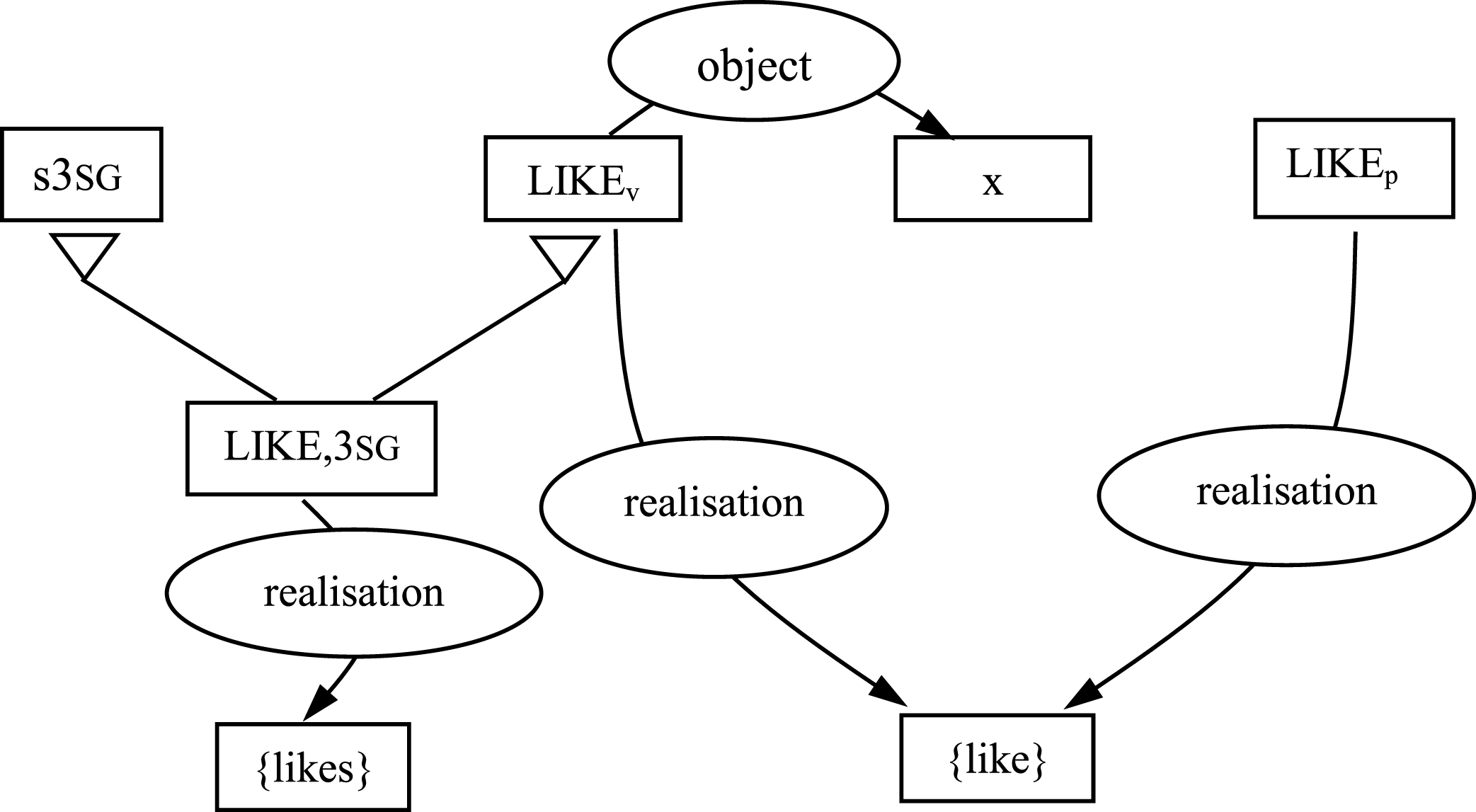
WG (following Stratificational and Neurocognitive Linguistics – Lamb Reference Lamb1966, Reference Lamb1998) accepts the network notion, so each unit (such as a word) is shown simply as a node whose content is provided by its relations to other units in the network. Figure 1 illustrates this idea with a simplified view of the language network around likes, the third-person singular of the verb LIKE
 $_{\text{v}}$
which also shows the homonymy of this verb with the preposition LIKE
 $_{\text{p}}$
. This diagram also introduces two notational conventions of WG: the small triangle meaning ‘isa’ (so LIKE,3sg isa, or is an example of, both LIKE
 $_{\text{v}}$
and 3sg); and the boxes containing the name of a concept, which may be either a relation (such as ‘object’, in a rounded box) or an entity (e.g. ‘the verb LIKE’, in a rectangular box). In words,
 $\{\text{like}\}$
is the realisation of both LIKE
 $_{\text{v}}$
and LIKE
 $_{\text{p}}$
,
 $\{\text{likes}\}$
is the realisation of LIKE,3sg, and x is the object of LIKE
 $_{\text{v}}$
.
A network for likes.

The main theoretical claim behind this network notation is that, because language is a kind of knowledge and knowledge forms a network, language too is just a network, and nothing else. There are no rules, no processes, no principles, so it’s a single integrated network all the way down. In short, WG is a constraint-based theory of language structure like HPSG, LFG and others, but with linguistic items as concepts related, within a single integrated network, both to each other and to concepts outside language. Unlike the structuralist view that language is just a network of linguistic items (words, morphemes and so on) the WG network is thoroughly embodied through its links to percepts (sounds and letters), motor-programmes (for articulating and writing), encyclopaedic concepts and even feelings (for connotations). ‘Language’ is our name for the part of that network that includes words, but the formal and cognitive properties of the language network are just the same as for any other part of the network. And of course one aim of this article is to demonstrate that such impoverished formal apparatus can accommodate even the complexities of pied-piping.
Moreover, if language is indeed a network, many of the standard assumptions of twentieth-century syntax need to be revised. For example, graph theory (the mathematical theory of networks) would have been a better basis for Chomsky’s theory than formal language theory with its focus on the generation of strings (McCawley Reference McCawley1988: 40). In graph theory, as in ordinary human cognition, any node may connect to any other node, so a single word could connect directly to another single word, without the need for an intervening ‘mother’ node. This assumption would have led inevitably not to phrase structure grammar but to dependency grammar, where one word may depend directly on another (so that the word children may depend directly on the word play even if they are both modified by some other word, as in Small children play noisily). Indeed, if language licenses sentences, then sentences themselves must be networks, with a potentially much richer structure than a phrase-structure tree. Pied-piping is a good area of syntax for exploring the richness of these structures.
One particularly crucial formal property of a network which cannot be captured in a tree is mutuality, where two nodes have the same relation to each other. This is common in the everyday cognition of kinship and other social relations; for example, if A is B’s sibling then B must also be A’s sibling. Consequently we may expect to find it in language structure as well, and indeed there are clear cases. Take the very simple example (75).

The dependency structure is unexpectedly complicated because each word depends on the other. One thing is clear: what is the subject of happened, so what depends on happened. However the converse is almost equally clear: happened must be the complement of what, which licenses a following verb – in short, this is a clear case of mutual dependency. This conclusion will be developed further in the more formal discussion of Section 5.1.
4.2 Node creation
One of the commonplaces of cognitive psychology is that our mental networks are dynamic, changing all the time as we apply our minds to new experiences. Some of these changes involve the activation levels in our underlying neural networks, but others involve the creation of new nodes for items of experience. In linguistics these are called ‘tokens’, in contrast with the permanently stored ‘types’ of the existing network; so when we hear a word, we must create a token node to carry its properties. For example, on hearing The cat sat on the mat, we must create two separate token nodes for the two thes, both linked to the same type node THE, giving six token nodes corresponding to just five type nodes.
These token nodes are new and unique representations of the experience concerned, whether this is something we perceive (e.g. an incoming word) or something we plan (e.g. a word we are about to utter) – or indeed, an idea that arises spontaneously in our minds. Most of these new nodes have only a fleeting existence, and vanish within seconds, but some stick in our memories (where psychologists call them ‘exemplars’ – Reisberg Reference Reisberg2007: 297). These remembered tokens allow us not only to remember experiences, but also to learn from them, so we can assume that our mental network has a constantly changing fringe of token nodes which occasionally trigger minor changes deeper in the network.
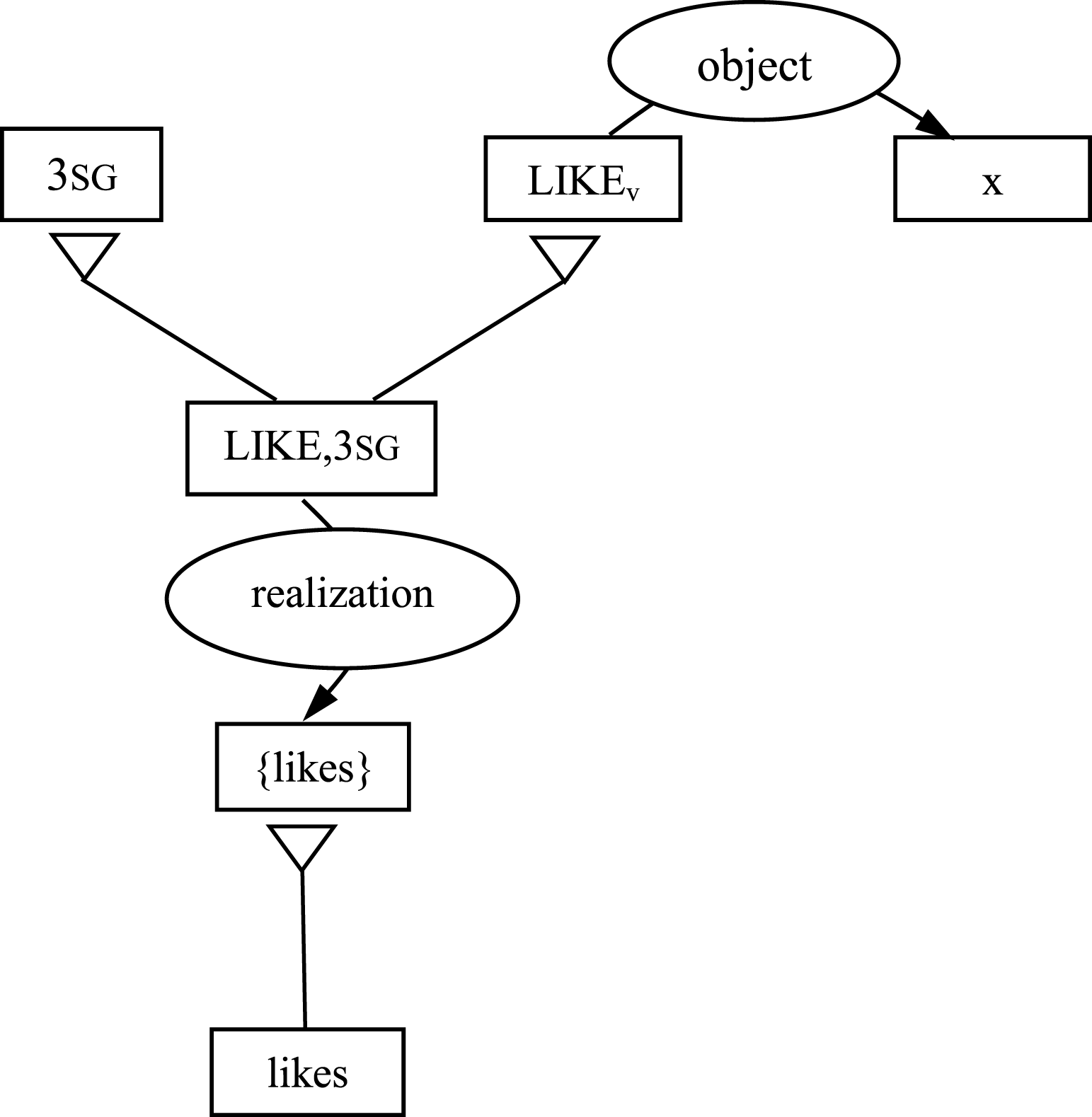
Creating token nodes for experience allows us to understand the experience, starting with a classification of the token. This applies to words in just the same way as to other objects of experience, and in both cases the logical link between the token and the type is the ‘isa’ relation mentioned earlier. This is illustrated in Figure 2, which shows a token of likes (identified as a token by its italic font) related by ‘isa’ to the relevant part of Figure 1. As we shall see below, this classification of the new token node gives it access to all the information in the network about the stored
 $\{\text{likes}\}$
, including its link to LIKE,3sg and ultimately to a syntactic structure and a meaning, so this diagram indicates a full understanding of the token (apart from the extra properties that are due to the context of utterance).
A token of likes isa
 $\{\text{likes}\}$
.

As we shall see below, we may even create a hierarchy of ‘sub-tokens’ to distinguish the effects of successive stages in the processing.
4.3 Default inheritance
Like many other cognitive theories, both in linguistics (Briscoe, Copestake & De Paiva Reference Briscoe, Copestake and De Paiva1993) and in Artificial Intelligence (Luger & Stubblefield Reference Luger and Stubblefield1993: 386–389), WG assumes that the underlying logic of thought is default inheritance – a process whereby stored patterns are inherited by tokens of experience, and which allows defaults to be overridden by exceptions. For instance, if we hear an example of the form
 $\{\text{likes}\}$
, we inherit the fact that it is the realisation of LIKE,3sg, which in turn isa 3sg and LIKE
 $_{\text{v}}$
, so it has an object, it means ‘like’, and so on; but if the example had been
 $\{\text{took}\}$
, we could accommodate it as an exceptional past tense of TAKE. WG avoids the familiar problems of non-monotonicity in default inheritance by simply assuming that inheritance is part of the process for building token nodes and that it works strictly bottom-up, so the first value inherited is always the most specific and can never be overridden by an even more specific value (Hudson Reference Hudson, Hippisley and Gisbornein press).
As mentioned earlier, a sentence’s structure must be a network if it is inherited from a network; and if it is a network, nothing prevents one word from relating directly to another word, as in dependency structure; so children can relate directly to both small and play in Small children play noisily. On the other hand, it could be objected that even if the word children can in principle relate directly to other words, we still need an extra node to carry the meaning ‘small children’. This is obviously not the meaning of children on its own, without modification, so maybe we do need the mother node (for the combination small children) after all? What this objection misses, however, is that we already have a node which is distinct from unmodified children: the node for the token children which (in this sentence) is combined with small, and means ‘small children’. In short, the token node children is the dependency equivalent of a phrasal node for small children.
Token nodes enriched by their context are very familiar outside language. For example, suppose I see an object which I classify as a sock; to do this, I create a node which we might call sock (again using italics for tokens), with an isa link to the ‘sock’ node in my long-term memory. But suppose I also see that this sock is in my wife’s hand. This bit of context (like the modifying word small) influences the properties for my sock node, adding the property ‘belonging to my wife’, which goes beyond the properties that sock inherits directly from ‘sock’.
The logic is exactly the same as in the linguistic example of small children, so there is nothing specially linguistic about interpreting words in the light of their context (linguistic or other). Whether we call this process ‘parsing’ or ‘merge’, the principle is the same: we create a new token node for the focus item (sock, or the word children) as influenced by the context, rather than for both the focus item and the context. In the sock example, the property of ‘belonging to my wife’ applies to sock, and not to the set
 $\{$
my wife, the sock
 $\}$
; and similarly for the linguistic example, where meaning ‘small children’ is a property of children rather than of the set
 $\{$
small, children
 $\}$
.
But another objection is that we have just thrown out the baby with the bathwater: we now no longer have a token node for children without modification. The fact is that in any theory of processing, there must be a step at which the token children has been identified as an instance of an underlying type, but hasn’t yet been modified. Moreover, as pointed out many years ago (Dahl Reference Dahl1980), in examples like typical French houses there must be a point in the processing where houses has been modified by French but not by typical, because typical applies to the meaning ‘French houses’ (meaning ‘typical of French houses’, and not just ‘typical of houses’).
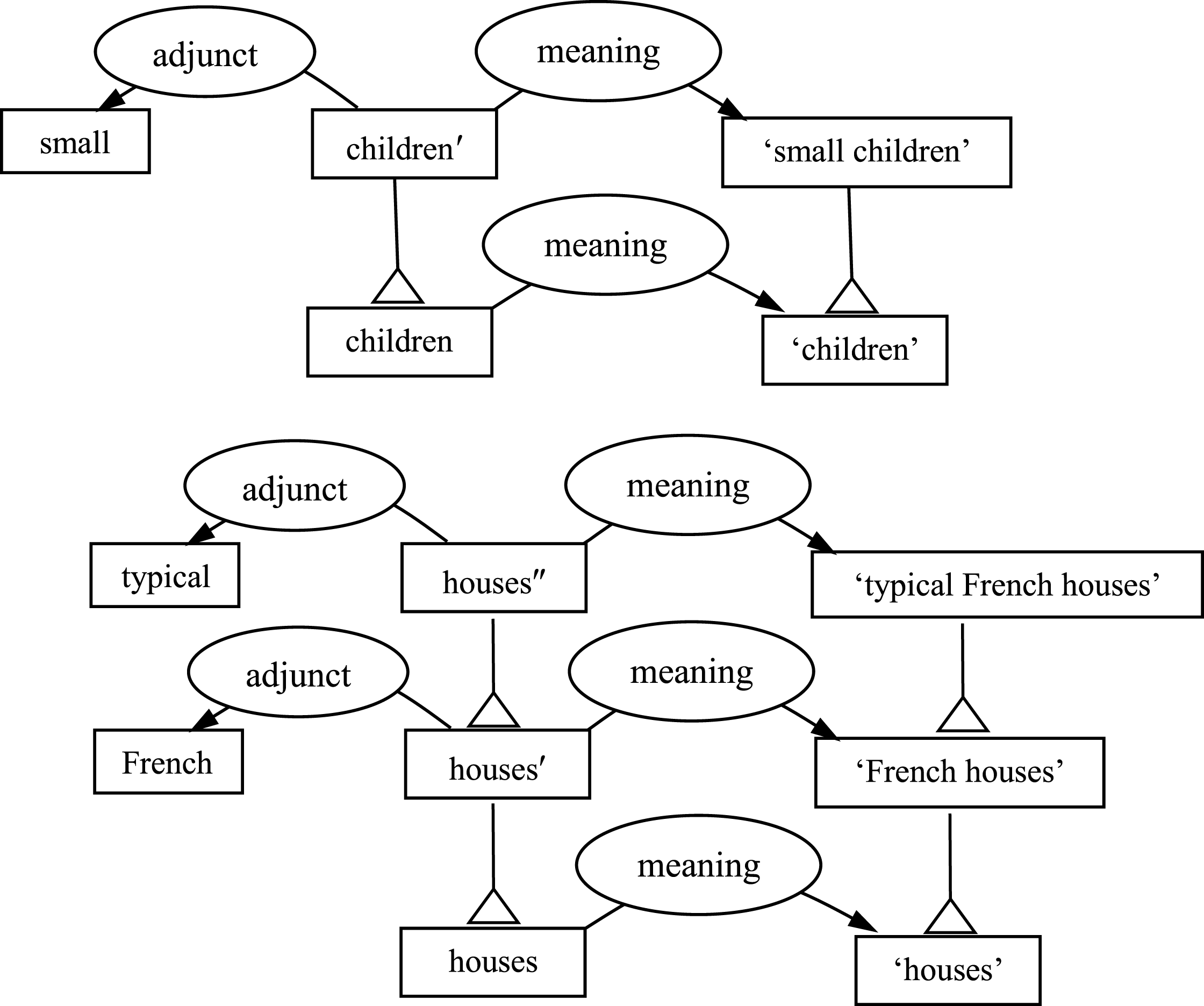
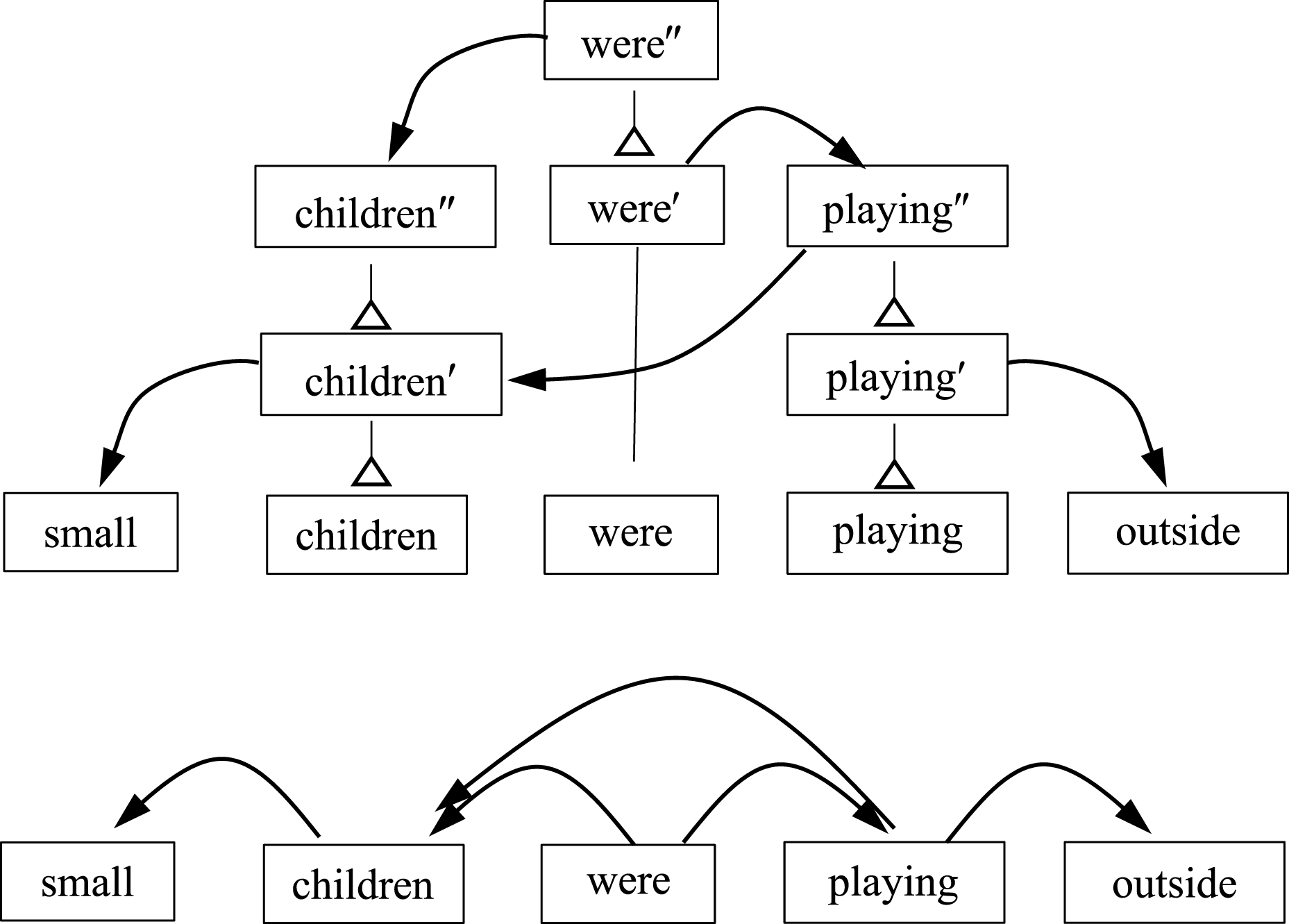
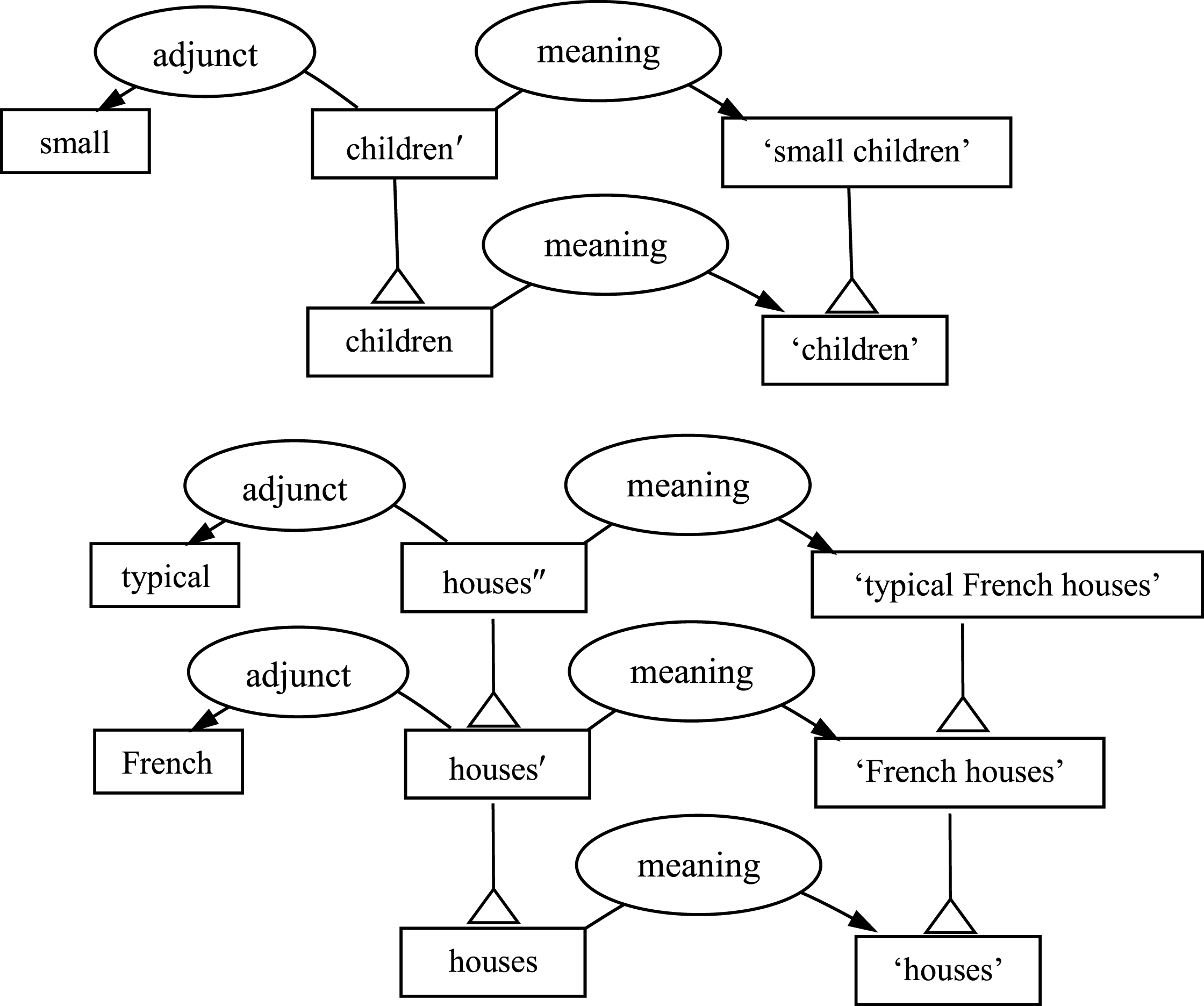
In short, what we seem to need is a hierarchy of token nodes, very much as in phrase structure, but based on the ‘isa’ relation rather than on part-whole relations. In small children we can therefore distinguish two tokens: children (without modification) and children
′
(as modified by small), where children
 $^{\prime }$
isa children; and in typical French houses we can distinguish unmodified houses from houses
 $^{\prime }$
(meaning ‘French houses’) and from houses
 $^{\prime \prime }$
(meaning ‘typical French houses’). These analyses are shown in Figure 3. In such a hierarchy, we can distinguish the unmodified token from its ‘sub-tokens’, so the token children has a sub-token, children
 $^{\prime }$
, meaning ‘small children’.
Small children and typical French houses without phrasal nodes.
Returning to our example Small children were playing outside, we now have an analysis of the phrase small children in which the sub-token children
 $^{\prime }$
stands for the phrase; so the subject of were is actually children
 $^{\prime }$
, not small children. The sub-token children
 $^{\prime }$
isa children and inherits its properties, but thanks to default inheritance, its own properties would block any conflicting properties that it might inherit. Even the adjective small leads to conflict in the semantics, because it means ‘smaller than default’, so small children are non-default in terms of size. But of course the addition of an adjunct creates no conflict in the syntax.
Nevertheless, this example does contain a syntactic conflict if we assume, as most of us do, that children
 $^{\prime }$
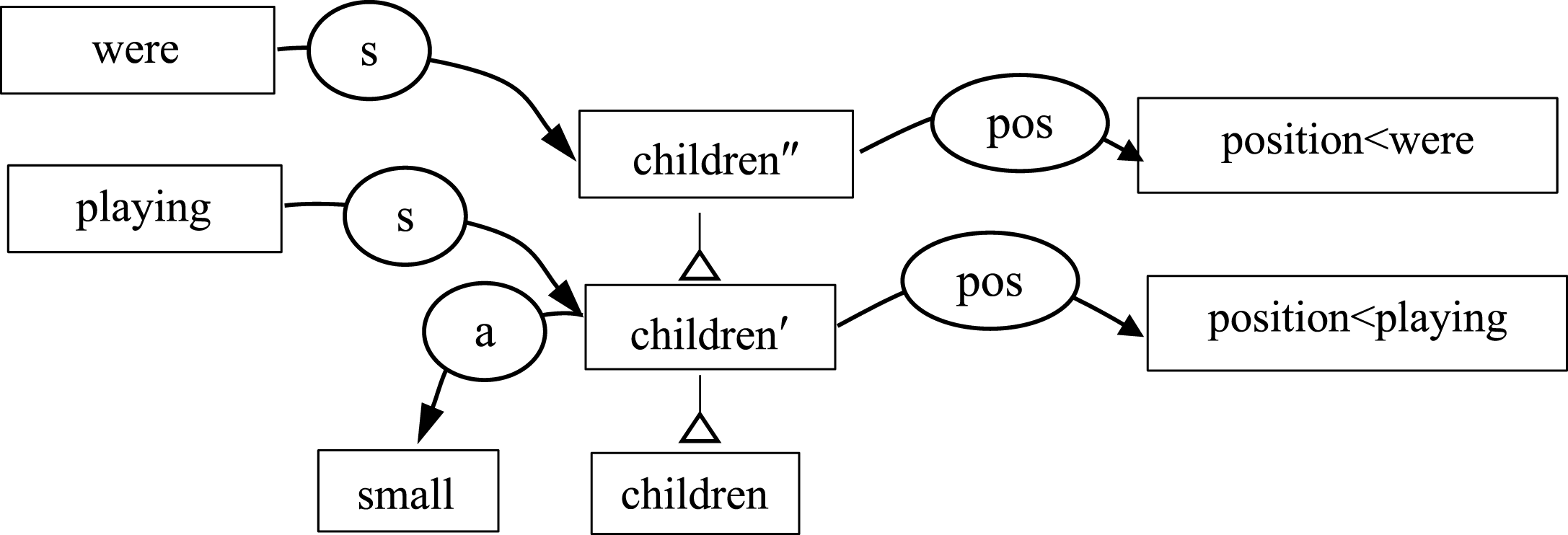
is the subject not only of were but also of playing. In transformational terminology its subject is ‘raised’ from the lower clause, but WG has no place at all for movement (or any other transformations) as such. On the other hand, the theory does make a clear distinction between defaults and exceptions, where the default usually corresponds to the ‘underlying’ or ‘earlier’ structure in a transformational analysis. In this case, therefore, we may say that children
 $^{\prime }$
inherits two conflicting positions, which for the time being we can call simply ‘position
 ${<}$
were’ (meaning ‘a position defined in relation to were) and ‘position
 ${<}$
playing’. The next section will develop a better mechanism for defining positions, but we already have the means for resolving the conflict: if children
 $^{\prime }$
inherits the default ‘position
 ${<}$
playing’, then we can introduce an even more specific sub-token called children
 $^{\prime \prime }$
(where children
 $^{\prime \prime }$
isa children
 $^{\prime }$
) to inherit the overriding ‘position
 ${<}$
were’. Figure 4 shows how the position of children
 $^{\prime \prime }$
(based on were) overrides that of children
 $^{\prime }$
(based on playing).
Subject raising in Small children were playing outside.

As can be seen, the effect is exactly the same as with a movement transformation, but the result is due to logical rather than temporal precedence. In the grammar, the various configurations of sub-tokens are defined simply as sub-networks; so far we have encountered two different grammatical patterns in which a new sub-token is created. First, we have the very general definition of a dependent in which a dependency creates a sub-token of its parent (e.g. the dependency of small creates children
 $^{\prime }$
and that of children
 $^{\prime }$
creates were
 $^{\prime \prime }$
, as we shall see in the next diagram). And second, the general definition of the subject-raising pattern (associated with the subject–complement dependency type) creates a sub-token of the raised subject (e.g. the relation between were and playing creates children
 $^{\prime \prime }$
). We shall see below how word order is represented in WG, but meanwhile the top diagram in Figure 5 shows the full dependencies and isa links for this sentence, while the lower diagram presents a simplified version of the same analysis in which the sub-tokens are collapsed.
The syntax of modification and raising in Small children were playing outside.

In prose, Figure 5 says that small modifies children, turning it into a distinct token concept children
 $^{\prime }$
with the meaning ‘small children’ and acting as the subject of playing
 $^{\prime \prime }$
. Similarly, outside turns playing into playing
 $^{\prime }$
, which children
 $^{\prime }$
turns into playing
 $^{\prime \prime }$
so that it means ‘children playing outside’. As for were, it combines with playing
 $^{\prime \prime }$
to produce were
 $^{\prime }$
, which in turn is modified into were
 $^{\prime \prime }$
by children
 $^{\prime \prime }$
to carry the meaning of the entire sentence, ‘Small children were playing outside’.
Since the notation is so unfamiliar to most readers, it is important to stress the similarities between this analysis and those provided in other theories. The idea that each dependent licenses an additional node showing its effect on the head word is very familiar from the Merge operation of Minimalism, the composition operation of Categorial Grammar and the ID schemata of HPSG, and no doubt many other theories include the same insight. And the idea that one word or phrase may be simultaneously part of two larger phrases is familiar from the re-entrance pattern in HPSG. Indeed, even the idea that a syntactic structure is a network is familiar from the HPSG claim that every structure is equivalent to a DAG (directed acyclic graph).
On the other hand, the differences are also important. For instance, although a DAG is a kind of network, we have already seen that WG networks are not DAGs because they do allow cycles. As for the difference between the phrasal nodes of other theories and the sub-tokens of WG, this is the logical contrast between partonomies and taxonomies, which have very different logical properties. For example, outside language we can contrast the partonomy formed by a hand and its fingers, and the taxonomy of ‘finger’ and ‘forefinger’. A finger is not a hand, but a forefinger is a finger, so a forefinger inherits the default properties of fingers, but not those of hands. Similarly inside language: a sub-token inherits all the properties of the more general token, which in turn inherits from the relevant stored type and all the more general categories to which this is linked by ‘isa’; but at every point exceptions may be expected. This allows just the right amount of flexibility in grammars for well-known oddities such as German Partial VP fronting, which allows lowering rather than raising (Hudson Reference Hudson2007: 143–144), and pied-piping.
4.4 Landmarks
Like networks, token nodes and default inheritance, landmarks are an obvious part of ordinary cognition. They play an important part in the semantics of Cognitive Grammar (Langacker Reference Langacker2007), where a number of relations including location are described in terms of a landmark and a trajector (the thing located); for instance, the book on the table locates the book (the trajector) in relation to the table (the landmark). In WG, however, this framework for defining location is applied not only in semantics, but also in syntax, where it is the main mechanism for handling word order; for instance, in the sentence Christmas is before Easter, the semantic structure identifies Easter as the landmark for Christmas, but the syntax identifies the word is as the landmark for the word Christmas (via the inheritable property that a verb’s subject precedes it). If we do think in terms of landmarks in semantics and general cognition, it would be odd if we did not apply the same framework to the order of words in a sentence and the onus is on those who believe language is special to produce evidence against this assumption.
Landmarks are an important part of any network model for the simple reason that a network has no inherent left-right dimension. Linguistics has always relied heavily on our writing system which uses this dimension for linear order, but the fact is that linear order is a relation, just like the other relations of syntax. A diagram such as Figure 5 implies this relation, but does not show it explicitly; but we know from psychology that experimental subjects can remember the identity of random words without remembering their order (Golomb et al. Reference Golomb, Peelle, Addis, Kahana and Wingfield2008), so we can be sure that a word’s linear position is a separate, and forgettable, property which can be represented in a network alongside all its other properties such as its class membership, its realisation, its dependents, its meaning, and so on.
Linear order in a network seems to require two different kinds of relation. At the most basic level, we need a ‘next’ relation between adjacent words in a string: in the string Monday, Tuesday, Wednesday, the word Tuesday is the ‘next’ of Monday, and in Small children were playing outside, each word is the ‘next’ of the word before it. This relation is certainly needed in morphology and phonology in order to explain, for example, that the word AN is realised as
 $\{\text{a}\}$
or
 $\{\text{an}\}$
according to whether its ‘next’ begins with a consonant or a vowel, as in a big apple and an apple.
But alongside this low-level relation we also need the more abstract ‘landmark’ relation in order to allow general ordering constraints, because these rarely apply just to adjacent items. Instead, we need generalisations such as ‘A verb’s subject stands before it’ or even the very general default for a head-initial language ‘A word’s dependent follows it’. In each of these generalisations, one word is treated as the landmark, the fixed point, and the other as the trajector, the item that takes its position (alongside other similar trajectors) from the landmark; so, like a syntactic dependency, the relation is asymmetrical. Indeed, many dependencies are defined in part by a landmark relation in which the parent word is the landmark and the dependent is the trajector; for instance, the ‘subject’ dependency in English is defined in part by its position relative to its landmark, the verb, in contrast with the ‘object’ dependency.
The decision to treat word order in terms of ‘next’ and ‘landmark’ has important theoretical consequences. For one thing, it means that the syntactic structure of a sentence can be a true network which does not rely on the left-right dimension – though, of course, for purely practical reasons of presentation network diagrams are easier to read if the word tokens are presented in order from left to right. More importantly, if a word’s position in linear order is a property of that word, then the position can be inherited by the usual mechanism of default inheritance. By default, a word’s parent is also its landmark, so landmark relations can be inherited from dependency relations; but like any other default, this can be overridden – exactly what we need in order to explain pied-piping.
This analysis fits well with another claim of WG: that every word token has deictic properties which may be relevant to its meaning (Hudson Reference Hudson1990: 65). For instance, the pronoun ME refers to the speaker, so ‘speaker’ is one of the properties of a word (and is available for carrying sociolinguistic restrictions on typical speakers). Similarly, a verb’s tense relates the time of the event to that of the word token itself; for instance, a token of past-tense walked refers to an example of walking whose time is earlier than the utterance-time of the token itself. (We assume, of course, that by default a word is spoken rather than written.) Moreover, we know from everyday experience that one of the things we may remember about a word token is when it was uttered, so we may assume that every word’s properties include its time – the time of utterance. So in an utterance of Mary walked, the time of the token of walked follows both the time of the walking, and also the time of the token of Mary.
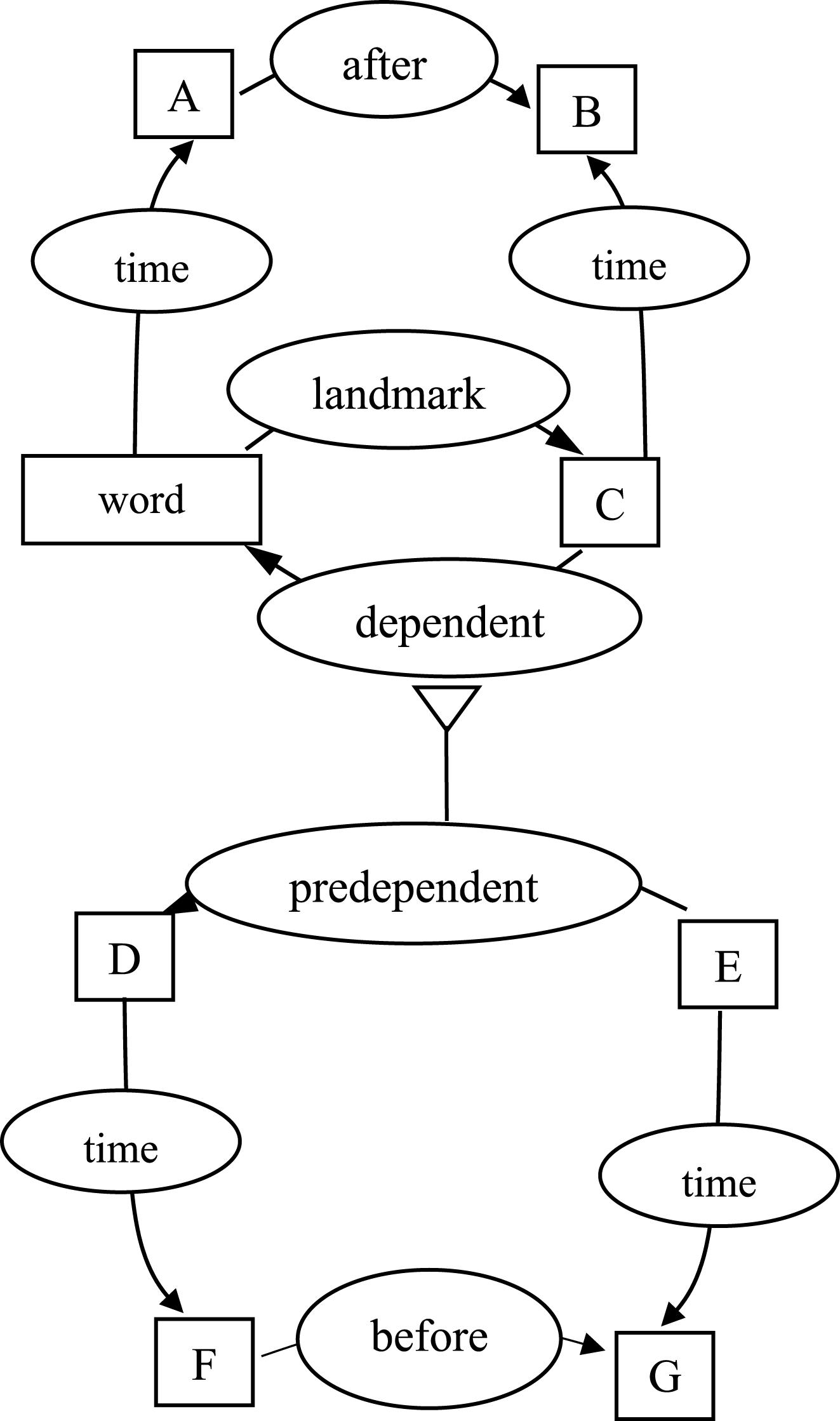
We now have the basis for a theory of word order. A typical word has both a time and a landmark which is another word, with its own time. The time of the dependent word is defined in relation to that of the landmark; so in Mary walked, the token Mary not only precedes walked, but is required to do so by the grammar of English. But the relevant part of the grammar doesn’t just define walked as the landmark of Mary; it also has to say that Mary stands before its landmark, so we need a mechanism for fixing this position as either ‘before’ or ’after’.Footnote [8]
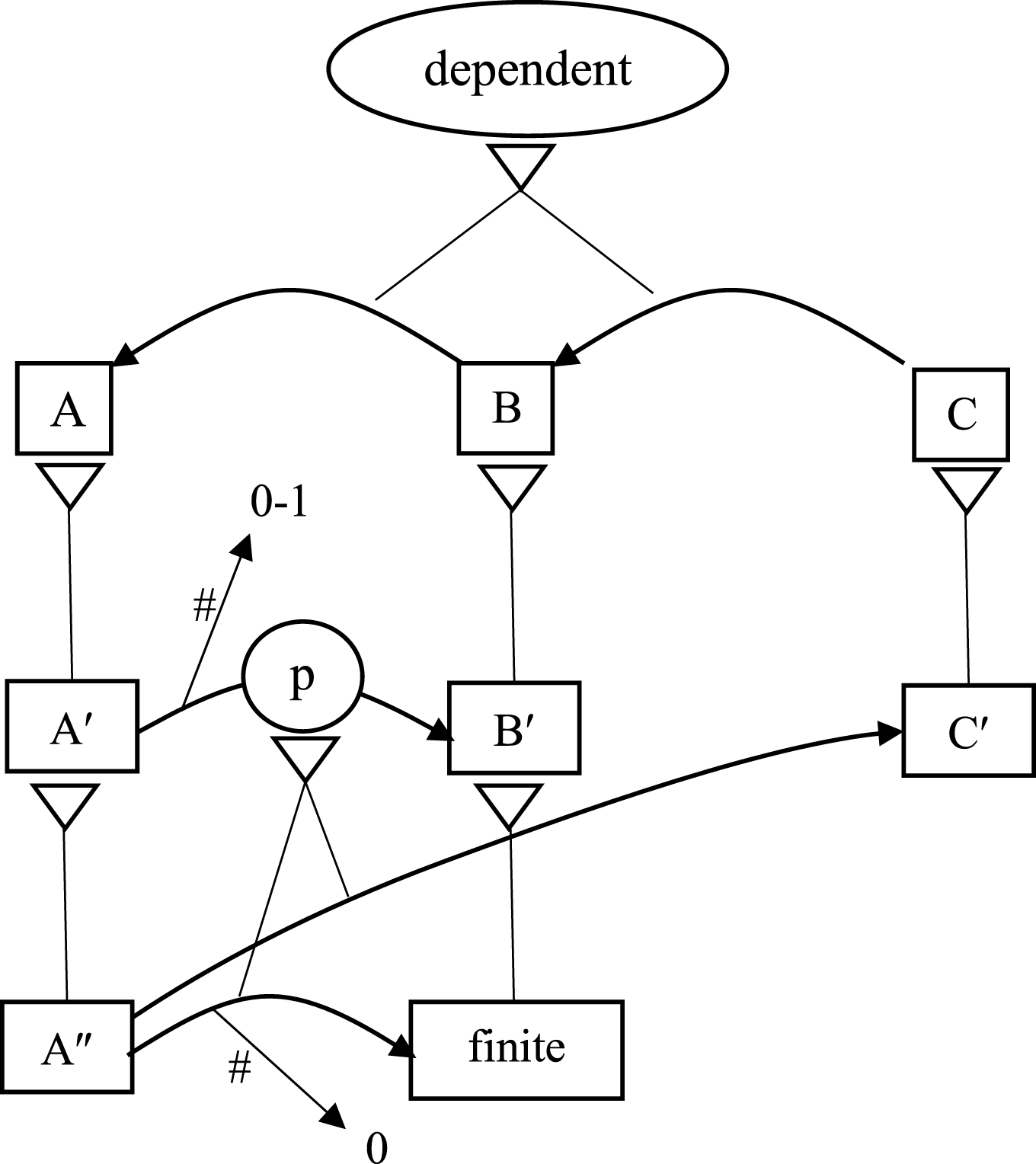
Figure 6 illustrates this mechanism, and at the same time it introduces the hierarchical classification of dependencies as either predependencies or postdependencies, according to whether the dependent typically precedes or follows its parent word (Hudson Reference Hudson1990: 121). (This distinction plays an important role in ‘head-medial’ languages like English, where dependency-type strongly influences order and both orders are about equally common, but it is irrelevant in more consistently head-initial or head-final languages.) The top of the diagram shows the default order, in which a word’s time (labelled A) is after its landmark’s time (B).Footnote [9] But exceptionally, a predependency (such as ‘subject’ or ‘extractee’, explained below) has a time D which is before its landmark’s.
A word-order generalisation and an exception.

This mechanism provides just the amount of flexibility needed for word order by allowing two different kinds of exceptionality: exceptional ordering and exceptional landmarks. The former are needed for cases such as subject–verb inversion, where (exceptionally) a verb’s subject may follow it; and the latter are needed for cases such as pied-piping, the subject of this paper.
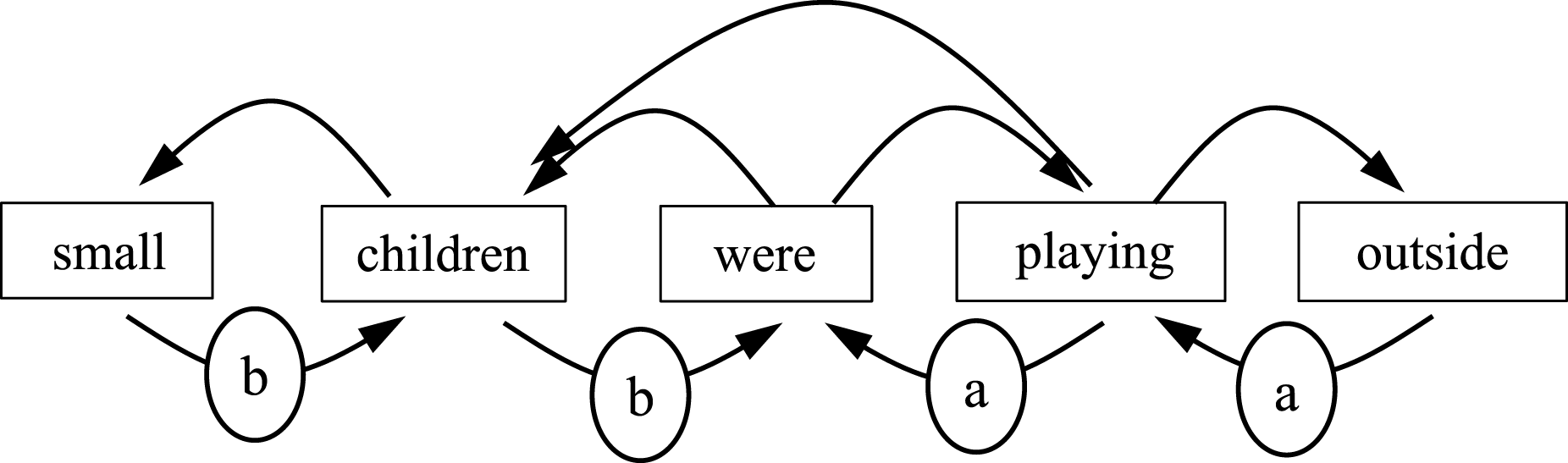
It can be seen that in the proposed analysis, landmark relations and dependency relations are two separate, but related, syntactic structures. This being so, it will be helpful to have a notation for syntax which allows us to combine the two structures. There is no established convention for this in WG so we now introduce the convention of writing all dependencies above the words and all landmark relations below them. The convention is illustrated in Figure 7, where the dependencies are simplified both by collapsing sub-tokens and by omitting relation labels, and the landmark relations are simplified by adding the labels ‘a’ and ‘b’ (for ‘after’ and ‘before’) to the landmark links and omitting the separate ‘time’ nodes.
Landmarks combined with dependencies in Small children were playing outside.

Notice that in general, each arrow above the words in Figure 7 is paired with an arrow below the words that points in the opposite direction; this is because the former point towards the dependent, but landmark arrows point towards the dependent’s parent. But, exceptionally, the dependency arrow pointing from playing to children has no paired landmark relation because, by default inheritance, the landmark link from children
 $^{\prime \prime }$
to were
 $^{\prime \prime }$
overrides it. This is the mechanism alluded to earlier which allows default inheritance to distinguish actual (or ‘surface’) word order from default (or ‘deep’) orders, and which will allow a satisfactory analysis for pied-piping.
The distinction between landmarks and dependencies is important because it is the landmarks, not the dependencies, that define the phrases that are continuous (or, in dependency terminology, ‘projective’). In Figure 7, although small children … playing outside is discontinuous, it is a phrase in terms of dependencies because both children and outside depend on playing; but it is not a landmark-based phrase because it is interrupted by were.
In formal terms, landmark arrows never intersect each other, in contrast with dependencies, which often do (as we shall see in later diagrams). This ban on intersecting landmarks has an easy non-linguistic explanation: the same is true of landmarks in general cognition. According to cognitive semantics (Talmy Reference Talmy2000: 315–316) an object’s landmark is another object which provides a ‘ground’ (a more easily identifiable reference point); for instance, if a bicycle is near a house it would be much more normal to treat the house as the bicycle’s landmark (The bike is near the house) than the other way round (The house is near the bike). The process of assigning landmarks is recursive, so if the house needs to be located it too can have a landmark (say, a church), forming a chain of landmarks: the church is the landmark of the house which is the landmark of the bike. Landmarks are chosen on the basis of many different properties, including size and permanence, but distance is also relevant, because the landmark needs to be the closest suitable object; so if the church stands between the house and the bike, it will normally be preferred to the house as the bike’s landmark. Of course, we have some flexibility where distance conflicts with other properties; for example, if the bike in some sense ‘belongs’ to the house we can describe it as the house’s bike, even if we then say that it is on the other side of the church; but the fact remains that we would normally expect the bike to stand by the house.
The Best Landmark Principle (Hudson Reference Hudson2010: 53) builds on this observation. According to this principle, the best landmark for an object is the nearest object that is more prominent. Given a row of objects A B C, if the best landmark for A is B, then A cannot normally be the best landmark for C; after all, B is both more prominent than A, and closer to C. And given a longer row of objects A B C D, landmark links would not normally intersect because that would mean that some object was preferring a more distant landmark to a nearer one.
This section has introduced the major parts of WG which are needed in explaining pied-piping: networks, node creation, default inheritance and landmarks, so we are ready to build a network analysis for the details of pied-piping in English, starting with prepositional pied-piping.
5 English prepositional pied-piping
We are now ready to explain the pied-piping found in examples like (1), This is the book in which I found it. The previous sections show, if nothing else, that both pied-piping and our mental resources are complicated; the network-based theory of WG is very similar in this respect to Construction Grammar, so I agree with the following assessment of the importance of formal clarity:
This is especially important for Construction Grammar theories, which postulate that a speaker’s mental grammar consists of an incredibly large number of constructions that interact with each other in a complex inheritance network … Only a precise, formalised model of such a network can ensure that it does not contain constructions whose combination is required to give a grammatical sentence but whose constraints conflict. (Hoffmann Reference Hoffmann2011: 235)
Like some versions of Construction Grammar (Hoffmann Reference Hoffmann2011: 227–275), this formalisation is inspired by work in artificial intelligence and cognitive psychology, but uniquely it also has roots in European dependency grammar.
5.1 Mutual dependency and landmarks
As mentioned earlier, one of the benefits of a dependency analysis is to be able to accommodate the mutual dependency associated with wh-words. From a cognitivist perspective it would be surprising if mutual dependency was not found in language because it is commonplace in our non-linguistic mental world: for instance, two people can be, and can know that they are, brothers, enemies or colleagues; and they can recognise that they are mutually ‘dependent’ in various ways. As far as language is concerned, mutual dependency exists in various places, but most obviously perhaps in wh-words, which have the unusual property of functioning in two structures at the same time: as part of the clause that they introduce, but also as part of a ‘higher’ structure, even if this structure is purely semantic. For instance, an interrogative pronoun introduces the higher structure of a question, but has its identity defined by a lower clause. This double functioning leads to the mutual dependency in the syntax of a question such as What happened in which what depends (as subject) on happened but happened depends (as complement) on what.
This conclusion is supported by an odd constraint illustrated in (76)–(79):

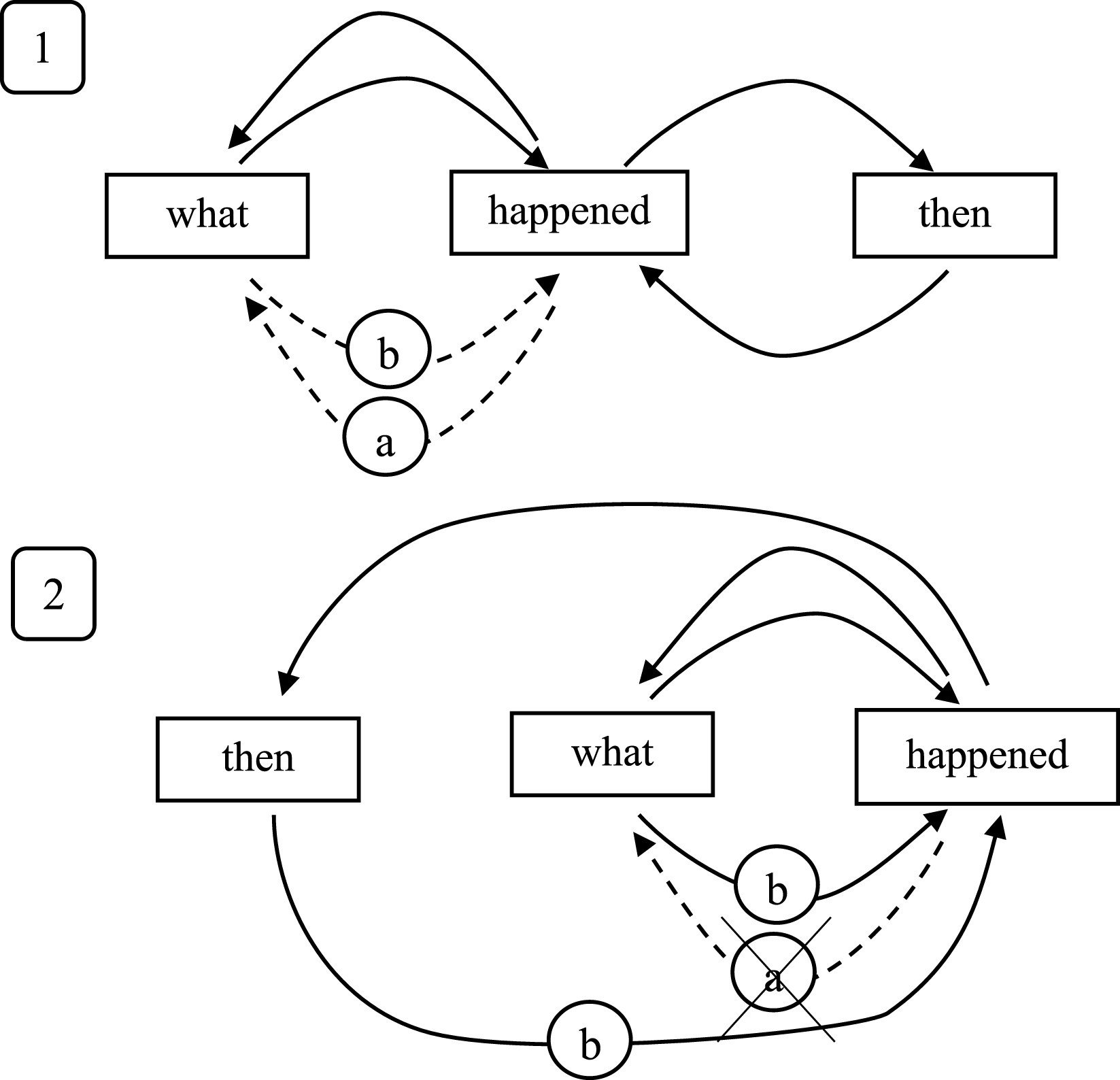
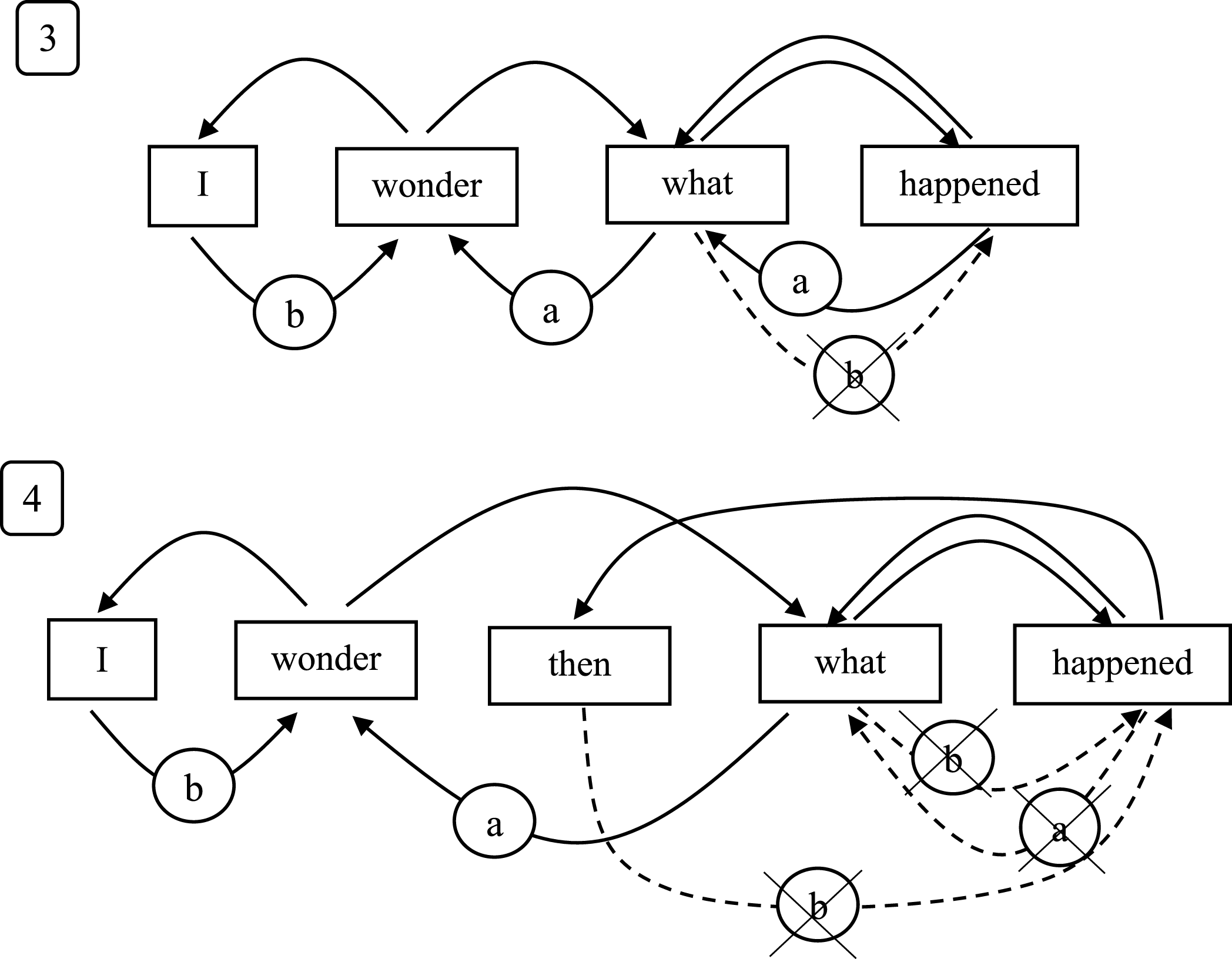
One explanation (Hudson Reference Hudson2003) is that fronting of then and subordination to wonder require conflicting structures which inevitably clash when the two are combined; but contrary to the earlier explanation, this conflict only affects the landmark structure. The structures for the first two examples are shown in Figure 8, where the dashed landmark arrows in structure 1 are alternatives: either what takes its position from happened, or the other way round, but the result is the same, with what before happened. In contrast, in structure 2 only one of these landmark relations is possible, because then only depends on happened, so happened must be its landmark and (by the Best Landmark Principle) happened must also be the landmark of what.
Happened is the landmark of what in What happened then? and Then what happened?

The other two structures are in Figure 9. In structure 3 what mediates between wonder and happened in terms of word order as well as dependency, so it must be the landmark for happened. And since what already has one landmark (wonder) it cannot also have happened. Thus each of the two alternatives is ruled out by one construction, so if the two constructions are combined, neither is possible. This is exactly the situation shown in structure 4, where the fronted then excludes what as landmark of happened and the parent wonder excludes happened as landmark of what. Equally bad is the landmark link from then to happened, because of the clash with the one from what to wonder.
What is the landmark of happened in I wonder what happened and *I wonder then what happened.

This discussion has confirmed the reality of mutual dependency, just the kind of ‘cycle’ that is forbidden in a directed acyclic graph, and which almost all modern grammatical theories, whether based on phrase structure or on dependency structure, assume is impossible in syntax. Moreover, the analysis offered here also supports the separation of landmark relations from dependency relations which our analysis of pied-piping will build on. And finally, it has shown that the wh-word sometimes acts as the landmark of the subordinate verb, and it is this pattern that we shall assume in the following discussion.
5.2 Extraction
Pied-piping is only found in extraction, so we need an account of how this is treated in WG. The main element in the analysis is a dependency relation mentioned earlier, ‘extractee’ (which in the diagram notation is reduced to ‘x
 ${<}$
’, in contrast with ‘
 ${>}$
x’ for ‘extraposition’); this links a wh-word (or other extractee) to a following verb (normally a finite verb), as in (80) below. As usual in the literature, the underscore marks the default position of the object of find, but in WG there is no movement from this position; indeed, movement, as such, is not possible in a network.

As mentioned earlier, the analysis does indeed assign two different positions to what, but their relation is logical rather than temporal: the actual ‘surface’ position overrides the expected, default, ‘deep’ or ‘underlying’ position.
Once again, extraction in syntax is easy to match outside language. For example, suppose I find a family photograph lying loose, and I know that our family photographs are typically stored in the family photo-album. In this context, the photograph is similar to a wh-word because it sets up an expectation for a larger structure (the album) to contain it. Conceptually, the challenge is to hold the photo in memory while looking for the album and then to find the right place for it within the album; this parallels the challenge of a wh-word, which has to be held in memory until a clause is found and, within that clause, a (default) place for the wh-word.
But extraction doesn’t just anticipate a later dependent. It also involves recursion, which is often (but wrongly, as I argue below) claimed to be unique to human language (Hauser, Chomsky & Fitch Reference Hauser, Chomsky and Tecumseh Fitch2002). Even an example as simple as (80) shows recursion because what has to be linked recursively to both did and find, as extractee to each. The first extractee link explains its position before did, and the second explains why it can also act as the object of find. This is the WG equivalent of the special construction which other theories allow to reproduce recursively down the chain of dependencies. And, again as in other theories, this recursion is licensed by the dependency between did and find. The recursion is limited only by the length of the rightward dependency chain, and allows multiple ‘hopping’ examples like (81), where what is linked recursively to no fewer than ten words (did, think, that, ought, to, admit, that, had, considered, stealing):

Once again non-linguistic analogues for this apparently special structure are easy to find. Continuing with the photograph example, if the photo is like the wh-word and the album is like the rest of the clause, each successive page is like the next word in the chain of dependencies, and the page where the photo belongs is like the word where the recursion ends. The procedure you follow is to look at the first page, and when you see a space, to insert the photograph; but in the absence of a space, you try the second page, and so on (recursively) until you find a space.
The WG mechanism for extraction (Hudson Reference Hudson1990: 190–202) builds on the very general classification of dependencies in Figure 6 as either predependencies (where the dependent by default precedes the parent) or postdependencies; the extractee dependency itself is a predependency (like the subject relation) but it combines with a postdependency to force the postdependent to stand (exceptionally) before its parent. The recursiveness of extraction comes from the fact that the extractee of one word may become the extractee of that word’s postdependent. For example, in (80) above what is the extractee of did, and since find is the latter’s postdependent, what may also be extractee of find, and if find had had another postdependent what could have been passed down again as extractee; and in example (81) what is linked, as extractee, to all ten words in the dependency chain. But of course the position of what is determined by only one of these links (the link to the clause root did), so what inherits its position from this link, thereby blocking all the other relatively default positions. This is the same sub-token-based mechanism as we assumed earlier in connection with the subject-raising in Small children were playing outside (see Figure 5). Similarly for extraction, we provide a hierarchy of separate sub-tokens of what, one for each link, such that default inheritance protects the position inherited by the token linked to did.Footnote [10]
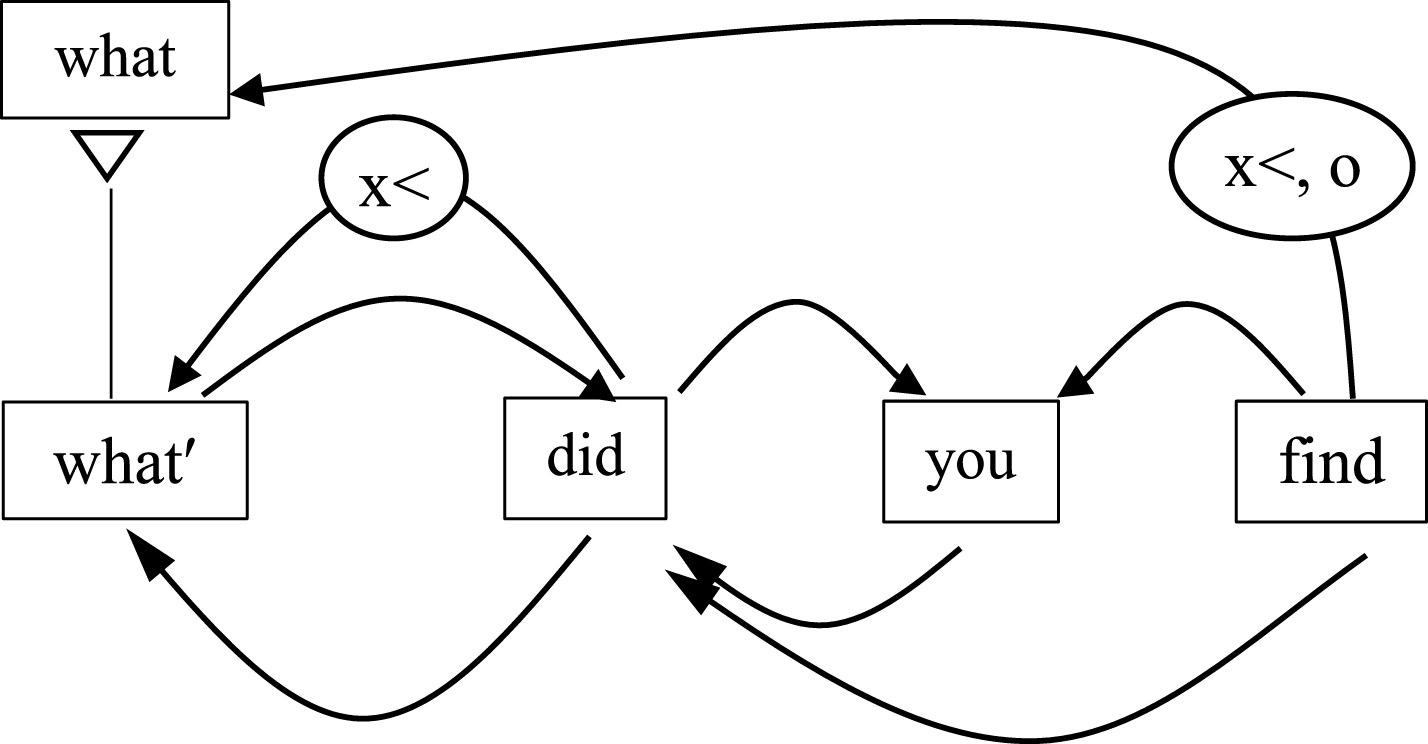
This recursion is very similar to the turning of pages in the photograph-album example, but in both cases the aim of the recursion is to integrate the item into the default structure by finding a space for the photo, or by finding a semantic role for the word; and once this has happened, the recursion ceases. For the word, recursion stops when the word is identified as a postdependent (as when what is identified as the object of find). The resulting structure for (80), therefore, recognises two sub-tokens of what, of which one is merely extractee of did and the other is linked to find both as extractee and as object. The dependency structure is shown in Figure 10, with all the other sub-tokens collapsed. This diagram has a small change in the notation: the sub-token what
 $^{\prime }$
is below the default what; this change puts the dependency that determines word order as near as possible to the landmark links below the words.
A simple wh-extraction in What did you find?

The main point of this example is that the default position of what as object of find is overridden by its exceptional position as extractee of did, giving What did … rather than … find what. In all other respects, however, the dependency of what on find is exactly the same as it would have been in a non-extracted example such as I found it.
5.3 Pied-piping
Turning now to pied-piping, we start with a pied-piped interrogative, (82):

As noted in Section 2, pied-piping is strictly a matter of word order, and nothing else, so this has exactly the same dependency structure (and semantic structure) as its stranded equivalent:

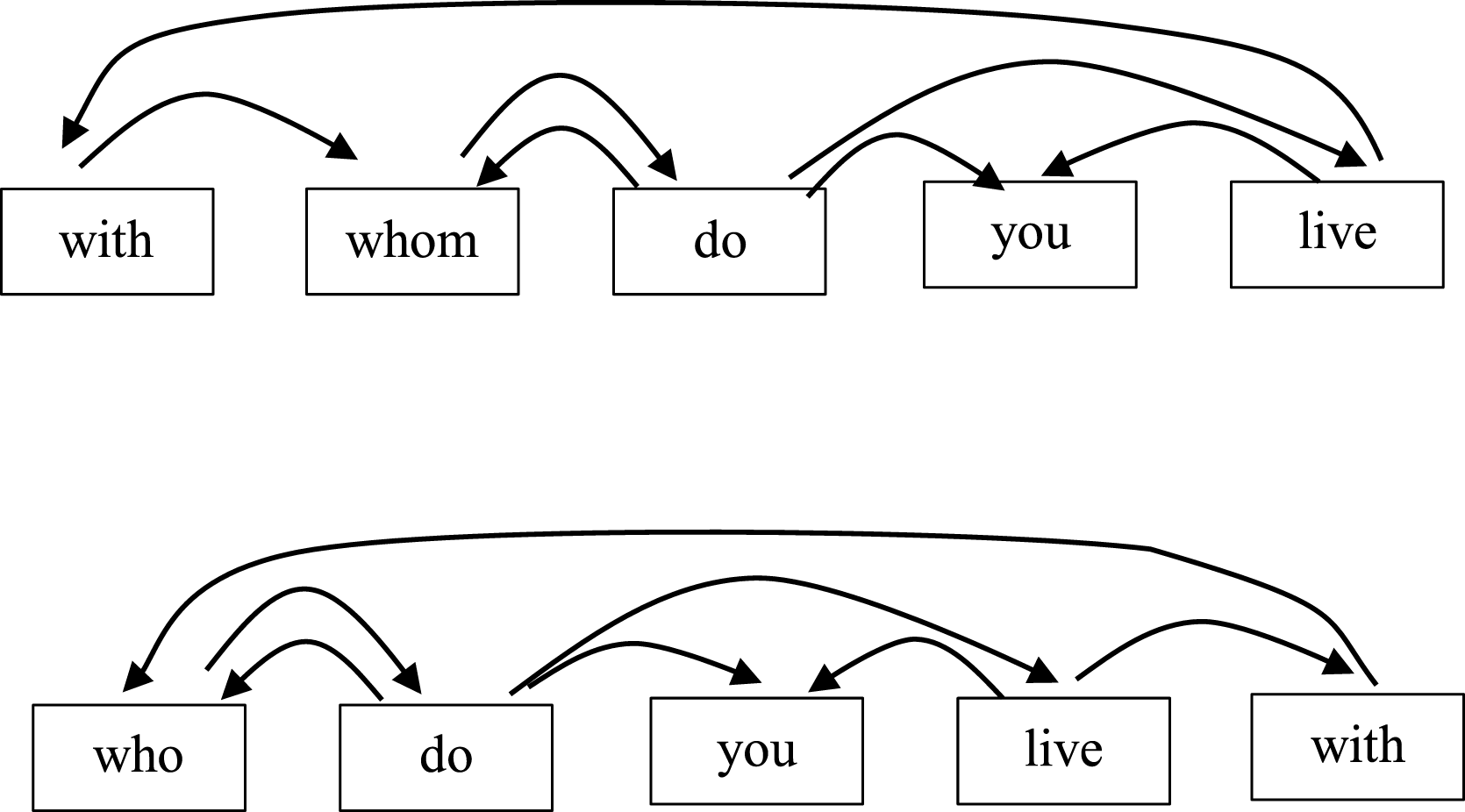
When reading the two dependency structures shown in Figure 11 it is important to bear in mind that, in a network, these two structures are topologically identical and indistinguishable.
Two identical dependency structures with different orders: With whom do you live? and Who do you live with?
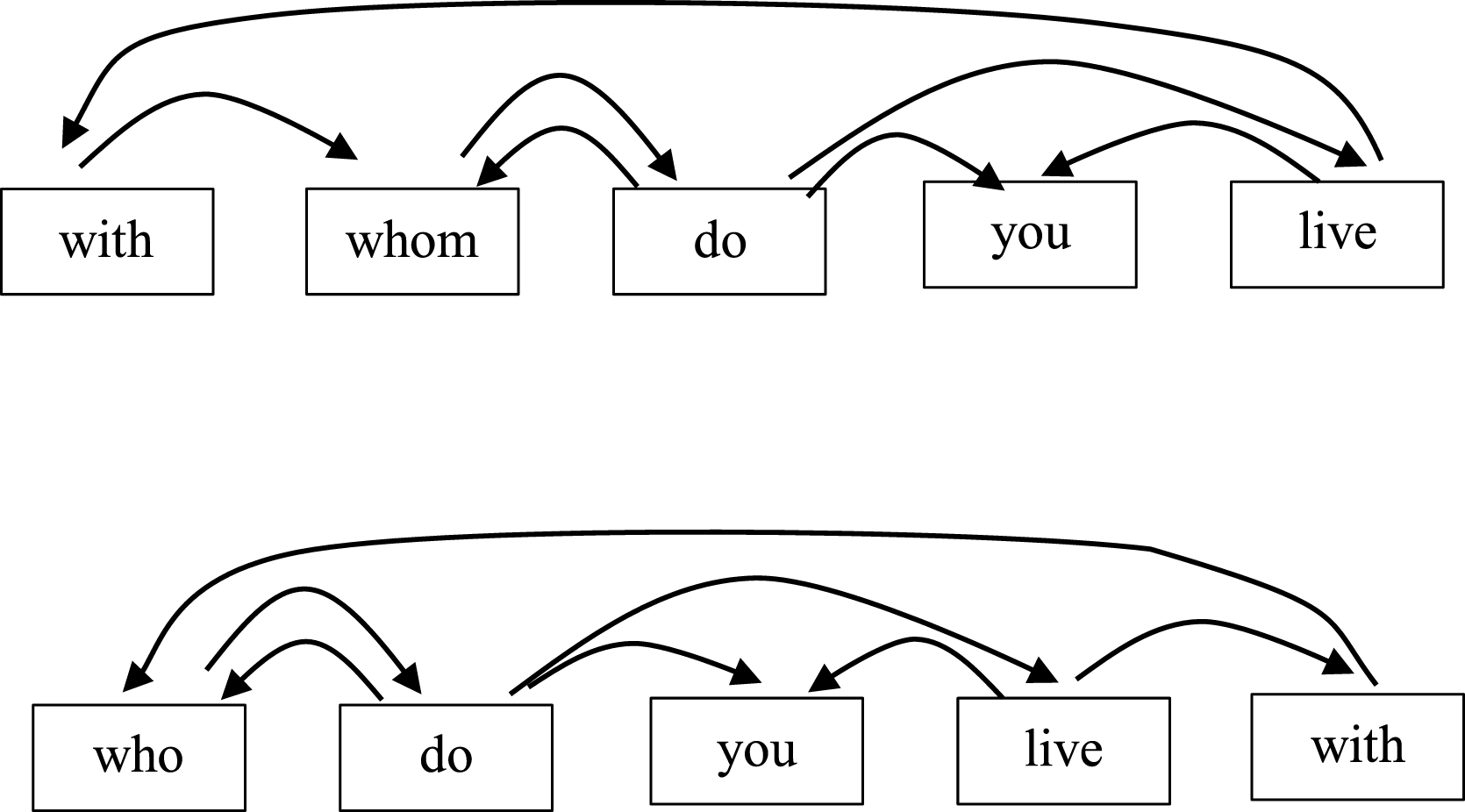
The question, therefore, is how to explain the different positions of with. What seems to be happening in the pied-piped example is that with replaces whom in the landmark structure; so with, instead of whom, takes do as its landmark, and with, instead of whom, also acts as landmark for do. It’s also clear that this is only possible because whom depends on with. But the same is true whether we have with whom do or who do … with, so what is it that triggers the landmark-based word-order difference? One possible answer, of course, is that nothing does: this is simply a choice in the mapping from dependencies to landmarks; whenever a wh-word depends on a preposition, the latter can – but need not – take over the former’s expected landmark relations. But although this rather complex generalisation could be expressed in a network, it must be only part of the explanation because the same is true for all the other pied-piping patterns reviewed in Section 3.
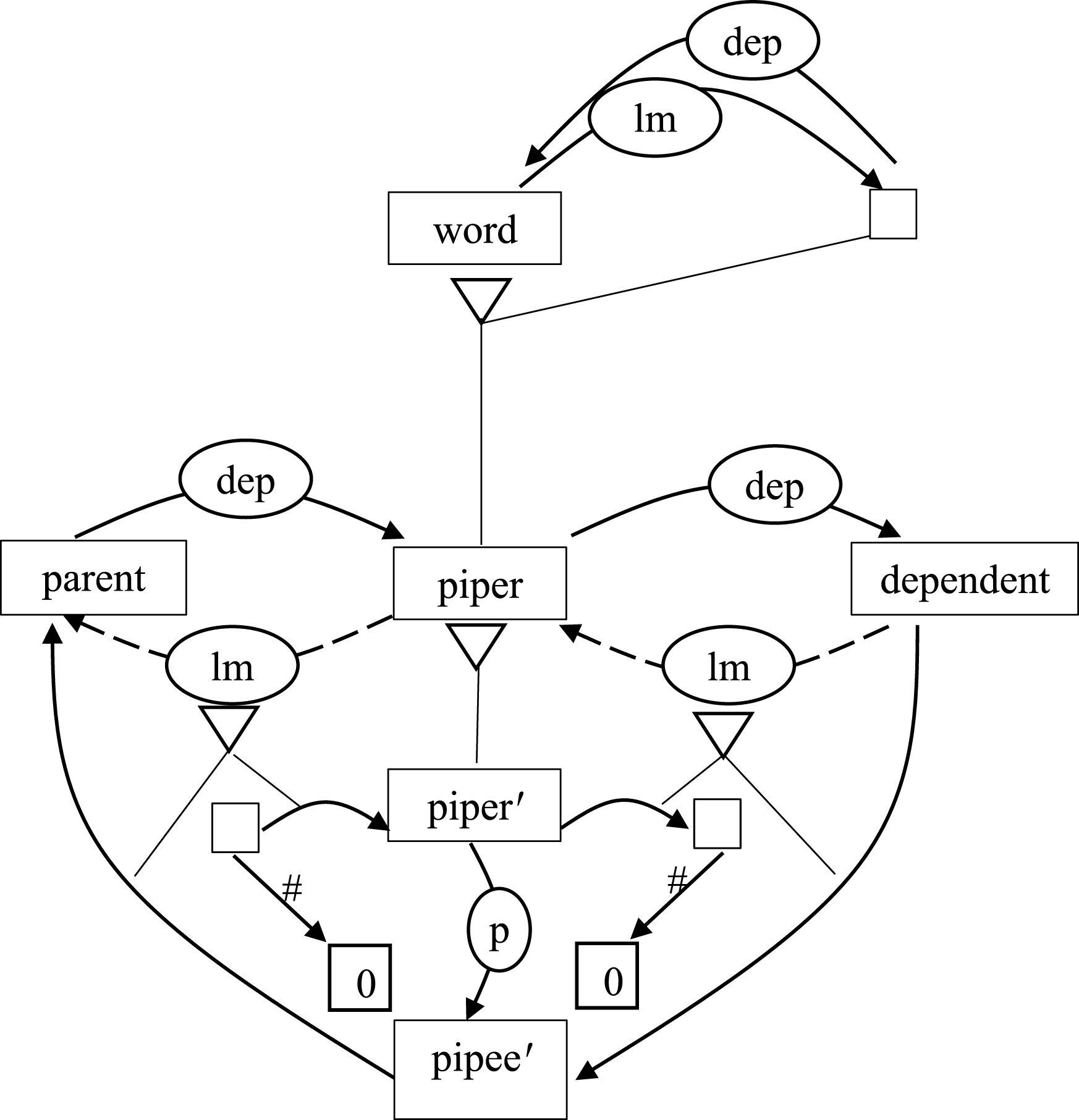
Much better would be a structural element shared by all pied-piped structures which triggers the same reorganisation of the landmark system, stated just once, so that the optionality could be introduced in the rules for assigning this element. But what is this element? It must be the structural feature that combines the wh-word which licenses the pied-piping with the parent or ancestor word that is affected by the pied-piping; so in (82) above it must bring together with and whom to show that (in contrast with the stranded equivalent) they are part of a pied-piping structure. In a network model, the feature must be the ‘pipee’ link between the two words, so in (82) with is the pipee of whom. This relation is an optional property of the wh-word, so the latter may have no pipee (in which case there is no pied-piping), and if it does have one the network can show which particular parent or ancestor it is. In this analysis, then, the pipee relation carries all the optionality of pied-piping, so the structural effects can be stated just once.
But what kind of a link is ‘pipee’? It acts as an interface between dependencies and landmark relations, but seems to be different from both: unlike dependencies, it links upwards towards parents and ancestors, and doesn’t fit comfortably into the contrast between predependent and postdependent; and unlike a landmark relation, it isn’t paired with an ordering relation. But it is definitely part of syntax, so it looks like an ad hoc syntactic relation. In WG this is not a theoretical problem, as relations can be created and learned as needed; so if dependencies and landmarks are learned, why not pipees too? Ordinary cognition offers easy examples of ad hoc relations similar to ‘pipee’, where an object determines the global location of its own landmark; for example, a car’s passenger (located within the car) can determine where the car is allowed to drive or park, and the contents of a can (again located within it) can determine where the can is stored. In short, ordinary cognition clearly provides what it takes to learn any ad hoc relation. Moreover, the ‘pipee’ relation is not the only such additional relation in syntax; one example is Rosta’s ‘surrogate’ relation mentioned earlier which does to dependencies what pied-piping does to landmarks. For instance, it can be argued that the optional that which introduces subordinate clauses is the surrogate of the finite verb, so when that is absent the verb is its own surrogate. Similarly, we may explain examples like how big a house by saying that
 $a$
is the surrogate of how.
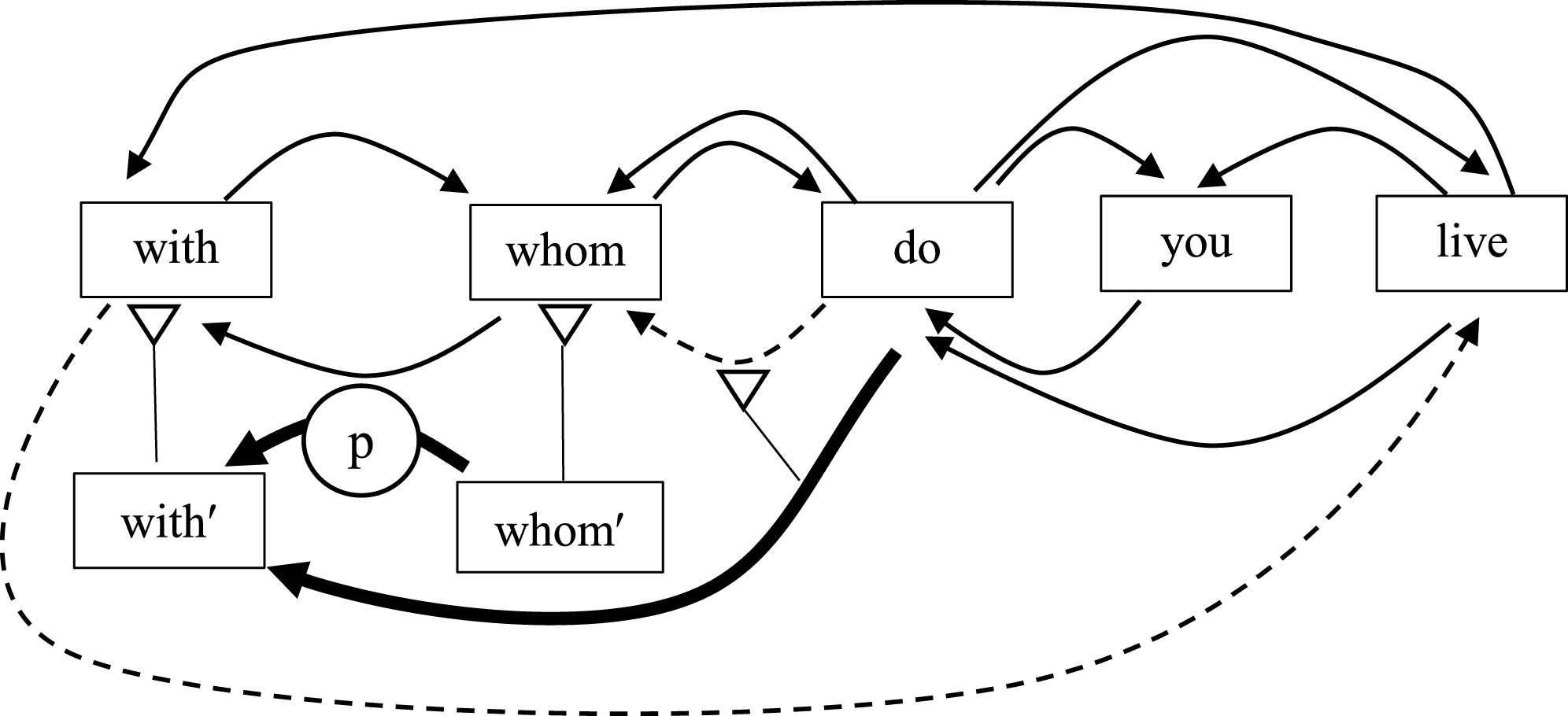
The ‘pipee’ relation is a crucial part of the analysis, so it needs to be included in structural diagrams alongside the dependencies and landmark relations that it relates. For convenience, it will be put below the words, alongside the landmarks, but to distinguish it from the latter it will be labelled ‘p’. Figure 12 uses this notation to show the structure of the pied-piped example (82), but also highlights both the pipee relation and the surface landmarks that it licenses, with the overridden defaults shown by dotted lines.
A simple example of prepositional pied-piping in With whom do you live?

The main point to notice in this diagram is the ‘pipee’ link from whom to with, which has the effect of transferring the landmark properties of whom to with:
-
∙ it turns with, instead of whom, into the landmark for do,
-
∙ it turns with, instead of whom, into the one word which has no landmark.
This particular structure is inherited from the sub-network for ‘pipee’ which will be presented in Section 6.5.
We now have the full apparatus needed for pied-piping:
-
∙ the ordinary dependency structure, in which dependency relations are properties of word tokens.
-
∙ the landmark structure which treats linear order as a property of word tokens.
-
∙ the isa relations between tokens and sub-tokens which resolve conflicts, including conflicts of linear order.
-
∙ the special ‘pipee’ relation from a wh-word to the word which replaces it in the landmark structure, and which automatically transfers the piper’s landmark relations to the pipee.
This analysis extends easily to other kinds of interrogative such as our original example, (2): In which drawer do you keep the bank statements? The only relevant difference is that the wh-word is the determiner which, rather than the pronoun. As it happens, WG treats determiners as heads (Hudson Reference Hudson1990: 268–76; Hudson Reference Hudson2004) so which is directly linked to the preposition, just as in the with whom example; but we shall consider examples below in which this is not so.
5.4 Pied-piping in subordinate interrogatives
Subordinate interrogatives such as (84) are slightly more complicated because the interrogative pronoun has an extra dependency.

In this case, what, or rather its sub-token what
 $^{\prime }$
, must depend on wonder as well as on wants, because wonder needs an interrogative word such as what. Moreover, wonder must be the landmark of what
 $^{\prime }$
because the latter, and the clause it introduces, takes its place among the higher verb’s dependents, as in (85), where what she wants separates wonder from its adjunct because she looks hungry (the cause of the wondering, not of the wanting).

This landmark link from what to wonder explains the order wonder … what.
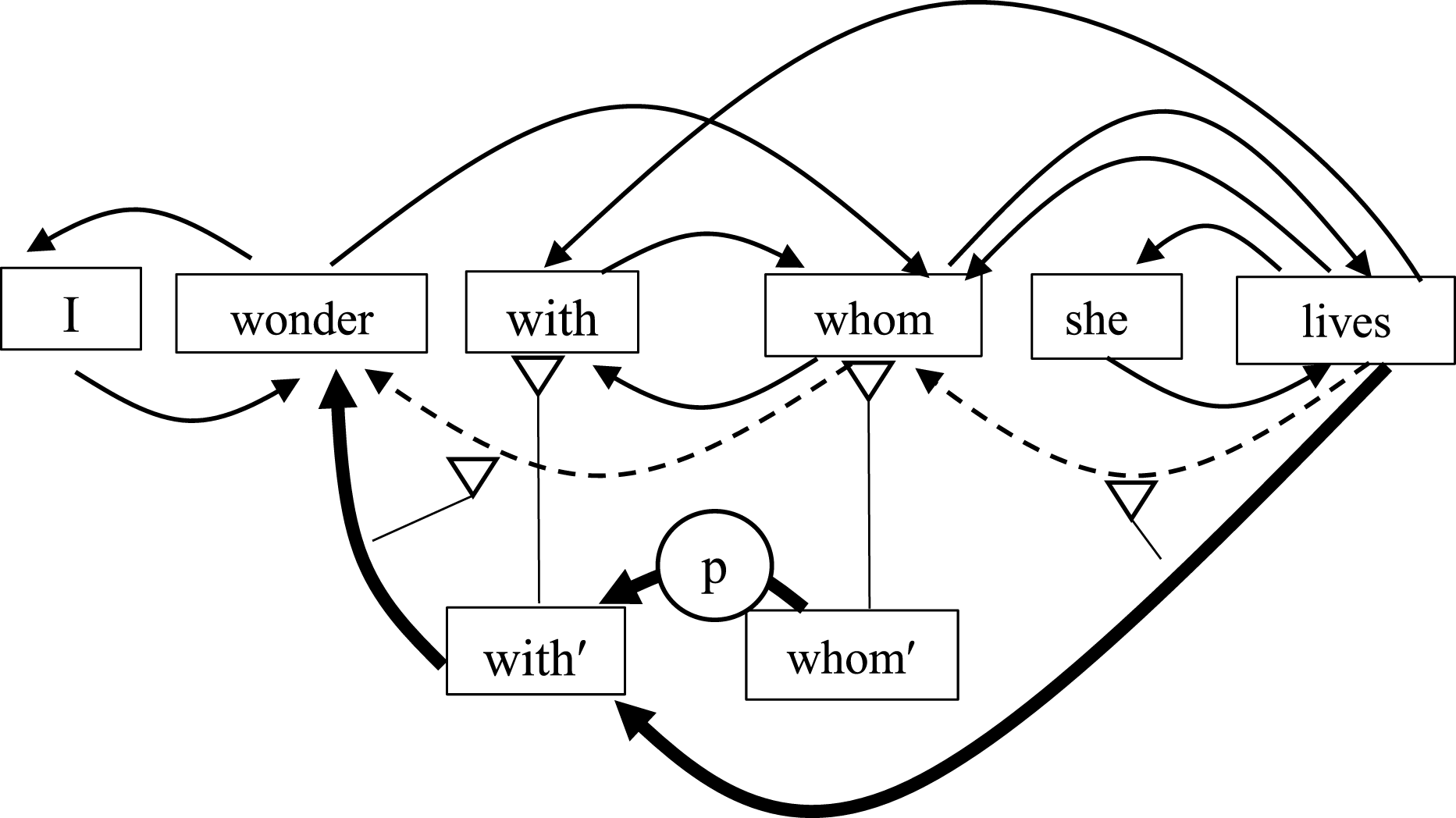
The same kind of analysis applies to a pied-piped example such as (86), giving the structure in Figure 13, where once again the heavy dotted lines show the pied-piping of with and its effect on word order.

As in the previous example, with inherits all the landmark properties of whom, but in this case it inherits a landmark link to wonder (instead of no landmark at all).
Pied-piping in a subordinate interrogative in I wonder with whom she lives.

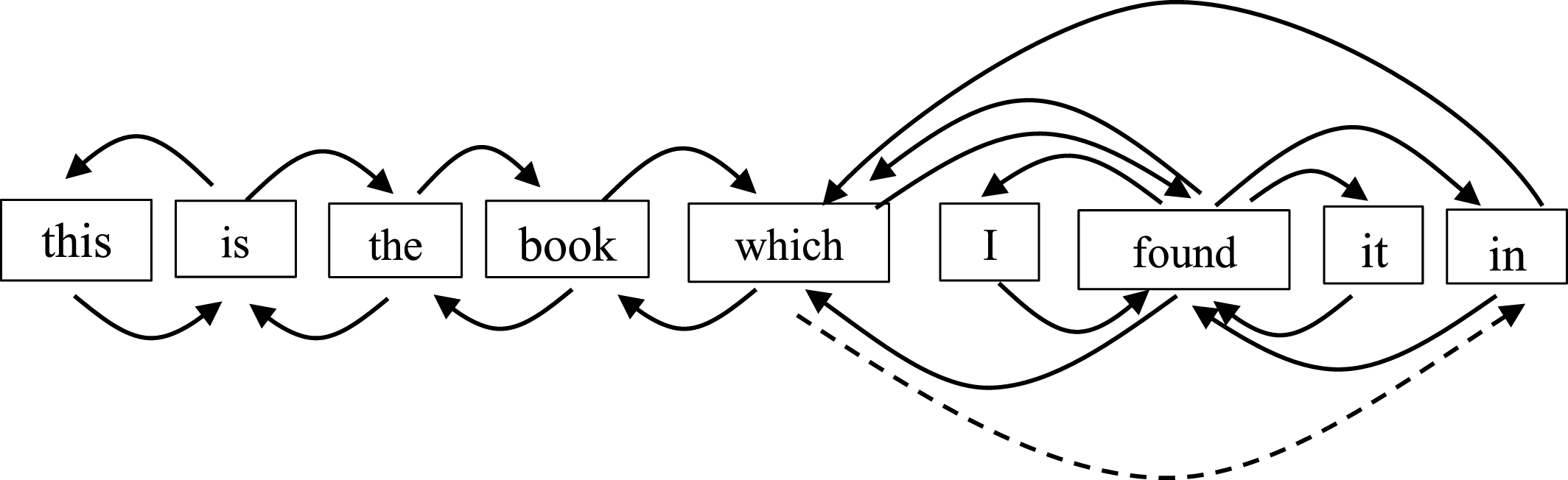
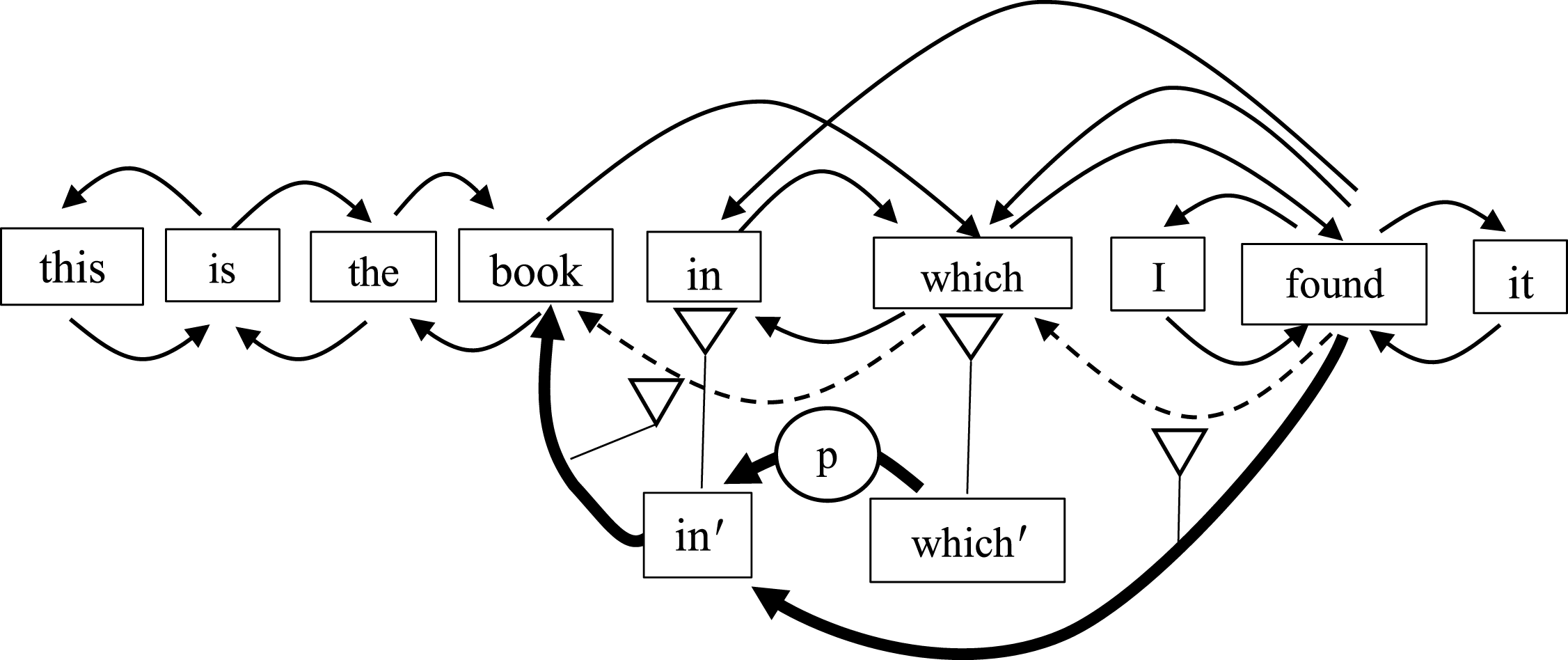
5.5 Pied-piping in relative clauses
Subordinate interrogatives lead comfortably into relative clauses, which have very similar syntactic structures except for the much greater freedom in pied-piping discussed in more detail below. Here too the wh-word has an extra dependency external to the subordinate clause; and here too, the wh-word has the external parent as its landmark. Take, for example, the stranded equivalent of our first example:

In dependency terms, which is an adjunct of the antecedent, book, but it is also the complement of in and the extractee of found. (In phrasal terms, the whole relative clause is the adjunct, but this is only by virtue of the link from which.) According to Figure 14, book is the landmark of which, overriding its dashed default landmark link to in; and the order which … found is guaranteed because which is the landmark of its complement, found.
A relative clause without pied-piping in This is the book which I found it in.

As with interrogatives, pied-piping is permitted by the ‘pipee’ relation, so we start with a simple example where a single preposition is pied-piped, our (1): This is the book in which I found it. Here the pipee is in, so it is in, rather than which, that has book as its landmark and provides the landmark for found. Figure 15 gives the structure for this example. As usual, the pipee in takes over the landmark relations of the piper which.
A relative clause with simple prepositional pied-piping in This is the book in which I found it.
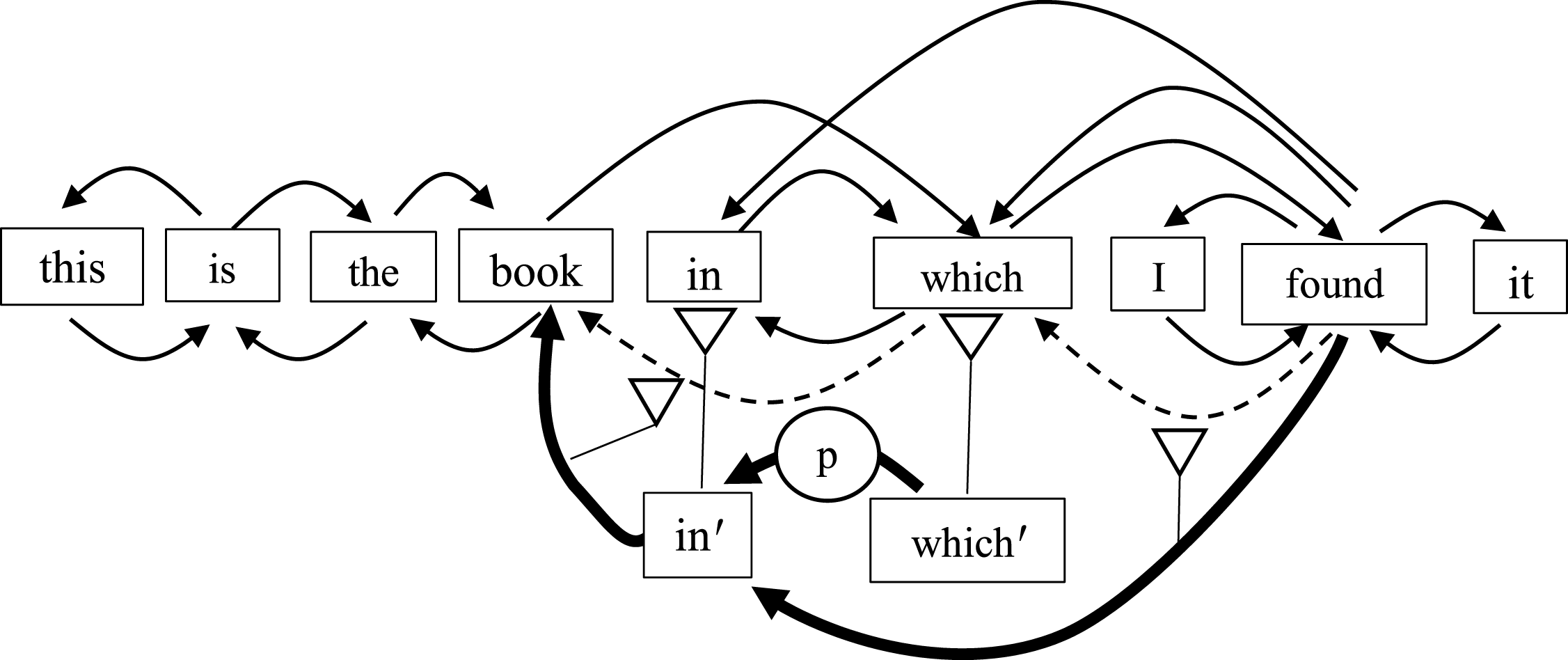
Having introduced the relation ‘pipee’ and shown how it extends the basic analyses of interrogative and relative clauses to include elementary prepositional pied-piping, we now move on to consider other and more complicated constructions.
5.6 Phrase-initial pied-piping
Phrase-initial pied-piping is different from prepositional pied-piping because the wh piper is initial in its phrase, as in how big or whose book; but their word order is still exceptional because the wh-word is not the head of this phrase, so how has to pied-pipe its parent as in (88):

However simple this example may appear, it is worth bearing in mind that no such structure is allowed in French, which otherwise is so similar to English:

This fact should alert us to the complexity of how expensive, due to the fact that how essentially has two conflicting landmarks: as dependent of expensive this should also be its landmark, but as wh-word its landmark should be the verb is. Fortunately the WG analysis allows us to reconcile the conflict by distinguishing two tokens of how, each with a different landmark. The surface order belongs to how
 $^{\prime }$
, where pied-piping allows expensive to be the sole landmark because is has been transferred, as landmark, to expensive. The structure is shown in Figure 16.
How pied-pipes two landmarks in How expensive is it?

Further complexities arise with how because it is one of the degree modifiers which allows the special structure in too big a house or how big a house. As mentioned earlier, it has been suggested that these structures treat the determiner
 $a$
as ‘surrogate’ of the modifier (Rosta Reference Rosta, Sugayama and Hudson2005), so in an example like (91) how has the determiner as its surrogate in dependency structure and also as its pipee in landmark structure.

The result is predictably complex, as can be seen in Figure 17, where ‘s’ stands for ‘surrogate’. It will be seen that how
 $^{\prime }$
has two pipees, but this is to be expected given the recursive nature of pied-piping, discussed below.
Pied-piping meets surrogacy in How big a house is it?

The other wh-word that produces phrase-initial pied-piping is whose, which introduces a different set of complexities. In this case the main issue is how this word relates to the other possessive constructions, such as John’s and the King of England’s daughter. In the WG analysis mentioned earlier (Hudson Reference Hudson1990: 276–282), the possessive suffix in both examples is a separate syntactic word, a clitic determiner called Z, so John’s is actually two syntactic words: JOHN Z, with a shared morphological realisation. In this case the two words are closely linked (by a dependency) in the syntax, but in the King of England’s daughter they are merely neighbours (linked by ‘next’). It is tempting to generalise this analysis to the ‘possessive determiners’, including whose, giving an analysis in which whose is syntactically WHO Z. Moreover, since the WG analysis of noun phrases recognises the determiner as the root word, in all these examples the root of the whole structure is the determiner Z; and in the specific case of whose, the wh-word WHO depends on Z, so pied-piping is involved even in as simple an example as (92).

In such cases, Z is the pipee of WHO, but the effect on word order is vacuous because they are morphologically fused.
Both how and whose add even more complexity by allowing recursive pied-piping, in which the pipee is not just the parent of the piper, but some more or less remote ancestor. The obvious examples all involve recursive possession, as in (93) and (94).

As we have seen already, recursion is easily accommodated in a cognitive network.
5.7 Complex pied-piping
The two kinds of pied-piping, prepositional and phrase-initial, can combine freely, as in the following examples.

Moreover, phrase-initial pied-piping is indefinitely recursive when combined with the possessive Z discussed earlier:

In all these cases, the pied-piped phrase follows ordinary syntactic patterns except for its position, which is determined exceptionally by the wh-word.
Once again the simplest conclusion is that the pipee relation can be passed recursively up the dependency chain without limitation. On the other hand, we still find the limitations on prepositional pied-piping noted previously: an absolute prohibition of finite verbs as the pipee, and a ban on recursive prepositional pied-piping in normal interrogative clauses.
5.8 Free relatives
In contrast with all other kinds of wh-word, those that introduce free relative clauses don’t allow any pied-piping (Heck Reference Heck2008: 342). For example, whereas with which is an alternative to which … with in (100) and (101), what … with in (102) cannot be changed into the with what of (103).

This restriction cannot be explained in terms of dependency structure, because pied-piping does not affect dependency structure so (102) and (103) have just the same dependency structure. But a functional explanation may be possible in terms of the processing difficulties of the sequence this is with what, where the normal procedures try to treat with as a dependent of is. On the other hand, some languages do allow free relatives with pied-piping. For example, German examples like (104) have been found in published writing (Müller Reference Müller1999: 61, quoted in Hoffmann Reference Hoffmann2011: 58):

This example is remarkable for the fact that wem ‘who’ is in the dative, as required by the preposition aus, but is also functioning as the subject of the higher clause, which would normally require a nominative wer. If German speakers can process (104), why can’t English speakers process (103)? This must be left as an unsolved problem.
The next section explains how these English patterns can be formalised in WG, and then Section 7 will explore the cognitive background for pied-piping.
6 Formalising the analysis
Section 5 presented a WG analysis of single-step prepositional pied-piping, so we now need to consider how this grammar needs to be expanded in order to accommodate the more complicated examples reviewed in Section 3 and analysed in Section 5. The earlier analyses all relied on the special relation ‘pipee’, which connected the wh-word to the word which replaced it in the landmark structure (responsible for word order). We shall now see that this relation is all we need to accommodate the more complex examples as well.
The main complexities are as follows:
-
∙ different provisions for relative, interrogative and free relative clauses
-
∙ recursive pied-piping in relative clauses and some interrogatives, with an absolute ban on finite verbs as pipees
-
∙ lexical restrictions on pipers (the wh-words), pipees and antecedents
-
∙ social restrictions on some kinds of pied-piping.
Arguably, all these possibilities and limitations are part of our ‘competence’, i.e. our knowledge of English, so the challenge is to incorporate them all into a formal model of that knowledge.
6.1 Pipers
We start with the wh-words themselves. WG provides a hierarchical classification of words which can contain both ‘pronoun’ and ‘relative pronoun’ in a hierarchical relation, as well as the individual lexemes such as WHO. This inheritance hierarchy, based on the ‘isa’ relation introduced earlier, replaces the syntactic features favoured by most other theories, and there is certainly no suggestion that the hierarchy might be part of ‘universal grammar’; it is learned rather than innate, and can vary freely between languages. One of the advantages of a hierarchical classification is the prevalence of this kind of classification outside language, in contrast with feature-structures, which are much more limited outside language. Another is the unified treatment that it allows for general categories and lexical items, contrasting with the fundamental distinction between features and items forced by feature structures.
One example of this unified treatment is the possibility of distinguishing ‘sub-lexemes’ – distinct uses of what is clearly a single item, comparable to the ‘sub-tokens’ discussed earlier. For example, it allows us to recognise a single lexeme WHO which requires a human referent, while also distinguishing the relative pronoun WHO
 $_{\text{rel}}$
from the interrogative WHO
 $_{\text{int}}$
. Even more specifically, WHO
 $_{\text{relZ}}$
, the sub-sub-lexeme of WHO
 $_{\text{rel}}$
which is found in relative (but not interrogative) whose, exceptionally allows non-human referents as in the table whose leg is broken. These sub-lexemes can inherit their distinct properties from the more general categories ‘relative pronoun’ and ‘interrogative pronoun’ because the hierarchy allows multiple inheritance; so WHOrel isa both WHO and ‘relative pronoun’. Similarly, ‘interrogative pronoun’ inherits from ‘interrogative word’ and ‘pronoun’, so HOW can inherit from ‘adverb’ as well as from ‘interrogative word’, and assuming that there are no other such words, the resulting intersection could equally well be called either ‘HOW’ or ‘interrogative adverb’. (Arguably, both WHEN and WHERE are pronouns, since they can both be used as relative pronouns.) The network in Figure 18 shows some of the relevant nodes.
Classification of words in a network.

This classification of words will allow us to identify words as potential ‘pipers’ in pied-piping. For instance, we can say that any interrogative word is a potential piper. But since pipers are lexically restricted, it seems likely that we shall need to include both general and specific information. How this can be done will be explained below.
6.2 Constructions
The subclassification system of WG accommodates constructions in terms of sub-lexemes of individual words, rather than by recognising a larger unit containing all the words. Sub-lexemes can be thought of as permanently stored sub-tokens, memorised from specific utterances. For example, an idiom such as KICK THE BUCKET is analysed as containing a special sub-lexeme of each of the words concerned: KICK
 $_{\text{bucket}}$
, THE
 $_{\text{bucket}}$
and BUCKET
 $_{\text{kick}}$
. (The choice of labels is, of course, trivial; indeed, one of the basic assumptions of network analysis is that labels are merely an analytical convenience, without any material content.) Each of these words has some unique properties; for example, KICK
 $_{\text{bucket}}$
is the only example of KICK that means ‘die’ and requires THE
 $_{\text{bucket}}$
as its object, and the latter is the only example of THE that occurs with KICK
 $_{\text{bucket}}$
and BUCKET
 $_{\text{kick}}$
. But at the same time, these words are also linked to the default lexemes KICK, THE and BUCKET, as has been shown through priming experiments (Sprenger, Levelt & Kempen Reference Sprenger, Levelt and Kempen2006). The proposed analysis captures the similarities to the default entries as well as the differences.
Another part of WG which supports the analysis of constructions is the mechanism of dependency and headedness. Even in this opaque idiom, the dependency analysis can build on the fact that KICK, as a verb denoting an event, is by far the best candidate for the head. In more transparent idioms headedness is clearly even more significant; in contrast, an analysis which attributes the meaning to the entire construction would be unrevealing. The same is true in all constructions, and not just in idioms, because it is the head, as modified by the dependents, that carries the meaning of the whole.
Returning to pied-piping, the same principles apply. For example, WHAT
 $_{\text{for}}$
and FOR
 $_{\text{what}}$
are the sub-lexemes of WHAT and FOR which occur in the what … for construction. This system allows both potential pipers (e.g. what) and potential pipees (e.g. for) to be specified either crudely, in terms of general word classes, or more delicately in terms of sub-classes or even specific lexical items. Moreover, in this system we can tie lexical constraints to the pied-piping or stranding constructions: so WHAT
 $_{\text{for}}$
cannot have a pipee to give *For what did you do it?, and WHICH
 $_{\text{way}}$
must have one to give the way in which ….Footnote
[11]
In view of the very construction-specific and lexically-specific constraints on pied-piping reviewed in Section 5, this degree of specificity is essential.
6.3 The optionality of prepositional pied-piping
Assuming, then, that we can distinguish the constructions which require pied-piping from those which forbid it or merely allow it, we now need a mechanism for expressing these differences in a network. Optionality is handled in WG by means of an elementary ‘quantity’ relation, whose values range over numbers. By default the quantity of any entity is 1, meaning that when it is possible structurally, we expect to find one token; but the default can be overridden by values such as ‘0–1’ (either 0 or 1) or ‘0’. In network diagrams, the quantity relation is labelled ‘#’, so the total network would include the sub-network shown in Figure 19 for WHAT
 $_{\text{for}}$
and WHICH
 $_{\text{way}}$
. The diagram shows that, by default, a pipee is optional, but it is impossible with WHAT
 $_{\text{for}}$
and obligatory with WHICH
 $_{\text{way}}$
.
WHAT
 $_{\text{for}}$
cannot have a pipee but WHICH
 $_{\text{way}}$
must have one.

Pipees as exceptional landmark bearers.

6.4 Pipees and landmarks
Now that we have a mechanism for adding the pipee relation as required, we can show how this relation produces the word order of pied-piping, which is shown in Figure 20. As explained earlier, a word’s parent is normally also its landmark; this is shown in the top section of the figure. This is the default arrangement, but pied-piping is exceptional because the piper has a pipee which takes over the piper’s role in landmark structure as follows:
-
∙ The word labelled ‘piper’ has the default landmark relations to both its parent and its dependents. These constitute the ‘underlying’ structure for the pied-piped structure.
-
∙ Pied-piping creates sub-tokens for both the piper and the pipee, and it is these sub-tokens that are linked by ‘pipee’.
-
∙ The pipee sub-token inherits the default landmark relations of the piper sub-token, as does the original piper, but the latter inherits them with zero quantity (# 0), meaning that they disappear.
6.5 Recursive pied-piping
Finally, the grammar needs to allow recursive pied-piping in some cases but not in others. Recursion is found in both prepositional and phrase-initial pied-piping, but it involves different mechanisms so we consider the two types separately.
By default, prepositional pied-piping is freely recursive and allows complicated structures like (20)–(24). The only general constraint is that a finite verb cannot act as a pipee (as in the ungrammatical (25)). The sub-network in Figure 21 shows how this recursion can be expressed in a network. In prose, if words A, B and C form a dependency chain, with A at the bottom, and if B
 $^{\prime }$
is the pipee of A
 $^{\prime }$
, then C
 $^{\prime }$
may also be the pipee of A
 $^{\prime }$
. The quantity ‘0–1’ shows that these relations are all optional, but if B
 $^{\prime }$
is a finite verb, it cannot be pipee (because the pipee relation has quantity ‘0’).
Defining ‘pipee’ recursively.

One possible objection to this analysis is that it identifies too many pipees, each of which could have the piper’s parent as its landmark. For example, in the book on the cover of which I wrote, the piper which creates four different pipees: on, the, cover and of; but only on takes over the piper’s landmark role. Why isn’t this possible for the other three pipees? The answer is that the pipee relations form an isa hierarchy: which:on (the pipee relation from which to on) isa which:the, which isa which:cover, which isa which:of. By default inheritance, the winning value is the one furthest from the default, at the bottom of the hierarchy; so which:on automatically beats all the other values for ‘pipee’ when applying the rule for landmarks.
The little grammar fragments provide the formal mechanisms for recursive pied-piping, whether in prepositional pied-piping or in phrase-initial pied-piping, but as we have seen, there are a great number of limitations which require more or less specific restrictions on pipers and pipees. One particularly challenging limitation is on ordinary wh-questions, because this limitation is suppressed in the ‘quiz interrogatives’ of (47)–(57); the challenge in this case is to integrate the linguistic facts into a network analysis which also defines ‘quiz’. All of these details need further research, but the claim of this paper is that the WG analysis provides a suitable framework for accommodating them.
7 Cognitive ends and means
The previous sections have all concentrated on showing how pied-piping can be accommodated in a theory such as WG which makes all the machinery of ordinary cognition, and only this machinery, available to grammatical analysis. Because of this theoretical focus, the discussion was all about how pied-piping works in just one language, Modern English. However, one of the basic assumptions of WG is that the challenge for linguistics is not to explain the similarities among languages, but rather to explain their differences (Evans & Levinson Reference Evans and Levinson2009). Given the problems of communication, each language evolves its own ‘engineering solutions’ which strike some kind of balance between competing pressures.
What, then, are the communication problems for which pied-piping is a solution? What relevant cognitive apparatus is available? And what solutions are found in other languages?
7.1 Communicative ends
Pied-piping always involves some kind of wh-word (or its equivalent in another language) which plays a part in the clause that it introduces; or (in dependency terms) it has a complement verb but is itself in a dependency chain leading down from that verb. The engineering challenge is to reconcile these two roles. As clause-introducer, the wh-word should be on the periphery of the clause, but as clause-part it ought to be wherever the ordinary rules of syntax locate it within the clause. In simple cases, there is very little conflict, but the Relative Clause Accessibility Hierarchy (Keenan & Comrie Reference Keenan and Comrie1977) shows that some cases are much more difficult, with prepositional complements and possessives at the hard end. These are the cases that pied-piping applies to.
English is a good language for exploring the benefits of pied-piping because in general we have stranding as an alternative. One question, therefore, is why English has evolved to provide both alternatives, and another is how we learn them and choose between them. A third question is whether either of these patterns is in some sense more likely to evolve than the other.
Addressing the last question first, a relevant fact is that pied-piping is much more common typologically (Hawkins Reference Hawkins1999: 277; Hoffmann Reference Hoffmann2011: 77), and this has been linked to the claim that pied-piping is far easier to process than stranding (Hawkins Reference Hawkins1999, Reference Hawkins2004; Gries Reference Gries2002). But can this claim be true? Consider this pair of incomplete examples:

From the speaker’s point of view, the pied-piped example is unarguably harder simply because of must be already part of the sentence plan, whereas the stranded example doesn’t even require a commitment, at this point, to any preposition, let alone to this particular preposition, so it doesn’t even require stranding. We could quote the mistaken repetition of the preposition in examples (55)–(57) as evidence that pied-piping is difficult for the speaker. In contrast, stranding allows the sentence to evolve incrementally in the speaker’s mind, without any anticipation of later needs or storing of words already uttered. And from the hearer’s point of view, of which equally certainly places a larger load on working memory than which does, especially since its semantic role is so hard to guess.
On the other hand, there are indeed some processing situations where pied-piping actually lightens the load on both speaker and hearer compared with the stranded alternative. One such benefit is to reduce the ambiguity and uncertainty that arises when parsing examples like (107), in contrast with the unambiguous pied-piped version (108) (Hawkins Reference Hawkins1999: 277).

Without pied-piping, who could be the object of want or call, and it is only the final for that resolves the ‘garden path’ uncertainty. This observation is of course true, but uncertainty is a fact of grammatical life, and pied-piping seems a very heavy sledgehammer to crack this small nut.
The most convincing functional explanation for the existence of pied-piping is that it helps when the clause introduced is complex, by distributing information more evenly than the stranded alternative (Johansson & Geisler Reference Johansson, Geisler and Renouf1998; Hoffmann Reference Hoffmann2011: 90). Johansson & Geisler quote the following examples from their corpus of spoken language (where # indicates a pause):

In both of these examples, the stranded alternative would place a heavy strain on working memory because of the many words separating which from the stranded preposition:

Similarly, one study found that ‘NP-contained’ prepositions (such as of in a beautiful picture of her) favoured pied-piping over stranding (Hoffmann Reference Hoffmann2011: 155). In all these cases, the cost of anticipating the preposition is outweighed by the reduced processing load later in the clause.
This benefit is similar to one of the benefits of topicalisation, which allows information to be redistributed within a complex clause. For instance, we might compare (110) and (112) with the following pair:

Topicalising the adjunct allows it to be processed separately from the rest of the clause, and allows it to be linked directly to can, whereas the end position in (114) leaves it separated from can by a lot of other words.
Nevertheless, these benefits of pied-piping only apply in extreme cases of processing complexity, and in most everyday examples pied-piping seems to be harder than stranding. The same conclusion emerges when we look at the grammatical apparatus needed. For stranding, all we need is the ordinary apparatus of recursive extraction, which by default allows stranded prepositions unless they are blocked. In contrast, pied-piping requires a considerable amount of extra structure in the grammar, as this paper has demonstrated. Even if all this structure can be matched in general cognition, the structure still has to be learned on the basis of often rather meagre usage data. English-speaking children rarely if ever use prepositional pied-piping (McDaniel et al. Reference McDaniel, McKee and Bernstein1998), but interestingly neither do their French-speaking counterparts (Guasti & Shlonsky Reference Guasti and Shlonsky1995), even though they have no stranding alternative. And finally, of course, we have the evidence from corpus studies (reviewed in Section 3.4) that pied-piping, like the use of wh-pronouns, is almost restricted to adult formal written prose.
In short, prepositional pied-piping is difficult for all concerned: speakers, hearers and learners. Why, then, is it the only option offered in so many languages? Or, reversing the question, why is stranding so unpopular among the world’s languages? It cannot be because it is in some way fundamentally incompatible with the structures of these languages, because (presumably under pressure from English) North American French allows it freely, even though European French does not; so in the former, but not the latter, examples like the following are fully grammatical (Roberge & Rosen Reference Roberge and Rosen1999):

Nor (contrary to Hawkins’s claims above) can it be because stranding is too hard to process, because, at least in the WG analysis, stranding involves precisely the same number of structural links as any other form of extraction; for instance, examples (117) and (118) both have the same number of structural links between what and the gap, and in English both are grammatical and both feel equally easy; but languages that forbid stranding would allow the equivalent of the second but not of the first.

In short, preposition stranding looks like a useful resource for any language.
Nevertheless, the fact remains that stranding is relatively rare, and this fact does need an explanation. One possibility is that stranding produces too much uncertainty in processing, as suggested by Hawkins’s principle ‘Avoid competing subcategorisers’ (Hawkins Reference Hawkins1999);Footnote [12] but it is hard to see why stranding is more problematic than any other kind of long-distance extraction. Another possibility worth considering is that the non-stranding of prepositions is part of a much more general ban on the stranding of ‘structure-words’ (aka ‘function words’), words whose grammatical function is (in traditional terminology) to ‘introduce’ ordinary nouns and verbs (i.e. noun phrases and verb phrases) by indicating their place in structure – i.e. how they relate to the rest of the sentence and/or to the context. Without this ban, all the following would be grammatical in English:


If structure words generally precede the words that they introduce, it is easy to see the functional motivation for this ban, though it is less obvious how the explanation generalises to head-final languages where structure words tend to follow.
In this context, then, preposition stranding requires a relaxation of a more general functionally motivated ban; so in languages like English the general ban on the stranding of structure-words is suspended for prepositions, at the cost of a small addition to the grammar, whereas the ban is applied in full in non-stranding languages.Footnote [13] Needless to say, if stranding is not an option, then even the cost of prepositional pied-piping is worth paying. And of course it is worth remembering that in some languages the basic element of pied-piping – the ‘pipee’ relation – is needed independently for phrase-initial pied-piping.
7.2 Different languages, different solutions
It is clear that there is nothing ‘natural’ about the engineering solutions offered by English to the fundamental problem of wh-type words which combine two conflicting sets of properties, each requiring a different position (either before the clause or within it). Other languages offer different ways of resolving this conflict, such as ‘wh in situ’ which favours the clause-internal relations.
We note here two particular variations on pied-piping: inversion and boundary marking. Inversion solves a problem of English pied-piped sentences such as (123).

The problem here is that the wh-word when is not clause-initial, in spite of the strong pressure to put wh-words first. As a solution, inversion is very simple: it changes the default order within preposition phrases so that the wh-word does come first, giving the equivalent of ‘when until shall we wait?’ Although this is not possible in Modern English, it was common in Middle English with purely pronominal wh-words, which were realised as where: wherefore, whereof, whereon, wheresoever, wherethrough, whereto, wherewith. Cognates are still normal in German and Dutch (e.g. German worin ‘in what’). However, these may not be clear examples of syntactic inversion because the inversion may be just in the morphology, on the assumption that the pronoun is cliticised to the preposition (as indicated by standard orthography). In other words, Middle English wherefore may have the normal order for what in syntactic structure but the reverse order only in the fused morphological realisation.
A much more productive kind of inversion, called either ‘pied-piping with inversion’ or ‘secondary wh-movement’, is found in some head-initial Meso-American languages (Broadwell Reference Broadwell1999, Reference Broadwell, Butt and Holloway King2006). This phenomenon is more relevant to the present discussion because it clearly involves syntax rather than morphology. For instance, (124)–(127), from San Dionicio Ocotepec Zapotec, show the effect of pied-piping with inversion when the piper is a possessor (Broadwell Reference Broadwell, Butt and Holloway King2006). Normally the dependent possessor follows the possessed, as expected in a head-initial language; this is shown in the first two examples, where the possessor is Màríí. But when, as in the second pair of examples, this is replaced by an interrogative, the latter triggers both pied-piping and inversion of the possessor and possessed so that the interrogative word is clause-initial, the most helpful place for it to be.

Such examples are easy to accommodate in the same kind of analysis as for English, based on the pipee relation. Once again, the pipee takes over the piper’s role in landmark structure, but this time it also affects this structure by reversing the normal landmark relation between the piper and pipee. Since the piper (here túú ‘who’) depends on the pipee, it would normally follow the pipee; but this default, giving the order possessed–possessor, is overridden by a special inversion rule giving possessor–possessed. Given the detailed lexical variability found in English prepositional pied-piping, it is not surprising that similar variability is found among prepositions in Zapotec, or indeed that the scope of the rule, in terms of word classes to which it applies, varies from language to language.
In short, pied-piping with inversion requires a very small extension of the analysis proposed for English, but (as Broadwell points out) the restricted variability gives no reason to assume that either pied-piping or inversion is in any sense part of universal grammar. Given the functional benefits and costs of pied-piping, inversion is a rather obvious way to reduce the costs.
The other variation on pied-piping is boundary marking, an overt word which in some languages marks the end of a pied-piped phrase and which Heck calls ‘Q’ (Heck Reference Heck2008, Reference Heck2009). The languages concerned include Tlingit, for which Heck reports the following examples:

The boundary-marking word is sá, which is obligatory after an interrogative word, and can only occur in the position indicated in the examples. With both the interrogative word and sá highlighted, it is easy to see how they provide a clear structural guide to hearers (not dissimilar in function to the English subordinator that, which signals the start of a clause). Although functional explanations are inevitably speculative, this strategy might be seen as yet another engineering solution to the problems of wh-type words. And in terms of the structural analysis, sá looks like a dependent of the pipee – a case where the pipee is more intimately related to the general dependency structure than it is in languages like English.
8 Conclusions
The main conclusion is that even pied-piping, for all its apparent peculiarities, is just part of general cognition, along with the rest of language. The analysis presented is at least compatible with all the known facts about pied-piping not only in English but in other languages; but it also assumes no theoretical apparatus beyond what we know is already available in general cognition for dealing with space, society and so on. This cognition includes networks (with rich hierarchies of relationships), node creation, default inheritance and landmarks, which are enough not only for ordinary syntax, but even for such an abstruse part of syntax as pied-piping.
But the ‘pipee’ relation which is the defining characteristic of pied-piping is peculiar in that it interrupts the normally direct relation between dependency structure and landmark structure. Similar relations are found outside language, so the ‘pipee’ relation does not support the idea that language is conceptually unique; on the contrary, if anything it shows that language is subject to much the same functional pressures as the rest of cognition, and that our minds are so flexible that we can invent new relations as needed.
Another general conclusion is that the observed patterns of pied-piping cover a range of engineering solutions to the problems posed by wh-words – stranding, pied-piping, inversion and boundary marking. If our aim is to understand the diversity of human language, then our explanations must start with these functional pressures, plus the cognitive resources that are available for dealing with them.