Introduction
Speaking rapidly in heavily accented English, Omir explained how he had lost the home that he had lived in for more than thirty years. There was the unspecified fraud committed by his cousin, a decline in business at his mechanic's shop, repeated failures to make his mortgage payments, and, finally, the bank's repossession of his house and resale to new owners. Omir's story of foreclosure was common enough in the legal self-help clinic where I was observing meetings between attorneys and litigants,Footnote 1 but the details of his loss—with its jumbled chronology, layers of accusation, and expressions of frustration and outrage—were difficult for me to piece together. Lisa, the attorney who was advising Omir, did not ask many questions; she let him talk as she sat listening with a faraway look in her eyes. Anticipating my future efforts to cohere Omir's narrative, I had hoped for Lisa's help in making sense of what had happened, but I also understood why she remained disengaged. As Director of the Appellate Legal Self-Help Clinic, Lisa's job was to assist with Omir's appeal, and for purposes of that appeal, Omir's presentist explanations mattered very little. The only facts that matter in a legal appeal are those that have already been presented to the trial court and recorded in its files.
Putting things on file is what Cornelia Vismann (Reference Vismann and Winthrop‐Young2008, 56) calls a “performative, reality-producing operation.” Whatever “reality” exists in law is limited to that which can be found in law's files. The preeminence of the file explains why trial attorneys so often look to the future, arguing their case before a trial court, while also, in common legal parlance, “building,” “making,” and “preserving” their record for appeal. The power of the file is unassailable, but the fealty of its representations can be—and often are—deeply contested. Not everything one wishes to put in the file makes it in there. There are rules for formatting, presenting, and submitting evidence to the court. If such rules are not followed, that evidence disappears from the record; such “facts” cease to exist (Scheppele Reference Scheppele1994; Latour Reference Latour, Brilman and Pottage2010). Consider, for example, Omir's experience in the trial court, which he explained to Lisa this way:
I took all the paperwork over there. I showed the judge and I told him, “Mister Judge, this is fraud, please stop the process.” And he ignored me. Always he say—he was telling me, “Bring right paper.” I say, “Right paper, what? That's the letter, that's the—everything you have,” you know?
The letter that Omir mentioned was not in his file, most likely because Omir had never presented it in legal form: as evidence supported by a declaration attesting to its provenance and validity. But I am transfixed by his query “Right paper, what?” because it points to questions about what it means to write legally, about how law performs reality, and also how paper might exist not only as an artifact but also as a medium of those operations. How does one forge a link between experience and evidence through paper? How are various claims made legible to the court that will later examine and judge them? And how might one read through all of this to the discursive life of law? Far from being a straightforward matter of technical assembly, these are taxing processual questions, especially in the legal self-help clinic where an insistent focus on completing legal paperwork has become an important means of providing “access to justice” (Rasch Reference Rasch2011).
I approach these questions through an account drawn from ethnographic research I conducted on legal self-help in 2012 and 2013. Legal self-help is a growing, still amorphously bounded, practice aimed at providing legal education and assistance to the hundreds of thousands of litigants who do not have lawyers to represent them in civil legal disputes. Unlike criminal cases, there is no right to a lawyer in civil litigation, and attorneys often are financially out of reach for the many low- and even moderate-income litigants who do not qualify for the limited free legal aid services made available to civil litigants. Recognizing the serious obstacles facing unrepresented litigants, many courts, government agencies, and lawyers have advocated for new models of legal assistance for litigants who do not have lawyers. In the United States, legal self-help is the fastest-growing segment of these new legal service models. Unlike other legal assistance—such as “low bono” and unbundled legal services—legal self-help services do not offer litigants any form of legal representation.Footnote 2 Instead, they focus on providing litigants with the information and resources needed to navigate the rules and regulations—such as meeting filing deadlines and formatting their papers—necessary to file and prosecute or defend their cases.
Stopping short of providing legal advice or representation in court, legal self-help services might more aptly be described as help to legal self-help (Bertenthal forthcoming). Providers of such assistance offer a variety of services, including guidebooks, telephone hotlines, online resources, and walk-in clinics. These services range along a spectrum from generalized user guides aimed at any litigant with a specific type of case to more specific advice tailored to individuals who interact with attorneys through hotlines or in person. Despite their operational differences, all these services share in common the goal of helping litigants without attorneys to better represent themselves. In this way, they embrace a general orientation to the empowerment goals that characterize the self-help phenomenon more generally (Rimke 2000), promising to, among other things, “assist a person's goals” so that they can “effectively represent themselves in court” and “navigate the maze” of court procedure.
As part of a broader study of these help to legal self-help services. I conducted approximately six months of fieldwork in an appellate self-help clinic in Los Angeles. The clinic offers assistance and advice to any individual without a lawyer whose case is on appeal. During my study at the clinic, I recorded by video and audio more than 100 meetings between litigants and attorneys, and supplemented those recordings with observations, unstructured interviews, and field notes.Footnote 3 The ethnographic methods and analysis employed in this study are particularly appropriate for producing interpretive accounts of legal self-help, and for illuminating the dynamics of how people come to think about law and, especially, how to use it.
There are only a handful of studies that examine such services in the United States (Greiner, Jiménez, and Lois R. Lupica forthcoming; Flaherty Reference Flaherty2002; Rasch Reference Rasch2011) or elsewhere (e.g., Giddings and Robertson Reference Giddings and Robertson2003, Reference Giddings and Robertson2014)—and none that do so ethnographically. There thus exists a “research vacuum” that has created not only a gap in our understanding of the different forms of legal services available today, but also a lack of critical information about the demand for and execution of such services (Charn and Selbin Reference Charn and Selbin2013, 155). By addressing these gaps, this article responds to repeated calls for a more empirical approach to the study of access to justice reforms, as well as a more concentrated focus on how people experience and understand the legal process (Aiken and Wizner Reference Aiken and Wizner2013; Albiston and Sandefur Reference Albiston and Sandefur2013; Steinberg Reference Steinberg2015). By focusing on these two aims together, I suggest that the study of access to justice reforms is not only relevant to the hundreds of thousands of litigants who benefit from legal services, but also that the study of legal self-help may contribute to sociolegal theory, including the development of law and legal knowledge.
My ethnographic exploration of the “right paper” follows the production and elaboration of a mode of reading and writing through which participants define the parameters of legal meaning and relevance within the space of a legal self-help clinic. The “right paper” offers a way to understand how participants in the legal self-help process develop legal literacy. In their efforts to produce the “right paper,” litigants and attorneys demonstrate not only a particularized understanding of law, but also make plain the process through which such understanding is developed and articulated through practice. I argue that attending to the process of creating the “right paper” thus enables us to see the law-in-books as law-in-action: the multiplicity of materials and practices it entails, and the components and fragile boundaries that need constant maintenance, shaping, and (re)assembly.
In the next section, I examine the role of writing and texts in law and society scholarship, and further develop my approach to studying the production of the “right paper.” I then provide a brief history of paper forms in law and legal contexts, including the role these forms play in making law and the litigant legible to each other. In the third section, I describe the present study, including the research site and analytic method. Turning to the specific issue of writing the “right paper,” I explore in detail one videotaped meeting between an attorney and litigant at the Appellate Legal Self-Help Clinic as they work to fill out a legal form. In addition to describing the general creative process, I examine the multiple ways these two participants define and enact “rightness” in and through their writing activity. I conclude by discussing the “right paper” as both a tool for accessing justice and a mode of knowledge production in and about the law.
Legal Language and Literacy
The analysis of everyday legal practice frequently assumes that “law is a language” (Stone 1981, 1156). This contention serves as both theory and method, and has encouraged “an exciting convergence among a number of disciplines” on the role of language in and through law (Mertz Reference Mertz1994, 447). Such scholarship primarily focuses on the “law talk” (Probert Reference Probert1972, 80) that emerges in court (Matoesian 1993), negotiations (Maynard Reference Maynard, Levi and Graffam Walker1990), jury rooms (Manzo Reference Manzo1996), lawyers' offices (Sarat and Felstiner Reference Sarat and Felstiner1995; Bogoch Reference Bogoch1997), and law school classrooms (Mertz Reference Mertz2007). In these studies, “law talk” manifests as verbal discourse, as researchers analyze the face-to-face interactions in direct and cross examinations, jury deliberations, legal education, and litigants' discourse with judges and attorneys. Over the past several decades, sociolegal scholars working within the field of law and language have offered significant insight into how individuals and institutions “speak” about and through law.
For many participants in the legal process, however, it is not so much what the law says as what it writes, and what it expects in writing in return. Texts are central to the production of legal knowledge and to the linking of law to an allegedly exterior world. Nearly every process in law involves the transformation of an abstract rule, experience, or fact into writing: written documents such as statutes and constitutions embody official rules and carry them to readers both within and outside of legal institutions; they also may be used in court as evidence. In addition to these formal texts, written documents appear in nearly every stage of the legal process. A complainant initiates a legal action through a written complaint; the defendant responds in writing. Much of the evidence exchanged between parties is through writing and includes copies of memos and emails and policies and notes that are written not for courts but in the ordinary course of business and everyday life. Litigants shape the direction of their case—seeking to request or exclude evidence, extend deadlines, or dismiss or limit legal arguments—through written motions. Witnesses and attorneys examine and contest written documents in court. Judges deliver their opinions in writing, and even when decisions are issued orally from the bench, or parties present oral argument, or evidence is collected through depositions, all that speech finds its way into written dockets and transcripts.
Writing is everywhere in law, yet the writing process has been largely ignored in sociolegal studies—an effect, perhaps, of an enduring framework that analytically sequesters law-in-books from law-in-action. When sociolegal scholars do look at legal writing, they do so by focusing on the artifacts of writing, by examining the documents that accumulate and circulate in the legal world. These documents enable the law to act “through their mere presence” (Coutin Reference Coutin2011, 592), as with the slow accretion of lists, modules, maps, and marks that cohere into, and eventually comprise the bulk of, a lawyer's closing argument (Scheffer Reference Scheffer2006). Documents are said to be the metaphorical and literal vehicles upon which law is carried from one person, space, or context to another (Trinch Reference Trinch2010; Komter 2012; Rock, Heffer, Conley 2013). The format of documents matters as well (Reed Reference Reed and Riles2006; Li Reference Li2009; Göpfert 2013), for, as Annelise Riles (1998, 2001) has argued, one also can read legal documents as aesthetic objects that layer familiar patterns to make meaning through visual, and not merely linguistic, phenomena.
Apart from the flow of written texts across mediums, or the aesthetic forms of such texts, however, there remains a less recognized but quite massive effect of writing as the medium through which law is accomplished. Law does not simply emerge from the way that texts appear or how they link together across multiple contexts—though these qualities and connections are indeed important. Documents are the product of a creative process (Briet Reference Briet, Day, Martinet and Anghelescu2006) and to understand a document, one must understand the process through which that document was written in the first place: the decisions to incorporate or exclude specific forms and content, the means through which complexities are assembled and put in order, the expectations and motivations that create a specific document in a specific way (cf. Lynch Reference Lynch1985; Latour and Woolgar Reference Latour and Woolgar1986; Callon Reference Callon, Law and Mol2002).
“Writing is doing,” as the linguist Béatrice Fraenkel (Reference Fraenkel, Jan Margry and Sánchez‐Carretero2011) put it in her theorization of writing (see also Fraenkel Reference Fraenkel2006; Pontille Reference Pontille2006).Footnote 4 Writing nails things down and also sets them in motion (Hull Reference Hull2012, 248), constructing not only the document and the very meaning of that document but also triggering a series of subsequent acts and effects. Writing, like speech, is not just a window onto a world (see Mertz Reference Mertz1994), but “is akin rather to the paths we walk as we make our way through the wider world” (Constable Reference Constable2014,15).
The question that thus presents itself is how reading and writing are performed and understood in legal contexts; how legal documents, and the knowledge they represent and produce, are made up. In short—how legal literacy is achieved. By “legal literacy,” I mean what people do with legal texts and how such texts are created, perceived, and used in specific situations—how texts fit into practices, not only in the courtroom but also within the legal system as a whole. Legal literacy in this sense is historically situated, embedded in broader social goals and cultural practices, and can evolve as new skills are acquired through processes of informal learning and sense making.Footnote 5
In this article, I examine how literacy practices not only construct law, but materialize it, congealing law and making it visible to both participants and observers. In what follows, I trace this process on both ideological and practical levels as I examine how legal documents are given shape through reading and writing acts, and how those forms come to embody relevant meaning, often in anticipation of their eventual sedimentation into one of law's books. Attention to this process provides important insight not only into the legal self-help clinic, but also into the “surprising transubstantiation” through which “all the troubles, all the misfortunes and disappointments, all the calculations and indignations of the persons involved in litigation [end] up, after a slow and difficult sedimentation, by becoming the text of the same law which now serves to give them justice” (Latour Reference Latour, Brilman and Pottage2010, 106).
Paper Forms
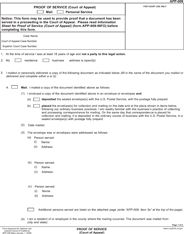
To understand the act of writing within the particular context of the legal self-help clinic, it is important to describe both the writing materials and the reasons those materials have taken their particular forms. As Don Brenneis (Reference Brenneis and Riles2006, 43) points out, “the authorship of the final documents is always shared—and often contested in terms of the fit between the literal framers' intentions and the respondents' texts.” In this section, I introduce the writing material that one is most likely to find in the legal self-help clinic: a fill-in-the-blank template that may be printed in hard copy, but that more often appears in electronic form. The form may be tailored for various purposes; different templates exist, for example, for filing a notice of appeal, for requesting an extension of time to file a legal brief, or even, in some clinics, for writing the brief itself. Forms also are used to effectuate required technical requirements, such as the Proof of Service form, which attests that a document has been served on the other party (see Figure 1).
California Civil Case Information Sheet.

Designed to be easy for legal self-help litigants to use, online forms may be seen in the context of projects to make litigants more “legible” to the law by making it possible for litigants to write their claims and legal arguments in ways that are comprehensible to the judges who must evaluate them (Rasch Reference Rasch2011). However, these forms also may be considered as a means to make the law more legible to ordinary persons, by presenting information and instructions in what legal reformers, policy makers, and court personnel commonly describe as “plain English” (Mellinkoff Reference Mellinkoff1963; Wydick Reference Wydick1978; Tiersma Reference Tiersma1999).
The emphasis on legal forms can be traced back to the nineteenth century, when there arose a popular movement to make law more accessible to the “common man.” Reflecting the theoretical populism of Jeffersonian Democrats, this movement rejected the perceived “aristocracy” of the professional bar and celebrated the “natural right” of citizens to practice law (Blackard Reference Blackard1939). Focused on improving lay knowledge of the law, there appeared at this time dozens of handbooks advising “‘every man … to be his own ready lawyer’” (Isaacs Reference Isaacs1915, 547). John Wells's Every Man His Own Lawyer is exemplary of such guides. First published in 1847, the book enjoyed significant commercial success, attaining, in the words of its author “a larger sale, it is believed, than any other work published within its time.” The introduction to an “improved edition” of the book promised that “[t]he professional man, the farmer, the mechanic, the manufacturer, the soldier, the sailor” would find within the book's pages
a convenient, comprehensive and reliable work which will enable him to draw upon any instrument in writing that may be required, in reliable form … A book that everybody can understand and that will enable every man or woman to be his or her own lawyer. (1879, 7)
Wells's book contained more than 500 pages, which were filled with dozens of fill-in-the-blank forms for such legal acts as conveyances, wills, mortgages, powers of attorney, landlord and tenant, debtor and creditor, and bills of sale, as well as patents, claims for bounty and arrears, fence-viewer's certificates, and so on. For Wells—and authors of similar guides—the reduction of legal practice to simple forms promised a means for persons to protect their “rights and privileges” that would “save them money, save them trouble, save them time, and save them lawyers and litigation fees” (1879, 7). These authors' explicit argument, couched in terms that would fit comfortably in any contemporary self-help guide, was that a person need not know special pleading rules or principles; he or she need only understand the nature of the problem, find the form that related to it, and fill in the blanks. Under such logic, paper forms functioned as instruments of a nascent democracy, primed to break down the perceived class and education barriers that separated members of the bar from those with legal needs.
Not everyone embraced the idea of turning “every man” into his own lawyer. The law professor and legal scholar Roscoe Pound bemoaned what he termed a “cult of incompetence” that emerged in the guise of democratic empowerment. The need for specialized education and training were only natural, he argued, in a society where “the growing importance of the social interests in security of acquisitions and security of transactions called for more detail and hence greater certainty of legal rule” (1914, 14). An increasingly complex society generated increasingly intractable social problems, and Pound was a fierce advocate for “ambitious schemes of social reform”—schemes that he asserted would call “not for less training and less specialization … but for more” (17). Simplified forms thus had no place in the practice of law as Pound envisioned it. Indeed, the fill-in-the-blank forms featured in “every man” guides were exemplary of the very kind of “mechanical jurisprudence” Pound (Reference Pound1908) hoped to purge from US law and legal practice.
Yet it was precisely in service of “ambitious schemes of social reform” that the form has emerged as a fixture in legal practice. Specifically, the development of simplified fill-in-the-blank forms arose as a primary means of addressing an “explosion” in the population of self-represented litigants (Greacen Reference Greacen2002). There is no right to counsel in civil cases, and an increasing number of litigants appear in court without a lawyer to represent them. Some courts estimate that as many as 90 percent of their cases involve at least one self-represented litigant.Footnote 6
Recognizing that litigants without lawyers are at a disadvantage in navigating what Pound rightly predicted would become a specialized system, a loosely coordinated group of reformers and advocates have urged the adoption of simplified forms and created legal self-help clinics in which litigants can obtain help completing them. Since 1991, when the first self-help clinic opened its doors in Maricopa County, Arizona, more than 500 such clinics have opened around the nation and serve nearly 4 million litigants in civil courts (ABA 2014). Recent surveys suggest that fill-in-the-blank forms today serve as “the most basic and common tool on the continuum of legal assistance” offered in these legal self-help clinics (Reasoner, McAllister, and Sales Reference Reasoner, McAllister and Sales2012, 7; ABA 2014).
Although commercialized forms, such as those published by the Nolo Company, might be the most familiar to readers, most of the forms used in courts today have been developed by groups working under the direction or with financial support from states' judicial councils. The ongoing design process aims to produce forms in language that is understandable to an “ordinary” person. As one of the volunteer attorneys at the Appellate Legal Self-Help Clinic explained to a litigant working to complete a change-of-address form:
And I'm actually gonna say something that you may or may not like to hear, but the State of California is, is taking huge, huge steps with the ABA [American Bar Association] to make things easier for people, for lay people to get into court … [They] have gone through great lengths to make forms that people can read. While you may think that it was easier years and years and years ago, I would say thirty percent of this form would have been in Latin, fifty, sixty years ago. You know, you just would have no idea. (Clinic Meeting #3, 1/18/13)
The “huge, huge steps” that this attorney described are part of a nation-wide effort to improve what legal reformers broadly refer to as “access to justice” (Steinberg Reference Steinberg2015). These efforts—which include opening legal self-help clinics—strive to make courts more accessible to litigants without lawyers by making it easier for them to understand and complete the necessary paperwork in proper form. Making it possible for “every man and woman to be his or her own lawyer,” as John Wells put it more than a century ago, thus has become not only a means of democratizing legal practice, but also an important means of producing more responsible judicial subjects.
Legibility has become a touchstone for advocates interested in helping litigants to craft the “right paper.” Once the writing process gets underway, however, this concern often recedes to the background—it has structured the form on which participants write but does not necessarily define what they define to be “right.” To understand the contours of the “right paper,” we must look beyond the explicit logics of simplicity and legibility. As anthropologist Matthew Hull (2003, 293) argues, it is important to attend to the details of how written artifacts are made and received—the logics that propel them into being—because form and function are never isolated, “[t]he material disposition of artifacts and the semiotic processes that involve them are mutually conditioning.” Following this logic, I argue the obvious but important point that there is no one way in which to write the “right paper.” To determine “right,” we must attend to qualities called into relevance in various accounts, examining how the concept of “right paper” is invoked by participants as they engage in legal practice. To do so, I now turn to the Appellate Legal Self-Help Clinic and the meetings I observed there.
The Appellate Legal Self-Help Clinic
The Appellate Legal Self-Help Clinic opened in 2007 as the product of a unique collaboration between the California Court of Appeal, the Appellate Courts Committee of the Los Angeles County Bar Association, and Public Counsel, a public interest law office that oversees the day-to-day operations and staffing of the Clinic. At the time of my study, lawyers at the Clinic provided information and advice to any litigant who did not have a lawyer and whose case was on appeal in the California courts. Between 2007 and 2014, more than 2,300 litigants came to the Clinic on at least one occasion, with a peak attendance of 429 attendees in 2011.Footnote 7
It is important to acknowledge that this clinic specializes in appeals, which are governed by rules and procedures distinct from the trial courts that have typically been the subject of sociolegal inquiry into the legal system. Because appellate courts typically review only questions of law, and rarely adjudicate facts, the content of the writings discussed here are be different than they would have been if prepared for a trial court. I selected this clinic because the court and Clinic Director were willing to accommodate this research, including the use of audio and video recording. Based on my observations and experiences in other clinics, however, I would suggest that although the appellate process is distinct, the writing process is not, and the strategies and interactions discussed here may be found even outside this unique context.
Lisa, the Director of the Appellate Self-Help Clinic, has more than twenty years experience in appellate law and frequently appears on the California list of Super Lawyers. In her role as a clinic attorney, however, she did not perform the work for which she has been so frequently recognized. Rather than write briefs and argue in court, Lisa instead described her work to me as making sure litigants' “papers are in order.” In return, litigants repeatedly told me that Lisa was “very, very helpful,” that she “answer[s] all questions,” and “that she'll make sure your paperwork is right.” One litigant's response to my question about what he found “most helpful” at the Clinic is indicative of even the unprompted assessments of the Clinic that I heard from litigants at almost every meeting:
Interviewer: What's the most helpful thing about being here?
Litigant: Um, she does all the work. [Group laughter.] No, she—it is, I can't tell you what it's like. It's like Katrina hits you and then the skies open up because you've got somebody that you can go to … . So when I come in here, you know, [they'll] explain what research I have to do and they tell you what's possible, what's not possible, and help with the paperwork. It's just knowing it's there and knowing that you can come and get help. (Clinic Meeting #1, 10/10/12)
This litigant's metaphor of the Clinic as a clearing amidst a storm highlights a commonly expressed perception of the Clinic as a refuge from all the antagonism and confusion that so often accompanies litigation. Indeed, many of the litigants with whom I spoke told me they felt a tremendous sense of relief after coming to the Clinic, and they came back repeatedly, visiting each time they were required to do something in order to move their appeal forward. Throughout these meetings, attorneys and litigants work together to complete the necessary paperwork and produce something that is “right.”Footnote 8
Writing the “Right Paper”
Questions of “right” are at the heart of law, but this does not mean that there exists a standard or universal meaning of that term. Rather than attempt to define or categorize what it means to be right in law, I present here, in descriptive form, the various meanings of “right” that emerged in conversations between attorneys and litigants in the Appellate Legal Self-Help Clinic. I annotate this list with contextual examples articulated by different litigants in the Clinic meetings that I observed and recorded:
-
• Provided by law—as in, “So, that I have the right to appeal before the Civil Service Commission” (Clinic Meeting #2, 10/19/12).
-
• Conforms to fact—as in, “Q: So you had asked for a court reporter's transcript? A: Right” (Clinic Meeting #7, 11/16/12).
-
• Conforms to rule—as in, “I had to refile the other one because I didn't put the right respondent” (Clinic Meeting #1, 10/17/12).
-
• Present state—as in, “But the thing [is], I can't have a lawyer right now. I don't have enough money to pay rent, child support, bills, and also the funeral bill …” (Clinic Meeting #3, 10/26/12).
-
• Correct in action or judgment—as in, “But you know I have a thing for standing up for what's right. You know I just don't like the fact that somebody doing something wrong and getting away with it” (Clinic Meeting #1, 10/12/12).
-
• Good or proper outcome—as in, “I hope it's [family law practice] heading in the right direction with … collaborative law and all that” (Clinic Meeting #1, 10/10/12).
-
• Personal entitlement—as in, “I have a right. If I have a right, I have to protect myself” (Clinic Meeting #10, 10/17/12).
On the surface, these categorizations offer a simple mapping of the multiple meanings of “right.” While such definitions are, to some extent, relative to person and context, they also are organized around the presence or absence of a verifiable standard: a fact exists or does not, a rule states a requirement that is followed or not, an action appears wrong or not. In the Clinic context, “right” is tightly associated—even identified—with measurable, recognizable characteristics that, more often than not, manifest in the seemingly mundane technical details of writing.
Of course, how these details are crafted and read is at the same time constrained by the material forms and ideological frameworks of legal self-help. The “right paper” is both a thing and an idea, and my ethnographic exploration of the concept necessarily moves in and through the different discourses and practices. These offer in turn a tangible manifestation of those individual interactions and institutional constraints that together give to legal papers the qualities of being “right.” In this section, I focus on these forces through one meeting between a litigant who I call Peter, and Lisa, who was the attorney staffing the Clinic that day.
No meeting in the Clinic was ever exactly the same as another, and I do not intend Peter to be a generalization of self-help litigants. However, in Lisa's meeting with Peter—as in the meeting with Omir, and with the other litigants quoted throughout—I did observe patterns in the ways such meetings unfolded, especially in the techniques through which writing, in its various forms, was accomplished. I am presenting an extended analysis of this one meeting with Peter rather than summarizing multiple meetings so as to allow maximum opportunity to examine and analyze the strategies and techniques that informed the writing process in the Appellate Legal Self-Help Clinic. The meeting between Lisa and Peter is especially useful for analyzing such patterns because it included a discussion of several different forms, which highlights multiple writing strategies; because the procedural history of Peter's case was relatively straightforward, which makes it possible to provide the necessary legal context with minimal explanation; and because the meeting, while lasting more than an hour, included few interruptions and thus allows me to offer a more seamless presentation of the writing process here.
In my exploration of that writing process, I rely on multimodal discourse analysis, which examines how the sociocultural world is produced through not only language but also different modes of communication, including inscriptions and embodied actions such as gesture and gaze (see Kress and van Leeuwen Reference Kress and van Leeuwen2001; Jewitt Reference Jewitt2008; Kress Reference Kress2009). I began this analysis by reviewing my notes and the transcripts of the Clinic meetings, reading the conversations as an important source of information about the writing activity that takes place in the Clinic (see Knorr-Cetina and Amann Reference Knorr‐Cetina and Amann1990). Through an iterative open coding process, I identified key writing processes and interactions. Focusing on examples of these processes in the videotaped meeting between Lisa and Peter, I expanded my analysis to include other modes of communication, noting for each excerpt reproduced here the participants' intonation, gestures, spatial orientation, and also the use of material objects such as papers, pens, and computers. Taken together, attention to multiple modes of communication facilitates a more holistic understanding of interpersonal, instructive, and embodied interactions, and presents an assemblage of complementary resources for examining how the “right paper” is produced, shaped, and constituted in and through different practices.
As they negotiate access to law and information through and across multiple forms, Lisa and Peter make visible how law transforms lived experiences—of loss, poverty, and divorce, for example—into legally cognizable claims. My empirical analysis shows in detail how such claims are actively interpreted, formatted, collectively configured, and then put on paper. I first introduce Peter and provide information about his case and the history of his interactions with Lisa and the Appellate Legal Self-Help Clinic. Next, I follow Peter and Lisa as they engage in the process, first, of sorting through the necessary appellate forms; then formatting a transcript; and, finally, filling in a Designation of Record form.
In attending to each of these activities, I suggest that the forms that pervade the Clinic space are imbued with specific logics and practices, and I highlight the articulation of such practices in the interactions between Lisa and Peter. In doing so, I do not offer a specific definition of the “right paper,” in part because a single, unitary definition does not exist, but also because my aim is to move away from the static, formulaic conceptualization of law memorialized by the trope of law-in-books and toward an understanding that accounts for the dynamic and situated character of legal writing. Aesthetics, conventions, ideologies, and creativities all emerge and intersect in the development of legal paperwork. Their unique combination in the particular circumstances of practice is what in fact gives rise to something that may be recognized as the “right paper.”
Initiating the Writing Process: Selecting the Proper Forms
Peter visited the Clinic one afternoon in January 2013 because he wanted to appeal an order entered by the trial court in his divorce case. The Clinic was busy that day, and I did not have the opportunity to interview Peter. In the course of the meeting, however, I learned that he is a doctor, and Lisa later told me that he used to be “well-known, a professor maybe.” I also learned that Peter was receiving California disability benefits and, as Lisa explained, this meant that he would be eligible for a fee waiver that would allow him to file his appeal without paying the approximately $900 in required fees. Peter had visited the Clinic before and, with Lisa's help, he had completed the forms required to start his appeal, but—due to some confusion over the filing fee—he had not yet filed those forms.
At the beginning of the meeting, Peter tells Lisa that he plans to file his initial paperwork in a few days, and he now wants to focus on completing the Designation of Record form, which will be due ten days after he has filed his other paperwork. The Court of Appeal generally does not consider new evidence—it reviews what was assembled in the trial court through motions, testimony, and the presentation of evidence. There are many documents that comprise a record and these are not automatically forwarded to the Court of Appeal. Instead, the appellant must “designate the record,” meaning that he must identify what part or parts of the record he would like to be considered by the Court of Appeal. The Designation of Record is thus both a document and an action, for once it is filed, it sets a whole process—the assembly and transfer of the record—in motion.Footnote 9
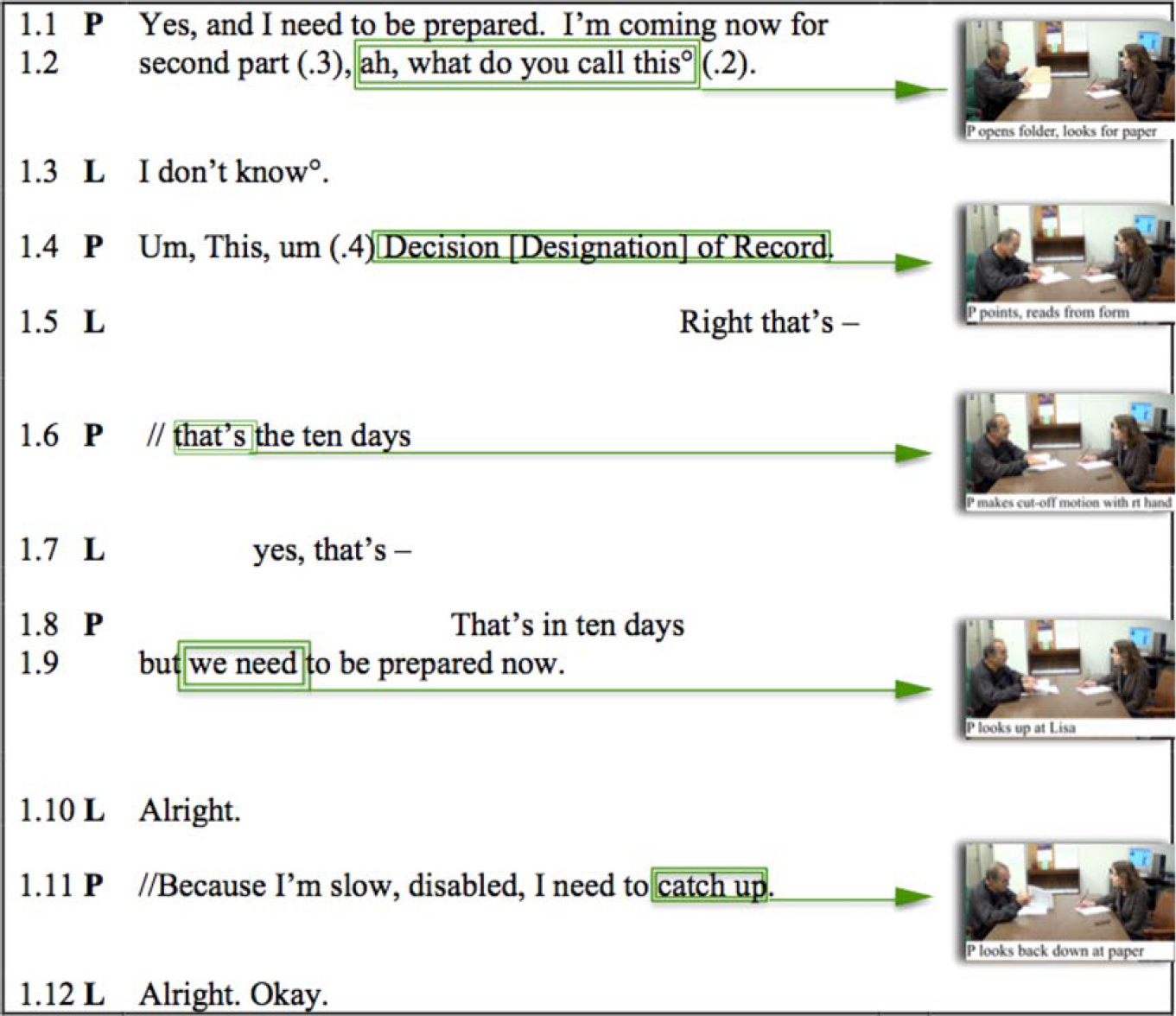
Excerpt 1
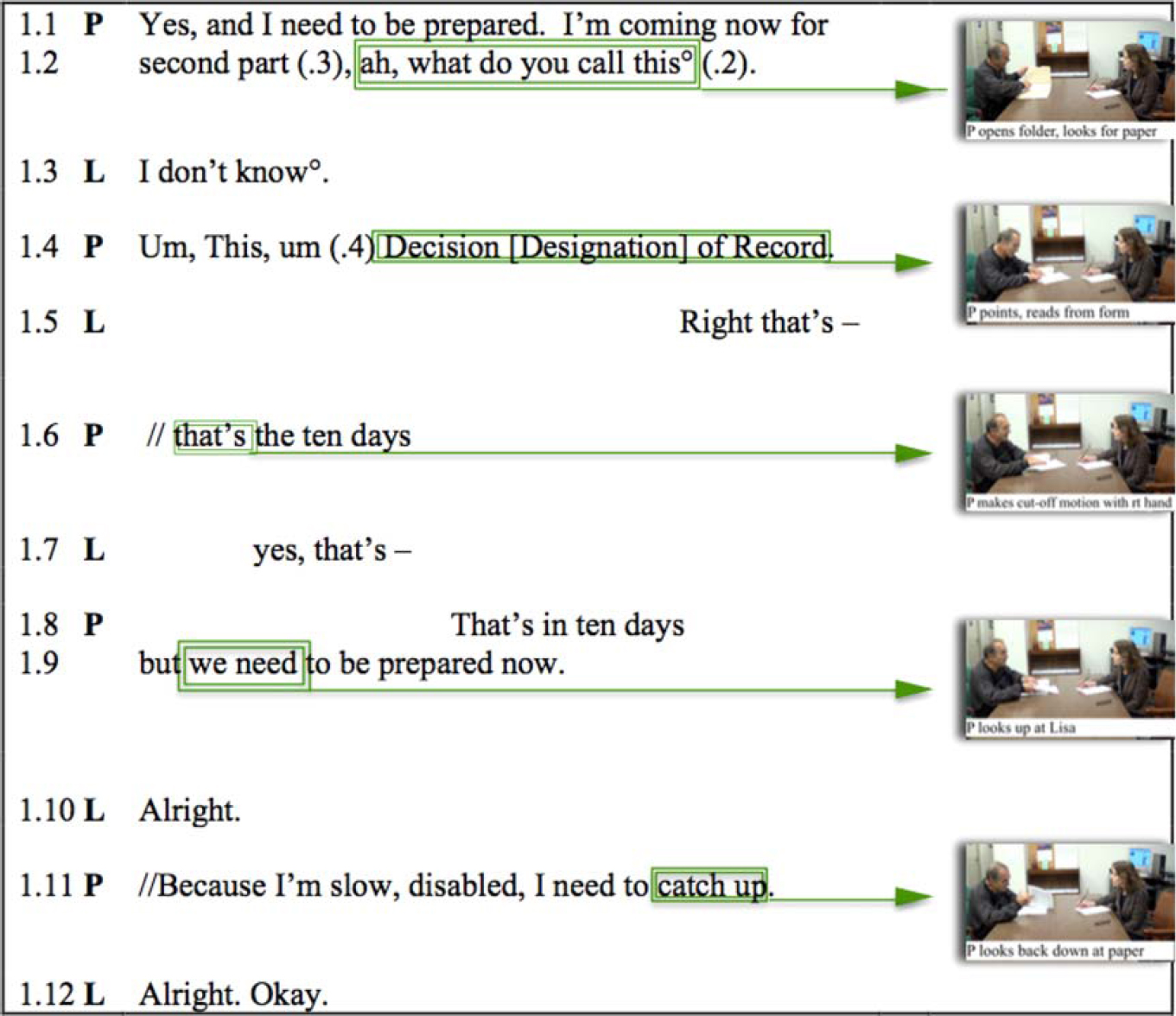
It is important to note that the meetings between attorneys and clients do not follow a standard script, and that the central activity is frequently defined, as it is here, by the litigant's expression of “need” or “want.” Peter's assertion that he “need[s] to be prepared” (Excerpt 1, line 1.1) defines the purposes and bounds of his visit and the subsequent activity. It is the main idea, the reason for the meeting. Peter's statement prompts Lisa to pick up her pen and poise it expectantly over the blank sheet of paper in front of her.
Peter also has a sheet of paper in front of him. The paper he looks at is a printout of instructions for filing an appeal, which Lisa had given to him in a prior meeting. Peter consults the paper—tracing the words with his finger as he reads (line 1.4)—to articulate what it means to “be prepared.” The paper momentarily supplants Lisa as a source of knowledge about the appeal process. With it in hand, Peter asserts further control over the conversation to impatiently assert the information that Lisa tries to convey in the present meeting (line 1.6). In doing so, he interrupts Lisa both verbally and with a brusque hand motion, indicating urgency to the task he proposed (line 1.6). Although Lisa expresses agreement, Peter appears to sense a latent objection, and reasserts that “we need to be prepared now” (line 1.9), even though they in fact have more than a week to complete this form. The switch from first-person singular to a plural “we” further clarifies Peter's vision of the Designation of Record as a joint venture—a collaboration that he justifies by explaining that he is “slow, disabled” (line 1.11).
While acknowledging Peter's “need” to begin work on the Designation of Record, Lisa does not immediately turn her attention to that task. Her pen hovers mid-air as she clears her throat and asks if she might look at the stack of papers that Peter has in front of him (Excerpt 2, line 2.1).
Excerpt 2

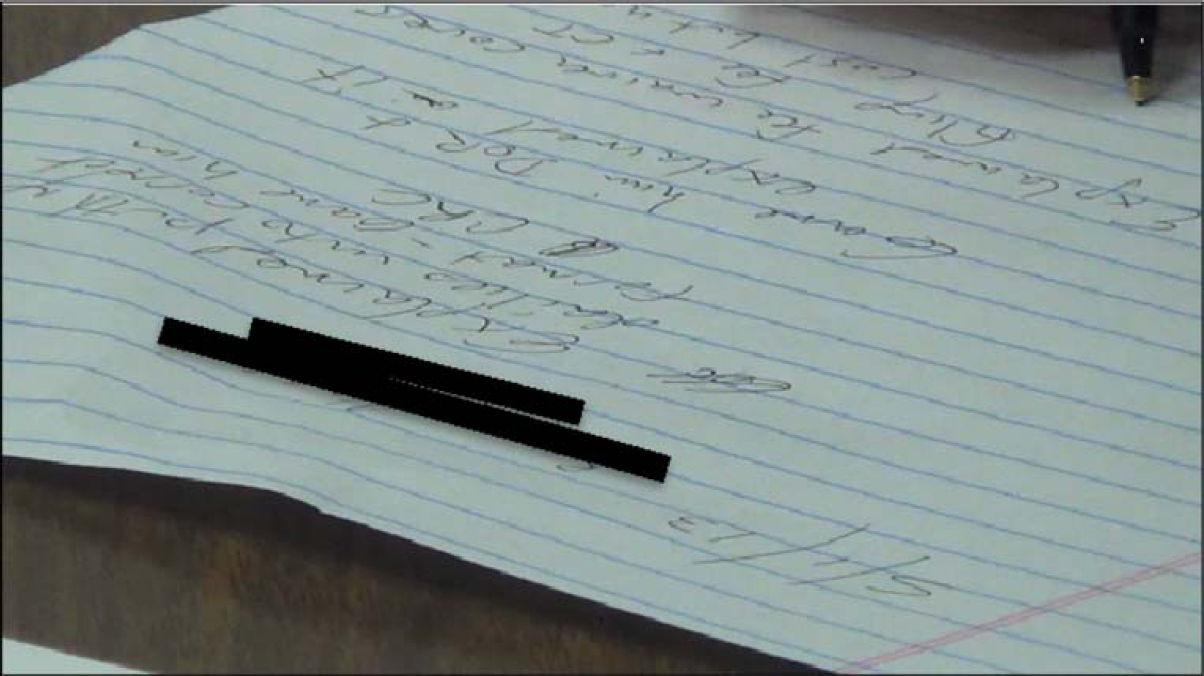
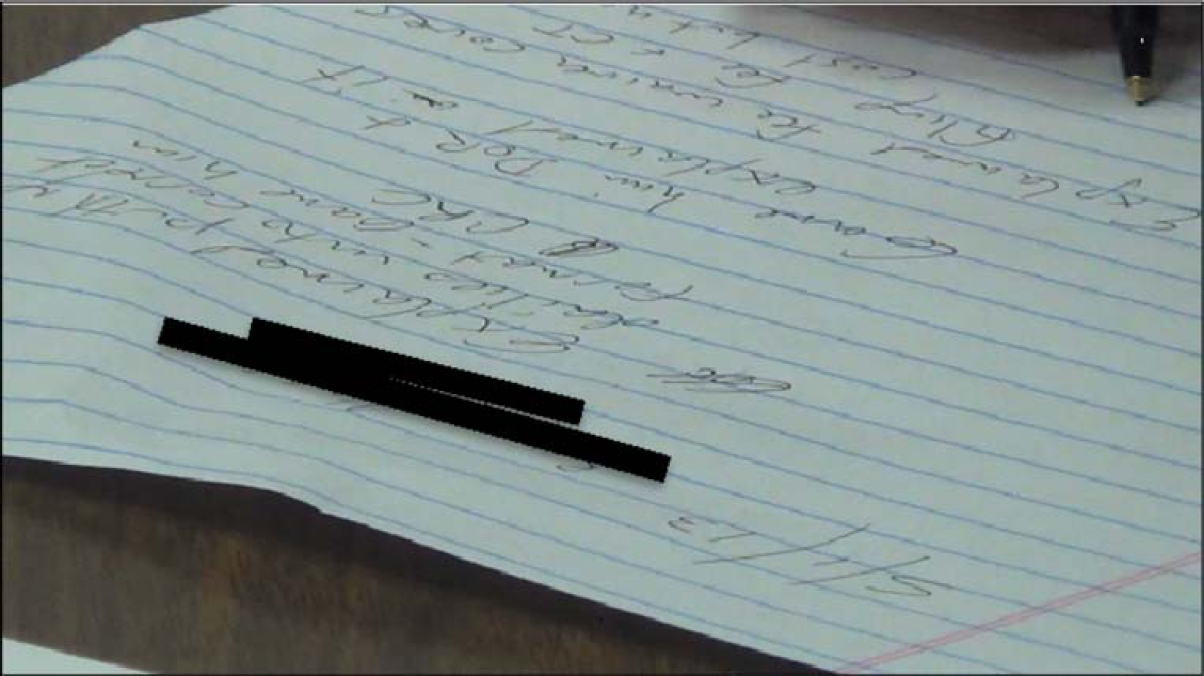
Up to this point, Lisa has been sitting in the same expectant pose. Once she has the papers in hand, though, she springs into action, moving her eyes rapidly across the pages and scribbling on the lined notebook sheet in front of her. She is jotting down information, making notes for her file. Indeed, over the course of their meeting, Lisa will transform this separate paper into a chronology of her meeting with Peter, making a record of the topics they discussed and tasks they completed, while also keeping track of the papers that they printed and consulted (Figure 2). Just as the papers seem for Peter to substitute for the information that Lisa might otherwise have provided, so these notes will serve for Lisa as a substitute for Peter's story in the future. Lisa can shorten or even obviate this sort of planning conversation in future meetings, for she can simply refer to her notes and determine exactly what they have done, and, by extension, what still needs to be done.
Lisa's Handwritten Notes. [Color figure can be viewed at wileyonlinelibrary.com]
As she writes, Lisa's attention remains focused entirely on the papers in front of her, seemingly oblivious to Peter's steady monologue. She does not look up until, after flipping through the papers that Peter has handed her, she sees a Request for a Fee Waiver form, and this prompts her to begin a new topic of conversation. After several minutes of conversation, during which Lisa explains fee waivers, Peter hands her a collection of papers bound in book form with a clear plastic cover and maroon backing. This rudimentary book is the Court Reporter's Transcript, which is a written transcript of his hearing in trial court. The transcript is an essential component of the record on appeal and Lisa quickly shifts from explaining the fee waiver to explaining what Peter must do to format the transcript so that it can be submitted to the Court of Appeal.
Writing is more than making marks on a page. It also, as de Certeau notes (1984, 134), “has power over the exteriority from which it has first been isolated” to organize—but also to foreclose—possibilities of lived experiences in the world. We see this power at work in the Clinic, as Peter and Lisa follow the path laid out by the papers in front of them. Although their meeting began with Peter expressing a “need” to complete the Designation of Record form, their interaction over the next ten minutes barely touches on this form. Instead, as reflected in Lisa's notes (Figure 2)—which tie acts of “explaining” to specific paper forms—the conversation jumps from subject to subject, dictated by whatever paper Peter or Lisa happen to be looking at. The “right paper,” as expressed here, is that which fits comfortably into the collection of existing papers. It is a missing piece that must be slotted into the picture of the case assembled by the papers already in hand.
Formatting and Assembly: Preparing the Reporter's Transcript
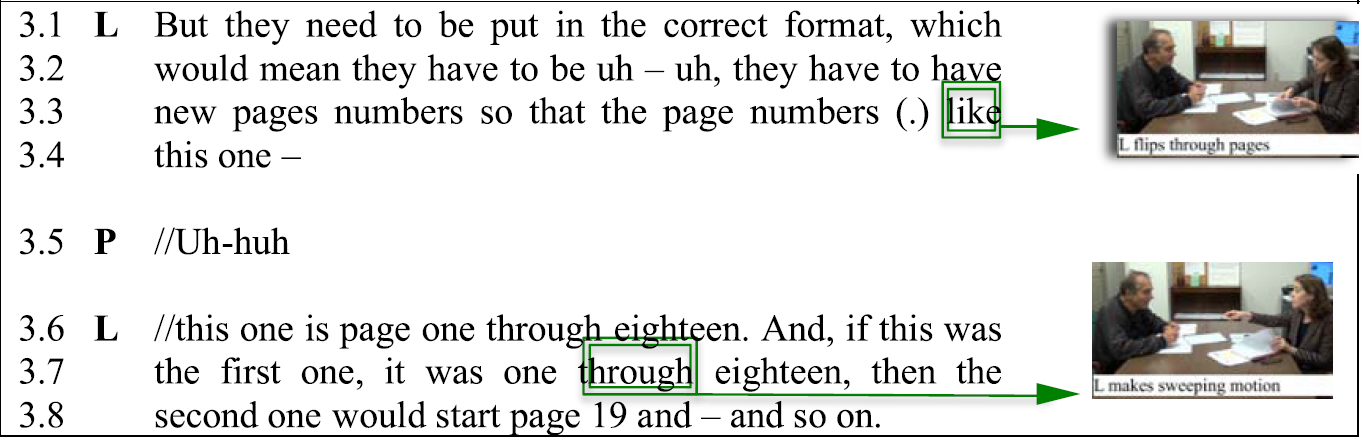
What is “right” in one sense, however, does not hold consistently across contexts. Thus, the Reporter's Transcript that Peter hands to Lisa is “right” in that it fits into the chronology of papers in the folder. Having completed the Notice of Appeal, and several other forms that already are in the folder, the next step is to assemble and present the Reporter's Transcript. However, this transcript cannot simply be handed to the court; it must be presented to it in a certain form. Lisa explains that the booklet Peter has showed her is what's called a “daily.” That is, it is prepared at the end of each day and begins anew the next day. Nodding knowingly, Peter confirms that he has “like, 40, 50” dailies. In the next excerpt, Lisa tells him that he cannot simply hand these to the court; they must be put in a different, “correct format” (Excerpt 3, line 3.1), meaning that they must be renumbered.
Excerpt 3

At first glance, the repagination requirement that Lisa explains seems a strangely onerous task, one that would seem to privilege the aesthetics of paperwork (Riles Reference Riles1998). However, there is more to it than simple formatting. Although Peter experienced his divorce trial over several days (or more), the Court of Appeal considers the trial to be one long, uninterrupted event. Continuous pagination reflects this sense of time and—through this simple edit—renders seemingly disparate events instances of the same thing. Lisa actively demonstrates this to Peter by using her hand to carefully and continuously mark out imaginary pages in a sweeping motion across the empty space extending out from the booklet on her desk (line 3.8). The continuity in her motion, as in the pagination, reflects, and also enacts, a seamless temporal and spatial connectivity.
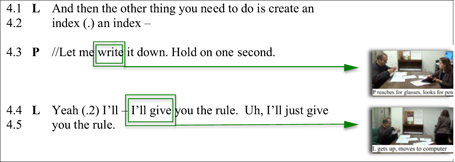
Repagination is but one example of the formatting that Peter must undertake to make the Reporter's Transcript “right.” In what follows, Lisa explains that he must also create an index (Excerpt 4, lines 4.1–4.2). In the middle of this explanation, Lisa turns to her computer (line 4.4.), types for a few seconds, and the printer whirrs into action. The paper that Lisa prints and lays on the desk in front of Peter is a copy of the relevant rule that specifies the format for the Reporter's Transcript. It will serve as both reference and authority for the instructions she provides.
Excerpt 4

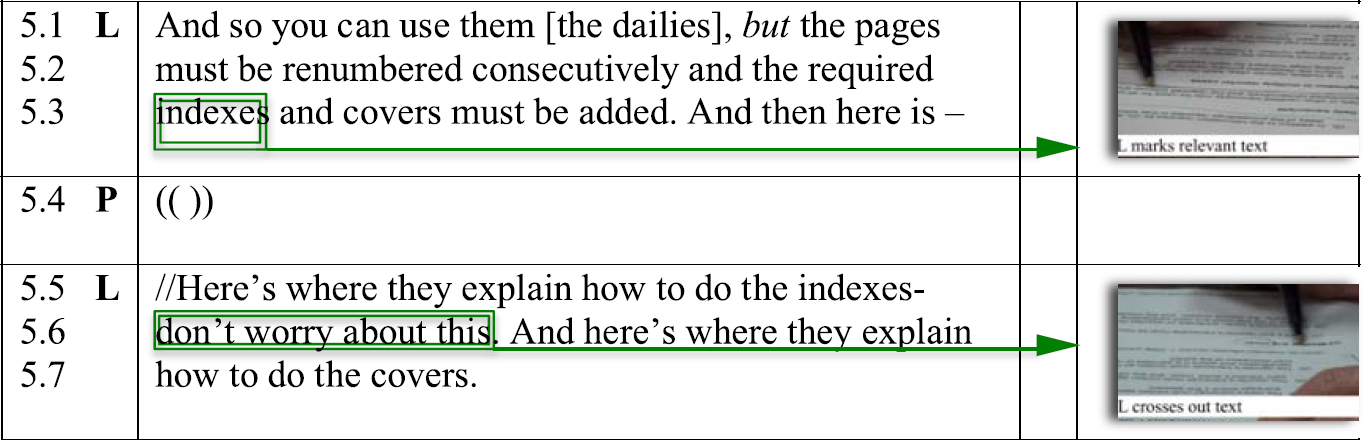
Excerpt 5

In Excerpt 5, Lisa singles out the section of the rule that refers to the formatting of a transcript. She uses her pen to highlight (Goodwin Reference Goodwin1994) the specific details under consideration. Through these markings, Lisa leaves a trace of the ongoing conversation, emphasizing words by underlining them (line 5.3), and crossing out text that is irrelevant (Excerpt 5, line 5.6). In this way, she commits abstract instructions into an enduring and material record, preserving them for future tasks. In a sense, she uses the paper as what Clark and Chalmers (1998) call a “cognitive resource”: an object “coupled” to the mind that directs thought and action in the world.
In the first part of this sequence, Lisa relies on imperative commands—for example, “must be added” (line 5.3)—which, for all their insistence, lack the force of authority, for it is not entirely clear who demands this action. In the latter half (lines 5.5–5.7), Lisa links her commands to the paper, which—while still embodying an uncertain “they”—provides the basis for the action she has just outlined. By tacking back and forth between the requirement and the authority for it, Lisa is modeling for Peter the process that he must follow to develop the “right paper.”
Not every decision Peter must make can be found in the printed rule, however. For example, the rule does not dictate what content should be included in the index, and Lisa supplements the paper with additional explanation (Excerpt 6, lines 6.1–6.2). Peter must anticipate what arguments he intends to make to the Court of Appeal, and what evidence he will need to support each of his assertions. The index that Peter and Lisa are constructing graphically represents the exhibits to be included in Peter's appeal, but, more than that, it becomes a workplace (Lynch Reference Lynch1985) in which Peter must work to strategize and plan legal arguments before they are actually articulated. Lisa explains that, in writing the index, Peter must at the same time visualize the legal brief he will write in several months (line 6.2), and anticipate what evidence he will need to support his arguments. The index thus becomes an important site in which past activity is captured in a present writing act, which itself is entirely constructed with an eye toward future argument.
Excerpt 6

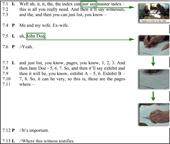
The function of the sheet as a resource for this process can be gleaned both from the participants' orientation to it throughout their conversation: they point to it, lean over it and direct their gaze to it, and mark it with graphic inscriptions that highlight and memorialize what they discuss in this intermediate interaction. Notice these gestures and actions in the discussion contained in Excerpt 7.
Excerpt 7

Even after Peter decides what exhibits he wishes to include in the index, he must actually write the index. As with most legal papers, there is a specific way of formatting this index, which Lisa demonstrates by writing (Excerpt 7, lines 7.1–7.3; 7.9–7.10). Here she formulates her explanation as a demonstration, transcribing her speech as she speaks, and lending the weight of the written document to her words as she speaks them. Once her words have been inscribed on the paper, the possibilities for mobilizing them for future use are endless.
In this excerpt, it is possible to see how these inscriptions mediate both the interactions between Lisa and Peter, and also between past and future actors and actions. Consider, for example, the creation of a right column, in which Lisa inscribes a series of numbers (lines 7.9–7.10). She explains that this is the format in which the index must be presented. The formatting is not arbitrary but is instead dictated by how the index will be used. Since exhibits generally are offered as evidence for a particular fact or argument, they must be meaningful in some way, but that meaning is neither absolute nor created by judges' interpretations. To derive this meaning, the judges must look to see how the lower court and litigants constructed that meaning in the trial court proceedings—that meaning, as well as the exhibit, will travel from the trial court to the Court of Appeal. The page numbers serve as a kind of index to that meaning, pointing the appellate justices to the text where they will find evidence for an interpretation of particular testimony, or exhibit.
As Lisa talks through all this with Peter, she uses reported speech to import the judges into the Clinic room. She tells him, for example, that the “point” of the index is so that “the justices, they'll have the exhibits, and they'll say, ‘This is an interesting exhibit. What did the witnesses say about this exhibit during the trial?’” The appellate court justices' reported need to see where the exhibits were discussed at trial is what dictates the dual columns of the index that Lisa drafts lines 7.7–7.11, and, specifically, provides the rationale for listing both the exhibit and the pages of the transcript where it is mentioned. These simple numerical inscriptions index the pages of the transcript where each exhibit is mentioned in the current record of evidence; they work to bring together future readers with the past proceedings.
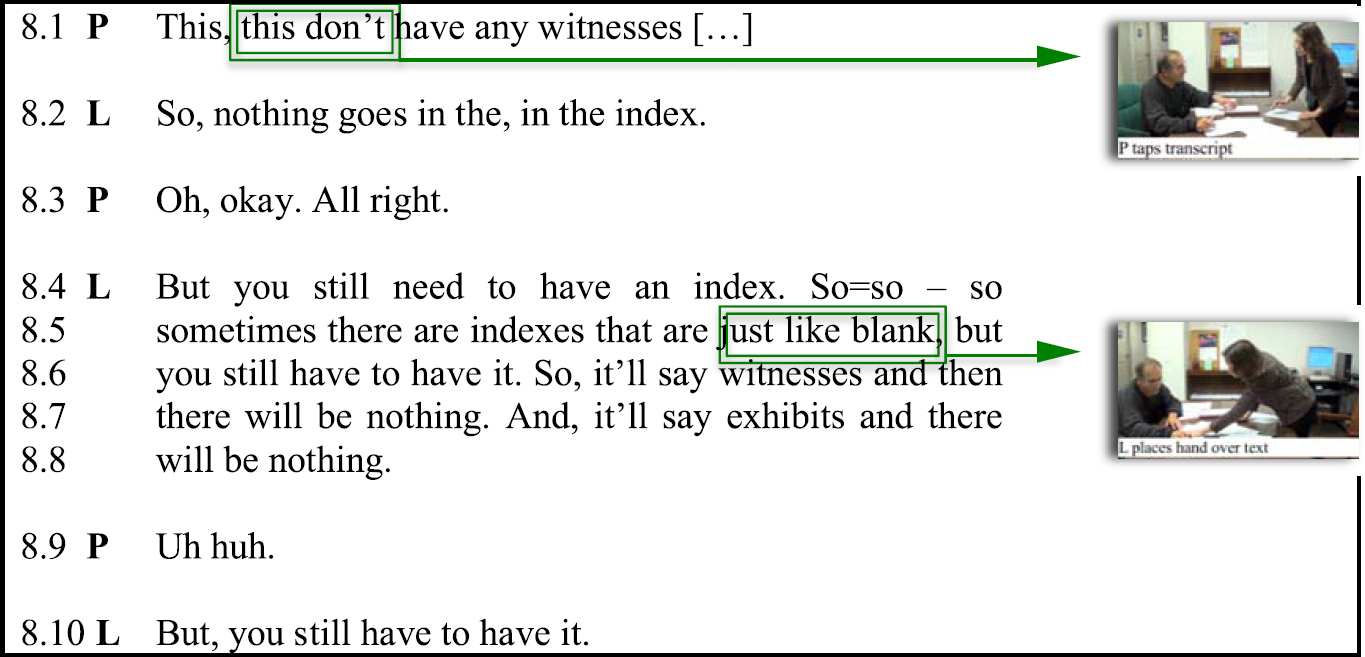
Although the index mediates between past and future, between Peter and the judges who will hear his appeal, it functions as something more than a mediator. It is a thing required to complete the paperwork, even though it may lack any substance. In the case of the index, meaning does not always derive from content. Peter tells Lisa that there were not even witnesses in the trial court—it was just attorneys arguing for both sides (Excerpt 8, line 8.1). Yet, as Lisa explains, he must still write the index, even if it contains nothing other than subheadings (lines 8.4–8.8).
Excerpt 8

When compelled to write an index, litigants must recall what happened in previous court proceedings and consider what evidence they can present in support of their appeal. The index materializes this memory. Its presence—its very “thingness”—signals that the act of remembering has taken place. The mere absence of an index, however, carries uncertain meaning. It could be an admission that there exists no evidence, or it might simply be an oversight, a failure to comply with one of the court's many technical rules. However, a blank index resolves this uncertainty, functioning as a placeholder for the absence of evidence, which, in an appeal, is as significant as the introduction of specific evidence. The index signals that the “right” process has taken place, even if the index cannot itself be written.
Creative Writing: The Designation of Record Form
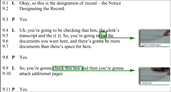
The writing strategies discussed thus far have mainly focused on papers that already exist, and that were, in fact, written by someone other than the litigant. This paper can be made “right” through a series of edits—repaginating, attaching an index, and the like—but it still will not be accepted by the court until it is transformed into a recognizably legal document. To effectuate this transformation requires returning to the form Peter originally referenced at the beginning of the meeting: the Designation of Record form (DOR) (Figure 3).Footnote 10
The First Page of the DOR Form
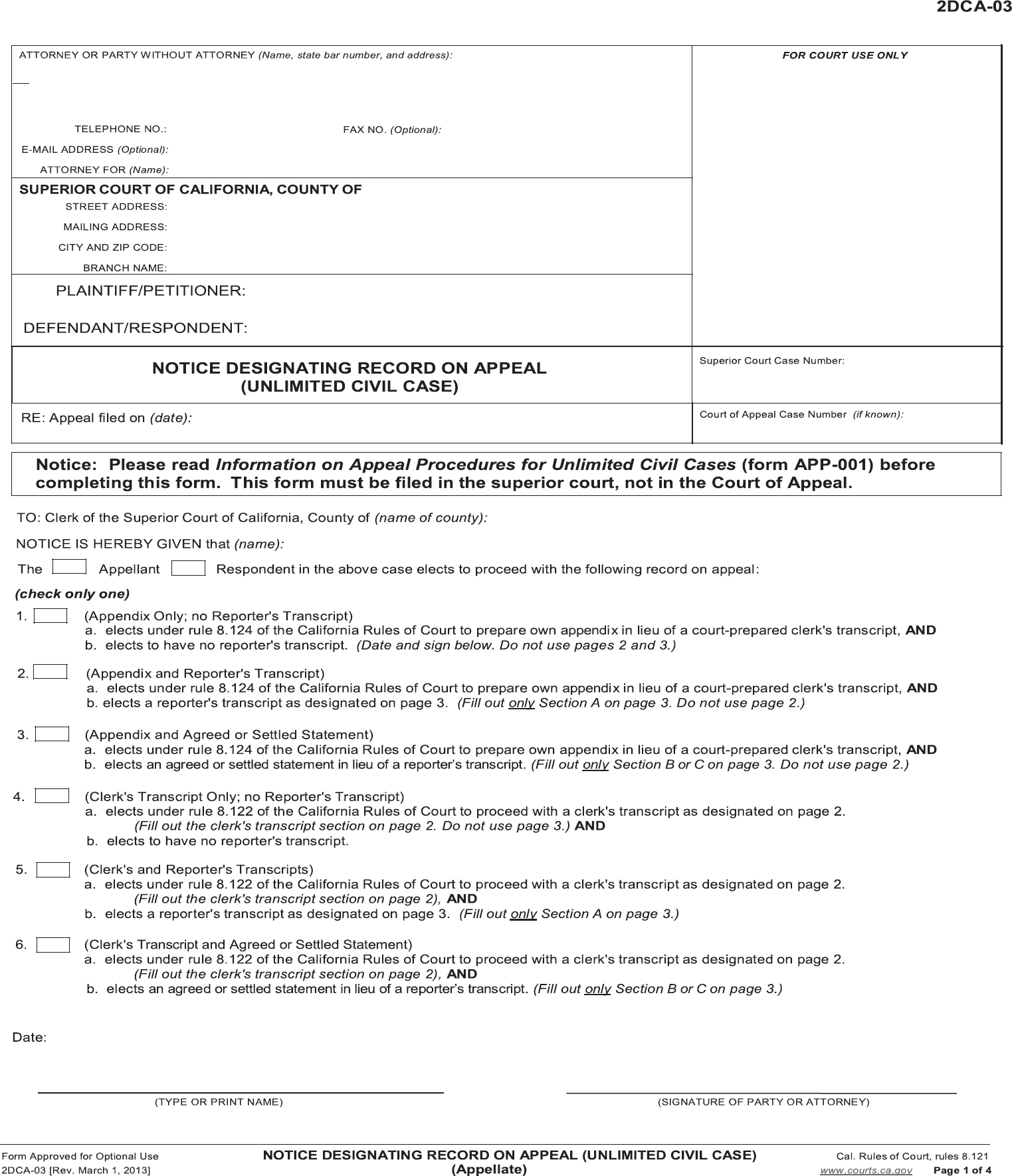
Several things are striking about the format of the DOR: the numbered statements arranged in outline form; the multiple references to rules that are not enumerated anywhere on that form; the blank spaces to fill in and the limited space in which to type or write; and the plethora of parentheticals. This form is indeed the product of an era of simplification—it eschews complicated legal terms and requires minimal effort by those completing the form. But the form's linear structure and neat boxes belie the very simplification that the form's creators once celebrated. The frequent references to other rules, and asides set off by parentheses, anticipate a more extensive knowledge about the law and require more than simply checking a box.
Another effect of all these asides and parentheticals is to index an assumed dialogue between the litigant and the institutional actors who created or will use this form. Different pronouns and sentence structures index the presence of at least two voices: a series of imperatives that directs “you” to complete the form in particular ways, and also affirmative statements that assert in the first person that he or she has complied with these instructions. This embedded dialogue both mirrors and codifies the legal process, which is comprised of a series of demands and responses. And, indeed, even such a simple form speaks to and for multiple audiences—some translation and explanation of its terms proves to be essential. This translation is precisely what Lisa tries to do in the segment of the meeting reproduced in Excerpt 9.
Excerpt 9

The act of filling out the form raises issues primarily concerned with deciding what content should be written: which boxes should be checked, which items should be listed in the spaces provided. The aesthetics of forms matter as well for, as Lisa acknowledges (Excerpt 9, lines 9.6–9.7), writing necessarily has to fit in the spaces provided. However, allowances can be—and are—made (for example, by expanding the form to include additional papers via attachment). This is one of several ways in which forms cease to be formulaic, opening up possibilities for modification based on individual circumstances and needs. Trying to produce the “right paper,” litigants enter into a play between conventions and creativity that requires them to know the rules but also to recognize opportunities for exceptions.
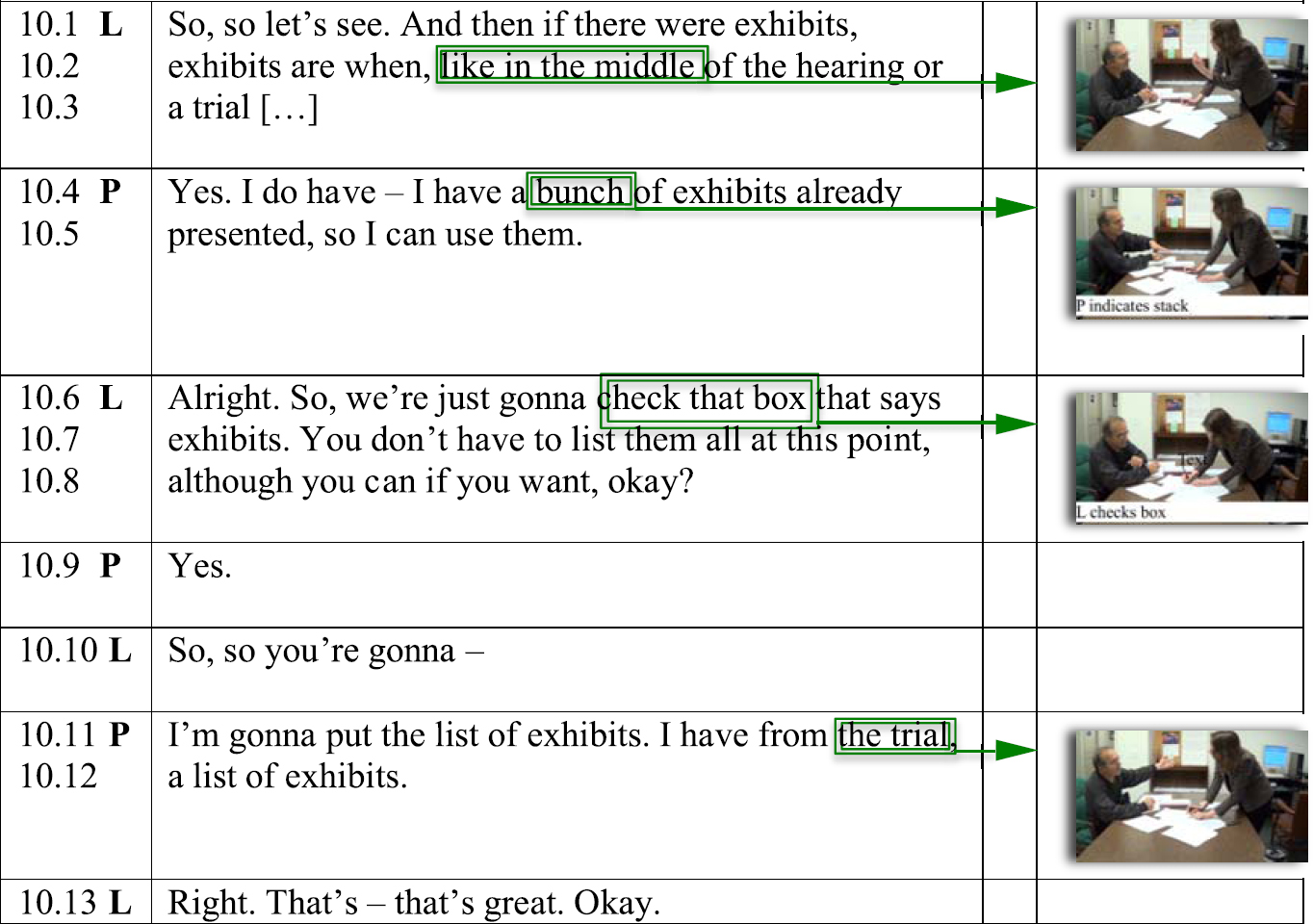
We can see this creativity at work as Lisa and Peter continue to discuss the DOR. In Excerpt 10, Lisa and Peter are no longer discussing witnesses and testimony, but instead focusing on exhibits, which are materials—bank statements, contracts, or other papers and objects—that were presented at trial and that Peter, for strategic reasons, might wish to use again in his appeal.
Excerpt 10

While Peter must indicate on the DOR that he intends to cite such exhibits in his appeal, he does not need to specify which exhibits he intends to use at this point (Excerpt 10, lines 10.6–10.7). Lisa signals that this is a point where Peter can deviate from the DOR form, listing exhibits if he “want[s] to” (line 10.8). The implication of Lisa's statement is that Peter should list the exhibits if he has them. This makes sense because Peter's claim ultimately will be stronger if he has sufficient evidence to support it; presenting a list of exhibits signals that such evidence is readily available. Peter acknowledges that he does in fact have “a bunch of exhibits” (line 10.4). He not only asserts this, but actively measures them by using his hands to form a stack, and moving imaginary piles across the desk from left to right (lines 10.4–10.5). Just as the written list materializes the substance of Peter's appeal, so, too, Peter's exaggerated gesture conjures the exhibits in the Clinic office, and further supports Peter's claims to Lisa. Having established that he does have many exhibits to present, Peter decides that he will in fact list them on the DOR form (line 10.11). Lisa confirms this decision as not only “great” but also as “right” (line 10.13). Her enthusiasm ratifies Peter's decision, and signals that his creative improvisation contributes to the achievement of the “right paper.”
Conclusion
There is a rich literature detailing the diffuse nature of civil disputing (Reese and Eldred 1994; Pleasence et al. 2006; Sandefur 2016). This study contributes to that literature by detailing how those disputes are shaped into cognizable legal claims. Rather than examine disputes that exist “in the shadow of law,” I examine disputes that are within the law—deeply entwined with the processes so often referred to as “law-in-books.” Although not typically the province of sociolegal studies, I argue that the disputes that take place in the context of a formalized legal process can be as intricate and dynamic as those taking place outside of it.
In this article, I thus have moved away from the notion of “formal law” as an isolated practice far removed from everyday life and everyday action to explore how law is dynamically produced in and through social interactions. Studying legal self-help services provides valuable insight into the emergence of law in a context in which law, and perceptions of law, are introduced and discussed by the participants themselves as they work through actual—rather than hypothetical—legal claims. Looking at law in this context foregrounds the “relational nature” of perceptions and understandings of law, making clearer the constituent social processes that underlie law while also offering the opportunity to examine how people make sense of law within the context of actual legal encounters (Young 2014, 516; Berrey, Hoffman, and Nielsen 2012). Understanding that legal service providers organize their interventions around producing the “right paper” is important because it redirects our attention to how legal services are delivered, and this has implications for how policy makers think about access to justice reform. Effective reforms will be those that not only make sense in an abstract way, but also those that are cognizant of actual practice and will work within and upon that practice. It therefore is crucial to understand how legal services are defined and delivered.
This study has endeavored to do just that by providing a close analysis of the way in which legal services are enacted in a legal self-help clinic—specifically, the ways in which self-represented litigants learn legal literacy. For all their aspirations to plain language and accessibility, the legal forms that litigants must fill out are not self-explanatory; indeed, the very fact that so many litigants seek help shows just how much litigants require assistance, even during an activity designed to facilitate their independence from attorneys. Without access to attorneys who can guide them through the mass of paperwork, many litigants would—as one clinic visitor put it—“have no idea what to do” (Clinic Meeting #3, 10/12/12).
Through such assistance, litigants learn that the “right paper” is easy to use and easy to understand; it is written in “plain English.” The “right paper” makes clear what needs to be presented and in what form so that clerks and judges are sure to see issues that need to be seen. And the “right paper” presents only those issues that the court can properly consider—leaving out in appeals, for example, extraneous information that was not previously presented in evidence or testimony. In this way, then, the “right paper” becomes a necessary component of exercising one's rights. In legal self-help, where paper forms have long been central to practices of democracy and claims making, attending closely to literacy practices helps make visible not only what constitutes law, but also highlights how people are made to understand law in the ways that they do. As interventions in the name of self-help multiply and pluralize legal practices, attention to the everyday practices of information and documentation in legal self-help clinics points to the politics and stakes of knowledge management and to the documentary bodies—both material and ideological—that animate law and its aspirations to justice.