Introduction
Research in the post-conflict mental health field supports a model of posttraumatic stress disorder (PTSD) symptoms, in which past exposure to traumatic events (TEs) and ongoing adversity both play contributory roles (Mollica et al. Reference Mollica, Sarajlic, Chernoff, Lavelle, Vukovic and Massagli2001; Steel et al. Reference Steel, Chey, Silove, Marnane, Bryant and Ommeren2009). The model does not take into account, however, the specific effects of traumatic losses (and associated grief symptoms) and the sense of injustice associated with exposure to human rights violations, distinctive characteristics of populations exposed to persecution (Boehnlein, Reference Boehnlein1987; Momartin et al. Reference Momartin, Silove, Manicavasagar and Steel2004; Silove, Reference Silove2013). We test an expanded model of PTSD symptoms that includes grief symptoms and a sense of injustice in a population sample from post-conflict Timor-Leste.
Several authorities have argued that the existential impacts of trauma need to be more fully acknowledged in understanding the pathogenesis and persistence of the PTSD reaction (Rogler et al. Reference Rogler, Cortes and Malgady1994). However, only a few studies in the post-conflict field have inquired specifically into these issues, the focus commonly being on the sense of injustice arising from exposure to human rights violations (Basoglu et al. Reference Basoglu, Livanou, Crnobaric, Franciskovic, Suljic, Duric and Vranesic2005; Rees et al. Reference Rees, Silove, Verdial, Tam, Savio, Fonseca, Thorpe, Liddell, Zwi, Tay, Brooks and Steel2013). For example, a study in the Former Yugoslavia found that a sense of injustice was one of several factors associated with PTSD amongst survivors of the civil war in that region (Basoglu et al. Reference Basoglu, Livanou, Crnobaric, Franciskovic, Suljic, Duric and Vranesic2005). In Timor-Leste (Rees et al. Reference Rees, Silove, Verdial, Tam, Savio, Fonseca, Thorpe, Liddell, Zwi, Tay, Brooks and Steel2013; Silove et al. Reference Silove, Liddell, Rees, Chey, Nickerson, Tam, Zwi, Brooks, Sila and Steel2014), we found strong associations between a sense of injustice and symptoms of PTSD, psychological distress (including depressive symptoms) and explosive anger. Similar results were found in relation to PTSD in a study amongst refugees from neighbouring West Papua, a population exposed to prolonged persecution and displacement (Rees & Silove, Reference Rees and Silove2011; Tay et al. Reference Tay, Rees, Chen, Kareth and Silove2015). As yet, however, little is known about the precise role that a sense of injustice plays within a comprehensive path model leading to PTSD symptoms.
Losses occurring in a setting of trauma may generate a persisting sense of injustice, which in turn may impact on PTSD symptoms (Horowitz, Reference Horowitz1986; Janoff-Bulman, Reference Janoff-Bulman1989; Herman, Reference Herman1992; Mancini et al. Reference Mancini, Prati and Bonanno2011; Smith et al. Reference Smith, Abeyta, Hughes and Jones2015). In civilian settings, bereaved persons who continue to ruminate about the injustice of their loss are more likely to experience a prolonged or complicated grief response (Eisma et al. Reference Eisma, Schut, Stroebe, Boelen, van den Bout and Stroebe2015). In addition to the sense of injustice, grief may be linked to PTSD symptoms in several ways. Exposure to atrocities confronts survivors with a direct threat to their personal safety in a context where they witness the violent death and injury of others, experiences that may trigger both a grief and PTSD reaction. In addition, core grief symptom, such as those involving preoccupations with, and yearning for the deceased, may act as triggers of PTSD symptoms. More general components of grief may exacerbate PTSD symptoms, for example, by increasing the tendency towards social withdrawal, isolation, avoidance and feelings of bitterness/anger.
The people of Timor-Leste experienced a prolonged period of conflict associated with extensive traumatic losses and human rights violations. After a brief civil war, Indonesia invaded the territory occupying it for 24 years (1975–1999), a period in which the indigenous population was exposed to extensive traumatic losses including widespread atrocities and extrajudicial killings (Modvig et al. Reference Modvig, Pagaduan-Lopez, Rodenburg, Salud, Cabigon and Panelo2000). Many Timorese died as an indirect consequence of the violence, for example, as a result of forced displacement, famine and illness. Following national independence (2002), a further period of internal conflict (2006–2007) resulted in deaths, injuries, burning of houses and internal displacement of communities (Silove et al. Reference Silove, Zwi and le Touze2006). These historical conditions are likely to have generated widespread reactions of grief and a sense of injustice within the survivor population.
Our overall objective in the present analysis was to examine the respective roles of grief symptoms and a sense of injustice in an expanded model of PTSD symptoms in a post-conflict society, Timor-Leste. We also examined the specificity of the pathways identified by testing two alternative models, in which indices of general psychological distress and grief were substituted for PTSD as the end points of the model.
Methods
Participants
The study was conducted between May, 2010 and November, 201l and involved a household survey of all men and women, 18-years and older residing in two villages in Timor-Leste. The sites were an urban administrative area (suco) in Dili, the capital of Timor-Leste and a rural village located an hour's drive away. Each administrative unit is defined by contiguous hamlets (aldeias) under the administration of one chief (chefe). Both locations were directly affected by the longstanding resistance war against the Indonesian occupation and by the subsequent episode of internal conflict that occurred in 2006–2007. We used GPS coordinates and aerial maps to locate all dwellings in the two locations. Participants provided written or witnessed verbal consent. The study was approved by the Human Research Ethics Committee of the University of New South Wales, the Ministry of Health of Timor-Leste and the chiefs of each village.
Measures
Exposure to conflict-related TEs
We assessed the 17 conflict-related TEs listed in the Harvard Trauma Questionnaire (HTQ) (Mollica et al. Reference Mollica, Caspi-Yavin, Bollini, Truong, Tor and Lavelle1992), modified to the context of Timor-Leste. TEs were assessed for the Indonesian occupation (1975–1999), and the subsequent period following national independence, which included the episode of internal conflict of 2006–2007. Items involved traumas directed at the self and others, including losses and separations. Typical items included political imprisonment, assault, torture, witnessing murder, exposure to atrocities, losses/separations of family or close others, and severe deprivation of medical care for self or others. We generated a composite trauma count (TC) by collapsing responses assessed for both historical periods; an item endorsed for one or both historical periods was assigned a score of 1 whereas a score of 0 indicated no exposure to that event for either of the two historical periods.
Ongoing adversity
We applied an inventory of daily adversities based on community consultations and refinement of items via an iterative process of piloting and feedback (Rees et al. Reference Rees, Silove, Verdial, Tam, Savio, Fonseca, Thorpe, Liddell, Zwi, Tay, Brooks and Steel2013). Items included, amongst others, insufficient food, inadequate finances (for school fees, to meet traditional obligations to family), poor shelter, unemployment and experiences of ongoing conflict (with spouse, children, extended family, young people and the wider community). The composite adversity count (AC) represented the addition of all endorsed items (1 = if an item was rated as a serious/very serious problem, 0 if rated as not serious/a less serious problem). The composite AC ranged from 0 to 27.
Sense of injustice
We asked respondents to identify and describe the worst acts of injustice they had experienced for the Indonesian occupation, the period of internal conflict and during contemporary times. By anchoring the inquiry to specific events, we aimed to avoid representing the concept of injustice in a purely abstract way. During piloting amongst Timorese drawing from a wide range of ages and backgrounds, we inquired into why participants nominated events as the worst form of injustice they had experienced. Participants offered reasons that were consistent with universal notions of injustice, referring to events as being grossly unfair, arbitrary and cruel which involved acts directed at the self or close others. They also characterized events as reflecting gross victimization or discrimination, usually involving abuses of power or intentional deprivations motivated by political reasons. In the study participants nominating an event were then asked whether the occurrence was a source of a persisting sense of injustice, and if so, whether their preoccupations caused them ongoing distress. Responses for each time period were scored as 0: no event nominated; 1: experienced an unjust event; 2: experienced an event and persisting preoccupations of injustice; and 3: experienced an event, persisting preoccupations of injustice and associated distress. In our modelling analysis, we included a composite latent index of injustice based on respondent scores (0–3) for each of the three historical periods.
Grief symptoms
We inquired whether participants had experienced a loss, defined as an event in which someone (family member, relative, or friend) close to the individual had died in the last 6 months, in the last 5 years, during the period surrounding national independence (before and after 2002), during the Indonesian occupation (1975–1999), and prior to the Indonesian occupation (pre-1975).
Those identifying a loss were then asked to rate four grief items on a five-point scale (0 = almost never, 1 = rarely, 2 = sometimes, 3 = often, 4 = always) experienced in the past 4 weeks. The initial item pool was based on symptoms most commonly described in the international literature amongst persons with prolonged grief (Maercker et al. Reference Maercker, Brewin, Bryant, Cloitre, Ommeren and Jones2013). Piloting amongst the Timorese yielded three consistently identified symptoms commonly experienced in relation to traumatic losses in the society, namely persistent yearning/longing for the deceased, intense bitterness and feelings of emptiness arising from the loss. A fourth item inquired into the degree of functional impairment associated with the grief symptoms endorsed. The items exhibited a high level of internal reliability (α = 0.87) in the present sample. The index of grief represented an addition of endorsed items in the present analysis.
Post-traumatic stress disorder (PTSD) symptoms and psychological distress
PTSD symptoms were assessed using the relevant section of the HTQ (Mollica et al. Reference Mollica, Caspi-Yavin, Bollini, Truong, Tor and Lavelle1992), comprising 16 items scored on a four-point scale (0 = none, 1 = some of the time, 2 = a lot of the time, 3 = most of the time). To assess psychological distress, we used the Kessler-10 scale, consisting of 10 items indexing depressive but also anxiety and somatic symptoms, each item scored on a five-point scale (1 = none, 2 = a little of the time, 3 = some of the time, 4 = most of the time, 5 = all of the time). Both the PTSD and psychological distress scales demonstrated high levels of internal reliability (HTQ PTSD, α = 0.95; K-10, α = 0.92). A previous study compared the HTQ and K10 with the relevant categories of PTSD and major depressive disorder of the Structured Clinical Interview for the Diagnostic and Statistical Manual IV applied in a blinded manner by experienced psychologists (Liddell et al. Reference Liddell, Silove, Tay, Tam, Nickerson, Brooks, Rees, Zwi and Steel2013). There was a sound level of convergence for both indices: Area Under the Curve (AUC) for PTSD 0.82 (95% CI: 0.71–0.94) and for the K10 0.79 (95% CI: 0.67–0.91). An HTQ score of 2.2 provided the best cut-off for PTSD: sensitivity 77.3%, specificity 87.5% and correct classification 83%. For the K-10, the international cut-off score of 30 or more provided the highest level of convergence: sensitivity 92.3%, specificity 66% and correct classification 71% (Silove et al. Reference Silove, Liddell, Rees, Chey, Nickerson, Tam, Zwi, Brooks, Sila and Steel2014). PTSD and psychological distress symptoms were applied as continuous variables in the analysis.
All measures were translated into Tetum, the most widely spoken language in Timor. Minor inconsistencies were addressed during piloting and the final versions were translated and back-translated using recommended international procedures (Van Ommeren et al. Reference Van Ommeren, Sharma, Thapa, Makaju, Prasain, Bhattarai and De Jong1999).
Personnel training
Eighteen field personnel received 2-weeks training followed by 2 months of field testing and piloting of survey measures supervised by BL and NT. Pairs of interviewers were required to achieve a 100% inter-rater reliability on the symptom measures prior to the study. Interviewers were conducted in participants’ homes and lasted an hour.
Statistical analysis
We generated descriptive data for socio-demographic variables, prevalence of TE exposure, items of ongoing adversity, mental health indices and the sense of injustice. All within household intra-class correlations for these indices were low (<0.05), allowing us to analyse all data according to individual participants.
We tested a series of structural equation models (SEM) of increasing complexity, the final model including indices of grief and injustice. In all models, continuous/count measures were used. First we tested the ‘conventional’ model in which paths led from TE exposure to PTSD symptoms, mediated by ongoing adversity. In the second model, we introduced the index of the sense of injustice located prior to PTSD symptoms. In the third model, we included both the index of grief symptoms and psychological distress at a point proximate to the endpoint of PTSD symptoms. We also investigated alternative pathways by substituting first grief symptoms and then psychological distress for PTSD as the end-point and re-examining the model fit indicators.
We applied Full Information Maximum Likelihood to estimate parameters of the path models based on continuous outcome variables. Criteria used to assess model fit (Hu & Bentler, Reference Hu and Bentler1999; Barrett, Reference Barrett2007) included a non-significant chi-square test; The Comparative Fit Index (CFI) (>0.90); the Tucker Lewis Index (TLI) (>0.90); the root mean square error of approximation (RMSEA) (<0.05), and the standardized root mean square ratio (SRMR) (<0.05). A large sample size increases the likelihood of producing a significant χ2. To test if sample size was a factor in generating a statistically significant chi-square test in our final, comprehensive model, we examined for differences in the parameter estimates of that model with the baseline model (Muthen & Muthen, Reference Muthen and Muthen2014). A further test involved an examination of the bias-corrected bootstrapped 95% confidence intervals in order to produce point estimates for indirect effects by randomly re-sampling (with replacement) 5000 pseudo-bootstrap samples (Preacher & Kelley, Reference Preacher and Kelley2011; Hayes, Reference Hayes2013). The analysis was performed in Stata version 13 (StataCorp, 2013) and Mplus version 7 (Muthen & Muthen, Reference Muthen and Muthen2014).
Results
Socio-demographic characteristics
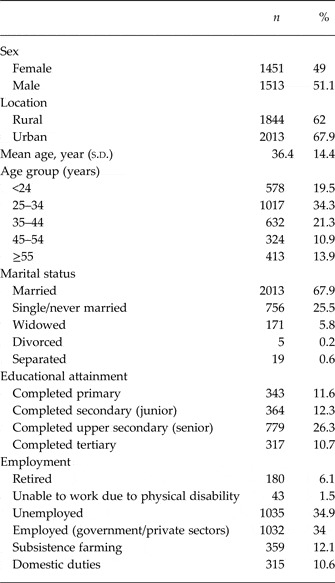
From the pool of 3597 adults, 2964 completed interviews, a response rate of 82.4% (non-response was due to refusal [n = 81], inability of our field staff to make contact in spite of three visits to the dwelling [n = 387], and incapacity, mostly arising from severe intellectual impairment or physical disability [n = 165]). The sample included 1451 men (49%) and 1513 women (51%) with an overall mean age of 36.4 years (s.d. = 14.43).
Table 1 indicates that two-thirds (n = 1844, 62%) resided in the rural area and a similar proportion (n = 2013, 67.9%) were married, the remainder being single/never married (n = 756, 25.5%), widowed (n = 171, 5.8%), divorced (n = 5, 0.2%) or separated (n = 19, 0.6%). Just over one in 10 (n = 343, 11.6%) had completed primary education, 12.3% (n = 364) junior school, 26.3% (n = 779) senior high school and 10.7% (n = 317) had received post-school education (college/university). A third (n = 1032, 34%) were engaged in paid employment (in a range of work including government and private sectors), others being occupied with subsistence farming (n = 359, 12.1%) or domestic duties (n = 315, 10.6%). The remainder were retired (n = 180, 6.1%), unable to work because of physical disability (n = 43, 1.5%), or unemployed (n = 1035, 34.9%).
Socio-demographic characteristics of the sample (n = 2964)

Prevalence of grief symptoms, post-traumatic stress and psychological distress
A traumatic loss was reported by 2947 persons (99.4%), the analytic sample the grief symptom index. Of those, 13.8% (n = 408) nominated a loss occurring prior to the Indonesian occupation (1975 or earlier, noting that there was a period of civil war leading up to the Indonesian invasion), 36.9% (n = 1094) during the Indonesian occupation (1975–1999), 14% (n = 414) during the period of national independence (circa 2002), 26.4% (n = 782) in the previous 5 years including the period of internal conflict and 8.4% (n = 249) in the 6 months prior to the study. The common causes of death were war-related, or a consequence of deprivation of emergency medical care or other forms of violence during the conflict.
Over two-thirds of those who nominated a loss endorsed at least one symptom of grief (that is, rated as some of the time or more frequently in the past 4 weeks), including persistent yearnings or longing for the deceased (n = 2178, 73.5%), feelings of bitterness about the death (n = 1293, 43.6%), and feelings of emptiness (n = 1152, 38.9%). In addition, a third (n = 957, 32.3%) reported functional impairment associated with grief symptoms.
In relation to other symptom measures, 15.3% (n = 453) met threshold for PTSD (>2.2) and 15.1% (n = 447) for severe psychological distress. There was a low but significant correlation between grief and PTSD symptoms (bivariate Pearson: 0.31, p < 0.05) and between grief and psychological distress (p = 0.24, p < 0.05), respectively.
Exposure to conflict-related TEs and ongoing adversity
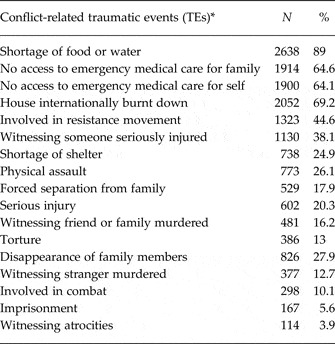
Commonly reported TEs (Table 2) included extreme deprivation of food or water (n = 2639, 89%), no access to emergency medical care for family members (n = 1914, 64.6%) and self (n = 1900, 64.1%,), home intentionally burnt down (n = 2052, 69.2%), involved in the resistance movement (n = 1323, 44.6%), witnessing assault (n = 1130, 38.1%), lack of shelter (n = 738, 24.9%), physical assault (n = 773, 26.1%), forced separation from family members (n = 529, 17.9%), witnessing murders of close others (n = 481, 16.2%) and of strangers (n = 377, 12.7%).
Prevalence of exposure to conflict-related traumatic events (n = 2964).

* Respondents reported exposure to at least one TE across two historical epochs (1975–1999; 2004–2007).
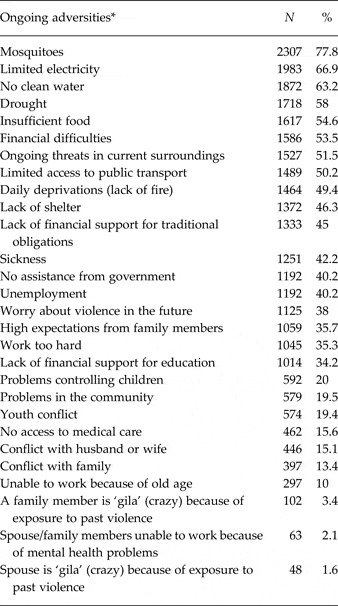
Ongoing adversities included exposure to mosquitoes (n = 2307, 77.8%), limited access to electricity (n = 1983, 66.9%), no access to clean water (n = 1872, 63.2%), conditions of drought (n = 1718, 58%), insufficient food (n = 1617, 54.6%), financial hardships (n = 1586, 53.5%), ongoing threats in current surroundings (51.5%, n = 1527), daily deprivations (n = 1464, 49.4%), lack of shelter (n = 1372, 46.3%), sickness (n = 1251, 42.2%), lack of external assistance by government or non-government agencies (n = 1192, 40.2%), lack of employment opportunities (n = 1192, 40.2%), problems/conflict in the community (n = 579, 19.5%) and conflict with spouse (n = 446, 15.1%) or family (n = 397, 13.4%).
Sense of injustice
The rates of persons with a sense of injustice (a score of 3) were 13.1% (n = 388) for the Indonesian occupation; 24.6% (n = 729) for the period including the internal conflict; and 18.5% (n = 549) for contemporary times. Bivariate tests showed statistical associations between the sense of injustice (for each of the three time periods) with all grief symptoms (results available on request).
Structural equation modelling
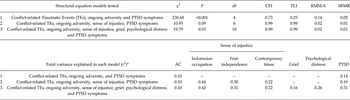
The base SEM (model 1) examining pathways from conflict-related TEs to PTSD symptoms, directly and via ongoing adversity yielded a poor fitting model (χ2 [4] = 230.68, p < 0.000, CFI = 0.86, TLI = 0.65, RMSEA = 0.08, SRMR = 0.04). In model 2, we included the sense of injustice as an intermediary step between conflict-related TEs and PTSD symptoms. The model produced a good fit l (χ2 [6] = 10.95, p = 0.09, CFI = 0.99, TLI = 0.99, RMSEA = 0.02, SRMR = 0.01), injustice accounting for 19% of the variance of PTSD symptoms.
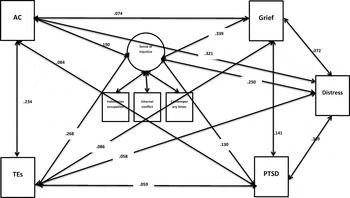
In model 3, the comprehensive model, the index of grief symptoms was introduced proximate to the sense of injustice and psychological distress proximal to PTSD symptoms. With the exception of a significant χ2, other indicators suggested a good fitting model: χ2 [10] = 19.79, p = 0.03, CFI = 0.99, TLI = 0.99, RMSEA = 0.02, SRMR = 0.01. Whether urban/rural residency was entered into the model made no difference to the fit indicators. A sensitivity test indicated only a minimal difference in parameter estimates for the tested model as compared with a parsimonious one with a non-significant χ2 suggesting that the significant χ2 was most likely attributable to the large sample size. Figure 1 presents the final model diagrammatically. Table 3 reports goodness-of-fit statistics for the sequence of SEM models tested.
A structural equation model examining pathways to PTSD symptoms (n = 2947). TEs, traumatic events; AC, adversity count; PTSD, post-traumatic stress disorder. All outcome variables were applied as continuous variables.

Endorsement of ongoing adversities (n = 2964)

* An adversity count (AC) generated based on a summation of endorsed items listed was used in the SEM analysis.
Reversing the positions of grief and PTSD symptoms by locating grief as the model end point produced a non-converging model. In addition, substituting severe psychological distress for PTSD as the endpoint yielded a model with a poor fit: (χ2 [29] = 638.70, p < 0.000, CFI = 0.78, TLI = 0.66, RMSEA = 0.08, SRMR = 0.06).
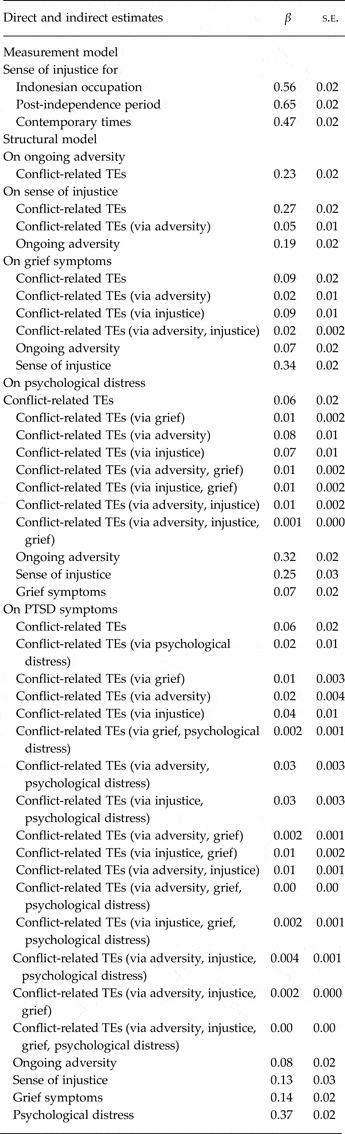
Table 3 shows the variance explained for PTSD symptoms in the successive models tested. Model 3, which included grief and severe psychological distress, accounted for a considerable proportion of the variance of PTSD (0.31). Tables 4 and 5 report the standardized direct and indirect effects for the final model with bootstrapped 95% confidence intervals. TE exposure led directly to PTSD symptoms and indirectly to that outcome via ongoing adversity. Ongoing adversity was strongly associated with psychological distress. Finally, grief and psychological distress were strongly associated with each PTSD symptoms.
Sequential structural equation models examining pathways from conflict-related traumatic events to post-traumatic stress symptoms

χ2, chi square; CFI, comparative fit index; TLI, Tucker Lewis index; RMSEA, root mean square error approximation; SRMR, standardized root mean square residual; PTSD, post-traumatic stress; AC, adversity count. All variables were applied as continuous variables in our modelling analysis.
* R 2 is calculated to show the proportion of variance explained in dependent variables included in each SEM model.
Standardized effects of direct and direct paths with bias-corrected bootstrapped 95% confidence interval

All direct paths are significant at 0.01. Seventeen participants who did not report any losses were excluded from the analysis, yielding a reduced sample of 2947. Significance of indirect effects was tested using bootstrap method (5000 samples); bias-corrected bootstrapped confidence limits (95%) are reported. All indirect paths are significant at 0.01.
Several additional indirect pathways led to PTSD symptoms, the majority involving grief and the sense of injustice. These included: from conflict-related TEs to the sense of injustice via adversity; from conflict-related TEs to symptoms of grief via adversity and injustice; from conflict-related TEs to severe psychological distress via adversity, the sense of injustice and grief; and from conflict-related TEs to PTSD via adversity, injustice, grief and severe psychological distress. Although all indirect pathways were significant, effect sizes were modest.
Table 4 shows that the sense of injustice was strongly associated with all mental health indices, particularly grief (β = 0.34, s.e. = 0.02, p < 0.01) but also severe psychological distress (β = 0.25, s.e. = 0.03, p < 0.01) and PTSD symptoms (β = 0.13, s.e. = 0.03, p < 0.01). Grief (β = 0.14, s.e. = 0.02, p < 0.01) and psychological distress (β = 0.37, s.e. = 0.02, p < 0.01) made substantial contributions to PTSD.
Discussion
Our findings support a theoretical model in which both grief symptoms and a sense of injustice contributed to pathways leading from conflict-related TEs to PTSD symptoms amongst a community sample of Timorese. Grief symptoms were strongly associated with a sense of injustice and both made major contributions to PTSD symptoms, directly and via a series of indirect paths.
Prior to considering our findings, we detail the strengths and limitations of the study. The survey involved a large sample and the response rate was high. Although we followed a systematic approach to adapting and translating our measures, we cannot discount the risk of transcultural errors in assessment. Although anamnestic bias can lead to inaccuracy in recording trauma and losses, we note that, in general, the events recorded are consistent with the known history of conflict in Timor-Leste. Importantly, however, the cross-sectional nature of our data can only indicate theoretical, not causal relationships. Our findings are restricted to two villages and may not be generalizable to the whole of Timor or to other populations. Longitudinal studies may assist in demonstrating the chronological sequencing of the relationships we investigated, particularly the relationship between symptoms of grief and PTSD.
Our index of grief includes the three core symptoms that were consistently identified amongst Timorese during piloting. We note, however, that our index does not include the full range of items proposed for the ICD-11 category of prolonged grief disorder (PGD) (Maercker et al. Reference Maercker, Brewin, Bryant, Cloitre, Ommeren and Jones2013). Assessing grief symptoms for 4 weeks is likely to have increased the accuracy of reporting but prevents us from inferring that the reaction was prolonged (Maercker et al. Reference Maercker, Brewin, Bryant, Cloitre, Ommeren and Jones2013). We recognize that the sense of injustice is a complex construct, which may be influenced by many variables, including personality factors that were not measured in our study.
Caveats notwithstanding, our study provides some support for an expanded model of PTSD symptoms in post-conflict societies, in which grief symptoms and a sense of injustice each play a central role. Past studies undertaken amongst other populations strongly suggest that grief symptoms are instrumental in the pathways leading to PTSD symptoms (Shear & Smith, Reference Shear and Smith2002; Kaltman & Bonanno, Reference Kaltman and Bonanno2003; Maercker & Znoj, Reference Maercker and Znoj2010; Mancini et al. Reference Mancini, Prati and Bonanno2011; Nickerson et al. Reference Nickerson, Liddell, Maccallum, Steel, Silove and Bryant2014; O'Connor et al. Reference O'Connor, Nickerson, Aderka and Bryant2015). In addition, although past studies have shown associations between the sense of injustice and PTSD symptoms, our analysis helps to locate the former within a comprehensive path model (Pham et al. Reference Pham, Weinstein and Longman2004; Basoglu et al. Reference Basoglu, Livanou, Crnobaric, Franciskovic, Suljic, Duric and Vranesic2005; Mendeloff, Reference Mendeloff2009; Sonis et al. Reference Sonis, Gibson, De Jong, Field, Hean and Komproe2009).
Our findings are readily interpretable within the historical context of Timor-Leste. Virtually all members of the Timorese community lost family members and close others during successive periods of conflict. Our previous studies showed that past human rights violations and contemporary grievances related to ongoing deprivations contributed to a persisting sense of injustice amongst the Timorese (Brooks et al. Reference Brooks, Silove, Steel, Steel and Rees2011; Rees et al. Reference Rees, Silove, Verdial, Tam, Savio, Fonseca, Thorpe, Liddell, Zwi, Tay, Brooks and Steel2013). Qualitative data suggested that the failure to bring most perpetrators of murder and atrocities to account may have magnified feelings of injustice within the population (Silove et al. Reference Silove, Zwi and le Touze2006). Study in South Africa indicated that witnessing murders and atrocities was a key form of trauma leading to PTSD and other psychiatric outcomes (Atwoli et al. Reference Atwoli, Platt, Williams, Stein and Koenen2015). In collective cultures such as South Africa and Timor-Leste, the violent death of others may be particularly potent in generating lasting feelings of injustice, adding to risk of PTSD.
Further research is needed to identify the precise mechanisms whereby grief symptoms impact on PTSD symptoms. One possibility is that symptoms of yearning and preoccupations with the deceased, core to the grief response, trigger and perpetuate the re-experiencing symptoms of PTSD, leading to an elaboration of the full reaction. At the same time, more general characteristics of severe grief such as withdrawal, feelings of isolation and a sense of bitterness could overlap with or exacerbate PTSD symptoms.
From a clinical perspective, our findings support the importance of focusing on both grief and the sense of injustice in treating PTSD in post-conflict populations. Elements of these two components already form part of existing interventions, including cognitive behavioural therapy for grief (Murray et al. Reference Murray, Cohen, Ellis and Mannarino2008), Interpersonal Therapy (Markowitz et al. Reference Markowitz, Milrod, Bleiberg and Marshall2009), Acceptance and Commitment Therapy (Hofmann et al. Reference Hofmann, Grossman and Hinton2011) and Schema Therapy (Landes et al. Reference Landes, Garovoy and Burkman2013). Our findings highlight the relevance of focusing on traumatic losses, their meanings and particularly a sense of persisting injustice, when conducting trauma-focused therapies for survivors of mass conflict with PTSD.
Conclusions
Our findings provide a theoretical foundation for an expanded model of PTSD relevant to post-conflict populations in which grief symptoms and a sense of injustice play inter-related roles. The model reflects the intricate nature of the inter-relationships of all these key factors (trauma, grief, sense of injustice, psychological distress) leading to the PTSD reaction. Recognition of the key roles played by each of the contributors to the model supports a comprehensive approach in applying psychotherapies for survivors of mass conflict experiencing PTSD symptoms.
Acknowledgements
We thank all our field staff for their support.
Financial Support
This research was supported by the National Health and Medical Research Council (NHMRC) Australia. NHMRC program number: RM08300.
Conflict of Interest
None.