Introduction
To begin, let me define the “field network” as a mode of knowledge production in modern science that has linked together geographically dispersed lay people whose activities are coordinated and directed from a central location.Footnote 1 Analyzing historically situated examples of the field network in practice offers a promising way to probe the relations between experts and lay people in the history of scientific observation.Footnote 2 While the lay-expert distinction has received considerable sociological attention (e.g., Epstein Reference Epstein1996; Wynne Reference Wynne, Lash, Szerszynski and Wynne1996), its analysis is less well developed in historical scholarship.Footnote 3 Recent commentators have critiqued the “professional” and “expert” as categories in the nineteenth century (Gooday Reference Gooday2008; Lucier Reference Lucier2010), but by the turn of the twentieth century, the lay-expert distinction, with its strongly hierarchical implications, was beginning to emerge in something resembling its modern form.
If lay people have seemed to maintain some partial control anywhere in modern science, it has been in the field, where the rigid social and physical boundaries characteristic of the laboratory are less clear (Kuklick and Kohler Reference Kuklick and Kohler1996; Kohler Reference Kohler2002). Yet even in the field, the social relations of scientific practice were becoming increasingly structured and hierarchically patterned by the end of the nineteenth century – thus rendering insufficient a historical approach based on mutual, collaborative agency.Footnote 4 Here my task is to examine the historical emergence of a particular material mode of field practice, concentrating on the beginning of the “high modernist” period of knowledge production around the turn of the twentieth century.Footnote 5 To do this, I present an extended example of a functioning field network in practice from the period when this high modern mode of knowledge production was establishing a foothold in the westward movement of American science.Footnote 6 By looking at a particular field network in detail at the ground level – in this case focusing on the Kansas hinterlands of the emerging U.S. grain belt metropolis of Kansas City – it will be possible to delineate how hierarchical collaboration was maintained in practice, despite some challenges and conflicts.
Weather Knowledge
For an example of a knowledge domain in which field networks of local observers were important, consider meteorology, the science of the weather. Despite its ubiquity in scientific observation and popular consciousness throughout virtually all historical periods, weather knowledge has attracted surprisingly little attention relative to other domains of knowledge until recently. In large part this may be due to the low status of meteorology compared to other disciplines, as well as the notorious difficulty of making generalizations about a phenomenon as complex and unpredictable as the weather (Daston Reference Daston, Daston and Stolleis2008; Rusnock Reference Rusnock2002; Zuidervaart Reference Zuidervaart2005). Yet observing the weather has often been on the leading edge of efforts to understand nature at trans-local scales.Footnote 7 Weather observing networks, probably more than any other kind, have been continuously dependent on a regular geographical distribution of collaborators (Locher Reference Locher2008).
The large geographical scale of weather phenomena, while consistent with present-day notions in meteorology, was not always assumed by local weather observers, however. For example, as Vladimir Jankovic (Reference Jankovic2000a) reminds us, a long chorographic tradition in early modern Britain identified weather peculiarities with local and regional natural history, rather than with metropolitan aims to aggregate knowledge over larger areas. Local wisdom could, in fact, be validated by long experiential familiarity with a place's natural features, even to more elite observers who believed in a “democratic theory of knowledge” attributing epistemic credibility to shepherds familiar with local peculiarities (Jankovic Reference Jankovic2000b). To ask a local observer to merely take simple observations with instruments and transmit them to a distant center of calculation could thus be interpreted as a markedly top-down alternative to any local ways of knowing an environment. This could be as true in the last century as it was in the early modern period. “Everyone is, in a sense, a born meteorologist,” as one Harvard professor noted in the early twentieth century, “or at least thinks of himself as such” (Ward Reference Ward1918).
Above all, applying a structural perspective to the organization of high modern meteorological networks helps us to understand how scientific practice has changed over time, especially the relations between experts and lay people, and between center and periphery.Footnote 8 As geographer Mark Monmonier has shown, by the end of the nineteenth century, the synoptic weather map had become an important icon for state-supported science (Monmonier Reference Monmonier1988). One could even argue that the weather map has been a key icon of scientific modernity more generally, penetrating into daily life as few other knowledge products have. Even – or perhaps especially – in such a busy power center as Washington, D.C., glass weather map displays attracted the attention of everyone from ordinary tourists to congressmen themselves. “The guides always show them to visitors,” remarked one newspaper account, “and, just before the daily sessions of Congress convene, crowds of members may be seen consulting the maps and commenting upon the weather at their homes” (Anonymous 1900).
Ethnographer Sarah Strauss has further argued that the synoptic and widely publicized weather map in the present day can be thought of as a “synopticon” (in contrast to the panopticon), meaning that it allows many to observe the few (Strauss Reference Strauss, Strauss and Orlove2003, 48). Moreover, as James Fleming (Reference Fleming1990) points out, meteorological research was the first large-scale cooperative project undertaken by the Smithsonian Institution in mid-nineteenth-century America. Finally, recent attention to the rich history of British weather knowledge by Katharine Anderson (Reference Anderson1999, Reference Anderson2003, Reference Anderson2005) on the nineteenth century, Jan Golinski (Reference Golinski2007) on the eighteenth century, and Vladimir Jankovic (Reference Jankovic2000a, Reference Jankovic2000b) on the early modern period has demonstrated how well-suited the topic of weather knowledge is for thinking about connections between expertise and lay wisdom, between metropolitan and regional or local perspectives, and between science and the rest of culture. The role of weather knowledge in everyday life makes it a suggestive locus for examining the interaction between lay and expert observation in field networks, as well as the construction of the lay-expert divide itself.Footnote 9
The epistemic advantage of the field-network-based forecast for producing weather knowledge was that it could combine many local weather observations on a single map at a central location, thus relying on the power of knowledge aggregation and generalizations about the large-scale movement of weather systems rather than on strictly local experience. The capacity of the metropolitan coordinator to combine observations quickly and effectively from disparate locations in order to make such forecasts, however, relied on more than just the ambition to do so. It required a new communications technology which appeared on the scene in the nineteenth century: the telegraph (Fleming Reference Fleming1990, 141–162; Locher Reference Locher2008). The westward movement of telegraph lines across the North American continent in many ways marked the potential expansion of weather observing networks.Footnote 10 While we should not assume that telegraphy automatically doomed the continuation of bottom-up local weather observation – and here one valuable counterpoint is Jamie Pietruska's (Reference Pietruska2009) study of how Michigan farmers maintained their own telegraph network for communicating weather information to one another – it is fair to say that telegraphy enabled the creation of larger networks. The telegraph was a necessary if not sufficient historical condition for larger-scale forecasting.
The Structure of Bureaucratic Meteorology
Under the Signal Service of the U.S. Army in the 1870s and 1880s, a national network of telegraphic weather observation stations developed and expanded from its Smithsonian roots, before the federal weather agency moved to the U.S. Department of Agriculture (USDA) in the early 1890s (Fleming Reference Fleming2000 and Reference Fleming and Walton2005; Hawes Reference Hawes1966; Whitnah Reference Whitnah1961, 43–81). There, the Weather Bureau would solidify its role as the dominant force in the organization of field networks to produce weather knowledge all across the U.S. Short-term forecasts – in other words, a predominantly applied, service role – became the Weather Bureau's main focus of operations. In 1908, advance forecasts of seven to ten days were added (Weber Reference Weber1922, 1, 9–10, 38; Pietruska Reference Pietruska2011, 101).
After the transition to civilian control, the Weather Bureau divided the country into large regional districts, which in turn supervised forecasting stations in major cities with their own paid staff members. While forecasts under the U.S. Army regime had been solely issued by the central office in Washington, D.C., the civilian Bureau initiated what its chief described as a “far more liberal and progressive” model:
The office of Local Forecast Official was created for such observers as had shown special fitness for forecast work, and they were assigned to duty at the more important agricultural, commercial or maritime centers, with instructions to carefully study the local climatology of their sections, so that products that are indigenous to limited areas, or interests which are of special importance to particular sections, might have such application of the weather forecasts as the intimate personal attentions of a competent local official could give. (Moore Reference Moore1905, 579)
While to some extent such forecasting officials might be expected to apply their own regional knowledge of the weather through their “intimate personal attentions,” the same could not be said for the lay people whose even more remotely distributed local observations provided much of the underlying factual data for a modernized and highly structured meteorology.
Here I am characterizing the emergence of systematic field networks organized by the U.S. Weather Bureau for making observations as “modern” – even “high modern” – meteorology. To later generations of meteorologists, such a description of early twentieth-century meteorology might seem puzzling. Indeed, as Robert Marc Friedman (Reference Friedman1989) has convincingly shown, the proponents of aerial studies and physical theory in meteorology in the early twentieth century saw themselves as meteorology's modernizers.Footnote 11 To be sure, there were similarities between the field observation networks and subsequent more sophisticated networks deploying meteorological theory, including their reliance on modern communications infrastructure for data collection and transmission and their close connections with the military. Yet disciplinary revolutionaries such as Vilhelm Bjerknes meant to overturn, not continue, the kind of meteorology described in this essay, by importing theoretical and mathematical rigor from the physical sciences. Likewise, later proponents of even greater theoretical rigor, more sophisticated instruments, and advanced academic training between 1920 and 1945 – indeed, meteorology was arguably not even fully professionalized until after World War II (Harper Reference Harper2006) – would look back at the network-building achievements of the previous generation as insufficiently “modern” in part due to their apparent reliance on local wisdom and experience (Turner Reference Turner, Fleming, Jankovic and Coen2006; Harper Reference Harper2008). In a way, then, the modernization of a scientific discipline is a recursive process, not a once-and-for-all achievement.
The emergent modernity of U.S. Weather Bureau meteorology around the turn of the twentieth century, however, is probably best symbolized by the production and circulation of weather maps, which surely must remain the best recognized icons of modern meteorological practice among the general public. Those maps, in turn, were based on field networks and the infrastructures that undergirded them. Those networks and infrastructures would become globalized during the Cold War era, motivated by the perceived necessity of international collaboration to successfully model atmospheric phenomena at an even larger scale, through the World Meteorological Organization's World Weather Watch in the 1960s. As Paul Edwards points out in his study of the “infrastructural globalism” that such an enterprise entailed, the shift from voluntary to obligatory governance was crucially important. And so it was, likewise, with what one might call the “infrastructural regionalism” of an earlier era of railroads and telegraphs. Meteorology once again provides a fruitful example, in this case for analyzing how the region may be “produced and maintained (as both object of knowledge and unified arena of human action)” through regional infrastructures (Edwards Reference Edwards2006, 229; see also Edwards Reference Edwards2010). Moreover its hierarchical structure constituted a strengthened, rigorously bureaucratic form of top-down control over knowledge production that, despite its evident decentralization, aggregated observations from the field through strict standardization and rigid discipline.
Kansas City's Weather Network, 1905–1915
Consider the weather observation network centered on the U.S. Weather Bureau's “local office” in Kansas City, Missouri, located near the Kansas-Missouri border. Kansas City, which might have appeared to be “local” from the perspective of Washington, was in fact the metropolitan center for a large region of fertile farm lands and small market towns. Here I focus on a single decade, 1905–1915, when the Bureau's hierarchical system of weather information gathering and forecasting had reached its full scale of operations. This high modernist period marked a decisive shift towards metropolitan and bureaucratic authority, when the notion of science-based expertise directing society reached the beginning of its fullest consummation. To be sure, Kansas City was at best a regional metropolis, of no greater significance than any of the other administrative regions of the U.S. Weather Bureau – save for its location in the heartland of the corn and wheat belt, which may have given it a certain degree of symbolic potency. But in its banality lies its usefulness for revealing the knowledge-producing structures that undergird even the most practical, applied science, far from the great urban laboratories of the East Coast.
At the Kansas City office, the “Local Forecaster” of the U.S. Weather Bureau was meteorologist-in-charge Patrick Connor. In 1876, he began his career with the weather service, as many later Bureau staffers did, while it was still operated by the U.S. Army Signal Corps. An Irish immigrant, Connor served short assignments in Toledo, Ohio; Des Moines, Iowa; Fort Grant, Arizona; and Shreveport, Louisiana before in November 1889 being placed in charge at Kansas City, where he served for more than forty years. During that time, he routinely brought together weather observations from across Kansas and Missouri in order to make regional forecasts. Occasionally he did venture into more ambitious projects, such as his experiment with longer-range forecasts based on solar magnetic theory, which one historian of the Weather Bureau quips “proved quite adequate for a carnival week at Kansas City” but nothing more (Whitnah Reference Whitnah1961, 88).Footnote 12 Upon his retirement in August 1930, Connor had administered the Kansas City site from the earliest days of the U.S. Weather Bureau through four decades of bureaucratic stability amidst social and economic change (Anonymous 1930).
From his office in Kansas City, Connor coordinated two special teams of observers scattered across Kansas and Missouri in the first decade of the twentieth century: the Corn & Wheat Region Observers and the River Observers. From the early 1890s, the Bureau hired lay observers in various regions around the country at a nominal fee to make observations for special reports on various agricultural crops, including cotton, rice, wheat, and corn, as well as special observers along major rivers prone to flooding. These local observers were administered through the decentralized system of district and local forecast centers that had developed by 1894 (Whitnah Reference Whitnah1961, 64). Teams of observers consisted of local residents at each of the desired observation sites, and each of them was paid a small amount of money to keep daily weather records and to communicate their information to the Kansas City office by daily telegraphed and monthly mailed reports. These local observers were not usually career scientists; some were shopkeepers, others were clergymen, still others were teachers. They did have to possess basic skills of literacy and numeracy, and be willing to comply with precise instructions every day, as the examples below will make clear.
In order to make daily forecasts in Kansas City, Connor required reliable, standardized data from sites across the region. For that he needed to establish trust and discipline in his geographically dispersed weather observers, who could be some distance away from the metropole. He particularly needed reliable observers in the sparsely populated western part of Kansas, where weather systems typically arrived first, before they reached the heart of the Midwestern grain belt. In order to make them follow his instructions, Connor could rely on moral suasion and the threat of cutting someone out of the network, strategies that field network organizers always have access to. But he did have one additional means of leverage: money. The local collaborators in Connor's weather observing network were paid twenty cents per day during the observing season. Receiving such an amount was contingent on “satisfactory service,” or as Connor put it in another letter, “for each daily observation taken and telegraphed as required” (Connor to J. B. Loughran, 8 April 1908, C&R, vol. 2; Connor to George K. Helder, 26 July 1909, C&R, vol. 4; Connor to R.E. Dunham, 28 March 1906, C&R, vol. 1).
The duties of a Corn & Wheat Region Observer were not complicated, but they necessitated diligent daily record-keeping and communication. Each day at 7 a.m. from April 1st to September 30th, the observer recorded the highest and lowest temperatures in the previous 24 hours, along with the amount of rainfall. By 8 a.m. at the latest, the observers would telegraph the data to Kansas City, except on Sundays. Monthly reports were submitted by mail on standardized forms (Connor to Corn & Wheat Region Observers, 13 March 1905, C&R, vol. 1; Connor to Corn & Wheat Region Observers, 25 September 1905, C&R, vol. 1; Connor to J. B. Loughran, 8 April 1908, C&R, vol. 2). Observers were scattered throughout Kansas and Missouri, always with local access to telegraph lines. Sites on the High Plains of central and western Kansas were located in the far hinterlands of Kansas City, but were crucial to the successful prediction of meteorological phenomena in more populated areas to the east.
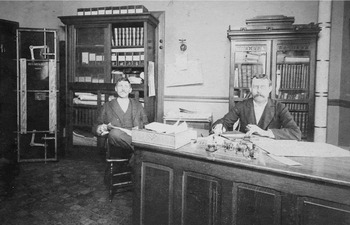
Once the weather observations arrived by telegraph at the Kansas City office, two assistants – in June 1906, they were named Mr. Dill and Mr. Anderson – prepared maps aggregating them (Connor to J. B. Loughran, 8 April 1908, C&R, vol. 2; Connor to George K. Heider, 26 July 1909, C&R, vol. 4; Connor to R. E. Dunham, 28 March 1906, C&R, vol. 1). In this manner, geographically distributed local data were converted into a more powerful form of knowledge that covered a whole region. The Weather Bureau staff members contributed their own local observations of the weather in Kansas City itself, initially from rented quarters in the Rialto Building at the corner of Grand Avenue and Ninth Street and later from the roof of the U.S. government building which housed them in a typical clerical office (see fig. 1) alongside other bureaucratic agencies (Connor to officials in charge, 2 May 1905, C&R, vol. 1; Connor to W. L. Kessinger, 11 April 1905, C&R, vol. 1).Footnote 13 Connor then issued a weather forecast based on the maps plotted by his assistants, distributing it to the public that very day. (Weather forecasting is surely one the most immediate forms of applied science in existence!)
“Unidentified station chief and colleague at a local forecast office” (ca. 1900). National Oceanic and Atmospheric Administration/Department of Commerce, National Weather Service Collection, Image 01303.

River Observers were also required to make daily observations, as specified in a “small pamphlet of instructions” (Connor to J. K. Thompson, 4 April 1905, C&R, vol. 1). Unlike the Corn & Wheat Region Observers, whose season corresponded roughly to the growing season of these vital crops, the River Observers reported during the spring and early summer season of potential flooding. In 1905, daily observations were telegraphed to Kansas City starting in April, while in 1906 they were scheduled to begin as early as January. Six days a week – plus Sunday “in case of high water, heavy rains, or an unusual rise” – through mid-summer, River Observers were expected to telegraph “the stage of the river, character of weather, and rainfall.” Like the Corn & Wheat reports, the information was to be sent as soon as possible after its 7 a.m. recording, with exceptions only for places where telegraph offices did not open until 8 a.m. The central office also asked them to note the “breaking up and movement of ice, and the formation of gorges which might result in damage to property above or below your station.” In the case of “dangerous conditions,” observers were instructed to telegraph the Kansas City office with details (Connor to River Observers, 27 March 1905, 23 December 1905, C&R, vol. 1). The River Observer field network did not extend as far into western Kansas but did include several locations in central Kansas on such rivers as the Solomon and Republican, as well as sites in neighboring states, such as Beatrice, Nebraska (Connor to Chief of Weather Bureau, 20 March 1905, C&R, vol. 1). Each summer, the Kansas City office compiled a general report on the occurrence of river flooding as well as the crop and property damage that resulted (Connor to Chief of Weather Bureau, 6 September 1905, C&R, vol. 1).Footnote 14
The Weather Bureau provided standardized recording instruments for all local observers, issued by section directors in each state (Connor to T.B. Jennings, 9 June 1905, C&R, vol. 1). While meteorological instruments had been popular parlor items for nearly two centuries in the Anglo-American world (Golinski Reference Golinski, Clark, Golinski and Schaffer1999),Footnote 15 the Bureau did not rely on private instruments to undertake its data collection. By making sure that standard quality instruments were supplied to each observer, the Bureau could improve the reliability of the data so that they could be more confidently brought together and transformed in the metropole. Connor also attempted to guide his local observers in the proper usage of the instruments, insisting for example that thermometers “be set each morning immediately after being read, and not disturbed afterward until the following morning” (Connor to Corn & Wheat Region Observers, 13 March 1905; C&R, vol. 1). Compliance with such standard practices was obviously difficult to enforce given the physical distance involved, so field network organizers like Connor had to trust their local observers. The scope for such trust was minimized by demanding adherence to strict bureaucratic rules and reducing the observers' role to reporting telegraphically-encoded instrument readings, but it could not be eliminated completely.
Three code words or phrases were ordinarily sufficient to transmit the temperature, the general “character of the weather,” and the rainfall, in that order. The proper sequence was crucial because that way the code word or words for temperature and rainfall were separated from one another (Connor to Corn & Wheat Region Observers, 13 March 1905, C&R, vol. 1). Precipitation was reported to the nearest two-hundredths of an inch, with odd figures rounded down to the next lower number. River Observers made a slightly different set of observations. Based on a table of code words, their reports included “the time of observation, direction of wind and state of weather, precipitation, stage of river, and change in last 24 hours.” All but the latter were given in code words, so that a typical telegraph message, according to Connor, might read: “Observer, Kansas City, Mo., Bank – Girth – Harry – Sunny-side – rise four six (4 feet 6 tenths)” (Connor to Arthur H. Cullen, 8 June 1905, C&R, vol. 1).
These coding procedures were designed to insure both fidelity in transmission of numbers and, more important, the lowest possible cost for transmission. “Never use figures in telegraph messages,” Connor admonished one local observer, adding that “[if] all observers made up messages such as yours this morning, the government would be bankrupt within a year” (Connor to John H. Sherman, 3 April 1905, C&R, vol. 1). In some locations, telegraph offices did not open until 8 a.m., so at those places Connor urged his local observers to explain “the importance of sending these messages first” to the station operators. “By doing this,” he urged, “much annoyance and correspondence will be avoided” (Connor to Corn & Wheat Region Observers, 13 March 1905, C&R, vol. 1). In at least one case, an observer in Macksville, Kansas was permitted to transmit her messages to the telegraph station by telephone, at that time a new and rare communications technology. Connor wrote a special letter to the superintendent of Western Union in Omaha, Nebraska, asking that the local telegraph operator be allowed to accept telephone messages. Still, Connor was apprehensive about possible errors that the communications relay might introduce, warning her: “You will have to be very careful in wording your messages so that no blunders may occur. Have the operator repeat each message back to you. Do not fail to add the words ‘filed at’ so & so, so that each message will show this office the time it was filed” (Connor to Nelia Poling, 19 March 1908, C&R, vol. 2).
Thus, just as many different kinds of scientific field work relied on railroad lines for its westward expansion in the nineteenth century (Vetter Reference Vetter2004), so too did weather observation networks rely on the telegraph lines that usually accompanied the railroads.Footnote 16 The telegraph route network constituted the de facto locational realm of possibility for the geographical distribution of daily weather data reporters on the frontier. The resulting map of observation sites was based on a combination of telegraph accessibility, attempted spatial dispersion, and the availability of reliable personnel. Consider the sites in western Kansas, thinly populated yet so crucial to the construction of weather knowledge in the metropole. In 1905, four towns in central and western Kansas had Corn & Wheat Region Observers: Dresden, McPherson, Macksville, and Russell (Connor to Chief of Weather Bureau, 17 April 1905, C&R, vol. 1). The same four sites were maintained for several years, with some difficulty in finding and keeping a good observer in Russell, which came to a head in 1908 as discussed below (Connor to Chief of Weather Bureau, 4 April 1906, C&R, vol. 1; Connor to Chief of Weather Bureau, 7 April 1908, C&R, vol. 2).
Before Connor could organize and manage his local observers, however, he had to find them in the first place. Most were recruited from the ranks of the volunteer observers who mailed in monthly reports to their state weather offices. In terms of traditional sociological categories, they were a diverse lot, as far as can be discerned from the limited information provided in Connor's brief annual personnel reports to the Chief of the Weather Bureau. Just among the Kansas observers, they included both men and women (with slightly fewer of the latter), and both native-borns and immigrants, including a Canadian and a German (Connor to Chief of Weather Bureau, 17 April 1905, C&R, vol. 1). Little systematic information is available about their occupations, although at least one was a clergyman, as indicated by his title, “Rev.”Footnote 17 Anecdotal evidence suggests that the percentages of men and women reflected in aggregate data might be suspect given that weather observing work may sometimes have been shared by family members, especially by a husband or wife. An example of this can be found in one of Connor's letters to a local observer in neighboring Missouri. When that local observer sought to be paid for both rural mail delivery and weather observing, Connor replied that he could not draw pay for both positions, “however small” the two amounts were, but could have his wife listed as the weather observer (Connor to M.G. Allen, 20 March 1905, C&R, vol. 1).
However they were selected, local weather observers required diligent management from Kansas City. Despite the differences in the end knowledge products of the Corn & Wheat Region Observers and River Observers, the tensions that emerged in the relationships between the Kansas City office and the dispersed field observers were similar. For both networks, Connor worked diligently to maintain common recording standards and reporting times. Coordinating and disciplining this heterogeneous group of lay collaborators was no trivial task. If Connor and his small staff in Kansas City were to maintain their status as reliable knowledge-makers at the center of calculation, then the stations around the periphery – many of them far to the west on the remote Kansas plains – had to be kept in line. Even usually reliable observers such as Nelia Poling, whose tenure is discussed below, received occasional reprimands for late reports. On 4 May 1908, Poling's telegraph message was filed eight minutes too late: “This is not right,” Connor wrote, and if the office opened late again, she was instructed to “please add the words to message to indicate when it was opened, as ‘office opened eight ten,’ etc.” so that the Kansas City staffers could properly “locate the trouble” (Connor to Nelia Poling, 4 May 1908, C&R, vol. 2).
Observational continuity over long periods in designated locations was important. Yet individual observers might be away for part of the observing season. Indeed, Connor himself took summer vacations, including one “leave of absence” to Manitou Springs, Colorado, in August 1905 that was granted from Washington on the same telegraphic lines over which other Weather Bureau communications traveled (Connor to Chief of Weather Bureau, 10 August 1905, C&R, vol. 1). In the case of local observers, who may or may not have had substitutes nearby to fulfill their duties temporarily, extended absences could present an obstacle to Connor's knowledge producing system. Apparently, substitute observers were usually adequate, for specific comment on them in Connor's correspondence is rare. However, problems did sometimes surface, as when an observer named Ed Haberlein had to leave his observing post in McPherson, Kansas, for part of June 1909. “You entrusted the work in poor hands,” complained Connor, “as will be shown by a comparison of the telegraphic reports with the monthly report, which has been beautifully prepared by yourself . . . I know your record for careful, conscientious work, and I am only surprised that any person accustomed to seeing your work would show such a lack of ability to follow your example” (Connor to E.F. Haberlein, 3 July 1909, C&R, vol. 4).
In addition to addressing occasional problems with substitute observers, the Kansas City office also had to manage transitions when faithful observers moved away or died, or when new stations were opened. For example, when Nelia Poling succeeded her husband Roey as Corn & Wheat Region Observer for Macksville, Kansas, after his death in the spring of 1906, things went fairly smoothly, with only one minor problem two years later when Poling filed one telegraphic report late without indicating the reason (Connor to Nelia Poling, 4 May 1906, C&R, vol. 1; Connor to Chief of Weather Bureau, 14 May 1906, C&R, vol. 1; Connor to Nelia Poling, 4 May 1908, C&R, vol. 2). The opening of a new weather observing post in Hays, a well-established military and supply town in western Kansas, was a little bumpier; the novice observer there had to be scolded at least once when reporting monthly and daily data that did not agree (Connor to George K. Helder, 26 July 1909, C&R, vol. 4; Connor to George K. Helder, 5 June 1910, C&R, vol. 5). For an office depending on regular and standardized reports from diverse locations across the state, any discrepancies might impair the reliability of the knowledge it produced.
Perhaps the strangest transition of all occurred when the local observer at Fort Scott, Kansas, Mr. W. W. Dillard, died in 1905. Upon reading of Dillard's death in a local newspaper early in June, Connor wrote to “Miss Dillard” (a hypothetical daughter) expressing his condolences but also inquiring about something surprising. “There has been no break in the continuity of telegraph reports in consequence of Mr. Dillard's death,” he commented, “and I would like to inquire who the person is that attends to the work.” He expressed interest in appointing that person as the new observer, making sure to point out that “[a] woman can fill the position.” He also noted that the monthly report form for May had not been received and asking that “two copies [be] mailed to this office as soon as possible” (Connor to “Miss Dillard,” 10 June 1905, C&R, vol. 1).Footnote 18
For delays in the transmission of daily readings by telegraph, problems could be especially complicated to solve. In the case of Dresden, located in the remote northwestern corner of Kansas, Connor experienced trouble right away in April 1905 when the reports of Mrs. Angeline Bock, the local observer, did not arrive. He investigated whether Bock herself or the telegraph office was to blame, even querying the district superintendent of Western Union Telegraph Company in Omaha, Nebraska, for an explanation (Connor to District Superintendent, 4 April 1905, C&R, vol. 1). By the next season, Connor had discovered to his annoyance that the telegraph messages from Dresden were relayed all the way west to Denver, Colorado, before being transmitted to Kansas City. Despite his satisfaction with the “very suitable” location of Dresden and what he now characterized as Bock's “very faithful” service, Connor reluctantly made inquires about what alternative sites might be available in northwestern Kansas with more direct telegraphic service (Connor to Official in Charge, 12 May 1906, C&R, vol. 1). No other town in that part of the state seemed to offer any improvement, so the station remained at Dresden.
However, two years later the Kansas City office was again complaining of delays in routing through Denver, exacerbated by the time zone difference – Denver and a few of the westernmost counties in Kansas followed Mountain Time rather than Central Time – and Bock was threatened with closure of the station if matters did not improve (Connor to Angeline Bock, 12 May 1908, C&R, vol. 2). Apparently, timeliness did improve, or perhaps no other viable alternative stations were available, because she continued to serve as a Corn & Wheat Region Observer for several years, although she was reprimanded once in 1910 for discrepancies between written and telegraphic reports (Connor to Angeline Bock, 3 June 1910, C&R, vol. 5). The problems with transmissions from Dresden also afflicted other stations in far western Kansas and Oklahoma, including Scott City and Enid, prompting Connor to take the matter up with Western Union (Connor to Chief of the Weather Bureau, 17 June 1908, C&R, vol. 2).
The difficult odyssey of the Corn & Wheat Region Observer station in Russell, Kansas, provides a fitting final example to illustrate the problems that the Kansas City office sometimes encountered in coordinating their lay observers and dispersed hinterland observing sites. When observer H. C. Seidel resigned in the spring of 1905, Connor accepted Seidel's recommendation of Lawrence McKeever as his replacement (Connor to L.A. McKeever, 13 April 1905, C&R, vol. 1; Connor to Chief of Weather Bureau, 18 April 1905, C&R, vol. 1; Connor to Lawrence A. McKeever, 27 April 1905, C&R, vol. 1). As Connor remarked to Seidel, McKeever's status as a man “of the cloth is, of course, a guarantee of his fidelity” (Connor to H.C. Seidel, 13 April 1905, C&R, vol. 1). But perhaps the clergyman was a bit too faithful, for he kept sending daily telegraph reports, even after the end of September when daily Corn & Wheat reports were supposed to cease. Connor had to ask the telegraph office in Russell to stop accepting McKeever's transmissions (Connor to Telegraph Operator, Western Union Telegraph Co., 5 October 1905, C&R, vol. 1). The troubles in Russell continued. Like many other rural Methodist clergymen, McKeever did not stay in one location very long. In the spring of 1906, he moved out of Russell, recommending that his successor, Rev. Royal Dunham, take his place (Connor to R.E. Dunham, 28 March 1906, C&R, vol. 1; Connor to Chief of Weather Bureau, 7 April 1906, C&R, vol. 1; Connor to Official in Charge, 7 April 1906, C&R, vol. 1).
Dunham proved to be a more difficult observer to discipline than McKeever, however. By the end of the summer, he had already run afoul of the Kansas City office's strict rules by failing to submit signed receipts for expenses and using the wrong report form (Connor to Royal E. Dunham, 7 July 1906, C&R, vol. 1; Connor to Royal E. Dunham, August 1906, C&R, vol. 1). At the beginning of the 1908 observing season, Dunham was again in trouble with the Kansas City office, this time because the telegraph messages were arriving too late (Connor to R.E. Dunham, 1 April 1908, C&R, vol. 2). On this occasion, however, the blame was ultimately laid at the feet of the telegraph office, which had changed its opening time to 8:30 a.m. Connor therefore decided to close the observing station at Russell and open one at Scott City, about one hundred miles to the west, instead (Connor to Chief of Weather Bureau, 11 April 1908, C&R, vol. 2; Connor to Chas. W. Stevens, 21 April 1908, C&R, vol. 2). This displeased Dunham, but Connor's telling and precise reply was simply that the station had been closed “not on account of your work, though the service rendered from Russell last season was very unsatisfactory” (Connor to Royal E. Dunham, 3 May 1908, C&R, vol. 2).
The initial opening of the Scott City station seemed to go well. J. B. Loughran, a local observer with some experience in submitting written weather records to the state office in Topeka, agreed to serve as the Corn & Wheat Region Observer for the new location beginning on 21 April 1908 (Connor to J.B. Loughran, 8 April 1908, C&R, vol. 2; Connor to J.B. Loughran, 16 April 1908, C&R, vol. 2). Yet when the day arrived for the commencement of telegraphic transmissions from Scott City, none arrived (Connor to J.B. Loughran, 21 April 1908, C&R, vol. 2). Two days later, Loughran finally did send a transmission, but it did not reach the Kansas City office until 9:20 a.m. (Connor to J.B. Loughran, 23 April 1908, C&R, vol. 2). Even a seasoned veteran volunteer observer of the state weather service thus proved to lack a full understanding of the standards and norms of the Kansas City office, and Connor sent a long letter clarifying his expectations (Connor to J.B. Loughran, 24 April 1908, C&R, vol. 2). The next problem was with the telegraph transmission route. Messages from Scott City were relayed through the central Kansas town of Great Bend, which did not open until 8 a.m. Connor therefore wrote the telegraph operator in Great Bend, informing him that the Weather Bureau's transmissions were “of very great importance to a variety of interests, and it is absolutely necessary that they reach this city before 8:30 a.m.,” giving “precedence over other business, and rush[ing] them immediately upon opening” the telegraph station each day (Connor to Operator, Western Union Telegraph Office, 30 April 1908, C&R, vol. 2). But even after this multi-pronged attack on the delayed messages, problems with late transmissions continued to occur, prompting Connor finally to recommend the closure of the Scott City station (Connor to J.B. Loughran, 27 April 1908, C&R, vol. 2; Connor to Chief of Weather Bureau, 11 July 1908, C&R, vol. 3; Connor to J.B. Loughran, 18 July 1908, C&R, vol. 3). Like those of other towns in the far western part of Kansas, the observing station at Scott City proved to be difficult to maintain as part of a regional network of weather data gathering that required uniform and timely reports from all stations. Even in the most routinized field networks – and even when regular participation was reinforced through monetary payments – finding reliable local observers and embedding them within a properly functioning communication network could still be a matter of trial and error.Footnote 19
These examples confirm that maintaining a reliable network of local observers in tight coordination with one another is not always easy to achieve in practice. As the case of the network of weather stations reporting to the Kansas City office of the U.S. Weather Bureau in the early twentieth century demonstrates, many kinds of problems could arise in a field network. Yet, since sending out a team of trained meteorologists to make reports from distributed locations throughout the states of Kansas and Missouri was well beyond the Bureau's budget, the district offices such as Kansas City relied on local lay people to act as paid observers in addition to their regular livelihoods. These collaborators had to be disciplined to make their reports according to a uniform set of standards and rules. While this coordination was achieved over the long run, it was not always easy, and individual cases proved recalcitrant despite repeated intervention, especially in the most remote observing locations of western Kansas. Even for such formally organized and semi-permanent networks of distributed field sites as the observer networks of the Weather Bureau, the need to carefully manage relationships between scientists and their lay collaborators was crucial to their ongoing success. Ultimately, however, Connor had the power to do whatever seemed necessary – admonishing observers or closing stations, for example – to produce timely weather knowledge through the field network he directed.
Conclusion
There is nothing particularly special about the U.S. Weather Bureau's Kansas City-based regional weather observation network of the early twentieth century. No one seeking out the greatest moments in the history of science would have the slightest chance of selecting Patrick Connor and his team of local observers in Kansas. No great theories were hatched there, no path-breaking observations were made there, and no technical innovations were birthed in the telegraph messages, written report forms, and standardized meteorological instruments that circulated between metropolitan Kansas City and its agricultural hinterlands. This field network was an utterly typical example of practical, low-status, everyday knowledge-making far from the centers of power. Indeed, its usefulness as a case study in many ways depends on its banality, making it a plausible exemplar of a routinized and widespread mode of knowledge production in the field.
At the same time, could anyone confuse this high modern field network with its predecessors of earlier centuries? The weather observers of the seventeenth and eighteenth centuries examined by Daston, for example, found their law-seeking aspirations thwarted at every turn not only by the endless variability of the weather itself but also by the bewildering variety of recording instruments, descriptive vocabularies, and observing times (Daston Reference Daston, Daston and Stolleis2008). To them, the Kansas City field network would likely have seemed a fascinating and alien enterprise, bringing a bureaucratically rationalized, strictly systematic, and hierarchically standardized order built upon telegraphs and state funding. Similarly, many of Jankovic's local weather observers in early modern England focused above all on particular events that occurred in their own regions; to them the subordination of such concerns to a centralized data-gathering system would have meant no small sea change in intellectual goals and trans-local relationships (Jankovic Reference Jankovic2000a, Reference Jankovic2000b). And unlike Rusnock's eighteenth-century medical meteorologists, who had to depend “upon the prestige of the Royal Society to motivate observers, as well as flattery and guilt” (Rusnock Reference Rusnock2002, 115), Connor's observers were disciplined by the cash nexus. Even the weather network builders of mid-nineteenth century Britain described by Anderson (Reference Anderson2005), such as Robert FitzRoy, could hardly have failed to be impressed by the tremendous scale and routinization of U.S. Weather Bureau operations a mere half century later, from the agricultural heartland around Kansas City to both coasts.
In my focus on top-down coercive authority exercised by the Bureau staff over subordinate collaborators in the field, I do not mean to suggest that local observers felt like they were being constantly oppressed or exploited. The reality is that we simply do not know how they conceived of their participation in the field network. Source materials reflecting the local point of view are hard to come by, and the records of the Kansas City office do not even include any files of letters sent by local observers to the Weather Bureau staff. Anecdotal evidence from other cases of collaboration with government knowledge production suggests that such participants could feel quite proud of their involvement in science even if they had no authority over the research design.Footnote 20 Indeed, even the strictly circumscribed trust accorded to local observers in a weather observation network presumably could elicit positive feelings for contributing to science. However, answering questions about how field science looked from local collaborators on the periphery for time periods beyond the reach of oral history will have to await case studies with access to documentary sources to reveal such a perspective.Footnote 21
And anyhow, my task has been rather different. In this paper, I have sought to reveal the material and structural organization of scientific field work, complementing work that has already shown the relevance of class analysis for understanding the history of science. Anne Secord (Reference Secord1994), for example, in her perceptive interpretation of the natural history correspondence networks that linked gentlemen and artisans in early nineteenth-century Britain, has drawn our attention not only to how the conventional class divide provides a relevant framework of analysis for the history and sociology of science but also to how both social groups perceived such networks as beneficial for their own interests. Here I have attempted to focus instead on the hardening of an important class divide within the structure of knowledge production itself – an epistemological class divide – which increasingly separated career scientists and lay people, just as industrialization in the material economy was eroding the power and autonomy of workers by the end of the nineteenth century. Exploitation across epistemological class lines, which manifested itself in routinized forms of low-level fact production absent any corresponding authority over generalization or any significant share in the credit for the higher-order knowledge thus produced and publicly displayed, was no less structural for its normality or acceptance by participants.
My interpretation of this field network might seem at first to cut against two prominent features of the case at hand: the low-status, “applied” quality of regional weather forecasting as a science and the decentralized nature of the U.S. Weather Bureau as an institution. One might think that such features point away from an account based on top-down, coercive authority. Yet it might also be argued that such a case presents an appropriate test for applying concepts like the field network as a mode of knowledge production given the sheer volume of knowledge produced within such organizational frameworks. Moreover, such an example suggests the existence of hierarchical power relations on scientific frontiers in the most peripheral field sites at which science operates, even in decentralized settings and for knowledge of direct applicability.
This exploration of the field network as a mode of knowledge production also suggests how research on the field sciences might shed new light on some recent issues of interest in studies of metropolitan scientific settings such as laboratories. Just as scholars have considered the crucial role of technicians in laboratory studies, emphasizing the extent to which their skills and contextual knowledge are crucial to lab science (Barley and Bechky Reference Barley and Bechky1994; Shapin Reference Shapin1989), so too can one identify a similar class dividing line in the field sciences, as this essay has argued. Moreover, if studies of university laboratory science have recently reemphasized how larger structural forces shape what goes on within them (Kleinman Reference Kleinman1998 and Reference Kleinman2003; Kohler et al. Reference Kohler2008), then an examination of government-directed field networks such as the one examined in this paper suggests the potential for future studies that investigate how larger social and economic forces shaped such field networks – in this case, the relationship between the capitalist rationalization of agriculture and the variegated knowledge-producing activities of state science agencies such as the U.S. Department of Agriculture. In their historical context, the emergence of new modes of scientific production in the field was not only stimulated by the epistemological challenge offered by the emergence of the laboratory as a privileged site for making knowledge, but it shared many of the same features, especially in the early decades of the high modern era.Footnote 22