Introduction
The peach fruit borer Carposina sasakii Matsumura (Lepidoptera: Carposinidae) is an important pest that seriously damages fruit trees such as apples, pears and jujubes in a large area of Asia (Zhang et al., Reference Zhang, Li, Xue, Zhao, Li and Ma2017a), with a damage rate of fruits up to 80% or more (Li et al., Reference Li, Zhang, Zhang, Zhou, Men, Zhuang and Yu2013). The adults mainly depend on olfaction to communicate with the environment. C. sasakii adult females release (Z)-7-nonadecen-11-one and (Z)-7-eicosen-11-one as sex pheromone to attract the adult males for mating (Han et al., Reference Han, Jung, Choi, Lee and Boo2000; Zhang et al., Reference Zhang, Li, Xue, Zhao, Li and Ma2017a). Nine carboxylic esters from apple fruits attract C. sasakii adult females or elicit their olfactory physiological responses, which may help the adult females choose oviposition sites (Wang et al., Reference Wang, Wang, Lv, Yang and Zhang2011; Sun and Wang, Reference Sun and Wang2015). However, the olfactory mechanism has not been well known, which limits the development of new technology for controlling the pest.
Olfaction in insects is mediated by specific odorant receptors (ORs) on dendrite membrane of olfactory neurons, which are involved in recognizing environmental odorants (Leal, Reference Leal2013; Fleischer et al., Reference Fleischer, Pregitzer, Breer and Krieger2018). However, ORs usually need the assistance of other olfactory proteins such as odorant-binding proteins (OBPs) and odorant degrading enzymes (ODEs). OBPs bind the odorants and transport them to ORs (Pelosi et al., Reference Pelosi, Zhou, Ban and Calvello2006, Reference Pelosi, Iovinella, Zhu, Wang and Dani2018). After ORs are activated by odorants, ODEs inactivate and degrade the odorants to free ORs for maintaining olfactory sensitivity (Pelosi et al., Reference Pelosi, Zhou, Ban and Calvello2006; Leal, Reference Leal2013). ODEs include many enzyme families such as carboxylesterases (CXEs), aldehyde oxidases (AOXs), alcohol dehydrogenase (ADs), glutathione S-transferases (GSTs), UDP-glucuronosyltransferases (UGTs) and cytochrome P450s (CYPs) (Leal, Reference Leal2013; Younus et al., Reference Younus, Chertemps, Pearce, Pandey, Bozzolan, Coppin, Russell, Maïbèche-Coisne and Oakeshott2014; Huang et al., Reference Huang, Liu, Su and Feng2016). The first insect ODE was identified from the moth Antheraea polyphemus (Lepidoptera: Saturniidae), which is a CXE used to degrade the female sex-pheromone component (E,Z)-6,11-hexadecadienyl acetate (Vogt and Riddiford, Reference Vogt and Riddiford1981; Ishida and Leal, Reference Ishida and Leal2005). Carboxylic esters are common components of moth sex-pheromones and host plant odorants, so CXEs are considered to be a major group of moth ODEs (Leal, Reference Leal2013; Groot et al., Reference Groot, Dekker and Heckel2016). CXEs usually contain conserved amino acid residues such as the oxyanion hole (Gly-Gly, Ala), the pentapeptide Gly-X-Ser-X-Gly, a Glu and a His, of which the Ser, Glu and His form a catalytic triad (Oakeshott et al., Reference Oakeshott, Claudianos, Campbell, Newcomb, Russell, Gilbert, Iatrou and Gill2005). In fact, CXEs are distributed widely in different insect tissues and play many important roles (Oakeshott et al., Reference Oakeshott, Claudianos, Campbell, Newcomb, Russell, Gilbert, Iatrou and Gill2005). For example, besides functioning as ODEs, they are also involved in resistance to ester insecticides (Hemingway et al., Reference Hemingway, Hawkes, McCarroll and Ranson2004), fat metabolism and mediation of juvenile hormone titer (Jones and Bancroft, Reference Jones and Bancroft1986).
Because heads are usually responsible for olfaction in insects, with the sensilla mainly on antennae and secondarily on palps, we analyzed head transcriptomes of C. sasakii adult females and males to identify olfactory proteins such as OBPs (Li et al., Reference Li, Wang and Zhang2019). In this study, we identified candidate C. sasakii CXEs by using the head transcriptomic data, and then analyzed their phylogenetic characteristics and expression patterns. Whether these CXEs function as ODEs remains to be further researched. This study laid the foundation for exploring the functions of C. sasakii CXEs.
Materials and methods
Insects and tissue collection
C. sasakii adults (1–3 days after emergence) were supplied by the Institute of Pomology, Chinese Academy of Agricultural Sciences. Their different tissues were respectively collected and stored at −80 °C until use, including intact heads (with antennae and palps), wings, thoraxes (without wings) and abdomens.
Gene identification and rapid amplification of cDNA ends
Candidate CXEs were identified by using unigene annotations from the head transcriptomic data of C. sasakii adult females and males (Li et al., Reference Li, Wang and Zhang2019). OrfPredictor 1.0 software was used to predict the open reading frames (ORFs) with default parameters. Because the ORFs of three C. sasakii CXEs were incomplete at the 3′ terminus, several conserved amino acid residues could not be identified. We used rapid amplification of cDNA 3′ ends (3′ RACE) to solve the problem. At first, total RNA was extracted from the heads of C. sasakii adults by using Trizol RNA Extraction Kit (Sangon, Shanghai, China). The integrity of the total RNA was judged by 1.5% agarose gel electrophoresis. Purity and concentration of the total RNA were checked using a NanoDrop spectrophotometer (Thermo Fisher Scientific, Shanghai, China). Complementary DNA (cDNA) was synthesized from the total RNA by using RevertAid Premium Reverse Transcriptase (Thermo Fisher Scientific, Shanghai, China) and 3′ adaptor primer (table S1). The first round of PCR was performed in a system (25 μl) including template cDNA (1 μl), gene-specific primer 1 (10 μM, 0.5 μl), outer universal primer (10 μM, 0.5 μl), dNTP (2.5 mM, 4 μl), Taq enzyme (5 U μl−1, 0.2 μl), 2× GC Buffer I (12.5 μl) and ddH2O (6.3 μl). The PCR product was used as template DNA in the second round of PCR. The second round of PCR was performed in a system (50 μl) including template DNA (2 μl), gene-specific primer 2 (10 μM, 1 μl), inner universal primer (10 μM, 1 μl), dNTP (2.5 mM, 8 μl), Taq enzyme (5 U μl−1, 0.5 μl), 2 × GC Buffer I (25 μl) and ddH2O (12.5 μl). The specific and universal primers are shown in table S1. The two rounds of PCR shared the same program: 95 °C for 3 min, 94 °C for 30 s, 58 °C for 30 s, 72 °C for 60 s (loop to 94 °C for 30 s, 33 times), and then 72 °C for 7 min. The final PCR product was checked by 1% agarose gel electrophoresis and then purified using Column DNA Gel Extraction Kit (Sangon, Shanghai, China) for sequencing.
Sequence alignment and phylogenetic analysis
The amino acid sequences of CXEs from C. sasakii were aligned by using the software ClustalX 2.1 with default parameters. MEGA 5.0 software was used to construct a phylogenetic tree for amino acid sequences of the CXEs from C. sasakii and three other lepidopteran species: Mythimna separata, Sesamia inferens and Spodoptera litura (table S2). The neighbor-joining method with Poisson correction of distances was chosen for constructing the tree, using a bootstrap procedure based on 1000 replicates to assess node support.
Gene expression analysis using transcriptomic data
Salmon 0.8.2 and DEGseq 1.26.0 softwares were used to analyze expression levels of C. sasakii CXEs in head transcriptomes of the adult females and males. Salmon was used for obtaining read counts and values of transcripts per million (TPM). The read counts were normalized with trimmed mean of M-values. DEGseq was used to explore expression differentiations of the CXEs between C. sasakii adult females and males. A differential expression will be determined if TPM ≥5 at least in one sex, |FoldChange| >2 and Q < 0.05 at the same time.
Gene expression analysis using quantitative PCR data
Quantitative PCR was used to analyze expression levels of C. sasakii CXEs in different tissues (heads, wings, thoraxes and abdomens) of the adults. Total RNA was extracted from these tissues using UNIQ-10 Column Trizol RNA Extraction Kit (Sangon, Shanghai, China), and then checked by electrophoresis. Concentration and purity of the total RNA were tested with a SMA4000 micro-spectrophotometer (Merinton, Beijing, China). Subsequently, Maxima Reverse Transcriptase (Thermo Fisher Scientific, Shanghai, China) was used to synthesize cDNA from the total RNA. The cDNA was diluted ten times, and then used as a PCR template. Quantitative PCR was run on an ABI StepOne Plus device (Foster, CA, USA) with a system (20 μl) including template (2 μl), a pair of specific primers (table S3; 10 μM, 0.4 μl per primer), 2 × SG Master Mix (BBI, Shanghai, China; 10 μl) and ddH2O (7.2 μl). Actin identified from the head transcriptomic data (Li et al., Reference Li, Wang and Zhang2019) was used as an endogenous reference. The reaction program was 95 °C for 3 min, and then 45 cycles of 95 °C for 5 s and 60 °C for 30 s. Dissociation curves were obtained based on device guidelines. Every test was performed in biological triplicate. The 2–ΔΔCt method (Livak and Schmittgen, Reference Livak and Schmittgen2001) was used to calculate relative expression levels of C. sasakii CXEs among different tissues. The data were compared by one-way ANOVA and LSD test at P = 0.05, using the software SPSS 17.0.
Results
Gene identification and sequence analysis
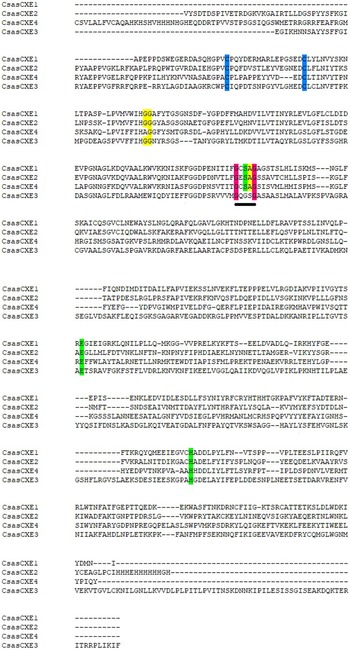
We identified four C. sasakii CXEs (CsasCXE1 ~ CsasCXE4) from head transcriptomes of the adult females and males (table 1). After 3′ RACE, the new sequence lengths are shown in table 1. Sequence alignment showed conserved amino acid residues that include the disulfide bridge (Cys, Cys), oxyanion hole (Gly-Gly, Ala), pentapeptide Gly-X-Ser-X-Gly, and catalytic triad (Ser, Glu, His) (fig. 1). However, variations of conserved amino acid residues occur in CsasCXE3 and CsasCXE4. The pentapeptide Gly-X-Ser-X-Gly is changed to a Gly-X-X-Ser-Gly motif in CsasCXE3, while the first glycine of the oxyanion hole is replaced by an alanine in CsasCXE4 (fig. 1).
Sequence alignment of candidate C. sasakii CXEs, showing conserved amino acid residues: the disulfide bridge (Cys, Cys; blue), oxyanion hole (Gly-Gly, Ala; yellow), pentapeptide Gly-X-Ser-X-Gly (underlined), and catalytic triad (Ser, Glu, His; green).

Candidate CXEs identified from head transcriptomes of C. sasakii adult females and males

Phylogenetic analysis
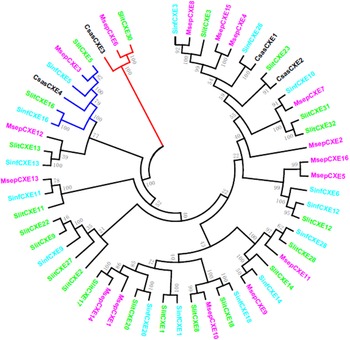
Phylogenetic analysis indicated that the CXEs with the Gly-X-X-Ser-Gly pentapeptide motif cluster in a major clade, including CsasCXE3, a M. separata CXE (MsepCXE6) and a S. litura CXE (SlitCXE30) (fig. 2). CsasCXE4, a M. separata CXE (MsepCXE3), two S. inferens CXEs (SinfCXE5 and SinfCXE16) and two S. litura CXEs (SlitCXE5 and SlitCXE16) form a clade in which the first glycine of the oxyanion hole is replaced by another amino acid (fig. 2). CsasCXE1 and CsasCXE2 are close to each other, but both of them are far away from CsasCXE3 and CsasCXE4 (fig. 2). Each of the four C. sasakii CXEs clusters in a clade with some of the other lepidopteran CXEs, with the bootstrap values 100, 91, 100 and 79 respectively (fig. 2).
Phylogenetic tree constructed for amino acid sequences of the CXEs from C. sasakii (black font) and three other lepidopteran species: M. separata (Msep, purple font), S. inferens (Sinf, cyan font) and S. litura (Slit, green font). Red lines show the clades with the Gly-X-X-Ser-Gly pentapeptide motif, while blue lines show the clades in which the first glycine of the oxyanion hole is replaced by another amino acid. Bootstrap values (%) are indicated at the nodes.

Gene expression analysis using transcriptomic data
Gene expression analysis using head transcriptomic data revealed that all the four C. sasakii CXEs have differential expressions between the adult females and males, of which CsasCXE2 and CsasCXE3 are expressed more abundantly in the females than males, but CsasCXE1 and CsasCXE4 are expressed at higher levels in the males than females (TPM ≥5 at least in one sex, |FoldChange| >2 and Q < 0.05 at the same time; table 2).
Comparison of gene expressions between C. sasakii adult females and males, an analysis using head transcriptomic data

Gene expression analysis using quantitative PCR data
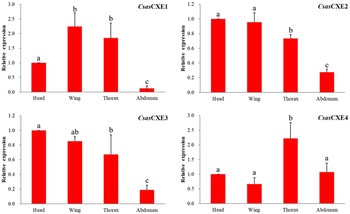
Gene expression analysis using quantitative PCR data revealed that the expression levels of CsasCXE2 and CsasCXE3 in the heads are higher than those in the thoraxes and abdomens, but are not significantly different from those in the wings (fig. 3). The expression level of CsasCXE1 is lower in the heads than in the wings and thoraxes, but higher than that in the abdomens (fig. 3). CsasCXE4 is equally expressed in the heads, wings and abdomens, but has the highest level of expression in the thoraxes (fig. 3).
Relative expression levels of C. sasakii CXEs among different tissues (head, wing, thorax and abdomen) of the adults. Expressions of each CXE in different tissues are normalized, relative to that in head. Data are shown as mean of triplicates with standard deviation (the bar). Different letters at the bars indicate significant differences in the expression levels between different tissues (P < 0.05, LSD test).

Discussion
C. sasakii adults mainly depend on olfaction to communicate with the environment, sensing sex pheromone (Han et al., Reference Han, Jung, Choi, Lee and Boo2000; Zhang et al., Reference Zhang, Li, Xue, Zhao, Li and Ma2017a) and host plant odorants (Wang et al., Reference Wang, Wang, Lv, Yang and Zhang2011; Sun and Wang, Reference Sun and Wang2015). However, the olfactory mechanism has not been well known. ODEs are important olfactory proteins, which inactivate and degrade odorants to free ORs for maintaining olfactory sensitivity (Pelosi et al., Reference Pelosi, Zhou, Ban and Calvello2006; Leal, Reference Leal2013). CXEs are considered to be a major group of moth ODEs (Leal, Reference Leal2013; Groot et al., Reference Groot, Dekker and Heckel2016). In this study, four candidate CXEs (CsasCXE1 ~ CsasCXE4) were identified by using head transcriptomic data from C. sasakii adult females and males. Transcriptome analysis has also been used to identify CXEs in other moths such as Hyphantria cunea (Ye et al., Reference Ye, Mang, Kang, Chen, Zhang, Tang, Purba, Song, Zhang and Zhang2021), Cnaphalocrocis medinalis (Zhang et al., Reference Zhang, Wang, Li, Li and Liu2017b), S. litura (Zhang et al., Reference Zhang, Li, He, Sun, Li, Fang, Ye, Deng and Zhu2016), Chilo suppressalis (Liu et al., Reference Liu, Gong, Rao, Li and Li2015) and S. inferens (Zhang et al., Reference Zhang, Xia, Zhu, Li and Dong2014).
Sequence alignment indicated variations of conserved amino acid residues in two C. sasakii CXEs (CsasCXE3 and CsasCXE4). The pentapeptide Gly-X-Ser-X-Gly is changed to a Gly-X-X-Ser-Gly motif in CsasCXE3, while the first glycine of the oxyanion hole is replaced by an alanine in CsasCXE4. Such variations occur not only in C. sasakii, but also in other species. The CXEs with such variations cluster well in the phylogenetic tree. Remarkably, we wonder whether such variations affect CXEs’ functions. The oxyanion hole is an important functional site of CXEs, which may be affected by the change of the Gly-X-Ser-X-Gly pentapeptide motif. This is because the second X in the motif is usually an alanine involved in the formation of the oxyanion hole, but the alanine often does not exist in the Gly-X-X-Ser-Gly motif. In addition, the replacement of the first glycine of the oxyanion hole may also affect its formation.
Phylogenetic analysis indicated that each of the four C. sasakii CXEs clusters in a clade with some of the other lepidopteran CXEs, with the bootstrap values 100, 91, 100 and 79 respectively. Although the bootstrap values are high enough to suggest possible functional similarities, the functions of these CXEs have not been determined. Two S. inferens CXEs (SinfCXE26 and SinfCXE5) clustered with CsasCXE1 and CsasCXE4 respectively were considered as candidate ODEs (Zhang et al., Reference Zhang, Xia, Zhu, Li and Dong2014), but their functions remain to be further researched.
Gene expression analysis using head transcriptomic data revealed that all the four C. sasakii CXEs have differential expressions between the adult females and males. The results suggest that these CXEs are likely to be involved in sex-related activities. CsasCXE2 and CsasCXE3 have similar tissue and sex expression patterns. The two CXEs have relatively high expression levels in the heads and are expressed more abundantly in the female heads than male heads. If the two CXEs function as ODEs, they may be able to inactivate and degrade carboxylic esters from host fruits in C. sasakii adult females. Although CsasCXE1 and CsasCXE4 are not dominantly expressed in the heads, the possibility that they serve as ODEs cannot be excluded. The two CXEs are expressed at higher levels in the male heads than female heads, so we wonder whether they are involved in inactivation and degradation of the sex pheromone in C. sasakii adult males. C. sasakii sex-pheromone components are not esters, so they should not be directly degraded by CXEs. However, maybe CXEs cooperate with other enzymes to participate in the processes. It was reported that different enzyme families may work together in inactivation and degradation of the same type of odorants (Steiner et al., Reference Steiner, Chertemps, Maïbèche and Picimbon2019). Our study laid the foundation for exploring functions of C. sasakii CXEs.
Supplementary material
The supplementary material for this article can be found at https://doi.org/10.1017/S0007485322000244
Acknowledgements
This work was supported by the Research Start-up Foundation for Introduced Talents of Shenyang Agricultural University (Grant number: 20153016) and the Research Start-up Foundation for Doctors of Liaoning Province (Grant number: 20170520379).
Conflict of interest
The authors declare none.