As Chicago became the center of gospel music, wrote Dena J. Epstein, it also became the publishing center for that music. She named the (Thomas A.) Dorsey House and the Martin and Morris Music Company [sic] the most historically notable of Chicago's gospel music publishers.Footnote 1 Anthony Heilbut concurred: “By 1942, gospel supported a good half-dozen publishing houses with Sallie Martin, Dorsey, and their discovery, Roberta Martin, running the [three] largest.” He pointed out that the Martin and Morris Music Studio (MMMS) had been “the largest Negro-owned gospel publishing company in America.”Footnote 2 Horace Clarence Boyer wrote that MMMS was the first, and after 1970, the sole black gospel publisher to distribute music by black as well as white publishers.Footnote 3 Acting on the fact that the MMMS was “the nation's oldest continually running black gospel music publishing company,” Bernice Johnson Reagon facilitated the acquisition of the company's archives for the Smithsonian's National Museum of American History (NMAH) in 1993.Footnote 4 And in his definitive study of Chicago gospel, Robert M. Marovich writes, “Of all the publishing entities sprouting up in Bronzeville [in the 1940s], the Martin and Morris Music Studio was the most successful and longest lived.”Footnote 5
And yet, few except the most avid historians and fans of black gospel even recognize the names of the company or its two remarkable owners. Is the MMMS legacy a “fakelore” that is simply repeated in every study of black gospel, or can all those assertions be supported? This article confirms that they can. Jointly owned by singer/impresaria Sallie Martin (1895/6–1988) and composer/arranger/pianist/organist Kenneth Morris (1917–88), the MMMS not only delivered original and arranged gospel songs to an eager public for over fifty years; it also offered ordinary people the chance to see their names in print as author or composer on the cover of a gospel octavo, copies of which could then be sold by that same ordinary person. The company grew steadily from its founding in 1940 through the mid-1960s, when annual sales peaked at $200,000. From that height in sales volume, through Sallie Martin's sale of her interests to Morris in 1973 and Morris's death in 1988, MMMS remained profitable, but more modestly so. Eunice (Necie) Seaberry Morris (1919–2005), Kenneth's wife, managed royalties and filled orders from 1988 until the early 1990s, when she began to pack up and dispose of the company's records.Footnote 6 The Martin and Morris Music Studio imprint so permeated the first fifty years of black gospel music that Morris's heirs continue to reap impressive royalties, including approximately $30,000 in 2015. The company's omnipresence in any serious discourse about black gospel is justified, but reasons for its longevity and the roles it played in the creation, dissemination, and proliferation of black gospel music from 1940 to 1993 have not been fully articulated. Supported with interviews of the owners by Bernice Johnson Reagon, James Standifer, and others, and holdings of the Martin and Morris Company Records at the Smithsonian's National Museum of American History, this article examines contexts for black-owned music publishing in the last century, the owners’ early business models, their respective roles in the company, marketing and expansion strategies, and musical impact on the entire gospel field, all of which heretofore have been related only in summary.
The MMMS in Context
In their desire to own and run a company in 1940, Martin and Morris joined a healthy nationwide trend. The National Negro Business League was founded by Booker T. Washington in 1900, at which time the United States was home to 20,000 black-owned businesses. That number doubled by 1914; undertakers, drugstore owners, workers in the domestic and beauty industries, and other types of retailers dominated the black business scene. In her history of black-owned business in the United States, Juliet Walker charts black business types and total numbers of owners and employees, by decade, between 1890 and 1940.Footnote 7 In 1940, when MMMS was founded, the total number of black owners and employees in business nationwide was 87,475. Professions representing the greatest percentages of African Americans in business were agents/salesmen (approximately 28% of the total), barbers/hairdressers (32%), retail merchants (20%), and restaurant owners (13%). In 1935, Chicago was home to 724 black-owned retail stores, which turned a cumulative profit of $2,735,000.Footnote 8 For 1938, Walker found 320 businesses of all types in Chicago's 47th Street black business district, only 26% of which were owned by black businesspeople.Footnote 9 The MMMS may have been counted among Walker's agents/salemen category for 1940, but publishers and printers were scarce enough not to be represented by name in her totals. By then, however, Chicago was in fact home to a handful of publishing companies owned by black Americans.
Among white religious, educational, and popular music publishers active in Chicago before the turn of the twentieth century, gospel publishers had become most prominent by 1900.Footnote 10 These companies continued to garner a significant portion of the city's music publishing trade until the 1920s. The most successful white gospel music publishers in the country, however, were located elsewhere. Primarily because they capitalized on the inherited singing school infrastructure, those companies made more money than the MMMS ever would. A. J. Showalter's Georgia company sold over six million copies of 100 separate gospel collections by the time the company ceased publishing music in 1940. Rooted in Texas, the Stamps-Baxter brand bostered its sales with a traveling male quartet, a radio station, and the influential magazine, Gospel Music News. Talmage W. Dean estimated that Stamps-Baxter's annual sales reached as high as four million dollars by 1949.Footnote 11
In Chicago's black community prior to 1930, “gospel” indicated hymns and choruses with texts ranging in age from those by Watts and Wesley to newer gospel songs like C. A. Tindley's “Stand By Me” (1905). Marovich divides Chicago's black sacred music publishers into those active during the transition from old-style hymnody to gospel (Pace and Bowles) and those founded after the advent of Dorsey-style gospel.Footnote 12 Charles H. Pace moved his Pace House Music from Benton Harbor, MI, to Chicago in 1915, ran the enterprise out of his home, and re-named it Old Ship of Zion Publishing. Significantly, Pace's arrangements were nearly exact transcriptions of his ideal performances, in contrast to the four-part, homophonic outlines later favored by Dorsey and Morris.Footnote 13 Pace eventually became the arranger for Lillian M. Bowles's House of Music, established in the late 1920s at the height of Chicago black music publishing, but also prior to the advent of Dorsey-style gospel. The Pace and Bowles organizations will reappear in the discussions below.
The most important predecessor for Martin and Morris was Dorsey, who merged his gutbucket blues-style tunes such as “Tight Like That” (1928) and “Terrible Operation Blues” (1930) with his Baptist spirituality in the early 1930s.Footnote 14 Publishing seemed the best way to make money in the sacred music business. Gospel Pearls (Nashville, 1921) and The Baptist Hymnal with Responsive Readings (Nashville, 1924) had been popular with African Americans, and Dorsey learned from Pace that recording royalties could only be secured if he had first published the music. He was initially unsuccessful because his four-part, homorhythmic settings were, in Michael Harris's estimation, innocuous.Footnote 15 It took a marketing plan involving live performances to launch Dorsey's new style, brimming with magnetic, original melodies, borrowed tunes, and texts describing a personal relationship with a readily accessible God. Dorsey's story is relatively well known. Less familiar, however, are the ways his path intertwined with that of his first business partner, Sallie Martin, whose participation was central to Dorsey's ultimate success.
Dorsey and Martin: A Gospel Infrastructure
The woman known as Sallie Martin was born on 20 November 1895 or 1896 near the small town of Penfield in Greene County, Georgia, which had been comprised mostly of cotton plantations prior to the Civil War.Footnote 16 She attested to knowing nothing about her father—Martin is her first married name and her birth family name has yet to be discovered.Footnote 17 Her childhood was spent with her mother and maternal grandparents.Footnote 18 Early on, she was exposed to hymns in an old country church, but during childhood, Sallie didn't sing, nor did she profess a Christian faith. She later told Anthony Heilbut that her mother's singing inspired her desire to be a traveling musician.Footnote 19
After the deaths, first of her grandparents and then her mother, a teen-aged Martin recalled telling her country cousins, “I never liked any cotton picking and no kind of working the fields . . . so, therefore, I'm going . . . to Atlanta.”Footnote 20 Thereafter, she joined the typical work force for urban black women, which included babysitting, cleaning houses, and washing clothes for white people. While living with her church-going host family in Atlanta, Martin states, she became a Christian and adopted the family's “no partying” rules.Footnote 21 Her often-quoted disdain for drinking, partying, and attending secular entertainments seems rooted in these experiences.
She gave birth to a boy she named Joel in 1915 and the next year married Wallace Martin (1898/99–1950) when she was twenty years old and Wallace eighteen.Footnote 22 In May of 1917, Atlanta's Old Fourth Ward, including the Martins’ home, was destroyed in a massive fire that decimated the residences of many African Americans. The Martins then relocated with their pastor, Reverend C. C. Ailer, and several other Mount Zion Baptist Church members to Cleveland, Ohio.Footnote 23 In this way, Sallie Martin joined the Great Migration northward, but not yet to her long-term home.
Gospel music was still a phenomenon of the future in 1917. As Martin told James Standifer in 1981, “At that time . . . there was nobody singing what you would call ‘gospel’ . . . you were either in a choir and you . . . sang either from a hymn book or a gospel book . . . [you were] just doing church work and singing.”Footnote 24 She found employment at a school on Cleveland's west side, and her husband opened a hamburger and barbecue stand in their front yard. Wallace's penchant for gambling and drink became a problem for Sallie and the couple separated. She permanently relocated to Chicago in 1923 and worked in a hospital.Footnote 25 However, Sallie Martin would not long be consigned to the background.
In 2011, Robert Fink named Thomas A. Dorsey and Sallie Martin “pioneers of black musical capitalism,” but when Martin first encountered Dorsey in 1929, neither had discovered how money could be made in the sacred music business.Footnote 26 Martin often recounted their first meeting: “I started with Mr. Dorsey in 1929. I went to [a church] rehearsal [and] came across one of his songs, ‘How about You.’ A girl brought it to me at the church. And I said, ‘where'd you find it?’ and she said, ‘oh, it's an old fellow over on 40th Street. . . .’ I said, ‘Oh well, I certainly would like to meet him.’ . . . ‘I'm going over.”Footnote 27 Martin went on, “[Someone's] daughter was playing [piano] but she couldn't transpose. That made the song be just a little high for me, so after the rehearsal was over, Mr. Dorsey said, ‘Well, you have a nice voice. . . .Would you like to work with a group?’ and I said, ‘oh, I wouldn't mind.’ . . . So we met together and got started, and for a number of years there, I guess three or four years, the group sang together and we traveled around a good many parts of Illinois.”Footnote 28
Soon after joining Dorsey's singing team, Martin noticed that he had no accounting system. Instead, he kept his cash in a drawer from which household and professional expenses alike were casually funded. The singers rehearsed in the bedroom he rented from his uncle, which, Martin recalls, “had an iron [bed] . . . no rug on the floor, and an old desk.”Footnote 29 Martin had been responsible for her own upkeep from her teen years, had struggled with and abandoned a gambling husband, and was the single mother of a fourteen-year-old son. Not surprisingly, she saw fit to take Dorsey's business in hand. After a few rehearsals, she remembers telling him, “you know, you have something here, but you don't know what to do with it.”Footnote 30 The upshot of that statement was that she began to manage his business, for which he paid her $4 a week. She then rented a room for $3 per week at the Ritz Hotel, not quite a block from Dorsey.Footnote 31 Dorsey also gave her 50% of music sales she made at choir rehearsals, a commission Martin readily capitalized upon.Footnote 32 Many years later, Martin and Dorsey recorded “I'll Tell It Wherever I Go,” which captures Martin's powerful shout-style delivery and Dorsey's light and under-developed accompaniment. Neither musician is at her or his best in this recording, a dynamic that also may have applied to their professional partnership.Footnote 33
Dorsey's small ensemble, which included Martin, first sang at the National Baptist Convention in 1930. In 1932, Martin joined the Gospel Chorus of the Pilgrim Baptist Church, where Dorsey conducted the choir.Footnote 34 Dorsey formed the first amalgamation of black gospel church choirs and named it the Gospel Choral Union, whose inaugural meeting took place in Chicago on 17 August 1932. Dorsey was elected president.Footnote 35 In the years to follow, Martin helped him set up choral unions throughout the South and Midwest. In these ways, Dorsey and Martin established a national gospel infrastructure where none had previously existed, quite a feat given the discrimination against touring black musicians, the white-dominated music publishing business, and the economics of the Depression era.Footnote 36
The next plank in what was becoming Dorsey's national advancement platform was added in 1933, when the still relatively new choral union hosted the first national convention of a new venture, the National Convention of Gospel Choirs and Choruses (NCGCC), at Pilgrim Baptist Church in Chicago.Footnote 37 Sallie Martin was elected corresponding secretary of the NCGCC at the meeting, and at the St. Louis convention the next year she assumed the office of National Organizer, a position she retained for decades.Footnote 38 Because the NCGCC reached hundreds of African Americans throughout the nation, conventions also drew representatives of the NAACP and National Association of Negro Musicians. In 1937, NCGCC leaders wired a letter urging senators in the ten states represented there to “use their influence to fight for passage of the Wagner-Costigan anti-lynching bill.”Footnote 39 The resolution committee of the NCGCC also sent President Roosevelt a telegram in 1940, urging a national prayer day and fair play for “Race members” in the armed services.Footnote 40 Dorsey and Martin's nascent black gospel music infrastructure thus participated actively in the fight for social justice in its first decade.
Kenneth Morris and Converging Careers
Sallie Martin's future partner, Kenneth Morris, was born in Jamaica, Queens, New York, on 28 August 1917. The teen years of the two musicians could scarcely have been more divergent in opportunities and experiences. An only child, Morris was raised by an elderly aunt who ensured that musical training was a central part of his childhood.Footnote 41 Piano lessons began around the age of eight, and he played both in his aunt's Baptist and her husband's Methodist churches, studied classical piano, took general courses at City College of New York, and piano, composition, arranging, and orchestration classes at what Morris called the Manhattan Conservatory.Footnote 42 Concurrently, Morris had a great time playing jazz with friends. Gig money was good, while matriculating at music school presented a financial hardship, and so he ended his formal musical education and continued to play jazz in New York. When Morris was seventeen years old, his band was invited to play at the 1934 Chicago Century of Progress (aka World's Fair), and his group headed west. Performing long hours beside Lake Michigan took its toll on Morris's fragile respiratory system—he was forced to leave the band during the Fair.Footnote 43 He remained in Chicago to recuperate with a family member, and his jazz colleagues returned to New York after 1 November.
By then, the momentum of Dorsey's gospel blues had picked up, and Morris's equal facility in church and jazz music equipped him well for the new gospel style. In 1937, he became the arranger/accompanist for Bowles Music Publishers.Footnote 44 About arranging all the the company's published music, Morris recalled, “Somehow or other, I'd have to get the song out of [a person's] head and on to paper.”Footnote 45 In addition, he innovated the concept of selling anthologies—hit songs bound along with the ones that did not sell as well—and later, folios of songs associated with popular singing groups.Footnote 46 His early contributions to the nascent gospel language are evident in his arrangements of “God Shall Wipe All Tears Away” (1935), “I Am Sending My Timber up to Heaven” (1939), and “God's Gonna Separate the Wheat from the Tare” (1939), which Horace Clarence Boyer asserted “broke ground in the field and became gospel music standards.”Footnote 47 A shrewd businessman even in his early twenties, Morris withheld the majority of his own songs while on Bowles's payroll. An exception is “Heaven Bells” of 1937, whose call-and-response style and focus on a single affect led Boyer to describe it as “only one step away from a Negro spiritual of the jubilee variety.”Footnote 48 Morris's arrangements were thus more forward-looking than the few original songs he published while working for Bowles.
Morris received another big break when a driving force in gospel, Reverend Clarence Cobbs (1908–79), hired him to direct the choir at Chicago's influential First Church of Deliverance. Cobbs had founded that Spiritualist church in 1929 and began morning radio broadcasts in 1934. Morris joined his team in 1938 and began more diligently to compose his own music during his four years there. He later recalled, “When I came along, [First Church of Deliverance] had a radio choir, but I changed it around to a gospel choir.”Footnote 49
His most significant innovation, however, was to incorporate the Hammond organ into services in 1939. Morris recalled his delight at playing such a flexible instrument, first demonstrated by its inventors in 1935: “It's endless what can be done with a Hammond organ. . . . People came from all over just to hear me play that organ. Oh yes, it swept! It swept! Instantaneously! I kept experimenting with it, and I was getting all kinds of [sounds] out of it that had never been heard by anyone else before—so much that Lyon and Healy hired me to exhibit the organ.”Footnote 50 Morris would tell Reagon in 1987, “I introduced the Hammond organ to Chicago and to the world”—a true statement in the realm of gospel.Footnote 51 Gospel organist Kenneth Woods, Jr. adds that Morris's Hammond organ technique infused the swing band sounds of 1930s Chicago into gospel just as Dorsey's piano style had earlier incorporated blues and ragtime of the 1920s.Footnote 52 Morris contributes a sprightly layer of Hammond organ to the accompaniment on Brother Joe May's recording of Dorsey's “Search Me, Lord” and more soulful and shapely instrumental answers to Mahalia Jackson's vocals on the traditional song “City Called Heaven.”Footnote 53 Morris wasn't solely responsible for the Hammond's subsequent popularity in R&B, rock, and soul, but in gospel music and in the absorption of its elements into other popular musical genres, his mark is indelible.
Just as Sallie Martin was considered Dorsey's apprentice rather than partner, so Morris was widely understood to be a staff musician, when in fact, his contributions were essential to the success of Lillian Bowles's business. Morris summarized his motivation to leave her employ: “Mrs. Bowles was using my work, but I wasn't getting paid proportionately.”Footnote 54 Further, “Mrs. Bowles didn't have a singing group. . . . [Such an ensemble] was a gold mine [that she wasn't capitalizing on]. The only way to produce a market was to have someone to introduce the songs to the people.”Footnote 55
Over at the Dorsey Company, Sallie Martin also felt underappreciated, even though The Defender frequently described her as “the national leader of gospel singing.”Footnote 56 By her account, the partnership ended in 1939 when Martin announced, “Mr. Dorsey, I'm just going to travel by myself.” “Of course,” she added, “[by that time], I was running his business and taking care of everything.”Footnote 57 As Kenneth Morris reiterated in 1987, “Sallie Martin was not getting her just due from Dorsey, and I wasn't getting my just due from Mrs. Bowles.”Footnote 58
Now professionally independent, Martin set out as a solo artist with pianist Julia Mae Smith, whom she had met on a tour to Ohio with Dorsey.Footnote 59 Gospel touring revolved around the NBC and the NCGCC conventions. “You see,” Sallie Martin said, “what I [did was] to make every National Baptist Convention and I [brought and sold] the music.”Footnote 60 For example, if “He'll Wash You Whiter than Snow” happened to be popular, Martin could sell between 500 and 1,000 piano/vocal copies. “That's the way I built my business: taking copies, selling them on the road, [and] paying expenses [with the proceeds].”Footnote 61 Rev. Eugene D. Smallwood, a composer and music director, further detailed this strategy:
[Organizers of the NBC and the NCGCC conventions] would let singers practice to “sort of warm up the meetings” and help gather people together for the main events. If [the convention delegates] were out for lunch at 12:00 and the afternoon session started at 2:00, the gospel singers would get in about 1:00 . . . and start singing their new numbers. The people would come in to hear the new numbers, because they'd have different people go through the audience and sell [the music]. . . . When the pastors would go back to their various churches, then they would bring the music back with them.Footnote 62
Savvy, energetic musicians like Sallie Martin made money, garnered national acclaim, and brokered the power of celebrity by following this model.
Martin was a touring ensemble singer for decades, beginning in the 1930s under Dorsey's auspices, continuing in the short interim between her break from Dorsey and the establishment of the MMMS in 1940, and therafter until around 1970, as leader of female ensembles sponsored by the MMMS. In later life, Martin relished telling “road stories” from the automobile trips that took her singing groups to rural areas in the Deep South. These experiences would have persuaded the less courageous to stay close to home, but Martin was apparently convinced that she could avoid or diffuse any racially fraught situation. Lodgings accessible to African Americans were sometimes poorly maintained, so Martin, Mahalia Jackson, and others traveled with disinfectant and cleaning equipment in their cars.Footnote 63 One evening Martin and the group stopped at a particularly uninspiring hotel near Lake Ponchartrain in Louisiana. “See,” she said, “at that time . . . the barrier [i.e., discrimination against blacks] was in full force, and oh, this hotel I'm telling you, it was nothing. I was scared to death. We got this room and I went up in it and I picked up [and cleaned under] the beds and everything else.”Footnote 64
Most chilling among Martin's remembered culture clashes was when she joined forces with the Roberta Martin Singers during the mid-1930s for a trip down South. She recalls a memorable night when the ensemble, comprising herself, Roberta Martin (1907–69), Willie Webb (1919–after 1990), Robert Anderson (1919–95), and Eugene Smith (1921–2009) were headed from Selma, AL, to Atlanta, with the teen-aged Anderson driving:Footnote 65
[A police] officer stopped us and we said, “What happened, officer?” He said, “This boy [can't] pass anyone on the right side. Why, he'll get somebody killed.” I said “The error was, he figured it was a cross road and . . . you were going across, and he just pulled to the right.” The officer says, “Where is your license?” So Robert [Anderson] was always so unconcerned, talks slower, and he was so long finding the license . . . so the [officer] got provoked. . . . the officer said—he used a curse word—“you get in the car and you all follow us.” [I] got under the [steering] wheel, they [started to book] him in a little old place—a little caboose or something—so I jumped out of the car and said, “Officer, you have us under the wrong impression. I'm on my way to Atlanta, Georgia, for a revival in the morning and I just closed out in southern Alabama. We're not somebody just around gallivanting and out for a big time. . . .” He said, “What have you got to show that you're doing some evangelist work?” . . . Roberta had published her first book and on the back was Christ on the cross, and I said, “well, here's some literature, so I opened the trunk and that was the first thing he saw. . . . When he came back, he said, “you have to learn this ‘[n-word]’ how to talk. If I had my black jack I'd beat him to death.”Footnote 66
Terrifying as these moments must have been, Martin continued to tour, but she did so according to her own strictly enforced rules governing her singers's behavior.
The Martin and Morris Music Studio—Set-up and Success in the 1940s
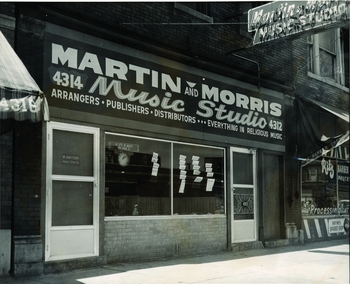
As Morris further established himself professionally, Sallie Martin occasionally dropped in to sing in Cobbs's radio choir. Soon after she left Dorsey's business, Martin and Rev. Cobbs had a conversation about her opening a new publishing company. Martin's net worth at that time amounted to $35 and an automobile.Footnote 67 Aware of her inability to read or notate music, Cobbs suggested she think about partnering with the talented and experienced young Kenneth Morris, his organist and choir director, and Bowles's former house musician. In Martin's memory, “[Morris] didn't have a penny, nothing but himself.”Footnote 68 The resourceful Cobbs used continuing inflow from his church building campaign to stake the remaining money; in 1940, Martin and Morris rented a store at 4315 South Indiana Avenue for $50 per month, bought showcases, and contacted Dorsey and Roberta Martin to let them know about the new business. They first named the venture the Martin and Morris Music and Studio Teaching School, but soon shortened the name to Martin and Morris Music Studio. Sometime between 1946 and 1949, they moved across the street into a former post office at 4312–4314 South Indiana (Figure 1).Footnote 69
Unidentified photographer, MMMS storefront, 4312–4314 S. Indiana Street, Chicago, mid-1940s. Martin and Morris Music Company Records, series 5, 8. Archives Center, National Museum of American History, Smithsonian Institution.

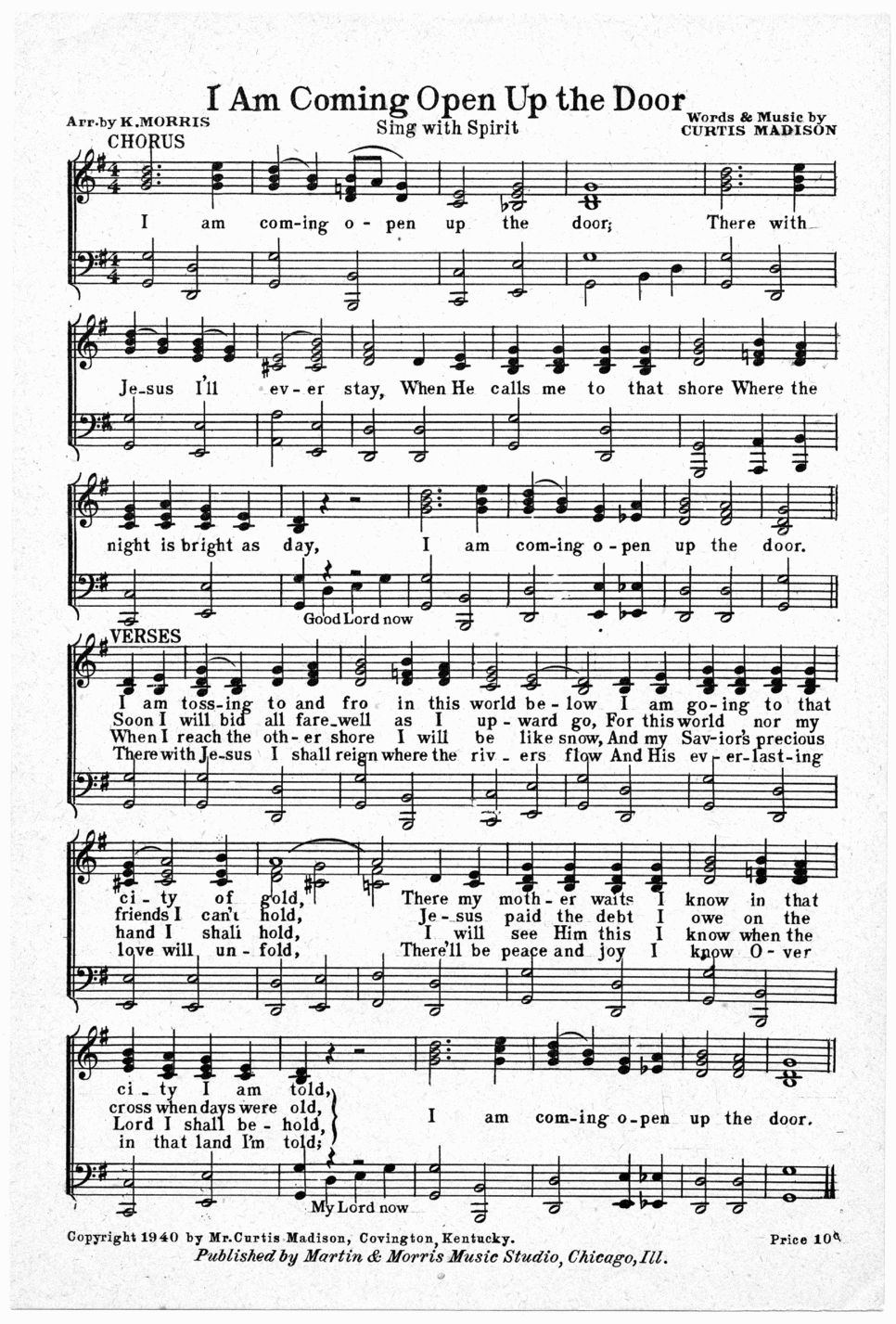
In its first year, MMMS published its own single-page octavos such as “I Am Coming, Open Up the Door” (Figure 2) and a compilation, The Three Stars Gospel Song Book. The Three Stars featured twenty-one songs, a hefty percentage composed and/or arranged by Morris, and one composed by his future wife, Necie G. Seaberry. Boyer estimated that about seventy of Morris's career total of more than 300 compositions were copyrighted in 1940 by the MMMS. His “I'll Be a Servant for the Lord” was his first to attract wide attention, in part because the Wings Over Jordan Choir sang it on their coast-to-coast radio broadcasts from CBS in Cleveland.Footnote 70
“I Am Coming Open Up the Door,” words and music by Curtis Madison, arr. Kenneth Morris (Chicago: Martin and Morris Music Studio, 1940). Martin and Morris Music Company Records. Archives Center, National Museum of American History, Smithsonian Institution.

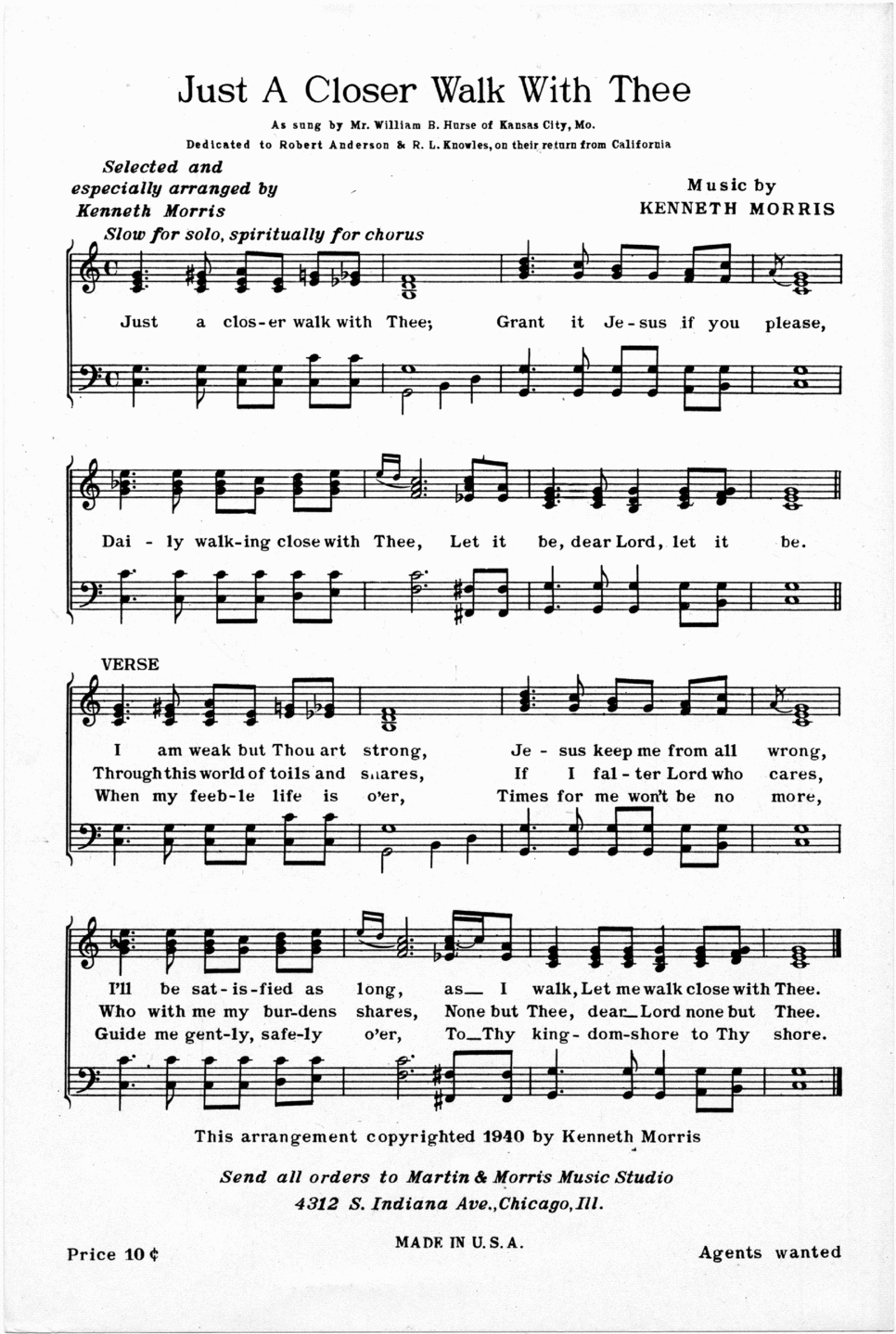
Kenneth Morris's most familiar arrangement is the perennial “Just a Closer Walk with Thee,” an anonymous tune he heard sung by William R. Hurse's Kansas City choir in 1940.Footnote 71 When asked the origin of the song, Hurse told Morris he had no idea; he had heard it all his life. Morris notated it on the spot and soon published an arrangement (Figure 3). The company's own Sallie Martin Singers performed it at a 1944 National Baptist Convention and, as Morris stated, “that is what put us on the map.” However, as Morris related to Reagon:
We weren't too careful about getting copyrights so [my arrangement of “Just a Closer Walk with Thee”] was stolen from me. . . . You have to remember that we didn't have any business sense at all. . . . We knew nothing about copyrighting or any of that end of it. . . . At ten cents a copy, there was no money involved . . . the expense of copyrighting was about two dollars, so it wasn't even worthwhile. . . . We just put the copyright notice on the song, just put it on there. . . . When [the white Southern publisher Winsett] took my song . . . that woke me up. . . . After 1944, we started copyrighting all our music.Footnote 72
“Just a Closer Walk with Thee,” original arrangement by Kenneth Morris (Chicago: MMMS, 1940). Martin and Morris Music Company Records. Archives Center, National Museum of American History, Smithsonian Institution.

At the next several National Baptist Conventions, they repeated “Just a Closer Walk,” together with Morris compositions including “Yes, God Is Real,” “Christ Is All,” and “Don't You Care,” all of which fortified the company's reputation as performers, creators, and distributors of everything desirable in gospel music.
The first-year ledgers from MMMS show a relatively simple business model and suggest that both owners filled telephone and mail orders and sold music to walk-in customers. For example, on 22 February 1942, Martin recorded a modest $1.90 in sales. Prices depended on the song: Roberta Martin's “Didn't It Rain” (arr. Willie Webb, pub. Bowles, 1939) cost fifteen cents per copy. Another of Martin's ledgers spans 5 May 1942 to January of 1943, during which time she recorded transactions with such black religious institutions as the Baptist Young People's Union Board of Chicago, the National Baptist Publishing Company, and the National Baptist Convention's Sunday School Board.Footnote 73 MMMS also did business with white-owned firms during the period, such as J. M. Henson Music of Atlanta, Stamps-Baxter Music in Dallas, Edward B. Marks in New York City, and publishing houses in Richmond and Pittsburgh.
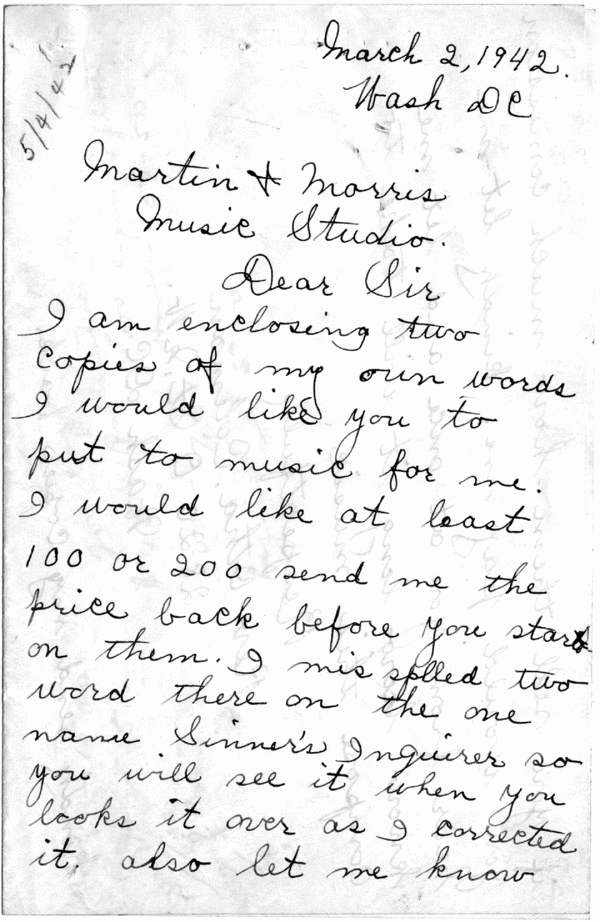
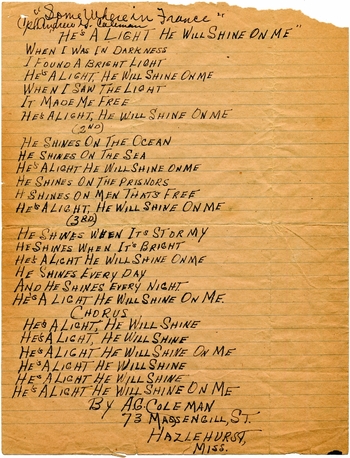
Entirely separate from the sale of already printed music was MMMS's well-documented service of helping people from all walks of life and regions in the United States turn their gospel poems, melodies, and lead sheets into published, voice-plus-accompaniment (or choral) arrangements (see Figures 4 and 5). Records show that some submitted ideas were rejected, but if Morris saw promise in the kernel of a song, he could turn out a deft harmonic setting—the mere skeleton of a full-blown gospel performance, but a published gospel song, nonetheless—in a day. Print versions of Morris's creative work were unbelievably affordable in 1940s, $25 for an original song, which explains why so many Americans could seek his services. Costs changed only incrementally during the first two decades the MMMS offered the service.
Order from Rev. Otha Coleman, Washington, D.C., 4 March 1942, for a setting (“He's a Light He Will Shine on Me”) of a poem authored by his son, Corporal Andrew M. Coleman, France, 1942. Martin and Morris Music Company Records, series 1,1. Archives Center, National Museum of American History, Smithsonian Institution.

“He's a Light He Will Shine on Me,” poem by Andrew M. Coleman sent to Morris for a musical setting. Martin and Morris Music Company Records, series 1,1. Archives Center, National Museum of American History, Smithsonian Institution.

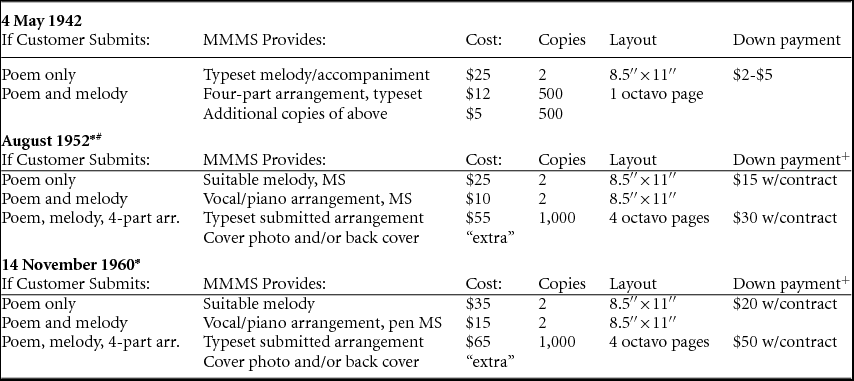
During the 1940s, the MMMS communicated its fee structure in individual letters and invoices. Table 1 shows that in 1942, if a customer submitted a poem only, the MMMS provided two copies of a new, typeset melody with accompaniment for $25. Additional copies of anything that had been typeset were $5 for 500. A purchaser would receive 1,000 typeset copies of a Kenneth Morris melody and accompaniment for her poem for $35. Each copy of that new gospel song thus cost 3.5 cents. With luck, the customer might sell all thousand for ten cents each, resulting in a gross profit of $100 and a net gain of $65.Footnote 74 Sometime prior to May 1952, the company printed and circulated its first “Songwriters Service” flyer, which was sent out with shipped orders and distributed on tours. The new structure retained the charge of $25 for two copies of a new Morris melody (now returned to the customer in manuscript), and two manuscript copies of a four-part vocal arrangement by Morris cost $10. One thousand typeset copies, arranged by Morris, now cost $55, so the conversion of a submitted poem to 1,000 copies of a melodized, harmonized, typeset, and printed octavo therefore cost $90: $25 for the melody, $10 for the arrangement, and $55 for the copies.Footnote 75 In 1960, the complete cost for returning that thousand copies to a customer who had supplied a poem only was $115. If the customer sent in a tape recording of his song, MMMS would publish a four-part, voice-plus-piano arrangement and 1,000 octavo-sized, black and white copies for $120. On the final version of the Songwriters Service flyer, the owners spelled out the deposit, return of materials, and refund policies. Advertising on the song's back cover cost extra and responsibility for copyrighting songs rested with the customer.Footnote 76
Prices and Services of the MMMS Songwriter Service, 1942, 1952, and 1960. Martin and Morris Music Company Records, series 1, 2. Archives Center, National Museum of American History, Smithsonian Institution.

*“We are not responsible for the return of your material unless accompanied by postal stamps sufficient for return.”
#“We will help you get your song on the market through our nation-wide contacts and mailing list.”
+ The flyer included a contractual agreement—“I agree to pay . . . the balance C. O. D. when the work is finished”—and a signature line.
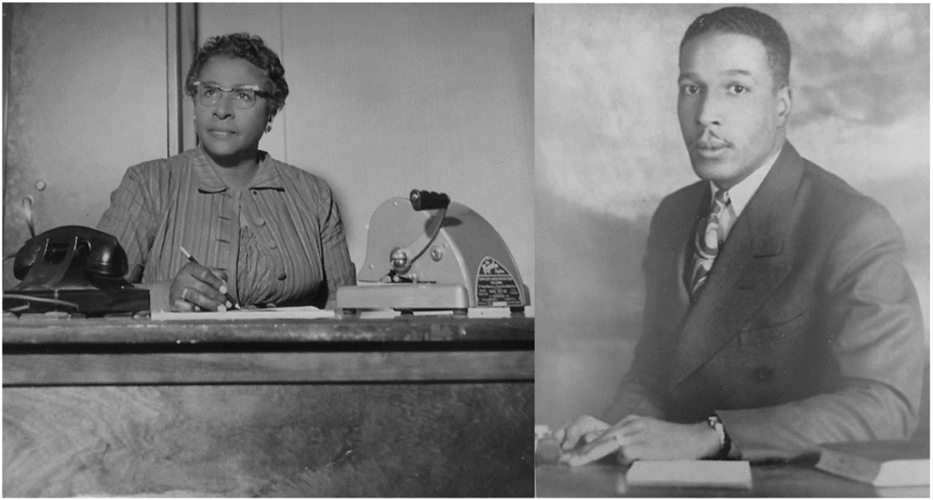
Writing, arranging, and managing the business in Chicago fully utilized Kenneth Morris's many professional gifts. Martin spearheaded the company's expansion by overseeing the addition of a Los Angeles branch in 1941 and hiring someone to manage what was essentially a replication of Morris's infrastructure in Chicago.Footnote 77 For a few years, she continued her itineracy between the two cities, but as she further established herself on the West Coast, Martin regularized her annual circuit. In 1947, she made Los Angeles her home base, from which she continued her career as a traveling artist and promoter of the MMMS brand.Footnote 78 Martin looked back on her pattern of travel in 1972: “I was really blessed to be booked from one year through another. . . . We spent about two to three weeks a year right in Chicago, we'd go to California for the winter, work out there through the winter, leave there in January and go to Miami, Florida, and then [tour] around up until the [choral] convention [in August], and . . . then we'd start out again, time to get back to California.”Footnote 79 In their first decade as partners, Martin and Morris thus established foundations of sustainable business and marketing practices that would propel them into their most profitable years (Figures 6 and 7).
Unidentified photographer, professional portraits, Sallie Martin and Kenneth Morris, mid-1940s. Martin and Morris Company Records, series 5, 8. Archives Center, National Museum of American History, Smithsonian Institution.

On the Road, on Recordings, and on Paper
One happy resonance between Sallie Martin and Kenneth Morris was a commitment to marketing their music through performance. The partnership provided Morris with his “gold mine,” the singing group Bowles had lacked, and Martin swiftly redirected her touring experience with Dorsey and later, with her accompanist, Julia Mae Smith, toward the success of the MMMS. The partners expanded her duo with Smith into the nation's first all-woman, touring black gospel group, known by several names, including the Martin and Morris Singers, the Sallie Martin Gospel Singers, and Sallie Martin and Her Singers of Joy.Footnote 80 One early ensemble comprised vocalists Martin, the adolescent prodigy Cora Brewer (whom Martin would later adopt), Charlie Mae Lomax, and Dorothy Simmons, with Smith as accompanist; they recorded four sides for Bronze, the first black-owned record company in Los Angeles, in 1940.Footnote 81 In Morris's “I'm Walking with My Jesus” (MMMS, 1940), the lilting but restrained opening verse showcases a surprisingly delicate balance of four heavily vibrating, soloistic voices. This overall sense of careful planning is underscored by Smith's nearly imperceptible walking accompaniment, only sparingly decorated. The texture broadens to incorporate more familiar, early gospel heterophony, call-response passages typical of Dorsey's 1930s style and a full-throated solo by Brewer toward the end.Footnote 82 Constraints of the studio notwithstanding, the impression left by this early recording is of five highly musical women, listening closely to each other and rendering a moderately lively song, but reserving their full expressive powers for another track. This track was the first of many recordings featuring a Sallie Martin female ensemble.
Born to Lucius and Annie Brewer on 4 November 1927, Cora came to Martin's attention through her singing at Chicago's Mt. Pleasant Baptist Church. Sallie Martin “informally adopted her in the early 1940s, possibly to ensure the Brewers of their daughter's safekeeping on the gospel highway, with its legendary temptations and dangers.”Footnote 83 The Brewers readily consented to the arrangement in order to help Cora reach her dream of being a gospel star.Footnote 84 The adoption appears to have been roughly contemporary with the 1942 death of Sallie's son, Joel Martin, who lost his life in the Allied Forces’ military campaign in North Africa.Footnote 85 Cora Brewer would then be known until her marriage as Cora Martin, and afterward, as Cora Martin-Moore.
Already on the 1940 recording of “I'm Walking with My Jesus,” the precocious Cora is a standout. By the time Sallie Martin moved her home to Los Angeles in 1947, Cora Martin was a seasoned performer with several years of touring to her credit. Los Angeles became for Cora what Chicago had been for Sallie: a place to put down roots and thrive as a musician and businesswoman.Footnote 86 Marovich writes that Sallie and Cora began helping Rev. John H. Branham organize a gospel choir at St. Paul Baptist Church at 21st and Naomi in Los Angeles.Footnote 87 The two Martins, Ruth Black, Erie Gladney, and J. Earle Hines accompanied by the St. Paul choir and Gwendolyn Cooper on piano, recorded a favorite Kenneth Morris song, “Dig a Little Deeper in God's Love” in February of 1948.Footnote 88 From 1953 to 1962, Cora owned and managed the Los Angeles Gospel Music Mart, a religious music publisher, studio, and record shop which may have begun as the West Coast location of the MMMS. In any case, the venture was financially backed by Sallie and, not surprisingly, it marketed MMMS publications.Footnote 89
Touring with an all-female ensemble was anything but simple, and the Brewers had been right to have concerns for their daughter's wellbeing. When they traveled by train, departures of Sallie Martin's group were usually marked with a short blurb and a photo in the Chicago Defender.Footnote 90 On these occasions, Martin maintained control of the tickets throughout the tour, the better to enforce her imperatives:
I'd try to tell [my singers] before they'd start. . . . “Well, now you have all day wherever you're going. I'm not going to . . . try to keep up with you where you're going . . . only thing, I want you to keep the way clear that you don't have any trouble, but remember when services are over at night, we go home. We have a meal and if it's anything that or games or something that you want to play or the piano or something we do that, but we do not go to taverns and [have a] big time and carry on when the service is over. We don't do that at all, I tell you before you go with me so that you'll know because I keep your railroad fare with me and I will send you home.” . . . I had grown people too, I didn't have children, but that was simply . . . my way everywhere I've been. I [can go back], I don't take a chance.Footnote 91
Martin was determined to keep her singers focused and safe, tour destination options open, and reputation free of scandal.
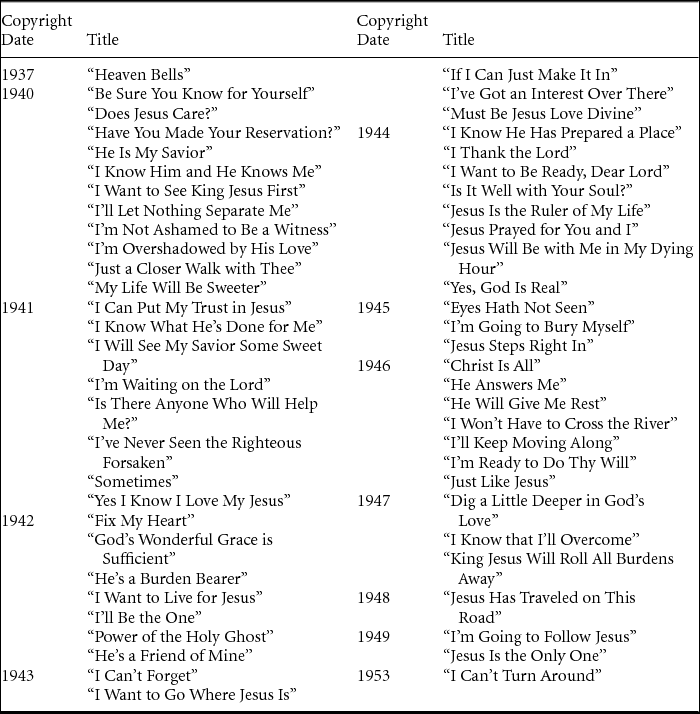
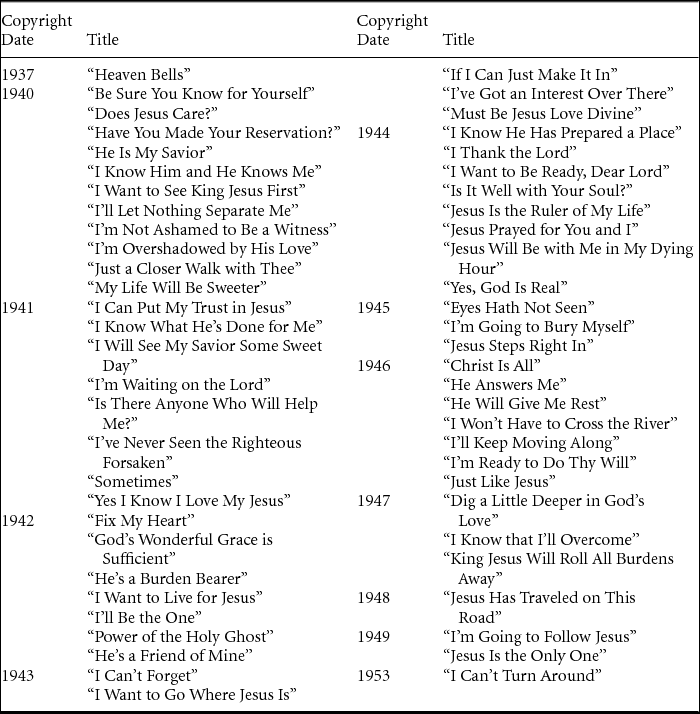
In these ways, Sallie Martin took the company's music to churches, civic meetings, and conventions around the country, while Morris, married to Necie G. Seaberry and a father by 1944, remained primarily in Chicago. In the early 1940s, he sold and demonstrated music in the store and learned on the fly about running a business. Further, as he told Reagon, “I gave lessons. We were not looking forward to the sale of music to make a living.”Footnote 92 Still, Morris's own compositions kept pace with the creative arrangements he completed for customers. He was most active as a composer in the 1940s, when he produced standards such as “I Can Put My Trust in Jesus” (1941) and his most popular song, “Yes, God Is Real” (1944). Of the latter, Boyer wrote that “African American church congregations know this song so well that they need neither the score nor the text to sing it.”Footnote 93 Morris's own favorite was “Eyes Hath Not Seen” (1945).Footnote 94 Its popularity was assured, in part, through recordings by Cora Martin and the Sallie Martin Singers (Specialty 808, 1951), Alex Bradford (Gotham, 1951), and Robert Anderson (Apollo 300, 1953).Footnote 95 In 1992, Boyer categorized fifty-eight songs from Morris's early career and stated that “Eyes Hath Not Seen” was “the most ambitious, progressive, and sophisticated song in the Morris catalog” (Table 2).Footnote 96
H. C. Boyer's table of 58 Compositions by Kenneth Morris, 1937–53. Table 8 in Boyer, “Kenneth Morris: Composer and Dean of Black Gospel Music Publishers,” in Bernice Johnson Reagon, ed., We'll Understand It Better By and By (Washington: Smithsonian Institution Press, 1992), 315.
As his reputation grew as a composer and arranger, Morris began to see market potential for his opinions about church music, including some he shared during an address at the National Convention of Gospel Choirs and Choruses in 1949: “Before the leader of church music can attain the art of choosing the right song at the right time, he must know how to select songs of worth and value from which he may make a choice; then test the songs for religious content, words, literary quality, tune and trust.”Footnote 97 Morris's prose booklets, comprising aphorisms intended for use as sermon illustrations, practical instructions for church ushers, inspirational poems by various authors, and practical guides for choir directors, were soon added to the MMMS catalog. His small monograph, Improving the Music in the Church (1949), contains chapters on the value of church music, music history, rudiments of music, ways to test and choose suitable repertoire, duties of church officers, and how to plan a program.Footnote 98 Guest author Thomas A. Dorsey contributed a chapter entitled “Ministry of Music in the Church.” Morris valued congregational singing but saw the choral director and choir as guardians of musical quality; he urged discipline in rehearsals and regular introduction of new songs to retain interest. He advocated half-voice rehearsal to preserve the voice and facilitate listening, careful attention to choral processions and recessions, and conservative dress: “It is not the loudness or gaudiness of costumes which makes a choir beautiful, but the cleanliness, neatness, and complete uniformity of all the members.”Footnote 99
Morris thus established himself as a creator and gospel tastemaker while managing an increasingly diverse business. Most of the surviving correspondence details ordering, contracting, communicating about proofs and rights to republish, negotiating copyright disputes, and collaborating with the printers and record companies as the latter assumed more importance in the MMMS enterprise.Footnote 100 Legal documents grew more sophisticated in step with the times. A handwritten letter signed by Robert Anderson sufficed as a contract to publish in 1942, while later agreements necessarily sorted out mechanical rights of music written by a customer, published by the MMMS, and recorded by labels such as Savoy and Specialty.
Items in the NMAH archive establish that Morris maintained all aspects of the music publishing and primary distribution activities of the company in Chicago and suggest that the Los Angeles store was a simple storefront that sold music.Footnote 101 Morris managed the financial records as well, shared them regularly with Martin, and signed all bank drafts. For example, his letter of 1 March 1955 to Martin reads, “enclosed you will find [a] check for February. I didn't wait until the bank statement was ready since you said you wanted to leave somewhere around the 4th of March. The Bank balance is around $7,000 and therefore I think we can safely take this dividend.”Footnote 102
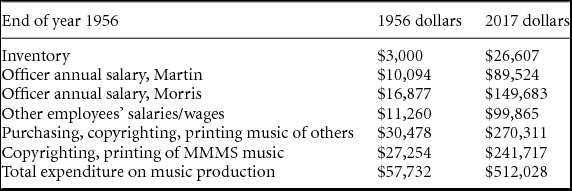
A 1943 survey by the National Negro Business League covering eleven cities in former slave states (plus Cincinnati) showed the best median sales volumes for black businesses ranged from $15,800 for retailers in Baltimore and $16,666 for miscellaneous businesses in St. Louis.Footnote 103 According to Morris, the MMMS fluctuated between $70,000 and $100,000 in sales in the company's “first years,” a more steady $100,000 per year from 1944 to 1954, and between $160,000 and $200,000 from 1955 to 1964, after which time sales volume “leveled off.”Footnote 104 A financial snapshot from the end of 1956 illustrates the company's annual profits at the onset of its most successful period. The cash ledger shows weekly check deposits to Drexel National Bank that ranged from $1,500 to $2,500.Footnote 105 As it flourished, MMMS supported other African American entrepreneurs, including Mary T. Washington's company for professional accountancy at the cost of $50 per month.Footnote 106 Ledgers confirm that each partner drew a salary in addition to something called an officer account, probably representing monthly net profits or dividends. In a typical year (1956), Morris's officer account was consistently $70 per month higher than Martin's, which might have equalized their shares if Martin kept profits from the music sales on tour. Morris's officer account averaged $1,182 per month, with a low of $171 in January and a high of $2,075 in December. The partners awarded themselves a bonus of $900 in December of 1956.Footnote 107 The 1956 ledgers also record the costs of running a thriving business: monthly payments to Illinois Bell, business equipment suppliers Pitney-Bowes for rental and maintenance, Federal Old Age Benefits for Morris, and monthly payments to the Internal Revenue Service of approximately $900.
As Table 3 shows, the grand total of MMMS expenditures for publishing music in 1956 was $57,732, which had the same buying power of over half a million dollars in May of 2017.Footnote 108 The company was therefore well established as a going concern by the end of 1956. It moved with the times by accepting and transcribing submitted songs from tape recordings when that technology emerged, and expanded its holdings by purchasing entire catalogs of defunct publishers such as Bowles in 1959 and Theodore Frye and Roberta Martin around 1978.Footnote 109
Conversion of several totals from the 1956 MMMS Ledger to approximate 2017 dollars, Consumer Price Index Inflation Calculator, 9 September 2017, ata.bls.gov/cgi-bin/cpicalc.pl. Martin and Morris Music Company Records, series 2, 3. Archives Center, National Museum of American History, Smithsonian Institution.

Wide Reach and Staying Power
Early on, the MMMS advertised its goal of being a one-stop music provider with the motto, “If It's in Music, We Have It,” a claim the owners later refined to the more accurate statement, “Everything in Religious Music.” Not surprisingly, when the Chicago Public Library acquired a single copy of each of the company's remaining inventory in the late 1980s, the acquisition amounted to 1,500 separate songs.Footnote 110 Kenneth Morris composed 134 of those (still less than half of his lifetime output), and other prominent gospel figures are represented in the total; ninety were composed by James Cleveland, fifty-six by Alex Bradford, thirty-nine by Roberta Martin, twenty-five by Thomas A. Dorsey, twenty-one by Dorothy Love Coates, fourteen by Clara Ward, ten by Cora Martin, and eight were the works of Sallie Martin. Doubtless, some of these songs were new arrangements or MMMS reprints, but many of them first appeared on the market as MMMS products. Approximately 150 authors are represented by only one MMMS publication, only one of which was an arranged classic, Adolphe Adam's “O Holy Night.” In 1972, a “robust,” fifty-five-year-old Kenneth Morris proudly told interviewer Anthony Griggs that he had composed or arranged at least eighty percent of all printed gospel music in circulation at that time, a claim that could plausibly withstand challenge. By Morris's reckoning in 1972, the MMMS still shipped music to every state in the United States and abroad, including England, France, the West Indies, and Liberia. He explained that international sales were initiated by black G.I.s who ordered music from him during World War II and the Korean conflict.Footnote 111
Morris's output continues to be relevant in today's gospel market. Since the initial release of “(Yes), My God Is Real” by the MMMS in 1944,Footnote 112 other publishers—Hill and Range, Linnenas, Singspiration, Big Three Music, and Pilot Point Music—offered reprints in octavo and anthology formats. The song is still available via standard sacred music distributors Hal Leonard and Word Music.Footnote 113 Morris's 1944 arrangement of “Just a Closer Walk with Thee” is sold in Hal Leonard's anthology Most Beautiful Hymns, and music distributor J. W. Pepper carries a new arrangement of “Dig a Little Deeper” (1947).Footnote 114 SheetMusicPlus distributes the latter arrangement, along with versions of “(Yes), My God Is Real” and “Just a Closer Walk with Thee.”Footnote 115 “Just a Closer Walk with Thee” was included in the (predominately white Southern Baptist Convention's) Baptist Hymnal of 1991,Footnote 116 and it appears in the online Cyber Hymnal as a Noteworthy Composer Score. Also readily available are the two Kenneth Morris tunes controlled by CCLI (Christian Copyright Licensing International): “My God Is Real” and “Dig a Little Deeper.Footnote 117
Sallie Martin also made her mark as a composer; Moses Hogan included her composition “Great Day” in his Oxford Book of Spirituals. Still, Martin's greatest creative legacies are her performances. Her final accompanist, Kenneth Woods, has said, “you had to see her to appreciate her.” She “tore the house up” at the 1948 NCGCC by using the microphone as a shovel in “Dig a Little Deeper,” and on a cruise in Washington, D.C., the same year, she sang “Move On Up a Little Higher,” during which her self-parody broke up the audience.Footnote 118 Marovich summarizes that “Sallie Martin's voice was a constant reminder that genuine spiritual passion and originality, no matter how stringent, can always wreck the house.”Footnote 119
Early in its phenomenal run, the MMMS found success in the recording industry. Morris's “How Sweet It Is” (1943) was recorded by the St. Paul Baptist Church Choir of Los Angeles in 1948 (Capitol 70002) and, according to Boyer, became the third recording by a choir to reach renown within the gospel field.Footnote 120 Mahalia Jackson included “(Yes), My God Is Real” in her set of a dozen songs at the 1958 Newport Jazz Festival, a performance that was marketed internationally that same year by Columbia (United States and Canada), Phillips (Italy, United Kingdom, Scandinavia), CBS (South Africa), and Coronet (Australia).Footnote 121 Jackson also recorded “Dig a Little Deeper,” “Just a Closer Walk with Thee,” “Jesus Met the Woman at the Well,” and many other Kenneth Morris tunes.
Nor did Sallie Martin shy away from the recording studio. After her participation in Rev. D. C. Rice's 1929 Vocalion recording of “I'm on the Battlefield for My Lord,” she recorded as a backup singer for Dorsey on four sides for the same label (1934).Footnote 122 With various incarnations of her Singers and featuring her daughter, Cora, in Los Angeles, she recorded Morris's “I'm Walking with My Jesus” (1940), “Just a Closer Walk with Thee” and “Dig a Little Deeper in God's Love” (1947), “Thank You Jesus” and “King Jesus Will Roll All Burdens Away” (ca. 1949), “I'm Going to Follow Jesus” (1950), and “I'll Make It Somehow” (1950).Footnote 123 Martin's version of “God Is a Battle Axe” (from Throw Out the Lifeline, Specialty 1952, 1993) is legendary for her joyous, shout-style delivery of the Old Testament story about three of the Hebrew faithful being spared from the fiery furnace.Footnote 124 It was included on the 2005 compilation Gospel Greats: 60 Legendary Performances and remains widely available via YouTube, BBC Music, and Spotify, among other sources.Footnote 125
Conclusions
My opening paragraph does, then, reflect a truth about the Martin and Morris Music Studio. Sallie Martin and Kenneth Morris were successful because of the ways their personalities diversified the business, but also for their shared qualities—unstinting work ethic, abiding Christian faith, and successful negotiation of business opportunities and impediments. Kenneth Morris arrived in Chicago in 1934, a seventeen-year-old shaped by the advantages of a stable home and musical experiences that were remarkable for an African American youth in the era. He suffered what the family calls a nervous breakdown after ill health forced him to leave an important jazz gig in 1934. Nonetheless, he established himself as a gospel innovator within the next five years. His long marriage to Necie Seaberry Morris, with whom he raised four sons to adulthood, was traditional and secure in comparison to Martin's less predictable personal life. Although he attended gospel conventions, he did not perform on extended tours, instead remaining tied to Chicago by the business and his family.
Morris learned best practices of running a business as he responded quickly to mistakes. He traded frequently with white-run and often controversial recording companies like Herman Lubinsky's Savoy Records (New Jersey), Art Rupe's Specialty Records/Venice Music (Los Angeles), and Don Robey's Peacock Records (Dallas). Under Morris's leadership in Chicago, the MMMS adapted and persisted in the rapidly changing landscape of mid-century popular music, first trading manuscript scores with its customers, and eventually transforming home-made and studio recordings into published gospel arrangements. In addition to being a creative and prolific melodist, Morris was a facile and apparently tireless craftsman whose published arrangements provided the harmonic outlines and textures, but little notated evidence of the spirit and fire of black gospel music. To Morris, performance style resided in practice; he proved himself to be a virtuoso gospel musician as he accompanied, trained, and coached groups ranging from convention choirs to the Sallie Martin touring vocal ensembles.
Sallie Martin suffered the loss of her grandparents and mother in adolescence, after which time she moved to the big city and undertook the responsibility of providing for her own needs. Her adult life was punctuated by many disappointments—at least two failed marriages, estrangement from and untimely death of her only biological child, and, in Anthony Heilbut's words, having boxed “herself into a friendless corner” in later life as a result of her direct and sometimes intimidating manner.Footnote 126 Yet, this inspiring performer seemed to thrive during strenuous annual tours and performances for audiences ranging in size from dozens to thousands. As a result of Sallie Martin's persistence, the company's music was performed annually in conferences of the National Baptist Convention and the National Convention of Gospel Choirs and Choruses. Products of the Martin and Morris partnership thus reached a wide public which, in turn, created a commercial demand for MMMS songs in print and on recordings.
Later in life, Martin also became a philanthropist on an international scale. She raised money for foreign missions and was chosen by Martin Luther King, Jr., to be his representative in Nigeria in 1960, to celebrate the country's independence.Footnote 127 She “gave back” not only to illustrious causes, but also privately, as gospel singer and composer Alex Bradford remembered, “She'd take you from place to place [where she was performing], she'd stake you, she'd loan you some money. I'm not only speaking of me—Raymond Rasberry, Robert Anderson, James Cleveland, any other singers who needed a break, Miss Martin knew you couldn't afford it, she'd lock arms with you. . . . She's an astute, disciplinarian woman—and I love her.”Footnote 128
At the age of seventy-seven, Sallie Martin sold her interests to Morris in an informal transaction. Missing documentation from that 1973 sale continues to vex the Morris heirs. Twenty-one years Martin's junior, Kenneth Morris continued to run the business alone for close to fifteen years. When he spoke to Reagon in 1987, the MMMS had become a mail-order house only and at the time of Morris's death the next year, the Martin and Morris Music Studio was the only surviving black gospel sheet music distribution house in the nation. After 1988, Necie Morris and her sons kept the business active in spite of dwindling sales until 1993.Footnote 129 Reginald Morris now oversees royalties and continues efforts to resolve ownership of the portion of MMMS music that was left in limbo after the dissolution of the partnership. He still lives in his childhood home, with his father's piano and his mother's portrait proudly on display. In contrast, the dispersal of Sallie Martin's assets remains a mystery, although Boyer reiterated the report that she was the wealthiest woman in gospel in the 1960s, eclipsing even Mahalia Jackson.Footnote 130
The foundational achievement of Sallie Martin and Kenneth Morris, which facilitated all the rest, was to forge a partnership that accommodated and highlighted their divergent personalities and professional strengths. They expanded on Dorsey's marketing and distribution networks and found their own agents when white music stores refused to sell their music. They represented the Company at all conferences of the NBA, NCGCC, and other religious organizations. They expanded with a West Coast branch of the MMMS as early as their second year and rightly can be considered a key player in the 1940s and 50s Los Angeles gospel scene. They bestowed upon the creators of sometimes pedestrian melodies and poems the opportunity first, to see their work in print and second, the potential to have that music marketed nationwide by gospel music celebrities. Ultimately, the Martin and Morris Music Studio, which began as a Chicago storefront wherein music was demonstrated and lessons were given, achieved landmark status among black-owned and -operated businesses as it helped define, proliferate, and sustain gospel music for over half a century.