Introduction
Head and neck cancer represents a significant global health burden, with increasing incidence rates worldwide. According to Cancer Research UK, head and neck cancer is the eighth most common malignancy in the UK, with approximately 12,500 new cases each year. The incidence of head and neck cancer in the UK increased by 34 per cent between 1993 and 2018.1
It is well established that head and neck cancer is closely associated with carcinogenic environmental factors and lifestyle, as well as genetic predisposition. Tobacco use and alcohol consumption, whether individually or together, are significant contributors to the risk of head and neck cancer, responsible for approximately 72 per cent of cases when both are used concurrently.Reference Gormley, Creaney, Schache, Ingarfield and Conway2
The importance of identifying risk factors for head and neck cancer is paramount. For example, tobacco has been identified as a major risk factor for the development of cancer of the oral cavity, pharynx and other malignant neoplasms of the upper aerodigestive tract. A noteworthy decrease in the risk of head and neck cancer is reported 11–20 years after quitting smoking. Some studies report a risk reduction of up to 82 per cent among individuals who had stopped smoking for 20 years or more compared with those who had quit up to 5 years prior.Reference Gislon, Curado, López, de Oliveira, Vasconcelos de Podestá and Ventorin von Zeidler3
Excessive alcohol consumption is a proven risk factor for head and neck cancer. This risk is lower than the risk associated with tobacco use but increases with increasing amount of alcohol consumed.
An extensive combined study examined the distinct impacts of tobacco smoking among individuals who never consumed alcohol and discovered a heightened odds risk (odds ratio = 2.13; 95 per cent confidence interval [CI] = 1.53, 2.98) for head and neck cancer. A subsequent investigation into their interaction indicated a compounded joint effect of tobacco and alcohol.Reference Hashibe, Brennan, Benhamou, Castellsague, Chen and Curado4
There is now substantial evidence that human papillomavirus (HPV) infection causes oropharyngeal cancer in the younger population. A significant increase in the incidence of tongue and tonsil cancer has been reported among 20–40-year-old patients. This increase in incidence in young people continues to grow and is associated with infection with HPV. However, HPV-associated oropharyngeal cancer responds well to radiation therapy. These patients have better survival rates compared with non-HPV-related cancer patients.Reference Cillo, Kürten, Tabib, Qi, Onkar and Wang5
The highest risk is posed by HPV type 16, but HPV type 18 has also been found in many patients with oropharyngeal cancer. The presence of HPV type 16 leads to a 15-fold increase in the risk of developing oropharyngeal cancer compared with individuals without the virus. Vaccination (Gardasil) against HPV types 16 and 18 reduces oral HPV infections, which are linked to oropharyngeal cancers, by approximately 88 per cent.6 However, the actual reduction in HPV-related head and neck cancers is approximately 50–60 per cent. This reflects the complexity of HPV transmission and the fact that while the vaccine is highly effective in preventing HPV infection, head and neck cancers have other contributing factors.Reference DeKloe, Urdang, Martinez Outschoorn and Curry7
High-risk HPV, particularly HPV type 16, stands as a significant contributing factor to oropharyngeal cancer, believed to spread through sexual contact, notably orogenital. Heck et al. revealed that having more than four oral sexual partners significantly elevates the risk of oropharyngeal cancer (odds ratio = 2.25; 95 per cent CI = 1.42, 3.58).Reference Heck, Berthiller, Vaccarella, Winn, Smith and Shan’gina8 In the UK, HPV has been linked to over half of cases. However, there is considerable global variation, and the interaction between smoking and HPV has been demonstrated to amplify the risk. Individuals with HPV-negative oropharyngeal tumours are more likely to be heavy smokers, facing an increased mortality risk with each additional pack year compared with HPV-positive cases.Reference Kian, Harris, Wheeler, Weber, Rosenthal and Nguyen-Tân9
While tobacco use, alcohol consumption and HPV infection are established risk factors, the potential role of a history of cancer in other body sites as a risk factor remains less clear. Two separate studies explored the risk of head and neck cancer in patients with prior haematological malignancies. They have concluded that having previously been diagnosed with haematological malignant tumours correlated with a heightened risk of solid head and neck cancers across various subsites. Moreover, patients with prior haematological malignant tumours exhibited poorer two-year and five-year overall survival rates for several subsites of head and neck cancer.Reference Mowery, Conlin and Clayburgh10, Reference Kim, Kim, Bang, Il and Sun D11
Radiotherapy and chemotherapy are also well-established risk factors for future cancers, which can develop within a year or several decades into the future. Breast, bone marrow and thyroid are the cancers most susceptible to radiation carcinogenesis.Reference Holm12
A recent study published a significant finding within their dataset of patients in the UK, whereby patients with a history of a previous diagnosis of cancer were more likely to develop head and neck cancer, making this a possible new risk factor to consider when producing cancer referral pathways and risk calculators such as the Head and Neck Risk Calculator version 2.Reference Siddiqui, Hamid, Caton and Cheang13
This study aimed to further our knowledge on this subject by evaluating the association between a history of any cancer and the subsequent risk of developing head and neck cancer. Our hypothesis is grounded in the premise that previous cancer might reflect a broader susceptibility to oncogenesis, possibly due to genetic, environmental or lifestyle factors.
Materials and methods
This study design was a multi-centre retrospective case–control study of 599 (310 males, 251 females) anonymised adult patient records from a head and neck cancer clinic, divided equally between patients with and without a diagnosis of head and neck cancer. The data were taken from two separate NHS hospitals in the Kent, Surrey and Sussex region. All the patients from the study were referred to the two-week wait head and neck cancer clinics between April 2018 and June 2023.
Patients referred to the head and neck 2-week wait clinic were identified retrospectively through electronic medical records. Their medical records were retrieved online and hand-searched for past medical history.
Patients whose referral diagnosis was a recurrence, rather than a new primary cancer, and those whose medical records were missing from the system were excluded. Lastly, patients who underwent radiotherapy of the head and neck in the past were also excluded from the primary study. In total, 38 patients were excluded, leaving 561 patients. All other patients who were referred with suspicion for head and neck malignancy and had their past medical history documented at the time of referral were included in the study.
Statistical analysis
Anonymised data were collected using Microsoft Excel and analysis was performed using the chi-square test for independence, facilitated by SPSS software (version 26.0, IBM Corporation), to assess the statistical significance of the observed association. Statistical significance was achieved at p values of less than 0.05 using 95 per cent CIs.
Results
The 561 patients were divided into two groups based on diagnostic outcomes: 273 in the test group, diagnosed with new primary head and neck cancer, and 288 in the control group, who, after referral for suspected head and neck cancer via the 2-week-rule pathway, received benign diagnoses.
Demographic analysis revealed a broad age spectrum across both groups, spanning from 18 to 98 years in the control group and 36 to 97 years in the test group, with a noticeable male predominance (70.3 per cent in the test group vs 40.3 per cent in the control group), suggesting potential gender-related susceptibility factors with a p value of less than 0.00001 (Table 1).
Demographic characteristics comparing the head and neck (H&N) cancer group with the no H&N cancer group, detailing median age, age range and gender distribution

H&N = head and neck
Significantly, 23.4 per cent of the test group (64 patients) had a previous cancer history, contrasting with 12.9 per cent of the control group (37 patients). This disparity was statistically significant, with a chi-square statistic of 10.5367 and a p value of 0.00117, indicating a robust association between previous cancer history and an increased risk of developing head and neck cancer.
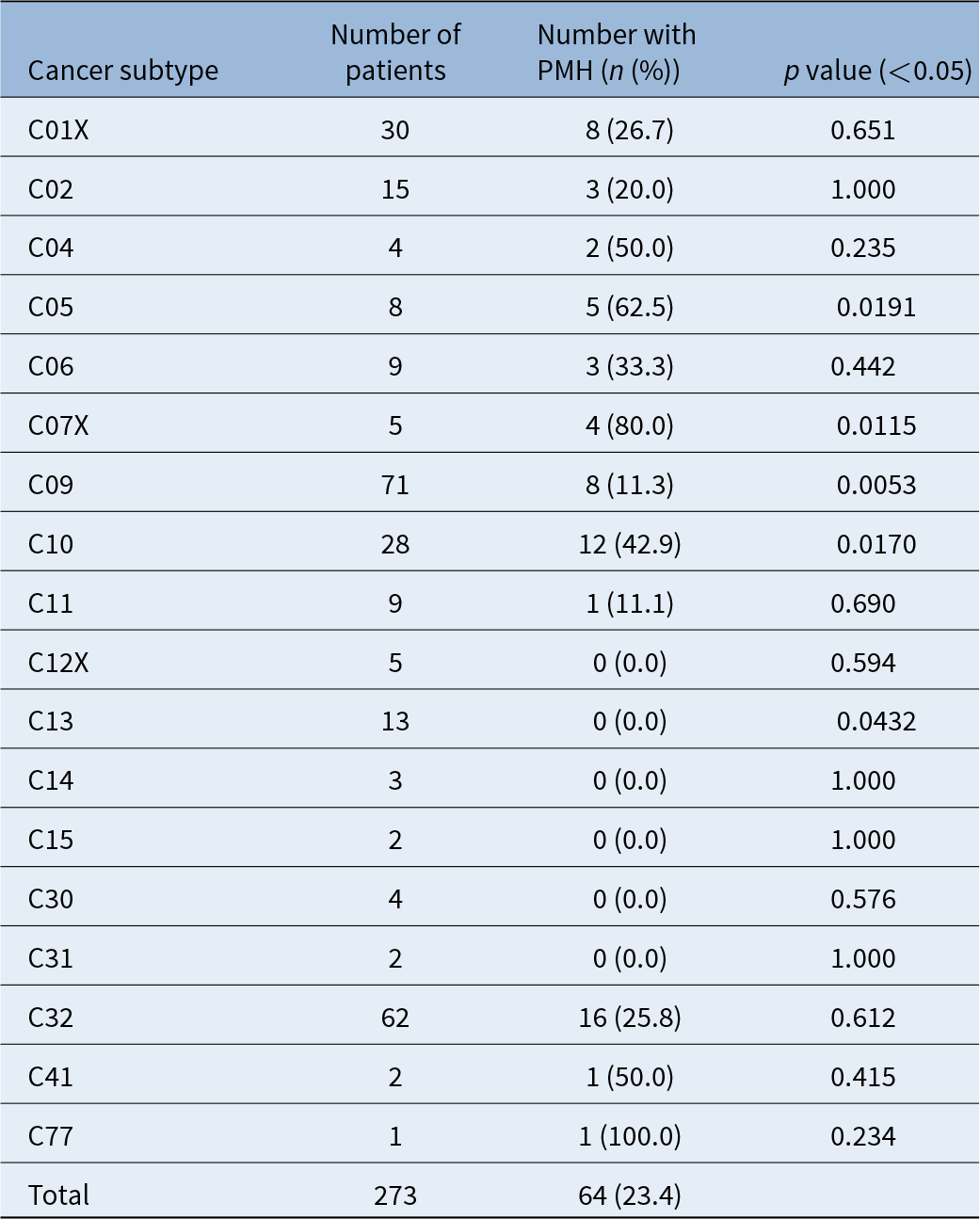
Subgroup analysis, using Fisher’s exact test, further dissected the data, revealing nuanced relationships between specific head and neck cancer subtypes and previous malignancy history (Tables 2 and 3). Noteworthy findings included significant associations in subtypes such as C05 (malignant neoplasm of palate) and C07X (malignant neoplasm of parotid gland), marked by their respective p values (C05, p = 0.0191; C07X, p = 0.0115). Conversely, other subtypes, such as C32 (malignant neoplasm of larynx), despite a higher incidence of previous malignancy history, did not exhibit a statistically significant correlation, highlighting the complexity of cancer risk factors.
Distribution of cancer subtypes and their association with previous malignancy history (PMH) in patients with head and neck cancer

Cancer type codes and names

The control group’s most common previous diagnoses were adenocarcinoma, including prostate and colonic adenocarcinomas, breast cancer and basal cell carcinoma (BCC) of the skin.
In contrast, the test group predominantly had a history of squamous cell carcinoma (SCC), pointing to a potential link between SCC and subsequent head and neck cancer risk. A total of 31 patients had a history of previous SCC: 15 patients had skin SCC, 15 had other primary SCC lesions of head and neck and 1 patient had an oesophageal SCC in their past medical history.
Our subgroup analysis underscores a notably higher incidence of previous malignancy history among specific head and neck cancer subtypes, particularly C01X (base of tongue), C10 (oropharynx) and C32 (larynx), compared with the control group. Remarkably, SCC emerges as the predominant prior cancer diagnosis within these subtypes. Specifically, 15 out of 120 patients in these subgroups had a history of SCC, in stark contrast to only 2 of the 287 patients in the control group. This disparity yielded a chi-square statistic of 29.4536 with a p value of less than 0.00001, signifying a profound and statistically significant association between oropharyngeal, base of tongue and laryngeal neoplasms and a prior history of SCC.
Our analysis further refined the patient cohort by excluding 10 individuals who had previously received radiotherapy for head and neck cancer, a well-documented risk factor for inducing secondary malignancies. This adjustment aimed to ensure an examination on 263 patients, of whom 54 had a documented history of prior cancer. Subsequent subgroup analysis revealed compelling evidence affirming a significant association between a history of prior cancer and the development of new head and neck cancer (p < 0.05). Even after the exclusion of patients with prior head and neck radiotherapy, SCC remained notably overrepresented in the cohort, with 8 out of 112 patients affected (p = 0.000215), underscoring the enduring impact of SCC on the risk of developing head and neck cancer.
Moreover, our analysis delved into the specific cancer types among patients excluded because of previous head and neck radiotherapy, revealing a diverse spectrum that included five cases of tonsillar SCC and one each of perinasal SCC, mandible alveolus SCC, parotid SCC, base of tongue SCC and anterior epiglottal neoplasm. This nuanced exploration highlighted the varied impact of radiotherapy as a risk factor and enriched our understanding of the primary study population’s risk profile.
Conversely, other previous cancers such as prostate carcinoma and BCC, did not exhibit a statistically significant association in this context, suggesting distinct risk profiles for different cancer subtypes. This differential impact underscores the complex interplay of various risk factors in determining the susceptibility to head and neck cancer development.
In the broader context of the test group comprising patients diagnosed with new head and neck cancer, 31 out of 273 patients had a documented history of SCC. This significantly high representation, supported by statistical analysis (p < 0.00001), reaffirms the potential role of SCC history in predisposing individuals to head and neck cancer. Importantly, this association persisted even after excluding patients with a history of head and neck radiotherapy, with 22 out of 263 patients showing SCC history.
Discussion
After conducting an extensive literature review, limited studies were found establishing a direct link between prior cancer diagnoses and the risk of developing head and neck cancer. However, several noteworthy investigations shed light on this connection. Two population-based cohort studies revealed a significant proportion of patients with a history of cancer, particularly haematological malignancies, exhibiting an elevated risk of solid head and neck cancers across various subsites.Reference Mowery, Conlin and Clayburgh10, Reference Kim, Kim, Bang, Il and Sun D11
Additionally, another study explored the impact of prior cancer history on survival outcomes in patients diagnosed with head and neck SCC, concluding that a prior cancer diagnosis significantly influenced survival rates, underscoring the importance of comprehensive risk assessment protocols encompassing both traditional risk factors and prior cancer diagnoses.Reference Kim, Kim, Bang, Il and Sun D11 One study also suggested a potential link between previous cancer history and heightened risk of developing head and neck cancer, although this association was not extensively reviewed.Reference Siddiqui, Hamid, Caton and Cheang13
This study introduces a novel perspective by investigating the association between prior cancer diagnoses and the risk of subsequent head and neck cancer development. While prior research has acknowledged certain risk factors, such as prior radiotherapy, comprehensive investigations into the broader spectrum of prior cancer diagnoses are relatively scarce. Thus, this study addresses this gap by demonstrating a significant relationship between prior cancer diagnoses, particularly SCC, and the heightened risk of developing head and neck cancer.
Cancer treatments, including chemotherapy and radiation therapy, may predispose individuals to the development of new primary cancers. Radiation therapy in particular increases the risk of secondary malignancies in the irradiated field, while certain chemotherapy agents have also been linked to elevated secondary cancer risks. To mitigate the impact of this well-known risk factor on the results, we excluded all patients previously diagnosed with even unrelated head and neck cancers.
The findings of this study challenge the null hypothesis and suggest that individuals with a history of cancer may indeed have a heightened susceptibility to subsequent head and neck malignancies. While tobacco use, alcohol consumption and HPV infection are recognised primary risk factors for head and neck cancer, this study delves into the lesser-explored aspect of the potential impact of prior cancer diagnoses on head and neck cancer risk. The data underscore a notable proportion of patients with a history of SCC, indicating a possible association between prior SCC and subsequent head and neck cancer development. This observation necessitates further investigation into the underlying mechanisms driving this association.
Furthermore, specific head and neck cancer subsites, such as oropharyngeal, base of tongue and laryngeal neoplasms, exhibited significant associations with prior SCC diagnoses. The overrepresentation of SCC in patients subsequently diagnosed with head and neck cancer underscores the need for heightened vigilance and tailored surveillance strategies in this population. Understanding the interplay between prior SCC and head and neck cancer development could inform risk stratification and facilitate early detection efforts.
The absence of a significant association between certain prior cancer types, such as prostate carcinoma and BCC, suggests the importance of delineating distinct risk profiles for various cancer subtypes. Future research endeavours should aim to elucidate the specific genetic, environmental and lifestyle factors contributing to the observed associations, enabling more refined risk assessment models.
In conclusion, this retrospective analysis provides compelling evidence supporting an association between prior cancer diagnoses and the heightened risk of developing head and neck cancer, with SCC emerging as a potential predisposing factor. These findings underscore the complexity of head and neck cancer aetiology and emphasise the importance of multifaceted risk assessment strategies. Integration of prior cancer history into risk assessment protocols and surveillance practices could enhance risk prediction accuracy and guide personalised preventive interventions. Further research endeavours are warranted to elucidate the underlying mechanisms driving these associations and refine risk prediction models, ultimately facilitating early detection and improving patient outcomes in head and neck cancer management.
• The study establishes a significant association between prior cancer diagnoses, especially squamous cell carcinoma (SCC), and the heightened risk of developing head and neck cancer
• Unlike previous studies focusing on traditional risk factors, this research fills a gap by exploring the broader impact of prior cancer diagnoses on head and neck cancer risk, offering fresh insights into its complex aetiology
• Integrating prior cancer history into risk assessment and surveillance for head and neck cancer could enhance prediction accuracy and personalise preventive interventions, improving patient outcomes
• The study highlights SCC as a significant predisposing factor for subsequent head and neck cancer, advocating tailored surveillance and interventions for SCC patients to enable early detection and intervention
• Further investigations into the mechanisms behind these associations and refining risk prediction models are crucial for understanding head and neck cancer aetiology and developing targeted preventive strategies
Limitations
While our study provides valuable insights, it is not without limitations. The retrospective design and reliance on medical records may introduce biases, and excluding patients with prior head and neck radiotherapy could limit the generalisability of the findings. Future research should aim to include prospective studies, explore the biological mechanisms underlying the associations observed and evaluate the impact of comprehensive risk assessment models on patient outcomes.
Author contribution
Zohaib Siddiqui and Sabina Dranova contributed equally to this work and are equal first authors.
Competing interests
None declared.