Who shall gauge or determine the true spirit that lies between the proudest or humblest outward show and the inward feeling?
Claude McKay, Banjo (1929)Footnote 1A badly dressed body is nobody at all.
Toni MorrisonFootnote 2In his novel Banjo: A Story without a Plot (1929), set among a group of “lost black vagabonds” in Marseille's Vieux-Port, Claude McKay reflected on the racial freight of clothing in the visual economy of the 1920s:
No getting away from the public value of clothes, even for you, my black friend. As it was, ages before Carlyle wrote Sartor Resartus, so it will be long ages after. And you have reason maybe to be more rigidly formal, as the world seems illogically critical of you since it forced you to discard so recently your convenient fig leaf for its breeches. This civilized society is classified and kept going by clothes and you are now brought by its power to labour and find a place in it.Footnote 3
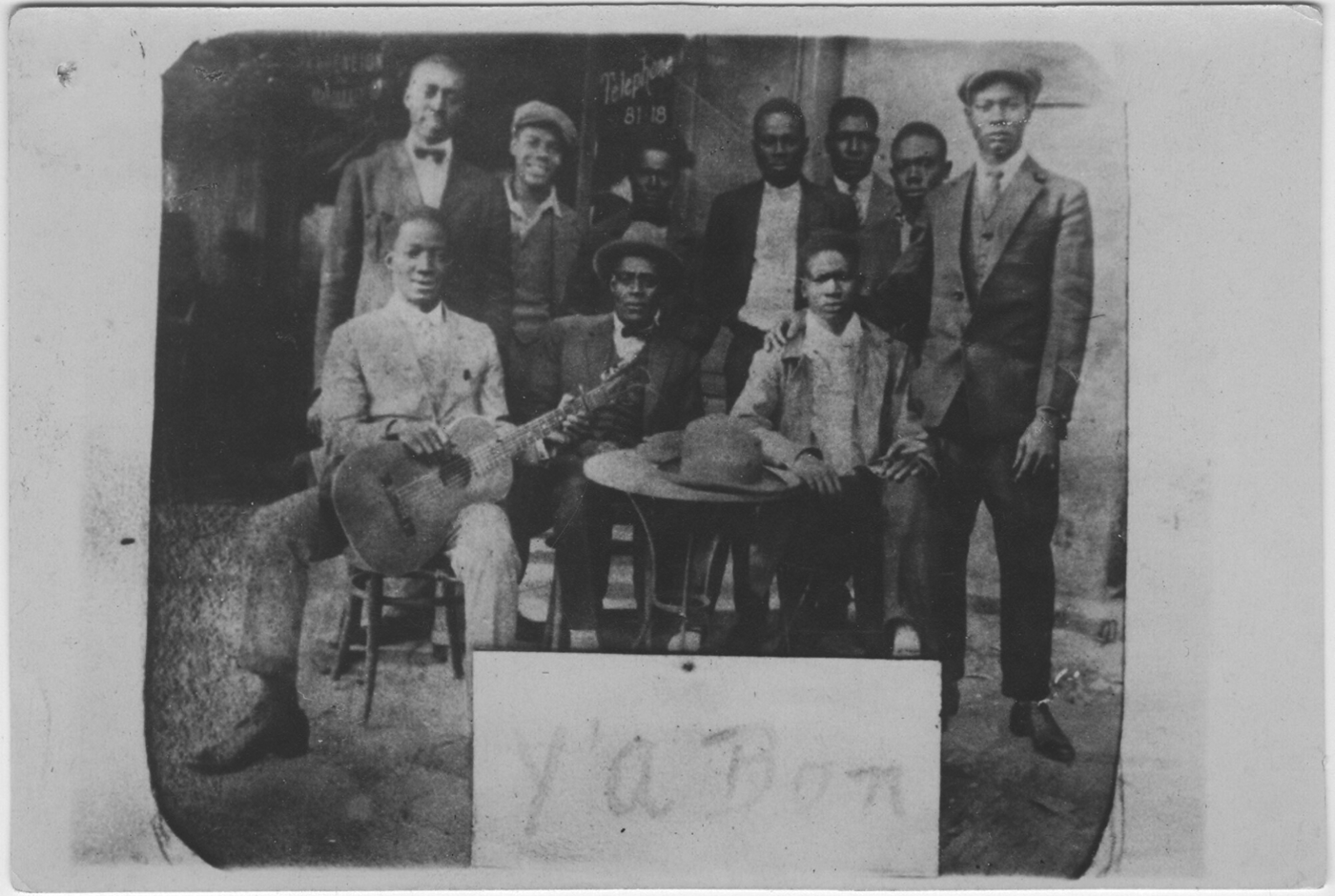
In this passage, appearing very near the book's end, clothing appears as yet another arm in the apparatus of the “the civilized machine” of European-derived constraint felt across the African diaspora.Footnote 4 Such material checks, exercised also in the 1920s with the increasing prevalence of passport regulations, reveal the complicity engendered by even the most ubiquitous of cultural practices. Concerned as Banjo frequently is with the juxtaposition, circulation, and recirculation of fastidiously described items of clothing by the inhabitants of Marseille's so-called “Ditch” (Figure 1), the novel acknowledges ways in which bodies remain ensnared in exhibiting and trading upon clothing – yet another form of merchandise in a modern consumer economy. Despite such evident restraints, apparent in the dress of Banjo's “beach boys” is a spirit of resistance to the material and “factual forces, irksome though they may be, that help to make an artist of a vagabond.”Footnote 5 McKay ultimately regards clothing as a manifestation of the aesthetic as well as bodily compulsion to freedom. After outlining prior modes of critical inquiry into McKay's second novel and some critical and theoretical approaches to the cultural politics of dress, I will discuss his representation of sartorial self-fashioning as part of a critique of narrowly categorical identities.
Marseille c. late 1920s (McKay not pictured), Claude McKay Collection, Yale Collection of American Literature, Beinecke Rare Book and Manuscript Library.

In addition to drawing on and contributing to critical conversations in transnationalist and black Atlantic studies, this article situates Banjo within discourses of black masculine style and self-fashioning. Like Bridget T. Chalk in her examination of the role of identity papers in Banjo, this article extends the ideological concerns of such critics as James Smethurst to encompass the textural politics of material culture. Acknowledging Banjo's articulation of an aesthetic of exile alongside its bourgeois critique, my analysis also shifts Monica L. Miller's Harlem Renaissance-era focus on black dandyism in Harlem proper to encompass the distinctive liminality of Marseille – at this time France's port of empire and a gateway to both Mediterranean and Atlantic worlds. My discussion of clothing's implication in group-identity formation expands upon Michael A. Chaney's investigation of “the way racial markers are recoded as class signs.”Footnote 6 Additionally, my consideration of the novel's sexual economy refocusses A. B. Christa Schwarz's analysis of McKay's bisexuality and his concern with themes of emasculation and male camaraderie. Unlike the recent interrogations of such critics as Brent Hayes Edwards, Paul de Barros, and Tom Lutz, whose discussions privilege the representation of Banjo's music, this article initiates an original avenue of inquiry into Banjo that nevertheless acknowledges the significance of its jazz-inflected cultural politics. Indeed, an improvisational, even tricksterish, brand of self-fashioning is the novel's crucial concern.
McKay – a Jamaican who spent much of the 1920s and 1930s abroad before taking American citizenship in 1940 – has come increasingly to be regarded, as by the novelist Caryl Phillips, as one among numerous twentieth-century “writers for whom the national label is unhelpful if we wish to see the full nature of their achievement.”Footnote 7 Indeed, in his 1929 review of Banjo, W. E. B. Du Bois characterized the novel as diasporic in orientation, comprising, as much as any coherent plot, “a sort of international philosophy of the Negro race.”Footnote 8 More recently, Edwards presented McKay as a precursor of Négritude and other more recent black Atlantic formulations.Footnote 9 McKay might also be seen to have anticipated Homi K. Bhabha's postcolonialist argument that the conceptual forging of the nation is perpetual, as modernization continually reinforces “the impossible unity of the nation as a symbolic force.”Footnote 10 In a 1928 letter to his friend Harold Jackman, McKay declared that “the outlaw soul … cannot reconcile itself to the fact of limitation to any one country, or allegiance to any one nation.”Footnote 11
Throughout Banjo, clothes are shown to rival other principal expressions (especially speech and music) of the contingencies inhering in interwar identity. Appearing in a period powerfully marked by nationalist sentiment, McKay's too often overlooked novel mounts a nuanced critique of the patriot's unctuous pieties; Banjo simultaneously challenges nakedly external taxonomies associated with class, race, and indeed sexuality. Despite Banjo's many potent subversions, it must be noted that McKay also invested its fashions, with the novel's characteristic ambivalence, with the capacity to reinscribe social difference. In Practice of Diaspora: Literature, Translation, and the Rise of Black Internationalism (2003), Edwards reads the novel as an expression of “the vertigo of intradiasporic communication,” within which “black internationalism is necessarily haunted by difference.”Footnote 12 Exile, Edwards suggests, is perpetual, in spite or because of Banjo's heightened transnationalism.
As such, this article considers whether Banjo's castaways – many of them musicians, sailors, and former soldiers described by Smethurst as proponents of “a transnational proletarian blackness” – provide an exilic alternative to Miller's Harlem-centred notion of “subversive dandyism.”Footnote 13 Miller, whose Slaves to Fashion: Black Dandyism and the Styling of Black Diasporic Identity (2009) is evidence of a burgeoning scholarly interest in the politics of black male fashion and self-fashioning, defines black dandyism as inherently dissonant and cosmopolitan: “Dandy style in the modernist period highlights the presence of a cultural condition in which the binaries that unnecessarily limit identity can be and are being challenged.”Footnote 14 In his lavishly illustrated Cutting a Figure: Fashioning Black Portraiture (2008), Richard J. Powell similarly interprets “black dandyism as a form of deconstructive, flagrant self-proclamation,” especially in the face of culturally imposed images of abjection – images with which Banjo, despite its frequent flamboyance, is often rife.Footnote 15
The following analysis will touch on those notions of exile and belonging negotiated within the novel's many descriptions of sartorial self-fashioning; I will demonstrate the ways in which clothing signals allegiance to and departure from the conventions of class-based, racial, and national identity. Also at stake in Banjo's patterns of dress are, as I will show, economies of work, play, and desire, and the diasporic practices of tricksterism or masking.
ORNAMENTS OF EXILE
In his influential 1899 study The Theory of the Leisure Class, American sociologist Thorstein Veblen reflected on “Dress as an Expression of the Pecuniary Culture” in incomparably visual terms. For Veblen, dress was not so much functional as ornamental:
our apparel is always in evidence and affords an indication of our pecuniary standing to all observers at the first glance … No one finds difficulty in assenting to the commonplace that the greater part of the expenditure incurred by all classes for apparel is incurred for the sake of a respectable appearance rather than for the protection of the person … It is true of dress in even a higher degree than of most other items of consumption, that people will undergo a very considerable degree of privation in the comforts or the necessaries of life in order to afford what is considered a decent amount of wasteful consumption.Footnote 16
In introducing his eponymous character, McKay describes Banjo (Lincoln Agrippa Daily), a man of humble origins in the American South, as wearing “a cheap pair of slippers” of “a kind much used by the very poor of Provence.” He accents his workmanlike blue-jean shirt with a knotted scarf bearing an “elaborate pattern of black, yellow, and red at both ends” – a sailor scarf with perhaps a hint of a pan-Africanist cast.Footnote 17 More a proletarian mash-up than an example of dandyish dress, Banjo's initial costume is characteristic of the culture of radical statelessness the novel describes. Indeed, much as McKay himself pursued an extended exile from British-ruled Jamaica, Banjo's flight from the Jim Crow South – impelled in part, we learn, by his brother's lynching – defines his character. Despite “Everything about him – speech, attitude, and movement – shout[ing] Dixie … Banjo insisted that his parentage was really foreign.”Footnote 18 His manner of dress is similarly defined by a flight from the South.
In a representative illustration of the novel's exploration of the fluidity of identity – which is to say of the ways in which officially imposed national identities are often rejected in favour of individualized medleys of elective cultural affiliation – Banjo perpetually transforms his sartorial self in Marseille, adopting (and adapting) the fashion idioms of his temporary home. Upon his arrival, the narrator states, “Banjo bought a new suit of clothes, fancy shoes, and a vivid cache-col. He had good American clothes, but he wanted to strut in Provençal style.” Despite this initial effort at assimilation, Banjo remains demonstrably emotionally linked with the South, not least through his music and cravings for southern cooking, and, indeed, he is reminded of his status as an étranger in a dispute over a restaurant bill, largely due to his inability to assume the French language as he assumes the local costume.Footnote 19 Despite his commitment to self-fashioning, the fluidity of identity may be a more wishful or romantic notion than it initially appears.
As such, fashion in Banjo is shown capable of reinscribing social difference; clothing comprises an important layer in the visual assessment of “black bodies” arriving in France from America, the Caribbean, and West Africa. In a chapter set in the diasporic meeting place of the “Café African,” the narrator notes the colonial dynamics within which class roughly equates to skin colour, remarking on the snobbery of the mixed-race patrons and describing the Senegalese both as “savages” and as “the blue overall boys of the docks.” Early in the novel, McKay makes evident the racialization of public space through the hyperawareness of skin colour: in one instance he moves, in the space of a few lines, from the observation of “slate-colored” to “gold-brown” to “coffee-black” to “chocolate-brown” bodies.Footnote 20 In doing so, he points to the powerfully visual imperatives of social stratification.
While individual characters in Banjo pursue the privileges of the fluidity of identity for themselves, bodies regarded as étrangers (like those of the Senegalese) remain subject to the rigid practices of classification and exclusion.Footnote 21 In other words, in observing or indeed reading the bodies of others, the beach boys typically regard clothing, like skin colour, as a transparent signifier, more often interpreting it as a uniform than as an intricately constructed disguise. An elegantly dressed soldier is evidently only “slumming,” rather than a part of the group; workers appear throughout the novel dressed in “proletarian blue”; the fishermen tramp “in their long felt boots”; the uniformed police, themselves expressing a preference for social fixity in their constant demands for identity papers, are a continual – and visible – threat to the beach boys. A rare kinship with a white character, Kid Irish, is expressed in terms of his wearing the irrefutable (and elemental) uniform of the vagabond: “an old and well-frayed seaweed-green jersey and a pair of once-black pants, now burned red by the sun, eaten up in the bottom and creased a thousand ways.”Footnote 22 Elsewhere, Banjo memorably defends his allegiance to the black race by declaring that “white folks smell like laundry soap” – an example of clothing becoming conflated with racial identity.Footnote 23
SENSUAL SELF-FASHIONING
As well as signalling social divisions, Banjo's clothing provides sensual pleasure, to himself and to others. He is restless in what to him appear to be dull clothes: “an American silk shirt with blue and mauve stripes, and, jauntily over his ear, a fine bluish felt” forced on him by a mandolinist. McKay writes, “It was always an irksome affair to him when he was not dressing to strut.” Elsewhere Banjo appears in finer feather, proclaiming, “‘I got the whole wul’ going my way. Look at me!’ … Banjo was in wonderful form in the cocoa-colored Provençal suit, the steel-grey Australian felt hat he had bought in Sydney, the yellow scarf hanging down his front, and full-square up-at-the-heel. Banjo had struck it right again.”Footnote 24 As well as tokens of travel, his clothes appear as the outward elaboration of his economic and sexual attitudes.
Indeed, in another example of his retention of an American frame of reference, his fashion sense appears largely inspired by his recollection of the flashy styles of Harlem's pimps. Much as the novel celebrates (and essentializes) black dancing, Banjo reflects on the failings of fashion among Marseille's pimps as an illustration of a racial truth:
What do them poah ofay trash in the Ditch know about doing the stuff in the big-style way it's done back home? … I nevah seen such a lotta mangy p-i in all mah life. A fellah doing that back home gotta show himself a man ehverytime. Him gotta come strutting swell and blowing big.Footnote 25
Such sentiments are a misguided, if inevitable, manifestation of Banjo's prevailing ethos of hypermasculinity, which can nevertheless be seen to partake of folk traditions privileging the rebellious instincts of black outlaws or bad men. According to black-studies scholar Eithne Quinn, the pimp has become “a totem of the antiaccommodationist, yet aspirational, desires of lower-class black men.”Footnote 26 In spite of the evident costs of his exploitative misogyny, another critic argues, the pimp's “attraction as a hero stems from the fact that he is a trickster” unbound by conventional morality, in keeping with the subversive trickster figures consistently present in African American folk tales.Footnote 27
In addition to representing such shape-shifting, Banjo's liberality of expenditure on dress despite the scarcity of money is a performative expression of the defiance of conventional thrift, as well as of flamboyant sexual possession and self-possession. Upon making Banjo's acquaintance in the novel's first chapter, the character Bugsy sardonically recalls seeing Banjo obliviously parading in one of his reveries of short-lived sexual and economic triumph: “you was too swell dressed up and strutting fine with that broad to see anybody else.” McKay describes numerous instances of the spectatorship of Banjo's clothing. In the eyes of a group of newly arrived African American sailors, “Banjo! So gay and dressy on his hand-to-mouth existence without ever worrying about anything … was marvellous!”Footnote 28 As with the beach boys’ thefts of wine and peanuts from the dock's abundant unguarded supplies, Banjo's indulgent pleasure in dress should be regarded as an act of improvisation tending to survival – at least the survival of the ego – under poverty's duress.Footnote 29
As the sailors’ view of Banjo's “gay and dressy” promenading might suggest, the novel is not short on implications of same-sex desire. Banjo recounts, for instance, a short-lived spree in Paris with “a way-back-down-home-in-Dixie peck”: a wealthy white man with whom he shared a bed before being offered “a thousand-franc note” in the morning. More relevant to this discussion is Banjo's bribing of Sarka, a Senegalese section boss responsible for hiring dock workers, with items of clothing: “a striped silk shirt,” and “a gorgeous oblique-striped necktie of the kind the college boys flaunt in America.”Footnote 30 Evidence of the transatlantic currency of American fashion, the gifts also contain the suggestion of sexual proposition. Sarka, described as “a fine, upstanding specimen of black man with strong white teeth and clear eyes, a full, gorgeously-carved mouth, and smooth-shining ebony skin” ultimately meets with Banjo at “the Rendezvous Bar” to collect the offering. Soon afterward, Banjo is described as having become Sarka's “friend and chief man” – a subject of “gossip” in the Café African. Banjo justifies his gesture by invoking what might be called the skin game of economics: “What's giving a man a shiert? … Life is a game a skin; black skin, white skin, sweet skin and all skin and selling one another is living it.”Footnote 31 His sense is of the inevitability of economic misuse even among intimates.
Heterosexual activity is similarly, if more explicitly, reduced, in the culture described in the novel, to prostitution. Lending some credence to Paul Gilroy's assertion that “the conflictual representation of sexuality has vied with the discourse of racial emancipation to constitute the inner core of black expressive culture,” gender relations are generally cast in mercenary terms.Footnote 32 One characteristic passage describes women as being “like sea gulls following a ship … whenever the boys had some paying business in hand.” In visiting one of the novel's many brothels with a band of new arrivals, Banjo observes a catalogue of feminine types, national and racial, young and old, attired in “European, African, Asiatic” styles: “Rose-petal pajamas, knee-length frocks, silken shifts … shimmering princess gowns, country-girl dresses of striking freshness … the piquant semi-nude and Spanish-shawled shoulders.”Footnote 33 McKay juxtaposes this account of clothing's fetishistic framing of the female body with an invocation of an image of comparatively crude masculinity – the “proletarian suits among all the striking feminine finery.” Banjo himself is shown to perceive certain dangers of feminization through clothing. Early in the novel, Latnah, the novel's lone figure of female agency, presents him with a gift of pyjamas in front of his friends: “all bright yellow and blue and black” – a kind of invitation to cohabitation, to domestication, even to love.Footnote 34 Banjo runs out with a pocketful of her money, apparently on the lash. We later learn that Banjo's friend Malty takes his place in Latnah's favour – and in the garish pyjamas. Despite Latnah's sartorial gesture, she remains vigilant in a novel in which numerous acts of violence are directed by men at women and by women at men. Banjo, for one, is aroused to a fit of sexual jealousy by a glimpse of the gold watch he squandered on a French prostitute. He curses her and smashes the watch; he is knifed for his troubles. Indeed, several male and female characters carry weapons in their clothes; Latnah's dress conceals a “silver-headed” dagger.Footnote 35
Gender relations in Banjo may also be understood as being roughly analogous to race relations. Indeed, in one passage revealing of McKay's views on European civilization's feminizing degradations, Ray, in response to a young poet's idealistic demands for “Justice,” replies that he “did not believe in that prostitute lady who is courted and caressed by every civilized tout.”Footnote 36 The conflictual representation of sexuality – and indeed the risks inherent in unclothing oneself for sexual purposes – is further explored in a chapter titled “Taloufa's Shirt-Tail.” Taloufa, a native of colonial Nigeria, returns to the beach boys in a state of dishevelment after a liaison with a prostitute. Robbed of his money, he is instructed by Bugsy to “Git you’ shirt in you’ pants, mon, git it in. You ain't in the African jungle with the monkeys in the trees now. Youse on the sidewalk of the white man's big city. Git it in, I say.”Footnote 37 As well as a racial economy, clothing is implicated here both in sexual and in economic circumspection – a means of self-restraint. It appears as a form of armour in unavoidably hostile environs.
ABSTRACTIONS OF HUMAN WORTH
Miller's notion of subversive dandyism does not adequately describe Banjo's fashions, in their eclecticism if not their exhibitionism. One can safely assume that the majority of Banjo's fashions fall foul also of the bourgeois standard and, increasingly at the time of the novel, the transatlantic distinction of the clothes worn in what Banjo refers to as the Riviera's “tony raysohts” – the likes of Nice and Monte Carlo, whence the knitted tennis shirt “with turned-down collar and half-length sleeves” was popularized in the 1920s.Footnote 38 While not belonging to the moneyed class of exhibitionists discussed by Veblen, Banjo and his mostly male associates (and the novel is primarily interested in men, both in hypermasculine and homoerotic terms) nevertheless often self-consciously display costumes and lifestyles more redolent of leisure than of labouring in their own unglamorous Mediterranean haunt. The beach boys’ fashions are not, however, a straightforward imitation of those of their supposed social superiors further east along the Côte d'Azur. Rather, they are emblematic of the beach boys’ refusal to submit themselves the working world on unequal terms – opting instead for the vagaries of vagabonding.
Apparent in Banjo's attentiveness to individual style is a sense of the indignity of the uniform. The undifferentiated clothing of the worker or soldier represents in the novel a form of institutional anti-fashion, the wearing of which is indicative of spiritless submission or defeat. Following the theft of his instrument, described as “his magic companion,” Banjo himself is driven to seek employment on the docks, where workers labouring under a common oppression are further obscured in their individuality by a noxious coating of coal dust. McKay frames Banjo's transformation to labourer in rather tragic terms. Ray, the Haitian writer who serves as McKay's alter ego in the novel, particularly laments Banjo's “dirty-drab contentment” and the suppression of his musical ambitions. Revealing the extent of his vicarious identification with the fashionably independent figure of Banjo, Ray announces, “Now you're nothing but a poor slave nigger in coal for une putaine blanche.”Footnote 39 Clearly, he resents Banjo cohabiting with a woman – a white woman, no less. McKay's suggestion is that Banjo's concealment in coal dust and incongruous work clothes has the effect of rendering him unavailable to Ray as an image (if unconfessed) of erotic masculinity.Footnote 40
As well as signalling such proletarian degradation, clothing functions as a transparent signifier in Banjo's sustained critique of bourgeois pretension. While the novel valorizes the subversions of Banjo's proletarian dandyism, Banjo himself compares fellow African American Goosey's “book larnin’” to “a dress suit” worn to a “dickty party” then folded up and put away. Ray is similarly scornful of “educated Negroes” cultivating an image of bookishness by toting “books to protect themselves from being hailed as minstrel niggers” and wearing glasses as “a mark of scholarship and respectability differentiating them from the common types.” The passage concludes, sardonically, “Perhaps the police would respect the glasses.”Footnote 41 The proprietor of the Café African makes evident his ostentation with his “gold spectacles with a gold chain”; coupled with the proprietor's “race talking,” Bugsy suggests they indicate a blindness to his own complicity in exploitation as a business owner and peddler of alcohol to a black clientele. Anticipating Houston Baker's views regarding bourgeois dandyism as a regressive form of white imitation, McKay aligned the proprietor's haughty self-fashioning with the “banditry in high places” that Banjo condemns as so costly to “the poor, the vagabonds, the bums of life.” The lyrical refrain of one chapter is “Everybody's Doing It” – an oblique reference to the little scams so common in a novel fundamentally concerned with money's distortion of human relations. “[T]here were many luxury-clean people who had become high and mighty by traffic in human flesh,” McKay writes, not least by way of “the buying and selling of black bodies,” both for labour and for sex.Footnote 42
Interwar Marseille provides the context for such economic abstractions of human worth. McKay portrays the city as one of vibrancy and sudden violence, due in large part to the prevalence of poverty and crowding in the ancient tangle of streets that constitute the Ditch. The hustle for food and drink are very early emphasized as characteristic of the vagabond life; in fact, the uncertainty of material provision represents the cost of pursuing this relative freedom. With a few notable exceptions, the state of a character's clothing in the novel provides a more or less reliable indication of the contents of his pockets and, often, of his psychological well-being. For Banjo, clothing, like money and companionship, comes and goes. In one passage, “he was very light of everything: light of pocket, light of clothing (having relieved himself at the hock shop), light of head, feeling and seeing everything lightly.”Footnote 43 Clothes are, as I have indicated, an important currency in Banjo. The last resort and defence of the impoverished, they are often the first reclamation of the newly well-heeled. There is also currency in going unclothed, as Ray reveals to the beach boys – and as McKay himself well knew. In a January 1927 letter, McKay wrote, “When I ran completely out of pocket and clothes and all pawnable things at Marseille, I came down here to Antibes and got a job as a model” – that is, as a nude model for artists indulging the fashion for ostensibly “African” subjects.Footnote 44 Four years earlier, McKay contracted pneumonia as a result of a similar foray into the world of undress in Paris's unheated artists’ studios in the winter.Footnote 45
Along similar lines, Banjo describes “the turning of the weather” as “detrimental to the boys, whose scanty clothing was suitable for summer only.” Ray buttons his coat against the privations of winter with thoughts of “a serviceable jersey that he possessed and of an overcoat that he possessed not.” A number of characters, including Banjo, fall ill. While Banjo recovers, Bugsy is found dead in a lightless room in the Ditch, dressed only in “rags.”Footnote 46 In an act of minor but eloquent protest against the degradations of the culture of the Ditch, a microcosm for McKay of European civilization as a whole, the beach boys provide clothes for his respectable burial. In ultimate recognition of the public (and ceremonial) value of clothing, “Goosey gave his blue Charleston pants, Ray an extra blue coat that he had, Banjo a shirt and socks.”Footnote 47 Even in death, Bugsy's body is sartorially inscribed.
Banjo contains other such instances of advocacy associated with clothes. Having internalized the middle-class values of his upbringing, Ray regards clothing more pragmatically than other characters; as a consequence, he keeps a “carefully-tended suit for special occasions.” Late in the novel, the drifter Lonesome Blue appears as a premonition of what becomes of the rootless, a kind of scarecrow version of Ray with marks of death upon him. “He was lifeless,” McKay writes, “existing mechanically because the life-giving gases still gave him sustenance … his skin was ash gray. His clothes were like rags eaten at by rats. The suit was originally Ray's who had received it second-hand from an American friend.”Footnote 48 It is of course Ray's presentable figure, clothed in formal speech and his single suit, that allows him to advocate for Lonesome, whose appearance raises the ire of the American consul's chief clerk. McKay suggests that acts of charity are too often prevented by excessive delicacy. We regard poverty aesthetically, as an assault on our visual sense, rather than morally, as the travesty it in fact is.
TRICKSTERISM AND MASKING
In addition to expressing social or racial solidarity, the beach boys’ self-fashioning practices emerge, at least in part, from those narrative traditions of folk wisdom or tricksterism demonstrated in Banjo's “Story-Telling” chapter. Henry Louis Gates's discussion of signifying, defined as a “double-voiced” narrative tradition marked by “repetition and difference,” is indeed relevant to the assessment of the novel's varied deployments of dress.Footnote 49 As the men swap tales about outwitting the likes of “Leopard” and “the boss folks,” Ray in particular acknowledges the necessity of the use of cunning in the absence of available force. Relative to the book's sartorial culture, this is manifested in the use of clothing as cunning disguise. It is two white characters, Kid Irish and his English companion, who nevertheless appear particularly advantaged in this regard. Described as “gentlemen panhandlers” and “honest bums,” the white men dress in “well-fitting clothes” before appealing to their fellow nationals abroad: “It's the only way to get the jack,” the Englishman claims, in what amounts to an exposé of bourgeois and professional cultures everywhere: “Wear good clothes and speak like a gentleman.”Footnote 50 Banjo demonstrates a similar facility in a section of the novel narrating the arrival in port of an American liner of the Dollar Shipping Company. While the ship tellingly bears on its funnel the symbol of the “mighty $,” the beach boys vie for the charity of an elegantly dressed “tall fair girl” gesturing imperiously at the rail. She “wore a reddish-gray traveling dress in which she was as striking as a Fifth Avenue shop's cut of a French model.” Banjo successfully extracts five dollars and five francs from the woman, in part on the strength of his “strutting elegance” and in part due to his fluent and obsequious dishonesty about hailing from Virginia.Footnote 51
In a sequence of rather more gleeful come-uppance for a white American abroad, another suit of clothes is exposed for the shoddy disguise it is. A young man of “the clean-shaven, clean-cut type” dressed in “a fine New York suit, reddish-brown stuff,” one of a group of slumming adventurers, objects to Ray's attendance at the screening of an erotic film on the grounds that a white woman is present.Footnote 52 Within a few pages, McKay reduces the well-dressed American “to a savage state,” with “a dirty rag of a loin-cloth for his only clothing,” another victim of the ruthless inhabitants of the Ditch. In Banjo's traversal of “the jungles of civilization,” the ostensibly savage and the ostensibly civilized are rarely what they seem.Footnote 53
CONCLUSION
In Turning South Again, Houston Baker remarks that the figure of the African American dandy in the early twentieth century was “all dressed up without any fully modern, urban place to go.”Footnote 54 Baker critiques the figure as one of bourgeois regression and, significantly, of self-abasement in the form of white imitation. Miller refutes this assessment in Slaves to Fashion, perceiving in the Harlem Renaissance dandy's staging of “dissonance” a knowing engagement with his “European and African and American origins.”Footnote 55 Characterizing modern fashion as a necessarily cosmopolitan expression, Miller argues that the dandy, as a figure implicated in the dynamics of Black Atlantic triangulation, “expresses with his performative body and dress the fact that modern identity, in both black and white, is necessarily syncretic.” She proposes that black dandyism in the Modernist period represented a dismantling of convenient binaries: of black–white and gay–straight in particular.Footnote 56Banjo's vivid castaways lend some credence to Miller's formulations. In embodying a destabilizing array of social and economic forces, however, McKay's slippery vagabonds ultimately shrug off even as commodious a mantle as subversive dandyism.
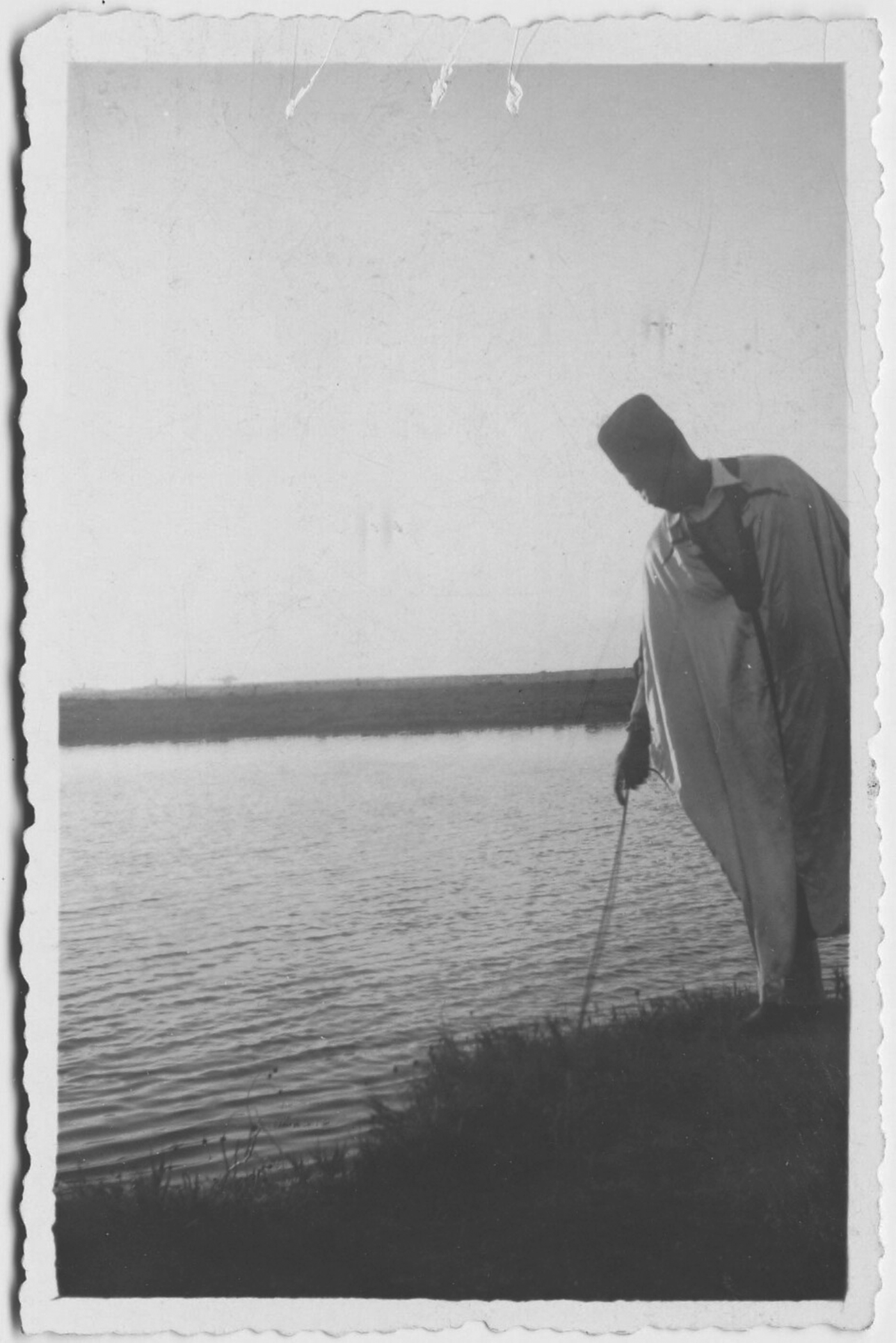
McKay in Morocco, c. early 1930s, Claude McKay Collection, Yale Collection of American Literature, Beinecke Rare Book and Manuscript Library.
“I am doing a book on Marseille,” Claude McKay wrote to Harold Jackman in November 1927. “It[’]s a tough, picturesque old city and I should love to show it to you some day. There are many Negro seamen from all over the world here and I spend my leisure time among them in their haunts.”Footnote 57 McKay's own “mighty life of restless searching within and without” underpins and informs Banjo's picaresque clamour.Footnote 58 The novel presents vagabondage as a means of escape from places and pasts marked by the absence of freedom; it is the defiant insertion of self in a transatlantic tradition marked by successive compulsions and erasures. In Banjo, the figure of the vagabond in his motley clothing may well be a metaphor for the condition of the writer himself. While making his home in Morocco in the early 1930s, McKay was photographed in the traditional fez and kaftan (Figure 2). His receptiveness to experience – and to the fluidity of identity – is apparent in this example of his own sartorial self-fashioning. He would write that
the vagabond lover of life finds individuals and things to love in many places and not in any one nation. Man loves places and no one place, for the earth, like a beautiful wanton, puts on a new dress to fascinate him wherever he may go. A patriot loves not his nation, but the spiritual meannesses of his life of which he has created a frontier wall to hide the beauty of other horizons.Footnote 59
While acknowledging the prevalence of such willing forms of blindness, McKay proposes in Banjo the possibility of clearer sight.