Introduction
Insect colonization and host location are worthy of study not only for their biological and ecological interest but also with a view to implementing novel techniques for integrated crop protection. The environment of a phytophagous insect is highly complex, and includes plants of various species and different ages and shapes, with only one or a few serving as hosts. During host plant location and selection for feeding, oviposition and mating, herbivorous insects need to integrate multimodal sensory inputs (Brevault & Quilici, Reference Brevault and Quilici2010) following three basic steps: initially, insects detect chemical plant volatiles that stimulate them to take off; then the visual stimuli such as contrast, colour and shape indicate where to land; and finally the mechano- and chemoreception indicate the host plant suitability (Finch & Collier, Reference Finch and Collier2000).
In Lepidoptera, host plant selection is primarily a function of the gravid female and chemical cues play the greatest role in host selection (Renwick, Reference Renwick1989). Chemicals in corn plant extracts stimulate the oviposition of the corn borers Ostrinia nubilalis, O. furnacalis, Chilo partellus and Sesamia nonagrioides (Binder et al., Reference Binder, Robbins and Wilson1995; Varshney et al., Reference Varshney, Babu, Singh, Agarwal and Jain2003; Konstantopoulou et al., Reference Konstantopoulou, Krokos and Mazomenos2004; Guo & Li, Reference Guo and Li2009). However, other factors such as interspecific and intraspecific interactions could affect host selection (Gabel & Thiery, Reference Gabel and Thiery1994; Harmon et al., Reference Harmon, White and Andow2003).
Maize is attacked by a complex of insects from the time it is planted until it is used as a food or feed (Eizaguirre & Albajes, Reference Eizaguirre and Albajes1989). In our study area, a number of lepidopteran caterpillars occur sympatrically and feed on different parts of the maize plant: Mythimna unipuncta and Spodoptera exigua feed on the leaves; Helicoverpa armigera feed on the maize ears; and S. nonagrioides and O. nubilalis are stem borers (Eizaguirre & Albajes, Reference Eizaguirre and Albajes1989). Except for O. nubilalis, the moths selected for this study belong to the Noctuidae family and share some components of their pheromone blend. The pheromone of the Mediterranean corn borer S. nonagrioides is a blend of four components: (Z)-11-hexadecen-1-yl acetate (Z11-16:Ac), (Z)-11-hexadecen-1-ol (Z11-16:OH), (Z)-11-hexadecenal (Z11-16:Ald) and dodecyl acetate (12:Ac) (Sans et al., Reference Sans, Riba, Eizaguirre and Lopez1997). The sex pheromone of M. unipuncta is a blend of Z11-16:Ac, Z11-16:OH and (Z)-9-hexadecenyl acetate (Z9-16:Ac) (Guerrero et al., Reference Guerrero, Canela, Riba, Eizaguirre, Albajes and Sarto1986); the sex pheromone of H. armigera is a blend of Z11-16:Ald and (Z)-9-tetradecenal (Z9-14:Ald) (Tamhankar et al., Reference Tamhankar, Rajendran, Rao, Lavekar, Jeyakumar, Monga and Bambawale2003); and the sex pheromone of O. nubilalis is a blend of two isomers, (Z)-11-tetradecenyl acetate (Z11-14:Ac) and (E)-11-tetradecenyl acetate (E11-14:Ac) (Klun et al., Reference Klun, Chapman, Mattes, Wojtkowski, Beroza and Sonnet1973).
Interspecific interactions between lepidopteran pests and/or with other insect groups have been studied by Ofomata et al. (Reference Ofomata, Overholt, Huis, Egwuatu and Ngi-Song1999), Eizaguirre et al. (Reference Eizaguirre, Sans, Lopez and Albajes2002), Harmon et al. (Reference Harmon, White and Andow2003), Gemeno et al. (Reference Gemeno, Sans, Lopez, Albajes and Eizaguirre2006), and Lelito et al. (Reference Lelito, Myrick and Baker2008). Specifically, the study of the effect of pheromone detection between different species has generated increasing interest because some pheromone compounds can act as a behavioural antagonist of males and females of other sympatric species (Stephens et al., Reference Stephens, Suckling and El-Sayed2008).
Eizaguirre et al. (Reference Eizaguirre, Sans, Lopez and Albajes2002) demonstrated that the densities of O. nubilalis in fields treated for mating disruption with S. nonagrioides pheromone released from PVC dispensers were always lower than those in untreated fields. In addition, Gemeno et al. (Reference Gemeno, Sans, Lopez, Albajes and Eizaguirre2006) found that rubber septa loaded with a constant concentration of the pheromone of O. nubilalis and different percentages of the S. nonagrioides pheromone cause dose-dependent antagonism in the field. In particular, the major component of the S. nonagrioides pheromone (Z11-16:Ac) displayed a potent antagonism in field and laboratory trials. Furthermore, in field studies, traps baited with S. nonagrioides pheromone attracted males of M. unipuncta (Albajes et al., Reference Albajes, Canela, Eizaguirre, Riba and Guerrero1988), while the addition of Z9-16:Ald, a minor component of M. unipuncta pheromone, significantly reduced the effectiveness of S. nonagrioides lure (Eizaguirre et al., Reference Eizaguirre, Lopez, Sans, Bosch and Albajes2009).
The above studies only evaluate the pheromone antagonism in males, but few studies consider whether females can recognize their own pheromone or the pheromone components of other sympatric species. If the female can detect conspecific or heterospecific semiochemicals, these chemical compounds could act as oviposition deterrents or stimulants that are of special interest in the female host location of S. nonagrioides, and therefore in new plant protection strategies. In this study we evaluated the electrophysiological and behavioural response of mated and unmated females and males of S. nonagrioides to their own complete pheromone blend, to its four components separately, and to the pheromone components of O. nubilalis, M. unipuncta and H. armigera.
Materials and methods
Insects
A laboratory culture was established with different populations of S. nonagrioides larvae collected from maize fields in the Lleida area (north-east Spain). Larvae were fed on a semi-artificial diet at 25°C, 50% RH and a 16:8 h (light: dark) photoperiod and the culture was renewed every three or four generations with larvae or pupae from the field (Eizaguirre & Albajes, Reference Eizaguirre and Albajes1992). For oviposition, single adult couples of males and females from different populations resulting from the laboratory culture were caged with a 5-leaf maize plant. Laid eggs were maintained on the plant till the day before hatching (larval capsule visible). Then, the eggs and a piece of leaf were transferred to a transparent cylindrical container (3.5 × 2 cm in height) with a 1 cm3 cube of diet. Seven days later the larvae were separated, labelled according to the original population, and reared individually in a similar container until pupation. Pupae were sexed by external morphological differences, and the resulting adults separated by sex were maintained at 20°C and a 16:8 h (light: dark) photoperiod. For experiments with virgin male and female individuals, pupae coming from different populations were transferred separately by sex to a plastic container (50 × 50 × 50 cm) to avoid unexpected matings in new emerged adults. For experiments with mating females, newly emerged males and females coming from different populations were transferred to a similar plastic container at a ratio of 1♀:2♂. After 24 h the moths were collected and used for the experiments. Individuals were used only once for experiments. After the experiments, supposed mated females were then dissected to confirm the presence in the bursa copulatrix of spermatophores, which indicate successful mating.
Chemicals
Pheromone components of S. nonagrioides (Z11-16:Ac, Z11-16:OH, Z11-16:Ald and 12:Ac), O. nubilalis (Z11-14:Ac and E11-14:Ac) and M. unipuncta (Z9-16:AC) were purchased from Pherobank (Wageningen, the Netherlands).
Electrophysiology
The EAG apparatus was purchased from Syntech (Hilversum, the Netherlands). In summary, charcoal-filtered and humidified air with air speed between 25 and 50 cm s−1 was continuously directed over the insect antenna through the main branch of a glass tube (7 cm long × 5 mm diameter). Test stimulations were carried out by giving puffs of air (300 ml min−1) through a Pasteur pipette for 100 ms using a TC-05 stimulus controller (Syntech). The pipette contained a small piece of filter paper (2 × 1 cm) on which the stimulus compounds were placed diluted in hexane. The solvent was allowed to evaporate before the tests.
Excised antennae of 24 h-old mated and unmated males and females were stimulated with 5 puffs of 10 μg at 30 s intervals in each of the treatments. Stimuli tested were the complete pheromone blend of S. nonagrioides in a ratio of 77:8:10:5 (Sans et al., Reference Sans, Riba, Eizaguirre and Lopez1997), its individual pheromone components, (Z11-16:Ac, Z11-16:OH, Z11-16:Ald, and 12:Ac) (Z11-16:ald is also the main component of the H. armigera pheromone), and the pheromone components of O. nubilalis (Z11-14:Ac; E11-14:Ac), and M. unipuncta (Z9-16:Ac). Experiments were conducted as in Giner et al. (Reference Giner, Sans, Riba, Bosch, Gago, Rayo, Rosell and Guerrero2009). In summary, antennae of 15 different insects were used for the experiments. Control puffs with a piece of paper containing only solvent (hexane) were also intercalated before and after the 5 puffs of each pheromone stimulus to determine the baseline depolarization of the antenna. The signals were amplified (100 × ) and filtered (DC to 1 kHz) with an ID-2 interface (Syntech), digitized on a PC, and analysed with the EAG2000 program. The relative EAGs to a test stimulus were calculated as R r =R i /((C 1+C 2)/2), where R i is the absolute amplitude of the stimuli and C 1 and C 2 are the responses of the control solvents before and after the 5 puffs of each treatment stimulation. Mated males corresponded to those that were introduced in the plastic container with the females. Unmated males were those that were absent from females from pupation and unmated females were those that were absent from males from pupation. Mated females were confirmed by dissection to examine the presence of spermatophores in the bursa copulatrix.
Dual-choice bioassays
A Y-tube olfactometer and a wind tunnel assay were used to test the olfactory responses of 24 h-old adult mated females of S. nonagrioides to the complete pheromone blend in a ratio of 77:8:10:5 and to its individual pheromone components (Z11-16:Ac, Z11-16:Ald, Z11-16:OH and 12:Ac), and to the pheromone components of O. nubilalis (Z11-14:Ac; E11-14:Ac), and M. unipuncta (Z9-16:Ac), along with odours emitted by maize plants.
The Y-tube olfactometer (Fig. 1) consisted of two main glass tubes (diameter 20 cm, length 34 cm) linked by a glass reservoir chamber (R) (diameter 20 cm, height 34 cm) containing the test insects. The tubes diverged in a ‘V’ form with an angle of 45°. At the other end of the tubes, two more reservoirs, similar in form and size to the previous one, contained the volatile source (S) along with a maize plant (T *), or solvent along with a maize plant (T 0). The dimensions of the tubes and reservoirs offered the insects sufficient room to fly freely inside the olfactometer. Two round holes (4 cm diameter) at a height of 28 cm from the base of each chamber allowed connection with two small exhaust fans (3 cm diameter). Another round hole (4 cm diameter) at the same height from the base of the first chamber (28 cm) was connected to an inlet fan. The inlet fans and the exhaust fans worked concomitantly to provide an air speed of 0.22 m s−1. The olfactometer was located in a climate room under a 16:8 h LD photoperiod at 25 ± 1°C and 65 ± 5% RH, illuminated by red light of 4 lux of intensity.
Diagram of Y-tube olfactometer. R, common reservoir for introducing test insects; T *, reservoir with the plant and the treatment; T 0, reservoir with the plant and the hexane (control); E, exhaust fan; F, inlet fan; S, volatile source (treatment or hexane).

The amount of individual compounds deployed was related to the amount used previously in wind tunnel experiments (10 μg of pheromone) (Sans et al., Reference Sans, Riba, Eizaguirre and Lopez1997). The solvent was allowed to evaporate and the dispensers were then ready to use. Two individual dispensers, one with the test compound and one containing hexane (10 μg) as a control, were placed inside the chambers (T * and T 0, respectively) along with the maize plant in front of the inlet fans. After each assay, the device was thoroughly cleaned with ethanol and the plants with the treatment or the solvent were moved to different chambers to avoid a positional bias. The order of treatments was randomized. The time given to the insects to respond to the maize plants both in the olfactometer and in the wind tunnel were the three first hours after the onset of the scotophase, because during this time, gravid females of S. nonagrioides seek host plants (preliminary experiments).
In each assay, groups of 3 to 5 mated females were released into the common chamber (R). Female behaviour was observed every 15 min. At the end of each assay (three hours later) the number of females in T * versus number of females in T 0 control was recorded. Only the females that performed the oviposition behaviour (oriented flight to the odour source, sweeping the plant with the ovipositor) and laid eggs, were taken into account for the statistical analysis. When a female showed the oviposition behaviour it was removed from the chamber. Females that did not show oriented flight or showed calling behaviour were removed from the olfactometer and not considered for the analysis. The assays were run until at least 35 insects responded to each compound.
The wind tunnel dual-choice assay was carried out in a laminar flow wind tunnel (length 151 cm, width 47 cm, height 44 cm) (Gemeno et al., Reference Gemeno, Sans, Lopez, Albajes and Eizaguirre2006) at 25 ± 2°C, 50% RH and a wind velocity of 0.3 m s−1 during the first and third hour of the scotophase. The tunnel was illuminated with a red light resulting in 4.5 lux intensity at the ceiling and floor.
Groups of 4 to 6 gravid females were placed at the downwind end of the tunnel at a distance of 125 cm from the two maize plants, which were located at the upwind end of the tunnel and placed 15 cm apart. Gravid S. nonagrioides females were offered a choice between two odour sources: maize plants along with hexane serving as a control; or the pheromone components of O. nubilalis, M. unipuncta, H. armigera and S. nonagrioides. Each treatment contained 10 μg of pheromone or hexane and was applied in a rubber septum to the middle of each maize plant. The assays were run until at least 40 insects responded to each treatment. As in the previous experiment, only the number of females that performed the oviposition behaviour and laid eggs were taken into account for the statistical analysis, and calling or non-flying females were removed from the tunnel.
Statistical analysis
All statistical analysis was done using JMP, Version 8 (2008). For all comparisons, the level of P = 0.05 was considered significant. Before the statistical analysis, the Shapiro Wilk test was used to check for normality distributions. For the electrophysiological recordings, depolarization means were analysed using ANOVA followed by Tukey's multiple range tests. All data obtained from the dual-choice assays (wind tunnel and dual-choice olfactometer) were subjected to a binomial test (Zar, Reference Zar1996), considering that females showed no preference for either olfactometer arm (50:50 response). Responses were converted to percentages for presentation.
Results
Electrophysiology
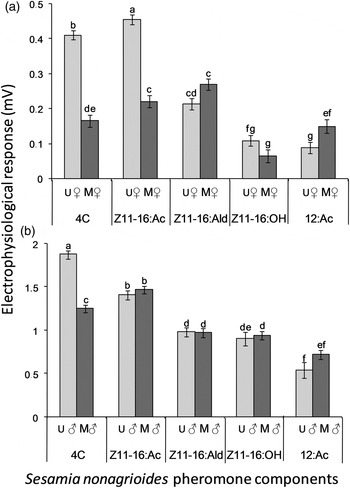
The results show a clear difference in the electrophysiological response between males and females, the male response always being higher than the female response (ANOVA test, F 1,226 = 1720; P < 0.001) (Figs 2A, B). Moreover, our results show that unmated females and males of S. nonagrioides are more sensitive to the female pheromone, showing higher electrophysiological response than the mated females and males (ANOVA test, F 1,469 = 5.65; P < 0.001).
Electrophysiological response of mated and unmated females (A) or males (B) of Sesamia nonagrioides to 10 μg of their own complete sexual pheromone blend, 4C ((Z)-11-hexadecen-1-yl acetate (Z11-16:Ac), (Z)-11-hexadecen-1-ol (Z11-16:OH), (Z)-11-hexadecenal (Z11-16:Ald) and dodecyl acetate (12:Ac); 77:8:10:5, respectively), and to its individual components, Z11-16:Ac, Z11-16:OH, Z11-16:Ald (also the main component of Helicoverpa armigera pheromone), and 12:Ac. U♀ = unmated female, M♀ = mated female, U♂ = unmated male, M♂ = mated male. N = 30 antennae. Bars with different letters are significantly different (Tukey's test, P < 0.05).

The response of the antenna of mated and unmated females of S. nonagrioides to their own complete pheromone and each component of the pheromone blend are represented in Fig. 2A. The highest response was obtained when the unmated female antennae were stimulated with the major component of their blend (Z11-16:Ac), the response to the full blend being lower. However, the highest responses of mated female antennae (Fig. 2A) occurred when they were stimulated with the aldehyde or the major component of their pheromone, the responses to the full blend being lower. No significant differences were found between the electrophysiological response to Z11-16:Ald in mated and unmated females. The lowest responses in the antenna of mated and unmated females were produced by Z11-16:OH and 12:Ac, and no significant differences were found between them (ANOVA test, F 9,967 = 66.25; P > 0.001).
The responses of the male antennae to the full blend and to each of the components are shown in Fig. 2B. As expected, the highest response was that of the antennae of unmated males to the full blend, followed by that of the antennae of unmated and mated males to the major component of their pheromone. The responses to aldehyde and to alcohol were similar in unmated and mated males. The lowest responses corresponded to 12:Ac and showed no differences between mated and unmated males (ANOVA test, F 9,906 = 45.8; P > 0.001).
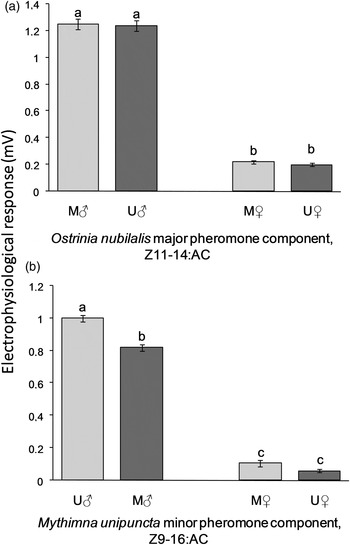
Figure 3 shows the electrophysiological response of mated and unmated females and males of S. nonagrioides to the major components of O. nubilalis pheromone and to the minor component of M. unipuncta. Male antennae showed a high response to the main component of the O. nubilalis pheromone (Z11-14:Ac) (Fig. 3A), but no differences were found between those of mated and unmated males (ANOVA test, F 1,113 = 1.95; P < 0.16). The electrophysiological recordings in female antennae displayed a lower response to the main component and, as in males, no differences were found between mated and unmated females (ANOVA test, F 1,187 = 0.6; P > 0.43) (Fig. 3A). There were no differences between the hexane control and the secondary component of the O. nubilalis pheromone (E11-14:Ac) in male and female antenna (data not shown).
Electrophysiological response of mated and unmated males and females of Sesamia nonagrioides to (A) the major pheromone component of Ostrinia nubilalis, (Z)-11-tetradecenyl acetate (Z11-14:Ac), and (B) the minor pheromone component of Mythimna unipuncta, (Z)-9-hexadecenyl acetate (Z9-16:Ac). U♂ = unmated male, M♂ = mated male, U♀ = unmated female, M♀ = mated female. N = 30 antennae. Bars with different letters are significantly different (Tukey's test, P < 0.05).

The results for the pheromone components of M. unipuncta are shown in Fig. 3B. Males of S. nonagrioides exhibited noteworthy electrophysiological responses to the minor sex pheromone component of M. unipuncta, and differences were found between mated and unmated males (ANOVA test, F 1,198 = 19.41; P < 0.001). Females also displayed EAG responses to Z9-16:Ac, although no differences were found between mated and unmated females (ANOVA test, F 1,208 = 2.03; P > 0.27)
Dual-choice bioassays
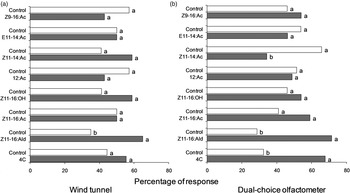
Figure 4 compares the behavioural responses of mated females in both tunnel flight (A) and Y-tube olfactometer (B) to a plant without any pheromone component (control) versus a plant with the full blend or each of the components of their own pheromone or the major components of the O. nubilalis and M. unipuncta pheromone. Gravid females preferred the plant with aldehyde (Z11-16:Ald) in both the wind tunnel and the olfactometer. Furthermore, gravid females preferred the plant with the full blend of their own pheromone to the plant alone in the olfactometer. On the other hand, when we tested the major pheromone component of O. nubilalis (Z11-14:Ac), S. nonagrioides gravid females preferred the plant alone to the plant with Z11-14:Ac. No significant differences were found when Z11-16:Ac, Z11-16:OH, 12:Ac and the minor pheromone component of O. nubilalis (E11-14:Ac) and M. unipuncta (Z9-16Ac) were tested in the wind tunnel and Y-tube olfactometer.
Behavioural responses of gravid females of Sesamia nonagrioides in dual-choice bioassays (wind tunnel and a Y-tube olfactometer) to 10 μg of their own complete sexual pheromone blend, 4C ((Z)-11-hexadecen-1-yl acetate (Z11-16:Ac), (Z)-11-hexadecen-1-ol (Z11-16:OH), (Z)-11-hexadecenal (Z11-16:Ald) and dodecyl acetate (12:Ac); 77:8:10:5, respectively), to its individual components, Z11-16:Ac, Z11-16:OH, Z11-16:Ald (also the main component of Helicoverpa armigera pheromone), and 12:Ac, and to the pheromone components of Ostrinia nubilalis, (Z)-11-tetradecenyl acetate (Z11-14:Ac) and (E)-11-tetradecenyl acetate (E11-14:Ac), and Mythimna unipuncta, (Z)-9-hexadecenyl acetate (Z9-16:Ac). N = 35–40. Bars with different letters are significantly different (Binomial test, P < 0.05).

Discussion
Previous studies of the pheromone interactions between adults of caterpillars feeding on maize demonstrated that S. nonagrioides males can detect and respond to female pheromone components and to the pheromone components of other sympatric species such as O. nubilalis, M. unipuncta and H. armigera (Albajes et al., Reference Albajes, Canela, Eizaguirre, Riba and Guerrero1988; Eizaguirre et al., Reference Eizaguirre, Sans, Lopez and Albajes2002, Reference Eizaguirre, Lopez, Sans, Bosch and Albajes2009; Gemeno et al., Reference Gemeno, Sans, Lopez, Albajes and Eizaguirre2006). The present study highlights that S. nonagrioides females also detect their own pheromone and pheromone components of sympatric species. Our results contradict those obtained by Acin et al. (Reference Acin, Carrascal, Abian, Guerrero and Quero2009), in which no EAG response was detected when the pheromone blend (Z11-16:Ac, Z11-16:OH, and Z11-16:Ald in a 84:15:1 ratio) was tested on female antennae of S. nonagrioides. The action potentials generated by activated sensory neurons (OSNs) on the insect antenna and recorded by EAG are a function of the preparation resistance, connection strength, insect vitality and position of the electrode (Nagai, Reference Nagai1983; Crnjar et al., Reference Crnjar, Scalera, Liscia, Angioy, Bigiani, Pietra and Barbarossa1989). Therefore, the differences between our results and those of Acin et al. (Reference Acin, Carrascal, Abian, Guerrero and Quero2009) could be due to the nature of the EAG or to the lower pheromone concentration used by them (100 ng versus 10 μg) during the electrophysiological experiments. For example, to display noteworthy EAG responses, females of S. exigua need 1 μg (Yang et al., Reference Yang, Dong and Chen2009) and those of Pandemis limitata need 10 μg (DeLury et al., Reference Delury, Judd and Gardiner2005).
Female response in EAG, although lower than that of males, was quite noteworthy, particularly with respect to the major component and to the complete pheromone blend, the responses of male antennae being about four times higher than those of female antennae. These results are in agreement with those obtained by Acin et al. (Reference Acin, Carrascal, Abian, Guerrero and Quero2009), who found that the pheromone binding proteins (PBPs) were more than 4 times higher in males than in females. In Noctuidae the presence of PBP in female antennae has been reported to be 50 to 100% of that in male antennae (Maïbeche-Coisne et al., Reference Maïbeche-Coisne, Sobrio, Delaunay, Lettere, Dubroca, Jacquin-Joly and Meillour1997; Konstantopoulou et al., Reference Konstantopoulou, Pratsinis, Kletsas and Mazomenos2006). Morphological characteristics of female antennae such as the number and type of the sensilla trichoidea (unpublished data) may also explain the low EAG response of female antennae in comparison with male antennae so, in species in which female are anosmic to their pheromone, antennae are less complex morphologically in comparison to males (Schneider et al., Reference Schneider, Lacher and Kaissling1964, Reference Schneider, Schulz, Priesner, Ziesmann and Francke1998). Our electrophysiological experiments reinforce the ‘autodetection’ hypothesis discussed by Stelinski et al. (Reference Stelinski, Il'ichev and Gut2006, Reference Stelinski, Holdcraft and Rodriguez-Saona2014). Female pheromone detection has also been demonstrated by EAG assay in other lepidopteran species (Palaniswamy & Seabrook, Reference Palaniswamy and Seabrook1978; Light & Birch, Reference Light and Birch1979; Ross et al., Reference Ross, Palaniswamy and Seabrook1979; Seabrook et al., Reference Seabrook, Linn, Dyer and Shorey1987; Den Otter et al., Reference Den Otter, De Cristofaro, Voskamp and Rotundo1996, Pearson & Schal, Reference Pearson and Schal1999; De Cristofaro et al., Reference De Cristofaro, Ioriatti, Pasqualini, Anfora, Germinara, Villa and Rotundo2004; Groot et al., Reference Groot, Gemeno, Brownie, Gould and Schal2005; DeLury et al., Reference Delury, Judd and Gardiner2005; Stelinski et al., Reference Stelinski, Il'ichev and Gut2006; Gökçe et al., Reference Gökçe, Stelinski, Gut and Whalon2007; Yang et al., Reference Yang, Dong and Chen2009).
Unmated S. nonagrioides males elicited the highest electrophysiological responses to the full blend and to the major sex pheromone component and a similar response to the major component of its own pheromone was signalled for Helicoverpa zea by Vickers and Baker (Reference Vickers and Baker1991). However, Linn et al. (Reference Linn, Campbell and Roelofs1987) demonstrated, in field trials with the oriental fruit moth, Grapholita molesta, that the active space of a multicomponent pheromone is a function of the female's full blend rather than of the major component alone.
The electrophysiological response of male antennae decreased after mating, indicating a decrease in sexual responsiveness that is common in several insects (Barrozo et al., Reference Barrozo, Gadenne and Anton2010; Fischer & King, Reference Fischer and King2012). The behavioural and physiological mechanisms leading to this loss of sexual responsiveness of insect males are still unknown although many studies have attempted to determine them (Gadenne et al., Reference Gadenne, Dufour and Anton2001; Barrozo et al., Reference Barrozo, Gadenne and Anton2010; Fischer & King, Reference Fischer and King2012). Our results showed that the antennal receptors may be involved in this drop in sensitivity to the female pheromone in mated males.
As occurred in males, the electrophysiological response of mated S. nonagrioides female antennae was lower than that of unmated females when the major sex pheromone component and the complete pheromone blend were tested, suggesting that the peripheral olfactory elements involved in this reduction are the same as those in mated males. Unmated females showed the highest electrophysiological response to the major pheromone component and to the complete pheromone blend. The behavioural consequences of autodetection in virgin females have not been studied for S. nonagrioides but Harari et al. (Reference Harari, Zahavi and Thiery2011) showed that pheromone autodetection by virgin female of Lobesia botrana affected the time of calling, the number of eggs laid and the survivorship of females. The response of the antennae of mated females differed from that of unmated females. The highest response of the antennae of the mated females was obtained when they were exposed to the aldehyde (Z11-16:Ald), followed by the major component of the pheromone (Z11-16:Ac). Different responses to volatiles between unmated and mated females have been demonstrated in other insects, such as Spodoptera littoralis, whose unmated females are more sensitive to lilac flowers and sex pheromone while mated females prefer green leaf odours (Martel et al., Reference Martel, Anderson, Hansson and Schlyter2009; Saveer et al., Reference Saveer, Kromann, Birgersson, Bengtsson, Lindblom, Balkenius, Hansson, Witzgall, Becher and Ignell2012). Thus, the change in the electrophysiological response of S. nonagrioides females to their own pheromone depending on the mating status could be a physiological adaptation, downregulating some olfactory receptors to focus the energy on finding suitable oviposition sites. Likewise, changes in the hemolymph concentration (conductance) of proteins, inorganic ions, lipids and carbohydrates could thus also explain variations in EAG between different physiological states.
A greater proportion of gravid females responded to the pheromone components in the olfactometer than in the wind tunnel, except for those of O. nubilalis, possibly because the odour plumes in the olfactometer never overlap. When gravid females had to choose for laying eggs in the dual-choice experiments between maize plants without any pheromone and plants with the different pheromone components, S. nonagrioides females preferred plants with Z11-16:Ald in the wind tunnel and in the olfactometer and with the complete pheromone only in the olfactometer experiments. These results coincided with those obtained in the EAG assays, in which the mated female antennae showed the highest response to Z11-16:Ald, a minor component of S. nonagrioides pheromone and the major component of H. armigera pheromone, followed by the complete pheromone blend. This response could be related to aggregation egg-laying behaviour, in which detection of conspecific or heterospecific females serves to locate an appropriate oviposition site or to improve the ability to overcome plant defences (Prokopy & Roitberg, Reference Prokopy and Roitberg2001). It is common that some pheromones specifically influence the females of many insects to lay eggs at the sites resulting in most egg deposition (Seenivasagan, Reference Seenivasagan, Sharma, Sekhar, Ganesan, Prakash and Vijayaraghavan2009). S. nonagrioides gravid females showed no preference for maize plant with the rest of their pheromone component versus maize plant without any pheromone component. The main component of the O. nubilalis pheromone, Z11-14:Ac, elicited a high response in the male antennae and a lower response in the female antennae in the EAG. This relatively low response of the females in the EAG was enough to produce the behavioural antagonism in the olfactometer assays that was also detected in males in wind tunnel and field-trapping experiments (Eizaguirre et al., Reference Eizaguirre, Albajes, Lopez, Sans and Gemeno2007). The pheromone detection of the sympatric species O. nubilalis probably helps S. nonagrioides gravid females to detect and avoid maize fields or plants on which O. nubilalis females are present in order to prevent interspecific competition of the larvae for food and space. On the other hand, the minor component of M. unipuncta pheromone, Z9-16:Ac, did not elicit any change in behaviour of the gravid females of S. nonagrioides in the wind tunnel or the olfactometer, although the high response of the males to this component in the EAG corresponds to the inhibitory effect obtained by Eizaguirre et al. (Reference Eizaguirre, Lopez, Sans, Bosch and Albajes2009) in wind tunnel and field-trapping experiments. M. unipuncta has different feeding or egg laying habits to O. nubilalis: the distribution of the egg masses may be either in the leaves of the corn plant or in wild grasses; larvae feed on the leaves and the different generations during the year do not completely overlap with S. nonagrioides. Therefore, the overlapping niche is not large, the interspecific competition between these two species is not high, and an evasion mechanism from interspecific pheromone perception is probably not necessary.
In summary, S. nonagrioides females can detect their own pheromone components and the pheromone components of other sympatric species and can modulate their behaviour according to the odours detected; gravid females are attracted to their own pheromone components but some pheromone components of other sympatric species act as behavioural antagonist. Both sexes showed greater EAG responses prior to mating. These results are important because although the response of males to the different components of pheromones has been widely studied for many species, the responses to the pheromone component of the females and the influence of this response on egg-laying behaviour have been far less studied.
Acknowledgements
We thank Joan Safont and Aurora Ribes for their technical assistance. This study was partially funded by the Spanish R&D Agency (Comisión Interministerial de Ciencia y Tecnología) through project AGL2011-23996.