

Introduction
Extant research has addressed drivers of local and organic food demand, willingness to pay (WTP), consumer perceptions and other important dimensions of alternative foods. Particularly important to alternative food system producers and advocates is the nature of these rapidly changing views, which have consequences in the broader context of the food system.
What began as an alternative to industrial agriculture and conventional food has developed into a local food movement. This is evidenced by popular books such as The Omnivore's Dilemma Reference Pollan1, and Animal, Vegetable, Miracle Reference Kingsolver, Hopp and Kingsolver2, and documentary films such as Food, Inc. and King Corn. In 2007, the word ‘locavore’ (a person with an eating preference for local foods) was added to the New Oxford English DictionaryReference Thilmany, Bond and Bond3. The popularity of local food has grown in response. According to the USDA's Agricultural Marketing Service, in 1994 there were 1755 registered farmers' markets, which grew to 4685 in 20084. Total value of sales at farmers' markets in 2007 was $1.2 billion, up from $404 million in 19925. Community supported agriculture programs (CSAs) have also seen significant growth in the past decade. The number of CSAs in the US has increased from just 50 in 1985 to about 2500 in 20086, Reference Brown and Miller7. Other outlets for local food sales such as roadside stands, small and independent local grocers and direct sales to local restaurants have also seen significant growthReference Tropp8.
The value of local food in the US market jumped from an estimated $4 billion in 2002 to about $5 billion in 2007, and is expected to increase to $7 billion by 2012Reference Tropp9. This has piqued the interest of many groups in local food. For example, retail and processing giants such as Wal-Mart and Frito-Lay offer local ingredients, and new retailers such as New Seasons Market are finding success by focusing in part on food milesReference Guptill and Wilkins10. Much of this change is in response to studies that indicate a high WTP for local food.
We know that organic foods benefit from a concrete definition and a certified labeling program, but local food is a more abstract concept, with definitions often varying by consumer perceptions. Many define local to be within a certain geographical distance, such as 100 miles, while some define local to mean some political boundary, such as a state border. Others point to a definition more rooted in ethics, community and other factors not directly corresponding to food milesReference Adams and Adams11. While there is no firm or standard definition for local, interest in local foods is high among consumers, producers and retailers.
What is unclear from previous work is (1) the linkage between the federal organic standards and the turn in demand for local food, and (2) the implications that this turn may have for the food system going forward. We describe the development of the local food movement and the change in consumer preferences concerning organic and local food characteristics, both pre- and post-USDA organic standards implementation. As large agribusinesses seek to capitalize on changes in consumer preferences, farmers' markets, CSAs and other direct and niche local food markets may be vulnerable to corporate co-optationReference Guptill and Wilkins10. This has serious implications for small farmers, consumers and many other stakeholders. In this context, our review provides some insight into the marketing potential of ‘local’ and the potential for its co-optation by industrial agriculture into ‘local lite’.
Our work extends the literature by specifically examining the studies that allow a direct comparison between characteristics now associated with local or organic foods. Our analysis indicates a turn in demand from organic to local that is coincident with the development of the federal organic standards. We discuss the implications of this on the potential corporate involvement in providing local food.
Industrial Agriculture and the Federal Organic Rule
It took 12 years for the USDA to adopt national standards for the production, processing and marketing of organically labeled food under the Organic Food Production Act of 199012. The USDA officially adopted the federal organic standards in October 2002 once it was satisfied that organic food would not ‘disparage the rest of the food supply’Reference Guthman13. The Organic Rule defines the minimum production, processing and input standards (National List of Allowed Substances) that must be met to use the organic label. The standards (1) apply to both domestically produced and imported organic products; (2) contain a list of allowed synthetic and prohibited nonsynthetic substances and a list of specific exceptions to the organic label requirement; (3) employ distinct guidelines for organic crops standards and organic livestock; (4) strictly define the handling and processing of organic products; and (5) include the USDA organic seal and a four-tier organic labeling scheme: ‘100% organic’, ‘organic’, ‘made with organic ingredients’ and ‘product contains some organic ingredients’.
Substantial price premiums coupled with public demand drew large agribusinesses into the organic foods marketReference Guthman13, Reference Buck, Getz and Guthman14. In 2006, sales of organic products reached $16.7 billion (3% of the $596 billion US food market), representing an annual growth rate of 20.9%15. Just 5 years earlier, sales of organic food products were $7.4 billion. Organic food now has more market share and a broader reach, but it is fundamentally different in character than when it started. Between 1990 and 2002, corporate agribusinesses took advantage of the USDA's formal rulemaking processes that disfavored the more ideological aspects of the organic movementReference Tovey16, and lobbied to allow genetically modified ingredients, irradiation, chemically raised meats and several previously prohibited substancesReference Hart17. By 2002, when the USDA adopted its Organic Rule, ‘organic’ was federally defined as an input-driven technical process rather than a concept based in sustainability; food could still be labeled organic if it was made by General Mills corporation, produced in China using forced labor, and sold only through Wal-MartReference Hightower18.
Organic foods fundamentally changed with the development of the federal standards. Effective marketing campaigns co-opted the central themes of the organic movement to increase market share, while the products were largely grown on farms that either abandoned the sustainable agronomic practices associated with organic agriculture or were recruited from the ranks of conventional agricultureReference Guthman19. This resulted in the conventionalization (taking on the characteristics of conventional agriculture) and bifurcation (dual structure of very large and very small producers) of organic agricultureReference Constance, Choi and Lyke-Ho-Gland20. The entry of large corporations, such as Danone and General MillsReference Sligh and Christman21, and the consolidation of food retail outlets, such as Whole Foods and Wild OatsReference Howard and Allen22, effectively cut out small farmers from the benefits of the boom in demand for organic foods. Production of organic food was forced toward large-scale, least-cost, input-oriented standardsReference Guthman19, and smaller competitors and those not adopting a least-cost production model were largely marginalizedReference Guthman13. Today, the organic market essentially functions as an oligopsony, with a small number of very powerful wholesaler/retailer ‘organic giants’ who limit farmer income; about 80% of the organic food market is handled by just two national distributorsReference Sligh and Christman21, Reference Guthman23.
Local as Response to ‘Organic Lite’
Many argue that organic food now suffers from the same problems that initially spurred the organic movement (see review by FeenstraReference Feenstra24). Early advocates of organic food focused on concepts now associated with local food. These included a discussion by HightowerReference Hightower25, Reference Hightower26 of the corporate control of US agriculture, including its impacts on small farmers, farm workers, consumers and food quality; Berry'sReference Berry27 description of the associated loss of community and culture; Gussow'sReference Gussow28, Reference Gussow29 essays on concerns over food, nutrition and the environment; and more recently, Kneen'sReference Kneen30 review of the social and ecological costs of the global industrial food system that stood in opposition to sustainability, food justice and community.
Organic food lost its essential nature as an alternative to industrial agricultureReference Allen and Sachs31. While the number of certified organic acres in the US nearly quadrupled from 1995 to 2005, the average size of certified organic farms more than doubled from 189 acres to 477 acres32. Some argue that many organic products achieve only the minimum standards such as pesticide- or GM-free content: ‘organic lite’. Today, every state in the US reports having at least one organic certified farm, but just 16% of organic foods are sold through direct marketing channels, such as farmers' markets, CSAs, cooperatives, etc33. The term ‘organic lite’ draws stark contrast with ‘deep organic’, which is identified with smaller scale, eco-friendly farming systemsReference Guthman19, or a dualism between shallow/corporate and deep/agri-ecological organicReference Morgan, Marsden, Murdoch, Morgan, Marsden and Murdoch34.
Critics view organic lite as ‘dangerously incomplete’ because it lacks a social visionReference Delind35. Dimensions such as community food security, farm-worker welfare, animal welfare, land stewardship, resource conservation, preservation of heritage breeds and sustainability are no longer strongly associated with organic foodsReference Buck, Getz and Guthman14 both in the USReference Guthman19 and abroad (e.g., IrelandReference Tovey16, Great BritainReference Clunies-Ross, Cox, Lowe, Marsden and Whatmore36, Reference Smith and Marsden37, Australia and New ZealandReference Lockie, Lyons and Lawrence38, Reference Lockie and Halpin39). Many in the organic movement were deeply disappointed by the effects of the Organic Food Production Act: ‘When we said organic we meant local. We meant healthful. We meant being true to the ecologies of the region. We meant mutually respectful growers and eaters. We meant social justice and community. In other words, industrial organic farming isn't really organic’Reference Hart17; organic is ‘more about fairness and respect than it is about parts-per-billion of pesticide residues’Reference Hightower18.
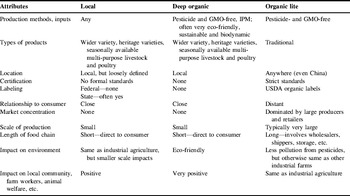
Many consumers have turned to local foods as a more holistic and authentic substitute for organic. For some, food miles rather than organic labels are the representation of sustainabilityReference Iles40, and organic movement supporters are now looking to local as the solution to industrialized organic foods: ‘as organic consumers, the first and foremost action we can take is a commitment to buy food produced as locally as possible’Reference Hamer41. For these consumers, local appears to be adequately defensible from ‘opportunistic corporate greening’Reference Buttel42 in marketing campaigns and takeover by industrial agriculture. The concept of local food presents a difficult problem for the large agribusinesses that now dominate the market for organic foods. ‘Foodsheds’Reference Kloppenburg, Hendrickson, Stevenson, Vitek and Jackson43 and ‘civic agriculture’Reference Lyson and Guptill44 leave no room for industrial farming, organic or otherwise. Both concepts stress the importance of eating close to home to reduce environmental and social externalitiesReference Kloppenburg, Hendrickson, Stevenson, Vitek and Jackson43 and rebuild communitiesReference Lyson and Guptill44. Local food has also gained interest from small organic farmers that reject certification and prefer to rely on a trust relationship with their consumerReference Constance, Choi and Lyke-Ho-Gland20. See Table 1 for a comparison of local, organic and deep organic.
Comparison of local, organic and deep organic foodsFootnote 1.

1 Adapted from a review of the literature.
The Turn in Preferences for Local and Organic Food
We review the literature on consumers' perceptions and WTP for local and organic food characteristics. Comparisons between local and organic food can be made both by summarizing generic findings for organic and local separately (sort of a meta-analysis), and by examining studies that explicitly include characteristics of both local and organic within the same study. We organize the studies into two groups: (1) where characteristics associated with local food are viewed as less important than those traditionally associated with organic foods today; and (2) where local is considered more important than organic. We summarize the key studies below, and highlight a turn in the demand for local food characteristics.
Local LESS important than organic
Numerous studies focus on factors influencing demand for organic food and consumer perceptions of various food characteristics that include consumer health, environmental impacts, etc. Very few of these studies also include characteristics associated with local food.
Most of the studies regarding organic consumers' motivations focus on perceptions of organic, attitudes and factors that influence purchasesReference Krystallis and Chryssohoidis45 or WTP for foods with varying levels of pesticide contamination, labeling, etc. (see review by ThompsonReference Thompson46). These studies typically conclude that organic consumers are motivated by concerns for the environment, consumer health and safety, and product attributes such as price, taste, appearance and freshness (e.g., Tregear et al.Reference Tregear, Dent and McGregor47, Browne et al.Reference Browne, Harris, Hofny-Collins, Pasiecznic and Wallace48).
Older studies of organic food found clear evidence of stronger preferences and/or WTP for characteristics associated more with organic food than for local food. Some of these studies involved consumers ranking food attributes. Studies implemented prior to the late 1990s found very strong support for factors such as protection of the environment, consumer health and conservation of resources, but weak support for supporting local communities, protection of farm workers and ecologically driven concepts such as preservation of nature–farm balance (e.g., Hawkes and StilesReference Hawkes and Stiles49, Sachs et al.Reference Sachs, Blair and Richter50, Goldman and ClancyReference Goldman and Clancy51, Sparling et al.Reference Sparling, Wilken and McKenzie52 and Govindasamy et al.Reference Govindasamy, Italia and Liptak53). For example, Sparling et al.Reference Sparling, Wilken and McKenzie52 found over three times more respondents indicating that concern for the environment was a major reason for purchasing organic than any factor now linked to local food (i.e., protection of farm workers). Likewise, Goldman and ClancyReference Goldman and Clancy51 found that concern for different aspects of the environment accounted for the top three of the seven ranked reasons for buying organic produce, while protecting farm workers ranked fourth and preserving a balance of nature only ranked sixth. Govindasamy et al.Reference Govindasamy, Italia and Liptak53 is the most recent study we uncovered that found very little support for local over organic food characteristics. Their mail survey asked consumers in New Jersey to rank 19 product characteristics in order of importance. Traditional product characteristics (i.e., freshness, taste/flavor and cleanliness) were rated highest and health value and absence of pesticides were next highest, while locally grown and country of origin were rated among the least important. Unfortunately, their survey did not examine other dimensions of local food (e.g., supporting small farmers).
A handful of studies from this period focus on food origin, but neglect a comparison with organic foods. Two of these studies found that consumers were much more interested in product quality, price, appearance and other traditional demand factors than product originReference Kezis, King, Toensmeyer, Jack and Kerr54, Reference Lockeretz55. For example, Kezis et al.Reference Kezis, King, Toensmeyer, Jack and Kerr54 surveyed consumers by mail in Maine, Delaware and West Virginia, and found that produce origin was much less important than quality, appearance, price, convenience and variety. LockeretzReference Lockeretz55 conducted intercept surveys at supermarkets, farmers' markets and agricultural fairs in Massachusetts, and found that only 14% at farmers' markets or fairs indicated support for local farms as a reason for shopping there. Instead, they valued freshness, convenience, prices and selection. The other two studies examined price premiums and found very little support for local foodReference Eastwood, Brooker and Orr56, Reference Bruhn, Vossen, Chapman and Vaupel57. Eastwood et al.Reference Eastwood, Brooker and Orr56 conducted consumer interviews in Tennessee, and found a very weak WTP premium for local tomatoes and peaches, but negative WTP for other local goods. They concluded that local produce should be priced below comparable out-of-state products. Bruhn et al.Reference Bruhn, Vossen, Chapman and Vaupel57 conducted intercept surveys at supermarkets, and found that 78% of respondents considered locally grown to be an unimportant characteristic; only 13% expected to pay a price premium for locally grown foods. Clearly, the locality of food sources was not considered a priority for most consumers during this period.
Local MORE important than organic
The turn from organic to local foods became apparent in studies conducted around the late 1990s. Both in the US and abroad, researchers began to note odd results in organic food studies. For example, a study of British consumers found that concern for the environment did not help differentiate organic produce buyers from nonbuyersReference Tregear, Dent and McGregor47, and only 9% of respondents indicated that concern for the environment was their primary reason for buying organic. Likewise, there was evidence that certified organic was losing its credibility and consumer supportReference Underhill and Figueroa58. Underhill and FigueroaReference Underhill and Figueroa58 surveyed residents of eight northeast US states to determine the relative impact of organic and certified organic on WTP. They found a slight preference for organic over certified organic (about 5% higher predicted probability of buying organic than certified organic) that could be interpreted as a preference for small farms. Also, several studies found that protection of self (consumer's health) was not the primary motivation for purchasing organic (e.g., Gallons et al.Reference Gallons, Toensmeyer, Bacon and German59).
The tipping point occurred in the late 1990s when studies began to find that consumers place a greater importance on purchasing local rather than organic foods, and they perceive that local foods are better for society (e.g., Gallons et al.Reference Gallons, Toensmeyer, Bacon and German59, ZumwaltReference Zumwalt60). For example, WolfReference Wolf61 found that consumers in California rate locally grown as somewhat to very desirable, a much higher rating than is given to grown organically. A later study by Wolf et al.Reference Wolf, Spittler and Ahern62 reported that California residents indicate locally grown to be a moderately important factor for shopping at farmers' markets, while organically grown is only a slightly desirable factor; shoppers also perceived local food as being fresher, better quality and more affordable. Gallons et al.Reference Gallons, Toensmeyer, Bacon and German59 found that locally grown is a very important (49%) or somewhat important (31.5%) reason for Delaware residents to shop at direct markets (e.g., farmers' markets). Fewer consumers indicated that organically grown was a very important (15.8%) or somewhat important (19.9%) reason.
Studies also began to find that these preferences for local foods translated into high WTP. Kezis et al.Reference Kezis, Gwebu, Peavey and Cheng63 interviewed consumers at Maine farmers' markets and found both a high relative ranking of characteristics associated with local foods and a high WTP. Respondents ranked organically grown much lower than support local farmers, and 79% were WTP an average 17% price premium for local foods. Ross et al.Reference Ross, Anderson, Goldberg, Houser and Rogers64 and Jekanowski et al.Reference Jekanowski, Williams and Schiek65 found similar results in their surveys in Maine and Indiana, respectively. ZumwaltReference Zumwalt60 surveyed consumers in four Midwest states about their attitudes for local, organic and all-natural foods. Forty-three percent of respondents were willing to pay at least 10% more for local foods, and while taste, quality and nutrition ranked highest, 70% rated support local farmer as very or extremely important; organic rated as the least important attribute (only 25% rated it as very or extremely important). Conversely, only 2.2% indicated supporting farmers/local farmers as one of their top two reasons for buying organic. Loureiro and HineReference Loureiro and Hine66 found that WTP is higher for local food than organic food in Colorado; on average, consumers are willing to pay 9.37% more for local and 6.64% more for organic. BrownReference Brown67 and Schneider and FrancisReference Schneider and Francis68 found similar results for Missouri and Nebraska, respectively.
More recent studies find even higher WTP for local food (e.g., Darby et al.Reference Darby, Batte, Ernst and Roe69, Toler et al.Reference Toler, Briggeman, Lusk and Adams70, Adams and AdamsReference Adams and Adams11). For example, Toler et al.Reference Toler, Briggeman, Lusk and Adams70 report that consumers in Oklahoma are willing to pay 33% more for a generic local good and 70% more if the farmer is perceived as less well off compared to the consumer. Also, Adams and AdamsReference Adams and Adams11 report WTP for a generic local good ranging from 48 to 107% more, on average, among three distinct groups of farmers' market shoppers in Florida. In addition to finding higher average WTP for local food, studies are finding a higher share of respondents associating local food with very positive environmental and social outcomes. For example, Zepeda and Leviten-ReidReference Zepeda and Leviten-Reid71 found that supporting local farms was important to about half of so-called alternative consumers in Wisconsin, and they viewed local as providing direct environmental, economic, community and health benefits. Hartman Group72 found similar views.
Discussion
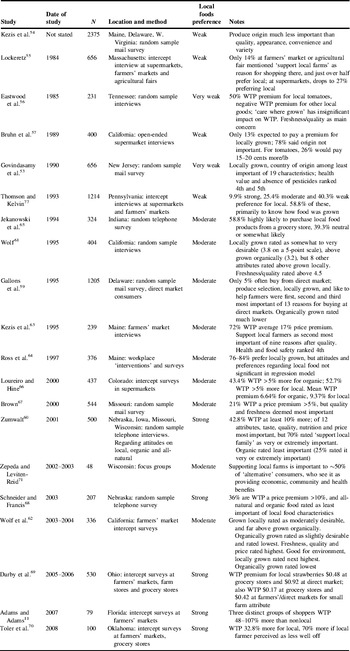
Schneider and FrancisReference Schneider and Francis68 review the literature on local foods from 1984 to 2003 and argue that preference for local foods is ‘rather inconclusive, indicating both weak and strong consumer preferences for local foods’ (p. 253). Rather than viewing consumer perceptions and WTP for local food as static during this time period, we contend that there was a sea change in both perceptions and WTP that is coincident with the shift from deep organic to ‘organic lite’. See Table 2 for a summary of select local food studies in the US.
Summary of select local food studies in the US.

We document a significant shift in consumers' perceptions of and WTP for local and organic food. In particular, changes in consumer views are coincident with the passage of the Organic Food Production Act of 1990 and the subsequent Organic Rule issued by the USDA. We note a distinct turn in the way consumers view both organic and local food, beginning with WolfReference Wolf61 and Gallons et al.Reference Gallons, Toensmeyer, Bacon and German59. Over the past decade, perceptions of local food have become much more positive, and consumers have indicated an increasingly high WTP for local food as compared to organic.
The shift in preferences and WTP from organic to local has been largely a result of consumers turning away from industrialization of organic agriculture, as previously discussed. The concept of ‘local’ is possibly more defensible than organic was, particularly given the genesis of the local movement in opposition to ‘organic lite’. The movement resulted from dissatisfaction with the health and environmental effects of a modern and industrial agricultural system that co-opted the organic food marketReference Giovannucci, Barham and Pirog73, and activists see it as a way to ‘reclaim the heart and soul of organics’ that became less about a social and political statement and more about a method of productionReference Ikerd74. If most consumers view ‘local’ as broadly defined to include sustainability, community food security, support for small farmers and a host of other issues, it may be seen as mutually exclusive from industrial agriculture.
The shift in preferences to local foods is also concomitant with a shift in individual consumption of fresh fruits and vegetablesReference Dimitri, Tegene and Kaufman75, which has been steadily increasing throughout the late 1980s and 1990s. Consumers are increasingly choosing where they shop based on the quality of produce, often leading them to key local food outlets such as farmers' markets and CSAsReference Guptill and Wilkins10. The push toward local food has also been driven in part by the restaurant industry and chefs, having discovered that high-quality, fresh and good priced produced can be obtained within the local food marketReference Giovannucci, Barham and Pirog73. For example, Cafe 150, the food cafe that caters to employees at Google headquarters, sources all its food within a 150 mile radiusReference Cloud76. The Chefs Collaborative website is a network of chefs that works with professionals in the culinary industry to foster a more sustainable food supply by improving the means to source food locally.
The shift in the way consumers view organic and local food has significant consequences for the food system. Local has supplanted organic as the fastest growing segment of the retail food market and has the capacity to change the structure of the food system in ways that organic agriculture did not. While ‘organic lite’ is associated with a change in production, processing and labeling practices, it did not lead to major changes in the long chain structure of the food system. If positive views of local food continue to strengthen, we may see even faster growth in the local food market, and in direct markets such as CSAs, producer–consumer cooperatives and farmers' markets. These changes may lead to improved community food security and fewer food deserts, more financial stability for small farmers, improvements in consumer health that are linked to eating more fresh and unprocessed foods, and other important environmental and societal impacts. It is too soon to tell whether these trends will be durable, but a successful local food system will require not just high demand, but accessibility. It is crucial that policy-makers pay meaningful attention to developing and supporting the local food system. For example, city and county planning offices have the capacity to greatly assist in building the infrastructure necessary for a thriving local food systemReference Nichol78. Rather than setting locales for farmers' markets in an ad hoc fashion, city redevelopment campaigns can allocate sites specific to the sale of local foods and design policies that encourage the growth of CSAs and farm cooperativesReference Nichol78.
Even if the trends in consumer preferences for local food continue, there may be changes to the nature of local food as there was with organics. Savvy companies are already using the local concept in their marketing. For example, Frito-Lay recently began a marketing campaign dubbed ‘Lay's Local’ that emphasized their use of potatoes grown near their factoriesReference Severson79, Reference Horovitz80. In 2008, Wal-Mart announced a commitment to source more local produce in an effort to keep food prices low, stating it expected to source about $4 million in locally grown fruits and vegetables from various farms across the USReference Gambrell81. Critics warn that the retail giant is likely to source its ‘local’ food from a very small number of large farms, effectively shutting out smaller operationsReference Gambrell81. The minimum requirements for a local grower to supply Wal-Mart include: (1) be equipped with UPC bar code technology; (2) have $2 million in commercial liability insurance; and (3) have a financial stability rating. These requirements are likely out of the reach of small local farmsReference Norton82.
Although there is a clear turn in the preferences for local food, there still exists a great deal of confusion about local and organic food characteristics. Bodini and NaspettiReference Bodini and Naspetti83 document that in some cases local and organic food are direct substitutes for one another and in other cases they are complementary. For example, they found that consumers tend to think of organic food as safer, but of less quality than local food. In particular, consumers who infrequently buy organic products are more likely to confuse local food products with organic food products, thinking them to be one and the same. Hughner et al.Reference Hughner, McDonagh, Prothero, Schultz and Stanton84 synthesized the empirical research on organic food demand and found that many consumers buy organic food because they believe it supports the local economy, a factor also emphasized by proponents of local food. This may suggest the opportunity to market some foods as being both local and organic.
The potential confusion between organic and local food stems in part from the relatively abstract concept of the meaning of ‘local’. Recent studies indicate that there is no widely accepted definition of ‘local’ by consumersReference Adams and Adams11, Reference Giovannucci, Barham and Pirog73. Local can mean anything from food miles to a social movement. Whole Foods, a natural foods retail operation, defines a product as local if the total transport time from farm to store is seven or fewer hours by truck85. Local is defined by Wal-Mart to be a particular state borderReference Norton82. Some argue for a system of geographical indications that would protect the local economy, assure consumers and allow them to properly identify credible products, and lower transaction costsReference Giovannucci, Barham and Pirog73. One of the benefits of such a system would be relieving consumers of the burden of getting to know farmersReference Guptill and Wilkins10. A concrete definition of ‘local’ could alleviate consumer confusion, but it has important marketing implications. A geographic definition of local foods (such as a county) or a temporal definition (such as from farm to fork in a day) increases the potential for product differentiation and marketingReference Darby, Batte, Ernst and Roe69, but may lead to ‘local lite’ if companies attempt to meet minimal standards.
Conclusion
We trace the change in consumer perceptions and WTP for local and organic food over the past few decades. When viewing them as dynamic rather than static (e.g., Schneider and FrancisReference Schneider and Francis68) our exploration uncovers a turn in the demand for local food that is significant to the broader context of the food system. Various drivers may have contributed to the shift toward local food, such as greater concern about industrialized organic agriculture and greater consumption of fresh produce. We indicate that the change is coincident with the development of federal organic standards and the arrival of ‘organic lite’. Our analysis contributes to the growing body of literature on factors driving local food purchases.
The increase in interest and WTP for local food is a boon to small farms, and could lead to structural changes in the food system that have major impacts on environmental and social externalities associated with industrial agriculture. However, it is too soon to tell whether these changes in consumer preferences will translate to a fundamental change in the broader food system. Several factors could seriously impact the success of local food: trends in consumer preferences may subside; large agribusinesses may find a way to co-opt local food into ‘local lite’ as was the case with organic food; access to local food may continue to be an issue; and consumer confusion about what constitutes ‘local’ may dampen interest.
Our analysis highlights several interesting interrelationships between local and organic food demand, but we acknowledge that varied and complex factors are driving the apparent change toward local foods, and several critical assumptions are inherent in the research examined in this paper. There are several fertile areas for future research on local food.
While much of the previous work has focused on local and organic food as satisfying essentially similar needs, questions arise as to the nature of consumers' views of organic and local. To what extent do food miles embody the broader notions of community, sustainability, etc.? How does experience with organic and/or local food impact demand for the other? Additional research is needed to identify and understand people who are concerned with ecological footprint (i.e., food miles) of moving food versus those who are primarily concerned with community economic development, ethics, anti-corporate sentiment and other strong motivators for local food purchases. Also, the thrust toward local food is often assumed as structural change in food demand, but many consumers may view local food as a novelty, and demand for it may not be sustained in the long run.
We are also lacking a thorough understanding of an integrated local food system that begins with the small- to medium-sized farms and ends with the retail outlet. What is the appropriate role, if any, for the processor or wholesaler in a local food system? How can collaboration between retail grocers and small farms be best structured to facilitate the local food economy? As noted in Guptill and WilkinsReference Guptill and Wilkins10, there are several institutional barriers to local producers supplying large retailers. What policies can local authorities use to improve access to local food? Little attention has been paid to the planning and building of the local food system infrastructure and facilitating the growth and expansion of the local food marketReference Thomson and Kelvin77. Also, while there is a variety of outlets for local food, there is a lack of knowledge as to what represents the most rewarding outlet for local food producers. For example, are farmers' markets better placed in an urban center for greater access to consumers or are they better placed at the rural–urban fringe for better access to producers? Finally, much debate in the popular literature has focused on whether or not a local food industry could support the demand for the current population. Research on how an alternative agricultural system based on local food can complement, or to some extent replace, the existing industrialized system is needed.
Acknowledgements
The authors would like to thank Alison Adams and Shida Henneberry (Oklahoma State University), Katherine Ralston (Economic Research Service, US Department of Agriculture), and two anonymous reviewers for their insight and helpful comments.