Recent data suggest that up to 11% of the US population uses antidepressants such as serotonin reuptake inhibitors (SRIs; Pratt, Brody, & Gu, Reference Pratt, Brody and Gu2011). This statistic includes pregnant women, 5–10% of whom report antidepressant use during pregnancy (Austin, Reference Austin2006; Cooper, Willy, Pont, & Ray, Reference Cooper, Willy, Pont and Ray2007; Huybrechts et al., Reference Huybrechts, Palmsten, Mogun, Kowal, Avorn, Setoguchi-Iwata and Hernández-Díaz2013), and this number may be increasing over time (Bérard, Boukhris, & Sheehy, Reference Bérard, Boukhris and Sheehy2016). SRIs are a mainstay treatment for depression and have historically been preferred by depressed pregnant women because of their relative safety profile, a view that emerged following initial reports of low risk for poor health or for congenital malformations (Harrington, Lee, Crum, Zimmerman, & Hertz-Picciotto, Reference Harrington, Lee, Crum, Zimmerman and Hertz-Picciotto2013; Lattimore et al., Reference Lattimore, Donn, Kaciroti, Kemper, Neal and Vazquez2005). More recent research calls this view into more question, however, with studies suggesting potential increased risk for cardiac malformations among children exposed (Bérard, Zhao & Sheehy, Reference Bérard, Zhao and Sheehy2017; Huybrechts, et al., Reference Huybrechts, Palmsten, Avorn, Cohen, Holmes, Franklin and Hernández-Díaz2014). In addition, a large cohort study exploring the association between prenatal SRIs and later child outcomes linked prenatal SRI exposure with slightly greater risk for autism spectrum disorders (ASDs; Croen, Grether, Yoshida, Odouli, & Hendrick, Reference Croen, Grether, Yoshida, Odouli and Hendrick2011), generating new concerns regarding increased risk for neurodevelopmental disorders. This initial report was followed by a plethora of studies and reviews on prenatal SRI exposures and ASD (Andrade, Reference Andrade2017; Freire, de Oliveira, & Pereira Pondé, Reference Freire, de Oliveira and Pereira Pondé2016; Gentile, Reference Gentile2015; Healy, Le Noury, & Mangin, Reference Healy, Le Noury and Mangin2016; Kobayashi, Matsuyama, Takeuchi, & Ito, Reference Kobayashi, Matsuyama, Takeuchi and Ito2016; Mezzacappa et al., Reference Mezzacappa, Lasica, Gianfagna, Cazas, Hardy, Falissard and Gressier2017; Rai et al., Reference Rai, Lee, Dalman, Newschaffer, Lewis and Magnusson2017). Similarly, recent studies have found significant associations between prenatal SRI exposure and atypical language development among toddlers and adolescents (Brown et al., Reference Brown, Gyllenberg, Malm, McKeague, Hinkka-Yli-Salomäki, Artama and Sourander2016; Handal, Skurtveit, Roth, Hernandez-Diaz, & Selmer, Reference Handal, Skurtveit, Roth, Hernandez-Diaz and Selmer2016; Skurtveit, Selmer, Roth, Hernandez-Diaz, & Handal, Reference Skurtveit, Selmer, Roth, Hernandez-Diaz and Handal2014).
Serotonin is a critical regulator of fetal neural development, influencing many processes such as neural cell division, neuronal migration, and synaptogenesis (Harrington et al., Reference Harrington, Lee, Crum, Zimmerman and Hertz-Picciotto2013, for a review; Whitaker-Azmitia, Reference Whitaker-Azmitia2001). SRIs can cross the placenta to influence the serotonin system (Rampono et al., Reference Rampono, Simmer, Ilett, Hackett, Doherty, Elliot and Forman2009) and may also be able to influence fetal neural circuitry. Although not fully understood, these and other potential mechanisms suggest that medication exposures that influence the serotonin system may also influence fetal neural development, and, in turn, postnatal behaviors.
Although meta-analytic and narrative reviews of the prenatal SRI exposure–ASD relationship tend to support a significant association (Boukhris & Bérard, Reference Boukhris and Bérard2015; Gentile, Reference Gentile2015; Man et al., Reference Man, Tong, Wong, Chan, Simonoff and Wong2015), a number of published studies fail to replicate this effect, especially when including important covariates (Castro et al., Reference Castro, Kong, Clements, Brady, Kaimal, Doyle and Perlis2016; Clements et al., Reference Clements, Castro, Blumenthal, Rosenfield, Murphy, Fava and Perlis2015; Harrington, Lee, Crum, Zimmerman, & Hertz-Picciotto, Reference Harrington, Lee, Crum, Zimmerman and Hertz-Picciotto2014; Hviid, Melbye, & Pasternak, Reference Hviid, Melbye and Pasternak2013; Malm et al., Reference Malm, Brown, Gissler, Gyllenberg, Hinkka-Yli-Salomäki, McKeague and Sourander2016; Rai et al., Reference Rai, Lee, Dalman, Golding, Lewis and Magnusson2013; Sørensen et al., Reference Sørensen, Grønborg, Christensen, Parner, Vestergaard, Schendel and Pedersen2013; Sujan et al., Reference Sujan, Rickert, Öberg, Quinn, Hernández-Díaz, Almqvist and D'Onofrio2017). In addition, although the literature now contains a number of studies with substantial sample sizes, primarily because of the availability of medical record and registry databases, methodological weaknesses remain. For example, levels of prenatal SRI exposure have typically been determined on the basis of medical and pharmacy record searches (Bérard et al., Reference Bérard, Boukhris and Sheehy2016; Boukhris, Sheehy, & Mottron, Reference Boukhris, Sheehy and Mottron2015; Brown et al., Reference Brown, Ray, Wilton, Lunsky, Gomes and Vigod2017; Castro et al., Reference Castro, Kong, Clements, Brady, Kaimal, Doyle and Perlis2016; Gidaya et al., Reference Gidaya, Lee, Burstyn, Yudell, Mortensen and Newschaffer2014; Liu et al., Reference Liu, Agerbo, Ingstrup, Musliner, Meltzer-Brody, Bergink and Munk-Olsen2017; Malm et al., Reference Malm, Brown, Gissler, Gyllenberg, Hinkka-Yli-Salomäki, McKeague and Sourander2016; Rai et al., Reference Rai, Lee, Dalman, Golding, Lewis and Magnusson2013; Sørensen et al., Reference Sørensen, Grønborg, Christensen, Parner, Vestergaard, Schendel and Pedersen2013; Viktorin, Uher, Reichenberg, Levine, & Sandin, Reference Viktorin, Uher, Reichenberg, Levine and Sandin2017) without independent verification of maternal medication use. Such proxies for fetal SRI exposure may not always be an accurate indicator of use, with one report suggesting that only 73% of women who filled a prescription for SRIs in pregnancy reported actually taking them (Skurtveit et al., Reference Skurtveit, Selmer, Roth, Hernandez-Diaz and Handal2014).
Similarly, many studies of fetal SRI exposure have relied solely on health or school registry data to determine ASD and language delay outcome status (Brown et al., Reference Brown, Gyllenberg, Malm, McKeague, Hinkka-Yli-Salomäki, Artama and Sourander2016; Croen et al., Reference Croen, Grether, Yoshida, Odouli and Hendrick2011; Hviid et al., Reference Hviid, Melbye and Pasternak2013; Malm et al., Reference Malm, Brown, Gissler, Gyllenberg, Hinkka-Yli-Salomäki, McKeague and Sourander2016; Rai et al., Reference Rai, Lee, Dalman, Golding, Lewis and Magnusson2013; Sørensen et al., Reference Sørensen, Grønborg, Christensen, Parner, Vestergaard, Schendel and Pedersen2013; Viktorin et al., Reference Viktorin, Uher, Reichenberg, Levine and Sandin2017). A large Swedish study tracking the prevalence of autism symptom phenotypes and registered ASD diagnoses over 10 yr found a significant linear increase in registered ASD diagnoses over time, despite a relatively stable prevalence of ASD symptoms as measured by validated parental interviews (Lundström, Reichenberg, Anckarsäter, Lichtenstein, & Gillberg, Reference Lundström, Reichenberg, Anckarsäter, Lichtenstein and Gillberg2015). These findings suggest that registry diagnoses of ASD, which are commonly used in studies on this topic, may not always accurately reflect child symptomatology or Diagnostic and Statistical Manual of Mental Disorders, 5th edition (DSM-5) criteria. Only a few prenatal SRI exposure studies in the extant literature have directly assessed children for ASD outcomes using parental reports or clinical observation (Harrington et al., Reference Harrington, Lee, Crum, Zimmerman and Hertz-Picciotto2014; Johnson, Smith, Stowe, Newport, & Brennan, Reference Johnson, Smith, Stowe, Newport and Brennan2016). The current study uses both of these assessment methods.
A major concern in the SRI exposure literature is how to best control for the potentially confounding influence of maternal depression severity during pregnancy. Although some studies on maternal depression and child ASD outcomes have had mixed findings depending on which maternal assessments and comparison groups were used, psychiatric difficulties seem to be more common among parents of children with ASD (for review, see Yirmiya & Shaked, Reference Yirmiya and Shaked2005). More broadly, a number of studies have found associations between maternal depression and a range of poor child outcomes (Brand & Brennan, Reference Brand and Brennan2009; Davalos, Yadon, & Tregellas, Reference Davalos, Yadon and Tregellas2012; Nulman et al., Reference Nulman, Koren, Rovet, Barrera, Streiner and Feldman2015). Despite this, not all SRI exposure studies have incorporated measures of maternal prenatal depression (e.g., Rai et al., Reference Rai, Lee, Dalman, Golding, Lewis and Magnusson2013), whereas others have inferred prenatal depression status based on diagnoses from medical records (e.g., historical diagnoses of major depressive disorder), which may not reflect the actual symptomatology that a mother experienced during pregnancy (Brown et al., Reference Brown, Ray, Wilton, Lunsky, Gomes and Vigod2017; Castro et al., Reference Castro, Kong, Clements, Brady, Kaimal, Doyle and Perlis2016; Viktorin et al., Reference Viktorin, Uher, Reichenberg, Levine and Sandin2017). Others have also used maternal retrospective reports of prenatal depression (Harrington et al., Reference Harrington, Lee, Crum, Zimmerman and Hertz-Picciotto2014), which may underestimate true exposure (Newport et al., Reference Newport, Brennan, Green, Ilardi, Whitfield, Morris and Stowe2008). Review of this literature suggests a need for studies that prospectively measure maternal depression severity as well as medication use in pregnancy and directly assess child social behaviors later in childhood to better understand the stability of behavioral effects. This is the primary goal of the current study.
Our research group previously found significant associations between prospectively measured prenatal SRI use and parent-reported pervasive developmental disorder (PDD) symptoms (which are closely tied to ASD symptomology) during preschool (Johnson et al., Reference Johnson, Smith, Stowe, Newport and Brennan2016). We also found that prenatal SRI exposure was associated with children's expressive language delays. Notably, few other studies on prenatal SRI use and child outcomes have focused on both social and language deficits. Most studies only assess one of these outcomes (although at least one study has assessed both outcomes during infancy; Pedersen, Henriksen & Olsen, Reference Pedersen, Henriksen and Olsen2010). Interestingly, a recent preclinical study found that prenatal SRI administration resulted in reduced rodent pup ultrasonic vocalizations, which are thought to reflect affective and communicative behaviors intended to elicit a maternal response (Maloney et al., Reference Maloney, Rahn, Akula, Rieger, McCullough, Jakes and Dougherty2017). The influence of prenatal SRI exposure on social behavior outcomes in this study was mixed, however, with no significant effects noted for juvenile play behavior, though rodents prenatally exposed to SRIs showed a significant decrease in preference for social stimuli in adulthood.
The current ASD literature has also largely focused on the DSM-IV conceptualization of ASD. However, in the DSM-5, ASD is separated from Social (Pragmatic) Communication Disorder, providing a classification for children who present with social communication deficits without other aspects of ASD (e.g., without restricted interests or repetitive behaviors). This revised diagnostic classification suggests that studies should examine the association between prenatal SRI exposures and both social communication problems and ASD symptoms. A secondary goal in the current study was to use clinician-administered assessments specifically designed to measure child ASD symptoms and child social communication (pragmatic language) abilities among a subgroup of our sample.
Overall, the current study aims to address limitations in the current literature by drawing on a prospective, longitudinal sample of mother–child dyads who have been followed throughout pregnancy into early childhood. This study reports on two follow-ups of this established cohort: (a) an online questionnaire follow-up evaluating maternal and alternative caregiver report of child social behavior outcomes (N = 137) and (b) an in-depth laboratory follow-up using maternal report and clinician-administered assessments of ASD behaviors as well as pragmatic language outcomes (N = 44). We specifically assessed whether these outcomes associate with prospectively measured prenatal SRI exposure, while controlling for prenatal depression.
Method
Participants
The present study followed mother–child dyads from an existing longitudinal cohort of women recruited from the Emory Women's Mental Health Program, an outpatient treatment facility for women suffering from mental health conditions during the prenatal period. A total of 229 women with prospectively collected prenatal medication use and self-reported depression data were invited to participate in an initial follow-up study when their children were −5 yr of age; 178 (77%) agreed to participate, thereby establishing the longitudinal cohort (Johnson et al., Reference Johnson, Smith, Stowe, Newport and Brennan2016).
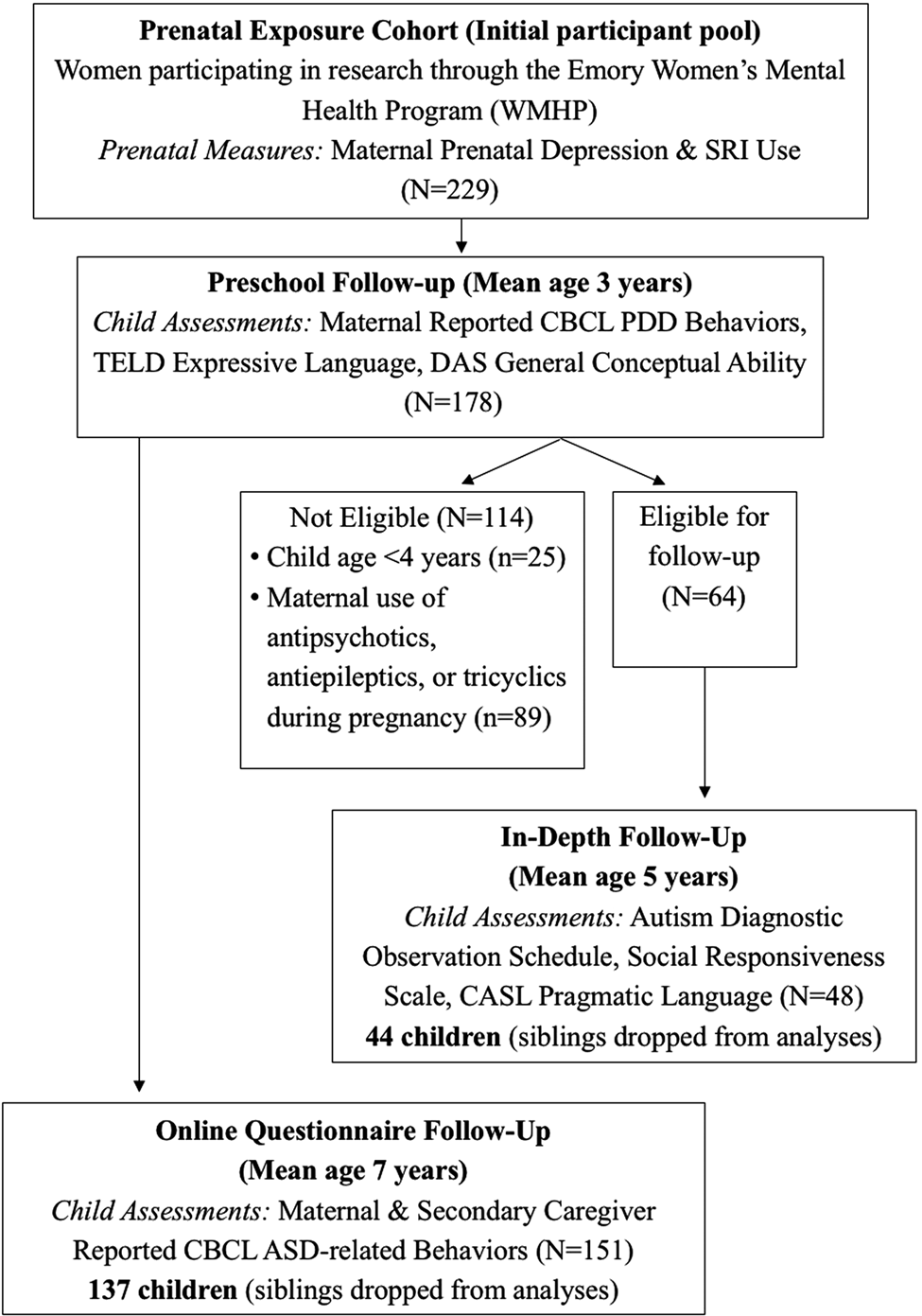
The present study reports on findings from two distinct follow-ups of this cohort (Figure 1). One follow-up was an online questionnaire study initiated when the children were in elementary school (age ≥6 yr). Mother–child dyads were eligible if they had participated in both the prenatal and preschool phases of the overarching study. A total of 151 children participated (85%). To maintain statistical assumptions of independence, children were excluded from the final database if their mother completed questionnaires on an older sibling in the cohort (n = 14), resulting in a total of 137 children whose mother consented to the follow-up and who had online questionnaires completed by a mother and/or alternate caregiver. The majority of this sample had information from both reporters: 136 children (99%) had questionnaires filled out by the mother and 100 children (73%) had questionnaires filled out by an alternative caregiver.
Initial and follow-up visits of mother–child dyads in the current longitudinal cohort. CASL, Comprehensive Assessment of Spoken Language. CBCL PDD, Child Behavior Checklist Pervasive Developmental Disorder. CBCL ASD, Child Behavior Checklist Autism Spectrum Disorder. DAS, Differential Ability Scales. SRI, serotonin reuptake inhibitor. TELD, Test of Early Language Development.

The second follow-up was an in-depth laboratory study focused on a subsample from the longitudinal cohort. This in-depth study included two comparison groups with similar levels of maternal prenatal depression severity: a group whose mothers used SRIs during pregnancy and a group whose mothers remained medication-free throughout pregnancy. To be included in this in-depth laboratory follow-up, mothers needed prospective data available from the prenatal phase of our longitudinal study that indicated either maternal SRI use or no use of any psychotropic medications during pregnancy, and subsequent participation in the preschool phase. Additional exclusion criteria included (a) child age <4 years, given that they may not yet evidence verbal fluency (n = 25), and (b) maternal use of antipsychotics, antiepileptics, or tricyclic antidepressants during pregnancy (n = 89). A total of 64 children were eligible; 48 (75%) participated (age range 4–7 years). To maintain assumptions regarding statistical independence of observations, participants with prior participation of an older sibling were excluded from the final database (n = 4), resulting in a final total of 44 mother–child dyads.
Procedure
In the online questionnaire follow-up, data were collected via a secure database called REDCap. Permission to recontact, along with contact information, was obtained during the preschool phase of the study. Mothers received a direct hyperlink to the online measures and were instructed to click on the link, read consent information thoroughly, and complete the online questionnaires if they agreed to study details. Participants were not required to complete every questionnaire in one sitting and were recontacted if measures were left incomplete for longer than 2 weeks. Behavioral questionnaires were also completed by an alternate caregiver (nominated by the child's mother) using the same REDCap procedures. During the in-depth laboratory follow-up study, mothers and their children were assessed during a 2-hour laboratory visit. Children were evaluated for ASD symptoms and pragmatic language abilities, and mothers completed standardized questionnaires about their child's behavior and ASD-related symptomology. Test administrators and coders were blind to prenatal exposure status. Mothers and alternate caregivers were financially compensated and children received a toy for participation. The Emory University Institutional Review Board approved these studies.
Measures
Prenatal measures
Maternal prenatal depression symptoms and SRI use
During pregnancy, mothers were evaluated prospectively at 4- to 6-week intervals. Depressive symptoms were assessed using the Beck Depression Inventory (Beck, Steer, & Brown, Reference Beck, Steer and Brown1996), a 21-item measure that addresses the presence/absence and severity of physical symptoms, behaviors, thoughts, and feelings that are associated with depression and were experienced in the past 2 weeks. Beck Depression Inventory scores were used to calculate an area under the curve measure of symptom levels across pregnancy, which was normalized to 40 weeks to account for differences in timing of delivery. Using the same methodology as in Johnson et al. (Reference Johnson, Smith, Stowe, Newport and Brennan2016), information on prenatal SRI exposure (as well as any other psychotropic and/or substance-related exposures) was gathered on weekly tracking sheets verified by study physicians. The tracking sheets asked about medication use over the week, with room to specify use of one (or more) types of SRIs taken that week. Of the women who took SRIs, 75% did so throughout the entirety of their pregnancy. Overall SRI exposure was next calculated by multiplying each SRI used by the number of weeks taken, standardized to a 40-week pregnancy. The standardized drug weeks for each SRI were then added to obtain a final overall calculation of prenatal SRI exposure. The mean number of drug weeks of SRI exposure was 34.7 (SD = 10.8) among the SRI group in the online follow-up study and 35.4 (SD = 9.2) among the SRI group in the in-depth laboratory study.
Preschool-age measures
Child cognitive ability
During the original preschool follow-up, children were administered the Differential Ability Scales, Second Edition (Elliott, Reference Elliott2007). An overall reasoning and conceptual ability composite score, the general conceptual ability, was calculated as a proxy for IQ. Higher scores represent higher ability.
Maternal and alternate caregiver reported PDD behaviors
Mothers and alternate caregivers completed the Preschool-Age Child Behavior Checklist (CBCL; Achenbach & Rescorla, Reference Achenbach and Rescorla2000). The PDD subscale of the CBCL assesses the occurrence of 13 child behaviors over the past 2 months that are considered to be risk factors for ASD, such as avoiding eye contact and not getting along with others. Higher scores indicate more PDD-related behaviors.
Child expressive language
Children were administered the Expressive Language subtest from the Test of Early Language Development, 3rd edition, a standardized measure of expressive language with high test-retest reliability and criterion validity (Hresko, Reid, & Hammill, Reference Hresko, Reid and Hammill1999). The measure evaluates a child's ability to answer open-ended questions and provide age-appropriate responses. Higher scores reflect greater expressive language abilities.
Online questionnaire follow-up measures
Maternal and alternate caregiver reported child ASD-related behaviors
ASD behaviors were measured using the School-Age CBCL, which was completed by the child's mother and an alternate caregiver (Achenbach, Reference Achenbach2001). In our sample, alternate caregivers included fathers (74%), grandparents (15%), teachers and day-care providers (7%), as well as other relatives (4%). T-scores on the Withdrawn, Social Problems and Thought Problems subscales were summed to create a CBCL ASD-related behavior score for each child. This score has been shown to discriminate between children with and without ASD, particularly among high functioning youth (Biederman et al., Reference Biederman, Petty, Fried, Wozniak, Micco, Henin and Faraone2010). Mother and alternate caregiver scores on child ASD-related behaviors were moderately correlated in this sample (r = 0.43).
In-depth laboratory follow-up measures
Clinician assessed ASD-related behaviors
Children were administered the Autism Diagnostic Observation Schedule (ADOS), a semistructured assessment of communication, social interaction, and play with demonstrated interrater and test-retest reliability as well as criterion validity (Lord et al., Reference Lord, Risi, Lambrecht, Cook, Leventhal, DiLavore and Rutter2000). Children in the sample met basic verbal fluency (i.e., produced a range of sentence types, were able to provide information about events), and were administered module 3 of the ADOS. The ADOS was administered by one of three trained clinical psychology graduate students and was simultaneously observed and co-coded by another trained student. Following administration, both coders scored independently and then met to determine a consensus rating. Each task loaded onto one of three domains: Communication (e.g., conversation, reporting of events), Reciprocal Social Interaction (e.g., quality of social response, overall quality of rapport), and Restricted and Repetitive Behaviors (e.g., compulsions or rituals). The goal of the current study was to assess the full range of ASD-related symptoms; therefore, the total ADOS score was calculated by summing the three domain scores. Higher scores represent more ASD symptomatology.
Quantitative measure of autistic traits
Mothers completed the Social Responsiveness Scale (SRS; Constantino & Gruber, Reference Constantino and Gruber2007) about their child. The SRS is a 65-item scale that evaluates the severity of ASD symptoms occurring in day-to-day scenarios. Previous studies note high interrater and test-retest reliability, discriminant validity, and a single factor structure (Bölte, Poustka, & Constantino, Reference Bölte, Poustka and Constantino2008). The overall standard score was used. Higher scores reflect more ASD symptoms.
Child pragmatic language
Child pragmatic language was assessed using the Pragmatic Judgment test from the Comprehensive Assessment of Spoken Language (CASL; Carrow-Woolfolk, Reference Carrow-Woolfolk1999). This test has been shown to have high test-retest reliability and appropriate criterion-related and construct validity (Reichow, Salamack, Paul, Volkmar, & Klin, Reference Reichow, Salamack, Paul, Volkmar and Klin2008). The test comprises 60 open-ended questions in which an examiner asks the child to describe what he or she would do in social scenarios (e.g., “What can a child say to her mother after spilling milk at the table?”). The examiner scores each response on a scale of 0 to 2 based on norm-referenced criteria. The Pragmatic Judgment test standard score was used, with higher scores reflecting more advanced language ability.
Statistical analyses and identification of covariates
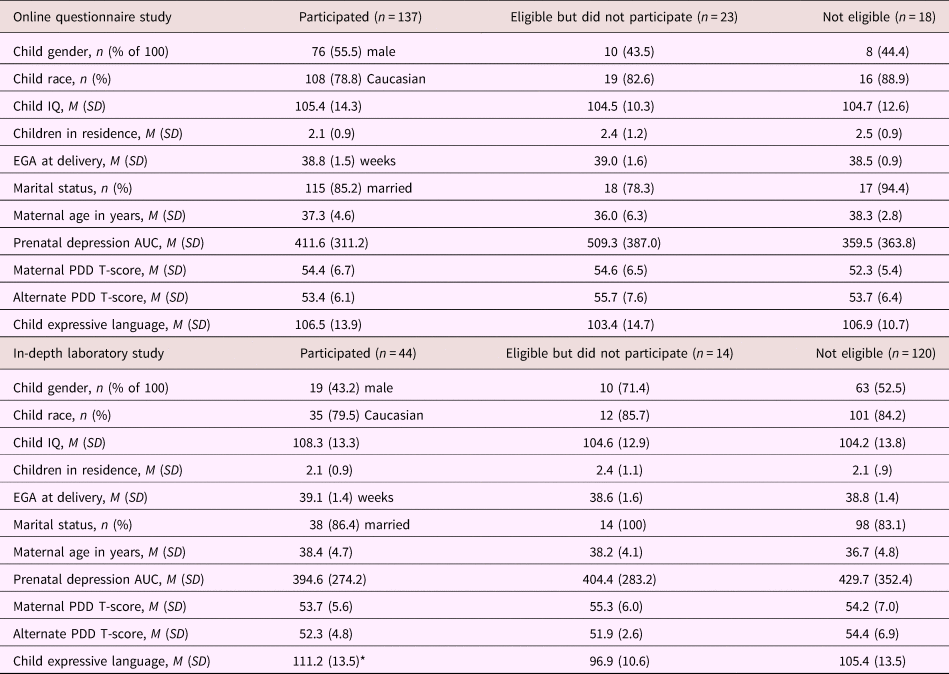
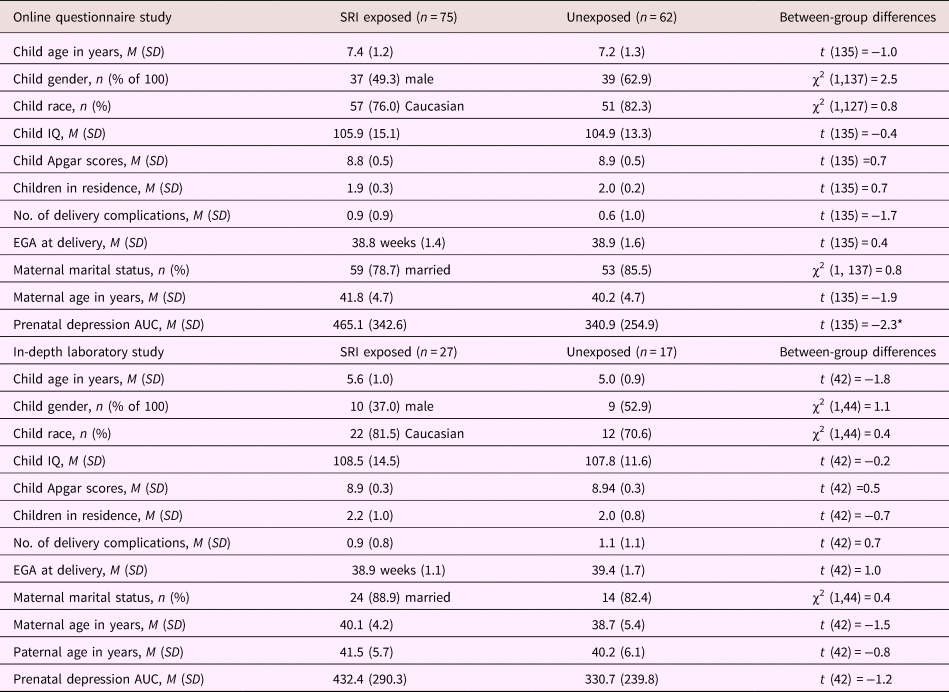
Characteristics of dyads who did and did not participate in the current follow-up studies are presented in Table 1. There were no statistically significant differences in depression between those who did and did not participate in the follow-up studies (Table 1). In the online questionnaire sample, reported prenatal depression symptoms were higher for mothers who took SRIs in comparison to those who did not take any psychotropic medications, although both groups reported a range of maternal depression levels (Table 2). In the in-depth study, however, depression was not significantly different among those who did or did not take SRIs (Table 2). Of note, there were no differences between the original pregnancy cohort and those who participated in the preschool follow-up (t = −0.99, p = .32). Because a major concern in the literature is controlling the confounding effects of maternal prenatal depression, we included this variable as a covariate in all analyses. In addition, child IQ was included as a covariate in all analyses to assess the effect of prenatal SRI use over and above any effect of global intellectual functioning. Additional variables that were evaluated as potential covariates included maternal, paternal, and child age at the time of follow-up, child sex and race, mother's highest level of education and marital status, number of children living in the home, child daycare attendance, and birth record data on gestational age, birthweight, delivery complications, and Apgar scores. Prenatal exposures to alcohol, tobacco, hypnotics, and anxiolytics (and in the questionnaire follow-up, antipsychotics and antiepileptics) were also tested as potential covariates, as were postnatal exposures to maternal psychiatric illness, psychotropic medication, and breastfeeding. The relationship between potential covariates and the outcomes of interest (ASD-related behaviors and pragmatic language) were examined via t tests or Pearson correlations. Any variables that were associated with study outcomes were included as covariates in the relevant analyses. Child age was positively associated with maternal report of CBCL ASD-related behaviors in the online questionnaire follow-up (r (136) = 0.21, p = .02). Child race and Apgar scores were associated with ADOS scores, such that Caucasian children, on average, had higher ADOS scores than children of other races (t (42) = 2.28, p = .03); lower Apgar scores were associated with higher ADOS scores (r (43) = −0.34, p = .03). All analyses with CBCL mother-reported ASD-related behavior scores as the dependent variable therefore included child age as a covariate, whereas all analyses with ADOS score as the dependent variable included child race and Apgar scores as covariates. These potential covariates were not significantly associated with CBCL alternate caregiver-reported ASD-related behaviors, CASL pragmatic language scores, or SRS scores.
Differences between dyads who did or did not participate in the current follow-up studies

Note: Maternal age represents the age at the indicated follow-up. Maternal PDD, alternate caregiver PDD, and child expressive language were assessed at the preschool-aged follow-up. EGA = estimated gestational age; prenatal depression AUC = depression scores across pregnancy calculated as the area under the curve from the Beck Depression Inventory assessed multiple times throughout pregnancy; M = mean; PDD = maternal or caregiver-reported child pervasive developmental disorder as measured by the Child Behavior Checklist; SD = standard deviation. *p < .05 difference between referent and comparison groups.
Differences between dyads who were and were not prenatally exposed to SRIs in the current follow-up studies

Note: Child, maternal, and paternal age represents the age at the indicated follow-up. EGA = estimated gestational age; prenatal depression AUC = depression scores across pregnancy calculated as the area under the curve from the Beck Depression Inventory assessed multiple times throughout pregnancy; M = mean; PDD = maternal or caregiver-reported child pervasive developmental disorder as measured by the Child Behavior Checklist; SD = standard deviation; SRI = serotonin reuptake inhibitor. *p < .05 difference between referent and comparison groups.
In the online questionnaire sample, linear regression analyses were used to assess whether prenatal SRI exposure predicted child CBCL ASD-related behaviors per maternal and caregiver report while controlling for covariates. The maternal and alternative caregiver ASD-related behavior scores were log transformed before analyses to reduce skewness and kurtosis. In the smaller in-depth follow-up, linear regressions were used to explore whether SRI exposure predicted to the ADOS and SRS assessments of ASD symptomology as well as to pragmatic language, while controlling for covariates. Further, linear regressions were used to evaluate whether prenatal SRI exposure predicted to ADOS and SRS while controlling for pragmatic language to examine whether any relationship between prenatal SRI use and ASD symptomology held after discounting variance explained by child pragmatic language. In all analyses, missing data were handled through listwise deletion. With the exception of alternative caregiver report of CBCL ASD-related behaviors (27% missing), missing data were minimal for all other variables.
Results
Preliminary analyses
For the online questionnaire follow-up, no differences emerged between mothers and children who (a) were not eligible for the follow-up, (b) were eligible but did not participate, and (c) were eligible and did participate. For the in-depth laboratory follow-up, children who were eligible and participated had higher expressive language scores than children in the other groups; no other group differences were statistically significant (Table 1).
Among children who were or were not exposed to SRIs, there were no differences on any of the participant demographics examined (Table 2). As noted previously, SRI exposure was significantly associated with higher prenatal maternal depression scores in the questionnaire follow-up, but not in the in-depth laboratory study (Table 2). In both follow-ups, Zoloft (sertraline) and Prozac (fluoxetine) were the most common SRIs used during pregnancy.
Prenatal SRI exposure and child ASD-related social behaviors
Results of linear regression analyses assessing the separate associations between SRI use in pregnancy and ASD-related outcomes are presented in Table 3. In the online questionnaire follow-up, prenatal SRI exposure was associated with child CBCL ASD-related behaviors per maternal report, but not per alternate caregiver report. Prior work suggests that sex may moderate associations between prenatal exposures and child outcomes (Swales et al., Reference Swales, Winiarski, Smith, Stowe, Newport and Brennan2018), and that SRI–ASD associations may be stronger among males (Harrington et al., Reference Harrington, Lee, Crum, Zimmerman and Hertz-Picciotto2014); therefore, post hoc analyses exploring sex as a moderator of associations were conducted. These analyses revealed that SRI exposure predicted alternate caregiver report of ASD-related behaviors among male children, but not among females (overall SRI-sex multiplicative interaction term: R 2 change = 0.07 β = 0.26, 95% confidence interval (95% CI) [0.09, 0.44], p = .01; SRI exposure effect for males only: R 2 change = 0.09, β = 0.28, 95% CI [0.02, 0.55], p = .04; and SRI exposure effect for females only: R 2 change = 0.03, β = −0.21, 95% CI [-0.63, 0.08], p = .15). SRI exposure did not interact with child sex to predict maternal report of ASD-related behaviors (overall SRI–sex multiplicative interaction term: R 2 change = 0.001, β = 0.04, 95% CI [-0.10, 0.21], p = .66).
Prenatal SRI exposure and child ASD and language outcomes in the current follow-up studies

Note: All analyses controlled for maternal prenatal depression and child IQ. Mother-reported ASD-related behavior analyses also controlled for child age; ADOS analyses controlled for child race and Apgar scores. Missing data were minimal except for the alternative caregiver-reported ASD-related behaviors (27% missing), and were handled by listwise deletion. In analyses, CASL was a standardized score, ADOS was the sum total of symptoms, SRS was the sum total of symptoms, and ASD-related behaviors were the sum total of T-scores of three subscales from the CBCL. Both the maternal and alternative caregiver-reported ASD-related behavior scores were log-transformed before analyses to reduce skewness and kurtosis. Child ASD-related behaviors were measured by the CBCL. ADOS = Autism Diagnostic Observation Schedule; ASD = autism spectrum disorder; CASL = Comprehensive Assessment of Spoken Language; CBCL = Child Behavior Checklist; SRI = serotonin reuptake inhibitor; SRS = social responsiveness scale.
In the smaller in-depth laboratory study, prenatal SRI exposure did not predict clinician-evaluated child ASD symptoms on the ADOS or maternal-reported symptoms on the SRS (Table 3). Given the smaller sample in the in-depth laboratory study, child sex was not examined as a moderator of outcomes on the ADOS or SRS.
Prenatal SRI exposure and child pragmatic language
Prenatal SRI exposure was negatively associated with child pragmatic language during the in-depth follow-up (Table 3). Moreover, prenatal exposure to SRIs accounted for 7.1% of the variance associated with language scores, even after controlling for child cognitive ability and maternal prenatal depression.
Disentangling child pragmatic communication and ASD-related behaviors
Pragmatic language and total ADOS scores were significantly correlated in this sample (r = −0.55). Because problems with language may negatively affect social interactions, lower pragmatic language scores may contribute to elevated ADOS scores. Although the initial SRI exposure and ADOS model was not statistically significant in our sample, we retested the model controlling for pragmatic language to assess for any change in variance. In this model, the amount of variance that SRI exposure accounted for in child ADOS scores dropped from 1.8% to 0.001%. Similarly, the amount of variance in SRS scores explained by SRI exposure dropped from 0.5% to 0.1% when pragmatic language was included as a covariate in the model. In this sample, prenatal SRI exposure explains little to no variance in ADOS and SRS scores once pragmatic language deficits are controlled.
Discussion
Recent studies suggest an association between prenatal SRI exposure and increased risk for ASD (Gentile, Reference Gentile2015; Man et al., Reference Man, Tong, Wong, Chan, Simonoff and Wong2015), although findings remain mixed. Previously, our group noted an association between prenatal SRI exposure and higher scores on caregiver-reported child ASD-related behaviors during preschool age (Johnson et al., Reference Johnson, Smith, Stowe, Newport and Brennan2016). These results, combined with those in our current school-age questionnaire follow-up, suggest that associations between prenatal SRI exposure and caregiver ratings of children's ASD-related behaviors are relatively persistent across early childhood and across raters, particularly for boys.
In our in-depth study, however, there was not a significant association between prenatal SRI exposure and ASD symptoms according to gold-standard clinician assessments or parent report as measured by the ADOS and SRS, respectively. Sample size in this study was small and inherently limited because the sample was drawn from those eligible in an established longitudinal cohort of mother–child dyads. It is possible that a larger sample may have detected an association, especially because the effect sizes in large population-based studies to date have been relatively small (for reviews, see Gentile, Reference Gentile2015; Man et al., Reference Man, Tong, Wong, Chan, Simonoff and Wong2015). The association between prenatal SRI exposure and maternal report of CBCL ASD-related behaviors from the online questionnaire follow-up remained significant, however, when tested among the smaller in-depth study subsample (R 2 change = 0.13, β = 0.42, 95% CI [0.04, 0.60], p < .01), suggesting that power may not be the only factor at play in the null findings from the in-depth assessment. Scores from three subscales on the CBCL (social problems, thought problems, and withdrawn/depressed) were combined to create the measure of maternal-reported ASD-related behaviors for the online questionnaire study. These subscales capture behaviors that are often associated with ASD, but are not necessarily unique to the disorder (for instance, sleep problems can be present in children with ASD, anxiety, depression, or attention deficit/hyperactivity disorder). Other items from these subscales include the presence of obsessions, compulsions, general difficulty getting along with peers (e.g., being bullied), and self-injurious behaviors. Again, such symptoms can be present among children with ASD, but are not part of the diagnostic criteria or exclusively present in ASD. This is of importance because there is also a growing literature on prenatal SRIs and other behavioral outcomes, such as internalizing behaviors (Hanley, Brain, & Oberlander, Reference Hanley, Brain and Oberlander2015) and anxious/depressive behaviors (Lupattelli et al., Reference Lupattelli, Wood, Ystrom, Skurtveit, Handal and Nordeng2018). In our in-depth study, the SRS, a measure of parent-reported ASD symptoms, more closely mirrors diagnostic criteria for ASD, including symptoms such as restricted interests, poor eye contact, and sensory sensitivity. These symptoms are not included on the school-age version of the CBCL; therefore, an alternative explanation could be that ASD-related behavior scores for children in the questionnaire follow-up (based on the CBCL measure) better reflect atypical social behaviors and not ASD per se.
If this alternative explanation is correct, it highlights the need for gold-standard assessments of both ASD and language, as well as other socially related behaviors, to avoid misdiagnosis. Research conducted at the Marcus Autism Center has found that 35% of children previously diagnosed with ASD by a community care provider did not meet criteria for this diagnosis when they were reassessed by clinicians using gold-standard measures including the ADOS and a developmental/IQ assessment. When reassessed, these children received a different diagnosis such as a behavior disorder or language delay (Hall & Hamel, Reference Hall and Hamel2012). Further, other studies have suggested that autism symptoms may not explicitly track with registered ASD diagnoses. Specifically, the number of registered ASD diagnoses appears to be increasing over time, even though the prevalence of ASD symptoms as measured by validated parental interviews was found to be stable (Lundström et al., Reference Lundström, Reichenberg, Anckarsäter, Lichtenstein and Gillberg2015). These findings, in addition to the findings from the present study, hold important implications for research, and particularly for research that relies solely upon registry-based diagnoses. An integral step in this field will be the use of direct, clinical assessments to provide more thorough, standardized evaluations and diagnoses.
Our laboratory previously found an association between SRI exposure and reduced expressive language at preschool age (Johnson et al., Reference Johnson, Smith, Stowe, Newport and Brennan2016). The current follow-up of this cohort at early school age also suggests an association between SRI exposure and language problems, with lower overall pragmatic language scores among those with SRI exposure. No prior studies have examined pragmatic language as a specific outcome following prenatal SRI exposure. Given a growing literature on prenatal SRIs and language concerns (Brown et al., Reference Brown, Gyllenberg, Malm, McKeague, Hinkka-Yli-Salomäki, Artama and Sourander2016; Johnson et al., Reference Johnson, Smith, Stowe, Newport and Brennan2016; Skurtveit et al., Reference Skurtveit, Selmer, Roth, Hernandez-Diaz and Handal2014), the overlap between pragmatic language deficits and ASD, and the current study's findings of an association between prenatal SRI use and pragmatic language ability, it would be interesting to explore whether prior ASD findings in the literature have been partly the result of specific effects of SRI exposure on child pragmatic language. Although preliminary, the current findings could further support the utility of separate classifications of ASD and Social (Pragmatic) Communication Disorder in the DSM-5, if they replicate in independent samples. Studies that conduct assessments of ASD and language in larger cohorts are necessary to further tease apart the potential risks of prenatal SRI exposure on these related domains of functioning.
Although SRIs explained a moderate amount of variance in pragmatic language scores, language scores among those with SRI exposure generally fell within the low-normal range in our sample; those in the current sample had a verbal fluency level that allowed them to complete module 3 of the ADOS. It is possible that this study's cohort, which was of fairly high socioeconomic status and primarily from intact families, may have relatively high language exposure or social support, both of which may offer protective benefit against prenatal SRI exposure. Children with SRI exposure who are raised in more stressful or less supportive contexts may be at greater risk for below average pragmatic language ability. Further work is needed to explore this possibility.
Few studies to date have explored sex differences in SRI-ASD outcomes, although the potential for such differences has been suggested. Specifically, Harrington et al. (Reference Harrington, Lee, Crum, Zimmerman and Hertz-Picciotto2014) found that prenatal SRI exposure was more strongly tied to ASD among male children, rather than all children combined, and our study also suggests the potential for more robust findings among males. Sex differences have been reported for other studies on prenatal SRI exposure and child outcomes (Pedersen et al., Reference Pedersen, Henriksen and Olsen2010), and serotonin itself is influenced by sex hormones (Bethea, Pecins-Thompson, Schutzer, Gundlah & Lu, Reference Bethea, Pecins-Thompson, Schutzer, Gundlah and Lu1998; Bethea, Lu, Gundlah & Streicher, Reference Bethea, Lu, Gundlah and Streicher2002). Further, Harrington et al. (Reference Harrington, Lee, Crum, Zimmerman and Hertz-Picciotto2014) is one of the few prior studies to also use parent and child assessments to confirm child ASD diagnoses, compared with registry databases. It may be useful for future studies to further explore whether sex may moderate associations between prenatal SRI exposure and child outcomes.
Nearly 75% of the women who took SRIs in our sample did so consistently throughout their pregnancy, limiting our ability to examine whether exposure timing is differentially related to offspring outcomes. Future research on timing may further inform clinical decision-making or point to potential risk mechanisms. For example, some studies suggest a stronger ASD association when SRI exposure occurs during the first trimester (Croen et al., Reference Croen, Grether, Yoshida, Odouli and Hendrick2011; Harrington et al., Reference Harrington, Lee, Crum, Zimmerman and Hertz-Picciotto2014), whereas others suggest that later exposure may associate with increased risk of other child behavioral outcomes such as anxious/depressive behaviors (Lupattelli et al., Reference Lupattelli, Wood, Ystrom, Skurtveit, Handal and Nordeng2018). In the first weeks of development, fetal serotonin is thought to be of maternal origin and can be transferred across the placenta. Further, serotonin transporters, the site of action for SRIs, are not thought to appear in the fetal brain until after the first trimester (Anderson, Reference Anderson2002; Harrington et al., Reference Harrington, Lee, Crum, Zimmerman and Hertz-Picciotto2013); therefore, early trimester effects may point to a potential role of maternal or placental changes in serotonin levels, whereas later effects may be due to more direct effects of SRIs on fetal neural circuitry. It is also possible that differences in the expression of serotonin transporters or serotonin receptors moderate the effect of SRI exposure.
Strengths of this study include its prospective, longitudinal design and use of standardized, thorough child assessments, filling an important gap in a field that is largely dominated by studies with substantial sample sizes, but are limited to medical and registry data (e.g., El Marroun et al., Reference El Marroun, White, van der Knaap, Homberg, Fernández, Schoemaker and Tiemeier2014; Liu et al., Reference Liu, Agerbo, Ingstrup, Musliner, Meltzer-Brody, Bergink and Munk-Olsen2017). Additionally, our maternal prenatal depression measures were collected prospectively, allowing for a more accurate assessment of SRI exposure above and beyond maternal depressive symptomatology. Our sample size, however, limited our ability to assess potential interactions between SRI exposure and maternal depression exposure; it may be that children at the greatest risk are those who are exposed to both SRIs and continued high levels of maternal depression. Parsing this out will be important for improved clinical decision making. Further, there is concern that those with severe depression may be less likely to participate or continue in research. Although the difference was not statistically significant, prenatal depression scores appear to be slightly higher among those who were eligible, but did not participate in the online questionnaire follow-up study. Concern and attention to the representativeness of women and children followed in longitudinal studies will continue to be important in research exploring the impact of depression and medication use on later outcomes.
When left untreated, maternal prenatal depression has been associated with a number of adverse child outcomes, including behavioral problems and altered stress regulation (Brand & Brennan, Reference Brand and Brennan2009; Brennan et al., Reference Brennan, Hammen, Andersen, Bor, Najman and Williams2000; Davalos, Yadon, & Tregellas, Reference Davalos, Yadon and Tregellas2012; Grigoriadis et al., Reference Grigoriadis, VonderPorten, Mamisashvili, Tomlinson, Dennis, Koren and Martinovic2013; Nulman et al., Reference Nulman, Koren, Rovet, Barrera, Streiner and Feldman2015; O'Donnell et al., Reference O'Donnell, Glover, Jenkins, Browne, Ben-Shlomo, Golding and O'Connor2013). Treatment decisions are multifaceted and therefore require weighing a number of differential risks. Recent literature suggests an association between prenatal SRIs and slightly increased risk for ASD and language delays; the current study preliminarily suggests a specific risk for child pragmatic language deficits. Studies that can incorporate and simultaneously assess language and ASD symptoms directly in larger cohorts are an important next step to allow for a thorough assessment of the potential risks, and benefits, of prenatal SRI use on maternal health and child outcomes.
Financial support
This research was supported by the National Institutes of Health (grants P50ES026071, R01MD009746, and RC1MH088609). Erica L. Smearman has received support from grant R01 MD009746 and T32 GM008169. Cassandra L. Hendrix is supported by the National Science Foundation Graduate Research Fellowship Program under grant DGE-1444932.