


Introduction
Globally, 75% of all under-five deaths or equivalently around 4.5 million deaths occurred within the first year of life in 2015 (WHO, Reference Subramanian, Ackerson, Subramanyam and Sivaramakrishnan2015). Twenty-one per cent of these deaths were in India (WHO, Reference Subramanian, Ackerson, Subramanyam and Sivaramakrishnan2015). Although India has made impressive advances in reducing infant deaths over the last two decades, with the estimated Infant Mortality Rate (IMR) decreasing from 88 deaths per 1000 live births in 1990 to 38 deaths per 1000 live births in 2015, it is still a daunting challenge to reduce it further and achieve the Sustainable Development Goals by 2030.
Of the 21 bigger Indian states in terms of population, just nine states (Assam, Bihar, Chhattisgarh, Jharkhand, Madhya Pradesh, Odisha, Rajasthan, Uttar Pradesh and Uttarakhand) contributed over 70% of all infant deaths (AHS, 2012–2013; see Registrar General and Census Commissioner, 2013, 2016). The IMR per 1000 live births in these states ranges from 57 in Madhya Pradesh to 33 in Uttarakhand (IIPS & Macro International, Reference Hobcraft, McDonald and Rutstein2007). Data from the National Family Health Survey-III (2005–06) highlight the caste differential in mortality at the national level. Notably, they show that 44% of infant deaths were observed among 4% of families in India irrespective of caste. Infant mortality rates are higher for Scheduled Castes (SCs) and Scheduled Tribes (STs) (64 deaths per 1000 live births for both group) than for those from ‘other than SCs and STs’ (hereafter referred as the Other Caste Group/OCG) at 54 deaths per 1000 live births (2005–06 NFHS). The differentials in the infant mortality pattern in India by caste status show that there is a wide gap in Jharkhand (81 for OCG, compared with 90 for ST), followed by Chhattisgarh, Madhya Pradesh and Odisha (Table 1).
Infant mortality rate (IMR) per 1000 live births by caste group and percentage of SC and ST population by selected states of central and eastern India, 2005–06
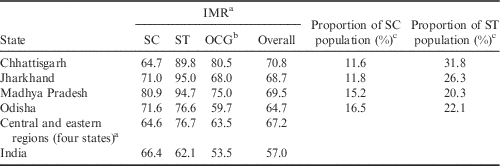
a Computed using NFHS-III data (2005–06).
b OCG includes Other Backward Castes (OBCs) and castes other than SC, ST and OBC.
c Proportion reported from the Census of India, 2011.
Figures for the central and eastern region and for India are based on 5-year birth histories. The rest of the figures are based on 10-year birth histories.
The prevalence of high infant mortality among certain caste groups in the central and eastern regions of India is not the only issue of concern; the concentration of infant deaths in a small number of families needs to be addressed. In other words, there may be a situation where there is high mortality in a region, but deaths are not randomly distributed over exposed families. Rather, there are certain high-risk families that experience deaths frequently, and other families who, despite sharing similar socio-cultural factors, do not experience frequent child loss. This situation is known as ‘death clustering’ (Das Gupta, Reference Das Gupta1990).
The literature suggests the clustering of deaths in families across different parts of the world: in Guatemala (Guo, Reference Gazdar and Drèze1993), India (Das Gupta, Reference Das Gupta1997; Arulampalam, Reference Arulampalam2006; Arulampalam & Bhalotra, Reference Arulampalam and Bhalotra2008), Senegal (Ronsmans, 1995) and Brazil (Sastry, Reference Rosenzweig and Wolpin1997), for example. Death clustering has been defined consistently in most studies in two ways: i) by counting the number women who have experienced more than one child loss (Das Gupta, Reference Das Gupta1990; Guo, Reference Gazdar and Drèze1993; Curtis et al., Reference Curtis, Diamond and McDonald1993; Curtis & Steele, Reference Curtis and Steele1996) and ii) if the expected number of child deaths among certain group of women exceeds that which would be expected if the risks were the same for all women and their children (Ronsmans, 1995; Zaba & David, 1996). Two aspects of death clustering make it an important issue in the analysis of mortality. One is that observations are not independent since siblings living in the same family have a shared environment. They share the same genetic pool and socioeconomic position, and also enjoy the same parental competence in terms of child care. The other aspect is clustering itself (Arulampalam, Reference Arulampalam2006; Arulampalam & Bhalotra, Reference Arulampalam and Bhalotra2008). Different societies can be compared by examining level of clustering and deriving important information about the distribution of mortality. Clustering is indeed an expression of heterogeneity in the risk of child deaths between sub-groups of populations. Additionally, it has been viewed as what is left unexplained after the observed correlates are controlled, and is thus attributed to unobserved or unobservable genetic, behavioural and environmental factors related to mortality risks and are common to certain groups of children (Guo, Reference Gazdar and Drèze1993; Ronsmans, 1995; Das Gupta, Reference Das Gupta1997; Sastry, Reference Rosenzweig and Wolpin1997).
In the present study four states, namely, Chhattisgarh, Jharkhand, Madhya Pradesh and Odisha (in central and eastern regions of India), were considered to understand the peculiarities of infant death clustering. Differentials in mortality patterns by caste and tribal status have received greater attention recently in India (Dyson & Moore, Reference Dumont and Sainsbury1983; Murthi et al., Reference Miller, Trussell, Pebley and Vaughan1995; Gazdar & Drèze, Reference Dyson and Moore1996; Maharatna, Reference Maharatna1998, Reference Maharatna2000, Reference Maharatna2005). If health planners were able to identify the high-risk mothers in certain communities, then health resources could be used more effectively.
Caste groups in India
Broadly, there are four official caste categories in India, namely, SCs, STs, OBCs and Others (Dommaraju et al., Reference Deaton and Drèze2008).
The term Scheduled Caste is recognized by the constitution of India and includes ‘untouchables’ or dalits, a group that is socially segregated and economically disadvantaged by their lower status in the traditional Hindu caste hierarchy. Social exclusion is considered the general characteristic of the SCs (Chitnis, Reference Chitnis1997). Members of SCs are hierarchically interdependent with the upper caste population, which makes them distinct from the STs (Dumont & Sainsbury, Reference Dommaraju, Agadjanian and Yabiku1970). The infant mortality rate among SCs is above 80 deaths per 1000 live births.
The term Scheduled Tribe refers to the specific indigenous people Adivasi or original inhabitants and is recognized by the constitution of India. It consists of over 400 tribes that tend to be geographically isolated (often in the hills, forest areas or islands) with limited economic and social interaction with the rest of the population. The maternal and child health status of tribal population is different from that of non-tribal population. The average Indian child had a 25% lower likelihood of dying under the age of five years compared with Adivasi (tribal) children born in 2001–2005 (Das et al., Reference Das, Kapoor and Nikitin2010). According to the NFHS-III (2005–06), in rural areas, where a majority of Adivasi children live, Adivasis contributed about 11% of all births and almost a quarter of all deaths under the age of five years.
In the present study, both Other Backward Classes (OBCs) and castes other than SC/ST, referred to as the Forward Class (Dommaraju et al., Reference Deaton and Drèze2008), are combined together as the Other Caste Group (OCG). Post-1990, after the initiation of the new economic policy in the country, the OBCs and castes other than SC/ST had a very similar standard of living and equal access to facilities in social, economic, political and health terms. Hence, their health status and mortality patterns are similar.
The above caste groups represent a broad classification with a substantial degree of heterogeneity within each category. However, these categories tend to be routinely used for population-based studies (Claeson et al., Reference Claeson, Bos, Mawji and Pathmanathan2000; Subramanian et al., Reference Shah and Dwivedi2008; Deaton & Drèze, Reference Das Gupta2009). Similar to arguments made for race and class (Rogers, Reference Reddy1989; Navarro, Reference Murthi, Guio and Drèze1990), it has been argued that once the socioeconomic status of low castes rises, the caste mortality differentials would disappear (Mahadevan et al., Reference Maharatna1985). Further, the under-five mortality rate (U5MR) for India has decreased from 101 to 74 per 1000 live births during the accelerated economic growth period 1998 to 2006. High rates of infant mortality and U5MR are in general inversely associated with income. These inequities are also accompanied by wide gaps across gender and caste (Gwatkin, Reference Guo2000; Subramanian et al., Reference Shah and Dwivedi2008). Though child mortality differentials between caste groups have been noted in the literature, they have typically been assumed to arise from socioeconomic differences. Ranjan et al. (Reference Pinker2017) found that the sex of infants, breast-feeding with colostrum and age of the mother at birth acted similarly between tribes and non-tribes. Yet factors such as state of residence, wealth, religion, place of residence, mother’s education and birth order behaved differently. Some studies have even showed that there is a cyclicality of neonatal deaths among tribes (Shah & Dwivedi, Reference Scalone, Agati, Angeli and Donno2011).
Scarring mechanism and unobserved heterogeneity
The mortality risk for a child in a particular family can be described as a function of previous childhood deaths in that family. The death of a child in a family scars or marks the survival prospects of the succeeding sibling. Alternatively, to define a state as a realization of a stochastic process, state dependence at the family level may be thought of in terms of the death risk of the index child being dependent upon the previous child survival status (died in infancy or not) (Arulampalam & Bhalotra, Reference Arulampalam and Bhalotra2008). The basic idea of separating state dependence (or scarring) from unobserved heterogeneity is well known in labour economics (e.g. Heckman, Reference Gwatkin1987). Childhood mortality risks are not randomly distributed across families, but rather there is a positive association of sibling deaths or ‘death clustering’ (see, for example, Hobcraft et al., 1983; DasGupta, Reference Das Gupta1990; Miller et al., Reference Merlo, Chaix, Ohlsson, Beckman, Johnell, Hjerpe and Larsen1992; Zenger, Reference Zaba and David1993; Guo, Reference Gazdar and Drèze1993; Curtis et al., Reference Curtis, Diamond and McDonald1993). A possible explanation for this is that families in which child deaths are concentrated are poorer or share genetic or environmental risks that predispose all of their children to a higher risk of death. In other words, families are different and there is inter-family heterogeneity in mortality risks. These observed differences (for example differences in maternal education) can be captured by including these variables as regressors in a model of child mortality. Recent research has gone further in incorporating unobservable heterogeneity (such as genetic traits or maternal ability) by allowing for family-level random effects (Arulampalam, Reference Arulampalam2006; Scalone et al., Reference Sastry2016).
The central aim of this study was to assess the level of death clustering among different caste groups in the selected states of central and eastern India. An attempt was also made to unfold the effects of scarring and unobserved residual heterogeneity at the mother level on infant deaths among all caste groups. A few studies have assessed the effect of caste on infant mortality, but to the authors’ knowledge this is the first to describe the issue of infant death clustering by caste group. It also highlights the caste differentials in death clustering through indicators like the intra-class correlation coefficient and median odds ratio, which are considered good measures of intra- and inter-family variation in mortality risk.
Methods
Family-level infant death clustering was examined using bivariate analysis, and the linkages between the survival prospects of siblings and mother-specific unobserved residual heterogeneity, scarring coefficient, Intra-class Correlation Coefficient (ICC) and Median Odds Ratio (MOR) were estimated through a multilevel random effects logit model. In the case of multilevel models or formulating a two-level model, it is common to assume normality for the cluster-level (Level 2, i.e. mother) variation and to assume independence of units within cluster (Level 1) conditional on the cluster-/mother-level variable, thus generating a model in which children are marginally correlated within mothers. In the multivariate normal case, the interpretation of both fixed effects and random effects (individual residual error and cluster variation) is simple. This is not true in the case of dichotomous response variables because of the non-linear relation between the covariates and the response variable (typically a logit relation). Since infant deaths within families are correlated due to exposure to similar parental care, household environment and common community effect, multilevel models were adopted to measure the magnitude and amount of dispersion of residual heterogeneity in infant mortality risks across mothers (Merlo et al., Reference Manski2006) among the various caste groups while controlling for several biodemographic factors. This is the most common approach in social epidemiology and research in public health.
The unexplained mortality component was shown through ICC and the unobserved residual heterogeneity was captured through MOR. The ICC measured the unexplained mortality component due to unobserved familial and maternal characteristics. The MOR quantified the variation between mother clusters (the second-level variation) by comparing two mothers chosen at random from different clusters. The MOR is the median odds ratio between the children of higher propensity of experiencing infant death due to their high-risk mothers and the children of lower propensity of experiencing infant deaths belonging to the low-risk mothers. The measure is always greater than or equal to 1. If the MOR is 1, there is no variation between mother clusters (no second-level variation) due to residual unobserved heterogeneity (Larsan & Merlo, Reference Larsen and Merlo2005). If there is considerable between-cluster/mother variation, the MOR will be large. The measure is directly comparable with fixed-effects odds ratios. As the MOR is a function of only the cluster/mother residual variance, and ICC is a function of both the mother residual variance and the individual/sibling-specific residual variance, they are not equivalent (one to one), and therefore they measure different aspects.
Data source
The data used in the study came from National Family Health Survey-III which was conducted in 2005–06. This survey interviewed 124,385 ever-married women aged 15–49 years at the time of the survey. In the central and eastern Indian region, among all caste groups there were 38,392 children born to 11,992 women. The birth history file has complete information about the retrospective history of births together with a record of child deaths for each mother for a period spanning more than 35 years (1968–2006). Thus, it provided a sufficient number of cases for analysis and it is possible to construct (unbalanced) panel data for mothers. Full retrospective birth histories were used for statistical analysis in the study.
The empirical model
In the NFHS-III (2005–06) caste information was originally collected for SCs, STs, OBCs and ‘Other’. The present study used only three caste groups, namely, SCs, STs and OCG. The latter included OBCs and the ‘Other’ caste categories. The dependent variables, i.e. infant death and survival status of the preceding child (i.e. the lagged variable), were both coded as binary variables – ‘1’ if a child died before the age of 12 months and ‘0’ otherwise. By taking child-specific and mother-specific covariates along with preceding child (lagged variable), the multi-level random effects logit model was applied. Children who were younger than 12 months at the time of the survey were dropped from the sample because they had did not have 12 months of exposure to mortality risk. When the index child was not a singleton but instead a twin they were also dropped from the model so that siblings could be identified properly.
Choice of independent variables
The predictors (factors) sex of the child, birth order, mother’s education, religion, exposure to mass media, availability of toilet facility, type of fuel used for cooking, standard of living and mother receiving tetanus immunization during pregnancy and preceding birth interval are considered the main determinants of infant and child mortality among all caste groups in India (Pandey & Tiwary, Reference Navarro1993). Apart from the above factors, tribal children face certain other adverse situations like insufficient food intake, frequent infections and lack of access to health services. They also have a lack of awareness about environmental sanitation, personal hygienic practices, proper child rearing, breast-feeding and weaning practices (Pandey & Tiwary, Reference Navarro1993; Reddy, Reference Ranjan, Dwivedi and Mishra2008). Women’s autonomy, social class, mother’s education and quality of care received by the children have also been cited as possible reasons for clustering (Madise & Diamond, Reference Larsen and Merlo1995). Causal factors that determine equality levels in the distribution of mortality risks for children among families or among mothers may conveniently be divided into two groups: biodemographic differentials and differentials in other socioeconomic characteristics of the families (and/or the mother) (Zaba & David, 1996). Biodemographic factors include mother’s age, fertility level, birth-spacing pattern as well as inherited genetic disorders and the mother’s medical condition and disease profile. Socioeconomic differentials include characteristics of the families such as income, occupation, social class and level of education, as well as factors relating to the wider environment of the child such as community, neighbourhood and family’s ecological and disease environment. The socioeconomic category also contains the much-discussed ‘maternal competence’ factor (breast-feeding behaviour and behaviours or attitudes that affect child health). Other authors have likewise stressed the connections among clustered mortality, family size and fertility patterns (Ronsmans, 1995). Arulampalam (Reference Arulampalam2006) argued that deaths may cluster in families not only because of unobserved heterogeneity (because siblings share certain traits) but also as a result of a causal process driven by the scarring effects. Heuristically, the death of one child ‘scars’ the family, and makes the next child in that family more vulnerable (Arulampalam, Reference Arulampalam2006). Earlier studies have often attributed death clustering to socio-demographic covariates: either a causal scarring effect (the previous sibling’s survival status being included as a covariate) or unobserved heterogeneity (with family- or community-specific effects) but not both (Curtis et al., Reference Curtis, Diamond and McDonald1993; Ronsmans, 1995; Sastry, Reference Rosenzweig and Wolpin1997; Bolstad & Manda, Reference Bolstad and Manda2001; Reddy, Reference Ranjan, Dwivedi and Mishra2008).
On the basis of the above, the following covariates, which affect infant mortality and clustering of infant death within families, were included in the analysis. Child-specific factors included: birth order, sex of the child and survival status of the previous sibling. Mother-specific factors included: mother’s and her partner’s educational attainment and year of birth of mother. Birth order was categorized into five categories: 1–2, 3, 4, 5 and 6+. The educational attainment of the respondent (mother) and her partner was categorized into two groups: literate and illiterate. Respondent’s (mother’s) year of birth was categorized as: 1956–1969, 1970–79 and after 1980. Information on household assets, immunization, prenatal care, access to piped water and relevant community-level variables was not used because these are time inconsistent (Rosenzweig & Wolpin, Reference Ronsmans1986). The same holds for breast-feeding. Covariates that have often been used in previous research that are time inconsistent (or endogenous) were avoided. The purpose of including mother-level random effects in the model was to control for the time-invariant component of these omitted variables; for example, for the fact that some mothers are more prone to breast-feeding than others. Mother’s age at birth and her cohort (year of birth) tend to capture trends in these omitted variables.
Statistical model
Consider that there are N children distributed in K different mother clusters. Each child has a vector of covariates x and the parameters corresponding to the covariates are in vector β . The K mutually independent cluster variables u 1, u 2, …. , u k, are not to be estimated, but rather the variation between clusters are to be quantified. Therefore, a normal distribution is assumed for the u values, and parameters characterizing this distribution can then be used to characterize the heterogeneity induced by the random effects.
The response variable ‘infant survival status’ (Y) is dichotomous in nature. A child is observed to die if Y=1, and 0 otherwise.
Level 1: for a child with covariate x , corresponding to the k th cluster, the probability of observing an infant death, i.e. Y=1 is:
 $${{P\left( {\left. {Y\,{\equals}\,1} \right|u_k;\,{\mib{x}} } \right)\,{\equals}\,{\rm exp}\ \left( {\eta \left( {{\mib{x}} ,\,u_k} \right)} \right)} \mathord{\left/ {\vphantom {{P\left( {\left. {Y{\equals}1} \right|uk\,\semi-colon\,\,{\mib{x}} } \right){\equals}{\rm exp}\left( {\eta \left( {{\mib{x}} ,\,uk} \right)} \right)} {\left( {1{\plus}{\rm exp}\,\left( {\eta \left( {{\mib{x}} ,\,uk} \right)} \right.} \right)}}} \right. \kern-\nulldelimiterspace} {\left( {1{\plus}{\rm exp}\,\left( {\eta \left( {{\mib{x}} ,\,u_k} \right)} \right.} \right)}}.$$
Level 2: for that child, the second-level equation is:
 $$\eta \left( {{\mib{x}} ,\,u_k} \right)\,{\equals}\,{\mib{\bibeta x{\plus}}} \gamma Y_{{nk{\minus}1}} {\plus}u_k,$$
where uk ~N(0,σ2). The covariate vector x contains individual-level (Level 1) and cluster-level (Level 2) covariates. The model also includes the observed survival status of the previous siblings, Y nk−1, the coefficient that picks up scarring. The null of ‘no scarring’ implies 0. The estimated parameter γ should be interpreted as the ‘average’ effect of scarring over the time period considered. In models of this sort, the previous sibling’s survival status Y ij−1 is necessarily correlated with unobserved heterogeneity. In order to identify a causal effect, it is important to take account of this correlation in the estimation. For variables varying within a cluster, the usual odds ratio interpretations apply for comparisons of children belonging to the same mother cluster. For example, the effect of the sex of a child may be interpreted as an odds ratio between a male and a female belonging to the same mother and with the same covariates except for sex of the child. For variables varying on the cluster level, the quantification is more difficult.
Results
Characteristics of the study population sample
Table 2 shows the characteristics of the sampled children by caste group in the studied area. The mean number of children ever born to women of the studied population was 3.2. Of the total, 17% births took place among SCs, 22% among STs and 61% among the OCG. Around a quarter of the children in Jharkhand, Odisha, Madhya Pradesh and Chhattisgarh were in STs, around 15% belonged to the SCs and the rest were from the OCG. The total numbers of infant and under-5 child deaths were 3483 and 4581, respectively. Mothers who belonged to STs experienced the highest proportion (12%) of infant deaths (Table 2). The prevalence of previous sibling’s death within families among various caste groups showed that nearly 10% of infant deaths occurred among SCs and STs, while around 8% of deaths of previous siblings during infancy took place among the OCG (Table 2). Around 10% of ST women had 6 or more births, whereas this was 9% and 6% for women belonging to SCs and the OCG, respectively. The majority of women in the sample were born during 1956–1959 (Table 2). Further, parental education across caste groups showed that more parents belonging to STs and SCs were illiterate compared with those of the OCG.
Characteristics and distribution of study sample by caste group and state, India, 1968–2006
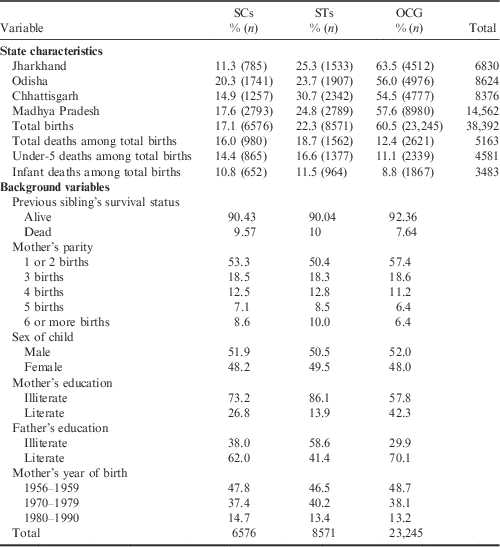
Data source: NFHS-III (2005–06).
Clustering of infant deaths in different caste groups
Table 3 shows infant death clustering and children ever born (CEB) to respondent mothers across different caste groups. The majority of infant deaths across caste groups were clustered in a few families. The CEB among families of SCs and STs was higher than for those belonging to the OCG (3.1). Nearly a quarter of SC, one-third of ST and one-fifth OCG families had 5 or higher order births. Nearly half of the infant deaths among SCs and STs were concentrated among 7% and 8% of families, respectively. Among other castes, nearly 4% of families experienced two or more infant deaths and contributed 40% of infant deaths.
Distribution of infant deaths among families by caste group, central and eastern states of India, 1968–2006
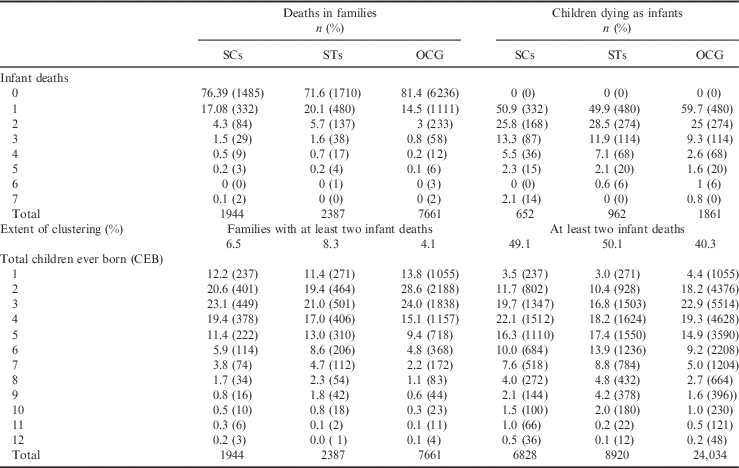
Table 4 shows the probability of infant death by caste group and state. In Jharkhand infants belonging to STs were at a higher risk of death compared with other castes. Similarly, in Chhattisgarh and Madhya Pradesh the probability of infant death was higher in STs, followed by SCs and OCG. The probability of infant death in Madhya Pradesh, Chhattisgarh and Jharkhand was higher among STs, followed by SCs and OCG. In Odisha, the probability of infant deaths was higher among the SCs. Columns 2 and 3 of Table 4 show the raw data probabilities for infant deaths of the index child based on the survival status of the previous sibling and the index child. The difference between the two is taken as a crude measure of the extent of clustering among the various caste groups, as shown in Column 4.
Probabilities of infant deaths by caste group in central and eastern states of India based on raw data and estimated using unobserved heterogeneity, 1968–2006
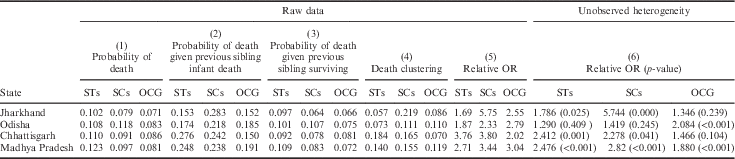
The probability of infant death clustering in Madhya Pradesh by caste group ranged between 0.12 and 0.16. It was highest among SCs, followed by STs and OCG. In Chhattisgarh the probability of death clustering was highest among STs, being 2.5 times higher than in the OCG. Further, in Jharkhand it is interestingly seen that the extent of death clustering among SCs was three times higher than in the OCG and four times higher than in STs. In Odisha the probability of death clustering was similar among SCs (0.11) and OCG but lower for STs (0.07).
Columns 5 and 6 show the relative odds ratio based on raw data and the estimates obtained from random effects logit model, which accounted for unobserved factors at mother level. In both columns, the obtained estimates are similar. They explain the likelihood of a newborn in the family facing infant death, if one of his/her earlier siblings died as an infant compared with those families where none of the earlier siblings had died as an infant.
These are just the observed tendencies in the data. Without further analysis, it would be impossible to draw inferences about whether the reflected scarring actually contributed to intra-family infant death concentration or if it is merely a reflection of the risks that are common to siblings on account of shared family characteristics (heterogeneity).
Model-based clustering analysis: scarring
Estimates of scarring by caste group from the model that ignored unobserved heterogeneity are shown in Column 1 of Table 5; these were compared with estimates from the preferred model that allowed for unobserved heterogeneity in Column 2 of the table. Column 1 shows that after controlling for parents’ education, year of birth of mother, child’s sex and birth order and previous sibling’s death in the families were found to be significant for all caste groups in all the states. Once the mother-level unobserved factors had been adjusted in the model, along with sibling’s previous death in Column 2, in Jharkhand the odds of having an infant death among the SC mothers whose previous child had died were six times higher than those who had not experienced death of the previous child (p<0.01). The coefficient of previous child’s death was not significant among OCG in Jharkhand. However, mother-level unobserved factors were significant for the OCG. This reflects the fact that mother-level unobserved factors affect the survival of infant more than scarring. In Odisha, among SCs and STs, although previous sibling’s death had an insignificant impact on the incidence of infant death of the index child, mother-level unobserved factors were found to be significant for both caste groups. However, for the OCG, only scarring doubled the odds of the risk of infant death in the families. In Chhattisgarh, scarring more than doubled the odds of having infant deaths among STs (p<0.01), while it was moderately significant for SC families (p<0.05) and insignificant for the OCG. Mother-level unobserved factors were significant for all the caste groups. In Madhya Pradesh, scarring was a significant factor for all the caste groups, doubling the odds of having an infant death. The highest was observed for the SCs (OR=2.82, p<0.001), followed by STs (OR=2.48, p<0.001) and OCG (OR=1.88, p<0.001). Mother-level unobserved factors in Madhya Pradesh explained infant deaths only for the OCG, and did not have any impact on the children of SCs and STs.
Effect of scarring on infant mortality by presence of mother-level unobserved heterogeneity and by caste group in central and eastern states of India, 1969–2006
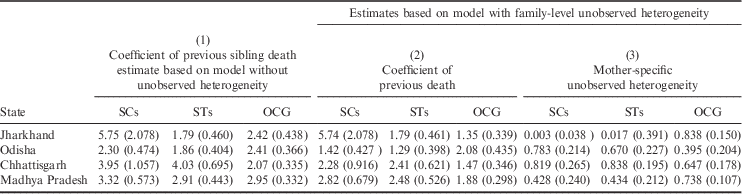
Figures in parentheses show standard error of the estimate.
Unobserved heterogeneity
Table 6 shows the role of intra-family unobserved factors operating at the mother level in explaining the clustering of infant deaths in families, along with the influence of inter-mother-level unobserved residual heterogeneity on the risk of infant deaths in families. The figures for the full model (which includes previous sibling’s death along with all the mother- and child-specific covariates) are compared with those of the null model (without any covariate) in order to measure the ICC and MOR of the various caste groups. Both ICC and MOR declined in all caste groups for all the states in the full model compared with the null model.
Intra-class correlation coefficients (ICC) and median odds ratios (MOR) using a random effects logit model by caste group in central and eastern states of India, 1969–2006Footnote a
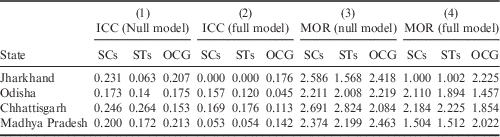
a Estimates are based on model with family-level unobserved heterogeneity
The ICC for SCs from Jharkhand was 0. 231 (empty model). This demonstrates that there was some degree of correlation between newborn propensities for infant deaths within the same mother, i.e. cluster. In other words, 23% of the variation in the risk of infant death was related to unobserved maternal or family characteristics. Similarly, for STs in Jharkhand it was 6% and for OCG 20%. In the case of the full model there was a huge reduction in ICC for SCs and STs, which became almost zero once the mother- and child-level factors were taken into account, which shows that other factors were playing a more important role than mother-level unobserved factors. However, mother-level unobserved factors played a role in the OCG as there was a marginal reduction in ICC. In Odisha the greatest reduction in ICC was among the OCG, which showed that mother-level unobserved factors had a less important role in explaining clustering, but for SCs and STs there was a small reduction showing that mother-level unobserved factors were responsible for intra-mother clustering of infant deaths, along with mother- and child-specific factors. In Chhattisgarh the full model shows that clustering of infant deaths within families could be explained by mother-level unobserved factors among all caste groups. In Madhya Pradesh, except in the case of OCG the mother-level unobservable factor made little contribution to explaining the correlated mortality risk between siblings of the same mother.
Median odds ratio (MOR) measures the role of between-mother residual heterogeneity (which may arise due to genetic and other factors), which increases or decreases the individual odds of infant death when two infants are randomly chosen from two different mothers. The results of the full model (Column 4, Table 6) indicate that when mother-specific (education of the mother and father, and year of birth of mother) and child-specific (child’s sex and birth order) covariates were adjusted in the model in Jharkhand, mother-level variation more than doubled the odds of having an infant death among the OCG, while it has little effect among SCs and STs. In Odisha, for the full model, an infant born to high-risk mothers among SCs would experience (at the median) more than twice the individual risk of having an infant death, while among STs and OCG high-risk mothers increase the individual risk of having an infant death by 89% and 45%, respectively. Similarly, in Chhattisgarh the mother-level differences in unobserved residual heterogeneity doubles the odds of having an infant death among SCs and STs, while among the OCG it raises it by 85%. Further, the results of the null and full model for Chhattisgarh show that though the risk was more than twice among all three caste groups in the null model, once the mother- and child-level factors were adjusted in the model the risk of having an infant death in families due to between-mother variation decreased marginally for SCs and STs, but more for the OCG. Furthermore, in Madhya Pradesh both the null and full models highlighted that the risk of infant death due to inter-mother differences was more among the OCG than SCs and STs. A high-risk mother doubles the risk of having an infant death in the family for other castes, while for SCs and STs it increases it by 50%.
Discussion
This study examined the level of infant death clustering in different caste groups in selected states of central and eastern India. Eight per cent of ST mothers and a slightly lower proportion of SC mothers had at least two infant deaths, compared with 4% in the OCG in the study region. The results demonstrate that families which had already experienced the loss of children had an increased chance of losing more children. The results were consistent in all the states and across caste groups. However, the figures were not significant in the OCG in Jharkhand and Chhattisgarh, as well as for STs and SCs in Odisha.
It is well documented that siblings share a large number of relevant demographic characteristics of their mother such as her age, breast-feeding patterns, level of fecundity and birth interval, which are all related to the parity of the mother, and these characteristics are strongly correlated with the level of death clustering. More than 4 in 5 infant deaths are attributed to those ST and SC families that had four or more children. In other words, infant deaths are much higher among women with high parity compared with those with low parity. The explanation stems from the fact that women who experience one or more child deaths are more likely than other women to progress to higher parities through either voluntary or physiological replacement mechanisms. Secondly, children born to high-parity mothers may suffer higher mortality risks than other children because of increased infection hazards, sibling competition or the depletion of maternal resources as a result of short birth intervals (Zaba & David, 1996). Miller et al. (Reference Merlo, Chaix, Ohlsson, Beckman, Johnell, Hjerpe and Larsen1992) also suggested that maternal depletion plays a prominent role in the risk polarization of infant deaths among high-parity mothers.
The study also examined scarring and unobserved heterogeneity in a single model to assess their effect on death clustering. Scarring was found to play an important role in intra-family death clustering in all the selected states with little variation among castes. After eliminating the risk of death for earlier born children, the experience gained by mothers when rearing them automatically helps reduce the risk of infant death of the index child, which would further significantly reduce the clustering of infant deaths. The scarring effect findings suggest a higher pay-off for interventions designed to reduce mortality. Manski (Reference Mahadevan, Murthy, Reddy, Reddy, Gowri and Sivaraju1999) called this the ‘activation of a social multiplier’ in the sense that reducing the risk of death of a child automatically implies reducing the risk of death of his or her succeeding siblings. The present results show that once the scarring effect is eliminated, it would further decrease mortality levels to some extent. The reduction in mortality was found to be highest among SCs from Jharkhand, followed by Chhattisgarh and Madhya Pradesh. Among STs, the reduction in clustered deaths was highest in Chhattisgarh, followed by Madhya Pradesh after adjusting for the scarring effects. Among the OCG, the highest levels of reduction in clustering were in Odisha and Madhya Pradesh, and were almost the same.
The reduction in mortality was observed whether or not unobserved heterogeneity was introduced in the model. As shown in Table 5, after eliminating the effect of scarring, the reduction in infant mortality was greater in Column 1 than in Column 2. Furthermore, once unobserved heterogeneity was present in the model, the level of infant mortality remained almost the same for all the states across the different caste groups. However, unobserved heterogeneity operating at mother level was significant in the case of SCs and STs for Odisha and Chhattisgarh, and for OCG in Jharkhand, Chhattisgarh and Madhya Pradesh. It might be argued that deaths may cluster in families not only due to the unobserved heterogeneity that siblings share, but also as a result of a causal process driven by the scarring effects on mothers and families from an earlier child death, making the next child in the family more vulnerable. One of the ways in which intra-family scarring occurs is when a mother quickly conceives after the death of an infant through either resumed fecundity or a wish to replace the child that was lost. In addition, scarring may also occur when an infant death causes the mother to become depressed, which may also have serious deleterious health effects on the next infant, either in the womb or after birth. The full impact of scarring can only be estimated if the previous infant’s survival status is included as a covariate while excluding the variable indicating the length of the previous birth interval.
In Jharkhand and Madhya Pradesh, the estimated error variance attributable to mother-specific unobserved heterogeneity was found to be less in the case of SCs and STs. This may be because maternal characteristics and behaviours are similar within the region, or perhaps it is influenced by community-level or biological factors (both are treated as nuisance parameter or error terms in the study model), making women at equal risk of experiencing infant death. Arulampalam and Bhalotra (Reference Arulampalam and Bhalotra2008) found that the estimated variance of mother-specific unobservable heterogeneity was also significant in the case of Madhya Pradesh and Jharkhand. This suggests that tribal mothers are equally vulnerable to experiencing child loss.
The caste differences in the scarring and mother-level unobserved heterogeneity might be due to the lack of high-quality health care infrastructure, or the presence of some genetic factors associated with mothers. In addition, it might be that community-level factors had an impact on the frequent infant deaths experienced by tribal mothers. The mother-level insignificant unexplained variation in Jharkhand and Madhya Pradesh for SCs and STs could be attributed to homogeneity in culture, poverty and hazardous environmental factors.
The ‘maternal competence’ factor (the mother’s breast-feeding behaviour or attitudes and behaviours that affect her child’s health), inherited genetic disorders and the mother’s medical condition and disease profile may be other relevant factors that could explain the significant inter-family unobserved heterogeneity in Odisha and Chhattisgarh. Previous studies have also found that unexplained variation between families or mothers could not always be observed, or in some cases was only modest (Das Gupta, Reference Das Gupta1990; Guo, Reference Gazdar and Drèze1993).
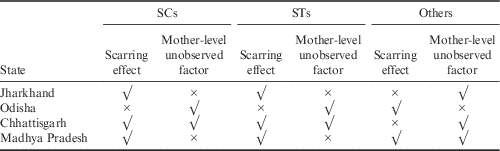
In summary, the disproportionately high number of infant deaths concentrated among SCs and STs is mainly due to the scarring factor in Jharkhand and Madhya Pradesh, mother-level unobserved factors in Odisha and both factors (scarring and mother-level unobserved factors) in Chhattisgarh. Similarly, among the OCG this is influenced by the scarring factor only in Odisha, mother-level unobserved factors in Jharkhand and Chhattisgarh, and both factors in Madhya Pradesh (for details refer to Table 7). The children of SC and ST mothers residing in the four states of central and eastern Indian region are susceptible to many health hazards in their early years of life due to poor household environment (hygiene and cleanliness), poor financial status, lack of awareness about institutional health check-ups and insufficient health infrastructure. All these factors contribute to elevating scarring, resulting in intra-familial clustering of deaths. The differences in inter-family heterogeneity among SCs and STs in child deaths among mothers could be attributed to differences in the maternal competence factor, genetic factors, other medical conditions and differential breast-feeding patterns. Tribes generally prefer traditional systems of medicine over well-established allopathy, and as a result out of ignorance child health is compromised. Just like in other parts of India, the OCG in this study region are better off than SCs and STs in all four states, but still death clustering at the mother level exists due to the interplay of scarring and mother-level unobserved factors in the different states. It could be harder to distinguish the factors acting differently in relation to mother-level unobserved factors and the scarring effect among the OCG than the SCs and STs because the four study states have a similar pace of development, so factors that affect SCs and STs may also affect the OCG, but with great differentials.
Role of scarring and mother-level unobserved heterogeneity by different caste groups in selected states of central and eastern region, India, 1969–2006
Guo (Reference Gazdar and Drèze1993), using data from Guatemala, concluded that the variation in death clustering among mothers was only slight once family income and mother’s educational attainment were controlled. Furthermore, he attributed the lack of residual or unexplained variation to the fact that in developing countries such as Guatemala, mortality resulting from poverty and environmental factors is still high. Under these conditions, only genes favourable to early survival are passed on by natural selection. Given the low residual variation between mothers, he dismissed differences in the quality of maternal care as a major source of unexplained death clustering. Sastry (Reference Rosenzweig and Wolpin1997) too found inter-family heterogeneity to be small and unimportant in his study in the Brazilian population, but only after controlling heterogeneity at the community level. It is argued that shared environmental conditions are more important determinants of shared frailty than either parental competence or genetic and biological factors. The present study was an attempt to assess death clustering behaviour giving due importance to cultural and ethnic differences.
Scarring is of considerable theoretical interest, contributing to the understanding of the interrelations between family behaviour, fertility and mortality. Scarring involves responsive behaviour that may be amenable to change through policy intervention, as there is a causal process whereby frequent infant death is affected by the previous sibling’s death in a family. If the causal process works through the fecundity mechanism, policies that improve the uptake of contraception would reduce death clustering among STs and SCs. More specific policy insight depends on identifying the mechanism underlying scarring. However, unobserved heterogeneity involves largely untreatable factors like genes or fixed behaviour, and unalterable family-specific traits which are central to the nature–nurture debate (Pinker, Reference Pandey and Tiwary2003). There is a need for systematic and comparative research into the varying levels and shaping of the familial component of children’s mortality hazards in different communities, time periods and environmental conditions. Heterogeneity can have implications for reproductive health and child survival programmes. In India, as in many other countries, health services are made available largely in response to demand. If child deaths are heavily concentrated in some families, this suggests that substantial improvement in child mortality could be achieved by adopting more cost-effective techniques and focusing health care resources on families at high risk of child death.
Acknowledgments
The authors are thankful to the editor and two anonymous referees for their constructive comments, and to Professor Wiji Arulampalam, University of Warwick, UK, for her help with a previous version of the manuscript. The study has benefited from a presentation at the 3rd Asian Population Association Conference, 27–30th July 2015, in Kuala Lumpur, Malaysia. The authors thank the International Institute for Population Sciences, Mumbai, for giving access to the data. This organization bears no responsibility for the analysis or interpretations that are presented in this paper.



