Parent–child shared book reading and toy play are two interactive contexts that are associated with language learning in preschool-age children. Shared reading interactions provide multiple opportunities for parents to expand their children's utterances, provide responsive feedback, and model complex linguistic input (Crain-Thoreson & Dale, Reference Crain-Thoreson and Dale1999; Kaderavek & Justice, Reference Kaderavek and Justice2002; Whitehurst, Arnold, Epstein, Angell, & Fischel, Reference Whitehurst, Arnold, Epstein, Angell and Fischel1994). Shared reading interactions have been shown to facilitate the acquisition of vocabulary and morphosyntactic skills in preschool children with typical development (e.g., Bus, van IJzendoorn, & Pellegrini, Reference Bus, IJzendoorn and Pellegrini1995; Crain-Thoreson & Dale, Reference Crain-Thoreson and Dale1992; Senechal, Reference Senechal1997; Whitehurst et al., Reference Whitehurst, Falco, Lonigan, Fischel, De Baryshe and Valdez-Menchaca1988, Reference Whitehurst, Arnold, Epstein, Angell and Fischel1994). Another frequently occurring context for parent–child interaction is toy play (Fromberg & Bergen, Reference Fromberg and Bergen2006). In comparison to shared book reading, toy play is considered to be more child directed, which may positively influence children's motivation to engage in play-based interactions (Kaderavek & Justice, Reference Kaderavek and Justice2002). Toy play is thought to provide children with opportunities to develop pragmatic competencies, such as sharing information with a play partner and regulating the behaviour of others (Norris & Hoffman, Reference Norris and Hoffman1990). Like shared reading, play-based interactions provide parents with multiple opportunities to support their children's language development by providing responsive language input and expansions of children's utterances (Norris & Hoffman, Reference Norris and Hoffman1990).
Both shared book reading and toy play have attracted considerable interest as intervention contexts for children with language impairment (LI; e.g., Crowe, Norris, & Hoffman, Reference Crowe, Norris and Hoffman2004; Dale, Crain-Thoreson, Notari-Syverson, & Cole, Reference Dale, Crain-Thoreson, Notari-Syverson and Cole1996; Kaderavek & Sulzby, Reference Kaderavek and Sulzby1998). However, relatively little is known about the nature of parent–child interactions in these two contexts and whether they provide similar or divergent language learning experiences. Thus, the central purpose of the current study is to examine how the interactions of mothers and children with LI differ in these two contexts in terms of their structural language (e.g., length of utterance) and discourse features (e.g., responsiveness). The results of this study will contribute to our theoretical knowledge of language acquisition from a social interactionist perspective by examining how variation in structural and conversational features of parents’ language input may be associated with language development in a sample of preschoolers with LI. These children, who have weaknesses in language development, may provide useful information regarding the extent to which environmental supports (e.g., maternal input) are associated with their language acquisition. From a practical perspective, this knowledge is important because psychologists, speech–language pathologists, and other professionals need information concerning the relative value of different contexts for designing effective adult–child interventions.
This study investigates the support for two compatible explanations of the relation between maternal speech input and variation in child language development within book reading and toy play. The first explanation is the structural hypothesis, in which it is believed that mothers’ speech input that is more complex than the child's may facilitate language development because it provides linguistic models that are slightly beyond the child's abilities (e.g., Cross, Reference Cross, Snow and Ferguson1977; Huttenlocher, Vasilyeva, Cymerman, & Levine, Reference Huttenlocher, Vasilyeva, Cymerman and Levine2002; Weistuch & Lewis, Reference Weistuch and Lewis1986). This model focuses on structural features of the language input (e.g., syntactic complexity and vocabulary diversity) and is derived from social interactionist accounts of language development in which mothers’ linguistic input to children provides semantic and syntactic models that facilitate children's language development. Although mothers are motivated by the desire to converse rather than to teach language, Cross (Reference Cross, Snow and Ferguson1977) demonstrated that these features of language input are positively correlated with accelerated language development. Therefore, this explanation for the effects of parent–child interaction would suggest that maternal mean length of utterance in morphemes (MLU-m) and type token ratio (TTR) should be positively associated with child language development. The second explanation, the responsivity hypothesis, focuses on discourse features of conversation (e.g., imitation and expansion) and explains the facilitatory effect of maternal input as a match between the child's processing mechanisms and the adult's input. In this hypothesis, speech that is responsive to the child's plan of the moment reduces contextual ambiguities, provides redundancy, and increases the saliency of the input such that more cognitive resources can be available for language learning (Harris, Jones, Brookes, & Grant, Reference Harris, Jones, Brookes and Grant1986; Tomasello & Farrar, Reference Tomasello and Farrar1986; Yoder, Kaiser, Alpert, & Fischer, Reference Yoder, Kaiser, Alpert and Fischer1993). Within this model, parents who use a responsive interaction style may provide more accessible input than parents who use a directive style that shifts attention away from the child's ongoing actions (Hebert, Swank, Smith, & Landry, Reference Hebert, Swank, Smith and Landry2004). The responsivity hypothesis is also derived from social interactionist accounts of language development that have identified significant positive correlations between maternal semantic contingency and variation in child language development (Bradshaw, Hoffman, & Norris, Reference Bradshaw, Hoffman and Norris1998; Conti-Ramsden, Reference Conti-Ramsden1990; Yoder, Spruytenburg, Edwards, & Davies, Reference Yoder, Spruytenburg, Edwards and Davies1995). According to this research, variation in the rate of language development reflects differences in the ways that parents match the content of their input to the child's plan of the moment. Such an account of the facilitative effects of parent responsivity would suggest that a responsive conversational style should be positively associated with child language development (Hebert et al., Reference Hebert, Swank, Smith and Landry2004).
One approach to improving language abilities of children with LI is to optimize the language-learning environment during dyadic interactions with parents. Shared book reading is one context that has the potential to provide these children with a valuable language-learning opportunity because parents have daily opportunities to read to their children (Kaderavek & Justice, Reference Kaderavek and Justice2002). However, research on children with LI has also indicated that shared book reading is associated with high levels of directive interaction and low levels of child participation (Kaderavek & Sulzby, Reference Kaderavek and Sulzby1998; Rabidoux & MacDonald, Reference Rabidoux and MacDonald2000; Vandermaas-Peeler, Nelson, Bumpass, & Sassine, Reference Vandermaas-Peeler, Nelson, Bumpass and Sassine2009).
A directive style of interaction can be characterized by different forms of control exerted by the caregiver. Tannock (Reference Tannock1988) described a directive interaction style as one in which the adult uses commands and test questions, selects the topic of conversation, or verbally dominates the conversation. Other researchers described this interaction style as coercive and defined it more broadly as maternal behaviors in which the mother directs “her child toward a goal without bearing the child's intentions in mind” (Bernicot, Comeau, & Feider, Reference Bernicot, Comeau and Feider1994, p. 22). Thus, a directive style of interaction associated with book reading may result in fewer responsive language models and input that is less finely tuned to children's language levels. In addition, some children with LI do not enjoy book reading and have been observed to show a low interest in this activity overall (Kaderavek & Sulzby, Reference Kaderavek, Sulzby, Watson, Crais and Layton2000; Kaderavek & Justice, Reference Kaderavek and Justice2002; Sulzby & Kaderavek, Reference Sulzby and Kaderavek1996). In comparison, toy play is a context that has the potential to motivate children to interact and is characterized by higher levels of child participation. Within toy play, children have multiple opportunities to direct the play (Girolametto & Weitzman, Reference Girolametto and Weitzman2002; Vandermaas-Peeler et al., Reference Vandermaas-Peeler, Nelson, Bumpass and Sassine2009). Moreover, child-centered play contexts appear to elicit the highest levels of responsive interaction from parents (Hebert et al., Reference Hebert, Swank, Smith and Landry2004). A responsive interaction style is characterized by behaviors of the caregiver that are responsive to the child's interests and communicative attempts (Girolametto & Weitzman, Reference Girolametto and Weitzman2002). In other words, the caregiver comments on the child's activities and encourages the child to engage in extended conversational turn taking by waiting, asking open-ended questions, and providing expansions of the syntactic or semantic content of the child's utterances. Bernicot et al. (Reference Bernicot, Comeau and Feider1994) labeled this interaction style as inductive and defined it as maternal behaviors in which the mother directs “her child toward a goal while bearing the child's intentions in mind” (p. 22). This responsive input has the potential to be more finely tuned to children's language levels and provides many opportunities for contingent responses to children's communicative attempts (Girolametto & Weitzman, Reference Girolametto and Weitzman2002; Herbert et al., Reference Hebert, Swank, Smith and Landry2004).
Few researchers have examined the effects of contextual variation on the language input of mothers to their typically developing children in book reading versus toy play. One study (Hoff-Ginsberg, Reference Hoff-Ginsberg1991) observed the interaction styles of 63 low- and upper-middle income mothers and their typically developing children during four settings: mealtime, dressing, book reading, and toy play. Regardless of income, maternal language input was more semantically diverse (i.e., number of different word roots) and syntactically complex (i.e., MLU) during book reading than during any other setting, including toy play. Further, upper-middle-income mothers were significantly more likely to provide topic-continuing replies than were low-income mothers. They were more likely to be responsive to child-selected topics of conversation during book reading than during toy play. A second study (Vandermaas-Peeler et al., Reference Vandermaas-Peeler, Nelson, Bumpass and Sassine2009) also investigated the interactional styles of mothers and their preschool children from low- and middle-income families. All 37 participating children had typical language development. Their interactions were coded for maternal directive style (e.g., teaching, commands, and suggesting–instructing) and interactive style (e.g., praise, suggesting, and relating the story to the child's experiences) in book reading and free play with toys. The results revealed that teaching was the most commonly used strategy during book reading, while suggesting a play idea was used most often during play. Moreover, low-income mothers were more directive than middle-income mothers. Finally, Kaderavek and Sulzby (Reference Kaderavek, Sulzby, Watson, Crais and Layton2000) investigated a group of 20 mother–child dyads in which half of the children had LI and the other half were typical developing. They reported detailed findings from 3 mother–child dyads with LI and examined how their interactions differed in book reading and toy play (Kaderavek & Sulzby, Reference Kaderavek, Sulzby, Watson, Crais and Layton2000; Sulzby & Kaderavek, Reference Sulzby and Kaderavek1996). There was a tendency for all three mothers to talk more during book reading than during toy play. However, with respect to maternal MLU and vocabulary diversity (i.e., TTR), no clear patterns emerged. Of note, the authors reported that two of the boys tended to be uncooperative during the book reading activity, whereas all children were highly motivated to play. In addition, the book reading session tended to be short (max. 10 min), while all children interacted with their mothers during toy play for the duration of the allotted time (i.e., 30 min). Overall, the children were more verbal during the toy play context. These findings suggest that book reading may be a challenging activity for some children with LI (Kaderavek & Justice, Reference Kaderavek and Justice2002) and that other activities, such as toy play, may be a more viable context for language learning. Unfortunately, statistical analyses of differences between groups (i.e., typically developing children vs. LI) and across contexts (e.g., book reading vs. toy play) were not reported.
In summary, two of these prior studies were conducted with typically developing children and provide contrasting results concerning responsiveness in book reading (Hoff Ginsberg, Reference Hoff-Ginsberg1991; Vandermaas-Peeler et al., Reference Vandermaas-Peeler, Nelson, Bumpass and Sassine2009). Only one of these studies examined complexity and found language input to be more complex in book reading than in toy play (Hoff-Ginsberg, Reference Hoff-Ginsberg1991). Finally, the only study to examine interactions of children with LI did not report clear results regarding contextual influences on the complexity of maternal language input and did not investigate maternal responsiveness. None of these studies examined the children's verbal participation during reading and play, nor did they examine the impact of the parents’ interactive styles on the children's language development. Given the importance of these two contexts for intervention, it is important to investigate systematically the influence of context on mother–child interaction in book reading and toy play.
The primary purpose of this study was to examine how interactive context (shared book reading vs. toy play) influenced interactions of mothers and their children with LI, with respect to structural aspects of maternal language input, maternal interaction style, and children's language measures. A secondary purpose was to investigate which features of maternal input were associated with children's expressive language skills as measured by standardized tests of language development. The following questions were asked. First, does mothers’ MLU-m and vocabulary diversity (TTR based on 50 utterances [TTR/50]) differ in the two contexts of book reading and toy play? Second, do children differ in their sentence complexity (MLU-m) and vocabulary diversity (TTR/50) in the two contexts? Third, do mother–child dyads differ in their ratio of mother to child utterances in the two contexts? Fourth, do mothers employ different interaction strategies (i.e., responsive or directive) in the two contexts? Fifth, is mothers’ language input or interaction style associated with children's expressive language skills (i.e., a composite score of two expressive language tests)?
METHOD
Participants
Data for this study were taken from a larger intervention study examining the effects of a group intervention program for preschoolers with LI (Girolametto, Johnson, Cleave, Chen, & Truxler, Reference Girolametto, Johnson, Cleave, Chen and Truxler2012). Children with typical development did not participate in the intervention program. The intervention sample consisted of 37 families who were recruited from active caseloads or waiting lists for language intervention offered by preschool speech and language services in two large metropolitan cities in central (n = 34) and eastern Canada (n = 3). In most cases, mothers participated in the study; however, other caregivers (e.g., fathers, grandmothers, or aunts) also participated in the intervention program. To reduce variability introduced by different caregivers, the interactions of 24 mothers and their preschool-aged children with LI were examined prior to receiving language intervention.
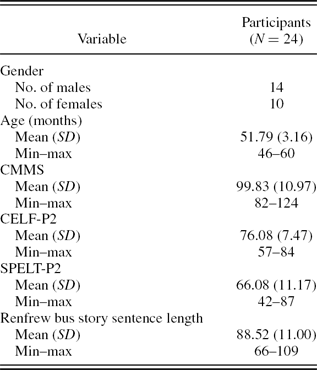
As can be seen in Table 1, children were, on average, approximately 51 months old (4 years; 3 months), and 58% of them were male. All 24 children with LI had nonverbal cognitive abilities within normal limits (M = 99.83, SD = 10.97) as measured by the Columbia Mental Maturity Scale (CMMS; Burgemeister, Hollander Blum, & Lorge, Reference Burgemeister, Hollander Blum and Lorge1972) and a LI as defined by a score at least one standard deviation below the mean on the core language composite of the Clinical Evaluation of Language Fundamentals—Preschool 2 (CELF-P2; M = 76.08, SD = 7.47; Wiig, Secord, & Semel, Reference Wiig, Secord and Semel2004). According to the CELF-P2 manual, 12 children were identified as having an expressive-receptive LI (M = 73.25, SD = 8.00), and 12 children had an expressive-only LI (M = 78.92, SD = 5.93).
Children's demographic characteristics

Note: Test results are represented in standard scores. CMMS, Columbia Mental Maturity Scales; CELF-P2, Clinical Evaluation of Language Fundamentals, Preschool 2; SPELT-P2, Structured Preschool Expressive Language Test, Preschool 2.
Although not employed as selection criteria, two additional measures were used to describe further the expressive language skills of the children. First, the Structured Photographic Expressive Language Test—Preschool 2 (SPELT-P2; Dawson et al., Reference Dawson, Stout, Eyer, Tattersall, Fonkalsrud and Croley2005) was administered to assess morphosyntactic skills. Participants earned an average standard score of 66.08 (SD = 11.17) on this test. Second, children participated in the Renfrew Bus Story (Cowley & Glasgow, Reference Cowley and Glasgow1994) and earned an average standard score on sentence length of 88.52 (SD = 11.00). These two measures were selected because the SPELT-P2 was a direct test of morphosyntactic forms typically mastered in the preschool age range and the Renfrew Bus Story provided an estimate of utterance length that was independent from the language sampled in the book reading and toy play contexts. In addition, based on 20-min language samples taken at pretest, all children had a MUL-m that was at least one standard deviation below the mean for their age (Miller, Reference Miller1981). None of the children had oral motor problems, frank neurological problems, or socioemotional difficulties as determined informally by the referring speech–language pathologist. The hearing abilities of most of the children were within normal limits; where screening results were consistent with conductive hearing loss, the children were referred to their physicians for follow-up. One child was diagnosed with a mild-moderate hearing loss and fitted with hearing aids. Statistical analyses were conducted to determine if the inclusion of this child affected the outcomes. Because inclusion did not substantially impact the results (i.e., structural or interactional aspects), it was decided to include the child's data.
Consistent with the diversity of large urban settings, 12 of the 24 children came from homes where they heard another language spoken at least 25% of the time. In these cases, the diagnosis of LI was also based on parental concern and parental report of a concomitant delay in the child's L1. According to parent report, all 12 of these children were English dominant at the time the data were collected. The length of time these children had been speaking English to communicate with others averaged 27 months, with a range of 10 to 38 months. The home languages of these 12 children included Cantonese (1), Hungarian (1), Mandarin (1), Pilipino (1), Portuguese (1), Russian (2), Sinhala (1), Somali (1), Spanish (1), and Tagalog (2). The bilingual children did not differ statistically from the monolingual children with respect to their age, nonverbal cognition, and English language skills (i.e., the CELF-P2, the SPELT-P2, and the Renfrew Bus Story).
Mothers were on average 34 years old (SD = 5.23) with a range of 27 to 45 years. Seven of the mothers had a high school diploma, nine had a college diploma, and eight had a university degree. Maternal education was coded using seven levels (1 = elementary school, 2 = some high school, 3 = completed high school, 4 = college courses, 5 = college diploma, 6 = university degree, 7 = graduate degree). Maternal levels of education were significantly lower for the bilingual children (M = 4.17, SD = 1.19) than for the monolingual children (M = 5.25, SD = 1.22).
Procedures
Testing included two sessions of approximately 1 hr each separated by a 1-week interval. During the first test session, a 15-min sample of mother–child book reading was collected. Mothers were given three books: Don't Forget to Come Back (Harris, Reference Harris1978), How to Catch a Star (Jeffers, Reference Jeffers2004), and Little Yellow Dog Gets a Shock (Simon, Reference Simon2003). Mothers were asked to read the storybooks as they normally would if they were at home with their children. Upon completion of the videotaped session, a research assistant administered the CMMS (Burgemeister et al., Reference Burgemeister, Hollander Blum and Lorge1972) and the Renfrew Bus Story (Cowley & Glasgow, Reference Cowley and Glasgow1994). The CMMS was used to estimate nonverbal intelligence because it is reported to have good concurrent validity relative to other tests of cognitive abilities. The Renfrew Bus Story was used to derive an utterance length score from a story retell that was independent of the mother–child interaction data. Mothers received a questionnaire about the child's developmental and family history to complete and return at the second test session. During the second test session, scheduled 1 week later, the questionnaire was collected and a 15-min sample of mother–child interaction with toy play was videotaped. Toys included three colors of play dough, a toy dog, and various cookie cutter shapes. Mothers were asked to play with their children as they normally would at home. Following this interaction, a research assistant administered the SPELT-P2 (Dawson et al., Reference Dawson, Stout, Eyer, Tattersall, Fonkalsrud and Croley2005). The SPELT-P2 is a standardized test of morphosyntax that provides an estimate of the children's language development. The book reading and toy play sessions were filmed 1 week apart and in the same order across all dyads to provide a consistent experience for all children with LI. This order must be kept in mind when interpreting the results of this study.
Representativeness of videotaped interactions
Immediately after each videotaped activity, mothers completed an informal questionnaire that asked them to rate the representativeness of each videotaped interaction using a 5-point scale (1 = very typical, 3 = typical, 5 = not typical). All mothers rated their amount of talk and rate of speech as typical (mean rating = 3.13 and 3.11, respectively). In addition, the mothers determined that their comfort level was typical of unobserved interactions (mean rating = 3.25). Mothers rated the children's level of interest/attention, amount of talk, and comfort as typical in both contexts (mean rating = 3.23, 3.19, and 3.09). Overall, these ratings indicated that mothers believed that their interactive behaviors and those of their children were similar to home interactions. A Wilcoxon signed ranks test revealed that maternal ratings for children's interest/attention were significantly lower for book reading (Mdn = 3.5) than for toy play (Mdn = 3), T = 41.500, Z = –2.26, p = .024. No other ratings were significantly different across the two contexts.
Transcription
All mother–child dyads were videotaped during 15 min of book reading and 15 min of toy play. From each of these 15-min samples, the first and last 1.5 min were omitted to allow children to familiarize themselves with the camera and to control for fatigue effects at the end of the sessions. Thus, 12-min samples in each context provided the data that were used in this study. A research assistant who was unfamiliar with the goals of the study transcribed the children's Renfrew Bus Story narratives and the mother–child interactions using the Systematic Analysis of Language Transcripts (SALT) software (Miller & Chapman, Reference Miller and Chapman2002). Twenty percent of the narratives and 20% of mother–child interactions were randomly selected and transcribed independently by a second research assistant for reliability purposes. Interrater reliability was calculated at the utterance boundary level (i.e., was the segmentation of utterances accurate?) and at the word level (i.e., was each word correctly transcribed?). Reliability was calculated using the following formula: number of agreements/(the number agreements + disagreements) × 100 (Sackett, Reference Sackett1978) and yielded 91.4% for words (n = 2,007 words) and 96.5% for utterance boundaries (n = 511 utterances) for the Bus Story transcripts. Furthermore, reliability yielded 93.2% for children's words (n = 3,055), 97.9% for children's utterance boundaries (n = 1,149), 96.2% for parents’ words (n = 7,740), and 95.7% for parents’ utterance boundaries (n = 1,930) for transcriptions of mother–child interactions.
Coding of maternal interaction style
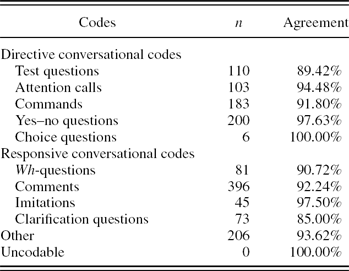
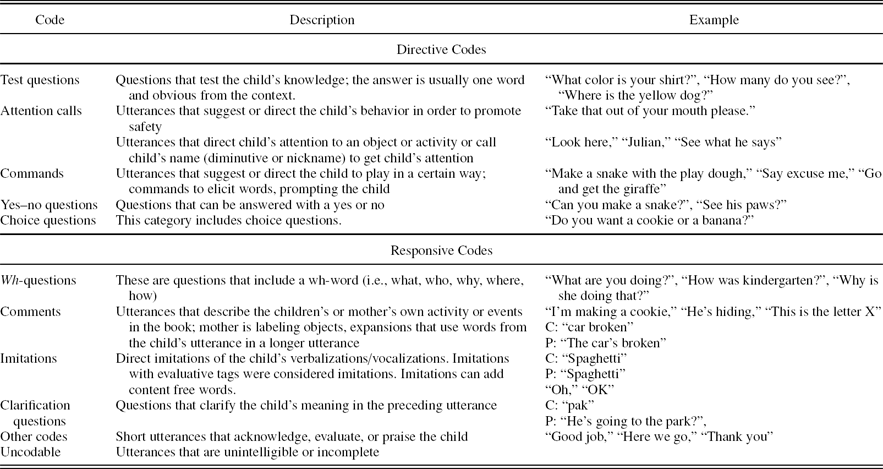
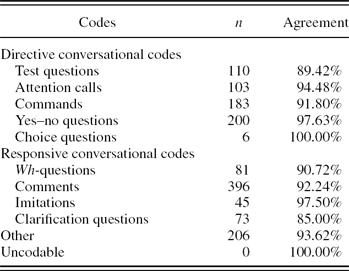
Each maternal utterance (excluding direct reading from books) was coded to describe mothers’ interaction style. The coding scheme was adapted from Girolametto, Weitzman, van Lieshout, and Duff (Reference Girolametto, Weitzman, Wiigs and Pearce2000) and previously demonstrated differences in interaction styles in early childhood educators when interacting with preschoolers in different contexts. Each maternal utterance received a directive or responsive code. Directive codes included test questions (e.g., What color is the dog?), attention calls (e.g., Julian, look here), commands (e.g., Make a snake with the yellow play dough), yes/no questions (e.g., Do you want some green play dough?), and choice questions (e.g., Is it the cat's chair or the dog's chair?). Responsive codes included open-ended wh-questions (e.g., What do you want to make now?), comments (e.g., She doesn't want her parents to go out), imitations (e.g., Child: “He's running”; Parent: “He's running”), and clarification questions (e.g., You think the babysitter's name is Sarah?). A research assistant coded the transcripts according to the coding system, and the first author independently coded a random sample of 20% from each context. Interrater reliability was calculated using the following formula: number of agreements/(the number agreements + disagreements) × 100 and yielded an overall agreement of 93.3% (n = 1,403). The reliability for the individual codes is presented in Table 2. A detailed description of the coding system with examples can be found in Appendix A.
Reliability of interaction codes for mothers (contexts collapsed)
Dependent measures
Structural measures
SALT was used to generate three dependent variables from the transcripts. First, SALT computed the MLU-m for mothers and children. The calculations of MLU-m were based on all completed and intelligible utterances produced by mothers and children in the two contexts (i.e., book reading and toy play). Second, SALT generated the TTR/50 for mothers and their children. The ratio was obtained by dividing the types (total number of different words) by the total number of tokens (total number of words). A high TTR indicates a high degree of lexical diversity, whereas a low TTR is thought to indicate a restricted vocabulary usage (Richards, Reference Richards1987). Richards (Reference Richards1987) pointed out that TTR might not discriminate between children who differ in age or language abilities. However, this measure was used because the children in this study were restricted in age range (46–60 months), had limited language abilities, and performed comparably on standardized language assessments. Third, SALT generated the total number of utterances for mothers and children in each context. These data were used to create the utterance ratio as an indicator of mother–child turn taking (the number of mothers’ utterances / by the number of children's utterances). A value near 1.0 indicated that the conversation was balanced, whereas values greater than 1.0 indicated that mothers talked more than children. These three measures were used to address the first purpose of the study, which was to compare mothers’ and children's language structure and utterance ratio across the two contexts of book reading and toy play.
Maternal interaction style
The frequency of each responsive and directive code was computed by SALT. These data were used to compare mothers’ use of each code across the two contexts. To examine the association between maternal interaction style and children's expressive language skills, the codes were summed to yield the total frequency of responsive codes and directive codes. A responsive interaction style consisted of all open-ended wh-questions, comments, clarification questions, and imitations. A directive interaction style was the sum of all commands, test questions, yes/no questions, choice questions, and attention calls.
Children's expressive language skills
The results of the Renfrew Bus Story for sentence length and the SPELT-P2 were combined into a single z score to represent children's expressive language skills. This was done because these two measures were conceptually related and the creation of a composite z score reduced the number of outcome variables. The correlation between these two measures was high (r = .639, p = .001). The composite z score was used to address the second purpose of the study, which was to investigate which features of maternal input were associated with children's expressive language skills.
RESULTS
Preliminary analyses
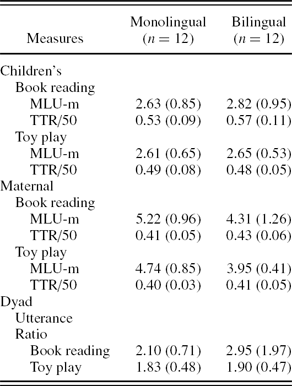
Preliminary analyses were conducted to examine within-group differences based on children's sex, their profile of LI, and the number of languages spoken in the home. A series of independent t tests were used with a Bonferroni correction. First, there were no significant differences between girls and boys in the sample with respect to MLU-m, TTR/50, or utterance ratio. Second, there were no statistically significant differences between subgroups of children with expressive-receptive LI and children with expressive-only LI on any of the dependent variables measured. Third, the bilingual children did not differ statistically from monolingual children with respect to any of the dependent variables. As can be seen in the first panel of Table 3, the MLU-m, TTR/50, and the utterance ratios of the bilingual children were comparable to those of the monolingual children. In addition, the characteristics of the monolingual and the bilingual mothers can be seen in the second panel of Table 3. There were no differences between monolingual and bilingual mothers with respect to MLU-m, TTR/50, utterance ratios, or interaction codes. Thus, all 24 mothers and children were collapsed into one group for subsequent analyses.
Means (standard deviations) of monolingual and bilingual mothers’ and children's structural language measures
Note: MLU-m, mean length of utterances in morphemes; TTR/50, token type ratio based on 50 utterances.
Group comparisons
Paired t tests were used to compare maternal and child measures across the two contexts of book reading and toy play. Where data were not normally distributed, a series of Wilcoxon signed-rank tests were used with a Bonferroni correction. Finally, we conducted zero-order correlations and multiple regression analyses that assessed maternal structural language and responsive interaction style as possible predictors of children's expressive language skills. A two-tailed alpha level of 0.05 was used for all statistical tests unless stated otherwise. Where parametric statistics were used, the effect size d was reported for each significant finding.
Mothers’ MLU-m was significantly longer during book reading (M = 4.77 SD = 1.19) than during toy play (M = 4.35, SD = 0.77), t (23) = 2.33, p = .029, with a small effect size, d = 0.43 (Cohen, Reference Cohen1988). However, maternal TTR/50 was similar during book reading and toy play (M = 0.417, SD = 0.06 and M = 0.405, SD = 0.04, respectively), and this difference was not statistically significant, t (23) = 0.84, p = .408, d = 0.24. These results indicated that the context of interaction influenced only MLU-m, which is an estimate of the linguistic complexity of mothers’ language input to their children.
An examination of children's MLU-m indicated that it was similar during book reading and toy play (M = 2.72, SD = 0.89 and M = 2.63, SD = 0.58, respectively). This difference was not statistically significant, t (23) = 0.46, p = .653, d = 0.12. However, children's lexicon was significantly more diverse during book reading (M = 0.55, SD = 0.10) than during toy play (M = 0.48, SD = 0.07), t (23) = 3.20, p = .004, d = 0.78. The effect size for lexical diversity was medium (Cohen, Reference Cohen1988). Thus, the book reading context provided more opportunities than toy play for children to demonstrate their expressive vocabulary skills.
The mother–child utterance ratio was calculated for each context (i.e., total number of maternal utterances/total number of children's utterances). Overall, mothers were verbally more active than their children. However, a paired t test revealed that the utterance ratio was significantly more balanced during toy play (M = 1.86, SD = 0.46) than during book reading (M = 2.52, SD = 1.51), t (23) = 2.37, p = .027, with a medium effect size, d = 0.67 (Cohen, Reference Cohen1988). These results indicate that mothers and children shared the conversation more equally during the toy play interactions.
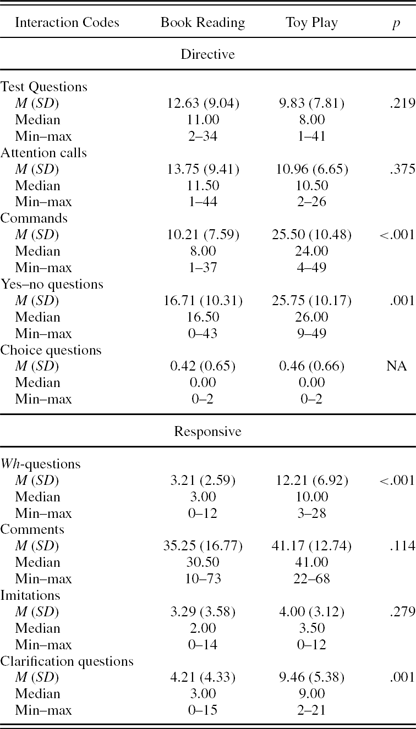
As can be seen in Table 4, mothers did not ask many choice questions, and this code was excluded from further analyses. Histograms revealed that the data for many of the interaction codes were not normally distributed (e.g., test questions, attention calls, commands, wh-questions, imitations, and clarification questions). Therefore, all interaction codes were submitted to nonparametric analyses comparing the two contexts. A series of Wilcoxon signed-rank tests were used with a Bonferroni correction. Thus, all effects are reported at a .006 level of significance (i.e., .05 divided by 8 codes). The effect sizes for nonparametric analyses were calculated using r, that is, the Z score divided by the square root of the total number of observations (Field, Reference Field2005). Cohen's criteria (Reference Cohen1988) for judging the size of the effect are applied to the results of this equation.
Descriptive statistics for mother's interaction codes in two contexts (N = 24)
Note: NA, not applicable. N = 24 mother–child dyads.
Two interaction codes that were thought to be indicative of a directive style were statistically significant across the two contexts. Mothers used significantly more commands and yes/no questions during toy play than during book reading (T = 287.00, Z = 3.92, p < .001, r = .57 and T = 265.50, Z = 3.30, p = .001, r = .48, respectively). These effect sizes were large and medium for commands and yes/no questions, respectively (Cohen, Reference Cohen1988). Furthermore, two interaction codes that were thought to be indicative of a responsive style were also significantly different across the two contexts. Mothers asked significantly more wh-questions and clarification questions during toy play than during book reading (T = 268.50, Z = 3.97, p < .001, r = .57 and T = 232.50, Z = 3.45, p = .001, r = .50, respectively). Both effect sizes were large (Cohen, Reference Cohen1988). None of the other comparisons was statistically significant.
Predicting children's expressive language skills
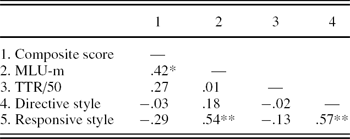
A correlational analysis was conducted to investigate if the maternal structural language and interaction style were associated with children's expressive language ability. For this analysis, MLU-m and TTR/50 across both contexts as well as the sum of all directive codes and the sum of all responsive codes across both contexts were correlated with a composite z score of children's expressive language skills. As can be seen in Table 5, only maternal MLU-m was significantly and positively associated with children's expressive language skills (r = .42, p = .040). In addition, the data indicate that mothers who produced longer utterances (MLU-m) used responsive utterances significantly more often (r = .54, p = .007). Moreover, maternal interactional styles (i.e., responsiveness and directiveness) were significantly associated with each other (r = .57, p = .003). Given that the two interaction styles were correlated, only the responsive style and maternal MLU-m were used as predictor variables in the regression analysis.
Correlations between maternal structural language and interaction style and children's expressive language skills (N = 24)
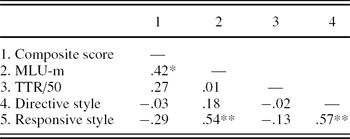
Note: Composite score is children's expressive language score. MLU-m, mean length of utterances in morphemes for mothers; TTR/50, token type ratio for mothers based on 50 utterances.
*p < .05. **p < .01.
A stepwise regression analysis was conducted to determine if maternal language (i.e., MLU-m) or interactional style (i.e., responsiveness) predicted children's expressive language development (i.e., the composite z score of the SPELT-P2 and the Renfrew Bus Story). Only mother's MLU-m was a significant predictor of children's expressive language skills, F (1, 22) = 4.77, p = .040, β = 0.42. In other words, mothers’ use of longer and more complex sentences accounted for 17.8% of the variance in the composite measure of children's expressive language.
DISCUSSION
The main goals of this study were to investigate if contextual variation influenced mother–child interactions and whether maternal input predicted child language development. The results yielded several noteworthy findings. First, the book reading context exposed children with LI to more complex maternal language and facilitated children's use of a more diverse vocabulary. Second, toy play was characterized by an eliciting style of interaction that resulted in a more balanced utterance ratio (i.e., greater child participation) than book reading. Third, only maternal MLU, and not conversational style, was predictive of language development for preschoolers with LI. Thus, this study contributes to the literature by revealing some important differences concerning the effect of context on mother–child interactions. Furthermore, it confirms the importance of maternal language complexity for explaining variation in child language development in 4- to 5-year-olds.
According to the structural hypothesis, maternal linguistic input that is more complex than children's abilities provides semantic and syntactic models that may facilitate their language development (Cross, Reference Cross, Snow and Ferguson1977). In the current study, the data show that mother's MLU-m was approximately one to two morphemes longer than the children's utterances. Moreover, only maternal language structure was related to children's language development. An examination of the structural features of maternal input indicated that the diversity of mothers’ vocabulary was similar in the two contexts; however, mothers’ utterances were longer in the book reading context. Theoretically, longer utterances could provide scope for greater vocabulary diversity by virtue of the fact that the utterances contain more words; however, this assumption was not supported by the current study. Longer utterances were also not associated with vocabulary diversity in descriptions of three mother–child interactions in the contexts of book reading and toy play (Kaderavek & Sulzby, Reference Kaderavek, Sulzby, Watson, Crais and Layton2000; Sulzby & Kaderavek, Reference Sulzby and Kaderavek1996). It is important to note that the effect size for contextual differences in maternal MLU was small, a difference of approximately one morpheme/word for every two utterances. Thus, overall, the findings regarding structural indices of maternal language input yielded close similarities in the vocabulary and language models afforded by both toy play and book reading.
An examination of the children's MLU-m and TTR revealed the opposite pattern. While children's MLU-m was similar in both contexts, their TTR differed. The finding that children's sentence lengths remained relatively stable across contexts is consistent with previous case study reports (Kaderavek & Sulzby, Reference Kaderavek, Sulzby, Watson, Crais and Layton2000; Sulzby & Kaderavek, Reference Sulzby and Kaderavek1996). One potential explanation for the lack of difference might reside in the fact that the books were most likely unfamiliar to the children. No mother indicated that her child knew the books. It may be the case that repeated readings would have facilitated more in-depth book discussions and longer MLU-m values (Crowe et al., Reference Crowe, Norris and Hoffman2004; Evans & Schmidt, Reference Evans and Schmidt1991). In contrast, the children's vocabulary was more diverse during book reading than during toy play, with a medium effect size. The scope of the vocabulary used during shared book reading is dictated by the book. Aside from labeling the pictures (e.g., characters and objects) in the book, the story plot or events in the book may facilitate talk that is unrelated to the book or that goes beyond the scope of the book's vocabulary. Conversely, vocabulary for toys and activities during toy play may have been more restricted owing to the child's plan of the moment or the number of toys provided. This result is consistent with the findings reported previously for case studies of children who also demonstrated a higher TTR during book reading as compared to toy play (Kaderavek & Sulzby, Reference Kaderavek, Sulzby, Watson, Crais and Layton2000; Sulzby & Kaderavek, Reference Sulzby and Kaderavek1996).
In the current study, children with LI were more verbally involved in the toy play conversation, as determined by the utterance ratio, which was significantly more balanced than in book reading. The effect size for this difference was medium, indicating that this contextual difference is an important finding. One explanation for this finding may be that children with LI may be more passive during book reading activities (Kaderavek & Sulzby, Reference Kaderavek and Sulzby1998; Rabidoux & MacDonald, Reference Rabidoux and MacDonald2000) or show less interest (Kaderavek & Sulzby, Reference Kaderavek, Sulzby, Watson, Crais and Layton2000; Skibbe, Mooney, Justice, & McGinty, Reference Skibbe, Mooney, Justice and McGinty2010). The significant difference found in maternal ratings of representativeness in the current study supports this explanation. Specifically, mothers in the current study rated their children's level of interest/attention significantly lower for the book reading interaction than for the toy play interaction. Thus, it may be challenging for mothers of children with LI to engage their children in conversation during book reading given their disinterest and lack of attention. A compatible explanation may be that mothers regard book reading as a listening activity, whereas they may consider toy play as an opportunity to have an interactive conversation about the play. This interpretation is supported by studies suggesting that mothers of children with LI tend to elicit few verbal responses during book reading (Crowe et al., Reference Crowe, Norris and Hoffman2004; Marvin & Wright, Reference Marvin and Wright1997) and by the data in the current study. These data indicate that mothers used an interaction style that sought to elicit, through commanding and questioning, a greater degree of child verbal participation in toy play than in book reading. In other words, mothers used a combination of directive and responsive strategies that are associated with a higher illocutionary force more often in toy play than in book reading (i.e., more commands, yes/no questions, wh-questions, and clarification questions). This, in turn, may have encouraged children to use more verbal utterances, resulting in a more balanced utterance ratio. Upon examination of the individual data, no distinct pattern emerged for mothers who were less responsive and less directive compared to the mothers who were more responsive and more directive. Although interaction style was not predictive of children's expressive language skills, this finding indicates that maternal interaction style is context dependent. However, it should be kept in mind that the small sample size may have impacted the power of the regression analysis and that a larger sample may have yielded different results.
The contextual finding for mothers’ interaction style is in contrast with the results of studies conducted with typically developing children. For example, parents of young children with typical development were more conversational and used higher rates of topic-continuing replies during book reading than during toy play (Crain-Thoreson, Dahlin, & Powell, Reference Crain-Thoreson, Dahlin and Powell2001). Hoff-Ginsberg (Reference Hoff-Ginsberg1990) reported that toy play elicited the highest rate of directives and the lowest rate of conversation-eliciting utterances in dyads of mothers with their typically developing children. However, the results of our study are consistent with findings by Crawley and Spiker (Reference Crawley and Spiker1983). They investigated the interactions of 18 mothers and their 2-year-old children with Down syndrome. Results indicated that mothers who were being rated as highly sensitive (i.e., they responded appropriately to their child's social initiations) also received moderately high directiveness ratings. Thus, mothers could be both directive and highly responsive. Moreover, Tannock (Reference Tannock1988) proposed that aspects of a directive interaction style (e.g., topic control) can be viewed as a supportive strategy when mothers interact with their children who are developmentally immature. In other words, introducing a new topic may engage an uninvolved child or redirecting the child's attention may prevent repetitive behaviors.
The observed pattern in the current study (low elicitation in book reading and higher elicitation in toy play) may represent an adaptation to the children's LI. This further highlights that it is important for speech–language pathologists, psychologists, and other professionals to observe parent–child dyads in different contexts when gaining language or interaction samples. One goal of language interventions based on shared reading (e.g., Crain-Thoreson & Dale, Reference Crain-Thoreson and Dale1999; Hargrave & Senechal, Reference Hargrave and Senechal2000; Whitehurst et al., Reference Whitehurst, Zevenbergen, Crone, Schultz, Velting and Fischel1999) is to teach parents how to engage their children in conversations by asking open questions about the story characters or events, pausing and waiting for a response, and expanding the children's answers. Finally, maternal MLU (across both contexts), and not interaction style, was found to be a significant predictor of children's language development. This indicates an association between mother and child structural language and not a cause and effect relationship. This finding further replicates previous work with typically developing children (Hoff-Ginsberg, Reference Hoff-Ginsberg1990; Huttenlocher, Levine, & Vevea, Reference Huttenlocher, Levine and Vevea1998) and children with LI (Girolametto, Weitzman, Wiigs, & Pearce, Reference Girolametto, Weitzman, van Lieshout and Duff2000). It provides further support for social interactionist accounts of language acquisition that ascribe a key role to structural elements of maternal speech input. The data in this study indicate that mothers’ MLU-m were 1.7 and 2.0 morphemes higher than those of the children, in toy play and in book reading, respectively. Consequently, the mothers in this sample modeled more complex language to their children in both contexts. These results support counseling parents to use language that is more complex than their child's language as a key intervention strategy for children with LI.
Limitations
There are a number of limitations to this study. One methodological limitation was that mother–child interactions were observed in a laboratory setting. Although mothers indicated that they felt comfortable in the videotaping situation, it is still possible that mothers and/or children would have behaved differently when observed at home. It is further conceivable that familiar toys and books or materials chosen by the child would have yielded different results. However, all children in this study used a standard set of books and toys, and should, therefore, have had similar opportunities to engage in interaction. A second limitation concerns the sample of children with LI, which was heterogeneous with respect to their language, cultural background, and maternal education. Many speech–language pathologists work with patients or families who come from diverse backgrounds. Thus, research including diverse populations is important because it can aid clinicians in decision making. In this study, children from different language backgrounds participated, and although there was variability in terms of the length of exposure to English, there were no significant group differences between monolingual and bilingual children with respect to their language skills or structural language measures. This might indicate that mother–child dyads were similarly affected by contextual variations, independent of their different language backgrounds. It also shows that the bilingual children in this study (who were English dominant and had been exposed to English for an average of 2 years) were not significantly different from their monolingual peers in terms of MLU-m, TTR/50, and standardized assessments of narrative sentence length or morphosyntax. A third limitation may have been the small sample size. In this study, only maternal MLU-m across both contexts predicted children's language skills. However, model building was limited by the sample size of 24 participants. A larger sample size would have provided us with more opportunities to investigate potential predictors of children's expressive language skills, such as maternal education.
Implications and future research
An examination of interactive context revealed that mother–child interactions differed in shared storybook reading and play. First, these results suggest that assessments of mother–child interaction should sample diverse contexts because maternal language input and child language measures may differ in systematic ways. In this study, mothers used an eliciting style during toy play, and their children were more verbally active than during book reading. However, book reading yielded a higher maternal MLU and more diverse vocabulary in children. The benefit of sampling diverse contexts is that this affords a more comprehensive and accurate evaluation of maternal language input and child participation. Second, parent-focused interventions that focus on modifying maternal language input need to take these contextual differences into account. The two contexts examined in this study exposed the children to differential language input that collectively may be facilitative of children's language development. Thus, including an intervention focus on ways to optimize maternal input across the day, in different activities, may result in increased child verbal participation in both contexts. Evidence from intervention studies indicates that parents can successfully be taught to use language-facilitating strategies during book reading (Crowe et al., Reference Crowe, Norris and Hoffman2004) and during toy play (Girolametto & Weitzman, Reference Girolametto, Weitzman, McCauley and Fey2006) with concomitant advances in children's language development. Third, although book reading has gained increased attention as a facilitative context for language and literacy learning (Kaderavek & Justice, Reference Kaderavek and Justice2002), the results of this study suggest that play interactions are also important and should not be overlooked in intervention programs. Future research needs to investigate the influence of other contexts on mother–child interaction. In addition, further investigations of the impact of maternal interaction style on language development need to be conducted using longitudinal designs that measure child language gains over time.
ACKNOWLEDGMENTS
This research was supported by a grant from the Social Sciences and Humanities Research Council (Canada) and the Canadian Language and Literacy Research Network. We are grateful for the support received from the two participating agencies in participant recruitment and testing: the Toronto Preschool Speech and Language Services, Toronto, and the Nova Scotia Hearing and Speech Clinics, Halifax, Nova Scotia.
Coding scheme for maternal interaction style