INTRODUCTION
Cryptosporidium is an obligate enteric parasite of the phylum Apicomplexa and an important cause of diarrhoeal disease in humans and livestock. The disease is particularly debilitating in neonates and immunocompromised individuals. In calves, lambs and kids, it is considered one of the main causes of morbidity and mortality (Current, Reference Current, Dubey, Speer and Fayer1990; Munoz et al. Reference Munoz, Alvarez, Lanza and Carmenes1996; De Graaf et al. Reference De Graaf, Vanopdenbosch, Ortega-Mora, Abbassi and Peeters1999). Studies from all over the world indicate that the parasite is also widespread in piggeries (Sanford, Reference Sanford1987; Tacal et al. Reference Tacal, Sobieh and El-Ahraf1987; Xiao et al. Reference Xiao, Herd and Bowman1994; Quilez et al. Reference Quilez, Sanchez-Acedo, Clavel, Del Cacho and Lopez-Bernad1996; Olson et al. Reference Olson, Thorlakson, Deselliers, Morck and McAllister1997; Ryan et al. Reference Ryan, Samarasinghe, Read, Buddle, Robertson and Thompson2003; Yu and Seo, Reference Yu and Seo2004; Hamnes et al. Reference Hamnes, Gjerde, Forberg and Robertson2006; Vítovec et al. Reference Vítovec, Hamadejova, Landova, Kvac, Kveton and Sak2006; Xiao et al. Reference Xiao, Moore, Ukoh, Gatei, Lowery, Murphy, Dooley, Millar, Rooney and Rao2006; Langkjaer et al. Reference Langkjaer, Vigre, Enemark and Maddox-Hyttel2007). However, while experimental infections in piglets may cause moderate illness with anorexia, vomiting and diarrhoea (Tzipori et al. Reference Tzipori, McCartney, Lawson, Rowland and Campbell1981; De Graaf et al. Reference De Graaf, Vanopdenbosch, Ortega-Mora, Abbassi and Peeters1999), natural infections appear to be largely silent in both young and adult pigs (Tzipori et al. Reference Tzipori, McCartney, Lawson, Rowland and Campbell1981; Quilez et al. Reference Quilez, Sanchez-Acedo, Clavel, Del Cacho and Lopez-Bernad1996; Olson et al. Reference Olson, Thorlakson, Deselliers, Morck and McAllister1997; De Graaf et al. Reference De Graaf, Vanopdenbosch, Ortega-Mora, Abbassi and Peeters1999; Vítovec et al. Reference Vítovec, Hamadejova, Landova, Kvac, Kveton and Sak2006). Four Cryptosporidium species have been isolated from pigs; C. suis (formerly pig genotype I), Cryptosporidium pig genotype II, C. parvum and C. muris (Ryan et al. Reference Ryan, Samarasinghe, Read, Buddle, Robertson and Thompson2003, Reference Ryan, Monis, Enemark, Sulaiman, Samarasinghe, Read, Buddle, Robertson, Zhou, Thompson and Xiao2004; Hamnes et al. Reference Hamnes, Gjerde, Forberg and Robertson2006; Xiao et al. Reference Xiao, Moore, Ukoh, Gatei, Lowery, Murphy, Dooley, Millar, Rooney and Rao2006; Langkjaer et al. Reference Langkjaer, Vigre, Enemark and Maddox-Hyttel2007). Pig genotype II has not been reported from humans so far, but there are a small number of reports of C. suis and C. muris infections in both immunocompromised and immunocompetent people (Xiao et al. Reference Xiao, Bern, Arrowood, Sulaiman, Zhou, Kawai, Vivar, Lal and Gilman2002; Caccio, Reference Caccio2005; Cama et al. Reference Cama, Gilman, Vivar, Ticona, Ortega, Bern and Xiao2006; Gatei et al. Reference Gatei, Wamae, Mbae, Waruru, Mulinge, Waithera, Gatika, Kamwati, Revathi and Hart2006; Muthusamy et al. Reference Muthusamy, Rao, Ramani, Monica, Banerjee, Abraham, Mathai, Primrose, Muliyil, Wanke, Ward and Kang2006). C. parvum, on the other hand, is the most important zoonotic agent of the genus.
The predominant usage of unfiltered surface water for drinking water, periods of heavy rainfall and soils prone to rapid surface run-off, leave Ireland vulnerable to water-borne outbreaks due to zoonotic Cryptosporidium species. However, it is unclear whether pigs represent significant environmental reservoirs for cryptosporidiosis in humans and livestock. In the present study, the prevalence of Cryptosporidium in 5 conventional piggeries was determined. The age-specific distribution of the 4 species was examined. Different approaches were used to investigate the presence of single and mixed infections.
MATERIALS AND METHODS
Sample collection
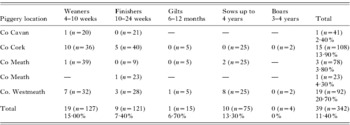
Between May and July 2005, 5 intensive commercial pig production units in Ireland, located in counties Cavan (1), Cork (1), Meath (2) and Westmeath (1) were visited. All animals were housed indoors on solid concrete floors and fed pelleted feed. In total, 342 faecal samples were collected from weaners (4–10 weeks of age), finishers (10–24 weeks of age), sows (up to 4 years old), gilts (6–12 months of age) and boars (3–4 years old) (Table 1).
Summary of the numbers of pigs positive for Cryptosporidium in various age groups in 5 farms (n indicates the total number examined)

Oocyst concentration using Sheather's sugar solution and DNA extraction
All samples were microscopically screened for the presence of Cryptosporidium oocysts following staining with auramine phenol (Office International des Epizooties, 2004).
Oocysts in positive samples were concentrated by flotation in Sheather's sugar solution (sp. gr. 1.18 at 4°C) (Current, Reference Current, Dubey, Speer and Fayer1990). DNA was then extracted according to the methods described by Boom et al. (Reference Boom, Sol, Salimans, Jansen, Wertheim Van and Van Der Noordaa1990) as modified by McLauchlin et al. (Reference McLauchlin, Pedraza-Diaz, Amar-Hoetzeneder and Nichols1999). Briefly, approx 200 μl of concentrated oocysts mixed with 900 μl of 10 m guanidinium thiocyanate in 0·1 m Tris-HCl (pH 6·4)-0·2 m EDTA (pH 8·0)-2% (wt/vol) Triton X-100, 0·3 g of 0·5 mm diameter glass beads (Stratech Scientific, UK) and 60 μl of isoamyl alcohol, were homogenized in a Mini-Beadbeater (Stratech Scientific) for 2 min. The mixture was left at room temperature for 5 min, and then centrifuged (12 050 g, 2 min). The supernatant was incubated with 100 μl of coarse activated silica at room temperature for 10 min with gentle agitation. Subsequently, the silica pellet was washed twice with 200 μl of 10 m guanidinium thiocyanate in 0·1 m Tris-HCl (pH 6·4), twice with 200 μl of ice-cold 80% ethanol, and once with 200 μl of ice-cold acetone. Each centrifugation was carried out at 8850 g for 20 s. After the final wash the pellet was dried under a vacuum at 45°C for 10 min. The DNA was eluted into 150 μl of nuclease-free water after vortex mixing and incubation at 56°C for 5 min. Prior to PCR amplification, all DNA extracts were purified by PVP (polyvinylpyrrolidone, Sigma) precipitation (Lawson et al. Reference Lawson, Linton, Stanley and Owen1997) as follows: 50 μl of extracted DNA were incubated with 150 μl of PVP-TE (10% [wt/vol] PVP in TE buffer) for 10 min at room temperature. Subsequently 100 μl of 2 m ammonium acetate and 600 μl of isopropanol were added to the mixture and the DNA precipitated by incubating at −20°C for 30 min. The DNA was pelleted by centrifugation (12 050 g, 10 min), dried and reconstituted in 50 μl of water.
PCR amplification of the SSU rRNA gene fragment
The nested PCR was carried out according to the protocol described by Xiao et al. (Reference Xiao, Morgan, Limor, Escalante, Arrowood, Shulaw, Thompson, Fayer and Lal1999). The primers were (forward) 5′-TTCTAGAGCTAATACATGCG and (reverse) 5′-CCCATTTCCTTCGAAACA GGA for the primary reaction, and (forward) 5′-GGAAGGGTTGTATTTATTAGATAAAG and (reverse) 5′-AAGGAGTAAGGAACAACCTCCA for the second PCR. Both PCR reations were carried out in a total volume of 50 μl containing 5 μl of PCR buffer, 200 μm of each deoxynucleoside triphosphate, 10 pmoles of each primer, 20 μg non-acetylated BSA and 1·25 U of Taq polymerase. In the first PCR, 6 mm MgCl2 and 5 μl of DNA template were added to the reaction mixture, in the 2nd PCR, the MgCl2 concentration was reduced to 3 mm, and the PCR template to 2·5 μl. The cycling conditions for both reactions consisted of an initial heating step at 94°C for 3 min, followed by 35 cycles of denaturing at 94°C for 45 s, annealing at 55°C for 45 s, and extension at 72°C for 1 min. The final extension was carried out at 72°C for 7 min.
The resulting PCR products were purified using the QIAquick PCR purification kit (Qiagen) and sequenced in both directions (GATC Biotech AG, Konstanz, Germany). In addition, PCR products were analysed by restriction fragment length polymorphism (RFLP).
RFLP analysis of the SSU rRNA gene of C. suis, C. parvum and genotype II
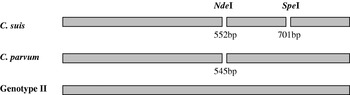
Two RFLP analyses were designed by targeting heterologous regions in the alignment of the SSU rRNA gene fragment from C. parvum, C. suis and pig genotype II. C. suis and C. parvum were characterized by an NdeI restriction site at positions 552 and 545 respectively. Digestion of the PCR products resulted in 2 fragments of 552 and 280 bp (C. suis) and 545 and 280 bp (C. parvum). This restriction enzyme site was absent in Cryptosporidium pig genotype II (Fig. 1). Moreover, a SpeI restriction site was found exclusively in C. suis isolates at position 701, and digestion of the PCR products generated 2 fragments of 701 and 130 bp. For the digestion, 4 μl of PCR product were incubated with 4 U SpeI or 8 U NdeI (New England Biolabs), and 1 μl of the appropriate restriction buffer in a total volume of 10 μl for 3 h at 37°C. After addition of 2 μl of loading dye, the total volume was loaded on to the gel. The digested fragments were fractionated on a 2% agarose gel and visualized by ethidium bromide staining.
Illustration of the alignment of the SSU rRNA gene fragment of Cryptosporidium suis, C. parvum and pig genotype II showing NdeI and SpeI restriction sites.

Cloning of SSU rRNA gene fragments
The nested PCR products of 3 isolates were cloned using the pGEM-T Easy Vector System (Promega) according to the manufacturer's instructions. From each isolate, 20 clones were re-amplified using the internal primer pair. The resulting products were screened using the RFLP assay described above. For each isolate, 1 representative clone for each RFLP-profile was sequenced.
Phylogenetic analysis
Sequences were aligned using ClustalW (alignments can be obtained from the authors upon request). Phylogenetic analysis of the relationship between sequences of our isolates and published sequence data was carried out using MEGA version 3.1 (Kumar et al. Reference Kumar, Tamura and Nei2004). This software programme was used to construct a Neighbour-Joining tree. Tree reliability was assessed by the bootstrap method with 1000 pseudoreplicates. Nucleotide sequence data reported in this paper are available in EMBL, GenBank™ and DDJB databases under the Accesssion numbers DQ833277 to DQ833280 and EF489036 to EF489040.
RESULTS
Cryptosporidium infections in the 5 piggeries
Oocysts were detected in the faeces of 39 out of the 342 pigs examined (11·4%) (Table 1). Prevalence decreased with age with 15% of weaners (4–10 weeks of age), and 7·4% of finishers (10–24 wks of age) infected, but peaked again among sows (13·3%). Infections in gilts and boars were rare. Positive cases were reported in all 5 farms, but were more common in piggeries that housed all age groups. In general, infection intensities were extremely low (with only 1–3 oocysts detected per slide). All pigs were healthy and with the exception of 3 samples, none of the stools was diarrhoeic. The 3 diarrhoeic samples were negative for Cryptosporidium. In a separate study on the prevalence of Salmonella in Irish piggeries it was found that between 4 and 18% of pig faeces on the 5 farms were also positive for Salmonella serotypes, the majority being Typhimurium strains (Kozlowski, Reference Kozlowski2006). While both pathogens were most commonly detected in weaners, there was no correlation between the two as over half (53%) of the Cryptosporidium-positive pigs were infected with this pathogen alone.
Prevalence of Cryptosporidium species
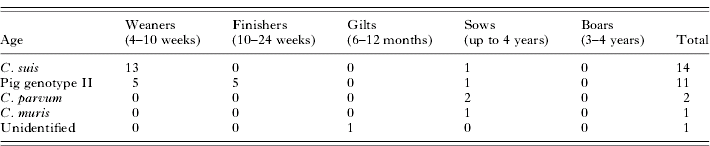
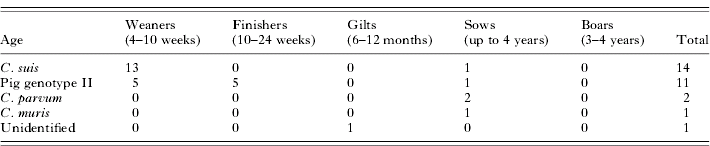
PCR amplification of the SSU rRNA gene fragment was successful in 29 of the 39 oocyst-positive samples. According to sequence analysis of the amplicons, 14 pigs carried C. suis and 11 pigs carried pig genotype II infections (identical to published sequences AF115377 and DQ182600, respectively) (Table 2). With 1 exception (an infection in a sow), all C. suis infections occurred in weaners (4–10 weeks of age), while pig gentoype II infections were evenly distributed between weaners and finishers (10–24 weeks of age) and 1 infection in a sow. Two C. parvum and 1 C. muris infection were identified in 3 sows from the same farm. The C. muris isolate was identical to published sequences (AF093498). The 2 C. parvum isolates were 99% homologous to each other and to published sequences of C. parvum isolated from bovine (AF093490), murine (AF112571) and human hosts (DQ388388). The DNA fragment amplified from the faecal sample of the gilt could not be identified because of poor homology between repeated forward and reverse sequences. Similarly, in at least 11 other isolates (7 weaners, 3 finishers and 1 sow), forward and reverse sequences differed considerably (ClustalW scores of same length fragments 91 to 98). ABI-profiles also indicated the presence of different alleles.
Prevalence of Cryptosporidium suis, pig genotype II, C. parvum and C. muris in pigs of different age groups
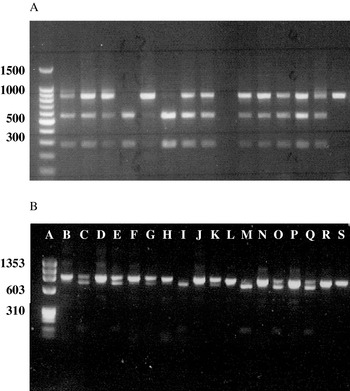
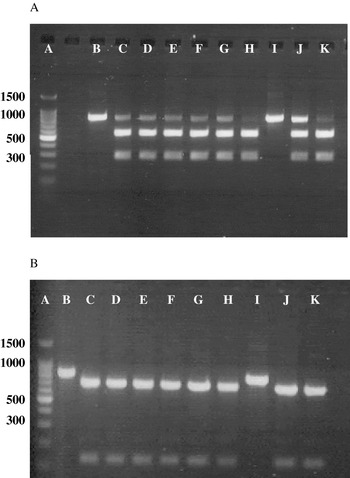
With the exception of the C. muris isolate (this species had not been considered when the assay was designed) and the unidentified isolate, all amplicons were correctly identified using the PCR-RFLP analysis. In a number of instances, NdeI digestion resulted in triple bands, SpeI digestion in double bands (Fig. 2A, B). This may have been either due to incomplete digestion and/or the presence of mixed infections.
NdeI (A) and SpeI (B) digestion of SSU rRNA gene fragments. (A) Lanes B to O show digested amplicons of 14 pig isolates. (B) Lanes B, D, F, H, J, L, N, P, R show undigested amplicons of 9 pig isolates. Lanes C, E, G, I, K, M, O, Q, S indicate respective digested products. Lane A: Molecular weight marker (100 bp ladder, Promega).

Cloning of the SSU rRNA gene fragment
Cloning of amplicons from 3 isolates (from 2 weaners sequence-identified as C. suis; and 1 gilt, unidentified by direct sequence analysis) revealed that the weaners carried mixed infections of C. suis and genotype II. The infection in the gilt was identified as a mixture of C. parvum (99% homology with published sequence AJ493079) (EF489036) and a genotype that showed low homology to any published sequence (EF489037).
The PCR-RFLP analysis was used to screen clones in order to select products for sequencing. In some clones, undigested DNA was observed alongside digested material (Fig. 3A, B).
PCR-RFLP profiles of 10 clones of the PCR product of one isolate, digested with NdeI (A) and SpeI (B). Lanes B, I: profiles characteristic of pig genotype II; Lanes C, D, E, F, G, H, J, K: profiles characteristic of Cryptosporidium suis. Lane A: Molecular weight marker (100 bp ladder, Promega).

Phylogenetic analysis of the 4 Cryptosporidium species
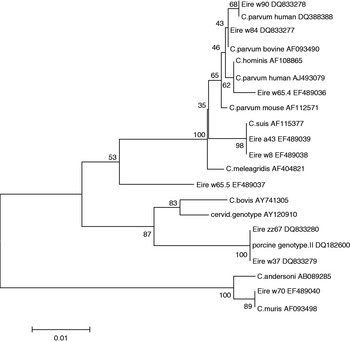
To establish the relationship between the novel genotype and other Cryptosporidium spp. detected in pigs and other mammals, the sequence was aligned with sequences of our own isolates and previously published sequences of C. parvum (AF093490, AF112571, AJ493079, DQ388388), C. suis (AF115377), pig genotype II (DQ182600), C. muris (AF093498), C. hominis (AF108865), C. bovis (AY741305), C. meleagridis (AF404821), C. andersoni (AB089285) and the deer Cryptosporidium genotype (AY120910) obtained from GenBank. Our C. parvum and C. suis isolates formed a clade with published sequences of C. parvum, C. hominis and C. meleagridis, while the undentified genotype grouped with pig genotype II, C. bovis and the cervid genotype (Fig. 4). The Irish C. muris isolate together with a published sequence of C. muris formed a separate group with C. andersoni.
Phylogenetic relationships of 9 Irish pig isolates using partial SSU rRNA sequences. Accession numbers are given in parentheses.

DISCUSSION
Cryptosporidiosis infection rates of between 5 and 32% (Sanford, Reference Sanford1987; Tacal et al. Reference Tacal, Sobieh and El-Ahraf1987; Xiao et al. Reference Xiao, Herd and Bowman1994; Quilez et al. Reference Quilez, Sanchez-Acedo, Clavel, Del Cacho and Lopez-Bernad1996; Olson et al. Reference Olson, Thorlakson, Deselliers, Morck and McAllister1997; Ryan et al. Reference Ryan, Samarasinghe, Read, Buddle, Robertson and Thompson2003; Yu and Seo, Reference Yu and Seo2004; Vítovec et al. Reference Vítovec, Hamadejova, Landova, Kvac, Kveton and Sak2006; Langkjaer et al. Reference Langkjaer, Vigre, Enemark and Maddox-Hyttel2007) have been reported from piggeries worldwide. The overall prevalence of around 11% observed in the present study is similar to infection rates reported from the Czech Republic (Vítovec et al. Reference Vítovec, Hamadejova, Landova, Kvac, Kveton and Sak2006), the US (Xiao et al. Reference Xiao, Herd and Bowman1994), Canada (Olson et al. Reference Olson, Thorlakson, Deselliers, Morck and McAllister1997) and Korea (Yu and Seo, Reference Yu and Seo2004). As in our study, infection rates elsewhere have been reported to peak in weanlings, with falling rates as pigs grow older (Sanford, Reference Sanford1987; Quilez et al. Reference Quilez, Sanchez-Acedo, Clavel, Del Cacho and Lopez-Bernad1996; Langkjaer et al. Reference Langkjaer, Vigre, Enemark and Maddox-Hyttel2007). It has been suggested that the withdrawal of protective maternal antibody and the stress of weaning renders weaners particularly susceptible to infection (Hamnes et al. Reference Hamnes, Gjerde, Forberg and Robertson2006). Indeed, nursing piglets that were not included in the present study are less commonly infected (Xiao et al. Reference Xiao, Herd and Bowman1994; Quilez et al. Reference Quilez, Sanchez-Acedo, Clavel, Del Cacho and Lopez-Bernad1996; De Graaf et al. Reference De Graaf, Vanopdenbosch, Ortega-Mora, Abbassi and Peeters1999; Vítovec et al. Reference Vítovec, Hamadejova, Landova, Kvac, Kveton and Sak2006; Langkjaer et al. Reference Langkjaer, Vigre, Enemark and Maddox-Hyttel2007). We observed a second peak of infection rates among sows. In this group stress associated with pregancy and hormonal changes may increase susceptibility to infection. It is possible that these animals maintain the parasite life-cycle in piggeries even in the absence of piglets. These low-level infections may provide a continuous supply of small numbers of infectious oocysts to infect susceptible piglets. Most other studies failed to detect infections in sows (Xiao et al. Reference Xiao, Herd and Bowman1994; Quilez et al. Reference Quilez, Sanchez-Acedo, Clavel, Del Cacho and Lopez-Bernad1996; Vítovec et al. Reference Vítovec, Hamadejova, Landova, Kvac, Kveton and Sak2006) but this may have been due to the numbers of animals examined or the limits of the detection methods employed.
It has been argued that destruction of the intestinal epithelia by the parasite may increase susceptibility to other enteric pathogens (Lefay et al. Reference Lefay, Naciri, Poirier and Chermette2001). However, in pigs, diarrhoea is regarded as a multifactorial problem with Cryptosporidium acting as an opportunistic co-pathogen at most (de Graaf et al. Reference De Graaf, Vanopdenbosch, Ortega-Mora, Abbassi and Peeters1999). We found no correlation with Salmonella infection for which pigs frequently act as carriers without suffering any clinial signs. Our study also confirmed the non-pathogenic nature of natural Cryptosporidium infections as none of the infected animals had diarrhoea and concentrations of oocysts were close to detection limits.
C. suis was most common among weaners while pig genoypte II was evenly distributed between weaners and finishers. In contrast, sows carried the full range of species known to occur in pigs. In addition to 1 C. suis and 1 pig genotype II infection respectively, 1 sow was infected with C. muris, confirming a recent report of the presence of this species in pig slurry (Xiao et al. Reference Xiao, Moore, Ukoh, Gatei, Lowery, Murphy, Dooley, Millar, Rooney and Rao2006). Two sows from the same farm carried an unusual C. parvum strain that had previously been isolated from bovine, murine and human hosts. While the present study only represents a snapshot of the epidemiology of Cryptosporidium in pigs in Ireland, it suggests that the levels of oocyst shed by pigs are very low compared to the numbers shed by calves or lambs. Moreover, in contrast to calves and lambs, most pigs carry species of little or no virulence to humans. It is thus unlikely that, compared to dairy or sheep farms, piggeries pose an important threat to drinking water, due to dilution effects. Pigs may, however, represent a source of infection to animal handlers. A genotype that did not align well with any published sequence of Cryptosporidium was detected in a gilt. Phylogenetic analysis indicated that it was more closely related to the C. parvum clade than the deer/pig genotype II group.
ABI-profiles and poor homology between forward and reverse sequenced SSU rRNA fragments and repeat sequencing analyses indicated the presence of different alleles in several samples. This was confirmed by cloning PCR products from 3 such animals. Increasingly, mixed Cryptosporidium infections are also reported from humans (McLauchlin et al. Reference McLauchlin, Amar, Pedraza-Diaz and Nichols2000; Tanriverdi et al. Reference Tanriverdi, Arslan, Akiyoshi, Tzipori and Widmer2003; Cama et al. Reference Cama, Gilman, Vivar, Ticona, Ortega, Bern and Xiao2006). The majority of such reports involve simultaneous infections of C. hominis and C. parvum, but Cama et al. (Reference Cama, Gilman, Vivar, Ticona, Ortega, Bern and Xiao2006) reported mixed infections of up to 3 species including C. felis, C. canis and C. meleagridis. Mixed Cryptosporidium infections may either be due to the simultaneous acquisition of infectious oocysts of mixed species, or the accumulation of several chronic infections over time. It is likely that both occurred in the pigs investigated in this study. Since the infections were subclinical, they would have gone unnoticed as they were transmitted throughout the intensively-farmed herds. Pigs infected in this manner probably accumulate numerous infections over time. In humans, chronic cryptosporidiosis is restricted to immunocompromised patients, and a gradual accumulation of several Cryptosporidium infections probably only occurs in this group. Indeed, most reports of mixed infections concern HIV-positive patients (Cama et al. Reference Cama, Gilman, Vivar, Ticona, Ortega, Bern and Xiao2006). Recently, piglets have been put forward as superior animal infection models when assessing Cryptosporidium pathogenicity (Enemark et al. Reference Enemark, Bille-Hansen, Lind, Heegaard, Vigre, Ahrens and Thamsborg2003) or oocyst viability by bioassay (Graczyk et al. Reference Graczyk, Lewis, Glass, Dasilva, Tamang, Girouard and Curriero2007). Since mixed chronic infections appear to be common in naturally infected pigs they may also be useful models for mixed infections in AIDS patients.
The PCR-RFLP which utilizes Xiao's primers and restriction enzymes specific for heterologous regions in the SSU gene fragment, is a useful tool for differentiating C. suis, C. parvum and pig genotype II. However, the cloning experiments showed that the assay cannot be used to identify mixed infections as digestion is sometimes incomplete.
Although the sample size was quite small our results suggest that cryptosporidiosis is common in commercial piggeries in Ireland. Infection rates peak in weaners and sows implying that the latter provide a continuous low level source of infection to piglets. Infections with C. parvum are rare and are likely to be of greater concern to animal handlers than suppliers of drinking water. Chronic mixed infections appear to be quite common in pigs which could be considered as models for mixed infections in humans.
The authors would like to thank Maciej Kozlowski, Nola Leonard and Celine Mannion for providing the pig faecal samples and the farmers for facilitating their collection. We also wish to thank IAWS, the Food Safety Promotion Board, Ireland and the President's Research Grant, University College Dublin for their financial support.