Introduction
Large public events are trait of contemporary Western European society. In Belgium, many large public events are organized annually (ie, fairs, sporting events, concerts, and music festivals). These events are referred to as mass gatherings (MGs). In this study, an MG is defined as an event “where there is the potential for a delayed response to [health] emergencies,”Reference Arbon1 and “that attracts sufficient numbers of people to strain the planning and response resources of the community, city, or nation hosting the event.”2 As these definitions make clear, MG events pose a challenge for on-site health care providers. While life-threatening emergencies are unusual at MGs, health care providers can be confronted with anything from self-treatment issues to cardiorespiratory arrest.Reference Scholliers, Gogaert, Vande Veegaete, Gillebeert and Vandekerckhove3 In addition to common medical problems, mass-casualty incidents do occur at MGs and should be taken into account in the planning phase of an MG.Reference Turris, Lund and Bowles4
Research concerning MGs comes with ample problems, and although MGs have been the subject of some decades of research, clear definitions of concepts and definitions are still lacking.Reference Turris, Camporese, Gutman and Lund5 One of the persisting problems in the risk assessment of MGs is the absence of a valid predictive model of patient presentation rates (PPRs).Reference FitzGibbon, Nable and Ayd6-Reference Scholliers and Gogaert8 The prediction models most cited in MG literature are the models developed by ArbonReference Arbon, Bridgewater and Smith9 and Hartman.Reference Hartman, Williamson and Sojka10 The Arbon model is based on regression modelling, whereas the Hartman model starts on stratifying events based on certain characteristics. Both models, along with several other models, not only lack extensive validity, but either over-estimate (Type I error) or under-estimate (Type II error) the required resources.Reference FitzGibbon, Nable and Ayd6,Reference Arnold7
The absence of valid predictive medical resource models is even more problematic when planning for music MGs. It is well-documented that music MGs (eg, concerts and raves) have a higher incidence of PPRs.Reference FitzGibbon, Nable and Ayd6,Reference Scholliers and Gogaert8,Reference Milsten, Tennyson and Weisberg11-Reference Grange, Green and Downs13 The predominant cause of higher PPRs and transport-to-hospital rates (TTHRs) at music events is the consumption of alcohol and illicit drugs.Reference Turris, Camporese, Gutman and Lund5,Reference FitzGibbon, Nable and Ayd6,Reference Grange, Green and Downs13 Studies among Belgian youth attending dance events, clubs, and rock concerts in the previous year show that 90% consumed alcohol, with up to 66% admitting to combining alcohol with illicit drug use.Reference Van Sassenbroeck, Calle and Rousseau14
A Belgian Plan Risk Manifestation (PRIMA) model has recently been developed but has not yet been validated (article in press).Reference Spaepen, Haenen and Hubloue15 The PRIMA model is a versatile predictive medical resource tool suitable for application across various types of MGs. The purpose of this study was to validate the PRIMA during music MGs in the province of Antwerp, Belgium.
Methods
Study Design
Collected data from patient encounters of 87 music MGs formed the basis for the conducted retrospective observational study. These events were held from January 2012 through December 2016 in the province of Antwerp, Belgium. The type of music event ranged from indoor to outdoor electronic dance festivals, to open air music events aimed at children, to outdoor rock concerts. These events were chosen to obtain a variety of sizes, sorts, and circumstances under which the events were organized.
All patients who sought medical help at one of the first aid stations on-site of the events were included in the study. Patients who referred themselves to an emergency department, without consulting on-site medical personnel or calling 1-1-2, were excluded. In-event health professionals (ranging from first responders to nurses and emergency physicians) were provided by either the Belgian Red Cross Flanders (Mechelen, Belgium) or the Flemish Cross (Antwerp, Belgium) and were present during the whole of the MG.
All first aid posts had sufficient basic first aid supplies or Advanced Life Support supplies. Patient encounters were defined as all assessments by trained health care personnel (eg, from minimal interventions by Basic Life Support providers to full patient assessment by physicians).
Data from the actual responses were collected by the in-event health services (IEHS; Belgian Red Cross Flanders or Flemish Cross). Both organizations use their own specific patient registration software, but both registration systems document patient demographics, triage code, treatment administered, and patient disposition. Belgian Red Cross Flanders uses Medical Triage and Registration Informatics System (MedTRIS)Reference Gogaert, Vande Veegaete, Scholliers and Vandekerckhove16 and Flemish Cross uses a Microsoft Excel database (Microsoft Corporation; Redmond, Washington USA).
After the MGs, the actual numbers of patient encounters were used as control data and were compared to the predictions generated by the Arbon, Hartman, and PRIMA prediction models. These three models were chosen because they were created to estimate the number of patient encounters and because they are generalizable to various types of events. Variables and parameters used to predict the number of patient encounters are available in the specific papers.Reference Arbon, Bridgewater and Smith9,Reference Hartman, Williamson and Sojka10,Reference Spaepen, Haenen and Hubloue15
Sample-Event Model
Music MG events were analyzed in the province of Antwerp, Belgium during a 60-month period. Full data were acquired for 87 music events of 619 events surveyed. No missing data were encountered as only events for which full data from the IEHS could be obtained were included. Events comprised in this study were attended by a combined audience of 4.1 million people.
The type of music events ranged from indoor to outdoor electronic dance music festivals (EDMFs) to outdoor music festivals aimed at children; from outdoor reggae festivals to outdoor rock concerts. All but one event were bounded or held indoor. Specific access and egress routes for emergency services were determined during pre-event risk analysis. All events, except for three, were held annually during spring or summer months (April-September).
Information obtained from the IEHS only included three categories determined by the presenting complaint, physician’s diagnosis and their ensuing treatment requirement(s) (life threatening, urgent, or minor), and if patients were transported to local hospitals. A specific data dictionary (definitions) regarding the collected codes was not used because of a lack of detailed information given by the IEHS. Detailed information such as patient demographics, clinical information (eg, diagnosis and treatment), and patient disposition were not obtained due to privacy restrictions.
Meteorological data (temperature in °Celsius, relative humidity in %, and humidity index in °C) were obtained through the Royal Meteorological Institute of Brussels, Belgium. Attendance estimates were gathered from event managers (based on official ticket sales) and were compared to estimates from local police departments or municipal emergency managers.
Statistical Analysis
Data were entered in a Microsoft Excel 2016 spreadsheet. Statistical analysis included means and medians (as the most resistant statistic) and interquartile ranges (IQRs). Nonparametric related samples test (Wilcoxon Samples Signed Rank Test) for comparison of the median in deviations in predictions of PPR was performed using SPSS version 23 (IBM Corp.; Armonk, New York USA). Confidence interval (CI) levels were set at 95% and results were deemed statistically significant at P <.05.
Ethical Information
Approval was granted by the medical ethics committee of Vrije Universiteit Brussel (Brussels, Belgium; B.U.N.143201422978).
Results
The total number of music MG events included in this study was 87 out of 619 possible events (14.1%). The total number of attendees was 4,126,435. The average amount of attendees per day of event was 26,970 (median 25,000; range 2,500-61,500). The average temperature for the day of the event was 21.8°C (71.2°F; range -1.8°C to 32.0°C [28.8°F-89.6°F]). Average humidity was 83.4% (range 47.0%-98.0%).
The total number of patients evaluated during these events was 51,383, of which 595 needed transport-to-hospital for further treatment. The total PPR was 12.45 patients/1,000 attendees. The average PPR for all events was 4.33/1,000 attendees, which was higher than average PPRs for music MGs seen in literature (ranges between <0.01-82.9). The highest PPR for a single event was 41.7 patients/1,000 attendees and was recorded at a children’s outdoor music event. The lowest PPR was 0.14 patients/1,000 attendees and was recorded at an outdoor sing along event.
Events ranged in size from small single-day events (2,500 visitors) to large multi-day events (>200,000 visitors). Most events had a big ratio of event-to-host population size (EHP) with an average ratio of 2.25 (range 0.02-15.92). All but one event were bounded and the average crowd mood was active to energetic. Alcohol was sold on-site at all events, except for a children’s outdoor music event, and consumption was high. At all events, especially at the EDMF, the use of drugs was considered present.
The majority of patient presentations were non-life threatening: 48,347 (94.1%) of all patients were considered minor (minor injuries or simple complaints). In all, 2,723 (5.3%) of the patients were deemed urgent, requiring active treatment on-site and full evaluation by a physician. The proportion of potentially life-threatening conditions requiring specialist resuscitative care was at 284 (0.6%), to be considered rare. Of particular interest though was that 215 patients (75.7%) presenting with life-threatening conditions attended an EDMF.
Over- or Under-Prediction of the Models
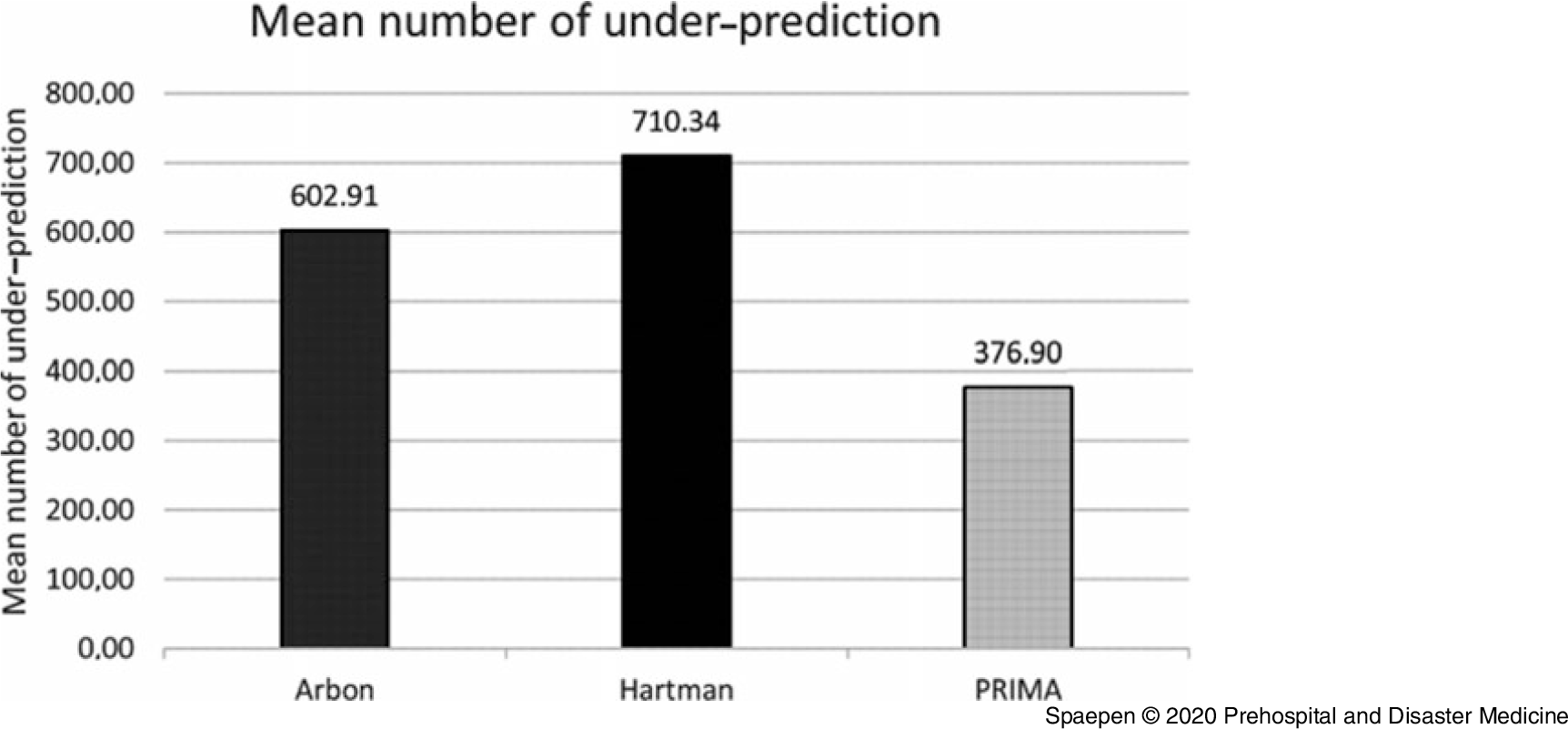
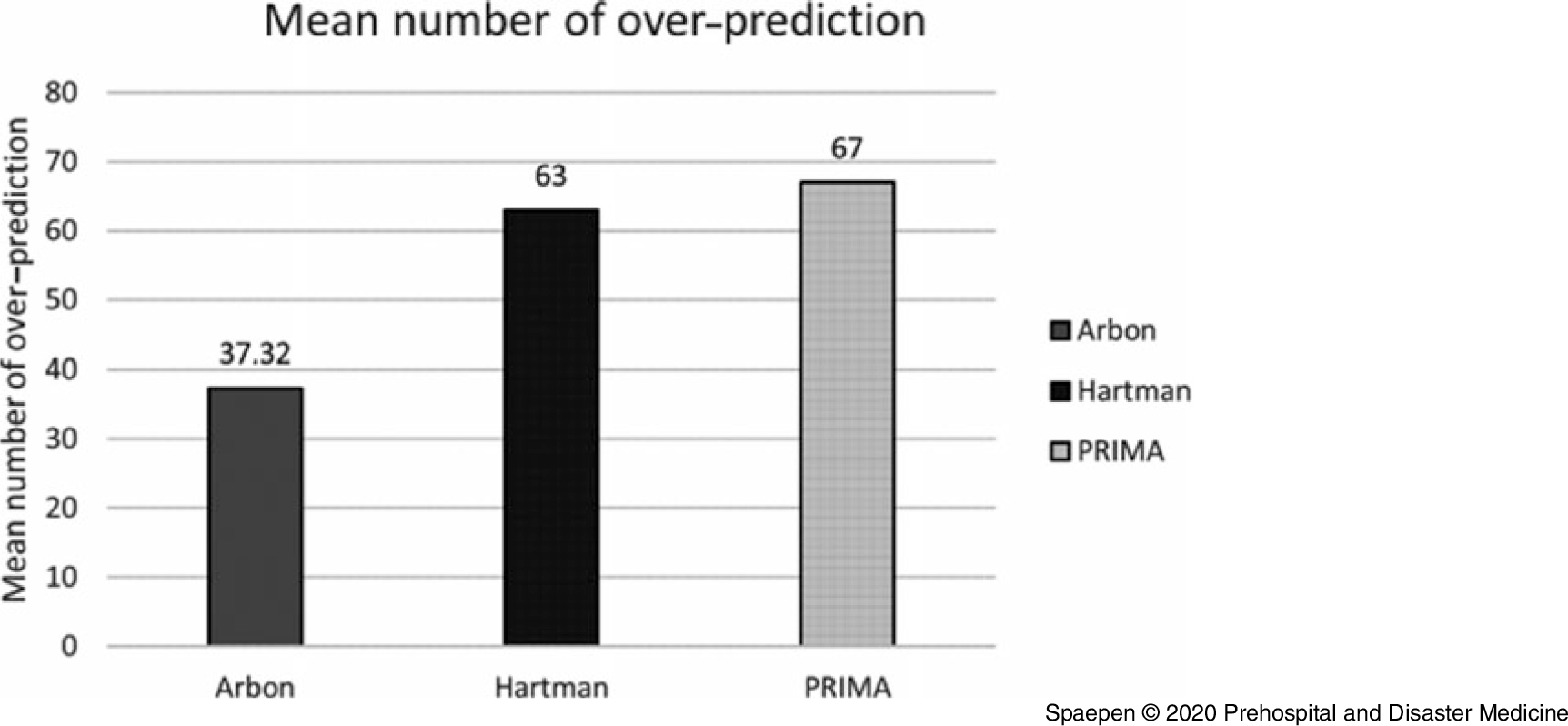
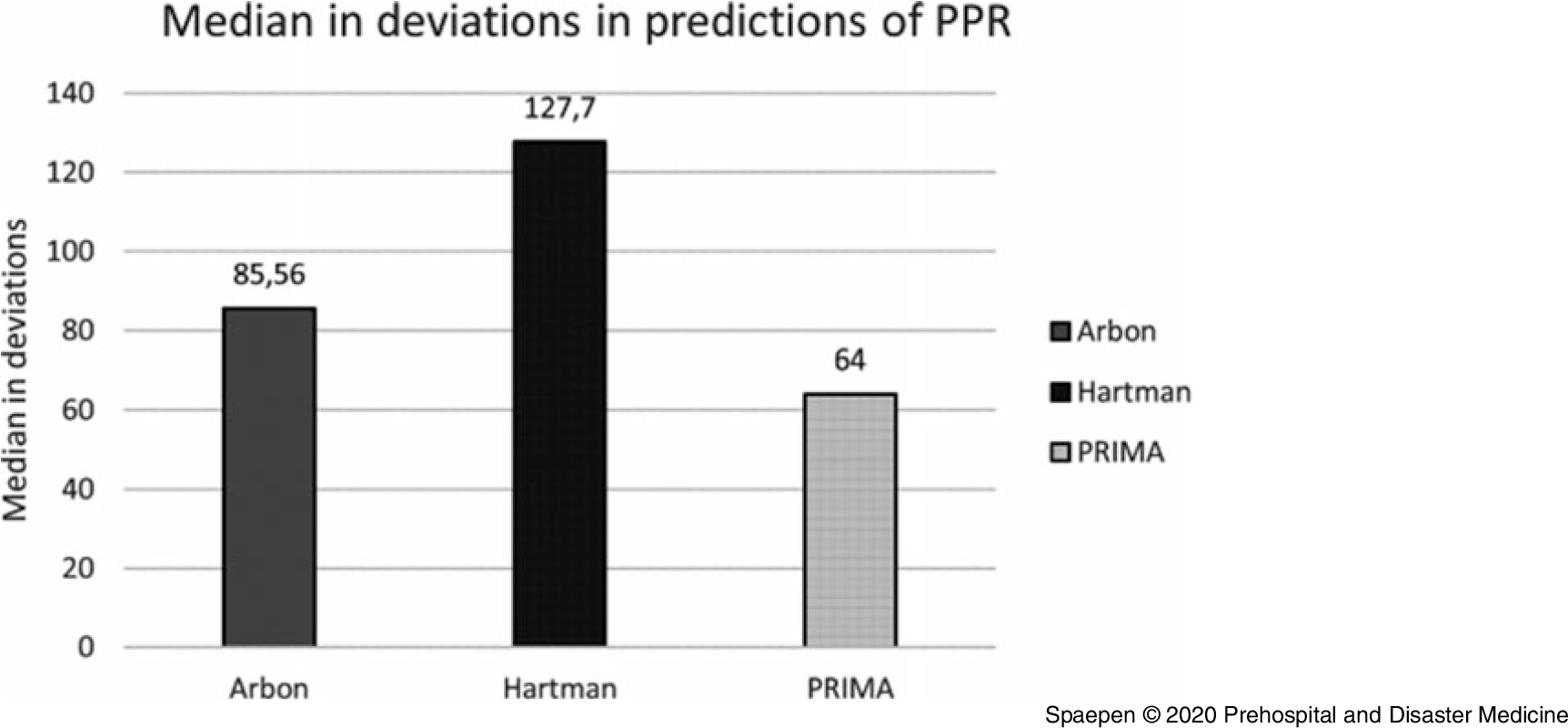
The Arbon model under-predicted the number of patient encounters for 65 events (74.7%) with a mean number of under-predictions of 602.91 (95% CI, 453.31-752.52; Figure 1). On 22 occasions (25.3%), the Arbon model over-predicted the number of patient encounters with a mean number of over-predictions of 37.32 (95% CI, 30.91-43.74; Figure 2). It had a median in deviations in predictions of PPR of 85.56 (IQR: -0.38 to 399.41; Figure 3).
Mean Number of Under-Prediction.

Mean Number of Over-Prediction.

Median in Deviations in Predictions of PPR.

The Hartman model under-predicted the number of patient encounters for 61 events (70.1%) with a mean number of under-predictions of 710.34 (95% CI, 546.90-873.97; Figure 1). On 26 occasions (29.9%), the Hartman model over-predicted the number of patient encounters with a mean number of over-predictions of 63.00 (95% CI, 57.10-68.90; Figure 2). It had a median in deviations in predictions of PPR of 127.70 (IQR: -34 to 444; Figure 3).
The PRIMA model under-predicted the number of patient encounters for 68 events (78.2%) with a mean number of under-predictions of 376.90 (95% CI, 288.91-464.89; Figure 1). On 17 occasions (19.5%), the PRIMA model over-predicted the number of patient encounters with a mean number of over-predictions of 67.00 (95% CI, 57.80-76.20; Figure 2). It had a median in deviations in predictions of PPR of 64.00 (IQR: 6.00-279.00; Figure 3). On two occasions (2.3%), the PRIMA gave a correct prediction of the number of patient encounters.
When comparing deviations in predictions between the PRIMA model to the Arbon model, there was a significantly higher difference in the mean deviation of the PRIMA model (median: 64.00; IQR: 6.00-279.00) than the Arbon model (median: 85.56; IQR: -0.38 to 399.41); T = 1.264; P = .006; r = -0.29. Similarly, the difference in mean deviation in predictions between the PRIMA model (median: 64.00; IQR: 6.00-279.00) and the Hartman model (median: 127.70; IQR: -34 to 444) was significantly higher; T = 1.043; P < .000; r = -0.38.
Discussion
The aim of this study was to validate the PRIMA model during music MGs in the province of Antwerp, Belgium. The results of this study are in-line with previous findings,Reference Turris, Camporese, Gutman and Lund5 although they show that in contrast to the Arbon and Hartman models, the PRIMA model made a correct prediction for two events. Only when looking at the times the PRIMA model under-predicted the estimation of patient encounters at music festivals, the PRIMA model was less accurate than the other models used in this study.
As indicated earlier, the prediction of number of patient encounters during MGs remains complex and somewhat enigmatic as each event has its own characteristics that influence decisions on the deployment of medical resources.Reference Nable, Margolis and Lawner17
Despite these challenges, the results are deemed to hold sufficient confidence because of the different methods the other models used in calculating their predictions. There is a low degree of dependency among the models used. The Arbon model has been developed on regression models, based on numerous environmental and event characteristics.Reference Arbon, Bridgewater and Smith9 The Hartman model, on the other hand, stratifies events by using a scoring system based on characteristics that are known to influence medical needs.Reference Hartman, Williamson and Sojka10 The PRIMA model is based on a calculation model with data provided by Belgian Federal Public Service (Brussels, Belgium), Health, Food Chain Safety, and Environment; event organizers; IEHS; and municipalities.Reference Spaepen, Haenen and Hubloue15
The average PPR for the events in this study was 4.33/1,000 attendees, which is slightly higher than PPRs for music MGs previously reported. Music MG frequently already have a higher PPR when compared to other MGs with similar attendances.Reference Hutton, Savage, Ranse, Finnel and Kub18 There is wide agreement that the availability of alcohol and illicit drugs leads to higher PPRs, and most notably music MGs.Reference Turris, Camporese, Gutman and Lund5,Reference FitzGibbon, Nable and Ayd6,Reference Grange, Green and Downs13,Reference Van Sassenbroeck, Calle and Rousseau14 Especially in Belgium, the consumption of alcohol (mostly beer) is commonplace. More worrying is the level of combined drug and alcohol consumption. In a study among Flemish students, no less than 66% of the participants admitted the combined use of illicit drugs and alcohol when going out.Reference Rosiers, Van Damme and Hublet19
As stated in the definition of an MG, it is important to remind the fact that MGs attract sufficient numbers of people to strain the planning and response resources of local emergency services. A high ratio of EHP, as seen in this study with an average ratio of 2.58, highlights the need for thorough pre-event planning in order to quantify the risk and mitigate the impact of the MG on the host community. To highlight as examples: an annual multi-day outdoor electronic dance event attracting 200,000 visitors is organized in a town with 17,000 inhabitants (EHP 11.78); and an annual multi-day outdoor rock metal festival attracting 150,000 attendees in a host community of 9,000 (EHP 16.66). Because of their overwhelming impact on the local community, health infrastructure, Emergency Medical Services, and other emergency services are strengthened.
As the results of this study are consistent regarding the incidence of medical emergencies during MGs, the high number of potentially life-threatening conditions at EDMFs is striking. It is common knowledge that EDMF-festivalgoers engage more in alcohol and illicit drug use,Reference FitzGibbon, Nable and Ayd6,Reference Scholliers and Gogaert8,Reference Friedman, Plocki and Likourezos12,Reference Hutton, Savage, Ranse, Finnel and Kub18 but the results above (75.7% of all life-threatening conditions) do raise concern. Future research should focus on PPR at EDMEs and the organization of in-event medical care at these events.
An important issue arises when predictive models continually under-predict the number of patient encounters for music MGs. The results of this study showed that all three models had an acceptable rate of over-prediction of number of patient encounters, but a high rate of under-prediction of number of patient encounters. This under-estimation of risk (Type II risk) could lead to injury or even death when events are falsely predicted not to happen.Reference Arnold7
The PRIMA program showed the lowest mean number of over-predictions of all three models. And although the PRIMA model had the highest rate of under-prediction, it did succeed in the correct prediction of the actual number of patient encounters on two occasions. Due to additional costs, over-prediction is not favored by event organizers. It does allow, however, for some flexibility in the IEHS and some may even see it as an additional service provided by the event organizer. Adding to that, it also allows for supplementary health care personnel in case some major incident should occur.
Previous work by Zeitz showed that a retrospective review of data is more accurate at predicting the number of patient encounters than the Arbon predictive model.Reference Zeitz, Zeitz and Arbon20 With the retrospective review of data incorporated in PRIMA, it seems to possess the best of both worlds. Nevertheless, both predictive models can be considered complementary in estimating the number of patients encounters. Although the promising results for the PRIMA model, the findings of this study suggest the need to further develop the PRIMA model into an even more accurate prediction model with less under-prediction.
Limitations
A major limitation of this study was the collection of data. Full data could only be obtained for 87 of 619 possible events (14.1%). As one partner provided a limited data set, the sample was smaller and far less-detailed than anticipated. Although a minimal data set for MGs has been developed,Reference Ranse, Hutton, Turris and Lund21 inconsistencies were found between the two data-providing partners and variation in the level of detail of data gathering.
A second limitation to this study is the lacking of a prediction of TTHRs by the PRIMA model. Contrary to the other models used, the PRIMA model does not generate a prediction of the number of patients that will need transport-to-hospital. Not including attendees who self-referred to a local emergency department is a third limitation, resulting in a possible under-estimation of the number of patients seeking help. A fourth and final limitation is the lack of European data concerning MGs and MG music events in particular. Stemming from a previous literature search,Reference Spaepen, Haenen and Hubloue15 none of the models have been validated in other countries,Reference Arbon1,Reference FitzGibbon, Nable and Ayd6,Reference Nable, Margolis and Lawner17 and nearly all literature, as well as both the Arbon and Hartman model, are non-European. Because of this, the PRIMA model was developed and proposed as the standard prediction model for all MGs in Belgium.Reference Spaepen, Haenen and Hubloue15 Because of the specific Belgian setup, the general applicability of this model to other countries could be limited.
Conclusion
Although the PRIMA model was developed for a multitude of MGs,Reference Spaepen, Haenen and Hubloue15 the research reported here focused on the validation of the PRIMA model for music MGs. When comparing the predicted patient encounters, all three models had high rates of under-prediction and moderate rates of over-prediction. When comparing mean deviations, the PRIMA model had the lowest mean deviation of all predicted PPRs. Belgian events of the types included in the presented data may use the PRIMA model with confidence to predict PPRs and estimate the IEHS requirements.
Despite its limitations, results of this study are in-line with existing literature. Not only was a higher PPR in music MGs compared to other MGs with similar populations confirmed with the reported results, it was also found that 75% of all life-threatening conditions were encountered at EDMFs. According to the above-mentioned results, it is recommended that more research specifically aimed at alcohol and drug-related problems and injuries at EDMF be conducted.
With nearly all events in this study having a high EHP, risking to strain regular emergency response resources, quantifying risk, and mitigating the impact of the MG on the host community remains of great importance. And as ArbonReference Arbon, Bridgewater and Smith9 already previously stated, predictive models remain useful tools in predicting PPRs at MGs and should therefore be one of the fields of interest in the developing science of MGs.
Acknowledgements
The authors would like to thank A. Vande Veegaete and S. Gogaert of the Belgian Red Cross Flanders; as well as R. Cardinas of the Flemish Cross for their contribution in the gathering of data. Acknowledgements also go to J. Adriaenssens for reviewing the manuscript of this study.
This manuscript was based on a thesis that was submitted in partial fulfilment of the requirements for the degree of European Master in Disaster Medicine.
Conflicts of interest
none