INTRODUCTION
In recent years, the intertidal crabs of Iraq have received renewed attention. Ng et al. (Reference Ng, Rahayu and Naser2009) revealed three new records of Camptandriidae from Fao and Shatt Al-Basrah, Abdul-Sahib (in preparation) lists a new record of the crab Macrophthalmus dentipes Lucas, 1836 from Fao, and Naser et al. (unpublished) provides new records of the grapsid crab Parasesarma persicum Naderloo & Schubart, 2010 from the north-west Arabian Gulf.
Although Bott (Reference Bott1973) and Crane (Reference Crane1975) presented the most comprehensive taxonomic account of Uca sindensis (Alcock, Reference Alcock1900), the survey by Collins et al. (Reference Collins, Jones and Clayton1984) on the fiddler crabs from sandy-mudflats of Kuwait proved to be most helpful. Their detailed redescription of U. sindensis helped confirm the identification of this species from the intertidal zone at Khor Al-Zubair, Basrah, Iraq.
MATERIALS AND METHODS
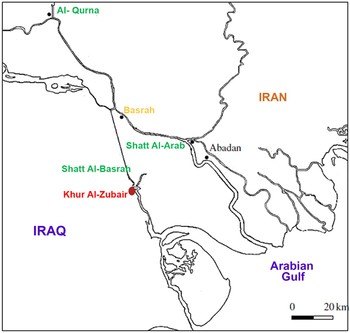
Specimens of the intertidal fiddler crabs were collected monthly from soft sandy-mudflats in the intertidal zones of Khor Al-Zubair, north-western Arabian Gulf (Figure 1) during May and June 2009. The specimens were collected by hand during the lowest tide, preserved in 70–80% ethanol, and deposited in the collections of the Marine Science Centre (MSC, 15), University of Basra and Zoological Reference Collection (ZRC) of the Raffles Museum of Biodiversity Research, National University of Singapore. Quadrats of 1 × 1 m2 were used to calculate the density of this crab.
Khor Al-Zubair region, Iraq.

Study area
Khor Al-Zubair is an extension of the Gulf waters in the lower reaches of Mesopotamia (Figure 1). It has an approximate length of 42 km, with a width of 1 km at low tide, and an average depth of 10–20 m. During 1983 this waterway was connected to the oligohaline marsh, Hor Al-Hammar, changing the environment of the Khor from a hypersaline lagoon to an estuary one (Hussain & Ahmed, Reference Hussain and Ahmed1999). The northern end of Khor Al-Zubair receives on average a fresh water influx of 700 m3 s−1 throughout the tidal cycle. The current in Khor is characterized by one direction throughout the tidal cycle towards the southern end (Arabian Gulf), with a velocity exceeding 2 m s−1 during the ebb tide and 0.66 m s−1 during the flood tide. At the southern end the water discharge reaches 10,000 m3 s−1 with a velocity range of 0.8–5.78 m s−1 with a large tidal range at Umm-Qasar reaching 4.3 m (Al-Badran et al., Reference Al-Badran, Al-Sadoon and Jassim1996).
MATERIAL EXAMINED (MSC)
Carapace measurements are length × breadth respectively.
Three females (8.2 × 13 mm), (8 × 12.5 mm), (7.7 × 12 mm); 11 males (9 × 14.2 mm), (5.7 × 9 mm), (9 × 14 mm), (7 × 11 mm), (8 × 13 mm), (7.6 × 12 mm), (7.5 × 11.5 mm), (9 × 14 mm), (7.5 × 11.5 mm), (5.7 × 9 mm), (5.4 × 8.5 mm) collected from Khor Al-Zubair port, 30°11′22.50″N 47°53′15.05″E, May 2009.
One female (4.5 × 7 mm); 4 males (3.3 × 5 mm), (3.8 × 6 mm), (3.6 × 5.5 mm), (5.4 × 8.5 mm), collected from Khor Al-Zubair port 30°10′43.78″N 47°53′41.66″E, June 2009.
Gelasimus inversus var. sindensis Alcock, Reference Alcock1900: 356.
Austruca sindensis.—Bott, Reference Bott1973: 322.
Uca (Amphiuca) inversa sindensis.—Crane, Reference Crane1975: 108, pl. 16 e–h, figures. 69 J, 99.
Uca sindensis.—Collins et al., Reference Collins, Jones and Clayton1984: 318–328, figures. 1–4; Jones, Reference Jones1986a: 157, pl. 42; Yamaguchi, Reference Yamaguchi1994: 175; Apel & Türkay, Reference Apel and Türkay1999: 134; Apel, Reference Apel2001: 115.
Uca sindensis.—Ismail & Ahmed, Reference Ismail, Ahmed, Lieth and Al Masoom1993: 158. [= Uca inversa (Hoffmann, 1874)]
Uca (Paraleptuca) sindensis—Ng et al., Reference Ng, Guinot and Davie2008: 241.
Uca sindensis.—Beinlich & Hagen, 2006: 26.
Uca sindensis.—Rosenberg, 2001: 860.
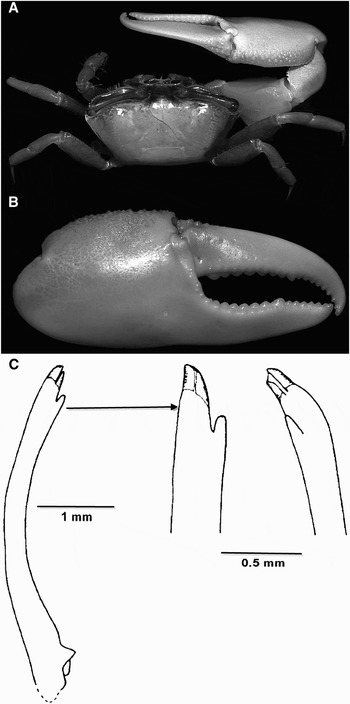
Uca sindensis (Alcock, Reference Alcock1900), male (9 × 16.1 mm). (A) Dorsal view; (B) major cheliped posterior view; (C) lateral and anterolateral view of left gonopod.

DIAGNOSIS
Carapace (Figure 2A): broader than long, largest male specimen 9 × 16.1 mm. Front broad. Anterolateral margins somewhat acute, moderately short. Orbits moderately oblique and suborbital region slightly granular. Merus of major cheliped with distal third of anterodorsal margin raised and coarsely rugose, but not angular (Figure 2A). Outer surfaces of manus smooth except on dorsal margin, curled over towards palm forming tuberculated flattened ridge bordering dorsal limit of carpal cavity on palm (Figure 2B). Gonopod with moderate torsion, anterior flange longer than posterior and clearly wider, palp extending below flange base (Figure 2C).
COLOUR
In hibernating specimens, carapace uniform dark-bluish. Major cheliped with external surface of manus deep pink with bluish tints ventrally, extending into pollex, with white above.
REMARKS
At Khor Al-Zubair beaches the fiddler crabs inhabit a narrow zone extending slightly seaward. The density distribution has a maximum value of 14 per 1 m2 during May to 5 per 1 m2 during June. Ovigerous females were not present in the total 19 specimens collected at Khor Al-Zubair during May and July, 2009. Males made up almost 80% of individuals, the same ratio recorded by Collins et al. (Reference Collins, Jones and Clayton1984) from Kuwait Bay during November and December 1981.
DISTRIBUTION
Karachi, Pakistan (Alcock, Reference Alcock1900; Crane, Reference Crane1975); Al Memlaha, Doha, Kuwait Bay, Kuwait (Collins et al., Reference Collins, Jones and Clayton1984); and Khor Al-Zubair, Iraq. Distribution around Arabian Gulf and westward towards Yemen is unknown.
ACKNOWLEDGEMENTS
M.D.N. thanks Dr Peter K.L. Ng (Raffles Museum of Biodiversity Research, Department of Biological Sciences, National University of Singapore) for confirming the identity of Uca sindensis; and Dr Clark (NHM) for reading and editing our first draft manuscript.