Introduction
Necrotising (malignant) otitis externa is a severe infection of the ear canal characterised by invasion and osteomyelitis of the temporal bone. It classically affects elderly, diabetic or otherwise immunocompromised individuals. In the pre-antibiotic era, mortality rates were high, estimated at up to 50 per cent. Although first described as ‘malignant’ otitis externa by Chandler in 1968,Reference Chandler1 some have adopted the name ‘necrotising’ otitis externa to more accurately reflect the disease process. Both expressions are accepted and may be used synonymously; for the remainder of this article, we will employ the term necrotising (malignant) otitis externa.
Necrotising (malignant) otitis externa is relatively rare. However, the principal risk factors of older age and diabetes are on the rise,2, Reference Diabetes3 resulting in a larger at-risk population. Here, we report our recent experience of five affected patients who presented to our district general hospital within one year. This represents a doubling of incidence compared to previous years. We describe the individual cases and discuss learning points. We also present an analysis of UK Government Hospital Episode Statistics data on this condition, which demonstrates rising incidence nationally.
Case reports
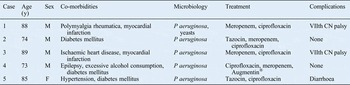
Table I shows a summary of the characteristics of the five cases.
Summary of case characteristics

Y = years; M = male; CN = cranial nerve; F = female
Case one
An 88-year-old man presented following a fall, with confusion and right otitis externa. A computerised tomography (CT) scan showed no bony erosion and the patient was discharged on topical antibiotics. Three weeks later, he developed facial palsy and canal granulation. A magnetic resonance imaging (MRI) scan demonstrated osteomyelitis of the mastoid process and inflammation around the stylomastoid foramen. He received six weeks' intravenous (IV) meropenem followed by six weeks' oral ciprofloxacin. His pain, inflammatory markers, ear findings and facial nerve palsy normalised 15 weeks after original presentation.
Case two
A 74-year-old diabetic man presented with a 4-week history of left otitis externa with canal granulation despite topical and oral antibiotic treatment. A CT scan showed no bony involvement and the patient was discharged on oral ciprofloxacin. At two weeks' follow up, his pain was worse and granulations persisted. Repeat CT now showed osteomyelitis of the canal involving the mastoid and temporomandibular joint. He received five weeks' IV meropenem followed by six weeks' oral ciprofloxacin. By 14 weeks, his pain, inflammatory markers and ear findings had normalised.
Case three
An 89-year-old man presented with left otitis externa. He received regular ear toilet and topical Gentisone®. One month later, he developed facial palsy and an ear canal polyp. A CT scan demonstrated left skull base osteomyelitis with stylomastoid foramen involvement. He was treated with six weeks' IV meropenem followed by six weeks' oral ciprofloxacin. His facial palsy persists, for which he is receiving treatment by the plastic surgery team. He is under ongoing out-patient review.
Case four
A 73-year-old diabetic man presented with left otitis externa. He received regular ear toilet, topical Gentisone and oral ciprofloxacin. Symptoms persisted after two weeks. A CT scan showed osteomyelitis involving the mastoid and temporomandibular joint. He was admitted for 2 weeks' IV meropenem, followed by 10 weeks' oral ciprofloxacin and 4 weeks' co-amoxiclav. His pain, inflammatory markers and follow-up MRI all indicated resolution by the end of his antibiotic course.
Case five
An 85-year-old diabetic woman presented with persisting left otitis externa and canal granulation despite multiple courses of antibiotics. A CT scan showed thickened canal soft tissue and bony involvement of the anterior middle-ear wall. She received four weeks' IV Tazocin® and topical ciprofloxacin (oral ciprofloxacin was not given because of the development of diarrhoea). Her pain and canal signs normalised after four weeks' IV treatment. The MRI scans also confirmed resolution of inflammation.
Discussion
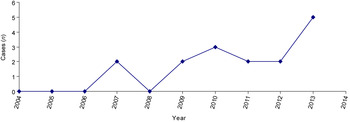
This paper was prompted by the observation that local necrotising (malignant) otitis externa incidence is increasing. Historical data at our centre show that cases have been on an upward trend for some years, and the number of cases doubled in 2013 (Figure 1).
Cases of necrotising (malignant) otitis externa per year at our centre since 2004.

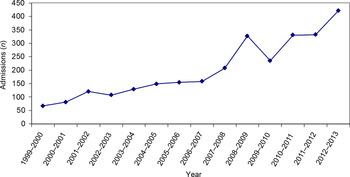
An interrogation of the Hospital Episodes Statistics data for England confirmed that this trend is national (Hospital Episodes Statistics uses the term ‘malignant otitis externa’).4 The data are shown graphically in Figure 2, in which a year-on-year increase in admitted cases can be observed, rising from 67 in 1999–2000 to 421 in 2012–2013. This represents a six-fold increase. When this time period is divided into two halves (first half 1999–2006 and second half 2007–2013), the mean number of cases during the first half (1999–2006) was 115 per year and during the second half (2007–2013) was 287 per year. Even using these more conservative averages, this represents a 2.5-fold increase. Over the same time period, the total number of hospital admissions increased from 11 149 538 to 15 145 633, a 1.35-fold increase. Therefore, the observed increase in necrotising (malignant) otitis externa cases is not simply a reflection of overall increased admissions across England.
Admissions of malignant otitis externa cases from 1999 to 2013, according to the Hospital Episode Statistics data for England.4

Although the Hospital Episodes Statistics database can be criticised for its accuracy5 and its retrospective nature, it remains the most comprehensive record of hospital episodes in England. Nevertheless, a long-term, prospective, multicentre study of necrotising (malignant) otitis externa is required to further corroborate our findings.
Regarding our patients' characteristics, all five patients were elderly (mean age of 82 years) and four had co-morbidities rendering them immunocompromised (three patients were diabetic and one was on steroids for polymyalgia rheumatica). This is in keeping with the published literature on known risk factors.Reference Mahdyoun, Pulcini, Gahide, Raffaelli, Savoldelli and Castillo6 Samples from all five patients grew Pseudomonas aeruginosa. In contrast to some reports,Reference Carfrae and Kesser7, Reference Bernstein, Holland, Porter and Maw8 none of the bacterial isolates were antibiotic resistant.
Slough has a large proportion of immigrants from the Indian subcontinent, raising the question of whether the increased rates were from this subgroup. However, only one of the five patients was of Indian ethnicity; the rest were Caucasians.
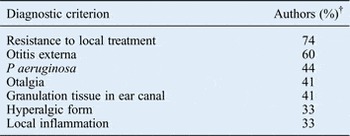
This study highlights the challenges in the diagnosis, management and follow up of necrotising (malignant) otitis externa. For instance, diagnosis was delayed in several patients who developed adverse sequelae before repeat imaging confirmed necrotising (malignant) otitis externa. There are no universally accepted diagnostic criteria for necrotising (malignant) otitis externa. A recent systematic review identified 27 studies, which defined their own varying criteria.Reference Mahdyoun, Pulcini, Gahide, Raffaelli, Savoldelli and Castillo6 This reflects the difficulty in diagnosis. Nevertheless, the common criteria cited across most studies were: a resistance to local treatment, otitis externa, pseudomonas infection and otalgia. Table II, adapted from Mahdyoun and colleagues' analysis,Reference Mahdyoun, Pulcini, Gahide, Raffaelli, Savoldelli and Castillo6 shows the most commonly cited ‘major diagnostic criteria’. Interestingly, imaging studies, age, diabetes and nerve palsy were less frequently mentioned by authors as major diagnostic criteria.
Most commonly cited ‘major criteria’ for necrotising (malignant) otitis externa diagnosis*

*For the years 1968–2011 (adapted from Mahdyoun et al.Reference Mahdyoun, Pulcini, Gahide, Raffaelli, Savoldelli and Castillo6). †Percentage of authors considering the diagnostic criterion as a major criterion
While scanning can confirm diagnosis and disease extent, negative scans must be interpreted with caution. In our own series, only one patient had clear radiological evidence of bony erosion at presentation. Among the remaining patients, two underwent CT, the findings of which were negative for erosion, and two were treated for simple otitis externa without imaging. Of these four patients, two developed facial palsy in the subsequent weeks, prompting repeat scans which showed osteomyelitis. The question remains: had these patients been aggressively treated from the start (regardless of scan findings), would the nerve palsy have developed? Bony erosion is only seen once demineralisation has occurred; this may take months to happen.Reference Hollis and Evans9 Therefore, we caution against being falsely reassured when initial CT scans are negative for bone erosion. In suspect cases, some advocate nuclear medicine scans; these can show early osteitis that is missed by CT scanning.Reference Mahdyoun, Pulcini, Gahide, Raffaelli, Savoldelli and Castillo6 If nuclear imaging is unavailable, such patients need close follow up and a low threshold for aggressive antibiotic treatment.
The mainstay of management is the use of systemic anti-pseudomonals, with the role of surgery relegated to obtaining tissue for histology and microbiology.Reference Mahdyoun, Pulcini, Gahide, Raffaelli, Savoldelli and Castillo6 All our cases were successfully treated using systemic antibiotics. A variety of different agents and protocols are suggested in the literature. However, the underlying principles are that the patient should receive broad-spectrum anti-pseudomonal cover until diagnosis is confirmed. Subsequently, the antibiotic is targeted towards microbiological culture sensitivities.
• This study indicates that the incidence of necrotising (malignant) otitis externa is rising, linked to the increase in ageing and diabetic populations
• Clinicians should not be falsely reassured by negative initial computed tomography scans in suspected necrotising (malignant) otitis externa cases
• In cases with a high level of suspicion, nuclear medicine scans (technetium-99 or gallium-67) can aid diagnosis
• All patients with relevant risk factors and persistent symptoms despite topical treatment should be treated aggressively
• Disease resolution is indicated by clinical findings, pain normalisation, inflammatory markers and imaging
• Follow up should be at least six months given the recurrence risk
No single test reliably demonstrates disease resolution; therefore, combined clinical examination, inflammatory marker normalisation (erythrocyte sedimentation rate and C-reactive protein) and radiological imaging are used to confirm cure. Computed tomography, MRI and technetium-99 scanning do not differentiate between active infection and old bony changes that can persist even after resolution. Courson et al.Reference Courson, Vikram and Barrs10 advocate gallium-67 scintigraphy or indium-111-labelled leukocyte scintigraphy combined with single-photon emission CT/CT, as these can differentiate healing bone from active infection while providing good anatomical information. Antibiotic therapy is continued and imaging repeated every two to four weeks until scanning is negative for infection. Furthermore, they advise at least a six-month follow up, to monitor for recurrence that may happen in up to 20 per cent of cases. However, a lack of access to these imaging techniques may preclude this approach; at our centre, this facility is not available and we utilised MRI for follow up in consultation with our radiologists.
In summary, we present evidence of an increasing necrotising (malignant) otitis externa incidence in the UK and discuss specific learning points regarding its management. To our knowledge, this is the first report to demonstrate an increasing trend, and we speculate that this is associated with the increase in the UK's ageing and diabetic populations.