Introduction
Pepper (Capsicum annuum L.) is an economically important vegetable crop worldwide. In Korea, pepper is grown throughout the country because it is broadly used as a spice and flavour ingredient. However, commercial pepper production in Korea continues to suffer from various diseases caused by fungal, bacterial and viral pathogens. In particular, viral diseases often cause the most severe damage in pepper because they are difficult to control and induce severe symptoms throughout the plant, including the fruit, resulting in a significant loss of yield and decreased commercial value (Kim et al., Reference Kim, Seo, Kwak, Kim, Kim, Cha and Choi2014; Kwon et al., Reference Kwon, Cho, Yoon and Chung2018). Therefore, extensive efforts have been made to develop pepper cultivars with resistance against viruses through classical breeding.
While more than 100 viruses were reported to infect pepper worldwide (Kenyon et al., Reference Kenyon, Kumar, Tsai and Hughes2014), seven viruses, including broad bean wilt virus 2 (BBWV2), cucumber mosaic virus (CMV), tomato spotted wilt virus, beet western yellows virus, pepper mottle virus, potato virus Y and pepper mild mottle virus, have caused major problems in pepper production in Korea (Kim et al., Reference Kim, Seo, Kwak, Kim, Kim, Cha and Choi2014; Kwon et al., Reference Kwon, Cho, Yoon and Chung2018). Among these viruses, two aphid-transmitted RNA viruses, BBWV2 and CMV, are overwhelmingly prevalent in Korean pepper fields: the incidences of BBWV2 and CMV infection were 71.4 and 73.3% in 2016, respectively, and the incidence of mixed infection by these two viruses was 55.1% (Kwon et al., Reference Kwon, Cho, Yoon and Chung2018).
Both BBWV2 (genus Fabavirus, family Secoviridae) and CMV (genus Cucumovirus, family Bromoviridae) are two of the most successful RNA viruses for worldwide dispersion and host adaptation. BBWV2 has a wide host range and damages various agriculturally important crops worldwide, including pepper, tomato, cucumber, broad bean and spinach (Ferrer et al., Reference Ferrer, Ferriol, Moreno, Guerri and Rubio2011; Kwak et al., Reference Kwak, Kim, Nam, Kim, Kim, Cha and Choi2013). CMV infects more than 1200 species, comprising more than 80 plant families and damages a number of crop species worldwide (Palukaitis and Garcia-Arenal, Reference Palukaitis and Garcia-Arenal2003). Nevertheless, genetic resources for resistance to BBWV2 have not been examined in pepper thus far, and no information is available on the resistance of commercial pepper cultivars to BBWV2. For resistance to CMV in pepper, a few monogenic resistance genes, including Cmr1 and Cmr2, have been mapped (Kang et al., Reference Kang, Hoang, Yang, Kwon, Jo, Seo, Kim, Choi and Kang2010; Choi et al., Reference Choi, Lee, Kang, Kim, Huy, Park, Son, Kwon and Kang2018). Although some CMV-resistant pepper cultivars have been developed and cultivated in Korea since the 1990s, the deployed resistance in pepper has been overcome by the continuous emergence of resistance-breaking CMV variants (Choi et al., Reference Choi, Kim, Lee, Kim and Ryu2005; Lee et al., Reference Lee, Jung, Shin, Lee, Choi, Her, Lee, Ryu, Paek and Harn2009; Kang et al., Reference Kang, Hoang, Yang, Kwon, Jo, Seo, Kim, Choi and Kang2010; Heo et al., Reference Heo, Kwon, Kim, Kwak, Han, Kwon, Rao and Seo2020).
Successful resistance breeding primarily relies on the identification of stable genetic resources for resistance. Thus, this study aimed to identify new breeding sources for resistance to BBWV2 and CMV in pepper. In particular, we included two BBWV2 (RP1 and PAP1) and three CMV strains (Fny, P1 and GTN) with different pathogenicity as viral sources to evaluate commercially grown pepper cultivars for viral pathotype-specific resistance. While the BBWV2 MP functions as a symptom severity determinant in pepper, the BBWV2-RP1 strain causes mild symptoms, and BBWV2-PAP1 induces severe symptoms of stunting, mosaic and leaf malformation (Kwak et al., Reference Kwak, Lee, Kim, Kim, Kim, Choi and Seo2016; Seo et al., Reference Seo, Kwak, Choi, Han, Kim and Choi2017). The CMV-Fny strain represents the CMV pathotype P0 that is unable to infect pepper cultivars with the Cmr1 gene (Choi et al., Reference Choi, Kim, Lee, Kim and Ryu2005; Kang et al., Reference Kang, Seo, Chung, Kim and Kang2012). The CMV-P1 strain belongs to the P1 pathotype that could overcome Cmr1-mediated resistance (Kang et al., Reference Kang, Seo, Chung, Kim and Kang2012). The CMV-GTN strain was identified as a new resistance-breaking pathotype isolated from a pepper cultivar resistant to CMV-P1 in 2013 (Choi et al., Reference Choi, Kwon, Choi, Cho and Yoon2015; Heo et al., Reference Heo, Kwon, Kim, Kwak, Han, Kwon, Rao and Seo2020).
Materials and methods
Virus sources and inoculation
Full-length infectious cDNA clones of two BBWV2 strains (RP1 and PAP1) and three CMV strains (Fny, P1 and GTN), generated in our previous studies (Heo et al., Reference Heo, Kwon, Kim, Kwak, Han, Kwon, Rao and Seo2020; Kang et al., Reference Kang, Seo, Chung, Kim and Kang2012; Seo et al., Reference Seo, Kwon, Choi and Kim2009, Reference Seo, Kwak, Choi, Han, Kim and Choi2017), were used as viral sources for each strain. Infectious cDNA clones of the viruses were inoculated by Agrobacterium-mediated infiltration (agroinfiltration), as described previously (Seo et al., Reference Seo, Kwon, Choi and Kim2009). Briefly, Agrobacterium transformants were grown at 28°C in LB medium containing 100 μg/ml kanamycin and 50 μg/ml rifampicin. Agrobacterium tumefaciens cultures harbouring each virus genomic segment were mixed in equal proportions. The mixture was infiltrated into the abaxial surface of leaves of 2-weeks-old Nicotiana benthamiana plants using a 1-ml syringe. For mechanical inoculation, crude sap prepared from symptomatic leaves of N. benthamiana infected with each virus strain was used as inoculum. Crude sap was rubbed on leaves dusted with carborundum (400 mesh). After inoculation, the leaves were washed with sterile water.
Plant materials and growth condition
Various plant species, including N. benthamiana, N. tabacum, N. clevenlandii, N. occidentalis, C. annuum, Solanum lycopersicum, Physalis floridana and Spinacia oleracea, were tested for the pathogenicity of the virus strains. Thirty-four commercial pepper cultivars were purchased from seed markets in 2019 and 2020. Seven accessions were obtained from the National Agricultural Plant Genebank of Rural Development Administration (genebank.rda.go.kr). The seven pepper accessions were chosen because they were previously shown to be resistant to CMV-P1 (Choi et al., Reference Choi, Lee, Kang, Kim, Huy, Park, Son, Kwon and Kang2018). A total of 41 pepper cultivar and accessions were evaluated for resistance against each strain of BBWV2 and CMV. To evaluate disease responses and resistance, 2-weeks-old seedling plants were sap-inoculated with each virus strain. Disease reactions were monitored for at least 4 weeks after inoculation. The inoculation experiments were repeated three to four times. Three plants were tested for each treatment in each experiment. In total, nine to 12 plants were examined for each treatment. At 4 weeks post-inoculation, upper uninoculated leaves of all tested plants were subjected to RT-PCR diagnosis. A plant positive for the virus by RT-PCR was considered to be systemically infected with the virus. The disease reactions of the pepper cultivars and accessions tested for BBWV2 and CMV resistance were evaluated based on the proportion of systemically infected plants and classified as follows: resistant (none of the inoculated plants were systemically infected); partially resistant (one or more but not all tested plants were infected); susceptible (all inoculated plants were systemically infected). All plants were grown in an insect-free growth chamber [26°C during the day and 24°C at night with a 16 h photoperiod; a photon flux density of 300 μmol/m2/s during the daytime; 60% relative humidity; plants were grown in 12 × 15 cm pots containing commercial bed soil (Seoul Bio, Korea)].
Phylogenetic analysis
Phylogenetic analyses were performed using the amino acid sequences of BBWV2 movement protein (MP) and CMV 1a protein because these viral proteins are the pathogenicity determinants in pepper (Kang et al., Reference Kang, Seo, Chung, Kim and Kang2012; Seo et al., Reference Seo, Kwak, Choi, Han, Kim and Choi2017). Sequence alignment was generated using ClustalW implemented in MEGA X software (Kumar et al., Reference Kumar, Stecher, Li, Knyaz and Tamura2018). Phylogenetic trees were reconstructed by the maximum likelihood method (Jones-Taylor-Thornton model) in MEGA X with bootstrap values calculated using 1000 random replications (Kumar et al., Reference Kumar, Stecher, Li, Knyaz and Tamura2018).
Virus detection
All inoculated plants were tested for systemic infection by RT-PCR using specific primer pairs at 4 weeks post-inoculation. In brief, total RNA was extracted from upper uninoculated leaves of tested plants using the TRI Reagent method (MRC, USA) according to the manufacturer's instructions. cDNAs were synthesized using M-MLV reverse transcriptase (Promega, USA) with primers specific for BBWV2 (BBWV2-1R; 5′-GCCATCTCATTGGCATGGA-3′) and CMV (CMV-3-3d; 5′-TGGTCTCCTTTTRAGGCCCCCA-3′), as described previously (Kwak et al., Reference Kwak, Kim, Nam, Kim, Kim, Cha and Choi2013). The resulting cDNAs were used to detect BBWV2 (using primers BBWV2-1R and BBWV2-1u 5′-AAACAAACAGCTTTCGTTCCG-3′) and CMV (using primers CMV-3-3d and CMV-3-3u 5′-AAGAARCTTGTTTCGCGCATT-3′). PCR reactions were performed for 35 cycles using Ex Taq polymerase (TaKaRa, Japan). PCR products were analysed by 1% agarose gel electrophoresis.
Results
Phylogenetic and biological characteristics of the BBWV2 and CMV strains used for pathotype-specific resistance screening in pepper
Phylogenetic analysis showed the evolutionary positions of the BBWV2 and CMV strains in the populations that include representative virus isolates obtained from pepper and several reference strains (Fig. 1). When the phylogenetic analyses were performed using the BBWV2 MP amino acid sequences, most of the BBWV2 Korean strains and isolates from pepper, including RP1 and PAP1, were closely grouped together (Fig. 1a). Meanwhile, BBWV2-PAP1 was more closely related to BBWV2-P2, which was isolated from Pisum sativum (Fig. 1a). In the phylogenetic tree reconstructed using the CMV 1a amino acid sequences, the CMV Korean strains and isolates from pepper were largely divided into two clusters (Fig. 1b). CMV-P1 and -GTN isolated from pepper were grouped together in the same cluster, whereas CMV-Fny isolated from Cucumis melo had a distant phylogenetic relationship with CMV-P1 and -GTN (Fig. 1b).
Phylogenetic positions of the BBWV2 and CMV strains used as the viral sources in the virus populations isolated from pepper. Phylogenetic trees were reconstructed by the maximum-likelihood method applying the Jones-Taylor-Thornton model for amino acid sequence analyses of BBWV2 MP (a) and CMV 1a (b). Eight BBWV2 isolates (Anhui, BR, DO, IA, MB7, P2, RG and XJ14-3) and seven CMV isolates (CTL, Ix, Leg, LS, PHz, Tfn and Y) were included as reference isolates, respectively. Broad bean wilt virus 1 strain PV132 (BBWV1-PV132) and peanut stunt virus strain ER (PSV-ER) were included as out-groups, respectively. Country of origin, collection year and GenBank accession number are indicated for each isolate. Numbers on the branches indicate bootstrap percentages based on 1000 replications (only values >60% are shown). BBWV2 and CMV isolates collected from pepper are indicated with red arrowheads. BBWV2 and CMV strains used as viral sources in this study are indicated with red boxes.

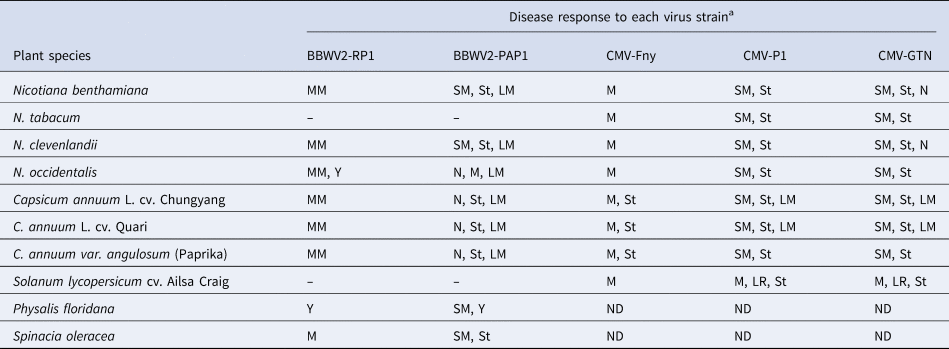
Infectious cDNA clones of each strain of BBWV2 and CMV were inoculated into N. benthamiana by agroinfiltration. After 2 weeks of agroinfiltration, crude sap was prepared from systemic leaves of N. benthamiana infected with each strain of BBWV2 and CMV and mechanically inoculated on the leaves of various plant species tested for the pathogenicity of the virus strains. The inoculated plants were monitored for at least 4 weeks post-inoculation to analyse symptomatology. RT-PCR detection confirmed that all plants that exhibited the symptoms were infected with the inoculated virus (data not shown). Only N. tabacum and S. lycopersicum plants were not infected with the two BBWV2 strains. The disease responses to each strain of BBWV2 and CMV in the tested plants are summarized in Table 1. In brief, BBWV2-PAP1 induced significantly stronger symptoms than BBWV2-RP1 in all infected plant species. Both CMV-P1 and -GTN induced severe symptoms and possessed limited symptomatic variations in the tested plant species. However, CMV-GTN caused additional necrotic symptoms in N. benthamiana and N. clevenlandii, while CMV-P1 did not (Table 1). CMV-Fny caused weaker symptoms than CMV-P1 and -GTN in all tested plant species. Our results showed that these virus strains have different pathogenic characteristics.
Disease responses of various plant species to different strains of BBWV2 and CMV

a Symbols for symptoms: LM, leaf malformation; LR, leaf-size reduction; M, mosaic; MM, mild mosaic; N, necrosis; SM, severe mosaic; St, stunting; Y, yellowing; ND, not determined; –, no infection (no symptoms and no virus detected by RT-PCR in upper uninoculated leaves).
Screening pepper germplasm for resistance to BBWV2 and CMV
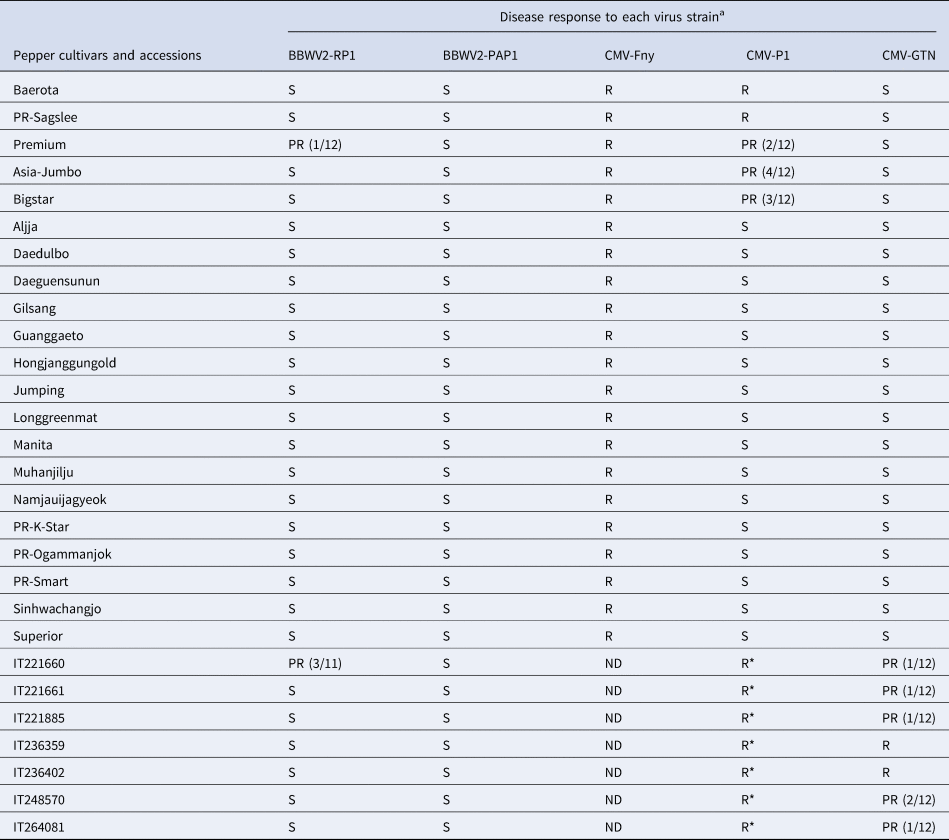
We next evaluated 34 commercial pepper cultivars and seven pepper accessions for resistance against each strain of BBWV2 and CMV. Upper uninoculated leaves of all tested plants were subjected to RT-PCR diagnosis after 4 weeks of inoculation. A plant negative for the virus by RT-PCR was considered to be resistant to the virus. In summary, 21 cultivars were resistant to CMV-Fny, whereas no cultivars resistant to CMV-GNT were identified (Table 2, online Supplementary Tables S1). Only two pepper cultivars (Baerota and PR-Sagslee) were resistant to CMV-P1, while three cultivars (Bigstar, Asia-Jumbo and Premium) were partially resistant (Table 2). Among the seven pepper accessions, two (IT236359 and IT236402) were resistant to CMV-GTN, while the other five were partially resistant (Table 2). In screening for resistance to BBWV2, only one cultivar (Premium) and one accession (IT221660) were partially resistant to BBWV2-RP1, but no tested cultivar or accession was resistant to BBWV2-PAP1 (Table 2). More specifically, BBWV2-PAP1 caused severe symptoms of stunting and leaf malformation in all tested pepper cultivars and accessions, except for the accession IT236402 (Fig. 2).
Symptomatology of pepper cultivars and accessions upon infection with BBWV2-PAP1. The BBWV2-PAP1 strain caused severe symptoms of stunting and leaf malformation in all tested pepper cultivars and accessions, except for the accession IT236402, which was systemically infected with BBWV2-PAP1 but showed no apparent symptoms.

Evaluation of pepper cultivars and accessions for resistance to different strains of BBWV2 and CMV

a Symbols for disease responses (number of plants infected/number of plants inoculated): R (resistant), none of the inoculated plants were systemically infected; PR (partially resistant), one or more but not all tested plants were infected; S (susceptible), all inoculated plants were systemically infected; ND, not determined; R*, resistance to CMV-P1 was reported by Choi et al. (Reference Choi, Lee, Kang, Kim, Huy, Park, Son, Kwon and Kang2018). Data were obtained from three to four independent inoculation experiments (three plants were tested for each treatment in each experiment). In total, nine to 12 plants were examined for each treatment. Systemic infection with the viruses was confirmed by RT-PCR at 4-weeks post-inoculation.
Discussion
In this study, we screened the pathotype-specific resistance of commercial pepper cultivars to BBWV2 and CMV by utilizing infectious cDNA clones of distinct strains of the viruses (two BBWV strains and three CMV strains). Plant RNA viruses have a rapid evolutionary rate due to error-prone replication and short generation times. Sometimes, the rapidly evolving nature of an RNA virus can cause difficulties for the consistent screening of resistant cultivars because the pathogenicity of the virus can change during its continuous passage under host-imposed constraints (Seo et al., Reference Seo, Sohn and Kim2011). Nevertheless, many resistance-screening studies have been conducted without a qualitative assessment of the viral sources. This concern can be overcome by using infectious cDNA clones of RNA viruses because there is no risk of accumulating mutations in the infectious cDNA clones in the form of plasmids when they are amplified in bacteria.
BBWV2 and CMV are the most prevalent viruses in Korean pepper fields, and the incidence of coinfection by these two viruses is significantly high in the fields (Kwon et al., Reference Kwon, Cho, Yoon and Chung2018), indicating that the development of new pepper varieties resistant to both viruses is necessary. To identify new breeding sources for resistance to BBWV2 and CMV in pepper, we screened 34 commercial pepper cultivars and seven accessions using the infectious cDNA clones of well-characterized strains of BBWV2 and CMV. While no commercial pepper cultivars were resistant to the newly emerged resistance-breaking strain CMV-GTN, several pepper accessions were resistant or partially resistant to CMV-GTN (Table 2, online Supplementary Tables S1).
Previous genetic mapping showed that these accessions contained genes that confer resistance at the same location as cmr2, a single recessive gene that confer resistance to CMV-P1 (Choi et al., Reference Choi, Lee, Kang, Kim, Huy, Park, Son, Kwon and Kang2018). Thus, it is likely that cmr2 also confers recessive resistance to CMV-GTN. However, we cannot exclude the possibility that additional resistance genes specific for CMV-GTN exist in the resistant accessions identified. Two pepper lines (Premium and IT221660) were partially resistant to BBWV2-RP1 but not to -PAP1, suggesting that these pepper lines contain dominant resistance genes that specifically interact with BBWV2-RP1 (Table 2). For genetic mapping and genotyping of these genes, allelism and inheritance analyses are required in future studies.
No pepper lines resistant to BBWV2-PAP1 were identified in this study. While most pepper lines infected with BBWV2-PAP1 showed severe symptoms, the accession IT236402 exhibited no obvious symptoms despite systemic infection by BBWV2-PAP1 (Fig. 2). Although this genetic trait cannot prevent viral infection, it seems that it can be utilized to increase the tolerance to BBWV2-PAP1. The identification of the responsible genes will be useful in breeding pepper resistance against BBWV2.
Supplementary material
The supplementary material for this article can be found at https://doi.org/10.1017/S1479262121000472
Acknowledgements
This research was supported in part by grants from Agenda Program (PJ014878) funded by the Rural Development Administration of Korea and Basic Science Research Program (NRF-2020R1I1A1A01072564) funded by the National Research Foundation of Korea. MHK was supported by the graduate research fellowships from the Ministry of Education through Brain Korea 21 Project (Global Smart Farm Division for Educating Innovative Human Resources.).