


%20--%3e%3c!DOCTYPE%20svg%20PUBLIC%20'-//W3C//DTD%20SVG%201.0//EN'%20'http://www.w3.org/TR/2001/REC-SVG-20010904/DTD/svg10.dtd'%3e%3csvg%20version='1.0'%20id='Layer_1'%20xmlns='http://www.w3.org/2000/svg'%20xmlns:xlink='http://www.w3.org/1999/xlink'%20x='0px'%20y='0px'%20width='64px'%20height='64px'%20viewBox='5.5%20-3.5%2064%2064'%20enable-background='new%205.5%20-3.5%2064%2064'%20xml:space='preserve'%3e%3cg%3e%3ccircle%20fill='%23FFFFFF'%20fill-opacity='0'%20cx='37.785'%20cy='28.501'%20r='28.836'/%3e%3cpath%20fill='%23595959'%20d='M37.441-3.5c8.951,0,16.572,3.125,22.857,9.372c3.008,3.009,5.295,6.448,6.857,10.314%20c1.561,3.867,2.344,7.971,2.344,12.314c0,4.381-0.773,8.486-2.314,12.313c-1.543,3.828-3.82,7.21-6.828,10.143%20c-3.123,3.085-6.666,5.448-10.629,7.086c-3.961,1.638-8.057,2.457-12.285,2.457s-8.276-0.808-12.143-2.429%20c-3.866-1.618-7.333-3.961-10.4-7.027c-3.067-3.066-5.4-6.524-7-10.372S5.5,32.767,5.5,28.5c0-4.229,0.809-8.295,2.428-12.2%20c1.619-3.905,3.972-7.4,7.057-10.486C21.08-0.394,28.565-3.5,37.441-3.5z%20M37.557,2.272c-7.314,0-13.467,2.553-18.458,7.657%20c-2.515,2.553-4.448,5.419-5.8,8.6c-1.354,3.181-2.029,6.505-2.029,9.972c0,3.429,0.675,6.734,2.029,9.913%20c1.353,3.183,3.285,6.021,5.8,8.516c2.514,2.496,5.351,4.399,8.515,5.715c3.161,1.314,6.476,1.971,9.943,1.971%20c3.428,0,6.75-0.665,9.973-1.999c3.219-1.335,6.121-3.257,8.713-5.771c4.99-4.876,7.484-10.99,7.484-18.344%20c0-3.543-0.648-6.895-1.943-10.057c-1.293-3.162-3.18-5.98-5.654-8.458C50.984,4.844,44.795,2.272,37.557,2.272z%20M37.156,23.187%20l-4.287,2.229c-0.458-0.951-1.019-1.619-1.685-2c-0.667-0.38-1.286-0.571-1.858-0.571c-2.856,0-4.286,1.885-4.286,5.657%20c0,1.714,0.362,3.084,1.085,4.113c0.724,1.029,1.791,1.544,3.201,1.544c1.867,0,3.181-0.915,3.944-2.743l3.942,2%20c-0.838,1.563-2,2.791-3.486,3.686c-1.484,0.896-3.123,1.343-4.914,1.343c-2.857,0-5.163-0.875-6.915-2.629%20c-1.752-1.752-2.628-4.19-2.628-7.313c0-3.048,0.886-5.466,2.657-7.257c1.771-1.79,4.009-2.686,6.715-2.686%20C32.604,18.558,35.441,20.101,37.156,23.187z%20M55.613,23.187l-4.229,2.229c-0.457-0.951-1.02-1.619-1.686-2%20c-0.668-0.38-1.307-0.571-1.914-0.571c-2.857,0-4.287,1.885-4.287,5.657c0,1.714,0.363,3.084,1.086,4.113%20c0.723,1.029,1.789,1.544,3.201,1.544c1.865,0,3.18-0.915,3.941-2.743l4,2c-0.875,1.563-2.057,2.791-3.541,3.686%20c-1.486,0.896-3.105,1.343-4.857,1.343c-2.896,0-5.209-0.875-6.941-2.629c-1.736-1.752-2.602-4.19-2.602-7.313%20c0-3.048,0.885-5.466,2.658-7.257c1.77-1.79,4.008-2.686,6.713-2.686C51.117,18.558,53.938,20.101,55.613,23.187z'/%3e%3c/g%3e%3c/svg%3e)
%20--%3e%3c!DOCTYPE%20svg%20PUBLIC%20'-//W3C//DTD%20SVG%201.0//EN'%20'http://www.w3.org/TR/2001/REC-SVG-20010904/DTD/svg10.dtd'%3e%3csvg%20version='1.0'%20id='Layer_1'%20xmlns='http://www.w3.org/2000/svg'%20xmlns:xlink='http://www.w3.org/1999/xlink'%20x='0px'%20y='0px'%20width='64px'%20height='64px'%20viewBox='5.5%20-3.5%2064%2064'%20enable-background='new%205.5%20-3.5%2064%2064'%20xml:space='preserve'%3e%3cg%3e%3ccircle%20fill='%23FFFFFF'%20fill-opacity='0'%20cx='37.637'%20cy='28.806'%20r='28.276'/%3e%3cg%3e%3cpath%20fill='%23595959'%20d='M37.443-3.5c8.988,0,16.57,3.085,22.742,9.257C66.393,11.967,69.5,19.548,69.5,28.5c0,8.991-3.049,16.476-9.145,22.456%20C53.879,57.319,46.242,60.5,37.443,60.5c-8.649,0-16.153-3.144-22.514-9.43C8.644,44.784,5.5,37.262,5.5,28.5%20c0-8.761,3.144-16.342,9.429-22.742C21.101-0.415,28.604-3.5,37.443-3.5z%20M37.557,2.272c-7.276,0-13.428,2.553-18.457,7.657%20c-5.22,5.334-7.829,11.525-7.829,18.572c0,7.086,2.59,13.22,7.77,18.398c5.181,5.182,11.352,7.771,18.514,7.771%20c7.123,0,13.334-2.607,18.629-7.828c5.029-4.838,7.543-10.952,7.543-18.343c0-7.276-2.553-13.465-7.656-18.571%20C50.967,4.824,44.795,2.272,37.557,2.272z%20M46.129,20.557v13.085h-3.656v15.542h-9.944V33.643h-3.656V20.557%20c0-0.572,0.2-1.057,0.599-1.457c0.401-0.399,0.887-0.6,1.457-0.6h13.144c0.533,0,1.01,0.2,1.428,0.6%20C45.918,19.5,46.129,19.986,46.129,20.557z%20M33.042,12.329c0-3.008,1.485-4.514,4.458-4.514s4.457,1.504,4.457,4.514%20c0,2.971-1.486,4.457-4.457,4.457S33.042,15.3,33.042,12.329z'/%3e%3c/g%3e%3c/g%3e%3c/svg%3e)
%20--%3e%3c!DOCTYPE%20svg%20PUBLIC%20'-//W3C//DTD%20SVG%201.0//EN'%20'http://www.w3.org/TR/2001/REC-SVG-20010904/DTD/svg10.dtd'%3e%3csvg%20version='1.0'%20id='Layer_1'%20xmlns='http://www.w3.org/2000/svg'%20xmlns:xlink='http://www.w3.org/1999/xlink'%20x='0px'%20y='0px'%20width='64px'%20height='64px'%20viewBox='5.5%20-3.5%2064%2064'%20enable-background='new%205.5%20-3.5%2064%2064'%20xml:space='preserve'%3e%3cg%3e%3ccircle%20fill='%23FFFFFF'%20fill-opacity='0'%20cx='36.924'%20cy='28.403'%20r='28.895'/%3e%3cpath%20fill='%23595959'%20d='M37.442-3.5c8.99,0,16.571,3.085,22.743,9.256C66.393,11.928,69.5,19.509,69.5,28.5c0,8.992-3.048,16.476-9.145,22.458%20C53.88,57.32,46.241,60.5,37.442,60.5c-8.686,0-16.19-3.162-22.513-9.485C8.644,44.728,5.5,37.225,5.5,28.5%20c0-8.762,3.144-16.343,9.429-22.743C21.1-0.414,28.604-3.5,37.442-3.5z%20M12.7,19.872c-0.952,2.628-1.429,5.505-1.429,8.629%20c0,7.086,2.59,13.22,7.77,18.4c5.219,5.144,11.391,7.715,18.514,7.715c7.201,0,13.409-2.608,18.63-7.829%20c1.867-1.79,3.332-3.657,4.398-5.602l-12.056-5.371c-0.421,2.02-1.439,3.667-3.057,4.942c-1.622,1.276-3.535,2.011-5.744,2.2%20v4.915h-3.714v-4.915c-3.543-0.036-6.782-1.312-9.714-3.827l4.4-4.457c2.094,1.942,4.476,2.913,7.143,2.913%20c1.104,0,2.048-0.246,2.83-0.743c0.78-0.494,1.172-1.312,1.172-2.457c0-0.801-0.287-1.448-0.858-1.943l-3.085-1.315l-3.771-1.715%20l-5.086-2.229L12.7,19.872z%20M37.557,2.214c-7.276,0-13.428,2.571-18.457,7.714c-1.258,1.258-2.439,2.686-3.543,4.287L27.786,19.7%20c0.533-1.676,1.542-3.019,3.029-4.028c1.484-1.009,3.218-1.571,5.2-1.686V9.071h3.715v4.915c2.934,0.153,5.6,1.143,8,2.971%20l-4.172,4.286c-1.793-1.257-3.619-1.885-5.486-1.885c-0.991,0-1.876,0.191-2.656,0.571c-0.781,0.381-1.172,1.029-1.172,1.943%20c0,0.267,0.095,0.533,0.285,0.8l4.057,1.83l2.8,1.257l5.144,2.285l16.397,7.314c0.535-2.248,0.801-4.533,0.801-6.857%20c0-7.353-2.552-13.543-7.656-18.573C51.005,4.785,44.831,2.214,37.557,2.214z'/%3e%3c/g%3e%3c/svg%3e)
%20--%3e%3c!DOCTYPE%20svg%20PUBLIC%20'-//W3C//DTD%20SVG%201.1//EN'%20'http://www.w3.org/Graphics/SVG/1.1/DTD/svg11.dtd'%3e%3csvg%20version='1.1'%20id='Layer_1'%20xmlns='http://www.w3.org/2000/svg'%20xmlns:xlink='http://www.w3.org/1999/xlink'%20x='0px'%20y='0px'%20width='64.000977px'%20height='64px'%20viewBox='0%200%2064.000977%2064'%20enable-background='new%200%200%2064.000977%2064'%20xml:space='preserve'%3e%3cg%3e%3ccircle%20fill='%23FFFFFF'%20fill-opacity='0'%20cx='32.064453'%20cy='31.788086'%20r='29.012695'/%3e%3cg%3e%3cpath%20fill='%23595959'%20d='M31.943848,0C40.896484,0,48.476562,3.105469,54.6875,9.314453C60.894531,15.486328,64.000977,23.045898,64.000977,32%20s-3.048828,16.457031-9.145508,22.513672C48.417969,60.837891,40.779297,64,31.942871,64%20c-8.648926,0-16.152832-3.142578-22.513672-9.429688C3.144043,48.286133,0,40.761719,0,32.000977%20c0-8.723633,3.144043-16.285156,9.429199-22.68457C15.640137,3.105469,23.14502,0,31.943848,0z%20M32.060547,5.771484%20c-7.275391,0-13.429688,2.570312-18.458496,7.714844C8.381836,18.783203,5.772949,24.954102,5.772949,32%20c0,7.125,2.589844,13.256836,7.77002,18.400391c5.181152,5.181641,11.352051,7.770508,18.515625,7.770508%20c7.123047,0,13.332031-2.608398,18.626953-7.828125C55.713867,45.466797,58.228516,39.353516,58.228516,32%20c0-7.3125-2.553711-13.484375-7.65625-18.513672C45.504883,8.341797,39.333984,5.771484,32.060547,5.771484z%20M44.117188,24.456055%20v5.485352H20.859863v-5.485352H44.117188z%20M44.117188,34.743164v5.481445H20.859863v-5.481445H44.117188z'/%3e%3c/g%3e%3c/g%3e%3c/svg%3e)
The Indian jurist Radhabinod Pal passed away in 1967, yet he has become an academic celebrity in recent years. Pal is famous in some quarters and notorious in others for his dissenting opinion in the Tokyo War Crimes Trial (1946–48), in which he sought to acquit twenty-five leaders of wartime Japan who were accused of crimes against peace, crimes against humanity, war crimes, and murder (see Figure 3.1).Footnote 1
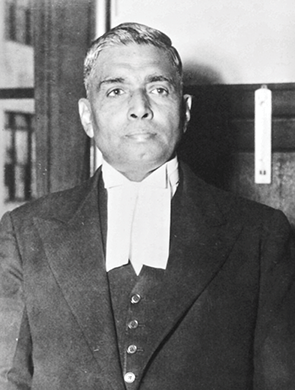
His lengthy opinion in that case, which was motivated by anti-colonial sentiments, has been lauded by some scholars as an early example of TWAIL (Third World Approaches to International Law) scholarship. It is, therefore, no wonder that most of the works written about him have been written by international law scholars.Footnote 2
Pal also wrote extensively on the history and philosophy of Hindu law, but his works on these topics have received far less scholarly attention. Some scholars have entirely ignored Pal’s theoretical works. Others have mentioned them, but they are not the primary focus of the discussion. Pal’s most detailed biography was written by the Japanese historian Nariaki Nakazato. Nakazato’s book seeks to provide a nuanced (and somewhat unflattering portrait) of Pal in order to counter the “Pal cult” prevalent in Japanese right-wing revisionist circles.Footnote 3 Although Nakazato does discuss Pal’s works on the philosophy and history of Hindu law, these are not central to the book.Footnote 4 Other authors exploring Pal’s jurisprudential thought seek, like Nakazato, to provide a thicker context to Pal’s Tokyo dissent.Footnote 5 None of these works examines Pal’s jurisprudential ideas in their own right, unlike this chapter, whose focus is Pal’s jurisprudential works rather than his Tokyo dissent.
Life and Works
Pal was born in 1886 in a village in the Kushtia district of Bengal, now part of Bangladesh. He came from a family that belonged to an artisan (potters) caste.Footnote 6 His father disappeared when Pal was just three years old. However, his uneducated but ambitious mother pushed the child to excel in his studies, having as a model Sir Gooroodas Banerjee, a Bengali judge of the Calcutta High Court and the first Indian vice-chancellor of the University of Calcutta.Footnote 7 After studying at a series of provincial schools and at Rajshahi College in northern Bengal, Pal enrolled at the best Indian college of the time, Presidency College in Calcutta, where he acquired a master’s degree in mathematics in 1907. In 1909, he obtained a law degree from Ripon College, another Calcutta institution. Between 1908 and 1911, Pal worked as a clerk in the Accountant-General’s office in Allahabad. In 1911, he returned to Bengal and, until 1920, taught mathematics at Ananda Mohan College in the town of Mymensingh, north of Dacca, and also practiced law there. In 1920, Pal earned a master’s degree in law from the University of Calcutta, and, at the suggestion of Sir Asutosh Mookerjee, the leading Bengali lawyer and educator, he resigned from his post at Mymensingh and moved to Calcutta.
In 1921, Pal started practicing as an advocate in the Calcutta High Court, and in 1923, he took up a teaching post at the Calcutta University College of Law. His doctorate, awarded in 1924, was based on a dissertation on the Hindu philosophy of law.Footnote 8 Pal’s interest in the topic may have been the result of the influence of his mentor, Mookerjee, or perhaps even the fact that his childhood model, Sir Gooroodas Banerjee, had also written on the topic.Footnote 9
As a lawyer, Pal specialized in income tax litigation, serving as a legal advisor to the Government of India’s Income Tax Department.Footnote 10 In the early 1940s, he was appointed to a temporary judicial position as an officiating judge of the Calcutta High Court. Between 1944 and 1946, Pal held the position of Vice-Chancellor of the University of Calcutta. On three occasions, he was invited to deliver the prestigious Tagore Law Lectures. Only one other lecturer in the history of this lecture series had this honor bestowed on them three times.Footnote 11
In April 1946, Pal was appointed the Indian judge in the Tokyo Trial. Given his nationalist leanings, it is somewhat surprising that the British rulers of India nominated him – but this was probably due to a bureaucratic blunder by the British authorities. Pal was neither the first nor the second choice for the position. The initial nominee declined due to health issues, while the second failed to respond altogether. With the deadline for nominating an Indian judge rapidly approaching, British officials hastily turned to a pool of retired and serving Indian High Court judges. Although Pal was only a temporary judge at the time and did not strictly meet the qualifications, he applied and was ultimately selected. Owing to the urgency of the situation, no thorough evaluation of his political views was conducted.Footnote 12 Pal had already been involved in high-profile international legal activities before the Tokyo Trial. In 1937, for instance, he was appointed joint chairman of the International Academy of Comparative Law. However, it was Pal’s dissent in Tokyo that made him famous the world over, especially in Japan, where his opinion was perceived in some circles as a sign of Asian solidarity against Western imperialism. After the Tokyo Trial, Pal served in a series of prominent positions. In 1952, he was elected to the UN-sponsored International Law Commission, becoming its chairman in 1958 and again in 1962. In 1957, he became a judge of the Permanent Court of Arbitration in The Hague, and in 1959, he was appointed National Professor of Jurisprudence by the Indian Government.
While Pal’s political views and affiliations changed over the course of his life, generally speaking, he can be described as an anti-colonial thinker influenced by pan-Asian ideas, Indian nationalism, and (to a certain extent) also Hindu nationalism.Footnote 13 The sources of his Pan-Asian ideology go back to 1905. In the spring of that year, Japan won the Russo-Japanese War, providing a model for anti-colonial activists across the non-Western world. In Bengal, Japan’s victory coincided with a political crisis that was the result of the partitioning of the province by the British, inspiring a nationalist awakening with which Pal came to identify.Footnote 14
Pal had several friends who were Indian nationalist activists. When he was a student at Presidency College he befriended Sarat Chandra Bose, the elder brother of Subhas Chandra Bose. Later, he would become an admirer of Bose’s younger brother. The young Bose was the president of the Congress Party in the late 1930s. During the Second World War, he fled India to Nazi Germany. He was later appointed Commander of the Indian National Army, a military force that collaborated with the Japanese Army. Other acquaintances of Pal, too, or their relatives, were involved in radical Indian nationalist agitation and anti-British terrorism in Bengal.Footnote 15
Pal was also connected with people associated with Hindu rather than Indian nationalism. In 1923, the Hindu nationalist activist V. D. Savarkar popularized the term Hindutva (Hinduness) to designate this ideology, which identified contemporary Hindus with the ancient Aryans and the Sanskrit language and argued that all Hindus shared a common race and a common culture. The notion of Hindutva was propounded by several radical right-wing political movements in India during the late-colonial period, movements that were somewhat inspired by, or had ties with, European fascism.Footnote 16 Pal was in close contact with Syama Prasad Mookerjee, the son of his University of Calcutta mentor, Asutosh Mookerjee. Syama Prasad, like his father, served as Vice-Chancellor of the University of Calcutta in the 1930s and then embarked on a Hindu nationalist political career. In 1943, Syama Prasad became president of the nationalist party Hindu Mahasabha. In 1951, he founded the right-wing Bharatiya Jana Sangh, a precursor to the Bharatiya Janata Party, one of the two major Indian political parties today. Like his father, Syama Prasad espoused a cultural-nationalist vision of Indian higher education.Footnote 17 Pal’s relationship with Syama Prasad and his followers at the University of Calcutta was somewhat uneasy.Footnote 18 However, his main biographer, Nakazato, states that he was associated with the “periphery” of the Hindu Mahasabha party and “had many things in common with what is today called Hindu nationalism.”Footnote 19
During Pal’s term as Vice-Chancellor of the University of Calcutta, he was involved in several nationalist incidents: In his 1945 convocation speech, Pal mentioned the need to serve the cause of Indian freedom, prompting the British Governor of Bengal to storm out of the hall. In the following year, Pal invited Jawaharlal Nehru, the future prime minister of India, newly released from a British prison, to give a convocation speech. Pal, together with Syama Prasad Mookerjee, was also present during violent student demonstrations that took place in Calcutta in November 1945 in protest at the trial of Indian National Army officers by the British.Footnote 20
Pal published several books during his lifetime. This chapter will focus on his works on Hindu law. Modern specialists do not hold these works in high regard, and they are seldom cited.Footnote 21 However, my interest lies not in a “vertical” chronological discussion of the history of the modern scholarship on Hindu law, or Pal’s influence (or lack thereof) on it, but in comparing some of the major themes found in Pal’s works with those found in the work of the other legal scholar whose thought I will examine in detail in the next chapter, on Samuel Eisenstadt.
Pal’s doctoral dissertation served as the basis for his book The Hindu Philosophy of Law in the Vedic and Post-Vedic Times Prior to the Institutes of Manu. This book was published in Calcutta around the mid-1920s.Footnote 22 It was then used for Pal’s 1930 Tagore Law Lectures, which he delivered in 1932.Footnote 23 The lectures were ultimately published in 1958 in a book entitled The History of Hindu Law in the Vedic Age and in Post-Vedic Times Down to the Institutes of Manu.Footnote 24
The relatively short 1920s book was mainly based on Pal’s reading of the Vedic hymns augmented by some references to works of Indologists such as Max Müller and the writings of Western political and legal philosophers – from Aristotle and Plato to Hobbes, Kant, John Austin, and Roscoe Pound. Pal began his book by discussing the importance of studying the “early Hindu fundamental conceptions of law” to reveal “the eternal glory of the old Hindu-philosophical-legal mind.” This perspective was important, he argued, both because ancient Greece and Rome were “indebted to Vedic India,” which had influenced their conception of law, and also because studying this history was “essential for a Hindu,” since law reflects “the immutable soul of the races.”Footnote 25 A brief overview of major Western theories of law followed. Pal then moved to a survey of the legal ideas embodied in specific Vedic hymns, attempting to attribute particular legal (but also theological and cosmological) ideas to specific Vedic sages. Pal also discussed legal concepts common to all “early Aryans” during the Vedic period. His survey then turned to the Hindu philosophy of law during the Brahmana and Sutra periods, when Hindu thinkers came to emphasize the function of law as a method for preserving the status quo, including the caste system.Footnote 26 Major themes in Pal’s analysis included the ends of the law, the social order, the Hindu doctrines of welfare and utility, the origin and role of the state, the sources of law, the place of custom as a source of law, and the role of reason in the creation of legal norms.
Pal’s 1958 book, The History of Hindu Law, was far longer than his earlier Hindu Philosophy of Law and contained two parts. In the first part, Pal discussed Vedic society, political institutions, and the legal philosophy of the Vedic period, followed by developments in Hindu legal philosophy in the later Brahmana and Sutra periods. The second part of the book was devoted to an overview of the norms of Hindu law in the different epochs between the Vedic period and Manu’s Code, each chapter discussing several categories of law (the law of persons, property, contract, crime, and procedure).
Another work related to Pal’s interest in Hindu law was The History of the Law of Primogeniture: With Special Reference to India, Ancient and Modern, based on his 1925 Tagore Law Lectures, delivered in 1926. The 558-page book, published in 1929, was extremely ambitious. Unlike most other Tagore Lectures, it was not confined to India but dealt with the comparative history of primogeniture. The parts dealing with regions outside India were based on secondary literature, while those dealing with India were original.Footnote 27 About half of the book was devoted to the global history of primogeniture outside India, containing chapters addressing the ancient world (Egypt, Babylonia, Greece, and Rome), England and English-speaking territories, France, Germany, Russia, China, and Japan. The second half dealt with the history of primogeniture in India from antiquity to the present, beginning with Vedic and post-Vedic times, moving to the period of Islamic rule, and lastly, discussing British India. The work was broad both in its geographical scope and also in its examination of a wide range of legal fields. It analyzed family law, the law of inheritance, property law, and various subfields of public law, such as constitutional, administrative, and tax law. The attempt to trace the global evolution of the concept of primogeniture led Pal to examine the history of this notion beyond private law, venturing into the rules regarding the inheritance of official positions, including those of kings or tax collectors.
Ideas
Western Jurisprudential Influences
Pal’s works echoed themes found in nineteenth-century nationalist, evolutionary, and racial theories of law that appeared in Germany and England. It seems that Pal drew from the early nineteenth-century German Historical School the notion that law reflected the “spirit of the people” or, as he put it, “a people’s individuality and originality … finds expression notably in its law.”Footnote 28 The mid nineteenth-century evolutionary version of the historical approach to law, embodied in the work of English scholar Henry Maine, also influenced Pal. One conspicuous influence of Maine’s work was found in Pal’s attitude to the type of sources that could be used to study ancient law and legal thought. A major source used by Pal in all his works was the Vedic hymns. Here, he followed Henry Maine’s approach in his book Ancient Law of using poetry to reconstruct ancient law. Just as Maine turned to Homer to learn about the law of the ancient Greeks, so Pal turned to the ancient Vedic hymns, extracting from them “concepts of law.”Footnote 29 Pal was also inspired by and accepted the idea that there were evolutionary stages through which every legal system was supposed to pass.Footnote 30
While a major jurisprudential influence on Pal’s scholarship was Henry Maine’s evolutionary legal thought, Pal’s works also showed an awareness of developments in early twentieth-century Western jurisprudence, especially the growing influence of sociology. His 1918 Introductory Lecture discussed the history of the Vedic Aryans with reference to the works of the nineteenth-century sociologist Herbert Spencer.Footnote 31 In his 1920s book The Hindu Philosophy of Law, Pal mentioned the works of two pioneers of the field of legal sociology, the American scholar Roscoe Pound and the Austrian scholar Eugen Ehrlich. In this book, Pal wrote that historical jurisprudence was “discredited for the moment” and observed that “the fashion of the time calls for a sociological legal history” that is a study not merely of how legal doctrines evolved in the past but also “the social causes and social effects of legal doctrines” and the relationship of legal history to social and economic history. Given the lack of sources, it was impossible, Pal admitted, to offer a thorough sociological analysis of how the social circumstances of the ancient Aryans gave rise to their legal ideas.Footnote 32 Nevertheless, Pal’s general understanding of the law was certainly influenced by the sociological approach, as is evident in his functionalist analysis of ancient Hindu law as a mechanism serving the “mundane” purpose of “the preservation of society” by providing stability.Footnote 33
The Antiquity and Superiority of Ancient Hindu Law Compared to Western Law
Nineteenth-century European representations of Hindu law, and of “Oriental law” more broadly, frequently cast it in a negative light, especially in contrast to Western legal traditions. Pal dedicated significant portions of his work to challenging these portrayals. His strategy, which mirrored that of many non-Western intellectuals of the era, can be described as a form of “triumphal apologetics,” that is, an argumentative approach that not only sought to refute Western depictions but also asserted that Hindu law was in fact both more ancient and superior to its Western counterpart.Footnote 34
Pal opened The Hindu Philosophy of Law with the argument, taken from the German legal philosopher Fritz Berolzheimer, that the legal and ethical conceptions of the Vedic Aryans influenced the ancient Greeks and Romans and, through them, all later European nations.Footnote 35 His 1929 book, Law of Primogeniture, too, praised non-Western law, generally, and Hindu law in particular. According to Pal, India, Babylonia, and China were “the three seats of archaic civilization,” and “the ancient history of each is absolutely free from European influence.”Footnote 36 In his 1958 book, Pal also made efforts to show the antiquity of Hindu law. In the Preface, Pal observed that “the history of Hindu law in the Vedic age really marks the dawn of law itself on this planet.”Footnote 37 Relying again on the work of Berolzheimer, Pal argued that the Hindu concept of cosmic (and human) order, rita, as the basis of all law, influenced Greek, Roman, and Christian thinkers. Indian ideas were thus “antecedents of later legal and ethical developments among the Greeks and Romans.”Footnote 38 At another point in his book, Pal criticized Western scholars who sought to “minimize … Vedic civilization” by dating the ancient collection of Sanskrit hymns, the Rigveda, to the year 1000 BC, thus implying that Hindu civilization appeared later than those of Egypt and Mesopotamia. Instead, Pal, relying on the works of previous scholars, argues that the beginning of Vedic culture dates back to about 6000 BC and, thus, predated “Babylon and Egypt.”Footnote 39
Pal did not merely claim that Hindu law was older than Western law. He also claimed that it was better. In his 1920s book, he compared Hindu law to Roman law and “Semitic law” and sought to demonstrate the superiority of Hindu law and Hindu jurists, whom he described as pioneers in creating law and legal philosophy. It is not surprising, therefore, to find that Pal ended this book with a call to his readers to “admire and marvel how in the dim past, when the rest of the world was as yet steeped in darkness, these savants [the ancient Hindu jurists] reached at the light to light the path of future generations, how they struggled, with all their keenness of intellect, to harmonise the discordant and to evolve a cosmos out of a pervading chaos.”Footnote 40
Pal argued that the monotheistic notions of the “unity of God” and the “brotherhood of man” first appeared in India and that, unlike other cultures in which the ideas of the unity of God had led, ironically, to intolerance and persecution, the Vedic Aryans did not succumb to religious dogmatism. This noble tradition, Pal noted, continued in Buddhism, which alone, out of all great world religions, flourished without persecution, censorship, or inquisitions and, in this respect, was “enormously superior to Christianity.” Pal characterized Christianity as a religion that is “wedded to militarism” and justifies its “bloodthirsty tendencies” by “an appeal to the savage Bronze-Age literature of the Old Testament.” In contrast, Hindus and Buddhists, Pal argued, lived side by side in India in peace and were never “guilty … of criminal lunacies [such] as the religious wars of the sixteenth and seventeenth centuries” in Europe.Footnote 41 Regarding earlier eras, Pal noted that the culture of the Vedic Aryans was “far in advance of the culture and civilization of the same period of the people of the countries from which it is said they migrated to India.” In India, therefore, “there was no twilight before dawn” because “the great people which has led the van of Indian culture have left no record of slow and painful struggle onwards through lessening darkness of barbarism towards the light of civilization.”Footnote 42
Evolutionary Schemes, Social Hierarchies, Democracy
Moving to specific topics often found in Western works, negative portrayals of Hindu law mentioned its static nature, its lack of systematization, and its amorality. Western critiques of Hindu law also noted that the substance of Hindu law was problematic because of its inegalitarian and undemocratic nature.
In his 1958 book, Pal sought to subvert the idea, associated with Henry Maine, that Hindu law was “a stagnant system, always standing still” due to its religious nature. Pal argued that this was not the case: Hindu law was dynamic, capable of changing to accommodate new economic and social circumstances.Footnote 43 One indication of the continuously evolving nature of Hindu law was the appearance of Hindu philosophers of law. The philosophy of law, Pal said, arises when an existing legal norm, based on custom, seems inconvenient. In order to change the norm, philosophers turn to reason and nature to justify its replacement. Therefore, the fact that Hindu philosophers of law already appeared during the Vedic era was an indication that Hindu law was dynamic.Footnote 44 A further common Western critique of Hindu law as a legal system that Pal sought to challenge was that it lacked unity and was “disintegrated” (meaning that specific rules applied to particular castes). Pal’s answer to this critique was to state that while Hindu law was personal rather than territorial, the notion of territorial law also appeared in Hindu law.Footnote 45 Finally, another Western critique was that ancient Hindu law was amoral because it lacked the concept of sin. In response, Pal argued that the Vedic hymns actually contain many examples of the belief in God, the perception of the difference between good and evil, and the notion that “God hates sin and loves virtue.”Footnote 46
Moving to the specific substance of Hindu law, a common Western critique was that Hindu law sought to preserve and glorify hierarchical social relations rather than being based on the notion of equality (a concept that is, of course, foreign to ancient religious legal systems in which various types of hierarchies between social groups are common). Specifically, there were three categories of persons that were treated as inferior by Hindu law: slaves, members of the lower castes, and women. Pal, it should be recalled, came from a family belonging to a caste of moderate social standing. He was also involved, later in his life, in encouraging female education (in 1948, he was appointed the president of the governing body of Bethune College, the first Asian institution of its kind for women).Footnote 47 Given these facts, it is understandable that the social hierarchies created by Hindu law would pose a problem for him.
Slavery was only briefly mentioned in Pal’s 1918 book, Introductory Lecture, and was not discussed at all in his 1920s book.Footnote 48 It was also not a major topic in his 1958 book. Pal did note in this latter work that slavery existed in Vedic society, but he qualified this fact in two ways. First, he began his very brief discussion of slavery by stating that:
… from the earliest times in all nations the system by which the stronger enslave the weaker has prevailed. In early times it was usual to reduce to the status of slave all captives taken in war. This was really a step in advance of the earlier indiscriminate slaughter of the vanquished enemies.Footnote 49
Second, while Pal noted that Vedic Aryans treated their slaves more like things than human beings, he nevertheless said that slaves could “improve their status and become almost equal to Aryans.”Footnote 50
As for the Hindu caste system, Pal used several arguments in its defense. First, he claimed that it did not exist in early Vedic society. “In the Rigveda,” he argued, “there is no clear indication of the existence of caste in the proper Brahmanical sense of the word. This caste system was only introduced after the Brahmans had finally established their claims to the highest rank in the body politic.”Footnote 51 Second, Pal acknowledged that, according to Hindu legal philosophy, the purpose of the law was “the preservation of the existing social institutions” – that is, the caste system. However, he argued that other ancient legal systems also regarded law as a method for preserving the social status quo. Specifically, he mentioned the Greeks, noting that the ancient Greek philosophers, too, were convinced that “in every society there must be grades, masters and servants, the privileged and the unprivileged, the upper and lower classes,” and that when the Greeks talked about equality, this was conceived as equality between members of the same class, not between all members of society.Footnote 52
Another method of defending Hindu law from the charge of inequality was to question the desirability of equality itself. In his 1958 book, Pal referenced the anti-egalitarian and anti-democratic ideas of Friedrich Nietzsche.Footnote 53 Indeed, Pal devoted several pages of that work to a summary of Nietzsche’s anti-egalitarian stance (based, it seems, on a chapter in a popular book, Will Durant’s The Story of Philosophy), discussing Nietzsche’s admiration for the Laws of Manu, and repeating Nietzsche’s anti-democratic and anti-Christian ideas.Footnote 54 The allusion to Nietzsche’s thought, it seems, was meant to imply that inequality was not merely a characteristic of ancient societies and ancient law.Footnote 55
Finally, another strategy for downplaying the role of caste in Hindu law may have been to minimize the significance of purity and pollution in Indian social relations. For instance, in his discussion of Nietzsche’s admiration for the Laws of Manu, Pal did acknowledge their “terrible” nature, and the way they were meant to reflect Brahmanical power. He even referenced specific provisions concerning social impurity. However, overall, the theme of purity and pollution was largely absent from his work.Footnote 56
More generally, one might speculate that Pal’s reluctance to directly criticize the caste-based nature of Hindu law might be seen as an academic variant of the concept of Sanskritization – that is, the process by which members of the lower castes seek social mobility by emulating the rituals or practices of the upper castes. Pal’s apologetic attempt to defend Hindu law was, according to this approach, a way to obscure his relatively low social origin.Footnote 57
Regarding the attitude of early Hindu law to women, Pal claimed that they were treated as equal to men. After quoting some verses from the Rigveda that implied that women were treated like chattels, Pal pointed out that there was also evidence that “Aryan women,” at least those belonging to the higher classes, “enjoyed equal freedom with men in all matters, social and religious,” which indicated the “high state of culture” of Aryan society. Similarly, marriage in Vedic texts, noted Pal, was not coerced but based on choice for both husband and wife.Footnote 58 When discussing Hindu law in the Brahmana and Sutra periods, Pal said that modern legal systems were characterized by individualism (treating individual adults as independent of their families) and by seeing women as “self-sufficient units” independent of their husbands. He then commented that, “even under ancient and medieval conditions the legal sense of the Hindus was akin to and approached” that of modern law – for example, by recognizing that women could own property in their own right. This independence, he then noted, declined during the Brahmana and Sutra periods. For instance, in the case of marriage, while the consent of the woman was required during the Vedic age, this was not the case in later periods.Footnote 59
Another aspect of Pal’s perspective on the legal status of women was found in his discussion of matrimonial relations. Explaining the morality of Vedic society, Pal noted that it “differed vastly” from that of the original inhabitants of India, the Dravidians, and “still more from the unmixed barbarism of the other races of India.” The matrimonial relations of Dravidian society were “rather loose” because it was a matriarchal society (unlike the “patriarchal and masculine” Vedic society). Vedic religion was “fairly right and respectable,” in contrast to Dravidian religion, which was “dark and repulsive, obscene and bloody” (presumably because, in Vedic religion, masculine gods dominated the pantheon, while female gods dominated the Dravidian pantheon).Footnote 60
Interestingly, in his book Law of Primogeniture, Pal went so far as to argue that ancient non-Western law had a more egalitarian attitude toward women than Western law. In his discussion of ancient Chinese and ancient Egyptian law and society, Pal approvingly quoted a book by nineteenth-century English author (and early feminist) Edith Jemima Simcox, who noted that, before the Semites and Aryans came to dominate the Old World, the first civilized states were established by “men of some other race – humane, industrious [… and] liberal in the treatment of women.”Footnote 61
Another strand of Western critique of the substance of Hindu law had to do with its alleged incompatibility with the notion of democracy.Footnote 62 In Pal’s 1958 book, he described Vedic political institutions as advanced, relying on the works of scholars of ancient Indian constitutional history such as Kashi Prasad Jayaswal and Benoy Kumar Sarkar (whose works are discussed in detail in Chapter 5). Repeating the claims of these scholars, Pal argued that representative institutions such as parliaments were not an English notion imported to India – they existed in India before the period of the British conquest. Buddhist assemblies were one example of such institutions, Pal explained. However, he argued that “similar institutions” had existed even during the Vedic period, mentioning various types of Vedic assemblies in which “rudiments of the present-day parliamentary practice [were] discernible.” Pal also mentioned republican political arrangements that arose in later periods of Hindu history and were somewhat similar to modern democratic assemblies.Footnote 63 While Pal was keen to show that Indians, too, had their own democratic institutions, he also qualified his comparison between Indian and Western ones, arguing that it would be wrong to equate the two. Quoting the Indian nationalist philosopher (and also revolutionary terrorist leader) Sri Aurobindo, Pal claimed that Indian political institutions were embedded in the “unique mentality” of the Indian race.Footnote 64
Collectivism
A major aspect of Pal’s approach to the issue of law and hierarchical social relations was his rejection of liberal individualist notions of law and society. The interwar and post-war periods were a time when many intellectuals, including Pal, showed interest in alternatives to nineteenth-century liberalism, such as fascism, corporatism, socialism, and communism.Footnote 65 For example, when discussing the nature of law, Pal rebuffed the view that society was merely “an aggregate of isolated abstract individuals.” He noted that the “Vedic Rishis [sages] scarcely ever consider man as ‘a whole in himself’ […] The isolated individual of course is an absurd abstraction in the philosophy of such a people.” According to the Vedic sages, law was a way of ensuring harmony – and harmony relied on “each individual’s keeping within a predetermined groove.”Footnote 66
This was not merely a statement about ancient Hindu society. At one point in Pal’s 1958 book, he embarked on a long digression chastising individualist Western civilization, which, he conceded, was “creative” but was also characterized by the evils of “disintegration and destruction” and “arrogant individualism.” Vedic society was no less creative than Western modern society, he said, but its creativity was distinct in the sense that it sought “integration and balanced co-ordination” – in contrast to “the modern world” (the West), which sought “individual order” as opposed to “collective order.” Western democracy created doubt and anxiety, undermining the communities that sustain the individual: “Freedom in the present-day life has lost its foundation in community and has become a torment; individualism of the present day strips the individual layer after layer of protective tissue. We require individualism, but we require individualism which would not wall man off from community …”Footnote 67
Pal’s Jurisprudential Contributions
Pal’s works on Hindu jurisprudence were, in many senses, derivative. They repeated ideas that had first appeared in texts produced by Europeans or by other, earlier, Indian thinkers. However, since Pal was both a lawyer and a scholar of Indian history, he offered a unique perspective on Hindu jurisprudence, one that combined his ability to read the original Sanskrit texts with his familiarity with Western jurisprudential scholarship. Three specific (although not necessarily original) ideas that characterized Pal’s works are outlined below.
The Aryan Framework
One major aspect of Pal’s 1920s works was the reliance on nineteenth-century Western linguistic, racial and legal theories that divided the world into races and assumed that all members of the same race shared similar legal ideas.Footnote 68 This perspective is reflected in the following statement by Pal:
In passing from one nation to another, we observe shades of jural distinctions, which become material differences when the nations belong to different races. Race is indeed a dominant factor in the effort of the human activity to realise itself. Throughout the ages the diversity of race has influenced indelibly the generation of law. In law, as in other parts of life, the heart of the race is what we must seek to discover …Footnote 69
At the beginning of his 1920s book, Pal stated that comparative law was “a necessary preliminary” to the study of legal philosophy since comparative law would allow us to see, beyond the difference between different legal systems, the “organic unity” of the legal philosophy they share. Given the importance of the study of comparative law, nothing was more important, he said, than “a study of the ancient Hindu minds” and the early “Hindu fundamental conception of law” as a way to discover the shared legal concepts of the “Aryan races [sic].” The Aryans were divided into western and eastern branches, but they all shared the innate “Aryan love for systems,” adding that “there is no world law, only racial laws.”Footnote 70
The theory about the existence of an “Aryan race” was a nineteenth-century European construct.Footnote 71 This theory is, now, of course, no longer in fashion. It was enthusiastically received in colonial India. It was used to prove the affinity between British colonial masters and their Indian subjects (especially upper-caste Indians). However, it could also be leveraged to support an argument for the antiquity and superiority of the Indian Aryans compared to European ones.Footnote 72 The infatuation of Europeans with ancient Indian ideas and symbols was also a feature that appealed to Indian intellectuals.Footnote 73 In Pal’s works, Aryanism served as a tool for critiquing Western monotheistic religions (and, indirectly, Western law). It was also used as a foundation for the rejection of the concept of “oriental despotism” that nineteenth-century European thinkers often used when describing Indian civilization.Footnote 74
Pal contrasted Aryans with the Semites, comparing the Vedic notion of law as a divine order governing the universe with the Semitic notion of God as “a personal and omnipotent Deity who gave the laws [commandments] just as He wills.”Footnote 75 The distinction between the law of the Semites and “Aryan” law was not found in Henry Maine’s work.Footnote 76 Pal may have taken this idea from the work of the nineteenth-century Bengali lawyer and intellectual Bankimchandra Chatterjee, who distinguished between the “Christian God,” who was conceived as a despotic monarch constantly policing his subjects, and the Indian divinity who was immanent in all creatures.Footnote 77 Another possible source for this contrast may have been the works of late nineteenth-century German scholars such as the German Indologist Paul Deussen, who contrasted Hinduism with Judaism and Islam and their “unapproachable and sadistic God.”Footnote 78 Of course, the fact that Islamic law was also a “Semitic” legal system was another advantage of the binary distinction between Aryan and Semitic law, at least for Hindu nationalists.
The distinction between Aryans and Semites also appeared in Pal’s work in his discussion of the Aryan conception of the nature of the state. Relying on the works of the Italian legal philosopher Luigi Miraglia, Pal argued that the “individualistic” Semites never succeeded in creating political stability, alternating between anarchy, despotism, and theocracy. In contrast, the Aryans created balanced governments composed of a king, a senate, and a general assembly.Footnote 79
Interestingly, the emphasis in Pal’s 1920s book on the “Aryan races” and the comparison between Semites and Aryans was toned down in his 1958 book. The term “Aryans” still appeared in the latter book. At one point, Pal still contrasted the Hindu gods with the “Semitic God” (whom he described as “whimsical and despotic”).Footnote 80 In another place in this book Pal seemingly endorsed a comparison made by Nietzsche between the Laws of Manu and the Bible, quoting Nietzsche’s characterization of the Bible as an “evil-smelling Jewish distillation of Rabbinism and superstition.”Footnote 81 However, the explicit contrast found in the earlier work between “Aryan ideas” and “the Semitic-Hebraic faith” was no longer there. This change may have been the result of the association of the concept of Aryanism with Nazi thought, or perhaps it was due to the fact that, following the end of British rule in India in 1947, Pal no longer felt a strong need to contrast Hindu religion with Christianity or Islam, both of which were identified with this “Semitic God.”
Nonetheless, while the notions of Aryan race and law were less prominent in Pal’s 1958 book, the work still relied on a racial theory of Indian civilization, a theory first developed in late nineteenth-century Europe. According to this theory, the Aryans were light-skinned migrants from the North who invaded an India inhabited by a dark-skinned aborigine population.Footnote 82 Early in his 1958 book, Pal discussed this theory, observing that some Western scholars saw the Aryans as migrants or invaders, while also noting that the Indian scholar Abinas Chandra Das, a lecturer on ancient Indian history at the University of Calcutta, argued that the Aryans actually emerged in the Punjab.Footnote 83 Later in the book, however, Pal no longer qualified his discussion, talking about Aryan society as being, indeed, headed by a “foreign race of fairer skin and Indo-Germanic speech” and about the Aryans “streaming into” an India inhabited by Dravidian tribes who were of “blacker blood” and espoused a barbaric religion and manners.Footnote 84
The Critique of Positivism
A second, and related, theme evident in Pal’s comparison of ancient Hindu and Western religion and law was the contrast he drew between the Hindu notion of law and modern Western positivist notions. In the work of the early nineteenth-century English legal philosopher John Austin, law was identified with the “command of the sovereign.” According to such a definition, Hindu law could not be considered “law” since it did not originate in the commands of a human sovereign. In his 1920s Philosophy, Pal therefore compared the “Semitic-Hebraic” faith, which created a personal and omnipotent law-giving God, to the Vedic Aryan notion of law. Among the Vedic Aryans, Pal said, “there was never … that all-controlling despotism which blot[s] out man.” Instead, the Vedic Aryans saw ethics and law as part of an eternal, immutable, harmonious order that was not based on despotic godly will but was more powerful than even the gods themselves. The cosmic harmonious order to which these gods were subject was created “for human benefit,” and they existed “for the purpose of maintaining the law.”Footnote 85 This eternal law, some of the Vedic rishis argued, could be discerned by the sages who sought it within their own hearts.Footnote 86 Since law was not the product of a divine sovereign (and certainly not of a human sovereign), and it existed “above the sovereign,” the Vedic rishis would not have believed “an Austin” if he were to have told them that “there is no law without a sovereign above the sovereign or besides the sovereign, law exists only through the sovereign.”Footnote 87 The rishis also rejected the modern positivist notion of law as a tool for social change. The end goal of the law, according to Hindu legal philosophy, was to preserve the social status quo based on the division of society into four castes, thus ensuring peace in society.Footnote 88
In his 1958 book, Pal repeated this rejection of the Austinian notion of law, suggesting that the source of law in ancient society was not the will of a political sovereign but “the light of Divine inspiration,” prophetically influencing individual law.Footnote 89 In order to prove that the ancient Hindu concept of law was not obsolete but was, in fact, also modern, Pal turned to a series of Western nineteenth- and twentieth-century jurisprudential thinkers who offered non-positivist definitions of law, the most important of which was Eugen Ehrlich. Quoting Ehrlich, Pal associated law not with the state and its institutions but with society, thus blurring the line between positive law and social norms.Footnote 90
The Law of Primogeniture also contained lengthy jurisprudential digressions, for example, a discussion of the “Hindu theory of custom,” allowing Pal to criticize the Austinian theory of law.Footnote 91 Indeed, Pal not only noted the difference between Western law and Hindu law in this respect but also used it to argue that Hindu law was superior:
In those systems where law does not emanate from the sovereign political authority, the king’s prerogative would not place him beyond the authority of law. Law that governs the subject would equally govern the king […]. Our law is not the whimsical, wilful command of any god or man however powerful he be.Footnote 92
Pal also indirectly criticized another element of Austin’s definition of law: the notion of sanction. Since the ancient Hindu philosophers saw human nature as “essentially good and sociable,” they did not see punishment as “a mere vulgar threat.” Instead, punishment was seen as a “sublime purifier.” Its existence was not due to the need for vengeance or the need to deter future offenders. Rather, it was “necessary for the welfare of the offender himself.”Footnote 93
Pal’s attack on Austinian positivism was also meant to defend the very notion of Hindu law. The Austinian definition of law served as the basis of a famous nineteenth-century debate between two British officials, James Henry Nelson and John D. Mayne, about whether an entity called “Hindu law” actually existed.Footnote 94 Nelson defined law as commands by “political superiors” and, naturally, concluded that, on that basis, Hindu law could not be considered “law.” As Pal noted, this definition was “narrow” in the sense of identifying law only with legislation, courts, and legal coercion. It was also associated, Pal explained, with a specific time and place – Europe after the rise of absolute monarchies in the early modern period. It did not fit the legal reality of ancient India.Footnote 95 Unlike modern Western law, Hindu law was always independent of the state, Pal argued. It did not emanate from it but was “above it and anterior to it,” and, because of this quality, it allowed “the weaker to rule the stronger.”Footnote 96
Pal’s depiction of Hindu law seems similar to the depiction of law by Western natural law thinkers. However, it is interesting to note that Pal also attempted to compare the Hindu notion of law to the ideas of the German Historical School, according to which law is not made by an individual human creator but reflects “the spirit of the people.” Pal also compared the Hindu notion of law to the idea found in the “modern French legal theory” of social solidarity, according to which any act of legislation is not a “true creation of law, but a declaratory statement or mere evidence of the rule of law previously created by social solidarity.”Footnote 97 French legal theory – specifically, the discussion of the relationship between instinct and reason in law by the French anti-formalist legal philosopher François Gény – was also used by Pal when discussing the sources of law according to the Hindu thinkers of the Sutra era.Footnote 98 Referring to the Manusmriti, Pal reasoned that “Manu may indeed be classed as a sociological jurist” (because he was concerned with the efficacy of the legal order rather than with its abstract validity).Footnote 99
Hindu Law and Society as an Alternative to the West
In his 1958 book, Pal criticized modern Western democracy at length. Recent events, he said (referring to the Second World War), had shown that common comparisons between the “strong, successful and progressive” European culture, based on democracy and industrialism, and the supposedly backward Indian culture were misplaced. “Perhaps the civilized world is no longer living in the delicious intoxication induced by the early success of science,” reflected Pal, since science has been “put to evil use” and, thus, we are living in an age of “spiritual chaos, intellectual doubt and political decadence,” one symptom of which has been the “acquisition of the atom bomb.” Quoting Sri Aurobindo, Pal noted that, in contrast to Western society, which was now a “madhouse where delusions govern amid hopeless and needless suffering,” the ideals of Indian society “were of the highest kind, its social order secured an inexpugnable basic stability, the strong life-force that worked in it was creative of an extraordinary energy, richness and interest, and the life organised remarkable in its opulence, variety in unity, beauty, productiveness, movement.” Pal acknowledged Western economic superiority but argued that it was the result of Western imperialism. “Asia’s billion people are made to keep on struggling against backwardness and starvation. Their struggle started more than a century and a half ago when these civilized lords of the West reached out aggressively for the wealth of the East.”Footnote 100
Pal distinguished between “the Western philosophy of life,” which sought to transform the world, and the philosophy of ancient India, which saw the universe as static and asked humans to adapt themselves to the existing “cosmic order.” Pal deemed the Western approach to be “creative” but simultaneously characterized by the evils of “disintegration and destruction.” Vedic society, too, was creative, he claimed, in the sense that it sought “integration and balanced co-ordination,” in contrast to modernity, which sought “subordination and domination” – the conquest of nature rather than “harmony with nature.” Western industrialism and democracy created doubt and anxiety, undermining the communities that sustain the individual. Pal thus called for a partial rejection of Western values, although he did acknowledge that it would be impossible to halt the industrialization of India if it were to protect itself from exploitation by the West.Footnote 101
Conclusion
Pal’s works on Hindu law were not created in a vacuum. They reflected ideas prevalent in the first decades of the twentieth century in India and, more specifically, among Bengali intellectuals affiliated with the University of Calcutta. Pal’s education, which combined familiarity with Hindu law and Western legal theories, and his political views, which were associated with Hindu cultural nationalism, naturally influenced his depiction of the philosophy and history of Hindu law. A similar relationship between life, politics, and legal thought is also found in the ideas of the person discussed in the next chapter, Samuel Eisenstadt.
Samuel Eisenstadt was a prolific author and an active academic entrepreneur in various fields, including law, linguistics, and history. However, unlike Radhabinod Pal, he never achieved national, let alone international, fame. In 1950s Israel, he gained a degree of public notoriety for being a “red professor” – that is, a communist academic – but, generally speaking, he was a relatively obscure figure during his lifetime, and now he is almost totally forgotten.Footnote 1 A few scholars have mentioned his works, mainly because of his activity during the first decades of the twentieth century as one of the leaders of the movement for the revival of Jewish law, but there are no comprehensive studies of his life, which was far more eventful than Pal’s, or of his thought.Footnote 2
Life and Works
Eisenstadt was born in 1886 in Borisov, a small provincial town in the western part of the Russian Empire (today’s Belarus). He came from a wealthy family on his mother’s side. His father, who ran a vocational school, was involved in socialist political activity as one of the founders of the Russian Zionist workers’ party Po‘aley Tsiyon. In 1903, the young Eisenstadt, too, joined this party. During the 1905 Russian Revolution, he took part in anti-government activities in Warsaw. He left Russia at the end of that year, moving to Switzerland to study law at the University of Bern.Footnote 3
During the first decade of the twentieth century, this university, the largest in Switzerland, hosted approximately 700 Russian students, about 40 percent of its student population at the time. Of these, more than half were Jewish. Most of the Jewish-Russian students studied medicine or philosophy. Only a few of them studied law because, as foreigners, they could not stay and practice law in Switzerland after graduation and because there were restrictions on the practice of law by Jews in the Russian Empire. Russian students were attracted to Bern because admission requirements for foreign students were lax. They were not required to present a high school diploma and could instead gain admission by passing an entry exam. Russian-Jewish students were also attracted to Bern because two Jewish professors were teaching there. One was Ludwig Stein, a professor of philosophy, who counted among his former students future communist luminaries such as Rosa Luxemburg. The other Jewish professor, Naum Reichesberg, who taught statistics and economics, was active in socialist circles and was famous for his work on workers’ rights.Footnote 4
Eisenstadt spent four years in Bern, between 1906 and 1910. In 1908, while vacationing in Russia, he was arrested by the Tsarist police for revolutionary activities. Upon release from prison, he returned to Switzerland and, in 1910, graduated with a doctorate in law. The topic of his doctoral dissertation was the procedure of the Jewish courts in Palestine until the end of the Talmudic period.Footnote 5
Following graduation, Eisenstadt returned to Russia, moving between various cities in the Empire. At first, he lived in Odessa, a hub of Zionist activities. There, he taught Jewish law at the Odessa Rabbinical Seminary, founded by a rabbi and scholar, Chaim Tchernowitz. Eisenstadt taught this subject using a “progressive socialist” approach, which appealed to his students but not to the conservative leaders of the Seminary, and this may have been the reason he only taught there for a brief period. During his time in Odessa, Eisenstadt also edited a short-lived Zionist student magazine.Footnote 6
Between 1915 and 1925, Eisenstadt lived in Moscow. Until the First World War, Moscow was not a major Jewish cultural center. However, following the 1917 Bolshevik Revolution, the Jewish population of Moscow swelled, and the city became a focal point for Jewish and Zionist educational and cultural initiatives. Eisenstadt was involved in many of them, including establishing the scholarly society for the study of Jewish Law mentioned in Chapter 2. He also found work as the head of the Hebrew-Jewish Department in what is now the Russian State Library. Between 1923 and 1925, Eisenstadt also headed the National Minorities Department of the USSR Museum of the Revolution.Footnote 7 According to his unpublished autobiography, during his Moscow years, he was arrested twice for Zionist activity and was under constant surveillance by the Soviet State Security Service, the GPU.Footnote 8 Eisenstadt left the USSR in 1925, moving to Mandatory Palestine. His decision to immigrate may have been related to growing political harassment by the GPU.Footnote 9
In Palestine, Eisenstadt served as the secretary of the Hebrew Language Committee (va‘ad ha-lashon ha-‘ivrit), an organization devoted to promoting the use of Hebrew by coining new words and publishing bulletins and dictionaries to assist in reviving Hebrew as a spoken language. Eisenstadt worked as the secretary of the Committee until it became an official government body (the Academy of the Hebrew Language) in 1953. Between 1933 and 1943, he was also the founder and director of the Labor Movement Archive and Museum (now the Lavon Institute for Labor Movement Research). His law-related activities during the period of the British Mandate in Palestine included editing a legal periodical that appeared sporadically between 1927 and 1933 (Ha-Mishpat); teaching courses on Jewish law at the British-run legal education institution, the Jerusalem Law Classes; and co-founding the Tel Aviv School of Law and Economics. Here, Eisenstadt taught courses on Roman law and Jewish family law. In addition, although he was not a licensed lawyer, he worked as a consultant on Jewish family law.Footnote 10
One particularly interesting aspect of Eisenstadt’s life was his growing affiliation with communism. He was a lifelong socialist. His family history, one would assume, would preclude any sympathy for communism since his brother, who lived in the USSR, fell victim to the Stalinist terror wave of the late 1930s.Footnote 11 Despite this, Eisenstadt drifted further toward the Left during the early 1940s, following a spat with the leading Zionist-socialist party in Palestine, MAPAI, which led to his resignation from the position of the manager of the Labor Movement Archive. The path from a more centrist socialist political affiliation to communism was not uncommon at the time, often under the influence of the victory of the Red Army during the Second World War.Footnote 12 In Eisenstadt’s case, the influence of his first wife, Roza, may have also played a role since she was described as “the real communist in the family.”Footnote 13
Beginning in the 1940s, Eisenstadt became involved in a variety of communist-affiliated political and educational activities in Palestine and, subsequently, the State of Israel. He became a member of the USSR Friendship League and, later, also a member of similar friendship associations with countries such as China and Cuba. He published a short-lived communist-affiliated magazine (Likud) in the late 1940s. He translated and published the constitutions of the USSR and East European states and other Soviet or Russian works, including a translation to Hebrew of Stalin’s biography. In 1950, he began teaching a course on socialist law in the USSR and Eastern Europe at the Tel Aviv School. He established Marxist adult educational centers in both Tel Aviv (“The House of Science and Culture – A Center for Marxist Education,” which operated from his apartment) and Haifa (the “Socialist University Classes”), where he delivered Marxist-influenced lectures on legal topics and Jewish history. He served as a member of the Israeli Central Committee of the communist-affiliated branch of the World Peace Movement and as a member of the Global Council of the World Peace Movement. He also served in various positions in communist-affiliated organizations such as the Israeli Union of Democratic Lawyers (and the International Association of Democratic Lawyers) and other Israeli fringe organizations of the 1950s, such as the Union for the Defense of Democratic Rights, the League of Human and Civil Rights, and the Central Committee for the Defense of the Arab Minority.Footnote 14
Eisenstadt’s status as a “red professor,” and perhaps his blind infatuation with figures such as Lenin, whom he physically resembled (short, bald, and sporting a goatee, see Figure 4.1), aroused public resentment. Following the Suez Crisis, students at the Tel Aviv School published a petition condemning Eisenstadt’s support for Nasser and for the Soviet repression of the 1956 Hungarian Revolution. They also criticized the course he taught on Soviet and East European law at the Tel Aviv School.Footnote 15
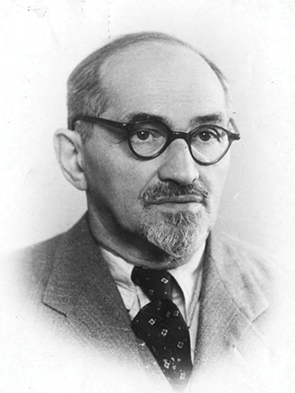
In the early 1960s, perhaps due to the growing anti-Zionism of Soviet Bloc countries or perhaps because the influence of his first wife, Roza, was no longer keenly felt (she died in 1957), Eisenstadt gradually abandoned communism. In 1963, he left a meeting of the World Peace Council in protest because of an anti-Israeli decision. In 1964, he publicly condemned anti-semitic caricatures published in the Soviet press.Footnote 16 In 1965, the Israeli Communist Party split as the Soviet Union gradually aligned with the Arab side of the Arab–Israeli conflict, leading Eisenstadt to become more critical of the Soviet policies.Footnote 17 His final break with communism came following the Six-Day War, when, describing himself as an “old communist,” he published a letter criticizing the Soviet Bloc for its anti-semitic approach and its support of the Arab cause.Footnote 18 Thus, while, in the 1950s, Eisenstadt had celebrated the victories of the Red Army during the Second World War, his 1967 book on the history of the revival of the Hebrew language was dedicated to “our victorious [Israeli] army.”Footnote 19 Another late-life shift occurred in the linguistic realm. Eisenstadt was a lifelong champion of the Hebrew language, but during his later years, he published several works in Yiddish. One of his last major projects before he passed away in 1970 was to edit an autobiography, in Yiddish, of an obscure Jewish-American actress.Footnote 20
Eisenstadt was a wide-ranging intellectual entrepreneur. He taught courses at many academic and non-academic venues. He established several legal and popular education institutions, including the Tel Aviv School of Law and Economics, which ultimately became Tel Aviv University.Footnote 21 He was a central player in the revival of the Hebrew language in Palestine, a prolific writer, editor, translator, and publisher of several (short-lived) journals.Footnote 22 He wrote works on Jewish law, the Hebrew language, the history of Jewish socialism in Hebrew and Yiddish, several biographical works, and even dabbled in children’s stories.Footnote 23 Most of his works were written in Hebrew and Yiddish, although there were also publications in Russian, German, and English.Footnote 24
In the legal realm, his oeuvre included a translation of one of the parts of the Justinian Code, a textbook on Roman law based on his lectures at the Tel Aviv School, as well as an extensive bibliography of works on Jewish law in several languages listing approximately 4,500 works.Footnote 25 He also published many law-related articles in various journals. Eisenstadt’s estate included several additional unpublished works on law, such as a historical dictionary of Jewish legal terms and writings on family law, socialist law, and the history of workers in Greco-Roman Palestine.Footnote 26
Ideas
Western Jurisprudential Influences
Eisenstadt wrote works on comparative law, Roman law, and Jewish law. He did not publish works dealing exclusively with jurisprudence. However, jurisprudence was certainly an important aspect of his scholarship. There were two main jurisprudential sources of inspiration for his works: the German Historical School and Marxist legal theory. In addition, it seems that he was also influenced by the notion of living law that was popular in early twentieth-century Central European legal scholarship.
The ideas of the Historical School shaped Eisenstadt’s views on law as a student and young legal scholar in the 1900s and 1910s.Footnote 27 Several key notions of this jurisprudential approach influenced Eisenstadt’s work, including the premise that history is essential for the study of law and the idea that law is a reflection of national culture (or “the spirit of the people”). The agenda and activities of Historical School scholars also served Eisenstadt as a model for how modern Jewish law scholars should operate.
One example of the importance of history for Eisenstadt can be found in a 1914 book review that he wrote on a pioneering doctrinal work on Jewish law, Principles of Jewish Law, written by another Russian-Jewish legal scholar, Asher Gulak. Eisenstadt criticized Gulak for assuming that Jewish law was a timeless, static entity. Gulak, Eisenstadt argued, ignored the historical development of Jewish law. The specific rules of this legal system were not merely a reflection of some timeless essence but were influenced by the particular environments encountered by the Jews in their various diaspora communities.Footnote 28 A 1917 article by Eisenstadt repeated familiar Historical School themes, such as the idea that the origins of law are to be found in the ancient customs of the people. Legislation, said Eisenstadt, was always merely an articulation of the “hidden law” that previously existed as a “social truth.”Footnote 29 Ancient Jewish national customs could be found in popular ballads, riddles, proverbs, and myths. They could also be discovered by comparing the law of ancient Israel to that of other ancient nations and to the laws of contemporary nomadic nations.Footnote 30
The belief that law was a reflection of the spirit of the people was also central to Eisenstadt’s description of the history of Jewish law.Footnote 31 Law, he said, mirrored the spirit of the race – and, in the case of Jewish law, the spirit of the “Semitic race.”Footnote 32 The way Eisenstadt reconciled the static and the dynamic aspects of Jewish law was to say that, while the principles of the Torah of Moses were timeless, the specific details of the commandments of Jewish law changed with every generation; thus, adherence to the “spirit” of Jewish law could be reconciled with the fact that this law changed as history progressed.Footnote 33 Eisenstadt also sought to emulate the research agenda of the German scholars associated with the Historical School: the academic collection and study of historical legal materials, their systematization, and their subsequent use as the basis for national codification (the historical–dogmatic approach) inspired Eisenstadt’s vision for the scholarly study of Jewish law.
Alongside the influence of the Historical School, Eisenstadt’s thought also reflected Marxist legal ideas. Marxist legal theory had already appeared in his first law-related article, a Yiddish piece published in 1908 in a New York journal, while he was still a law student (see Figure 4.2).
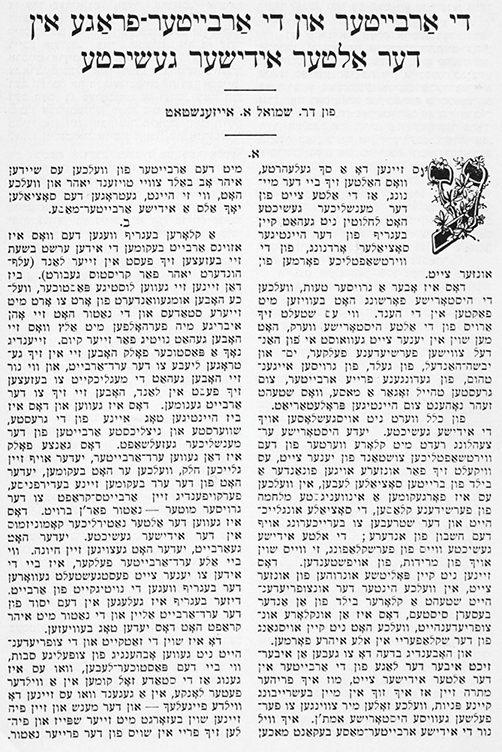
The topic of this article was the history of labor relations and labor law in ancient Jewish society. Here, Eisenstadt offered a reading of biblical history using a class-struggle perspective (and also compared early biblical Jewish society, which he claimed was classless, to ancient Hindu society, which was divided into castes).Footnote 34
In a 1923 article published in the USSR, Eisenstadt described Second Temple legal disputes between the Pharisees and the Sadducees, and between the Hillelite and the Shammaite schools of interpretation, as reflecting the nature of law as “an instrument of oppression in the hand of the ruling aristocracy.”Footnote 35 Later, in 1926, he published a book in Yiddish on the biblical prophets. In this book, he offered what many would see as an anachronistic, “secular” view of the prophets (admittedly quite common among Jewish and Zionist thinkers during that period), portraying them as “social activist[s] and political fighter[s],” who only used religious language because religion was the mode for social critique at the time, but were, in fact, “social thinkers,” “pioneering leaders and spokesmen for the village and city masses,” “tribunes of the people,” protesting at the corruption of the “ruling classes” or the “landowning class.” According to Eisenstadt, the prophets sought to rally against the “poverty and destitution” of the “victimized masses,” offering a “progressive” and “utopian” vision of “social justice and equality.” The prophets, argued Eisenstadt, took this stance in the name of a “revolutionary social idea.”Footnote 36
Eisenstadt returned to the topic of ancient Jewish labor law in a 1937 article entitled “The Hebrew Worker During the Period of the Mishnah.” Here, he provided a class-based Marxist-inspired history of the Jewish people. Eisenstadt described the biblical prophets as the ones “who first discovered the contradiction between the poverty and deprivation of the masses, and the luxurious life of the rulers.” Such “exploitation” of the “popular masses,” he said, also occurred during the period of Persian rule in Palestine. Later, the Sadducees, whom he described as a “conservative political party,” blocked the development of “social legislation,” found in embryonic form in Mosaic law, and the Pharisees, “party of the people,” sought to “give a role to the working masses in the legislative process of the state.” Some “urban intellectuals” also joined the “party of the artisans and peasants,” seeking to “heal their moral consciousness, and purify their lives with hard work.” During this period, laws to “safeguard the rights of the working community” were enacted, creating comprehensive labor legislation based on “social equity” – the first labor legislation ever created, according to Eisenstadt.Footnote 37 In a later lecture, delivered in 1948, Eisenstadt described the biblical prophets as defenders of “the rights of the working people, bearing the vision of world peace and the fraternity of nations,” and again stated that the Pharisees fought to safeguard “the rights of the working masses.”Footnote 38
In a popular lecture delivered in 1951, Eisenstadt told his listeners that, in regimes based on “class exploitation,” law serves as a “weapon of the ruling class to oppress the exploited classes,” but that socialist law is “a weapon of the working class … to impose the dictatorship of the proletariat in order to vanquish capitalism and create a society free of exploitation.”Footnote 39 In the 1950s, he also produced a fully fledged Marxist description of the history of Jewish family law, offering a “historical-sociological analysis” of the development of ancient Jewish family law based on the assumption that there was a defined sequence to the development of social–legal relationships and that no nation is free to circumvent any of the stages of that evolutionary scheme. In his analysis, he linked economic needs to family law rules regarding polygamy, dowry, family property, and inheritance. He noted the rise of a class-based society during the period of biblical judges and kings, discussing economic tensions, social ruptures, and the political subjugation of farmers by the kingly urban elite, and arguing, again, that class tensions led to the appearance of prophets – depicted by him as “social equality warriors and defenders of the rights of the farmers.”Footnote 40 Another example of Eisenstadt’s Marxist approach to the history of Jewish family law can be found in a 1962 article that he published in an East German history journal, in which he compared Jewish and Roman family and inheritance law.Footnote 41
Marxist influence was also found in Eisenstadt’s works on Roman law. One can see this influence in his 1953 textbook on the topic, which was based, he declared, on a social and historical approach to the study of Roman law – one that saw the development of this law as stemming from the conditions of the Roman economy and from a class struggle that stood at the basis of the Roman regime of slavery. In this book, Eisenstadt claimed, for example, that major changes in Roman law were the result of economic and political conditions: massive slave revolts that occurred in the territories ruled by Rome in the period between the first century BC and the first century AD.Footnote 42
Finally, Eisenstadt’s works echoed the ideas of the German Free Law Movement.Footnote 43 In Chapter 2, I mentioned the impact of Free Law ideas on Dikshtein’s thought. One can also see echoes of free law ideas, and especially the contrast between dry formal law and “living law,” in Eisenstadt’s works. In one of his first articles, written in Moscow in 1910, he said that Jewish law “should be filled up by the content of life and should nourish life with its spirit.”Footnote 44 In another early article published in 1911, Eisenstadt provided a survey of Jewish legal history. Throughout the article, Eisenstadt talked about “life” or “social life” as determining the nature of law and modifying it. In this twenty-page article, the term “life” appeared in various permutations no less than forty times. Eisenstadt talked about Jewish law as being a “social science, a science of life,” about oral Jewish law as a law that “flows and changes” with the flow of life. Here is how he poetically described the characteristics of legal discourse in the Talmud:
The most sophisticated creation of Jewish law is the Talmud. It does not contain terse rules, dry paragraphs, or skeletal legal structures that do not speak to the heart or to logic. We see in the Talmud Jewish law at the time of its creation; we hear the debate as it bubbles and roars in the study hall, full of the storm of the senses and the exaltation of logic; every legal question is discussed passionately; the clear skies of the east are reflected in the debate, and it is adorned with the beautiful flowers of legend (aggadah). Before our eyes, a mighty battle unfolds; the sages fight with the tactics of developed logic and immense sharpness; they twist and turn, trespassing boundaries, soaring to the skies and descending to the depths of the idea they are debating, and finally, one of them appears with the crown of victory upon his head, his eyes shining. All the people see that his approach is true and just, and the matter is resolved.Footnote 45
Apologetics: The Superiority of Jewish Law
Eisenstadt claimed that, unlike previous scholars of Jewish law, he would not engage in an apologetic defense of this legal system. When surveying the literature on Jewish law in Europe from the Renaissance onward, he criticized eighteenth-century works for being apologetic and thus attempting to hide the “objective truth” regarding Jewish law.Footnote 46 However, in practice, Eisenstadt often actively sought to show the superiority of Jewish law. In his unpublished autobiography, he explicitly discussed this problem. Describing the very first courses he taught on Jewish law (at the Odessa Rabbinical Seminary), he noted that he was torn between his commitment to objective scientific critique and his “fervent love for our national heritage.”Footnote 47
Eisenstadt’s urge to demonstrate the superiority of Jewish law was frequently found in those works of his in which he compared Jewish to Roman law. For example, in an article published in 1929, using a series of binary opposites, Eisenstadt claimed that Roman law was based primarily on power and the need to govern. In contrast, Jewish law was based on morality and the desire for absolute good. Roman law was based on action, and Jewish law was based on emotions. Roman law sought to serve the ruling citizens of Rome, many of whom were soldiers. At the center of Jewish law, in contrast, stood weak persons – the child, the orphan, the foreigner, the alien. Roman law was individualist, and Jewish law was collectivist. The purpose of Roman law was to protect the Roman conquerors, whereas the purpose of Jewish law was to maintain peace and justice. Roman law was based on external imposition and, therefore, did not require widespread learning of its rules. In contrast, Jewish law maintained itself through an extensive system of grassroots learning in Talmudic academies.Footnote 48
Eisenstadt repeated these dichotomies in a 1937 article. Jewish law, he said, was based on “justice, peace, and equality between all humans,” while Roman law was based on the desire for “personal benefit, power, and control.” Roman law, he explained, was modified by the morality of Jewish law following the Christianization of the Roman Empire; and, in subsequent centuries, there were repeated attempts to synthesize Jewish morality with Roman law. For example, Hugo Grotius undertook such an endeavor in the early modern period, with the creation of modern international law – whose goal, according to Eisenstadt, was to subdue the human urge to fight and dominate other persons. However, modern international law could not prevent global conflicts of the type that the world was witnessing in the 1930s. Only Jewish law could redeem the world from such conflicts.Footnote 49
Finally, on the jurisprudential level, Eisenstadt argued for the superiority of Jewish law based on the nature of Jewish law texts and Jewish legal education. In a 1941 article, he contrasted the modern sovereign legislator, who “prevents freedom of opinion and silences opposing voices,” with Jewish law, which he described as a “truly popular law.” Because of its popular nature, Jewish law texts did not present a unitary façade: they contained evidence of the debates surrounding the rules of Jewish law. In the Talmud, for example, readers were exposed to the differing opinions of the rabbis and could decide for themselves if a certain rule was correct.Footnote 50 Eisenstadt also compared the Jewish model of legal education favorably with the model found in Western universities. In a 1913 article, Eisenstadt discussed the Jewish study hall (beyt midrash) and said that it represented a popular and non-hierarchical model of legal education that was not geared toward practical ends but toward pure learning. As such, it was superior to the Western model.Footnote 51
Evolutionary Schemes, Social Hierarchies, Democracy
Non-Western law was generally seen by nineteenth- and early twentieth-century Western legal thinkers as representing a lower rung on the evolutionary ladder of the development of law. One reason for this depiction was that non-Western law was understood as being closely tied to religion. Henry Maine, for example, described Hindu law in his book Ancient Law as a law based on ancient codes, which could not be reformed because of the sanctity of religion.Footnote 52
Eisenstadt, both because of his apologetic approach to Jewish law and also because he was a lifelong secular socialist, sought to distance Jewish law from Jewish religion. He did acknowledge that, originally, law and religion were intermingled since law was seen as emanating from God.Footnote 53 He also conceded that Jewish law was based on the idea of heavenly justice.Footnote 54 However, the religious nature of Jewish law was not part of its essence. Jewish law, he proclaimed in an early article, was a secular law that was only “hidden” in religious texts because of the Jewish Exile.Footnote 55 In an article on the distinction between public and private Jewish law, he noted the religious nature of Jewish law but then explained that public law wore a “religious mask” during the Jewish Exile, Jewish religion merely being a “receptacle” for law. Because Jewish religion had a “social and national aspect,” he claimed, it did not distort public law but, rather, preserved it until such time as its secular nature could be revealed.Footnote 56 Another aspect of Eisenstadt’s ambivalent attitude to the religious nature of Jewish law can be found in his book on the biblical prophets. Here, he argued that the prophets were actually secular social reformers who used the language of religion only because that was the convention during biblical times.Footnote 57
Just like Pal, Eisenstadt, too, devoted much effort to justifying the inegalitarian nature of the legal system he was studying. One major expression of this inegalitarianism was found in the existence of slavery. In a 1917 article, Eisenstadt observed that, while slaves did exist in ancient Israel and were treated as property, they were not seen as similar to animals or movable property, as was the case in other ancient legal systems. Among nomadic peoples, such as the early Israelites, he said, the difference between slaves and masters was not great, and there was no chasm of class difference, such as that which existed in more economically advanced nations. Slaves and masters herded the flocks together, and slaves were not subjected to hard labor. For example, they were not involved in building city walls like slaves in urban societies. Slaves were considered members of the family and were able to inherit the property of a childless master.Footnote 58
In a long article published in 1927, Eisenstadt compared the attitudes of Roman and Jewish law to slavery. He remarked that slavery existed in Roman law and was not initially regarded by Roman lawyers as problematic. However, with the rise of Christianity, Roman lawyers began to see slavery as opposed to natural law. All men, they came to believe, were born free; and, therefore, slavery became a problem to be justified. Jewish law did not have the same problem because, while Jewish law did recognize slavery, the recognition was “limited.”Footnote 59 Roman law’s initial attitude to slavery was the result of the fact that the Roman Empire was a huge state artificially composed of a conglomerate of occupied countries and nations, which could not survive without mass enslavement under harsh conditions. In contrast, the agrarian residents of Palestine had no opportunity or desire for conquest or the enslavement of war prisoners, and their main occupation – farming – was carried out by themselves or by tenants and hired hands. Jewish law recognized slavery, then, but the rules that governed it were far more lenient than those of Roman law. Thus, while Roman citizens could become slaves (and then lose their citizenship), Jews could not become lifelong slaves (and, if foreigners enslaved them, they had to be redeemed); slaves who were treated harshly by their owners were emancipated, unlike Roman slaves; and, although slaves could inherit the property of their childless master, the master could not inherit the property of the emancipated slave.Footnote 60
One point on which Roman law was more liberal than Jewish law, to modern eyes, was that of the status of the children of slaves. Roman law declared that the child of a free man and a female slave was free, while Jewish law declared that this child was a slave. The harsher norms of Jewish law, explained Eisenstadt, were the result of the fact that foreign slaves were common in Rome, which thus became “an international nation.” In contrast, Jews in Palestine waged constant wars against the influx of foreign slaves and, therefore, were less lenient toward the offspring of mixed couples.Footnote 61
Eisenstadt also dealt extensively with the status of women in Jewish law. He taught family law at the Tel Aviv School of Law and Economics, and his wife was a member of various feminist organizations in 1950s Israel. Thus, it is not surprising that the topic concerned him, and his works on the legal status of women ranged widely. They included articles dealing with ancient Jewish family law, the legal position of women in the ancient city of Ugarit, and the status of women in contemporary Israel. However, Eisenstadt was not merely a scholar interested in describing family law. When the Israeli Parliament debated the Israeli Women’s Equal Rights Law of 1951, Eisenstadt prepared a long memorandum criticizing the law for not being radical enough.Footnote 62 He also called for extensive reforms in Jewish family law, which the State of Israel applied in litigation between Jewish litigants and which tended to discriminate against women. Noting the conservative nature of this area of law, he advocated for creating a codification committee to reform it.Footnote 63
When discussing the status of women in Jewish law, Eisenstadt often adopted a critical tone. For example, he said that polygamy, recognized by Jewish law in the biblical period but also later (for example, in the major sixteenth-century codification of Jewish law by Rabbi Joseph Karo), was a norm that was left over from the “primitive period” of Jewish law and that it should be formally abolished to ensure equal rights for women.Footnote 64 However, while, in some of his writings, Eisenstadt was critical of the attitude of Jewish law to women, one can also find evidence to the contrary. For example, in an article he published in English in 1948, Eisenstadt attempted to prove that Jewish law did not discriminate against women. In discussing law during the era of the biblical patriarchs, he noted that daughters and widows inherited an equal portion of the inheritance to that of men but that this rule did not apply when women married outside the family. This exception, he explained, was justified in order not to divide family property. He then stressed that, in this scenario, the women would be compensated for their lost share of the family property. Later, the protection of widows was guaranteed by a marriage contract containing provisions promising a minimum sum of fixed compensation for the wife in the case of divorce or the husband’s death. In addition, daughters, too, were entitled to alimony upon the death of their father.Footnote 65
A final aspect of Eisenstadt’s apologetic attitude was found in his attempt to depict Jewish law as inherently democratic. Jewish law, he said, was not a product of rulers or kings. It was “popular [and] democratic … the people were the creator of law” – or, more specifically, the prophets, who were the “tribunes of Israel” and personified the needs of the people.Footnote 66 Elsewhere, Eisenstadt discussed the history of the Council of Four Lands, a Jewish representative body that existed in early-modern Poland, describing it as being, in fact, a Jewish parliament.Footnote 67
Collectivism
In his 1953 textbook on Roman law, Eisenstadt devoted several pages to comparing Roman and Jewish law. Roman law, he said, was the law of a society of masters who owned both men and property, and their ownership was based on the notion that the individual right of private property had no limits. In contrast, the rules of property and inheritance in Jewish law were based on the idea of collective ownership, and the notion of individual property was undeveloped and limited.Footnote 68 The collectivist nature of Jewish law was also expressed in specific legal doctrines such as the jubilee year rule, the seven-year agricultural sabbatical cycle, and in rules pertaining to labor law, charity, levirate marriage, and quasi-contract.Footnote 69
In 1957, Eisenstadt published an article comparing the notion of the legal persons in Jewish and Roman law, claiming that this notion did not exist in ancient Roman law and only appeared later, in medieval and modern times. This, he claimed, was because the idea of a legal person required both a conception of property that did not focus solely on private property and also a recognition that abstract, bodiless entities can exist. Neither of these ideas, said Eisenstadt, was present in ancient Roman law, which was based on the premise of the absolute individual property rights of the head of the household, the paterfamilias, and on a polytheistic religion whose many gods took on bodily forms. In contrast, property in Jewish villages in Palestine until the end of the Second Temple period was held in common. Communal religious groups sharing their property, such as the Essenes, were also widespread. In addition, abstract thinking, which rejected corporeality, was also common among Jews, and this outlook was evident not solely in the theological realm but in the legal sphere too. Ancient manifestations of this approach included, for example, the collective liability of biblical towns and tribes, while later expressions were found in the appearance of local and central religious and charitable endowments.Footnote 70
The individualism–collectivism contrast was also noted by Eisenstadt in an article in which he remarked that Roman law protected private property, unlike Jewish law (and other oriental legal systems), which saw individuals (and their property) as an indivisible part of the collective.Footnote 71 One qualification regarding the binary dichotomy between individualist Roman law and collectivist Jewish law that Eisenstadt did make, however, was that he noted how the Ten Commandments reflected a regime of private property.Footnote 72
Eisenstadt’s Unique Jurisprudential Ideas
Eisenstadt was not a deep jurisprudential thinker. Nevertheless, his scholarship contains several interesting ideas, three of which I will mention here.
Nationalist and Marxist Legal Theory Combined
Eisenstadt saw no problem in combining the nationalist legal ideas of the Historical School with Marxist legal theory. This is less surprising than it perhaps seems. First, Marx himself was a student of Friedrich Carl von Savigny, the founder of the Historical School.Footnote 73 Marxist legal theory, therefore, may be seen as indebted to, and in part shaped by, the principles of this intellectual tradition. Second, 1920s Soviet policy, to which Eisenstadt was exposed while living in Moscow, encouraged and celebrated the creation and propagation of the national cultures of the nations that were living under Soviet rule rather than attempting to erase them. Lenin and Stalin, in particular, argued for national self-determination (within the confines of a unitary central Soviet state, of course). This policy led to the promotion of national languages (Yiddish, in the case of the Jews).Footnote 74 It also had implications in the legal sphere. In the early 1920s, for example, there were attempts to integrate Shari‘a courts in Central Asia into the Soviet legal system and to “harmonize” Islamic law and Soviet legislation.Footnote 75 Thus, Eisenstadt’s desire to study and use Jewish law would not have been seen by him as being in contradiction to his socialist and, later, communist beliefs.
A Non-Western Model of Legal Education
In Jewish law, Eisenstadt found a unique concept of legal education that differed significantly from the Western concept. In an article published in 1913, Eisenstadt compared European universities to the “typically oriental” Jewish study hall. The Orient, he claimed, seeks spiritual development. It strives for harmony between religious and moral values and social needs, while the West seeks cultural conquest and technical development, and its universities are, therefore, places for the training of a professional and practical elite (medical doctors, lawyers, teachers, architects, and so on). Eisenstadt then contrasted Western universities with the Jewish study hall, which he characterized as a gathering place for those unsatisfied by mere territorial conquest or technical advancement. Unlike the Western university, he argued, the Jewish study hall is not a training ground for the sons of the upper classes of society – it is a popular institution open to all. There are no teachers and students, as everyone is both student and teacher simultaneously; everyone seeks an eternal living truth, where the boundaries between individuals blur in the noise of “enthusiastic debate.” The Zionists of Palestine, he noted, had already established vocational schools. However, this was not enough. This oriental model of legal education embodied in the study hall should, he argued, be resurrected in Jerusalem, and “the great Hebrew worldview,” frozen and enslaved in Europe to foreign cultures, should be revived, creating a new generation of Jewish youth imbued with both “tradition and life.”Footnote 76 In his 1950s book on Roman law, Eisenstadt repeated these ideas about the unique nature of Jewish legal education. He observed that one of the major differences between Roman and Jewish law was that, unlike the Romans, the Jews did not view law as the exclusive domain of rulers and specialists only. Jewish law was a topic that all members of society were supposed to study.Footnote 77
A Non-Western Genealogy of International Law
Finally, Eisenstadt offered an interesting argument about the antiquity of international law (echoing the ideas of other interwar Jewish law scholars who will be discussed in Chapter 6). As early as 1918, Eisenstadt argued that international law was not invented in the early modern period – one could already discern the rules of international law in the biblical period.Footnote 78 In 1926, he wrote an article attacking the common view that international law was created in Europe. The discovery of ancient Near Eastern texts by Western archaeologists, he said, revealed that international law was not born in Europe in the early modern era and should not only be associated with thinkers such as Hugo Grotius. The Bible and texts from Egypt, Babylonia, and the Hittite Empire indicated that international law existed in the ancient Near East. The generalization and abstraction that are hallmarks of modern international law were missing, but the idea itself could be found in literary myths, in diplomatic letters between ancient kings, and in specific treaties. Eisenstadt then offered an extended analysis of the Bible and the descriptions it contains of various international practices from the age of the Patriarchs and later biblical periods, identifying parallels with modern international law in areas such as international boundary-setting, negotiations, allegiances, treaties, the status of diplomatic envoys, and rules governing wars.Footnote 79 Eisenstadt also contrasted international treaties of the ancient Near East that were based on realist considerations – the need to show political strength and to accommodate the violence of the bigger powers of the region – with the ideas of the biblical prophetic movement, which, as it gained strength in ancient Israel, fostered a new approach to international law that was based on public morality.Footnote 80
Another facet of Eisenstadt’s argument about the antiquity of Jewish international law appeared in his book The Prophets, published in Yiddish in 1926. Eisenstadt described biblical prophets as “outspoken, principled opponents of war and bloodshed” who opposed the “reactionary” nature of war and were “internationalists” in their outlook. According to his reading, the prophets “sharply criticized the never-ending militarization of the great powers [of the ancient biblical world] and sought to show the ineffectuality of physical power in international conflict,” determined to expose “international injustice.”Footnote 81
In his discussions of international law, Eisenstadt voiced ideas that are somewhat comparable to the ideas of contemporary TWAIL (Third World Approaches to International Law) scholars. The proponents of TWAIL argue that international law is a system that was created by Europeans in the early modern period to legitimize and sustain the plunder and subjugation perpetrated by Western great powers on the Third World. TWAIL scholarship emerged in the late 1990s, but the scholars associated with it acknowledge that it had precursors. However, they place these precursors in the period of decolonization immediately after the Second World War.Footnote 82 Eisenstadt’s discussion (as well as that of the scholars that will be discussed in Chapter 6) shows that similar ideas about the non-Western origins of international law antedated the end of the Second World War.
Conclusion
Eisenstadt’s life and thought were undeniably exceptional. No other thinker associated with the idea of reviving Jewish law combined a passion for cultural nationalism with a political commitment to communism. Nevertheless, in many other respects, Eisenstadt’s views were similar to those of a larger cohort of early twentieth-century Zionist legal thinkers. The influence of the German Historical School, the assertion of Jewish law’s superiority over Western legal systems, and the apologetic attempts to justify the more problematic aspects of this ancient legal system were all traits that were shared by many of Eisenstadt’s fellow Jewish legal scholars working in the Diaspora, in Mandatory Palestine, and Israel. Can we also compare Eisenstadt to contemporary Indian legal scholars such as Pal? This is the question that I will now explore.
Radhabinod Pal and Samuel Eisenstadt were born in the same year, 1886, in two imperial territories, colonial India and imperial Russia. As young adults, both witnessed the momentous, revolutionary events of 1905. Russia’s defeat in the Russo-Japanese War inspired young Indian nationalists such as Pal. It was also one of the factors that spurred a revolutionary wave of unrest across the Russian Empire during 1905, ultimately setting the stage for the downfall of the Empire twelve years later, in 1917, and shaping the lives of a generation of Russian socialist revolutionaries, including Eisenstadt.
Pal and Eisenstadt also shared many additional biographical traits: both followed similar educational trajectories, studying law in Western or Western-style academic institutions; both were influenced by a blend of Western historical and sociological theories of law; both sought to use the legal past in the service of a modern cause – namely, anti-colonial nationalism; both – perhaps because of a personal motivation to prove their academic worth as legal scholars, perhaps as a result of their shared resentment toward European culture, or perhaps as a result of heartfelt pride in their particular legal heritage – wrote apologetic works on their respective religious legal systems; both attempted to show that the conventional evolutionary Western view of non-Western legal systems was mistaken; both sought to show the superiority of these systems, for example, by favorably juxtaposing their alleged peace-loving nature with imperialistic Western society and law; and both sought to downplay the non-egalitarian aspects of their respective religious systems – for example, by arguing that persons deemed by these systems as socially inferior such as slaves and women were actually treated humanely, or that modern democratic institutions had their ancient counterparts in Hindu and Jewish law; both emphasized the collectivist nature of their respective legal systems and contrasted this collectivism favorably with Western individualism; and both held non-mainstream political views (Hindu, as opposed to Indian, nationalism in Pal’s case and communism in Eisenstadt’s case), which, perhaps, impeded the widespread reception of their legal ideas.
Pal’s life and ideas represented a larger group of Indian scholars trained in law who were interested in Hindu legal history and Hindu jurisprudence. Most of these scholars were associated with the University of Calcutta. The ideas found in Pal’s works on Hindu law echoed similar ideas found in other works produced in India in the late colonial period. However, unlike these scholars, who all remained obscure, Pal achieved lasting international recognition thanks to his Tokyo Trial dissent. Eisenstadt, too, was, in some senses, representative of a cohort of Jewish law scholars who were active in the early and middle decades of the twentieth century. Eisenstadt’s affiliation with communism was unique, but apart from his idiosyncratic political views, his life and ideas mirrored those of many of his fellow Jewish law scholars: his Eastern European origins and the educational path that he followed, combining traditional religious studies with a law degree obtained from a European university, were two characteristics that many other scholars belonging to the early twentieth-century movement for the revival of Jewish law shared. His legal ideas were not unique either. One can find other works produced by Jewish law scholars at the time that show the influence of the Historical School. The arguments about the superiority of Jewish law over Roman law, the apologetic defense of some of the more unsavory aspects of Jewish law, and the interest in the collectivist elements of this legal system – all could be found in the writings of various scholars.
There were also significant biographical and jurisprudential differences between the two men. Pal began his academic career as a mathematics teacher, later focusing exclusively on law. Eisenstadt was far more versatile. He was a legal scholar, linguist, publisher, librarian, and political activist. His works spanned many genres and included academic articles, monographs, textbooks, and translations.
Pal published his works in English and thus wrote not just for an Indian audience but also for non-Indian readers. His intended audience was primarily academic, rather than the general public. Eisenstadt also produced academic works (for example, his bibliography of works on Jewish law), but some of his works (such as his book on the prophets) were intended for a broader, lay audience. Because Eisenstadt’s works were written in Hebrew, his readership, by definition, was narrower.
Like other Indian scholars, Pal’s discussion of Hindu law was heavily influenced by English law and by the ideas of English-speaking thinkers. Two major imaginary interlocutors of his were the nineteenth-century English legal scholars John Austin and Henry Maine, both of whom were criticized by Pal in his attempt to defend Hindu law. Eisenstadt’s work was primarily influenced by Continental law scholarship and especially by the nineteenth-century German scholars of Roman law. Nineteenth-century historical approaches to the study of law influenced both men. However, Pal was also influenced by Continental anti-formalist legal theories, and by American sociological jurisprudence, while Eisenstadt blended the ideas of the Historical School with Marxist theory.
Pal and Eisenstadt were legal historians of ancient religious legal systems, but the historical approaches that informed their works differed. While Pal’s works summarized and analyzed the history of Hindu law, the history he offered was not deeply embedded in the economic and social context of ancient Indian society. In contrast, Eisenstadt, inspired by Marxism, contextualized the history of Jewish law by linking it to economy and society.
The comparative legal taxonomies used by the two scholars were also different.Footnote 1 Pal sought to incorporate ancient Hindu law within a broader shared framework, that of the Aryan legal family. According to him, Hindu law was an early (and superior) Aryan legal system. Eisenstadt, meanwhile, focused not on similarity but on difference. He sometimes referred to Jewish law as part of a larger, oriental, legal family.Footnote 2 However, perhaps because the two major legal systems he taught were Roman and Jewish law, Eisenstadt’s comparative vision was often starkly binary. He talked about two major legal systems competing for dominance in global legal history: Roman and Jewish law, which represented different sets of values and jurisprudential ideas.
Like the scholars of Hindu and Jewish jurisprudence that I discussed in Part I of this book, the goals that underlay Pal’s and Eisenstadt’s interest in their respective ancient legal systems differed. Pal, like most other Indian scholars of his time, was largely interested in Hindu law not because he saw it as a possible source of norms for the future legal system of India but because he regarded its study as a way to bolster pride in the Hindu past. Eisenstadt, by contrast, like many other Jewish law scholars of his generation, was not interested in Jewish law merely for its historical significance. Rather, he approached it as a possible source for the law of the future Jewish State.
Pal was no proponent of the actual use of Hindu law to replace the legal system created by the British in India during the colonial era. When discussing the possible use of modern legal categories to analyze ancient law, he remarked that asking whether “an ancient institution was adequate for modern conditions” was misguided. Legal institutions should be judged with reference to the “peculiar social needs of their times” and not to the present, he reasoned.Footnote 3
The fact that “legal revival” also meant, in the specific Indian context, modernization and unification of the law through codification may have led to Pal’s rejection of this notion. This is evident in his reaction to the post-independence codification of Hindu personal law. In the mid-1950s, the newly independent Indian State enacted four Hindu Code Bills meant to reform and codify Hindu personal law (the Hindu Marriage Act, Hindu Succession Act, Hindu Minority and Guardianship Act, and Hindu Adoptions and Maintenance Act).Footnote 4 A month before the enactment of the Hindu Marriage Act of 1955, Pal participated in an all-India convention on the Hindu Code Bills, where he attacked both the reform of the Hindu law of succession and the Hindu law of marriage. Regarding the desire to introduce divorce in Hindu law, Pal said that the indissolubility of marriage “was the binding force that cemented it” and that “we must not shut our eyes to the evils of divorce.” Other participants expressed similar sentiments, stating that “we should not blindly imitate the West.”Footnote 5 One can conclude that Pal’s works on Hindu law were not motivated by a desire for its actual use, because such use also entailed its modernization. Instead, Pal’s works were meant to counter condescending Western portrayals of this legal system and to instill pride in ancient Indian history.
Pal’s reluctance to use Hindu law was also applicable to Hindu jurisprudence. As we saw, a major characteristic of Hindu jurisprudence was its affinity with natural law theory. However, when the time came to apply the latter in practice, Pal could have easily based his Tokyo Trial opinion on natural law theory, but he declined to use the opportunity. Instead, Pal’s dissent in Tokyo affirmed the positivist approach to international law.Footnote 6 In this context, it is interesting that Pal’s extremely lengthy Tokyo dissent does not mention Hindu law or Hindu jurisprudence.Footnote 7
Meanwhile, the use of Jewish law as a foundational element of the legal system governing the lives of the Jews of Palestine (and later, the State of Israel) was a central concern for many early twentieth-century Jewish legal scholars, including Eisenstadt.Footnote 8 In Eisenstadt’s view, the academic study of Jewish law was a prerequisite for the revival of Jewish law as the law of the Jewish community in Palestine and of the future Jewish State. In this, he was following the scholars of the German Historical School, who argued that the academic study of Roman and Germanic law should precede the creation of a civil code for Germany. The study of Jewish law, Eisenstadt believed, would thus serve to provide a basis for the law of a reborn Jewish polity.Footnote 9
The difference between Pal’s and Eisenstadt’s attitudes to legal revival may have been partly the result of differences in their biographies. Eisenstadt studied law in a Central European university and was thus influenced by the idea (typical of Continental legal systems) that law professors play an important role in creating new legal norms. More specifically, the research agenda of the German Historical School, which gave legal scholars a major role in producing law codes based on historical materials they collected, inspired Eisenstadt’s academic activities. In contrast, Pal, trained in an anglicized university in India, may have been less influenced by the Continental vision of the role of law professors (and, specifically, legal historians) as major producers of legal norms.Footnote 10 In addition, Pal was a legal scholar but also a practicing lawyer trained in anglicized Indian law. On the other hand, Eisenstadt was a scholar and law teacher, but not a legal practitioner. His legal training in Switzerland did not expose him to English law. When he moved to Palestine, he attempted to work as a consultant on Jewish family law, but he never formally practiced law, either in Mandatory Palestine or post-independence Israel. Thus, he was far less committed than Pal to the existing anglicized legal system within which he was working.
I would now like to focus on one specific topic, the political motivations of the two scholars. Both Pal and Eisenstadt espoused radical political ideologies. However, their political views were to be found at the two opposite ends of the spectrum. Pal was a right-wing nationalist, while Eisenstadt was a socialist and later a communist. How did their radical politics influence their scholarship?
The difference between right-wing and left-wing ideology led Pal and Eisenstadt to depict Hindu and Jewish law in different ways. Pal argued that the main goal of Hindu law was to preserve social stability. Law was supposed to reflect an immutable, harmonious cosmic order, and this order was reflected in a stable society characterized by integration and coordination, a society in which every person knew and accepted their place within the social hierarchy. On the other hand, Eisenstadt described Jewish law as a revolutionary rather than a conservative force, constantly striving toward social justice and endeavoring to protect the weak against the strong.
Despite being on both sides of the political spectrum, Pal and Eisenstadt’s radical political views had a similar underlying utopian basis. They looked to their respective legal systems for alternative values to those of Western liberal law. Propelled by a utopian motivation, Pal and Eisenstadt mined the texts of their respective religious legal system to find a new legal and social vision that could replace the existing colonial order, and, more broadly, the liberal ideology that dominated their legal education. Yet their pursuit of an idealized past left them unable to confront the flaws within these systems. Pal, under the influence of pan-Asian, Indian, and perhaps also Hindu nationalism, could only see the dark side of the West: British colonial oppression in India and later (after the Second World War) American global imperialism, exemplified by the use of the atomic bomb against Japan. He downplayed the evils of his own inegalitarian caste-based legal system (as well as the evils of the heroes of his pan-Asian ideology, the Japanese). Eisenstadt, meanwhile, was tempted by a romantic infatuation with the biblical prophets and their modern-day emulators, communist intellectuals. He, therefore, sought to downplay the more problematic aspects of Jewish law (such as its attitude toward slaves and women) and also ignored the suffering and death of millions of persons killed by communism in the Soviet Union and elsewhere before, during, and after the reign of his hero, Joseph Stalin, whose biography, it will be recalled, he translated in the 1940s. This utopian romantic infatuation with the legal past was, it seems, a poor guide to the present and future, fostering idealized visions that provided enticing alternatives to the existing legal order but, ultimately, proved to be problematic.
Pal and Eisenstadt did not know of each other and knew little about each other’s legal systems. Pal did not seem to know much about (post-biblical) Jewish law. This legal system was seldom mentioned in his scholarship, and in the few times he did mention it, he used secondary sources that portrayed it in an unflattering manner.Footnote 11 There were also hints of Holocaust denial in his works.Footnote 12 India and its laws were mentioned in some early articles by Eisenstadt.Footnote 13 However, apart from these brief allusions, there is no indication that he knew anything of any significance about Hindu law, let alone about Pal’s scholarship.
There was one place in which Pal and Eisenstadt could have met but did not. In December 1954, an “Asian Conference of Lawyers” convened in Calcutta. This event was sponsored by the International Association of Democratic Lawyers (IADL), a progressive association that was, in fact, a Soviet-sponsored communist front organization.Footnote 14 Eisenstadt sent a telegram to the participants to support their struggle “for human rights, democratic freedoms, [and] coexistence in peace of free and sovereign nations.”Footnote 15 Pal was an anti-communist.Footnote 16 However, curiously, he agreed to inaugurate this conference – perhaps the result of the anti-imperialist and anti-Western stance of the IADL.Footnote 17
The communist ideology that lurked behind the IADL façade has long since lost its power, at least in most countries of the world. Now, with hindsight, we can see this ideology in all of its complexity: A movement born out of laudable concerns for the oppressed that morphed into a monstrous and evil dogma responsible for the murder of millions of people during the twentieth century. The same complexity is also the hallmark of nationalism, the ideology that inspired Pal and Eisenstadt. It, too, is emancipatory and oppressive, empowering and bloody simultaneously. The same ambivalence underlies any reflection on the life and ideas of Pal and Eisenstadt. The lives of both scholars are inspiring. Both came from oppressed groups and modest backgrounds. Both became highly educated legal scholars, producing an impressive array of interesting and sometimes even innovative works on their respective religious legal systems. However, both, in hindsight, made morally questionable political choices ultimately born out of their romantic infatuation with nationalist ideas and with their respective ancient religious legal systems.
Sometimes, however, romantic utopian infatuation with the past is not only negative but has a positive, hopeful side. In the next part of this book, I will focus on scholars writing not on law generally but on a specific legal subfield – public law. I will examine Indian and Jewish scholars belonging to the academic milieu that I described in Parts I and II of the book who wrote works on ancient Indian and Jewish public law under the influence of historicist jurisprudential theories. I will show how these scholars sought to prove that the institutions and values of ancient Indian and Jewish political thought and public law were compatible with modern Western democratic institutions and liberal values. This attempt had little impact on the actual constitutional law of post-independence India and Israel. However, as I shall ultimately argue in the Epilogue, it is relevant and important today because of its potential positive use in mitigating some of the anti-democratic and anti-liberal sentiments that have appeared in recent decades in Israel, India, and other countries.
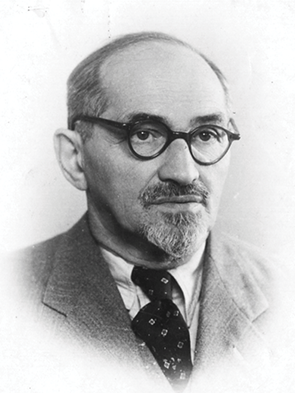
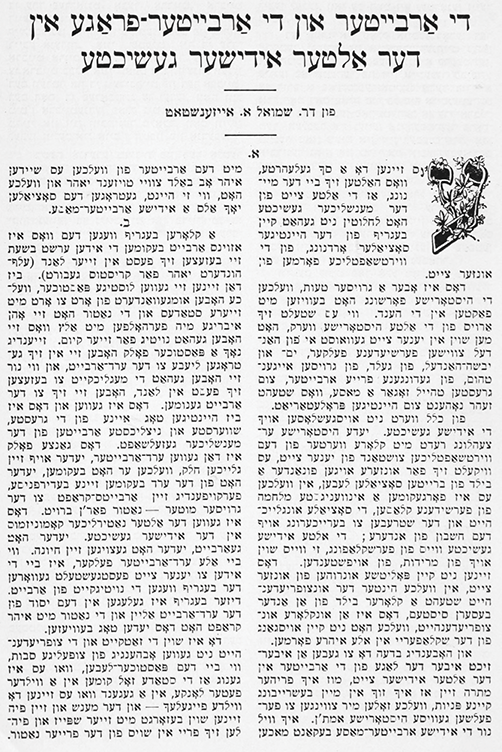

 Open access