



1. Introduction
Nowadays, the flow around surface-mounted finite height obstacles has been intensely studied due to its wide engineering applications, such as the vortex generators on aircraft, semiconductor heat exchangers, and microfluidic devices. There are various complex flow phenomena occurring around the isolated stationary obstacles, such as flow separation, shear layer interactions, vortex formation, shedding and merging, and interactions between different vortical structures. These flow phenomena are closely related to practical vortex-induced vibrations, resonance, noise generation, and fatigue failure. Although practical engineering scenarios typically involve turbulent boundary layers, the flow structures are difficult to form and develop stably because of turbulence interference. In contrast, the vortex structures in the laminar boundary layer can be better identified and extracted without the complicating effects of freestream turbulence, which is advantageous for understanding the corresponding dynamics. Meanwhile, in experimental studies, typical geometric shapes such as square cylinder, circular cylinder, and hemisphere are commonly used as simplified models to reduce experimental complexity. Thorough investigations of the flow characteristics around such bluff obstacles are essential for improving understanding of the flow physics and developing optimal flow control strategies.
A considerable number of experimental and numerical studies have investigated flow around these obstacles (Castro & Robins Reference Castro and Robins1977; Wang & Zhou Reference Wang and Zhou2009; Porteous, Moreau & Doolan Reference Porteous, Moreau and Doolan2017; Rastan et al. Reference Rastan, Sohankar and Alam2017; Zhu et al. Reference Zhu, Wang, Wang and Wang2017; Puckert & Rist Reference Puckert and Rist2018; Schröder et al. Reference Schröder, Willert, Schanz, Geisler, Jahn, Gallas and Leclaire2020; Liu et al. Reference Liu, Wang, Zhu and Pan2024, Reference Liu, Zhu and Wang2025), revealing some of the important coherent structures and the principal parameters governing the flow behavior. For surface-mounted finite square and circular cylinders, Wang et al. (Reference Wang, Zhou, Chan, Wong and Lam2004) and Pattenden, Turnock & Zhang (Reference Pattenden, Turnock and Zhang2005) proposed a comprehensive model for the main flow structures, including the horseshoe vortex (HSV), spanwise vortices, and tip and base vortices. Regarding the hemisphere, Acarlar & Smith (Reference Acarlar and Smith1987) conducted the seminal study on vortical structures around it. They identified the horseshoe vortex system and periodical shedding hairpin vortices in the separated shear layer around a hemisphere using flow visualization techniques. These studies provide effective analytical frameworks for the flow around surface-mounted bluff obstacles.
In general, these flow features are affected by obstacle geometry, aspect ratio (
 ${\textit{AR}}=h/d$
, where
 $h$
and
 $d$
are the height and width of the obstacle, respectively), the state and thickness of the incoming boundary layer, and Reynolds number (Rostamy et al. Reference Rostamy, Sumner, Bergstrom and Bugg2013; Sumner Reference Sumner2013; Yauwenas et al. Reference Yauwenas, Porteous, Moreau and Doolan2019; Essel, Tachie & Balachandar Reference Essel, Tachie and Balachandar2021; Hajimirzaie Reference Hajimirzaie2023; da Silva et al. Reference da Silva, Sumner and Bergstrom2024). Comprehensive reviews of studies on these parameters are well documented by Porteous, Moreau & Doolan (Reference Porteous, Moreau and Doolan2014) and Forouzi Feshalami et al. (Reference Forouzi Feshalami, He, Scarano, Gan and Morton2022). As early as 1977, Castro & Robins (Reference Castro and Robins1977) conducted one of the earliest experimental investigations of flow around surface-mounted cubes in both uniform and turbulent flows. Based on the measurements of surface pressures and wakes, they found that separating shear layers reattach to the cube surface in a turbulent boundary layer but not in uniform flows, which highlighted the importance of boundary layer characteristics in determining the flow behaviors around surface-mounted obstacles. They also reported that the Reynolds number effect was not significant for the case of turbulent flows. Many related studies further showed that the Reynolds number has a limited influence on the large scale vortical structures around the obstacles, especially on the cylinders with fixed separation points (Okajima Reference Okajima1982; Sakamoto & Arie Reference Sakamoto and Arie1983; Williamson Reference Williamson1996; Bourgeois, Sattari & Martinuzzi Reference Bourgeois, Sattari and Martinuzzi2011). In addition, Diaz-Daniel, Laizet & Vassilicos (Reference Diaz-Daniel, Laizet and Vassilicos2017) and da Silva et al. (Reference da Silva, Sumner and Bergstrom2024) compared the flow around surface-mounted cubes immersed in laminar and turbulent boundary layers through numerical simulations and found that both the incoming boundary layer state and its thickness may have significant effects on the flow, including the unsteady characteristics, vortex structures, and flow dynamics. Another important parameter is aspect ratio, which fundamentally alters the wake topology. Sakamoto & Arie (Reference Sakamoto and Arie1983) conducted systematic experiments on square and circular cylinders with various aspect ratios immersed in turbulent boundary layers. They proposed a critical aspect ratio (
 ${\textit{AR}}_{cr} \approx 2$
) below which the antisymmetric Kármán vortex shedding is suppressed and replaced by symmetric arch-type vortices. Thereafter, Sumner, Heseltine & Dansereau (Reference Sumner, Heseltine and Dansereau2004), Tsutsui (Reference Tsutsui2012), Porteous et al. (Reference Porteous, Moreau and Doolan2017), and Yauwenas et al. (Reference Yauwenas, Porteous, Moreau and Doolan2019) conducted comprehensive experimental and numerical studies on the wake of a finite wall-mounted cylinder with aspect ratios in the range
 $0.125\lt \textit{AR}\lt 23$
, identifying several shedding regimes. Each shedding regime displayed an additional acoustic tone as
 ${\textit{AR}}$
was increased. However, Wang & Zhou (Reference Wang and Zhou2009) proposed the steady presence of a unified arch structure with a single dominant frequency within the near-wake region of a square cylinder regardless of
 ${\textit{AR}}$
.
Furthermore, although there are many similarities between the flows around surface-mounted finite square and circular cylinders, there are also some significant differences. Kindree, Shahroodi & Martinuzzi (Reference Kindree, Shahroodi and Martinuzzi2018) conducted a comparative experimental study of the flow around a cantilevered circular and square cylinder. They found that significant differences between these two cylinder wakes were observed in both the spectra of the fluctuating fields and the mean flow topology. Hajimirzaie (Reference Hajimirzaie2023) studied the vortex structures developed in the wake of square and circular cylinders of low aspect ratio
 ${\textit{AR}}=1$
in a laminar boundary layer. The more complex systems of streamwise structures were observed in the square cylinder compared to the circular cylinder. Overall, previous studies have confirmed that geometric configurations have a significant impact on the flow characteristics.
In addition to the wake, the flow features upstream and at the top of the obstacles have received increasing attention, as they also play an important role in the near-field dynamics. Rostamy et al. (Reference Rostamy, Sumner, Bergstrom and Bugg2013) experimentally investigated the instantaneous flow field above the free end surfaces of surface-mounted finite circular cylinders and square prisms. The instantaneous velocity fields around both cylinders exhibited flow structures distinct from the mean flow and typically contained more irregularly distributed vortex structures. Essel et al. (Reference Essel, Tachie and Balachandar2021) investigated the variation of time-averaged and instantaneous recirculation regions on the top surface of the surface-mounted cylinders with
 ${\textit{AR}}$
. They found that the leading-edge vortex diminishes as
 ${\textit{AR}}$
increases, while the arch vortex is enhanced near the centre of the cylinder, thereby affecting the downwash of the flow into the near-wake region. Cao et al. (Reference Cao, Tamura, Zhou, Bao and Han2022) topologically described the complete near-wall flow patterns around a surface-mounted square cylinder, specifically flow separation patterns upstream of and above the cylinder. Apsilidis et al. (Reference Apsilidis, Diplas, Dancey and Bouratsis2015) focused on the fluid-structure interactions upstream of a circular cylinder mounted on a smooth wall and studied time-averaged and instantaneous behaviors of the turbulent HSV using planar particle image velocimetry.
As a common feature of surface-mounted cylinders and hemisphere obstacles, HSVs form upstream of the junction of the obstacle with the ground plane from the rolling up of separated shear layers. In engineering applications, HSVs are often associated with significant pressure fluctuations, complex energy exchange, and cavitation (Hou et al. Reference Hou, Tang, Fan, Chen, Liu, Tian, Cheng and Jiang2025). The detailed experiment by Baker (Reference Baker1979) first revealed that, as Reynolds number increases, the flow topology of juncture flow evolves from a single primary HSV to multiple vortices, while the transition from a steady HSV system to an unsteady one also occurs. Meanwhile, the distance of the primary vortex’s centre from the obstacle’s centre correlates positively with the Reynolds number. Apparently, the unsteady oscillatory behavior of the HSV system would inevitably affect the characteristics of the obstacle wake, and therefore investigations on it are necessary. Baker (Reference Baker1991) analyzed the oscillation of HSV systems around the base of wall-mounted obstacles. They attributed the oscillatory behavior to oscillations of the entire vortex system and the oscillations of the vortex core itself. Wei, Chen & Du (Reference Wei, Chen and Du2001) suggested the incessant shedding of HSV and merging or wrapping with each other would cause the oscillatory behavior of the juncture vortex system. Devenport & Simpson (Reference Devenport and Simpson1990) experimentally investigated the behavior of the vortex system upstream of a cylindrical wing mounted normal to a flat surface. They concluded that a complete quasi-periodic routine begins with the presence of a single large-scale HSV, followed by new vortices forming and merging with HSVs, and finally the formation of a new HSV under the action of instability and restarting the cycle. Additionally, they observed that the HSV systems display a bimodal behavior associated with a zeroflow mode and a backflow mode and alternate quasi-periodically between these two states. The zeroflow mode is associated with the vertical ejection of fluid at high velocities and occurs when upstream incoming fluid blocks the backflow, while the backflow mode is characterized by a strong near-wall flow ejected in the direction opposite to the bulk flow. The bimodal unsteadiness has been considered as an important characteristic of junction flows in many studies (Paik, Escauriaza & Sotiropoulos Reference Paik, Escauriaza and Sotiropoulos2007; Apsilidis et al. Reference Apsilidis, Diplas, Dancey and Bouratsis2015; Kirkil & Constantinescu Reference Kirkil and Constantinescu2015). However, discussion about the potential existence of additional modes except these two still exists. Hou et al. (Reference Hou, Tang, Fan, Chen, Liu, Tian, Cheng and Jiang2025) confirmed the existence of an intermediate mode in addition to the zeroflow and backflow modes, occurring during the transition from the backflow mode to the zeroflow mode.
Although the complex behavior of HSV system in junction flow has been widely studied, most existing work has focused on the junction region between high
 ${\textit{AR}}$
circular cylinders or wall-normal wings and a flat plate. Simpson (Reference Simpson2001) and Gazi & Afzal (Reference Gazi and Afzal2020) conducted a detailed review of the relevant investigations, summarizing the formation mechanism and characteristics of vortices in front of the circular cylinder or wing. However, experimental explorations on the unsteady characteristics of HSVs upstream of low
 ${\textit{AR}}$
obstacles, especially for
 ${\textit{AR}}\lt 1$
, are fairly scarce. Previous studies have primarily focused on the characteristics in junction flow of obstacles with larger
 ${\textit{AR}}$
. In contrast, the flow past a low
 ${\textit{AR}}$
obstacle possesses more complex and pronounced unsteady three-dimensional characteristics due to the combined effects of the wall and free end. Additionally, unlike circular cylinders and wings, square cylinders have sharper edges, resulting in fixed separation points, which lead to different characteristics of the surrounding HSV system. Furthermore, previous studies have often investigated the upstream and top flow separately, whereas their interaction remains rather underexplored, particularly for low
 ${\textit{AR}}$
obstacles where this coupling could become especially pronounced.
In conclusion, significant gaps remain in understanding the characteristics of the flow around low
 ${\textit{AR}}$
surface-mounted obstacles, especially for
 ${\textit{AR}}\lt 1$
. Experimental comparisons of the flow in front of different canonical obstacle geometries under the same incoming boundary layer condition are still scarce. Moreover, the unsteady characteristics of the upstream HSV system and the flow at the top for low
 ${\textit{AR}}$
obstacles, as well as their interactions, have not yet been clarified in sufficient detail. In the current work, time-resolved particle image velocimetry (PIV) was employed to quantitatively measure the flow field around the surface-mounted square and circular cylinders with a much lower
 ${\textit{AR}}$
(
 ${\textit{AR}}=0.5$
) immersed in a laminar boundary layer. The flow field around a hemisphere at the same height (
 ${\textit{AR}}=0.5$
) was also measured for comparative analysis. Flow characteristics, including the time-averaged flow pattern, unsteady characteristics, and the interactions between flow structures upstream of and above the obstacles, are analyzed. The unsteady characteristics of the HSV system, including variations in their location, strength, and number, are thoroughly explored, with the aim of providing valuable insights for the dynamics around the surface-mounted obstacles. The paper is structured as follows. Section 2 describes the experimental setup. The mean flow fields of the three obstacles are presented in § 3. Section 4 focuses on the unsteady characteristics over the square cylinder. Finally, § 5 gives the conclusion.
2. Experimental set-up
The present experiment was conducted in the low-speed water channel of the Institute of Fluid Mechanics at the Beijing University of Aeronautics and Astronautics, with the test section size of 600 mm
 $\times$
600 mm
 $\times$
3000 mm (height
 $\times$
width
 $\times$
length). A flat plate of dimensions 500 mm
 $\times$
15 mm
 $\times$
1500 mm (height
 $\times$
thickness
 $\times$
length) was installed horizontally 100 mm away from the bottom of the water channel to avoid interference by the channel-wall boundary layer. A 5:1 elliptical leading edge was adopted on the plate to ensure the incoming boundary layer stays in a laminar state. The isolated aluminum obstacle model with smooth surfaces and sharp edges was mounted on the flat plate, with the distance between its centre and the leading edge of the plate being 300 mm. The surfaces of the models were painted black with flatting paint to significantly reduce the amount of reflection. Figure 1 illustrates the experimental setup schematic view and the definition of the coordinates. Three obstacles were examined in the current study, including a square cylinder, a circular cylinder, and a hemisphere, respectively, as schematically shown by the model diagram. To facilitate comparative analysis, all three models adopted the same height of
 $h=10$
mm. The diameter of both the circular cylinder and hemisphere is 20 mm, while the length of the base edge of the square cylinder is also 20 mm. As such, the aspect ratio of the current three obstacles is uniformly
 ${\textit{AR}}=0.5$
. The incoming free stream velocity was set to
 $U_\infty ={154.8}\mathrm{\,mm\,s^{-1}}$
with a turbulence intensity less than 0.8 %, so that the Reynolds number based on the height of the obstacle is 1530 (
 $ {\textit{Re}}_h=U_\infty h/\nu$
, where
 $\nu$
is the kinematic viscosity of the fluid). The origin of the coordinate system is located at the centre of the obstacles, and
 $x$
and
 $z$
denote the streamwise and vertical directions, respectively. The corresponding velocity components are denoted as
 $u$
and
 $w$
.
Schematic view of the experimental setup and models.

The experiment was carried out using a time-resolved two-dimensional PIV to quantitatively measure the flow field in the streamwise-wall-normal (
 $x$
–
 $z$
) plane. The target flow field was illumined by a laser sheet with a thickness of approximately 1 mm, coincident with the axial center plane of the obstacles along the streamwise direction. The laser was generated by a dual-head Nd:YAG laser (Beamtech Vlite-Hi-527-50) with an energy output of
 ${50} \mathrm{\,mJ\,pulse^{-1}}$
. Hollow glass beads with mean diameters of
 $5$
–
 ${20}\,\unicode{x03BC}\,\textrm{m}$
and a density of
 ${1.05} \mathrm{\,g\,cm^{-3}}$
were used in the water tunnel as seeding particles. The Stokes number of these tracer particles was approximately
 $10^{-4}$
, much smaller than unity, demonstrating that these hollow glass beads followed the flow reliably. Particle images were recorded by a high-speed CMOS camera (Photron Fastcam SA2 86 K-M3) equipped with a Nikon lens of 105 mm focal length. The camera has a resolution of 2048
 $\times$
2048 pixels for the field of view, which covered the range
 $-5.5\lt x/h\lt 2.5$
and
 $-0.5\lt z/h\lt 3$
. The magnification was
 $0.04$
mm pix
 $^{-1}$
. The sampling frequency was 360 Hz, yielding an average particle displacement of 8 pixels in the free stream. To assess the convergence of the statistical estimates, at least 21 150 PIV snapshots were collected for each obstacle.
The recorded PIV images were preprocessed using the POD-based background removal method, firstly (Mendez et al. Reference Mendez, Raiola, Masullo, Discetti, Ianiro, Theunissen and Buchlin2017). Then, the final velocity fields were calculated using the multi-pass iterative Lucas–Kanade (MILK) algorithm (Champagnat et al. Reference Champagnat, Plyer, Le Besnerais, Leclaire, Davoust and Le Sant2011; Pan et al. Reference Pan, Xue, Xu, Wang and Wei2015) from the particle images with four pyramid levels and five Gauss–Newton iterations per level. The interrogation window sizes were set to 32
 $\times$
32 pixels, yielding the vector pitch of 0.34 mm. Following the method of Qu et al. (Reference Qu, Wang, Feng and He2019) and Zhu, Wang & Liu (Reference Zhu, Wang and Liu2024), the uncertainty in the instantaneous velocity is approximately
 ${1.44} \mathrm{\,mm\,s^{-1}}$
, and the corresponding relative uncertainty is below 0.9 %. Additionally, the PIV experiment yields uncertainty of 0.0007 in the time-averaged fields.
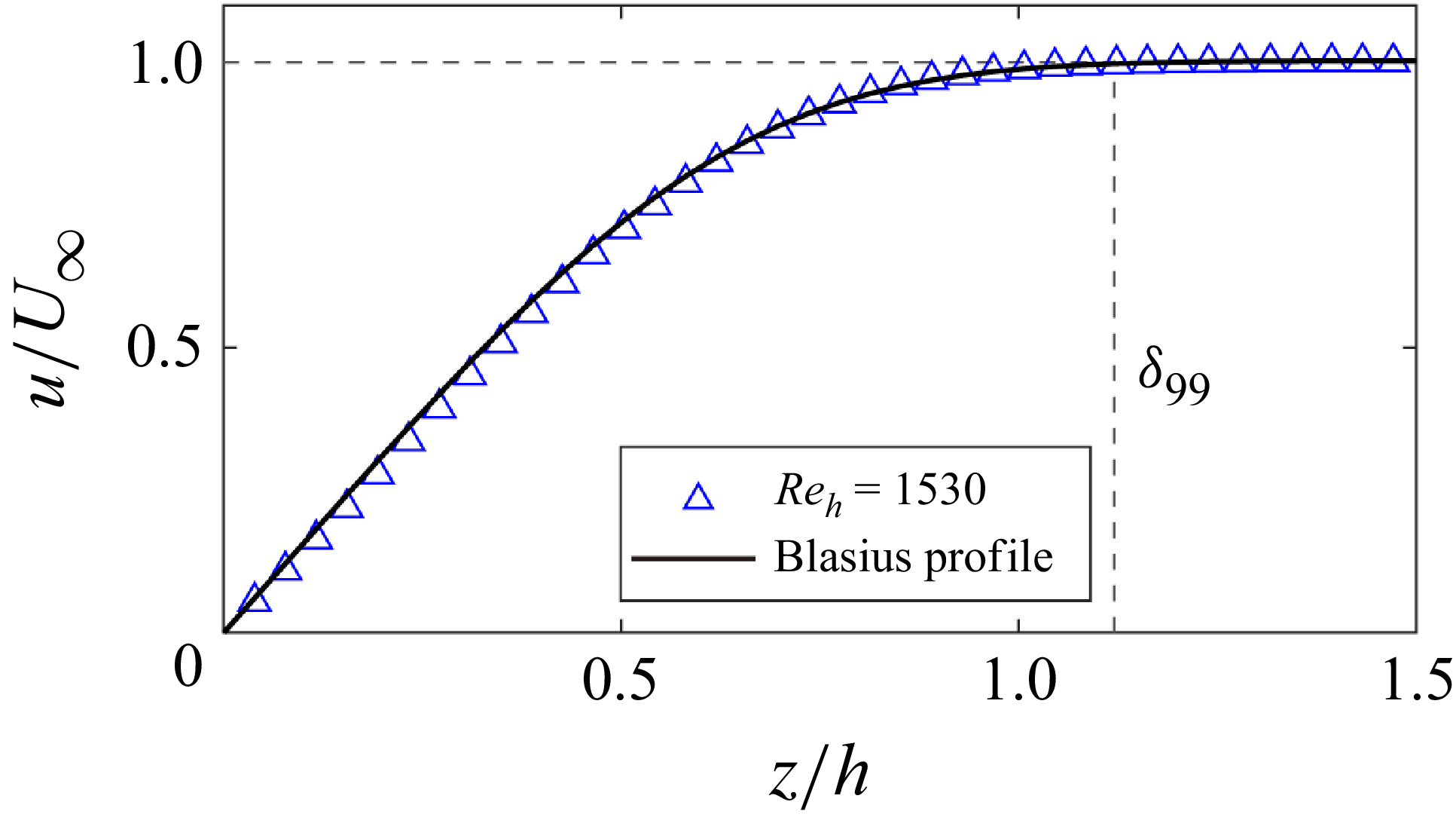
According to the study of da Silva et al. (Reference da Silva, Sumner and Bergstrom2024), the effects of the boundary layer state exist on all flow structures around the surface-mounted obstacles, especially for the HSV system. Therefore, the state of the undisturbed boundary layer was checked in the current work. As shown in figure 2, the time-averaged streamwise velocity profiles without the obstacle fit the Blasius solution very well. Moreover, the shape factor
 $H$
is 2.56, which is defined as the ratio of the displacement thickness to the momentum thickness of the undisturbed boundary layer. Both indicate that the incoming boundary layer is in a stable laminar state. The boundary layer thickness defined by
 $0.99U_\infty$
is
 $\delta _{99}=1.12h$
, which guarantees that the laminar boundary layer submerges the three obstacles.
Comparison of the undisturbed boundary layer profile and the Blasius solution.

3. Mean flow fields
Figure 3 presents the time-averaged contour plots of the dimensionless streamwise velocity component superimposed with the mean streamlines to describe the flow topologies over three different obstacles. A topologically similar system of horseshoe vortices was clearly identified upstream of the three obstacles, consisting of three clockwise rotating vortices and an anticlockwise vortex. The three clockwise vortices are referred to as HSV1, HSV2, and HSV3, respectively, according to the distance away from the leading edge of the obstacles. The anticlockwise vortex located between the HSV1 and HSV2 is referred to as secondary HSV (SHSV). Additionally, a distinct separation bubble was observed on the top of both the square and circular cylinders, which is denoted by top separation vortex (TSV) for conciseness. The absence of TSV at the top of the hemisphere was expected, as it possesses a continuous geometry without any sharp-edged platform. All these vortex cores are marked by black triangles. The integral of streamwise mean velocity in the vertical direction
 $ \psi (x,z)=\int _{wall}^{z}U(x,Z){\rm d}Z$
has been calculated, and the isopleth of
 $\psi =0$
is plotted in figure 3. Evidently, the isopleth
 $\psi =0$
can be considered as the upper bound of the mean separation bubbles in front of and above the obstacles (Fang & Tachie Reference Fang and Tachie2019).
Contours of time-averaged streamwise velocity superimposed with the mean streamlines for the three obstacles: (a) square cylinder; (b) circular cylinder; (c) hemisphere. The solid black lines correspond to the isopleths of
 $\psi =0$
. The multiple vortex cores are indicated as black triangles respectively.

As shown in figure 3, the upstream flow separation occurs at approximately
 $x/h=-4.3,-3.1,-2.8$
for the three obstacles, respectively, and the front stagnation points on the windward side are located at about
 $z/h=0.85,0.75,0.5$
, respectively. Namely, the flow separation onset position is successively delayed from the square cylinder to the circular cylinder and finally to the hemisphere. Correspondingly, the scale of the upstream separation region decreases in sequence. Additionally, the scale of each HSV structure upstream of the three obstacles also decreases sequentially, with a more compact arrangement. This phenomenon can be attributed to the presence of planar free ends on square and circular cylinders that differ from the hemisphere, while the square cylinder additionally features a sharp-edged plane perpendicular to the incoming flow. These geometric features exert a strong blocking effect on the incoming flow, inducing a more pronounced adverse pressure gradient. Consequently, flow separation occurs at a more upstream location, and the front stagnation point shifts upward. Ultimately, the larger separation region and corresponding HSV structures develop.
For the top flow, the time-averaged reverse flow regions of both the square and circular cylinders occur at similar streamwise locations, approximately at
 $x/h=-0.1$
, arising from the separated shear layers rolling up and forming separation bubbles. However, the flow reattachment point of the square cylinder (
 $x/h=0.5$
) is located further upstream than that of the circular cylinder (
 $x/h=0.8$
), corresponding to a shorter flow separation range. This difference can be attributed to the sharp leading edge perpendicular to the incoming flow of the square cylinder, which is expected to generate a stronger separated shear layer and TSV than above the circular cylinder. The resulting stronger downwash then leads to earlier reattachment of the top flow over the square cylinder.
Contours of TKE for the three obstacles: (a) square cylinder; (b) circular cylinder; (c) hemisphere. The local maxima of TKE are indicated as black crosses.

Figure 4 depicts contours of turbulence kinetic energy (TKE) with local maxima marked by black crosses. Notably, two concentrations of high fluctuating energy are identified upstream of the square cylinder, denoted as
 $T_{S1}$
and
 $T_{S2}$
, respectively. The concentration
 $T_{S1}$
is located between the vortex structures HSV1 and HSV2 and is higher than the core of SHSV, while the concentration
 $T_{S2}$
is nearly coinciding with the core of HSV1. The values associated with the two local maxima (
 $\approx 0.055U^{2}$
) are comparable. Similar features have been observed upstream of cylinders by Kirkil & Constantinescu (Reference Kirkil and Constantinescu2015) at a much higher Reynolds number
 ${\textit{Re}}_D=5 \times 10^{5}$
. They believed that these two maxima are associated with the zeroflow mode and the backflow mode. However, the bimodal behavior, which is characterized by the double-peak probability density function, is not observed in the current result (presented in Appendix). This may be attributed to the status of the incoming boundary layer. As da Silva et al. (Reference da Silva, Sumner and Bergstrom2024) found in their study of cubes, this signature double-peak PDF of the bimodal behavior in the vicinity of the HSV core is only observed for the turbulent boundary layer case. Furthermore, at the current Reynolds number, TKE upstream of the circular cylinder is significantly lower than at the free end, with no distinct peak region present. Similarly, TKE around the hemisphere exhibits low levels. These differences arise because, compared to square cylinder, circular cylinder and hemisphere have smoother curvatures, allowing the HSV system to smoothly wrap around the obstacle and develop downstream. Consequently, the upstream velocity fluctuations are stronger for the square cylinder among the three obstacles, corresponding to the more pronounced unsteady characteristics of the HSV system. In addition, another TKE peak is identified at the top of both the square (figure 4
a, denoted as
 $T_{S3}$
) and circular cylinders (figure 4
b), located between the leading edge of the obstacle and TSV. This region corresponds to the separated shear layer from the free end of cylinders, which rolls up and forms the TSV.
Given the pronounced unsteady characteristics upstream of the square cylinder, the spectral analysis is further conducted on the streamwise velocity fluctuations at the three TKE peaks
 $T_{S1}$
,
 $T_{S2}$
, and
 $T_{S3}$
. As shown in figures 5(a) and 5(c), there are two different characteristic frequencies
 $St_2=0.09$
and
 $St_1=0.018$
(named according to their magnitude) in the spectra corresponding to
 $T_{S1}$
and
 $T_{S3}$
, respectively. Interestingly, both of these two characteristic frequencies are observed in the spectrum at point
 $T_{S2}$
(figure 5
b). Among these, the high frequency
 $St_2$
is generally comparable with the dimensionless frequencies around the square cylinders with low aspect ratios reported in the literature, for example
 $St=0.065 \sim 0.105$
in Sakamoto & Arie (Reference Sakamoto and Arie1983),
 $St=0.08 \sim 0.09$
in Okajima (Reference Okajima1982),
 $St=0.09$
in Porteous et al. (Reference Porteous, Moreau and Doolan2017), and
 $St=0.08$
in da Silva et al. (Reference da Silva, Sumner and Bergstrom2022). In addition, Baker (Reference Baker1991) found that the unsteady oscillations of the HSV system consist of two frequency components, namely the secondary oscillation corresponding to
 $St=0.01$
and the stronger primary oscillation corresponding to
 $St=0.08$
, which is similar to the double-frequency behavior observed in the present study. Therefore, it is reasonable to expect that the two characteristic frequencies are associated with distinct mechanisms, while the coexistence of
 $St_1$
and
 $St_2$
suggests that complex dynamics exist near the HSV1 upstream of the square cylinder. These concerns are explored in detail in the following section.
Frequency spectra of streamwise velocity fluctuations upstream of the square cylinder at points
 $T_{S1}$
,
 $T_{S2}$
, and
 $T_{S3}$
, respectively.

Streamwise variation of vorticity thicknesses
 $\delta _\omega$
for the three obstacles: (a) square cylinder; (b) circular cylinder; (c) hemisphere. Solid and hollow triangles correspond to wall shear layer upstream and the shear layer emanating from the free end, respectively.

Spatial two-point correlation coefficient of the streamwise velocity fluctuations for the three obstacles: (a) square cylinder; (b) circular cylinder; and (c) hemisphere. The reference point is located at
 $x/h = -0.9$
,
 $z/h = 1.1$
for square cylinder and circular cylinder, and at
 $x/h = 0.1$
,
 $z/h = 1.1$
for hemisphere.

Figure 6 presents the streamwise variation of multiple vorticity thicknesses for the three obstacles, which is defined as
 $\delta _\omega =(U_{\textit{max}}-U_{\textit{min}})/(\partial U/\partial z)_{\textit{max}}$
, where
 $U_{\textit{max}}$
and
 $U_{\textit{min}}$
denote the maximum (free stream) and minimum streamwise mean velocity, respectively, in the vertical direction. According to Brown & Roshko (Reference Brown and Roshko1974) and Fang & Tachie (Reference Fang and Tachie2019), the vorticity thickness can be adopted to quantify the growth of shear layers. As shown in figure 6(a), the upstream shear layer is affected by the HSV system and grows significantly near the front of the square cylinder, even exceeding the height of the square cylinder. This is reasonable because the presence of a square cylinder obstructs the incoming flow and creates a significantly adverse pressure gradient, leading to the lift of the upstream shear layer. Meanwhile, another shear layer originates from the leading edge of the square cylinder and develops downstream. Consequently, the two shear layers overlap spatially for the square cylinder with a low aspect ratio. Subsequently, the spatial two-point correlation analysis was performed to further examine the interaction between the upstream and free end shear layers. As shown in figure 7(a), an apparent correlated region is observed connecting the upstream and free end flow, indicating clear interaction between the top and upstream flows of the square cylinder. In contrast, the circular cylinder and hemisphere exert less obstruction to the incoming flow, with shear layers in front of both obstacles being lower than the obstacle height. Simultaneously, shear layers developing downstream are present at the free ends of both obstacles. As shown in figure 6(b, c), the upstream and free end shear layers of the circular cylinder and hemisphere are quite independent. Moreover, the correlated regions remain localized near the free end (figure 7
b, c), suggesting that the interactions between the two shear layers are much weaker in these two cases.
4. Unsteady characteristics over the square cylinder
Based on the above results, among the flow fields over the three obstacles at the current Reynolds number, the flow over the square cylinder exhibits the most pronounced unsteady characteristics, with the strongest interaction between the upstream and top flows. These findings are also confirmed in subsequent analyses. Therefore, the subsequent study focuses on the unsteady characteristics presented around the square cylinder.
4.1. Unsteadiness of HSV system
Firstly, attention is turned to the unsteady characteristics of the HSV system upstream of the square cylinder. Among multiple vortex structures upstream of the obstacles, the three vortices HSV1, SHSV, and HSV2 possess stronger vorticities and are able to be identified robustly in the instantaneous flow field. Also, these three vortices maintain similar relative spatial arrangements. Thus, we track these three representative vortices to quantify the dynamic characteristics of the HSV systems. The
 $Q$
-criterion (Hunt, Wray & Moin Reference Hunt, Wray and Moin1988; Jeong & Hussain Reference Jeong and Hussain1995) is employed to identify vortex structures in this investigation, which is defined as
 $Q=(\varOmega ^2-S^2)/2$
, where
 $\varOmega$
is the rate of rotation and
 $S$
is the rate of flow strain. The exact centre locations of the three vortices are identified as the weighted centroids of the
 $Q$
concentration region separately in each instantaneous snapshot. Specifically, based on their mean locations in the time-averaged flow field, three individual search regions were defined around the corresponding vortices. Within each search region, the weighted centroids of corresponding vortex heads are calculated as
 $x_c=\int _L xQ{\rm d}l / \int _L Q{\rm d}l$
and
 $z_c=\int_L zQ{\rm d}l / \int_L Q{\rm d}l$
, where
 $L$
is the integral region enclosed by 50 % of the maximum value of the local
 $Q$
field. The two-dimensional probability density functions (PDF) of the locations of centre of HSV1, SHSV, and HSV2 upstream of the three obstacles are mapped in figure 8, providing a concise way to map the oscillation topology of these vortices simultaneously in time and space (Apsilidis et al. Reference Apsilidis, Diplas, Dancey and Bouratsis2015). Apparently, the centre locations of the three vortices in front of the square cylinder exhibit more dispersed spatial distributions, indicating that the upstream HSV system is highly dynamic. In contrast, the vortex cores upstream of the circular cylinder and hemisphere maintain relatively fixed positions, further confirming the absence of noticeable unstable oscillations in HSV system in these two cases. For the square cylinder case, locations of HSV1, SHSV, and HSV2 all exhibit significant oscillations in both the streamwise and vertical directions. Specifically, the streamwise oscillation extents of the three vortices upstream of the square cylinder are roughly the same, approximately
 $0.45h$
, whereas the corresponding vertical oscillation extents are
 $0.15h$
for HSV1,
 $0.1h$
for SHSV, and
 $0.09h$
for HSV2, respectively. The fact that the streamwise oscillation amplitudes of the three vortices are considerably higher than the vertical ones indicates that the streamwise oscillations of HSV structures upstream of the square cylinder are dominant. Furthermore, the PDF concentration regions of the three vortex centres remain well separated, each clustered within the streamwise ranges of
 $x/h=-2 \sim -1.5$
(HSV1),
 $-2.4 \sim -2$
(SHSV), and
 $-2.9\sim -2.4$
(HSV2), respectively, and there is limited overlap among them. This suggests that the three representative vortices oscillate independently upstream of the square cylinder, whereas the vortex merging events among them are not common.
Probability density function distribution of locations of three vortex cores for the three obstacles: (a) square cylinder; (b) circular cylinder; (c) hemisphere.

Moreover, we assess cross-correlation between the streamwise position of the core of three vortices upstream of the square cylinder (denoted as
 $x_{\textit{HSV1}}$
,
 $x_{SHSV}$
and
 $x_{HSV2}$
, respectively). As shown in figure 9(a), there are clear positive correlations between each pair of the three vortices. Furthermore, the cross-correlation curves reach their peaks at the zero-time lag, indicating that there is no phase difference between the variation of streamwise positions of these three vortices. Among them, the frequency spectrum of
 $x_{\textit{HSV1}}$
is plotted in figure 9(b), possessing a sharp peak at
 $St_2=0.09$
. This indicates that the aforementioned three major HSV vortex structures undergo periodic streamwise oscillations at frequency
 $St_2$
. In other words, the mechanism corresponding to the high-frequency feature
 $St_2$
in the upstream region of the square cylinder is the spatial oscillation of the HSV system.
(a) Cross-correlations between the streamwise positions of the core of three vortices, respectively. (b) Frequency spectrum of
 $x_{\textit{HSV1}}$
.

(a) Cross-correlations between the tangential velocity of the three vortices, respectively. (b) Frequency spectrum of
 $\tau _{\textit{HSV1}}$
.

In addition to spatial oscillations, variations in the vortex strength are also worth studying. In the current work, the tangential velocity of the corresponding vortex is used to quantify their instantaneous strength. The tangential velocity (denoted as
 $\tau _{\textit{HSV1}}$
,
 $\tau _{SHSV}$
and
 $\tau _{HSV2}$
, respectively) is defined as the average tangential velocity along the boundary of the vortex core, which is 50 % of the maximum value of the local
 $Q$
field. Figure 10 provides the cross-correlation between them, as well as the spectrum of
 $\tau _{\textit{HSV1}}$
. It is observed that the tangential velocities of HSV1 and HSV2 with the same rotation direction are positively correlated. Conversely, the tangential velocity of SHSV is negatively correlated with theirs. This indicates that the strength of clockwise rotating vortices and the anticlockwise vortex alternates over time, demonstrating mutual suppression. Additionally,
 $\tau _{\textit{HSV1}}$
possesses a distinct characteristic frequency
 $St_1=0.018$
as shown in figure 10(b), suggesting that HSV1 undergoes periodic amplification and decay while oscillating in the streamwise direction. Due to the high correlation, the strengths of these three vortices all manifest periodic variations at low frequency. Namely, the strength variation behaviors of the HSVs in front of the square cylinder correspond with characteristic frequency
 $St_1$
. Recalling figure 5, the coexistence of two characteristic frequencies at point
 $T_{S2}$
can be attributed to the combined effects of the position oscillation and strength variation of HSV1. Yet the vertical range of SHSV is closer to the wall, and its strength variation has scant effect on flow near point
 $T_{S1}$
. Since the point
 $T_{S1}$
is the saddle point between HSV1 and HSV2, position oscillations of vortices have a primary influence on the flow around it. Therefore, point
 $T_{S1}$
mainly exhibits high-frequency characteristics.
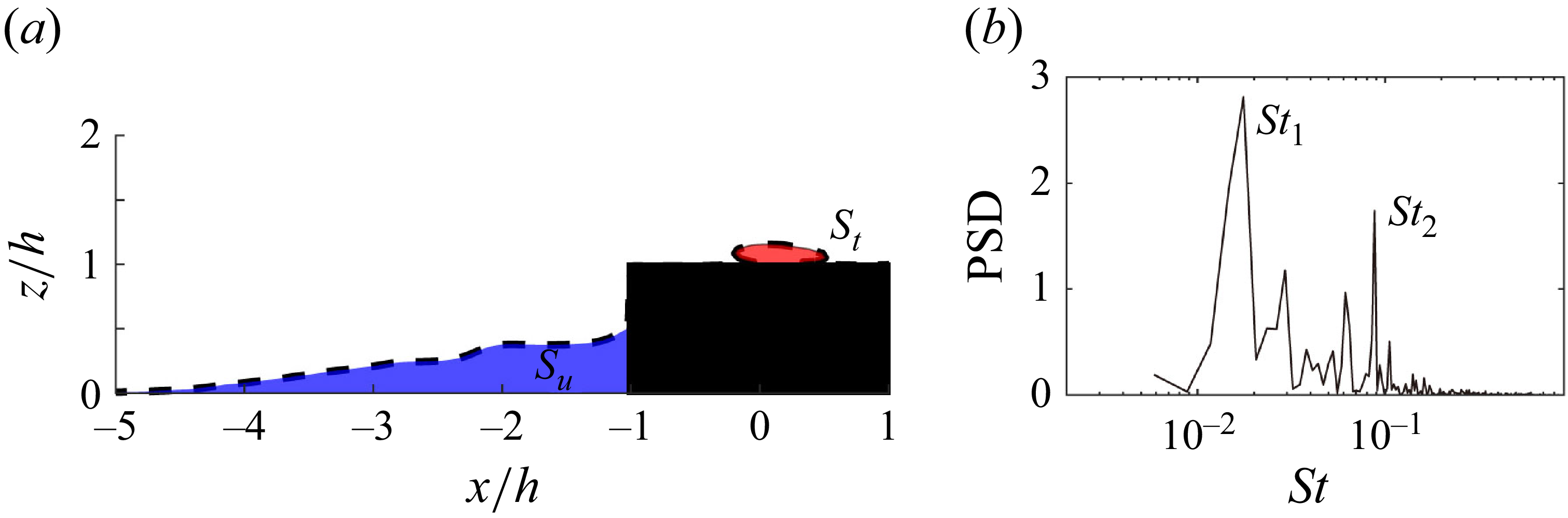
For completeness, the unsteady characteristic of the entire HSV system upstream of the square cylinder is also studied, in addition to the three easily traceable vortex structures mentioned above. As another important metric, the size of the separation region upstream of the square cylinder is closely associated with the dynamic behavior of multiple HSVs. Herein, the instantaneous reverse flow area (the straightforward summation of areas with
 $u\lt 0$
, denoted as
 $S_u$
) is used to quantify the size of the instantaneous entire separated region upstream of the square cylinder, namely the area of the blue region in figure 11(a). To assess the temporal characteristics of the whole separated region, figure 11(b) provides the frequency spectrum of
 $S_u$
. Clearly,
 $S_u$
possesses two characteristic frequencies at
 $St_1=0.018$
and
 $St_2=0.09$
. This indicates that the aforementioned two dynamic mechanisms collectively contribute to the oscillation of the entire HSV system upstream of the square cylinder.
(a) Schematic diagram of the size of reverse flow area upstream of and above the square cylinder. (b) Frequency spectrum of
 $S_u$
.

4.2. Statistics of vortex number
In addition to position and strength, the number of HSV vortices upstream of the square cylinder also exhibits complex temporal variations at the current Reynolds number. Compared to clockwise vortex structures, anticlockwise vortices are weaker and more difficult to capture. Therefore, this section discusses the number of clockwise HSV structures in front of the square cylinder in detail. It should be noted that the usual identification criteria based on local quantities (such as
 $Q$
-criterion) are quite intermittent for structures such as HSV3 further upstream due to small scales. To avoid this limitation, the
 $\varGamma _1$
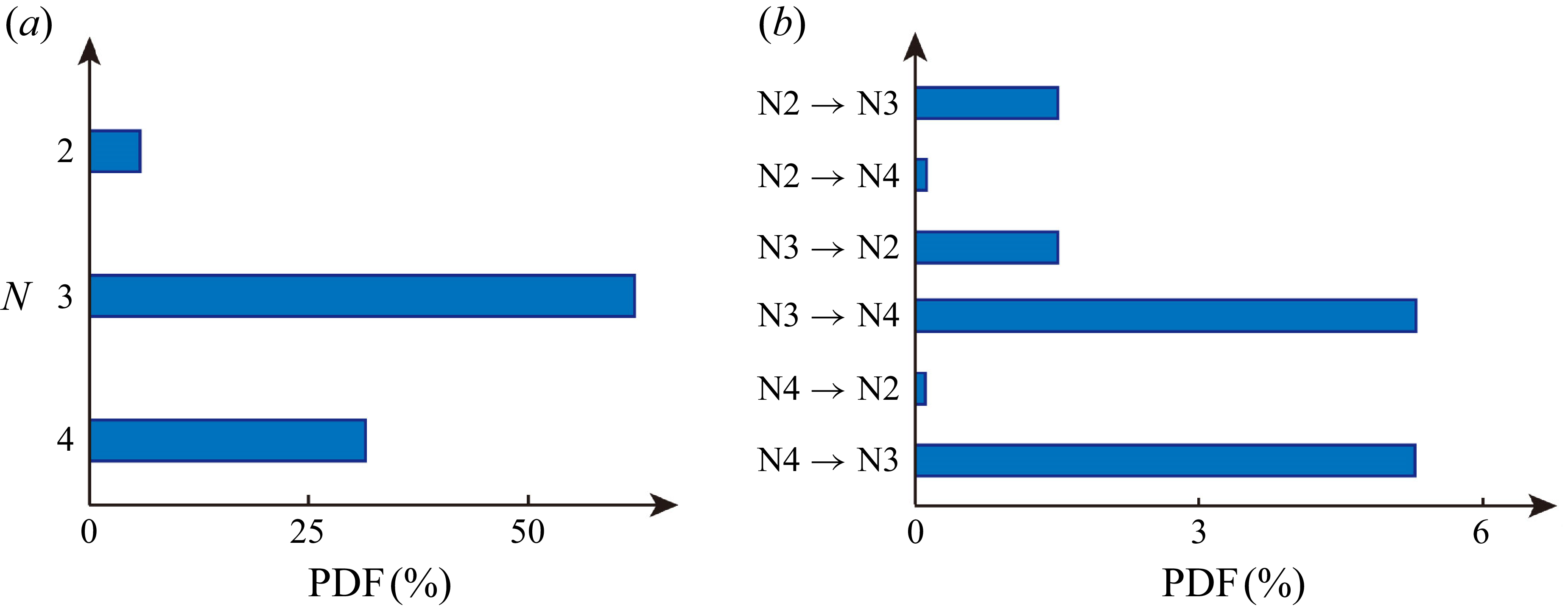
vortex identification function (Graftieaux, Michard & Grosjean Reference Graftieaux, Michard and Grosjean2001) is employed to pinpoint the vortex, which is able to robustly characterize the small-scale vortices based on only the topology of the velocity field. Figure 12(a) gives the statistics of the number of instantaneous clockwise vortices at different snapshots. It is indicated that all samples can be classified into three categories based on the number of clockwise vortices, corresponding to 2, 3, and 4 clockwise vortices, respectively. For conciseness, these three categories are referred to as N2, N3, and N4 in the following text.
(a) Statistics of the number of instantaneous clockwise vortices in front of the square cylinder. (b) Statistics of the switching process between different patterns.

Conditional averaged flow fields. (a), (b), and (c) correspond to pattern N2, N3, and N4, respectively. The superimposed blue lines are isopleth
 $U=0$
.

To further investigate the flow pattern corresponding to different categories, conditional averaging is applied to the samples under three conditions. As shown in figure 13, the flow pattern corresponding to pattern N2 manifests the simplest organization, consisting of only two clockwise vortices, HSV1 and HSV2, as well as an anticlockwise vortex, SHSV, between them. Notably, the streamwise range of the HSV2 is quite large, spanning about
 $x/h=-3.3\sim -2.3$
. Pattern N3 (figure 13
b) features a contracted streamwise extent of HSV2 accompanied by the emergence of a third clockwise vortex (HSV3) further upstream. Since the pattern N3 is the most frequently observed configuration, as evidenced by figure 12(a), its topology is very similar to the time-averaged flow field shown in figure 3, indicating its dominant role in determining the mean flow characteristics. For the pattern N4 (figure 13
c), a fourth clockwise vortex structure HSV4 appears upstream of HSV3. Nevertheless, the intensity of HSV4 is very weak and difficult to detect in the time-averaged flow field, although the N4 pattern is the second most common pattern. Additionally, the switching process between patterns is also statistically analyzed. Note that only the PDF of pattern changes is counted, while consecutive frames corresponding to the same pattern are ignored. As shown in figure 12(b), the most common transition occurs between patterns N3 and N4, followed by transitions between N2 and N3. The probability of a direct transition between N2 and N4 is extremely low, almost negligible. In summary, the flow field upstream of the square cylinder intermittently switches between these three patterns.
Conditional averaged the streamwise position (a) and tangential velocity (b) of three vortex structures HSV1, SHSV, and HSV2, at three patterns. Both figures give the absolute values for intuitiveness.

Furthermore, as intuitively observed in figure 13, the length of the upstream separation region of the square cylinder is directly proportional to the number of clockwise vortices. That is, the more vortex structures there are in the HSV system, the larger the separation region. This is reasonable because only with a sufficient separation region can more vortex structures be accommodated.
To gain a deeper understanding of the three patterns, the streamwise position and tangential velocity of three main vortex structures (HSV1, SHSV, and HSV2) are conditionally averaged. For intuitiveness, figure 14(a) gives the absolute values of the conditional averaged streamwise positions, which indicate the distance from the conditional averaged vortex core to the origin (angular brackets
 $\langle \boldsymbol{\cdot }\rangle$
represent conditional averaging). Since N3 is the dominant pattern at the current Reynolds number, we consider it as the baseline pattern. As shown in figure 14, the conditional averaged distances between the three vortices and the origin are minimum in pattern N3, while their corresponding tangential velocities are intermediate compared to the other patterns. When the number of clockwise vortices deviates from the baseline, whether more or fewer, HSV1, SHSV, and HSV2 all move away from the square cylinder. For pattern N2, the tangential velocities of both HSV2 and SHSV decrease compared to baseline N3. This reduction, coupled with the distinct larger scale of HSV2 and SHSV in pattern N2, suggests that the dissipative effects acting on these vortices are relatively weaker in pattern N2, leading to a strong coherence within the vortex structures. During the transition from pattern N2 to N3, the original HSV2 undergoes instability, ultimately breaking down and forming smaller-scale structures HSV2 and HSV3. Conversely, the merger of HSV2 and HSV3 has been witnessed during the transition from N3 to N2, forming a large-scale HSV2 structure. A similar spatial trend is observed in pattern N4, where both HSV2 and SHSV proceed to move further away from the square cylinder. However, unlike the pattern N2, the tangential velocities of these vortices in pattern N4 surpass those in pattern N3, suggesting a heightened susceptibility to dissipation and instability. The scales of HSV2 and HSV3 further decrease compared to N3, and the further cascade of instability promotes the generation of HSV4. Meanwhile, the transition from pattern N4 to N3 occurs via the vortex merging between HSV4 and HSV3.
4.3. Interaction between HSV and TSV
We now turn our attention to the unsteady characteristics of the separation bubble on the top of the square cylinder, namely TSV, and the interaction between HSV systems and TSV. This interaction between vortex systems is a unique phenomenon specific to the square cylinder among the three obstacles, as indicated above. Considering the small scale of instantaneous TSV, the area of reverse flow above the square cylinder is calculated to quantify the size of TSV (denoted as
 $S_t$
), indicated by the area of the red region in figure 11(a). Figure 15(a) presents the temporal cross-correlation of
 $S_u$
and
 $S_t$
. The value of
 $R(0)$
is as high as 0.91, which is indicative of a good synchronization of
 $S_u$
and
 $S_t$
. Meanwhile, the spectrum of
 $S_t$
is plotted in figure 15(b), indicating that
 $S_t$
possesses two characteristic frequencies identical to
 $S_u$
at
 $St_1=0.018$
and
 $St_2=0.09$
.
(a) Cross-correlations of
 $S_u$
and
 $S_t$
. (b) Frequency spectrum of
 $S_t$
.

The phase-shifted co-spectrum
 $\phi (f,0)$
.

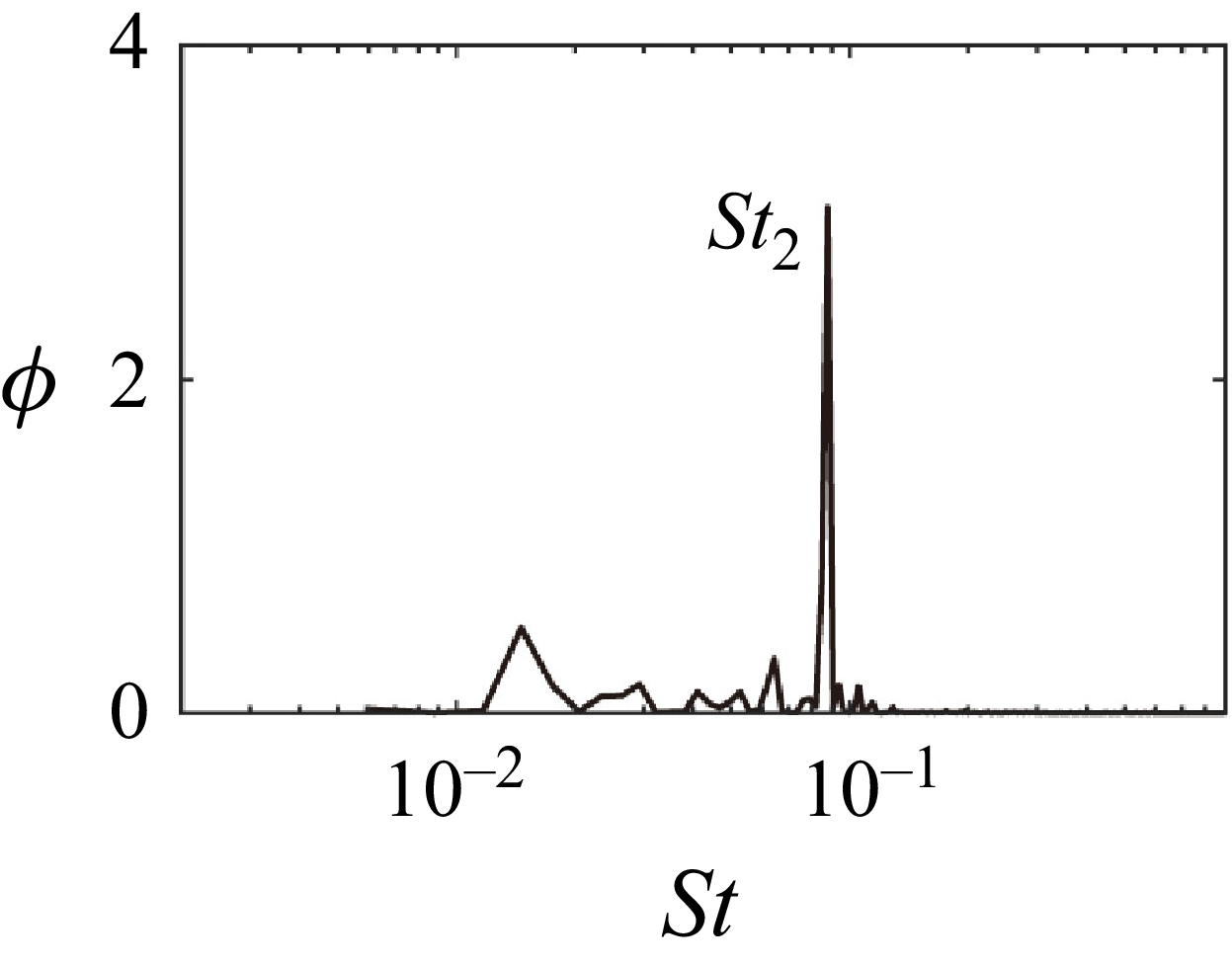
In addition, the phase-shifted co-spectrum is adopted to further evaluate the contribution to the peak value of the cross-correlation
 $R(t)$
from different frequencies, which is defined as:
 \begin{equation} {\phi (f,t)=\overline {\widehat {S_u}(f)[\widehat {S_t}(f)\exp(2\pi \textit{ift})]^*}+\overline {\widehat {S_t}^*(f) \widehat {S_u}(f) \exp(2\pi \textit{ift})}}. \end{equation}
Here,
 $i=\sqrt {-1}$
, and
 $\widehat {(\boldsymbol{\cdot })}$
and
 $(\boldsymbol{\cdot })^*$
denote the Fourier transformed coefficient and complex conjugate, respectively. Since the peak of
 $R(t)$
is reached at
 $t=0$
value, the
 $\phi (f,0)$
is plotted in figure 16. It is seen that the
 $\phi$
possesses a distinct peak at
 $St_2=0.09$
, while trivial magnitudes at the other frequencies including
 $St_1=0.018$
. This indicates that the peak value of the cross-correlation coefficient is primarily governed by the higher frequency
 $St_2$
, while the contribution of the lower frequency
 $St_1$
is limited. Interestingly, the peak value
 $St_2=0.09$
exactly coincides with the characteristic frequency of spatial oscillation of the HSV system. Therefore, both the separation regions upstream of and above the square cylinder are influenced by spatial oscillations originating from the HSV system, experiencing a high-frequency oscillation at
 $St_2=0.09$
. However, although both
 $S_u$
and
 $S_t$
exhibit distinct peaks at frequency
 $St_1$
, the low-frequency characteristics of these two separation regions may be attributed to different sources. Based on figure 5(c), the low-frequency characteristics are observed in the shear layer generated at the free end of the square cylinder. Therefore, the low-frequency characteristics of the separation bubble at the top of the square cylinder may be influenced by the instability of the shear layer at the free end of the square cylinder.
5. Conclusion
The present study conducted time-resolved two-dimensional PIV to investigate the flow characteristics around surface-mounted obstacles at Reynolds number
 ${\textit{Re}}_h=1530$
. Three different geometries (square cylinder, circular cylinder, and hemisphere) are considered maintaining the same aspect ratio of 0.5 and height of 10 mm, and are completely submerged in the laminar boundary layer of
 $\delta /h=1.12$
. The novelty of this study lies in experimentally comparing the effects of geometry on the flow characteristics in front of surface-mounted obstacles at such a low
 ${\textit{AR}}$
. The unsteady characteristics and corresponding dynamic mechanisms upstream of and above the square cylinder are revealed, as well as the interactions between them. Meanwhile, a direct correlation between vortex number and flow pattern has been established.
The time-averaged flow topologies around the three obstacles are quite similar. However, the upstream region of the square cylinder is significantly larger, forming larger-scale HSV structures. Simultaneously, the unsteady characteristics over the square cylinder are markedly stronger than those over the circular cylinder and hemisphere, with higher TKE amplitudes. Furthermore, pronounced upstream-top flow interactions exist in the square cylinder case, which are not evident in the flow around the circular cylinder and hemisphere.
Two dynamic mechanisms have been observed upstream of the square cylinder, corresponding to two different characteristic frequencies. The mechanism corresponding to the high-frequency feature
 $St_2$
is the spatial oscillation of the HSV system. The cores of three major HSV vortex structures (HSV1, HSV2, and SHSV) that can be robustly identified undergo periodic streamwise oscillations. The streamwise locations of their cores exhibit high positive correlations with no phase difference. Meanwhile, the strength variation behaviors of the HSVs correspond with characteristic low frequency
 $St_1$
; that is, the vortices upstream of the square cylinder experience periodic amplification and decay while oscillating along the streamwise direction. Differently, the strength of clockwise and anticlockwise vortices alternates over time, indicating mutual suppression. Additionally, the unsteady characteristic of the entire HSV system upstream of the square cylinder is also investigated. The temporal characteristics of the whole separated region possess two characteristic frequencies corresponding to
 $St_1$
and
 $St_2$
, which confirms that the aforementioned two dynamic mechanisms collectively contribute to the oscillation of the entire HSV system upstream of the square cylinder.
Moreover, based on the different numbers of clockwise vortices in the instantaneous flow field, all samples can be classified into three categories corresponding to 2, 3, and 4 clockwise vortices, respectively. The flow patterns corresponding to each category are obtained through conditional averaging. Statistical analysis of the switching process between patterns reveals that the flow field upstream of the square cylinder intermittently switches between these three categories. However, the probability of a direct transition between N2 and N4 is extremely low, and all pattern switches involve the baseline pattern N3. When the number of clockwise vortices in the instantaneous flow field deviates from the baseline, whether more or fewer, the three main structures (HSV1, SHSV, and HSV2) all move away from the square cylinder. But their tangential velocities increase with the number of clockwise vortices, suggesting a heightened susceptibility to dissipation and instability. These findings establish a direct correlation between vortex number and flow pattern, providing new insights into the spatiotemporal characteristics of HSV system upstream of the bluff bodies.
Finally, the unsteady characteristics of TSV and its interactions with HSV systems are explored. Both the separation regions upstream of and above the square cylinder are influenced by spatial oscillations corresponding to the high frequency
 $St_2$
originating from the HSV system. Differently, the low-frequency features in the region above the square cylinder originate from the instability of the shear layer at the free end. In summary, the present work enhances the understanding of the oscillatory mechanisms over the surface-mounted obstacles, providing valuable insights for future research on different geometric obstacles with small
 ${\textit{AR}}$
.
Funding
This work was supported by the National Natural Science Foundation of China (no. 11721202).
Declaration of interests
The authors report no conflict of interest.
Appendix. Joint PDF analysis
Figure 17 presents the joint probability density functions (JPDF) of the local streamwise and vertical velocity fluctuations at the two TKE peaks
 $T_{S1}$
and
 $T_{S2}$
upstream of the square cylinder (refer to figure 4). The resulting JPDF distributions exhibit single continuous clusters rather than two distinctly separated clusters. This observation supports the absence of a typical bimodal behavior (characterized by double-peak PDF) upstream of the square cylinder immersed in the laminar boundary layer. These distributions may also serve as a useful reference for future studies.
JPDF at point (a)
 $T_{S1}$
and (b)
 $T_{S2}$
upstream of the square cylinder, respectively.



 ψ=0


 TS1
 TS2
 TS3

 δω

 x/h=−0.9
 z/h=1.1
 x/h=0.1
 z/h=1.1


 xHSV1

 τHSV1
 Su

 U=0


 Su
 St
 St
 ϕ(f,0)

 TS1
 TS2


