

Introduction
Traditional chicken belong to a population of chickens with no comprehensive information about the breeds. These are the local chickens raised by farmers and often show large phenotypic diversity (FAO, 2012). The diversity of these animal genetic resources is important to the livelihood and food security of marginal farmers/raisers. A genetic reservoir of breeding stocks to meet the changing environmental conditions are potential sources of genes pertaining to resistance or tolerance among emerging diseases, could thrive in locally available resources, and fit with consumer preferences for meat and egg products (Boettcher et al., Reference Boettcher, Tixier-Boichard, Toro, Simianer, Eding, Gandini, Joost, Garcia, Colli and Ajmone-Marsan2010; Hoffmann, Reference Hoffmann2010). However, such a diversity is threatened by changes in the production system (Reges and Gibson, Reference Reges and Gibson2003), indiscriminate crossing of breeds (Hiemstra et al., Reference Hiemstra, Drucker, Tvedt, Louwaars, Oldenbroek, Awgichew, Kebede, Bhat and da Silva Mariante2006), occurrence of catastrophe and degradation of environment (FAO 1998, 2007). This is manifested by 38 percent of the reported poultry breeds in the world at risk with some already extinct (Hoffmann, Reference Hoffmann2010). Furthermore, reports showed that in Asia, more need to be characterized, while most are of unknown risk status (FAO, 2007).
In the Philippines, the population of traditional chicken or popularly known as native chicken decreased from 62 to 47 percent of the total chicken inventory from 2001 to 2010 or about 1.5 percent decrease per annum. Among the 16 regions of the country, the highest population inventory of native chickens is in Western Visayas (BAS, 2011). Few places in this region served as pilot areas for in situ conservation (MASIPAG, 2010). The existing research undertakings focus on standardization of DaragFootnote 1 chickens among research institutions (Cocjin et al., Reference Cocjin, Lambio, Hipolito, Gonzales, Linga, Tomambo, Roxas, Arenga and Casiple1999, Reference Cocjin, Roxas, Arenga and Casiple2001, Reference Cocjin, Roxas, Arenga and Casiple2004, Reference Cocjin, Roxas, Casiple and Arenga2007; Patricio and Cabarles, Reference Patricio and Cabarles2007; Lopez, Reference Lopez2008; Tomambo et al., Reference Tomambo, Cocjin, Roxas, Casiple and Arenga2010). This implies scarcity of data on other groups of traditional chickens. Information on the phenotypic and molecular characteristics of these chickens is important for intelligent decision-making about conservation and/or improvement (Davila et al., Reference Davila, Gil, Resino-Talavan and Campo2009; Boettcher et al., Reference Boettcher, Tixier-Boichard, Toro, Simianer, Eding, Gandini, Joost, Garcia, Colli and Ajmone-Marsan2010; FAO, 2012; Zanetti et al., Reference Zanetti, de Marchi, Dalvit and Cassandro2010). These are some available information crucial for phenotypic characterization (Avante and del Fierro, Reference Avante and del Fierro1991; Lambio, Bondoc and Grecia, Reference Lambio, Bondoc and Grecia1998, 2000; Escobin et al., Reference Escobin, Bondoc, Lambio and Roxas2005), molecular characterization (Roxas et al., Reference Roxas, Villanueva and Lambio1996; Lambio and Barrion, Reference Lambio and Barrion1998) and description of production environment (Guevara, Lambio and Peñalba, Reference Guevara, Lambio and Peñalba1991; Oñate, Reference Oñate1991; Roxas and Escarlos, Reference Roxas and Escarlos2000; Magpantay et al., Reference Magpantay, Supangco, Pacificador, Sevilla, Lambio and Gayeta2006), but are limited to traditional chickens in other regions. In Western Visayas, only few studies dealt with the production environment (Sulinthone, Reference Sulinthone2006; Lingaya, Oliveros and Magpantay, Reference Lingaya, Oliveros and Magpantay2007) and molecular characterization of traditional chicken (Roxas et al., Reference Roxas, Villanueva and Lambio1996). The limited migration of people who brought chickens, the presence of higher mountains, poor road network and socio-cultural differences might have led to morphological divergence of these genetic resources (Roxas et al., Reference Roxas, Villanueva and Lambio1996). There is, therefore, a need to identify distinct morphological characteristics of traditional chicken, which are crucial in Western Visayas, Philippines. These are vital inputs to the existing activities and future chicken breed development utilizing local chicken genetic resources as source of stocks.
The role of traditional chicken is crucial to the economy of the country and region. It is a cheap source of animal protein and provides extra income among families in rural areas (Lambio, Bondoc and Grecia, Reference Lambio, Bondoc and Grecia1998; Lingaya, Oliveros and Magpantay, Reference Lingaya, Oliveros and Magpantay2007). More than 6 million smallholder or marginal farmers keep this fowl as an integral part of their farming system (NSO, 2005; Bagiou, Reference Bagiou2010). The annual need in Western Visayas alone is 64 million heads of dressed traditional chicken (Belleza, Reference Belleza2010). A niche exists for this chicken because it is organically grown and is leaner and its meat has a distinctive taste. However, with exponential human population growth, there is high probability that the increasing demand cannot be met. This is seen as opportunity by would-be raiser-entrepreneurs, but the availability of information on source of breeding stocks is limited (Belleza, Reference Belleza2010; Bagiou, Reference Bagiou2010). Hence, this study was conducted to identify the distinct morphological traits of traditional chicken groups from the different provinces of Western Visayas, Philippines. The findings will serve as inputs to the development of this industry.
Materials and methods
Sampling sites and number of chickens characterized
The provinces of Aklan, Antique, Capiz, Guimaras, Iloilo and Negros Occidental in Western Visayas were included as sampling sites. The number was determined using the equation suggested by Israel (Reference Israel1992). Forty-five raisers of traditional chickens were purposely identified in three municipalities of each province considered (Dana et al., Reference Dana, Dessie, van der Waaij and van Arendonk2010a). This was done to minimize taking data from closely related flocks (Mwacharo et al., Reference Mwacharo, Nomura, Hanada, Jianlin, Hanotte and Amano2007). One rooster and two hens possessing dominant plumage colour and pattern were borrowed from each identified raiser for characterization. Guidance from the personnel of the municipal agriculture office and the farmer technician of Magsasaka at Siyentipiko para sa Pag-unlad ng Agrikultura (MASIPAG) in some areas with allied people organizations (PO's) prior to and during the visit for data collection were sought.
Data collected
The data gathered were based on the guidelines set by FAO (2012), Cuesta (Reference Cuesta2008) and FAO and UNEP (1986). The data collected were the following.
Qualitative traits
These data included plumage colour and pattern; feather distribution and morphology; colours of the earlobes, skin and shank; shapes of the head, breast and body; comb type and skeletal variants (Supplementary Figure S1). These were determined by an actual examination of one rooster and two hens from the identified flock of traditional chickens of each raiser. Only those chickens ageing more than 10-months-old with dominant plumage colour and pattern were considered for characterization.
Morphometric traits
The morphometric traits were determined by a direct measurement including body length, circumference and height; wingspan and primary feather length; and tail length, and were all taken using a tape measure. Lengths of beak, drumstick shank and middle toes; and diameter of drumstick and shank were determined using a digital calliper (Supplementary Figure S1). Centimetre was used as a unit of measurement. Live weight was also determined using a 5 kg capacity digital weighing scale.
Statistical analysis
Qualitative traits
Data on plumage colour and pattern, earlobe colour, skin colour, iris colour, shank colour, feather morphology and distribution, head shape, breast shape, body shape, comb types and skeletal variants were analysed using Kruskal–Wallis test (Dana et al., Reference Dana, Dessie, van der Waaij and van Arendonk2010b). Significant differences in the frequency of occurrences among provinces were analysed using the least significant differences (LSD) for ranks.
Morphometric traits
The data were analysed using univariate general linear model (GLM). Live weight was considered as the dependent variable, whereas the beak length, body length, body circumference, body height, wingspan, primary feather length, drumstick length, midlength diameter of drumstick, shank length, midlength diameter of shank, tail length, middle toe length and fixed effects of traditional chicken sex were the independent variables. These data were used to derive the different coefficients in the model generated from univariate GLM. The statistical model used was
 $$\eqalign{Y & =- 2.793+0.115X_1+0.015X_2+0.032X_3+0.006X_4 \cr & \quad +0.004X_5 +0.005X_6+0.034X_7+0.090X_8+0.024X_9 \cr &\quad +0.750X_{10}+0.025X_{11} +0.002X_{12} -0.099X_{13} \pm 0.123}$$
where Y is the live weight (kg) of traditional chickens. −2.793 = (α) intercept of the model; X 1 = beak length; X 2 = body length; X 3 = body circumference; X 4 = body height; X 5 = wingspan; X 6 = primary feather length; X 7 = drumstick length; X 8 = midlength diameter of drumstick; X 9 = shank length; X 10 = midlength diameter of shank; X 11 = tail length; X 12 = middle toe length; X 13 = fixed effects of chicken sex (1 = male; 2 = male); 0.123 = standard error (S.E.).
The model indicates any change in live weight of traditional chickens owing to accumulated linear effects of the above-mentioned independent variables. Live weight was further analysed using the univariate analysis of variance (ANOVA). The Duncan multiple range test (DMRT) was used to determine significant differences between and among means.
Results and discussions
Plumage colour
Results show that 23.70 percent of the 810 traditional chickens in Western Visayas had brown plumage. This was followed by 17.41 percent having black plumage; red, 12.35 percent; wheaten, 9.88 percent; slate, 7.78 percent; white, 7.53 percent; barred, 5.80 percent; splash, 5.68 percent; silver, 5.43 percent; and, red-pyle and gold plumage as remaining percentages.
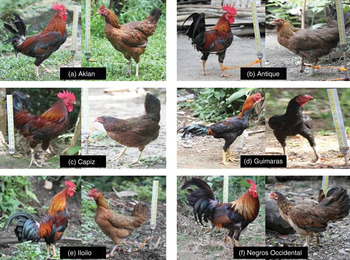
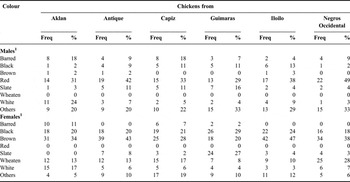
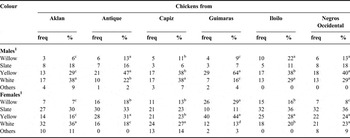
Among the roosters, 37.04 percent of 270 characterized chickens possessed red plumage (Figure 1; Table 1). It ranged from 29 to 49 percent with those from Negros Occidental having the highest and those from Guimaras, the least. About 24 percent of the roosters in Aklan were observed to have white; the same percentages (18 percent) were recorded for barring in Aklan and Capiz; 16 percent had slate in Guimaras and 13 percent had black-coloured plumages in Iloilo. In hens, the findings revealed that 35 percent of the 540 characterized had brown plumage (Figure 1). Hens from Iloilo had appeared to have the highest percentages (47 percent) and those from Guimaras had the least (20 percent) for this colour. Greater percentages of hens from the latter province were prominently having black (29 percent) and slate plumages (27 percent). Those from Negros Occidental were noted to have wheaten plumages. Hens in Aklan had a larger distribution for white (17 percent) and barred (11 percent) plumages. However, statistical analysis revealed that the distribution of occurrences of each plumage colour across provinces were not significantly different (p > 0.05).
Dominant features of traditional chickens from different provinces of Western Visayas, Philippines. Roosters had laced-red plumage and red earlobes, whereas hens had pencilled-brown plumage except for those in Guimaras that had laced-black plumage and red with white earlobes; both had normal feather morphology, feather distribution and skeletal variants; equally had wedge-shaped breast. (a) Chickens from Aklan had single comb, white shank and skin, amber-coloured iris, wedge-shaped body, flat head, whereas roosters had snake-like and hens had flat-shaped head. (b) Chickens from Antique had wedge-shaped body, white skin, and roosters had single comb, amber-coloured iris, yellow shank and snake-like head, whereas hens had pea comb, golden brown-coloured iris, slate shank and flat head. (c) Chickens from Capiz had single comb, white skin and shank, amber-coloured iris, snake-like head; whereas males had blocky-shaped and hens had wedge-shaped body. (d) Chickens from Guimaras had pea comb, yellow skin and shank, amber-coloured iris and snake-like head, whereas roosters had blocky-shaped and hens had wedge-shaped body. (e) Chickens from Iloilo had single comb, white skin, snake-like head and wedge-shaped body, whereas roosters had yellow and hens had slate shank. (f) Chickens from Negros Occidental had white skin, wedge-shaped body; roosters had single comb, amber-coloured iris, yellow shank and snake-like head, whereas hens had pea comb, golden brown-coloured iris, slate shank and flat head.

Distribution as to plumage colour of traditional chickens from different provinces of Western Visayas, Philippines.

1The occurrences of each plumage colour within the row are not different (p > 0.05).
The higher occurrences of red plumage among roosters and brown plumage in hens may be inherited from their progenitor – the red junglefowl and through natural selection. These colours enable them to mimic dry leaves and debris when threatened by dangers. This is the same with the chickens in Guimaras having black and slate plumages which make it easy for them to hide, when threatened, in the grey to black bark of mango trees. The preferences of raisers for other colours further increase diversity in plumage colours.
The findings on the description of dominant plumage colours are similar to the observations of Avante and del Fierro (Reference Avante and del Fierro1991) on Philippine red junglefowl and Banaba chickens of Batangas. Other variants are the same as those described by Lambio, Grecia and Amado. (2000) among other genetic groups of Philippine native chickens. Studies conducted in Maison District of Sonla Province in Northwest Vietnam on the H'mong chickens showed that 70.66 percent had brown, 14.78 percent had black and 14.56 percent had white plumages (Cuc et al., Reference Cuc, Muchadeyi, Baulain, Eding, Weigend and Wollny2006). The trends in brown and black plumage occurrences among these chickens are similar to the present findings. The observed differences in the magnitude of plumage colour occurrences are probably because of limited colour variations among chickens and selection preferences of its raisers.
Plumage colour pattern
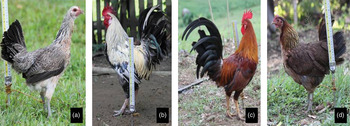
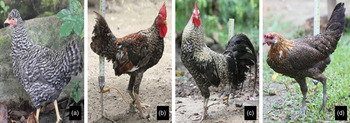
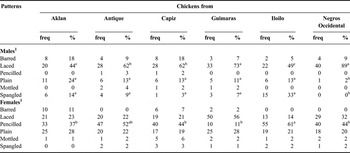
As found, 39.88 percent of the 810 characterized chickens had laced-plumage colour patterns (Table 2; Figures 2b and 2c). This was followed by 28.02 percent of chickens with pencilled (Figures 2a and 2d), 19.63 percent with plain, 5.80 percent with barred (Figure 3), 4.69 percent with spangled, and chickens with the mottled plumage colour were the least. The majority of the roosters had laced-plumage colour pattern. Those from Negros Occidental had the highest (p < 0.05) occurrence, but comparable to those in Guimaras. The same proportion (62 percent) of roosters in Antique and Capiz had this colour pattern. The occurrences of plain and spangled colour pattern were comparable across provinces except for those in Negros Occidental which had the lowest (p < 0.05). The distribution of roosters with barred and mottled plumage colour pattern from the various provinces were not significantly (p > 0.05) different. The occurrences of different plumage colour patterns except for the pencilled among hens in different provinces were not different (p > 0.05). The distribution of pencilled colour patterns ranged from 11 to 61 percent with hens from Iloilo having the highest (p < 0.05) occurrences and those from Guimaras having the lowest.
Plumage colour patterns among the traditional chickens in Western Visayas, Philippines: (a) silver-pencilled hen, (b) silver-laced rooster, (c) red-laced rooster and (d) brown-pencilled hen.

Variants of barred plumage colour pattern among traditional chickens: (a) female with white and black barred, (b) golden barred rooster, (c) silver barred rooster and (d) autosomal barring in pencilled-brown hen.

Distribution of traditional chickens from different provinces of Western Visayas, Philippines as to their plumage colour pattern.

1The occurrences of plumage colour patterns within the row with no common superscript are different (p < 0.05); those with no superscript are not different (p > 0.05).
Diversities in plumage colour patterns can be attributed to feather developmental mechanisms, genes of chickens and raisers selection practices. According to Smyth (Reference Smyth and Crawford1990), the colour patterns were owing to the distribution of eumelanin and the presence or absence of pheomelanin at feather developmental stage. The kind and concentration may vary among cells because of molecular gradients at feather follicles. The position of feather in the body may also affect the expression of colour pattern because of differences in intensity of melanin pigmentation in the skin (Yu et al., Reference Yu, Yue, Wu, Wu, Mayer, Medina, Widelitz, Jiang and Chuong2004). These are also governed by different gene action as added by Smyth (Reference Smyth and Crawford1990). Probably, raisers retained the chickens with attractive colour patterns as their replacement stocks.
The results of this study on the different types of plumage colour patterns are similar to the portrayal of Philippine red junglefowl and other native chicken genetic groups as described by Avante and del Fierro (Reference Avante and del Fierro1991) and Lambio, Grecia and Amado (Reference Lambio, Grecia and Amado2000).
Iris colour
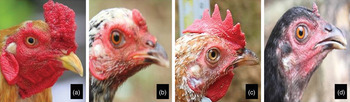
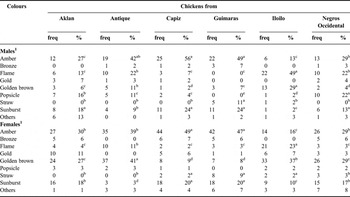
Results showed that 35.19 percent of the 810 characterized chickens had amber-coloured iris (Table 3 and Figure 4a). This was followed by 162 chickens with golden brown (Figure 4b), 120 for sunburst (Figure 4c), 94 for flame (Figure 4d), 35 for popsicle, 32 for gold, 27 for bronze and 21 for straw coloured iris. The light brown, chocolate, light bronze, fog, peach, silver, light gold, rich red, bronze with gold and brown comprised the other colours with less than ten chickens each possessing such colour. Among the roosters, those from Capiz had the highest (p < 0.05) occurrences of amber-coloured iris but comparable to those in Antique and Guimaras. The majority (49 percent) of roosters found in Iloilo had flame-coloured iris. Those in Negros Occidental had the highest (p < 0.05) occurrences of popsicle-coloured iris. The occurrences of amber coloured iris in hens ranged from 16 to 49 percent with those from Capiz having the highest (p < 0.05) and those from Iloilo having the lowest. Hens from Antique had prominently golden brown-coloured iris. Gold-coloured iris was somewhat higher among the hens found in Aklan.
The four iris colours of traditional chickens with larger occurrences: (a) rooster with amber, (b) hens with golden brown, (c) hen with sunburst and (d) hen with flame-coloured iris.

Distribution of traditional chickens from different provinces of Western Visayas, Philippines as to their iris colour.

1The occurrences of iris colour across provinces with no common letter superscript are different (p < 0.05); those without letter superscript are not different (p > 0.05).
The results on diversities of iris colour may be attributed to the interactions of melanin and carotenoids, ingestion and utilization of xanthophylls, and its correlation with other genes expressing colours to other parts of the chicken body. According to Smyth (Reference Smyth and Crawford1990), the iris colour was owing to the presence of melanin and carotenoids, such as the xanthophylls. Interactions during eye development brought changes in eye colour. The diversity in iris colour of hens can be attributed to the presence of carotenoids in ingested feeds and its utilization for egg yolk production. The brighter coloured iris of roosters can be because of excess carotenoids reacting with the melanin. In addition, eye colour was closely correlated with shank colour and can be modified by genes associated with plumage colour.
Similar studies conducted in the provinces of Seam Reap, Rattanakiri, Kampong Cham, Kampot and Odar Meanchey in Cambodia showed that 70.74 percent of the chickens had orange; brown, 10.20 percent; pearl, 15.42 percent and red, 3.48 percent iris colour (FAO, Reference Dinesh, Geerlings, Solkner, Thea, Thieme and Wursinger2009). The findings of Duguma (Reference Duguma2006) in Ethiopia showed that all their chickens had black-coloured eye. The observed differences were probably owing to the absence of standardized characterization guide for traditional chickens. The phenotypic characterization guide drafted by FAO was released only in November 2010 (FAO, 2012).
Earlobe and skin colours
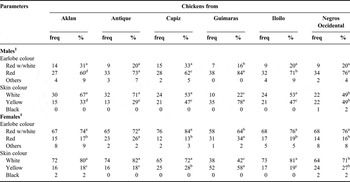
Table 4 exhibits the distribution of traditional chickens from different provinces of Western Visayas, Philippines in terms of earlobe and skin colour.
Distribution of traditional chickens from different provinces of western Visayas, Philippines as to their earlobe and skin colour.

1The occurrences of earlobe and skin colours across provinces are different (p < 0.01); those with no superscript are not different (p > 0.05).
Earlobe colours
As reported, 57.41 percent of the characterized chickens had red with white earlobes. About 37.53 percent had red, 2.22 percent had white and 1.85 percent had turquoise earlobes. The remaining percentages comprised chickens with black, black with red and yellow earlobes. The distribution of roosters with red earlobe ranged from 60 to 84 percent. Those from Guimaras had the highest (p < 0.01) occurrence, but is almost the same with those found in Antique and Negros Occidental. This was followed by those in Iloilo, Capiz and Aklan. The distribution of chickens possessing red with white earlobes was comparable across provinces except for those in Guimaras. Hens from Capiz had the highest (p < 0.01) distribution of red with white earlobes. However, this was almost similar to those observed in Aklan, Antique, Iloilo and Negros Occidental. Hens from Guimaras had the lowest (64 percent) distribution of red with white earlobes, but had the highest (p < 0.01) distribution of chickens with red earlobes.
The variety of earlobe colours can be because of ancestral lineages and mutations. According to Ohta et al. (Reference Ohta, Kajita, Kusuhara and Kakiwaza2000) and Nishida et al. (Reference Nishida, Rerkamnuaychoke, Tung, Saignaleus, Okamoto, Kawamoto, Kimura, Kawabe, Tsunekawa, Otaka and Hayashi2000), there were possibilities of hybridization between the sub-species of Gallus gallus 1000 years ago. For example, bankiva, murghi and gallus which have white earlobes could have crossed with the jabouillei and spadecius, which had red earlobes. Smyth (Reference Smyth and Crawford1990) explained that the white pigment present in the earlobe was made of purine bases and not of melanin or carotenoid. It was inherited as a polygenic trait. The possibility of mutations on genes responsible for the expression of melanin and carotenoids were also considered given the occurrences of other earlobe colours.
In a similar study conducted in Cambodia, 82 percent of traditional chickens had red with white earlobes (FAO, Reference Dinesh, Geerlings, Solkner, Thea, Thieme and Wursinger2009). This was followed by 12.16 percent having red with yellow, 2.82 percent having blue or turquoise, 2.26 percent having white and 0.2 percent having red coloured earlobes. The observation in Ethiopia showed that 67.0 percent had white, 17.9 percent had red with white, 18.6 percent had red and 0.7 percent had black earlobes (Duguma, Reference Duguma2006). The trends of red with white earlobes in Cambodia were similar to that of the present study. The findings on distributions of other earlobe colours were different from those in the cited studies. Probably, these differences were owing to adaptability of chickens with specific earlobe colour to local conditions. This pigmentation in the earlobes serves as thermoregulatory by absorbing or radiating solar radiation away from the body (Stettenheim, Reference Stettenheim2000; Egahi et al., Reference Egahi, Dim, Momoh and Gwasa2010). The occurrences of black and yellow earlobes indicate that this event is not only true in the Philippines but also in countries like Ethiopia and Cambodia.
Skin colour
Results showed that 65.19 percent of the 810 characterized chickens had white skin (Table 4). This was followed by 34.20 percent with yellow skin and the remaining percentages had black skin. The highest (p < 0.01) distribution of white skin was observed among the roosters in Aklan, Antique, Capiz and Iloilo. Those in Guimaras were top (p < 0.01) for having yellow skin. Equal distribution of white and yellow skin was detected in Negros Occidental. About 2 percent of `the roosters in the said province had black skin. The distribution of white skin in hens ranged from 42 to 82 percent with those from Antique having the highest (p < 0.01) and those in Guimaras having the lowest. However, hens in the latter province were notable for having yellow skin. Equal proportion (2 percent) of hens in Aklan and Negros Occidental had black skin.
The diversity in skin colour may be owing to hybridization of parental lineages, mode of inheritance and mutations in genes responsible for colouration. Eriksson et al. (Reference Eriksson, Larson, Gunnarson, Bed'hom, Tixier-Boichard, Stromstedt, Wright, Jungerius, Vereijken, Randi, Jensen and Andersson2008) found out that yellow skin did not originate from red junglefowl (G. gallus) for it had white skin. They pointed out that yellow skin was inherited from the grey junglefowl (Gallus sonneratii) and Ceylon junglefowl (Gallus lafayettii) which hybridized with red junglefowl. This hybridization took place in captivity mediated by man for certain purposes (Collias and Collias, Reference Collias and Collias1967; Morejohn, Reference Morejohn1968; Ohta et al., Reference Ohta, Kajita, Kusuhara and Kakiwaza2000; Nishibori et al., Reference Nishibori, Shimogiri, Hayashi and Yasue2005; Pointer and Mundy, Reference Pointer and Mundy2008; Silva et al., Reference Silva, Guan, Ho-Shing, Jones, Xu, Hui, Notter and Smith2008). The deposition of xanthophylls in the skin was governed by autosomal dominant white (W +) and recessive yellow (w) alleles (Smyth, Reference Smyth and Crawford1990). This may explain the dominant distribution of chicken with white skin in the region. The mechanism in the expression of white skin was because of beta-carotene dioxygenase 2 (BCDO2) enzymes, which prevent the transfer of xanthophylls by converting it into colourless apocarotenoids in skin but not in other tissues (Eriksson et al., Reference Eriksson, Larson, Gunnarson, Bed'hom, Tixier-Boichard, Stromstedt, Wright, Jungerius, Vereijken, Randi, Jensen and Andersson2008). Smyth (Reference Smyth and Crawford1990) added that the white and yellow skin phenotypes can be accurately determined when chickens reached the age of 12-weeks-old and beyond. This was because of the delayed deposition of xanthophylls in the skin after hatching. Moreover, molecular studies showed that the skin colouration was because of mutations in tyrosinase (TRY) genes. According to Chang et al. (Reference Chang, Coville, Coquerelle, Gourichon, Oulmouden and Tixier-Boichard2006), mutation in intron 4 of TRY gene was the cause of recessive white mutation in chickens. Zhang et al. (Reference Zhang, Chen, Sun, Liu, Ojang-Ba and Gu2009) added that exon-1 and 5′ flanking region of TYR gene can be responsible for the different flesh colours among chickens.
In a similar study conducted in Sonla province of Northwest Vietnam and Ethiopia, the proportions of skin colours were different from the present observations. It showed that 94.71 percent of the local chickens in Vietnam had yellow skin, whereas 5.29 percent had black skin (Cuc et al., Reference Cuc, Muchadeyi, Baulain, Eding, Weigend and Wollny2006). The trending for yellow skin was similar to those recorded in Ethiopia. Dana et al. (Reference Dana, Dessie, van der Waaij and van Arendonk2010b) reported that 52 percent of the indigenous chickens had yellow skin and 48 percent had white skin. The observed differences in the distribution of occurrences is probably because of the fitness of chicken with yellow skin in the place; proximity of these places to areas where the G. sonneratii (India) and G. lafayettii (Sri Lanka) were believed to have originated (Eriksson et al., Reference Eriksson, Larson, Gunnarson, Bed'hom, Tixier-Boichard, Stromstedt, Wright, Jungerius, Vereijken, Randi, Jensen and Andersson2008), and abundance of naturally occurring feedstuffs rich in carotenoids (Smyth, Reference Smyth and Crawford1990).
Shank colour
Table 5 presents the distribution of traditional chicken from different provinces of Western Visayas, Philippines as to shank colour. Out of 810 characterized chickens, 265 had yellow shank. This was followed by 200 with white, 186 with slate, 116 with willow, and the remaining had black, black with yellow, yellow with red and dark orange-coloured shank. The roosters in Guimaras had the highest (p < 0.05) proportion of yellow shank, but comparable to those in Antique and Negros Occidental. Those in Aklan had the highest proportion of white-coloured shank. The same percentage (38 percent) of roosters in Capiz had yellow and white shank. About 22 percent of roosters in Iloilo possessed a willow-coloured shank. Occurrences of slate shanks in hens were comparable across provinces. The highest (p < 0.05) percentages of those with yellow and willow shank were observed in Guimaras. Hens from Aklan were prominent for having white-coloured shanks.
Distribution of traditional chickens from different provinces of Western Visayas, Philippines as to their shank colour.

1The occurrences of earlobe and skin colours across provinces are different (p < 0.05); those with no superscript are not different (p > 0.05).
The diversity in shank colour can be owing to interactions of major and modifier genes as pointed out by Smyth (Reference Smyth and Crawford1990). This was controlled by dermal melanin (id +) inhibition of dermal melanin (Id), black extension factor (E) and autosomal white (W +) genes located in the Z chromosome. Id and id + expression were confined in the dermis, whereas E and W + in the epidermis. He added that homozygosity to E in chickens will express black shank. The interactions of id + and E with dominant white (I) chickens will express slate or willow shank. The presence of sex-linked barring, mottling and wheaten genes will inhibit the expression of id +. Barring makes the pigmentation of shank lighter in rooster than hen, whereas mottling expressed small black spots in white shank. The presence of W + interacting with melanin will appear as blue or slate shank and the w for green or willow. Yellow shank was because of the interaction of homozygous recessive for w and e + with homozygous Id, whereas white shank was brought about by the accumulated effects of W +/W +Id/Id e +/e +. According to Onibi, Folorunso and Elumelu (Reference Onibi, Folorunso and Elumelu2008), the addition of carotene-rich feedstuffs to chicken ration further enhanced yellow pigmentation of the shank.
The trend in occurrences of shank colour was closer to the findings of similar studies conducted in Cambodia where 48.64 percent had yellow, 17.82 percent had grey-blue, 13.44 percent had white, 11.22 percent had green and 8.70 percent had black-coloured shank of their traditional chicken (FAO, Reference Dinesh, Geerlings, Solkner, Thea, Thieme and Wursinger2009). Yellow-coloured shank also had the highest distribution in Dekina, Nigeria. Daikwo, Okpe and Ocheja (Reference Daikwo, Okpe and Ocheja2011) reported that 40.50 percent of the local chickens in this place had yellow shank. This was followed by 37.25 percent having black with yellow, 13.75 percent having black and 8.50 percent having white-coloured shank. Unlike in Vietnam, it was reported that 95.59 percent of H'mong chickens had black and 4.41 percent had yellow shank (Cuc et al., Reference Cuc, Muchadeyi, Baulain, Eding, Weigend and Wollny2006). The observed differences in the distribution of yellow-coloured shank in the present study and those in Cambodia and Dekina, Nigeria with the H'mong chickens of Vietnam, is possibly because of genes and selection practices of raisers. According to Cuc et al. (Reference Cuc, Muchadeyi, Baulain, Eding, Weigend and Wollny2006), these local chickens were noted for having yellow skin and black meat and shank. Raisers deliberately select these characteristics because of their medicinal attribute. Those raisers in other mentioned countries focused more on the economic performance of traditional chickens and less regard on the colouration and pigmentation.
Head and body shapes
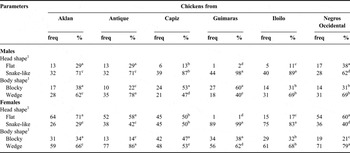
Table 6 highlights the distribution of traditional chickens from different provinces of Western Visayas, Philippines as to their head, breast and body shapes.
Distribution of traditional chickens from different provinces of Western Visayas, Philippines as to their head and body shapes.

1The occurrences of head and body shapes with no common superscript are different (p < 0.05); those with no superscript are not different (p > 0.05).
Head shape
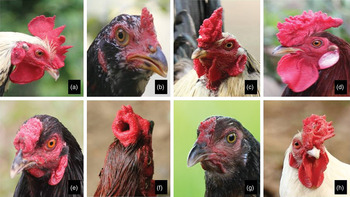
Results show that 64.69 percent of the traditional chickens had snake-like heads, whereas 35.31 percent had flat-shape heads. Figure 5 shows the variations in head shapes of traditional chickens. The data further show that roosters from Guimaras had the highest proportion of snake-like head but comparable to those in Iloilo. This was followed by 87 percent in Capiz and same percentages (71 percent) in Aklan and Antique. The roosters in Negros Occidental had the highest percentage (38 percent) for flat head. Hens from Aklan, Antique and Negros had the highest (p < 0.05) percentages for flat head, whereas those in Guimaras and Iloilo had the highest for snake-like head. Those in Capiz had an equal distribution of flat and snake-like head. Variations in head shape were probably because of genes and their possible pleiotropic effects on the growth rate. It was observed that chicken with snake-like head were heavier than those with flat head. Only limited published information dealing with head shape are available and further studies should be conducted to verify its correlation with live weight.
The variations of head shape of traditional chickens: (a) single comb rooster with flat head, (b) single comb rooster with snake-like head, (c) single comb hen with flat head, (d) single comb hen with snake-like head, (e) pea comb rooster with snake-like head, (f) pea comb hen with snake-like head, (g) pea comb hen with flat head and (h) pea comb rooster with flat head.

In similar studies conducted in Amhara, Benshangul Gumuz, Oromia and southern regions of Ethiopia, 46 percent had flat, 34 percent had crest and 20 percent had snake-like head (Dana et al., Reference Dana, Dessie, van der Waaij and van Arendonk2010b). The observed differences in distribution may be because of the classification of different head shapes. It was suggested by the FAO (2012) that head shapes should be either snake-like or flat shapes. Crested head was classified under the category of feather distribution which was adapted in the present study. The study of Dana et al. (Reference Dana, Dessie, van der Waaij and van Arendonk2010b) was conducted before the release of draft guidelines.
Body shape
The findings reveal that 66 percent of the 810 characterized chickens had wedge-shaped bodies, whereas the remaining percentage had blocky bodies (Table 6). The highest (p < 0.05) distribution of roosters with wedge-shaped body was observed in Antique. This was followed by same percentage (69 percent) in Iloilo and Negros Occidental. Those in Guimaras had the highest distribution for blocky-shaped body but comparable to those in Capiz and Aklan. Hens from Antique and Negros Occidental had the highest (p < 0.05) proportion of wedge-shaped body. This was followed by 68 percent in Iloilo, 66 percent in Aklan, 62 percent in Guimaras and 53 percent in Capiz. Those in Capiz were prominent for hens having blocky body but comparable to those in Aklan and Guimaras.
Somes (Reference Somes and Crawford1990a) reported that the variation in body conformation was because of the accumulated expression of body size genes, specific body part genes and genes responsible for the development of muscular tissues. He added that the wedge-shaped body was brought about by natural selection considering that raisers did not put emphasis on their selection. This shape reduces air friction when the bird is flying. Scarce information related to this phenotypic trait was observed.
The results of this study were different from the observations of Dana et al. (Reference Dana, Dessie, van der Waaij and van Arendonk2010a) among the indigenous chickens in Ethiopia. They reported that 87 percent of their chickens had blocky, 9 percent had triangular and 4 percent had wedge-shaped body. These differences may be attributed to multigenes interactions, environmental conditions, available resources and management practices of raisers in each country.
Comb type and live weight
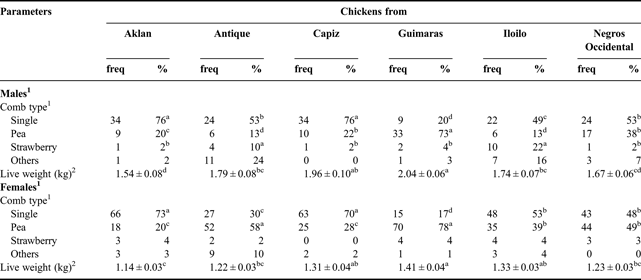
Table 7 shows the distribution of traditional chickens from different provinces of Western Visayas, Philippines as to comb type and live weight.
Distribution of traditional chickens from different provinces of Western Visayas, Philippines as to comb type and live weight.
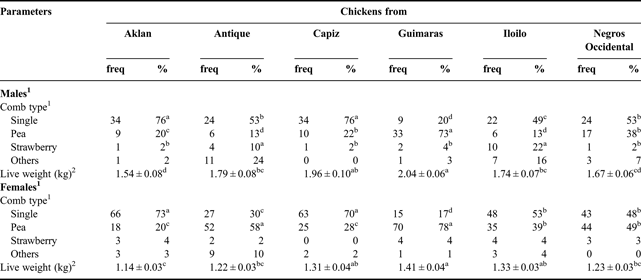
1The occurrences of comb type across provinces are different (p < 0.05); those with no superscript are not different (p > 0.05).
2The differences in live weight across provinces with no common superscript are different (p < 0.01).
Comb type
Slightly more than half (50.49 percent) of the characterized chickens had single comb (Figure 6a). This was followed by 40.12 percent with pea comb (Figures 6b and 6c). The remaining percentages had rose (Figure. 6d), strawberry (Figure 6e and 6f), walnut (Figure 6g) and buttercup comb (Figure 6h). Roosters in Aklan and Capiz had the highest (p < 0.05) distribution of single comb. This was followed by same percentage (53 percent) of those found in Antique and Negros Occidental. Highest (p < 0.05) distribution of roosters with pea comb was in Guimaras. Those in Iloilo were prominent for occurrences of strawberry comb. Highest (p < 0.05) frequencies of hens with single comb was observed in Aklan and Capiz, whereas those in Guimaras and Antique top the distribution for pea comb. Hens found in Iloilo and Negros Occidental were intermediate for the occurrences of single and pea comb.
The variations of comb types among traditional chickens: (a) rooster with single comb, (b) hen with smaller pea comb, (c) rooster with larger pea comb, (d) rooster with rose comb, (e) rooster with strawberry comb, (f) rooster with inverted strawberry comb, (g) hen with walnut comb and (h) rooster with buttercup comb.

The dissimilarity in the occurrences of comb types may be attributed to interactions of different genes responsible for its expression. Somes (Reference Somes and Crawford1990b) pointed out that single comb (p +) was inherited by domesticated chickens from the G. gallus, G. sonnerati and Gallus lafayettei. Number of points in the comb was owing to the presence of genes for rugged rose comb (He +). According to Duguma (Reference Duguma2006) single comb was dominant among traditional chickens in tropical regions for it helps reduce 40 percent of body heat. These clarify as reason for its dominant occurrence in the region. On the other hand, the crosses between pea and rose comb chickens produce offsprings possessing walnut and strawberry combs. Chicken with buttercup comb had wider nostril and was found to be incompletely dominant (Somes, Reference Somes and Crawford1990b; Wright et al., Reference Wright, Boije, Meadows, Bed'hom, Gourichon, Vieaud, Tixier-Boichard, Imsland, Hallbook and Andersson2009; Dorshorst, Okimoto and Ashwell, Reference Dorshorst, Okimoto and Ashwell2010). Other related information about walnut and buttercup comb is limited.
The results on the trends of distribution of single comb were quite similar to the findings of Egahi et al. (Reference Egahi, Dim, Momoh and Gwasa2010) in Markudi, Nigeria but different from those reported by Dana et al. (Reference Dana, Dessie, van der Waaij and van Arendonk2010b) in Ethiopia. Previous researchers reported that 43.33 percent had single, 23.33 had pea, 15.56 percent had walnut and 17.78 percent had rose comb, whereas the latter claimed 53 percent had pea, 16 percent had rose, 13 percent had single, 13 percent had duplex and 6 percent had walnut. The observed differences may be because of the prevailing conditions in the place and the frequency of genes carrying such comb expression as elaborated above (Somes, Reference Somes and Crawford1990b; Duguma, Reference Duguma2006).
Live weight
Roosters from Gumaras have the highest (p < 0.01) mean live weight of 2.04 ± 0.06 kg but not significantly different (p > 0.05) from those in Capiz (Table 7). Those in Aklan weighing 1.54 ± 0.08 kg were the lightest. The mean live weights of rooster from Antique (1.79 ± 0.08 kg), Iloilo (1.74 ± 0.07 kg) and Negros Occidental (1.67 ± 0.06 kg) were comparable. Results also show that the mean live weight of hens from Guimaras (1.41 ± 0.04 kg) was the highest (p < 0.01); however, it is close in comparison with those in Capiz (1.31 ± 0.04 kg) and Iloilo (1.33 ± 0.03 kg). The lowest mean live weight of 1.14 ± 0.03 kg was observed among the hens in Aklan. Those in Antique (1.22 ± 0.03 kg) and Negros Occidental (1.23 ± 0.03 kg) were of comparable weight.
The dimorphism in chicken started at egg cells before fertilization given the heterozygosity (ZW) of hens as governed by different genes and hormones (Johnson, Reference Johnson1988; Henry and Burke, Reference Henry and Burke1998; Bannister et al., Reference Bannister, Tizard, Doran, Sinclair and Smith2009; Smith et al., Reference Smith, Roeszler, Ohnesorg, Cummins, Farlie, Doran and Sinclair2009; Zhao et al., Reference Zhao, McBride, McQueen, McGrew, Hocking, Lewis, Sang and Clinton2010; Parchami and Dehkordi, Reference Parchami and Dehkordi2011). Remes and Szekely (Reference Remes and Szekely2010) pointed out that the domestic roosters were 21.50 ± 0.55 percent heavier than hens. Consequently, the overall phenotypic expression follows the Rensch's rule that states males are larger than female in larger species and females are larger than males in smaller species (Colwell, Reference Colwell2000).
In addition, the bigger size of traditional chicken in Guimaras is probably because of genes. According to Erlinda Azuela (personal communication, 2011), these bigger and barbarous looking chickens were brought by Muslim sailors from Jolo a long time ago. They were used for cockfights or locally known as “pauwak” with native cocks raised by people in the place. The proliferation of “pauwak” enabled their ancestors to acquire more of these chickens for such activity. Through time, these traditional chickens from Jolo evolved and became adapted to the environment in Guimaras. The smaller size of traditional chicken in Aklan may be owing to the presence of predators in its wide forested area. The smaller body size allows them to be more flighty when in danger.
The live weight of roosters was comparable to those of other genetic groups of native chicken in the country. Avante and del Fierro (Reference Avante and del Fierro1991) reported that Paraokan weighed 2.0–2.5 kg, and the Banaba, Camarines and Bolinao had 1.5–2.0 kg live weight. The weight of hens ranged from 1.4 to 1.6 kg that was slightly higher than those in Western Visayas. Observed differences were probably owing to the expression of genes associated with body weight.
Conclusions
Results show that traditional chicken from Guimaras had amber iris, yellow skin and shank, snake-like head, pea-comb and heaviest. Those from Antique had wedge-shaped body, whereas those from Aklan had the lightest live weight and possessing single-comb. Thus, the traditional chicken from the different provinces except for Iloilo, Capiz and Negros Occidental of western Visayas was morphologically distinct.
Supplementary material
Supplementary online material is available at http://cambridge.journals.org/AGR.
Acknowledgments
The authors express their deepest gratitude to the Department of Science and Technology – Philippine Council for Agriculture, Forestry and Natural Resources Research and Development (DOST-PCARRD), Central Philippine University (CPU) and Commission on Higher Education (CHED) for the financial support in conducting this study. The support of Magsasaka at Siyentipiko para sa Pag-unlad ng Agrikultura (MASIPAG) and those of local government officials of the different sampling sites in Western Visayas, Philippines during the field visit and data collection are likewise acknowledged.
Statement of interest
The authors hereby declare that there is no conflict of interest involved in this study.