Vallacher and Wegner (Reference Vallacher and Wegner1987) noted that the immediate precursor to action is a mental representation of what one is doing. Assuming that the determinants of the identification level of a behavior are personal and situational (Trope & Liberman, Reference Trope and Liberman2003, Reference Trope and Liberman2010; Vallacher & Wegner, Reference Vallacher and Wegner1987, Reference Vallacher and Wegner1989), we focus on how the personality traits at the construal level, cross-situational consistency in self-concept and self-control relate to each other and are useful for predicting future behaviors. Because each concept involves different nuances, the understanding of their relationships can have important theoretical and practical implications.
The construal level theory (CLT) and the action identification theory (AIT) offer a coherent frame to explain and predict behaviors. Both theories link mental representation to decisions and behaviors: People can represent the same action at different levels of abstraction. In CLT, Trope and Liberman (2003) noted that, although some individuals generally represent behaviors by focusing on their final goals (i.e., using an abstract way of thinking), others tend to represent behaviors by employing the means to achieve these goals (i.e., using a concrete way of thinking). These types of representations differ in their motivational consequences. In the action identification theory Vallacher and Wegner (1987) noted that the different styles of representing an action determine whether a person will act consistently with their values and personal identities or whether they will instead attend more to the context in deciding what behavior to undertake.
The differences between AIT and CLT are subtle. AIT states that an action’s feasibility is the main determinant of concrete representations, whereas desirability is the key element of abstract representations. CLT emphasizes that the fundamental factor determining the construal level is psychological distance. Whereas AIT focuses on how actions are mentally represented, CLT extends its interest to objects, situations, and events beyond actions (see Fujita, 2008).
Research on mental representation has obtained successful results in applied psychology. For instance, depressive rumination can be reduced by inducing a concrete mindset (Watkins, Moberly, & Moulds, Reference Watkins, Moberly and Moulds2008), and people are more sensitive to persuasive messages when the ad matches the recipient´s construal level (Fujita, Eyal, Chaiken, Trope, & Liberman, Reference Fujita2008; Spassova & Lee, Reference Spassova and Lee2013; White, MacDonnell, & Dahl, Reference White, MacDonnell and Dahl2011). In our proposal, the role played by the construal level is particularly significant in influencing predictions related to behaviors. CLT has shown that, when people use an abstract mindset, they form judgments and behavioral intentions focusing more on their personal values (Eyal, Sagristano, Trope, Liberman, & Chaiken, Reference Eyal, Sagristano, Trope, Liberman and Chaiken2009), general attitudes (Carrera, Muñoz, Caballero, Fernández, & Albarracín, Reference Carrera, Muñoz, Caballero, Fernández and Albarracín2012), affective attitudes (Carrera, Caballero, Muñoz, González-Iraizoz, & Fernández, Reference Carrera, Caballero, Muñoz, González-Iraizoz and Fernández2014), and desired attitudes (Carrera, Caballero, Fernández, & Muñoz, Reference Carrera, Caballero, Fernández and Muñoz2017).
The possibility of measuring the personal tendency to identify or to mentally represent an action in a more abstract or a more concrete way was formalized in the Behavioral Identification Form (BIF), a scale developed by Vallacher and Wegner (Reference Vallacher and Wegner1989). This scale evaluates the personal disposition to represent actions (i.e., personal agency) through the preference to define behaviors based on motivations and final goals (high abstraction level) versus focusing on the means and contexts in which the actions occur (low abstraction level). This dispositional measurement has also been employed as a criterion to validate primes that manipulate the construal level (see Liberman & Trope, Reference Liberman and Trope1998). The BIF is widely accepted as the best procedure to measure chronic individual differences in the tendency to construe events at a high versus low level; previous research showed a clear convergence in findings between studies that manipulate versus measure a participant’s level of construal (see Freitas, Salovey, & Liberman, Reference Freitas, Salovey and Liberman2001; Fujita, Reference Fujita2008; Magen & Gross, Reference Magen and Gross2007).
Abstraction and Self-Concept (Cross-Situational Consistency)
Vallacher and Wegner (Reference Vallacher and Wegner1987, p. 8) noted that high-level identification (abstract) lends itself to action stability because it effectively shields the person against the emergence of alternatives and obstacles. Abstract identity allows people to maintain their course of action in the face of changing conditions, thereby allowing cross-situational consistency: A person who identifies his/her action of “cycling” at high level as “getting exercise”; when an obstacle (e.g., mechanical problem in the bike) modifies the situation, he/she can change the activity to “jogging” while, phenomenologically, he/she is doing the same thing.
In the frame of AIT, Wegner, Vallacher, Kiersted, and Dizadji (1986) found that false feedback on personality traits (e.g., cooperativeness versus competitiveness) had less influence on predictions when an individual described past behaviors and focused on their abstract characteristics (e.g., expressing opinions, communicating values, showing personality traits) than in a task where actions were described focusing on specific details (e.g., particular commentaries, gestures, questions asked). Cross-situational consistency was activated when people described their actions with a high level of abstraction, making external information less influential.
According to CLT, a behavior’s feasibility and its contextual constraints are more relevant in representing an action or an object when people are in a concrete mindset, while attending to global concerns (desirability) leads people to maintain actions in the pursuit of goals across situations, thus demonstrating cross-situational consistency (see Liberman & Trope, Reference Liberman and Trope1998). Both theories, AIT and CLT, support cross-situational consistency as one of the main characteristics associated with high-level construals and the abstract way of thinking.
Cross-situational consistency is one of the main dimensions used to explain the complex relationship between self-concept and social context (see Fernández et al., Reference Fernández, Carrera, Páez, Alonso-Arbiol, Campos and Basabe2014; Fernández, Carrera, Páez, & Sánchez, Reference Fernández, Carrera, Páez and Sánchez2008; Fernández, Páez, & González, Reference Fernández, Páez and González2005; Hofstede, Reference Hofstede2001; Markus & Kitayama, Reference Markus and Kitayama2010). Recent research on a multidimensional definition of self-concept includes cross-situational consistency as one of the main components of the self (see Cross, Hardin, & Gercek-Swing, Reference Cross, Hardin and Gercek-Swing2011; Owe et al., Reference Owe, Vignoles, Becker, Brown, Smith, Lee and Jalal2014; Vignoles et al., Reference Vignoles, Owe, Becker, Smith, Easterbrook, Brown and Bond2016). Vignoles and collaborators extended the theory of independent and interdependent self-construals proposed by Markus and Kitayama (Reference Markus and Kitayama1991) to a 7-dimensional model of self-reported ways of being independent or interdependent. These seven dimensions include consistency (in contrast to variability) across situations, a dimension that shares several traits with abstraction and self-control.
Cross-situational consistency specifies a preference for pursuing final goals versus attending to contextual constraints. Vallacher and Wegner (1987) noted that individuals with high-level identification maintain a course of action in the face of changing conditions and with the passage of time (see Vallacher and Wegner, Reference Vallacher and Wegner1987, p. 8). In the framework of CLT, Nussbaum, Trope and Liberman (Reference Trope and Liberman2003) showed that when participants were in an abstract mindset, they perceived greater cross-situational consistency in others’ behavior, increasing the correspondence bias found by Jones and Davis (Reference Jones, Davis and Berkowitz1965).
In this vein, extensive cross-cultural research has shown that individuals from cultures with a predominance of an independent self-concept focus less on context to explain and predict others’ behaviors (van Boven, Kamada, & Gilovich, Reference van Boven, Kamada and Gilovich1999). More recently, when studying persuasion, Spassova and Lee (Reference Spassova and Lee2013) found that individuals with a more independent self-concept (in contrast to an interdependent self-concept) tended to represent future events in more abstract and decontextualized terms and made more favorable evaluations when an advertising message was framed in the distant temporal future (i.e., an abstract mindset).
Abstraction and Self-Control
Fujita and collaborators noted that more abstract, high-level construals promoted successful self-control (Fujita, Reference Fujita2008; Fujita & Carnevale, 2012; Fujita et al., Reference Fujita, Eyal, Chaiken, Trope and Liberman2008). Freitas et al. (Reference Freitas, Salovey and Liberman2001) used the BIF to show that individuals with abstract construal (in contrast to concrete) preferred to receive negative but relevant diagnostic information rather than positive but non-relevant information. When people construe events at a high versus low level, they make decisions based on their global concerns more than on local rewards. Across 6 experiments, Fujita, K., Trope, Y., Liberman, N., and Levin-Sagi, M. (Reference Fujita, Trope, Liberman and Levin-Sagi2006) showed that participants with an abstract mindset showed less preference for immediate over delayed outcomes. They found that people who had been induced to acquire an abstract style of thinking reported stronger intentions to participate in psychological studies that offered high-level benefits with low-level costs, evaluated temptations less positively and had more negative evaluations of indulging in temptations. Fujita and Han (Reference Fujita and Han2009) asked their female participants to choose between eating an apple or a candy bar. Participants in the abstract condition, relative to those in the concrete condition, were 50% more likely to prefer the apple, suggesting heightened self-control. All of these results show that those at a high level of construal exerted more self-control and acted in accordance with higher-level considerations.
Extensive previous research supports that abstraction leads to an increased ability to resist temptations (see for a review Fujita & Carnevale, Reference Fujita and Carnevale2012). We expect that these results will be supported by dispositional measures of self-control, as indicated by the scale proposed by Tangney et al. (Reference Tangney, Baumeister and Boone2004). People with higher scores on the self-control scale showed fewer impulse control problems, such as binge eating and alcohol abuse – decisions that involve choosing the healthier option for the sake of long-term benefits instead of giving in to short-term temptation (Fujita, Reference Fujita2008).
Overview of the Studies
Among individual differences, Study 1 tested the assumption that a higher construal level is associated with greater cross-situational consistency. Study 2 extended this relationship to self-control. Practical implications were tested in Study 2 to predict participants´ intentions for sugar consumption. Because abstraction, cross-situational consistency and self-control are evaluated as personal dispositions, we did not propose a specific pattern of causal relationships between them.
Study 1. Construal Level and Cross-Situational Consistency
We hypothesized that a more abstract way of thinking would be related to situational consistency, whereas a more concrete way of thinking would be related to cross-situational variability. Both psychological constructs were evaluated with dispositional measures.
Method
Participants
A sample of volunteers studying psychology at Universidad Nacional de Educación a Distancia (UNED, Spain) participated in this study in exchange for course credit (73 males and 177 females, M age = 34.42, SD = 11.23). To assess a general population, they were asked to collect data from two adults (one woman and one man). Thus, the final sample was composed of 725 participants (44.6% males and 55.4% females). The participants’ ages ranged from 18 to 60 years (M = 35.28; SD = 10.81). For control analyses, age was categorized in deciles. The level of education was distributed as follows: primary educational level (9.4%), middle-high school (46.8%), undergraduate (15.5%), graduate (21.3%), masters’ (6.1%), and doctorate (1%). Employment status was distributed as follows: 41.7% workers, 13.6% students, 27.4% combined studies and work, 14.9% unemployed, and 2.6% retired.
Procedure
All questions were answered through the Qualtrics platform. The questionnaire contained several scales (see the Instruments and variables section).
Instruments and variables
The scales measured dispositional tendencies and were presented in the following order:
Consistency versus variability. This scale was measured using the consistency subscale included in the new scale of independent-interdependent self-concept proposed by Vignoles et al. (2016). This dimension of self-concept consists of three positive items (“I behave the same way even when I am with different groups of people”, “I always see myself in the same way even when I am with different people”, and “I behave the same way at home and in public”) and three negative items (“I act very differently at home compared to how I act in public”, “I see myself differently in different social environments”, and “I behave differently when I am with different groups of people”)Footnote 1. The negative elements were recoded so that a greater score indicated greater consistency in a 6-point scale. The reliability of this subscale was satisfactory (α = .86).
Construal level. Way of thinking was evaluated with the BIF designed by Vallacher and Wegner (1989). According to AIT, any action can be represented in a high-level, abstract style focusing on why a person performs the behavior or in low-level, concrete style focusing on how a person performs the behavior. The BIF is a 25-item dichotomous response survey offering a series of actions (e.g., eating) and two alternative descriptions of each action (abstract vs. concrete). Participants were asked to choose the description that best defined each action.
We created a construal level index (α = .85) by summing each participant’s response, assigning 0 when the response was concrete and 1 when it was abstract. A higher BIF score (i.e., scores ranging from 0 to 25) represents a greater tendency to identify actions at a more abstract level, which is indicative of an abstract way of thinking.
Social-demographic data. After the previous scales, we asked about sex, age, level of education, and employment status.
Results
As a control check, we conducted analyses of variance (ANOVAs) on construal level (BIF scores) and consistency scores using sex, age, educational level, and employment status as factors. The results showed that there were no significant differences in sex F(1, 722)consistency = 1.78; F(1, 722)construal level = 1.22; age F(9, 715)consistency = 0.85; F(9, 715)construal level = 1.51; level of education F(5, 718)consistency = 1.74; F(5, 718)construal level = 1.01; or employment status F(4, 719)consistency = 1.71; F(4, 719)construal level = 2.51; (all Fs, ns; ps > .14). Given that the BIF scale varied from 0 to 25 (higher scores meaning higher abstraction), the participants showed a high level of abstraction (M = 17.53, SD = 4.86). Additionally, given that consistency was measured by using items in a 6-point scale, we can conclude that the participants presented a medium level of cross-situational consistency (M = 3.56; SD = 0.81).
The Pearson correlation showed a positive and significant relationship between abstraction and cross-situational consistency, r(723) = .12; p < .002. This finding corresponds to higher abstraction and higher cross-situational consistency.
To expand on these results, we submitted consistency scores to a one-factorial ANOVA using the BIF classification in both the abstract and concrete styles. First, we classified participants into two groups based on a median split of their BIF scores (Md = 18). Both groups presented significant differences in the construal level (M concrete = 13.99; SD = 3.52 and M abstract = 21.82; SD = 1.92), F(1, 723) = 1298.62; p < .001, ηp2 = .64.
As predicted, participants who had been categorized as presenting an abstract style demonstrated a higher level of cross-situational consistency (M abstract = 3.67; SD = 0.81) than participants categorized with a concrete style (M concrete = 3.46; SD = 0.80), F(1, 723) = 12.27; p < .001, ηp2 = .17.
Study 2. Construal Level, Cross-Situational Consistency, and Self-Control
Previous research has revealed relationships between self-concept and self-control (Weisz, Rothbaum, & Blackburn, Reference Weisz, Rothbaum and Blackburn1984), between self-concept and abstraction (Smith & Trope, Reference Smith and Trope2006; Spassova & Lee, Reference Spassova and Lee2013), and between self-control and abstraction (Fujita, Reference Fujita, Eyal, Chaiken, Trope and Liberman2008; Fujita & Carnevale, Reference Fujita and Carnevale2012; Fujita et al., Reference Fujita, Eyal, Chaiken, Trope and Liberman2008). Study 2 examined the relationships between the dispositional measures of construal level (BIF), cross-situational consistency (the subscale in the self-concept scale proposed by Vignoles et al., Reference Vignoles, Owe, Becker, Smith, Easterbrook, Brown and Bond2016), and self-control. Dispositional self-control was measured using the brief scale designed by Tangney and colleagues (Reference Tangney, Baumeister and Boone2004), and later validated and refined by Maloney, Grawitch, and Barber (Reference Maloney, Grawitch and Barber2012). This reduced version of the self-control scale identifies two main factors: Restraint and impulsivity.
To examine the influence of the proposed relationships between the three psychological concepts (i.e., abstraction, consistency and self-control) on a particular behavior, we asked participants about their plans to control future sugar intake (i.e., a health-related behavior. Positive correlations are expected between the three personal dispositions and between these dispositions and the intention to control sugar consumption in the future. We do not have any hypotheses about one specific sequential model between the three dispositional traits measured; all the constructs are personal dispositions; therefore, any one of the constructs is a prevailing dimension over the others.
Method
Participants and Procedure
All the participants were undergraduate volunteers who were studying psychology at UNED (Spanish speakers); they participated in exchange for course credits (N = 244; 40.2% males and 59.8% females). The participants’ ages ranged from 18 to 65 years (M = 33.92; SD = 10.76). The scales and questions were presented using the Qualtrics platform, as in Study 1.
Instruments and variables
The dispositional scales and questions were presented in the following order:
Consistency versus variability. As in Study 1, consistency was measured with the subscale of cross-situational consistency included in the self-concept scale designed by Vignoles and collaborators (2016). The reliability of this subscale was acceptable (α = .84).
Construal level. The personal level of abstraction was obtained from the reduced version of the BIF scale (Vallacher & Wegner, 1989), which included 14 items (α = .81; scores ranging from 0 to 14).
Self-control. Dispositional self-control was measured using a multi-factor version of the Brief Self-Control scale originally developed by Tangney, Baumeister and Boone (2004) and later refined by Maloney, Grawitch and Barber (Reference Maloney, Grawitch and Barber2012). This shorter version reduces the number of items from 13 to 8 for measuring impulsivity (e.g., “I say inappropriate things”) and restraint (e.g., “People would say that I have iron self-discipline”). Items must be rated on a 5-point scale ranging from 1 “not at all like me” to 5 “very much like me”. Impulsivity includes four items (α = .70) related to acting on spontaneous thoughts and feelings (M = 3.77; SD = 0.69). Restraint includes four items (α = .66) that measure self-discipline and resistance to temptation (M = 2.86; SD = 0.66). To calculate self-control scores, we recoded reversed items so that greater scores on the self-control scale (and in each component) indicated greater self-control.
Behavioral intentions to control sugar intake (future behavior). The last few questions on sugar consumption were presented as an independent study to collect data about health-risk behaviors in the Spanish population. We asked about participants’ future intention to control sugar consumption with two items: "To what extent do you have the intention/disposition to control sugar consumption in the future?" on a 7-point scale ranging from 1 (“not at all”) to 7 (“very much”). The behavioral intention to control future sugar consumption was calculated by averaging these two items, intention and disposition (α = .76). As a control check, we evaluated past sugar intake behavior: From 1 (much less than 25 g per day) to 4 (much more than 100 g per day). Participants were offered several examples to illustrate how much sugar some daily products contained (e.g., can of Coke 39 g; one tablespoon of Ketchup 4 g; a glass of frozen yogurt 24 g; a donut 48 g).
Results
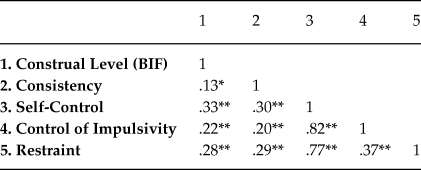
The correlation matrix showed that there were associations between the abstraction level, cross-situational consistency, and self-control. All the variables were positively and significantly related (see Table 1). These results show that the abstract construal level was clearly related to the self-concept characterized by cross-situational consistency and to high self-control. Impulsivity and restraint, as self-control dimensions, were also associated with abstractness and consistency. Given the shorter BIF version of 14 items, the participants showed a high level of abstraction (M = 10.76, SD = 2.51). Because self-control and consistency were measured by using a 5-point and 6-point scale, respectively, we can conclude that the participants showed a moderate-high level of self-control (M self-control = 3.37, SD = 0.54; M impulsivity = 3.77, SD = 0.69 and M restraint = 2.86, SD = 0.67) and a moderate cross-situational consistency (M = 3.66, SD = 0.81).
Pearson Correlations between Construal Level, Cross-Situational Consistency and Self-Control (Impulsivity [Reversed] and Restraint)

Note: N = 244.
* p < .05. ** p < .01.
To deepen the relationships between the three personal dispositions examined, we conducted a set of regression analyses in which dispositions were used as criteria or predictors to evaluate the role played by each of them to predict the others.
To determine which personal disposition better predicts the construal level, the BIF scores were regressed onto cross-situational consistency and self-control. According to this model F(2, 241) = 14.98; p < .001, both variables explained 10% of construal level (R 2c = .10), with self-control being significant, b = .32, t(241) = 5.01; p < .001. Cross-situational consistency was not significant, b = .04, t(241) = 0.6; p = .55.
We repeated the multiple regression analysis using impulsivity (reversed) and restraint to predict construal level. The model was significant F(2, 241) = 12.74; p < .001; both components explained 8% of construal level (R 2c = .08). Control of impulsivity and restraint were both significant, with restraint being a slightly better predictor, b = .23, t(241) = 3.57; p < .001, than control of impulsivity, b = .13, t(241) = 1.97; p < .05. We noted that both self-control factors were relevant to predict abstractness. This result supports the 2-factor structure of self-control proposed by Maloney and collaborators (2012).
We conducted a hierarchical regression analysis to predict self-control based on cross-situational consistency and construal level (BIF scores). The model was also significant F(2, 241) = 25.89; p < .001; construal level and cross-situational consistency explained 17% of self-control (R 2c = .17), and both personal dispositions were significant: construal level, b = .29, t(241) = 5.01; p < .001, and cross-situational consistency, b = .26, t(241) = 4.45; p < .001.
Finally, cross-situational consistency was regressed onto construal level and self-control. The results showed that the model was significant F(2, 241) = 12.28, p < .001, R 2c = .08, with only self-control being significant, b = .29, t(241) = 4.44; p < .001. When impulsivity (reversed) and restraint were included as predictors, only restraint, b = .23, t(240) = 3.45; p < .001, significantly predicted cross-situational consistency, F(3, 240) = 8.27, p < .001, R 2c = .08.
From a dispositional perspective, these findings support that the abstract construal level is closely associated with higher self-control. Moreover, high self-control as a personal disposition was associated with higher abstractness and greater cross-situational consistency in self-concept. Finally, cross-situational consistency was better predicted by self-control (i.e., restraint).
Although all three concepts were related, the links between self-control and the two other construals were stronger. The correlation between construal level and consistency was significant but low, r(242) = .13, p < .05. Notably, this result is similar to the correlation observed in Study 1, r(723) = .12, p < .002, even when the sample size was smaller and a shortened version of the BIF scale (14 items instead of 25) was used.
For practical implications, future behavioral intentions were regressed onto construal level, self-control (general), and cross-situational consistency (all variables were standardized). The model was significant F(2, 240) = 8.10; p < .001, explaining 8% of future intentions to control sugar intake (R 2c = .08). Construal level, b = .21, t(240) = 3.21; p < .001, and self-control, b = .14, t(240) = 2.12; p < .05, were the most significant predictors. When this analysis was repeated with the addition of past sugar consumption as a control covariate in the second step (M = 2.40; SD = 0.80), the second model showed a significant improvement from 8% to 10%, R 2c = .10, F(1, 240) = 7.13; p < .01, with construal level, b = .19, t(239) = 3.02; p < .01, and past behavior as significant predictors, b = –.16, t(239) = –2.67; p < .01. Self-control was marginally significant, b = .11, t(239) = 1.68; p = .09.
Although regressions showed that cross-situational consistency was not a significant predictor of future control of sugar intake, the partial correlation controlling past behavior was nearly significant, r p (241) =.12, p = .052.
Discussion
In Study 1, we examined the relationship between the dispositional construal level and cross-situational consistency, one of the main components of self-concept emphasized by the most recent scale in this topic (see Vignoles et al., 2016). The results show that an abstract way of thinking indicates higher cross-situational consistency, whereas a concrete style is related to less consistency. When people represent actions attending to their essential features, they report a greater tendency to behave in the same manner in different situations.
Our results add empirical evidence of the relationship found in previous studies (see Spassova & Lee, 2013) by using a larger and more heterogeneous population and focusing on a new dimension of the independent self-concept referred to as cross-situational consistency (see Vignoles et al., 2016).
In Study 2, we extended the relationship between construal level and consistency to dispositional self-control. Fujita (2008) had previously stressed that CLT is a good framework to predict and explain how people resist temptations. A set of regression analyses showed acceptable links between these three dispositional concepts. Cross-situational consistency and self-control explained 10% of construal level, with self-control being a significant predictor. Construal level and cross-situational consistency explained 17% of self-control; both were significant predictors. Finally, cross-situational consistency was regressed onto construal level and self-control; this model explained 8% of variance, revealing self-control (restraint) as the most important factor. Previous literature has shown a relationship between abstraction and self-control in experimental settings (e.g., Fujita 2008) and between abstraction and self-concept as personal disposition (e.g., Spassova & Lee, 2013). The present research supports these relationships by evaluating abstractness, self-control and cross-situational consistency as personal dispositions. We note that although all three concepts are related, the links between self-control and the two other constructs are stronger.
For practical implications, Study 2 analyzed the relationships between the three dispositional concepts and future behavioral intentions for sugar consumption. The results showed that people with a more abstract way of thinking, higher consistency, and higher self-control reported lower intention to engage in future sugar intake (i.e., risky behavior). Regression analyses supported construal level and self-control as the main predictors of future behavioral intention.
These results demonstrate that the links between construal level, consistency and self-control are coherent with the expected behavioral intentions. The practical implications of this work are not limited to predicting behavioral intentions; previous research on persuasion has shown that a match in abstraction between persuasive messages and a recipient’s personal characteristics improved advertising effectiveness (e.g., Fujita et al., 2008; Spassova & Lee, 2013). The present research provides new conceptual relationships to explore this matching effect in multiple construals when designing persuasive messages.
After describing several strengths in our studies, we must recognize some limitations that temper our interpretations. First, our participants were mainly undergraduates, and this feature could explain their high level of abstraction. To partially solve this problem, in Study 1, we included data from the general population collected by undergraduates who agreed to participate. This strategy allowed us to add data from those who had not studied at the university (primary educational level 9.4%, middle-high school 46.8%). Second, our studies follow a cross-sectional correlational strategy, so we cannot propose causal relationships. Taken together, the results of this research point to the importance of considering the construal level, cross-situational consistency and self-control as important individual differences in behavioral predictions.