Introduction
Sedative hypnotic drugs are amongst the most commonly used medications by older adults. For example, benzodiazepines are used by approximately 16% to 33% of community-dwelling older adults (Jorm et al., Reference Jorm, Grayson, Creasey, Waite and Broe2000; LeChevallier-Michel et al., Reference Lechevallier-Michel, Berr and Fourrier-Reglat2005). Despite widespread use, large-scale studies consistently state older adults who use sedative hypnotics are at increased risk of adverse effects, such as: two-fold risk of memory and concentration problems (Sabrina et al., Reference Sabrina, Dufouil and Alperovitch2002), four-fold risk of daytime fatigue (Glass et al., Reference Glass, Lanctot, Herrmann, Sproule and Busto2005), two-fold risk of falls and fractures (Allain et al., Reference Allain, Bentue-Ferrer, Polard, Akwa and Patat2005), and two-fold risk of having a motor vehicle accident while driving (Barbone et al., 1998). Furthermore, older adults prescribed sedative hypnotics are more likely to have a greater number of hospitalizations, increased medical costs (Zisselman et al., Reference Zisselman, Rovner, Yuen and Louis1996), and increased risk of mortality (Kripke et al., Reference Kripke, Langer and Kline2012) compared to those not receiving sedative hypnotics.
Given these adverse consequences, providers and medical organizations should question whether the benefits of sedative hypnotics outweigh the increased risks. For instance, studies examining whether short-term use of sedative hypnotics for insomnia in older adults improves sleep quality and total sleep time have suggested that these agents do improve sleep; however, the treatment effects obtained were small (Glass et al., Reference Glass, Lanctot, Herrmann, Sproule and Busto2005). Moreover, these drugs do not normalize sleep (Mendelson, Reference Mendelson1995) and have been found to affect the sleep architecture of older adults (i.e. increase stage 2, decrease stage 3/4, and interfere with the production of slow-wave sleep; Bastien et al., Reference Bastien, LeBlanc, Carrier and Morin2003). When accounting for the increased risk of adverse effects associated with sedative hypnotics, the efficiency of these drugs for the management of insomnia is diminished. In fact, these adverse effects are so great that the use of sedative hypnotic drugs among older adults is often considered inappropriate and should be avoided (Carr, Reference Carr2005). To avoid inappropriately prescribing, guidelines have been established against the use of sedative hypnotics among older adults (e.g. American Medical Directors Association, 2006; Campanelli, Reference Campanelli2012). Similarly, specific scheduling of sedative hypnotics (e.g. 2–4 week trial period; Schutte-Rodin et al., Reference Schutte-Rodin, Broch, Buysse, Dorsey and Sateia2008) and lower dosage recommendations for drugs containing zolpidem (U.S. Food and Drug Administration [FDA], 2013) have been established for older adults.
Among older adults, the older veteran population is at a particularly high risk of receiving sedative hypnotics because they are more likely to have one or more mental health disorders (Kessler et al., Reference Kessler2014), including insomnia and other sleep complaints. According to Pugh et al. (Reference Pugh2005), about 33% of older veterans receive potentially inappropriate medications (PIMs), such as sedative hypnotics. Unfortunately, there is limited research investigating potential demographic and clinical variables associated with veteran receipt of a sedative hypnotic (Pugh et al., Reference Pugh2005; Reference Pugh, Hanlon, Zeber, Bierman, Cornell and Berlowitz2006). To develop ways to improve prescribing in this vulnerable population, additional research is needed to explore the relation between sedative hypnotic use by type of mental health diagnosis, particularly during the time period when older adults are most likely to receive a sedative hypnotic (i.e. within 12-months following a newly reported mental health diagnosis). The goal of this analysis is to fill this gap and to extend on previous findings by examining the prevalence and factors associated with sedative hypnotics use in older veterans with a newly reported mental health disorder. No a priori hypotheses were made about the rates of sedative hypnotic use within 12-months following a newly reported mental health diagnosis. Consistent with previous findings (Pugh et al., Reference Pugh2005; Reference Pugh, Hanlon, Zeber, Bierman, Cornell and Berlowitz2006), it was hypothesized that veterans with greater psychiatric comorbidity would be at increased risk of receiving a sedative hypnotic medication within 12-months of a newly reported mental health diagnosis.
Methods
A cohort of veterans receiving primary care services at VAPHS during 2007 (January 1, 2007 to December 31, 2007; n = 38,879) was used to create a study sample of veterans age 65 years and older with any newly reported mental health diagnosis between January 1, 2007 and January 1, 2011 (n = 1,513). To ensure veterans had adequate opportunity to be prescribed a sedative hypnotic following a newly reported mental health diagnosis, those who died during the period of data collection (n = 634) were excluded from analyses; therefore, the final sample consisted of 879 veterans. This study was approved by the Institutional Review Board at VAPHS.
Patient population
To emphasize the relationship between psychiatric disorders and sedative hypnotic use, this study focused on veterans with a newly reported mental health diagnosis. A new diagnosis was defined as (1) any mental health disorder diagnosed within the “prospective” data collection period (January 1, 2007 to January 1, 2011) and (2) no similar diagnosis – same diagnostic category (e.g. depressive disorders) – within 6 months prior to the date of the index diagnosis. Veterans’ could have more than one newly reported mental health diagnosis within the data collection period (January 1, 2007 to January 1, 2011). The cohort was restricted to newly reported mental health disorders as a method to capture a time frame when older adults are the most likely to receive a sedative hypnotic. The following mental health disorders were identified using International Classification of Diseases – Ninth Edition – Clinician Modification (ICD-9-CM) codes: depression, anxiety, post-traumatic stress disorder, substance/alcohol related-disorders, personality disorder, adjustment disorder, cognitive disorders, insomnia, and severe mental illness (i.e. bipolar disorders, psychotic disorders, and schizophrenia).
Sedative hypnotic use
The sedative hypnotics were identified through a search on clinicalpharmacology.com, an online drug database (Elsevier Gold Standard), as well as discussions with VA providers. The following medications were classified as sedative hypnotics: selective benzodiazepine receptor agonists (z-drugs; i.e. eszopiclone, zaleplon, zolpidem), trazodone, benzodiazepines, hydroxyzine, and diphenhydramine. Medications were grouped by class with the benzodiazepines sub-classified as “on-label” or “off-label” for the treatment of insomnia. Even though it is an antidepressant, trazodone was included because it has sleep-inducing (hypnotic) effects and is frequently used to treat insomnia (James and Mendelson, Reference James and Mendelson2004). Furthermore, trazodone, as well as hydroxyzine, was considered a common first- or second-line medication for the treatment of insomnia by clinicians, often before a z-drug. The most commonly used on-label sedative hypnotic was temazepam and the most common off-label sedative hypnotic was trazodone. Sedative hypnotic use was tracked for 12-months following each newly reported mental health diagnosis.
Patient characteristics/predictors of sedative hypnotic use
Measures of sociodemographic characteristics including gender, race (white, black, other, unknown), marital status (previously married, married, single/never married, unknown), service-connection (none, 1–49%, 50%+) and age (65–74, 75–84, 85+ years) were collected at entry into the dataset (January 1, 2007 to December 31, 2007). In order to measure the impact of multimorbidity on sedative hypnotic use, we used the Chronic Condition Indicator (CCI), which was developed as part of the Healthcare Cost and Utilization Project (HCUP). Archival medical data (i.e. chronic health conditions) was tracked “prospectively” from 2007 through the end of 2011(December 31, 2011) and “retrospectively” from 2007 back to the first records for each veteran in the VAPHS electronic medical records. Outpatient ICD-9-CM codes were used to calculate the total number of chronic organ systems affected for each veteran. Number of chronic organ systems ranged from 0–18, with higher scores indicating greater multimorbidity. Lastly, we calculated the number of newly reported mental health diagnoses.
Statistical analyses
χ 2 tests and analyses of variance (ANOVA) were used to identify significant differences in demographic and clinical characteristics of veterans receiving and not receiving sedative hypnotics within 12-months following a newly reported mental health diagnosis. Effect sizes (Cohen's d; Cohen, Reference Cohen1988) were calculated reflecting differences between veterans receiving and not receiving sedative hypnotics. Descriptive analyses examined the prevalence of sedative hypnotic use, by type, for each class of newly reported mental health disorder. Multivariate logistic regression analysis was used to identify factors associated with receiving a sedative hypnotic. Given the small number of females in our sample, multivariate analyses were restricted to the male veterans (n = 859). Sedative hypnotic use (1 = received within 12-months following a newly reported mental health diagnosis, 0 = did not receive within 12-months following a newly reported mental health diagnosis) was the dependent variable, with race, marital status, age, service connection, number of chronic organ systems, and number of newly reported mental health disorders entered as predictor variables. All predictive factors were simultaneously entered into the model. Odds ratios (OR) and standard estimates were estimated, along with Wald χ 2 tests.
Results
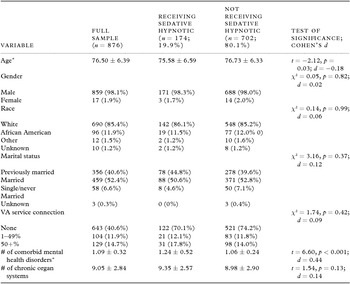
Table 1 presents the demographic and clinical characteristics of our sample. This sample of older veterans (M = 76.50 ± 6.39) was predominantly male (98.1%), Caucasian (85.4%), married (52.4%), and non-service connected (73.4%). Even though a large proportion of our sample was Caucasian, these rates are similar to those reported in national veteran samples (80% Caucasian; Office of the Under Secretary of Defense, Personnel and Readiness, 2012). Based on univariate analyses, veterans receiving sedative hypnotics within 12-months of a newly reported mental health diagnosis were more likely than those not receiving sedative hypnotics to be younger (t(874) = −2.12, p = 0.03, d = −0.18) and have a greater number of newly reported mental health disorders (t(874) = 6.60, p < 0.001, d = 0.44).
Demographic and clinical characteristics of older veterans with a newly reported mental health disorder

Note. *= p < 0.05.
Sedative hypnotic use
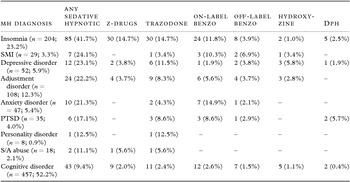
Table 2 presents sedative hypnotic use prevalence rates over the 12-months following each newly reported mental health disorder. Sedative hypnotics were commonly prescribed for older veterans with newly reported mental health disorders at a rate of 19.9%. Older veterans with newly reported insomnia (41.7%) were most likely to receive a sedative hypnotic followed by the diagnosis of a severe mental illness (24.1%) and depressive disorder (23.1%). Even though there was slight variation depending on the type of newly reported mental health disorder, trazodone (6.7%) and on-label benzodiazepines (5.9%) were the most commonly prescribed sedative hypnotics to older veterans.
Rates of sedative hypnotics use by type of mental health diagnosis

Note. MH = mental health; Benzo = benzodiazepines; DPH = diphenhydramine; SMI = severe mental illness; PTSD = post-traumatic stress disorder; S/A = substance/alcohol related-disorders.
Factors associated with sedative hypnotic use
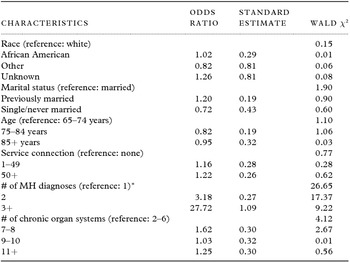
Table 3 presents the results of the multivariate logistic regression analysis. Race, marital status, age, service connection, and number of chronic organ systems were not associated with receiving a sedative hypnotic. The number of newly reported mental health disorders was the only significant factor associated with receiving a sedative hypnotic. When compared with having only one newly reported mental health disorder, the odds of receiving a sedative hypnotic increased by more than three-fold (OR = 3.18; 95% CI = 1.85–5.47) in older veterans with two newly reported mental health disorders; the OR increased immensely (OR = 27.72; 95% CI = 3.25–236.62) in older veterans with three or more newly reported mental health disorders.
Factors associated with receiving sedative hypnotics for male veterans

Note. *= p < 0.05.
Exploratory analyses
Given that a large portion of the sample (n = 634) were excluded because they had died within the prospective 12-month period, the previous analyses were repeated and the pattern of results did not significantly change. Individuals receiving sedative hypnotics were more likely than those not receiving sedative hypnotics to be younger (t = −4.82, p < 0.001; d = −0.33) and have a greater number of newly reported mental health diagnoses (t = 4.85, p < 0.001; d = 0.29). Older adults with newly reported insomnia were most likely to receive any type of sedative hypnotic (40.6%). Benzodiazepines and trazodone were the most commonly prescribed sedative hypnotics. Number of newly reported mental health diagnoses was a significant factor associated with sedative hypnotic use. The only difference between results occurred in the predictive analyses, such that age was a significant factor associated with sedative hypnotic use in the full sample (n = 1,513) but not in the non-deceased sample (n = 879). Odds of receiving sedative hypnotics decreased with increasing age in the full sample (n = 1,513) which may be an artifact of the veteran dying within the prospective 12-month period.
Discussion
Not only are sedative hypnotics commonly used but they likely account for a notable portion of PIMs prescribed to older veterans. Among our sample of older veterans with a newly reported mental health disorder, approximately 20% were prescribed a sedative hypnotic medication. Consistent with past research (Simon and Ludman, Reference Simon and Ludman2006), older veterans with a newly reported insomnia diagnosis were the most likely to receive a sedative hypnotic, with trazodone and on-label benzodiazepines being the most common. Even though it is often used in lieu of benzodiazepines, trazodone is not recommended for the treatment of insomnia in the elderly because of limited efficacy data, side effects, and drug-drug interactions (Ancoli-Israel, Reference Ancoli-Israel2000).
Consistent with our hypothesis, these results highlight the high prevalence of sedative hypnotic use, many of which are PIMS, in older veterans with greater psychiatric comorbidity. This is particularly concerning because there are alternative non-pharmacological treatments that are equally, if not more, effective. There is a significant, and growing, body of evidence that sedative hypnotics, despite being the most commonly used, should not be the primary treatment of insomnia. Due to the risk profile of many sedative hypnotics, they should especially be used sparingly or avoided in older adults (Carr, Reference Carr2005; Campanelli, Reference Campanelli2012). Rather, cognitive and/or behavioral treatments, like brief behavioral treatment for insomnia (BBTI) and cognitive behavioral therapy for insomnia (CBTI), are the recommended interventions and sedative hypnotics should be a secondary option and used for short periods of time. When compared to sedative hypnotics, CBTI has been found to be equally effective in the short-term treatment of insomnia and even more effective for long-term outcomes (Smith et al., Reference Smith2002; Sivertsen et al., Reference Sivertsen2006). Similarly, effective non-pharmacological approaches are available for older adults with depression (Cuijpers et al., Reference Cuijpers, van Straten and Smit2006), anxiety (Thorp et al., Reference Thorp, Ayers, Nuevo, Stoddard, Sorrell and Wetherell2009), PTSD (Dinnen et al., Reference Dinnen, Simiola and Cook2015), and substance/alcohol abuse (Schonfeld et al., Reference Schonfeld2000), which are conditions often seen in veterans with insomnia (Troxel et al., Reference Troxel2015).
Limitations
Several considerations and limitations should be noted. While the database is longitudinal (archival cohort with retrospective and prospective data collection), causal inferences are difficult to make due to the nature of administratively collected data. The data are only as reliable as the staff and/or automated processes in which data are entered and there is always some level of error and uncertainty about the accuracy. Next, the study was limited to VA primary care data and did not include any non-VA/community healthcare the veterans may have received. Similarly, VA inpatient hospitalizations or specialty care appointments were not tracked in the dataset which could have potentially resulted in biased rates of sedative hypnotic use. The parent study focused on the clinical characterization of insomnia and while data on many psychotropic medications were collected, namely sedative hypnotics, data on other psychotropic medications were not collected (e.g. anti-depressants and anti-psychotics) which are commonly prescribed and have their own adverse effects (Carr, Reference Carr2005; Lindsey, Reference Lindsey2009). Furthermore, medications used to treat insomnia are often indicated for other disorders, especially benzodiazepines for the treatment of anxiety disorders. We attempted to control for this by identifying drugs by searching the instructions on the prescriptions for directions such as “at bedtime” and “for sleep.” Only a small minority of the thousands of prescriptions included this information. Therefore, the medications included in the analysis should be interpreted with some caution; however, the most common drugs used in this analysis are those primarily used for the treatment of insomnia, namely trazodone and temazepam. Also, over-the-counter medications such as sleep aids containing antihistamines were not assessed. Other types of data not collected which may have been useful in this analysis include psychotherapy codes and psychotherapy outcome data, self-reported symptoms (e.g. PHQ-9), and provider factors (e.g. degree, demographics). In addition, female veterans represented a small proportion of our sample and additional research is needed to see if they have different predictors of sedative hypnotic use than male older veterans. Nevertheless, our analysis is an important starting point for examining this issue.
Future research/implications
Sedative hypnotic use is highly prevalent among older veterans despite their common categorization as PIMs and a large body of evidence stating that if intended to treat insomnia, cognitive and/or behavioral interventions are recommended. Future research can build on these results by a more thorough assessment of patient, provider, and system characteristics and how they contribute to the high rates of sedative hypnotic prescribing. Because sedative hypnotics are often requested by older adults, additional research is needed on the patient's role in the treatment decision-making process. Research and quality improvement efforts should also focus on providing the most relevant and helpful information regarding sedative hypnotics to both clinicians and patients regarding effectiveness, risk profiles, and the cost/benefit of using these medications. Research should continue to identify risk factors for prescribing (clinicians) and receiving (patients) sedative hypnotic medications in order to prevent adverse events and provide alternative non-pharmacological treatments. By advancing our understanding of the processes related to sedative hypnotic use, accessibility to standard-of-care practices will increase and overall quality of care should improve.
Conflict of interest
None.
Description of authors’ roles
Dr. DiNapoli designed and carried out the analyses for the current study, and wrote the paper. Dr. Bramoweth designed the parent study, compiled the dataset, and assisted with writing the paper. Mr. Cinna assisted with writing the paper. Dr. Kasckow was assisted with statistical design, mentorship of primary author, and review of the writing.
Acknowledgments
This project was funded by VISN 4 MIRECC Pilot Project (PI: Bramoweth). The contents of this paper do not represent the views of the Department of Veterans Affairs or the United States Government.