

Background
Pregnancy and Opioid Use
Overdose deaths in the United States have been increasing for over two decades, primarily due to opioid use. Recently released data shows that over 93,000 drug overdose deaths were reported in 2020—the highest on record and nearly a thirty percent increase from 2019.Footnote 1 The rate of opioid use disorder (“OUD”) among women who give birth quadrupled from 1.5/1000 delivery hospitalizations to 6.5/1000 between 1999 and 2019.Footnote 2
According to the World Health Organization (“WHO”), the National Academy of Medicine (“NAM”), and the American College of Obstetricians and Gynecologists (“ACOG”), medication for OUD (“MOUD”) with methadone or buprenorphine is the gold standard of treatment for OUD, including for pregnant women.Footnote 3 Women who are deterred from entering MOUD experience higher rates of miscarriages and low birth weight among their children as well as higher rates of maternal death.Footnote 4
Among women with OUD, eighty to ninety percent of pregnancies are unintended compared to fifty-one percent in the general population.Footnote 5 Though it is well established that using drugs during pregnancy results in risks for both the mother and baby, including miscarriage or severe developmental abnormalities for the child, there is little research that examines the motivation or that informs public policy and regulation for drug treatment among pregnant women.Footnote 6 Researchers at Johns Hopkins University examined whether pregnant drug-using women would be more likely than non-pregnant drug-using women to have higher motivation for addiction treatment and found that pregnant women were more than four times as likely as non-pregnant women to express stronger motivation for treatment.Footnote 7 More recently, a team from Yale University found that most women in their study identified their children and their roles as mothers and caretakers as important motivators for entering treatment.Footnote 8
Despite the efficacy of MOUD during pregnancy,Footnote 9 the current regulatory landscape often inhibits treatment entry and retention in care. Recent research in a Medicaid population in one state indicated that less than thirty percent of pregnant women with OUD received medication, and rural and minority women were less likely than urban white women to receive MOUD.Footnote 10 Women who named a father on the birth certificate were also more likely to get appropriate medication for their OUD.Footnote 11 Motherhood can inhibit treatment entry as women fear losing custody by disclosing substance use.Footnote 12 This is perhaps particularly true for mothers using opioids, as such use is by definition criminal, unlike the use of tobacco or alcohol.
Policy Impacts on Treatment Utilization
Purportedly aimed at reducing harm to fetuses and infants, laws punishing women who use substances while pregnant have been in place throughout the United States for decades.Footnote 13 These laws disproportionately impact racial and ethnic minorities and people who are poor, who simultaneously lack access to prenatal healthcare and substance use treatment.Footnote 14 There is no evidence to support the claim that civil and criminal legal penalties discourage substance use during pregnancyFootnote 15 and experts have long predicted the numerous negative consequences that attend to these legal strategies, including lack of prenatal care leading to poor birth outcomes.Footnote 16
Policy discussions have focused on the difference between punitive and supportive policies to address substance use during pregnancy.Footnote 17 However, policies that are perceived as supportive by experts may not be received in the same way by pregnant women. There is a growing discussion regarding child abuse laws being used to create sympathy for a fetal rights agenda and reduction of women’s autonomy and privacy in ways that are not applied to men.Footnote 18 Recent research suggests the need for more focus on emotional and structural resources for women caretakers with opioid dependence instead of the current landscape of coercion and surveillance to enhance both treatment entry and longer-term positive outcomes.Footnote 19
Methods
This analysis is focused on how state laws and regulations impact pregnant women who use drugs, particularly opioids, across the United States and the District of Columbia. We used legal databases maintained by Westlaw and Lexis, supplemented by publicly available state child welfare and health and human services agency policy reports and statements, to conduct a systematic review of the laws, regulations, and policies among the fifty states and the District of Columbia that apply to substance use during pregnancy and drug treatment for pregnant women who suffer from substance use disorders. That review focused on state laws and rules that pertain to state agency interventions regarding drug use during pregnancy, state drug reporting and testing rules that apply to pregnant women, and relevant state drug treatment program availability, funding, and access criteria.
In addition, we analyzed 2019 data from the National Child Abuse and Neglect Data System (“NCANDS”) to assess which states had the highest rates of child removal in the first year of life with drug use as a causal contributor. We limited the analysis to infants under age one in the age category and to children who received foster care (which equates to child removal as it includes any substitute care). We calculated the proportion of children removed by race and the proportion of children removed with a contributing factor of drug abuse (their word) by a caregiver by race/ethnicity of the child. We did not include alcohol abuse (again, their word) alone as a factor, but some caregivers who have both alcohol and drug use issues are included. We computed ratios of the proportion of children removed with a contributing factor of drug abuse by various race/ethnicity categories (white, Black, American Indian/Native Alaskan, Asian/Pacific Islander, Hispanic). All children who met the criteria for Hispanic were included in that category regardless of race and were not included in the race category so that there was not duplication. We calculated ratios of removal with drug abuse as a contributing factor as a proportion of births by minority race/ethnicity compared to whites by state and report on those states that have the greatest disparity. Comparisons are not adjusted for caregiver age, income, neighborhood, or other factors that may influence the relationship between race and child removal.
Treatment, legal landscape, and funding analyses were also conducted to identify barriers and facilitators to care for people with OUD.
Results
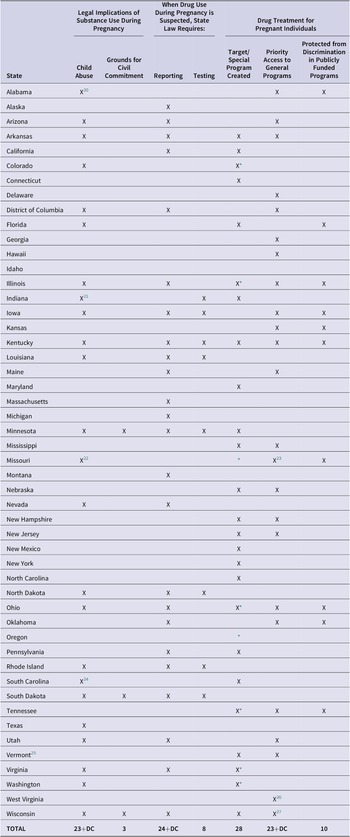
The results of this analysis are described in the tables herein. Table 1 outlines all fifty states and laws or policies within the following categories: legal implications of substance use during pregnancy, state mandated protocol when drug use is suspected during pregnancy, and drug treatment for pregnant individuals. The first category includes (1) Child abuse and (2) Grounds for Civil Commitment; the second includes state law required (3) reporting and/or (4) testing; and the third includes (5) creation of target/special programs; (6) priority access to general programs; and (7) protection from discrimination in publicly funded programs.
State Laws & Regulations: Substance Use During Pregnancy

* Establishes requirements for health care providers to encourage and facilitate drug counseling.
Twenty-three states and the District of Columbia have civil child-welfare statutes that mandate that substance use during pregnancy is child abuse. In addition, three states treat substance use during pregnancy as grounds for civil commitment and twenty-four states and the District of Columbia require health care professionals (“HCPs”) to report suspected prenatal drug use. Lastly, eight states require HCPs to test pregnant women for prenatal exposure if they suspect drug use.
Twenty-eight states offer drug treatment programs specifically targeted to pregnant women. Also, twenty-three states and the District of Columbia require pregnant women receive priority access to state-funded drug treatment programs and ten states prohibit publicly funded drug treatment programs from discriminating against pregnant women.
A. Legal Implications of Substance Use During Pregnancy
Table 1 scratches the surface of the legal landscape of each state for pregnant women with OUD. Generally, child welfare regulation remains the purview of the state and state legislatures and law enforcement officials have sought to penalize drug use during pregnancy in numerous ways. Several states have applied non-specific criminal statutes—laws that do not expressly refer to substance use during pregnancy—to pregnant individuals. As a result, individuals have faced an array of criminal charges as a result of substance use during pregnancy in at least forty-five states.Footnote 28 Those charges include “possession of a controlled substance, delivering drugs into a minor (through the umbilical cord), corruption of a minor,” child abuse, child neglect, reckless endangerment, manslaughter, and murder.Footnote 29 In two states—South Carolina and Alabama—the state supreme court has upheld the legality of such convictions on the theory that a fetus is “a child for purposes of [each] state’s criminal [code].”Footnote 30 In contrast, most other state appellate courts have overturned similar convictions, either because (1) “a fetus could not be considered a child or person under criminal child abuse statutes” or (2) “the legislature did not intend for an existing criminal statute to apply to a pregnant woman and her fetus.”Footnote 31 Despite these successes, it should be noted that the women challenging such convictions were forced to endure the severe financial, social, and liberty costs related to criminal prosecution.Footnote 32
No state currently explicitly criminalizes drug use during pregnancy, though the State of Tennessee did pass such a law in 2014.Footnote 33 The law declared that, for purposes of Tennessee’s criminal code, terminology addressing victims of crimes included “a human embryo or fetus at any stage of gestation in utero.”Footnote 34 The statute further clarified that “nothing … shall preclude prosecution of a woman for assault [through] the illegal use of a narcotic drug … while pregnant, if her child is born addicted to or harmed by the narcotic drug and the addiction or harm is a result of her illegal use of a narcotic drug taken while pregnant.”Footnote 35 That statute contained a sunset provision, which caused the lapse of its most severe provisions in July 2016,Footnote 36 and a bill to reinstate the provision was introduced in the state legislature in 2019 without success.Footnote 37 That stated, the language in that statute specifying that fetuses are inclusive of victims of crime throughout the Tennessee criminal code did not lapse.Footnote 38
Child welfare laws in twenty-three states and the District of Columbia characterize substance use during pregnancy as per se child abuse or neglect.Footnote 39 These laws are implemented through civil statutes or administrative regulations,Footnote 40 and enforcement may involve interaction with state agencies (e.g., Child Protective Services) that have the authority to institute custody proceedings and seek a court order to remove children from their parents.Footnote 41
Three jurisdictions have enacted statutes that permit the state to civilly commit individuals that use substances during pregnancy.Footnote 42 Wisconsin’s statute allows the state to hold a pregnant individual “against her will for the duration of her pregnancy, [provides] her fetus … its own court-appointed lawyer, [and creates the potential for her to] lose custody of her baby after birth.”Footnote 43 Wisconsin’s law was declared unconstitutional by a federal judge in 2017;Footnote 44 however, that judgment was vacated by an appellate court the following year.Footnote 45 As a result, Wisconsin’s statute that permits the civil commitment individuals who use substances while pregnant remains enforceable by state authorities.Footnote 46
Suspected Drug Use During Pregnancy
Twenty-four “states and the District of Columbia specifically require health-care providers to report when they treat infants who show evidence at birth of having been exposed to drugs, alcohol, or other controlled substances.”Footnote 47 Fifteen states “requir[e] health care workers to report [when] they suspect a woman is abusing drugs during pregnancy.”Footnote 48 The federal government also imposes mandatory reporting requirements through the Child Abuse Prevention and Treatment Act (“CAPTA”), which requires states to adopt various child abuse policies, which importantly include substance use while pregnant, and procedures in order to be eligible for federal funding.Footnote 49 The Administration for Children and Families has clarified that, under CAPTA, “health care providers must notify Child Protective Services … of all infants born and identified as affected by substance abuse, withdrawal symptoms resulting from prenatal drug exposure, or a Fetal Alcohol Spectrum Disorder.”Footnote 50 All fifty states receive CAPTA funding. As a result, there is some version of health care provider mandatory reporting in this context in place in every state in the country, thus essentially criminalizing drug use while pregnant, though tobacco use is notably absent.Footnote 51
Mandated Drug Testing and Reporting
Health care professionals in eight states must drug test pregnant mothers, and/or their infants at birth, if drug use is suspected.Footnote 52 A state hospital’s policy of conducting surreptitious drug testing on pregnant individuals in the course prenatal care was challenged in 2001 in Ferguson v. City of Charleston. Footnote 53 In Ferguson, the Supreme Court determined that a state hospital’s administration of drug tests without a pregnant patient’s consent and subsequent provision of those positive results to law enforcement authorities constituted an illegal seizure and, therefore, violated the Fourth Amendment to the United States Constitution.Footnote 54 While Ferguson proscribes a state actor from drug testing a pregnant individual without consent and for law enforcement purposes, it does not explicitly prohibit states from utilizing drug testing for child welfare purposes. Consequently, states continue to conduct “properly designed” mandatory drug testing policies.Footnote 55
Relationship of Child Welfare Removals to SUD rates
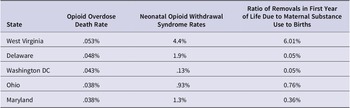
States with the highest overdose rates do not necessarily have the highest child removal rates due to substance use. Prior research attempting to find a relationship between child removal and opioid use have found too much state level variation to demonstrate an association.Footnote 56 It is a matter of policy and how it is implemented that creates the relationship between child removals and OUD. Only West Virginia is in the top five states in the United States for overdose death rate, neonatal opioid withdrawal syndrome (“NOWS”) rate and rate of child removal with substance use as a causal factor. Note the disproportionate rate of child removal compared to other states and to the NOWS rate in West Virginia.Footnote 57
West Virginia has both the highest rate of child removals in the country, as well as the highest rate of drug overdose deaths. Despite no law requiring it, all mothers are urine drug tested at the point of giving birth. Additionally, according to the West Virginia Bureau of Medical Services has moved from approximately 300 residential treatment beds in 2017 to approximately 1,400 in 2021 without an increase in prescribing MOUD during the years 2018 and 2019, a likely indicator that residential care is favored over MOUD. Policy that appears on paper to be supportive, such an increased number of residential beds, may perhaps be in fact quite coercive, with a higher percent of children removed at birth in West Virginia than experience withdrawal symptoms.
In contrast Delaware has high rates of overdose deaths and NOWS, but low rates of child removal with parental substance use as a causal factor. In the early 2000s, Delaware had a demonstration project funded by the Center for Medicaid and Medicare Services (“CMS”) to improve early identification and provide community-based services to families instead of removing children from their parents’ care. These different policy foci perhaps have led to very different rates of child removal.
2019 States with the Highest Opioid Overdose Rate Compared to Incidents of NOWS and Child Removals

Note. The states with highest rates of NAS are West Virginia, 4.4% of births, Maine, 2.3% Delaware 1.9%, Kentucky 1.9% and Vermont, 1.9%.
Race/Ethnicity Bias
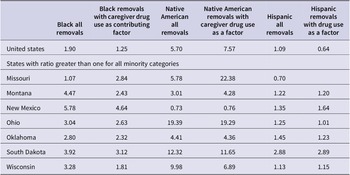
In most states, the proportion of Black and Native American infants under age one who are removed from their parents’ care is significantly higher than that of whites, with the national ratio of infants removed to births in 2019 being 1.4% for white infants, 2.7% for black infants, 8% for Native American infants, and 2% for infants of Hispanic ethnicity. In some states, the ratio of removals of Native American infants to births in 2019 was 30% (Nebraska, Minnesota, Ohio). Table 3 shows the states that have disparities in all three race/ethnicity categories for both overall removals and removals with caregiver drug use as a contributing factor. At the national level, the disparity between black and Hispanic infant removals compared to whites is less when caregiver drug use is a factor, but for Native American infants it is higher.
Ratio of minority race/ethnicity to white infants under age 1 removed overall and with caregiver drug use as a contributing factor
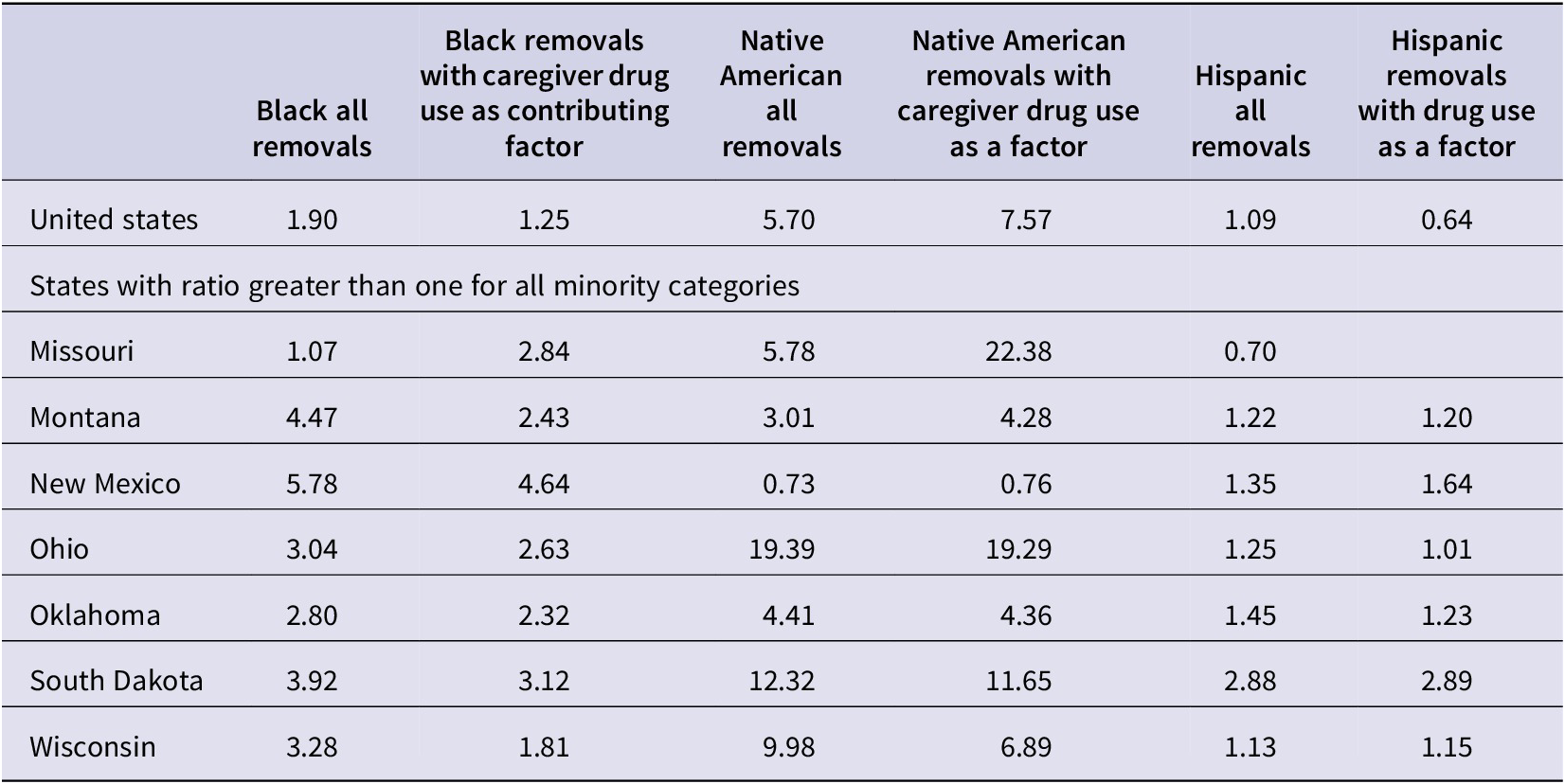
Note. Missing data for CO, ID, IA, KS, NJ, NY, ND, SD, VT, VA make these states incalculable.
There is significant missing data for several states that makes it impossible to conduct any analysis on drug use as a contributing factor. In some additional states, the numbers are so low that they are probably not representative of the true proportion.
Discussion
Supportive Policies
Policies concerning drug use during pregnancy remain evidence resistant and “[p]unitive policies [remain] more prevalent than supportive” ones.Footnote 58 In addition, pregnant individuals continue to face significant barriers in obtaining substance use disorder treatment.Footnote 59 Such obstacles may include lack of childcare, transportation, or health insurance, circumstances which are often compounded by the fact that many substance use disorder treatment providers will not treat pregnant individuals.Footnote 60 Twenty-eight states have created or funded drug treatment programs specifically targeted to pregnant individuals; twenty-three states and the District of Columbia provide pregnant women with priority access to state-funded drug treatment programs; and ten states prohibit publicly funded drug treatment programs from discriminating against pregnant women.Footnote 61 Healthcare providers are required to encourage and facilitate drug counseling for their pregnant patients in six states. States appear to have made progress in “supportive” laws and policies.Footnote 62
While treatment entry is an important goal, regulations that formalize policies that are supportive on their face are often tied to coerced treatment. Fourteen of the twenty-eight states that offer specialized treatment for pregnant and post-partum women also have child welfare laws that mandate reporting or define drug use during pregnancy as child abuse. The choice of entering treatment or losing custody is a common outcome of supportive state laws. Research reveals that a combination of coercion and increased treatment availability does lead to increased treatment utilization by pregnant women.Footnote 63
Child welfare workers have little faith in MOUD and have high expectations of parental failure or relapse,Footnote 64 leading many women to be required or encouraged to attend abstinence based residential treatment, which has significantly lower efficacy than treatment with MOUD, and necessitates going through withdrawal, which may be harmful to the fetus.Footnote 65 Fewer than half of pregnant women who have an OUD receive appropriate medication and rates are lower for women of color.Footnote 66 Women who do access MOUD during pregnancy may be punished by child removal when their infant experiences NOWS at birth. Child removals due to NOWS have increased in tandem with the growth in OUD, even though research suggests that most cases of NOWS are related to infants born to women in appropriate MOUD treatment.Footnote 67 In qualitative research, women express the concern that participation in treatment will increase their probability of involvement with the child welfare system, particularly if they receive medication.Footnote 68 Therefore, there is some risk or perception of risk that using appropriate treatment while pregnant may increase scrutiny and risk of removal of children, both the newborn and other children in the home.
Family treatment courts operate in forty-eight states and have been demonstrated to increase the time a mother spends in addiction treatment and to facilitate reunification.Footnote 69 While completion of family court, like other drug courts, is associated with improved outcomes for mother and children,Footnote 70 completion is not the most common outcome and the increased drug testing, interaction with the court and home visits required by family drug courts are often more intrusive than standard child welfare protocols, setting parents up for failure.Footnote 71
State laws that seem supportive can impose obligations on pregnant individuals that deter them from seeking treatment and/or discourage them from engaging in frank discussions with their healthcare provider or even from seeking prenatal care at all.Footnote 72 In Missouri, for example, prenatal healthcare providers are required to utilize a state-provided assessment form that “documents the substance abuse risk of each patient.”Footnote 73 The state further requires those providers to have pregnant women sign a form that identifies any substances that the patient has discussed with the provider. Such a system effectively demands a written admission of criminal activity by pregnant patients who seek treatment for substance use. These so-called support laws that encourage discussion of substance use between health care providers and patients, in reality, are inhibitors of discussion and a cause for late or no prenatal care.
Biases with Mandated Testing and Reporting
Testing and reporting laws for pregnant women are a form of status offense,Footnote 74 defined as criminalizing a behavior in a specific group that would not be criminal in another group. Non-pregnant people cannot be involuntarily tested for drugs and referred to the child welfare system. This discriminatory practice has the counter-productive outcome of pregnant people delaying prenatal care to avoid criminal or child welfare involvement.
Testing and reporting laws are not uniformly applied. Women of color and poor women are more likely to be suspected of using drugs and reported based on those suspicions. Hospitals, in particular, are likely to under-report potential drug use by high- and middle-income white women and over-report or suspect and test low-income minority women.Footnote 75 More recent evidence from the state of Washington, which has no reporting mandate, demonstrates that hospitals serving a large Medicaid population were more likely to report prenatal substance exposure. Infants exposed to stimulants and those born to Native American mothers were more likely to be reported. In that study, only half of infants diagnosed with exposure were reported to child protective services.Footnote 76 Other studies show that minorities and low-income families are also more likely to have abuse substantiated or have children removed rather than receive supportive services, and poor children of color are more likely to have long stays in foster care.Footnote 77 Each step of the process is disproportionately to the detriment of poor, minority women and their children.
These types of policies perpetuate “administrative violence.”Footnote 78 Administrative violence, in this context, is represented by laws and policies or processes of administering the laws and policies that appear on the surface to be supportive but are not in fact. Administrative violence can be the “supportive” policy to provide residential treatment but not provide or even allow treatment using MOUD. It can be the “supportive policy” of encouraging providers to identify and refer to treatment using state provided forms that are then submitted to the state for intervention. It can be the policy that allows rather than requires screening which is then applied only to certain groups.
Schneider and IngramFootnote 79 discuss the influence of social constructions on policy agendas using policy chain analysis. Often, the policy in its stated version ostensibly makes sense, but once the policy is applied, we can see how it reinforces the dominant power structure and continues to disenfranchise those in the target population – mothers and their children in this case. Using language such as “suspected” drug use and allowing doctors to use their own discretion when deciding who they suspect encourages implicit biases and promotes stigma. Laws that punish the mother and remove the child from her only serve the purpose of separating the family postpartum and do nothing to help the family, but add to multi-generational trauma.Footnote 80
Suggestions for Potential Regulatory Changes
This analysis brought to light the extensive challenges faced by pregnant women with OUD, which has fostered some suggestions and recommendations for regulatory change. First, family courts should be required to allow access to effective OUD treatment, which must include MOUD regardless of location of care. Also, states must prohibit custody removals and terminations of parental rights based solely on positive drug tests for opioids and other non-prescribed drugs. Newborns with symptoms of NOWS should be managed with care that promotes maternal involvement, including the encouragement of breastfeeding and maternal/child bonding instead of being separated and/or removed from their mothers and reported to child welfare services. We need to encourage and fund family centered treatment programs that include childcare, transportation, parental skill building, and co-located child wellness checks. The reliance and/or preference of residential care needs to be reduced, and instead we should provide in-home support and true evidence-based practices. MOUD should be the standard of care for treatment of opioid use disorder and women should be able to access it easily from the provider of their choice without the requirement of accepting ancillary services if they do not perceive the need and their child’s only risk factor is parental substance use.
Conclusion
Laws aimed at substance abuse during pregnancy should support women’s access to and success in SUD treatment and, thereby, effectively reduce harm to fetuses, infants and families. States should abolish criminal punishment as a response to substance use during pregnancy and amend their treatment regulations to eliminate exceedingly onerous demands on treatment programs and pregnant individuals. States should strive for “cross-sector policy engagement around prenatal substance use” aimed at increasing access to appropriate treatment to achieve positive public health outcomes.Footnote 81
This study suggests state regulations for pregnant women with OUD exist in a patchwork throughout the country; there are no proven benefits of the regulatory framework for maternal or infant health. Instead, some regulations limit access to care and retention in care. Does drug use in pregnancy and among parents (particularly women) need to be criminalized? Identifying and mitigating harmful regulations may markedly improve outcomes for mother, child and the community. Future research should prioritize understanding of “supportive policies” including whether they have real benefits to pregnant women and their children.
Acknowledgements
This project is supported by the Health Resources and Services Administration (HRSA) of the U.S. Department of Health and Human Services (HHS) as part of an award totaling $3,755,673 with 0% percentage financed with non-governmental sources. The contents are those of the author(s) and do not necessarily represent the official views of, nor an endorsement, by HRSA, HHS or the U.S. Government.