Introduction
Incidents involving the release of hazardous materials (HAZMAT) often occur unexpectedly, threatening both individual and public health. One such example would be the 2011 Fukushima Daiichi Nuclear Power Plant (Japan) incident which contributed to 600 disaster-related deaths and an increased radiation risk to 20,000 nuclear plant workers.Reference Ten Hoeve and Jacobson1 Another incident involving nerve gas poisoning in the Tokyo, Japan subway resulted in 11 deaths and more than 5,000 people requiring emergency medical evaluation.Reference Okumura, Takasu and Ishimatsu2 Furthermore, the lack of adequate decontamination and personal protective equipment (PPE) protocol led to 23% of staff at the responding hospital experiencing secondary exposure to Sarin.Reference Okumura, Okumura, Ishimatsu, Miura, Maekawa and Naito3 Personal protective equipment play an essential role in HAZMAT incidents, minimizing the risk of secondary infection of patients and emergency medical responders.
As full-body garments, PPE are designed to be impermeable, and with high insulation capabilities, in order to provide the necessary protection from fire, chemical, biological, radiological, nuclear, and explosive (CBRNE) hazards.Reference Buller, Tharion, Duhamel and Yokota4 However, this also leads to increased physiological strain, reduced thermoregulation ability, and decreased heat transfer to the environment,Reference Cheung, Petersen and McLellan5,Reference Muza, Banderet and Cadarette6 thereby exacerbating heat stress and limiting work times.Reference Levine, Quigley, Cadarette, Sawka and Pandolf7-Reference Grahn, Makam and Craig Heller9 Heat stress is a known occupational health hazardReference Lucas, Epstein and Kjellstrom10 that leads to reduced work capacity and productivity,Reference Kerslake11,Reference Kjellstrom, Holmer and Lemke12 reduced cognitive performance,Reference Ramsey13-Reference Parsons15 and an increased risk of accidents and occupational injuries.Reference Parsons15,Reference Ramsey, Burford, Beshir and Jensen16
In addition to heat stress, PPE users are also at increased risk of suffering from heat-related illnesses (HRIs). The adverse effects of HRIs have been demonstrated in numerous studies across professions utilizing PPE, such as health care personnel of Ebola treatment centers,Reference Grahn, Makam and Craig Heller9 construction workers in Hong Kong,Reference Chan, Guo, Wong, Li, Sun and Han17 mine rescue workers,Reference Marszałek, Bartkowiak and Dąbrowska18 and fire fighters.Reference Kim, Kim, Lee and Lee8 Up to 74.8% of firefighters were found to have experienced HRI symptoms, with 5.0% experiencing such symptoms 20 times or more in a year.Reference Kim, Kim, Lee and Lee8 Myocardial infarctions are the leading cause of fire fighter deaths in the United States and are attributed to the additional strain on the cardiovascular system caused by high thermal loads.19 Illnesses can rapidly progress to heat exhaustion, collapse, and even death from heat stroke,Reference Bouchama and Knochel20 thus necessitating proper assessment and management of HRIs. Health care workers are particularly at risk due to their lack of acclimatization.
While mild heat stress may not lead to significant adverse effects, development of hyperthermia often progresses insidiously and may remain undetected initially.Reference Hunt, Billing, Patterson and Caldwell21 Furthermore, multiple factors such as environment, activity, and individual variation contribute towards one’s risk of occupational heat exposure, making it immensely difficult to accurately predict the risk of HRI.Reference Lucas, Epstein and Kjellstrom10 Monitoring the extent of heat stress is not logistically nor financially feasible, and efforts should be concentrated on methods to minimize occupational heat stress and discomfort instead.
Wearable cooling devices allow for personal microclimate cooling and are another method aimed at reducing the adverse effects of heat stress from PPE use. Previous studies have explored the use of both passiveReference Smolander, Kuklane, Gavhed, Nilsson and Holmér22 (ie, chilled garments and ice packs) and active cooling devices (usually involving a pump circulating chilled coolant).Reference Grahn, Makam and Craig Heller9,Reference Cadarette, Levine and Staab23 While active cooling devices are able to attain a higher rate of cooling, this comes with many drawbacks, including the need for external powering and their greater weight. An ideal cooling device for PPE users should be lightweight, easy to don/doff, and not hinder the individual’s mobility.
This was an observational, clinical implementational study to determine the effectiveness of the CarbonCool cooling system (Global Healthcare SG; Singapore) – a half-body cooling vest – in participants undergoing a HAZMAT decontamination recertification exercise. Physiological measurements such as heart rate (HR), weight, temperature, and blood pressure were obtained. Specific feedback on the experience by participants was also reported.
This study hypothesizes that the cooling vest would help to reduce heat stress, as assessed through physiological measurements and qualitative surveys. The main outcome of interest is safety and tolerability – whether participants have to abort the use of the cooling vest due to discomfort or cold injuries.
Methods
Study Design and Methods
This was a prospective, single-center, observational and feasibility study. The study was conducted on two separate occasions during the Hospital Decontamination Recertification Exercise for HAZMAT (Singapore General Hospital; Singapore) in 2016 and 2018. Six cooling vests were provided on the first occasion and four suits on the second occasion. These were allocated to participants who were thus designated as the intervention group, while the remaining participants were allocated into the control group. Due to practical considerations, there was no blinding of participants to the allocated intervention or control. The data analyst was blinded to treatment allocation.
As a pilot study, the aim was to assess the safety and efficacy of the CarbonCool half-body vest.
The institute’s Central Institutional Review Board granted exemption for this research project (CIRB 2018/3189).
Setting
This study was conducted at Singapore General Hospital, Singapore in an outdoor setting. Singapore is a highly urbanized, small tropical island, with a land area of approximately 276.1 square miles and population density of 20,065 persons per square mile.Reference Ho, Chew and Wong24 Temperatures in Singapore range from an average of 23.3°C to 31.7°C (73.9°F-98.8°F) daily, with high humidity and rainfall throughout the year.Reference Ling Hii, Rocklöv and Ng25
Selection of Participants
A total of 12 male and 11 female participants from Singapore General Hospital took part in this trial. Participants were all healthy staff (without comorbidities) who had undergone training as decontamination staff for mass HAZMAT incidents with yearly recertification. There were 13 participants in the control group and 10 participants in the intervention group.
Interventions
Written informed consent was obtained from subjects prior to the start of trial procedures. No additional training was conducted prior to the actual trial as participants were already trained in both the exercise and the donning of PPE. All participants were required to wear standard PPE necessary for hospital decontamination station crew during HAZMAT operations and training. Participants in the intervention group wore the CarbonCool vest over a T-shirt, followed by the standard PPE (CLD500 suit; Paul Boyé Technologies; Labarthe-sur-Lèze, France), which is a Level B suit consisting of a full face-piece with an airway purifying respirator and chemical resistance clothing.Reference Yeung, Chan, Lee and Chan26 Participants in the control group wore only a T-shirt and standard PPE. All participants were subject to the same amount of physical activity during the training exercise and donned the PPE for a total of 55 minutes.
CarbonCool Cooling System
The CarbonCool cooling system consists of a free-size half-body sleeveless vest made of neoprene and thermoplastic polyurethane and can hold up to 12 MPad (Global Healthcare SG; Singapore); MPad encases a graphite water solution found to be 15-times more thermally conductive than ice and is responsible for the cooling properties of the vest.
The MPad is located within the external material at the abdominal, shoulder, as well as upper and lower back area regions. The cooling vest was fitted over a T-shirt, with Velcro straps used to secure the vest snugly around the user. Each CarbonCool vest weighs less than four kilograms and is manufactured to be suitable for up to one hour of use. The MPad was kept in a freezer for at least 24 hours prior to use in the study, then was subsequently placed in the pad holders of the vest.
Physiological Measurements
For each participant, weight, body temperature, heart rate (HR), and both systolic blood pressure (SBP) and diastolic blood pressure (DBP) were recorded before donning the PPE and CarbonCool vest and again after the training exercise concluded. Heart rate and blood pressure readings were obtained using the Propaq CS monitor (Welch Allyn, Inc.; Skaneateles Falls, New York USA). Temperature was measured using Covidien tympanic thermometer (Covidien LLC; Mansfield, Massachusetts USA).
Variables and Outcome Measures
Primary outcomes are safety, comfort, and mobility of participants while wearing the cooling vest. This was assessed via qualitative surveys conducted after the exercise for participants in the intervention group. Secondary outcomes are physiological measurements such as HR, blood pressure, temperature, and weight. Heart rate and blood pressure were recorded and body temperature was measured using a tympanic thermometer.
Statistical Analysis
Descriptive statistics for basic demographics and outcome variables were calculated, with two-sample t-test for continuous variables and Fisher’s Exact test for gender. Linear regression was used to study the effect of intervention on difference in before-after in physiological measurements, adjusting for age and gender. Data were analyzed using R (R Foundation for Statistical Computing; Vienna, Austria).
Results
Population Flow
This study recruited 23 participants, 13 of whom were in the control group while 10 were in the intervention group. Measurements obtained from all patients in both groups were analyzed in their assigned groups. There were no crossovers between groups or drop-outs from either group.
Baseline Characteristics
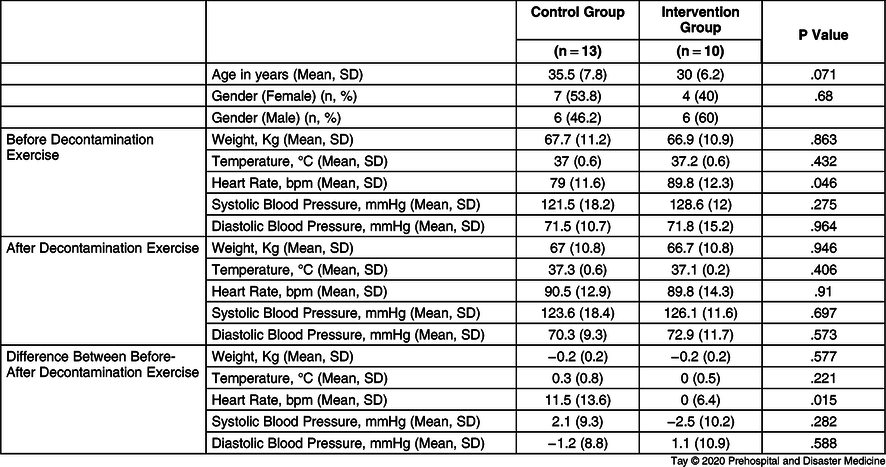
Table 1 shows the basic demographics and vital signs of the control and intervention groups, both before and after donning the PPE. The mean age in the control group was slightly higher at 35.5 years old with SD = 7.8 as compared to the intervention group at 30.0 years old with SD = 6.2. Females made up 53.8% and 40.0% of the participants in the control and intervention groups, respectively.
Demographics and Physiological Measurements in Control and Intervention Groups

Perceptual Responses
Three main aspects of the vest (comfort, mobility, and other) were assessed. Feedback from the participants found that the cooling vest was comfortable, did not feel heavy, and gave a sensation of being cooled down. For mobility, movement was reportedly unhindered by the vest.
Participants reported positive feedback regarding the ease of wearing and removing the cooling vest. Cooling effects were also reported to have lasted for up to 45 to 55 minutes, after which the sensation of coolness started to diminish. Despite this, the vest remained comfortable.
Physiological Measurements
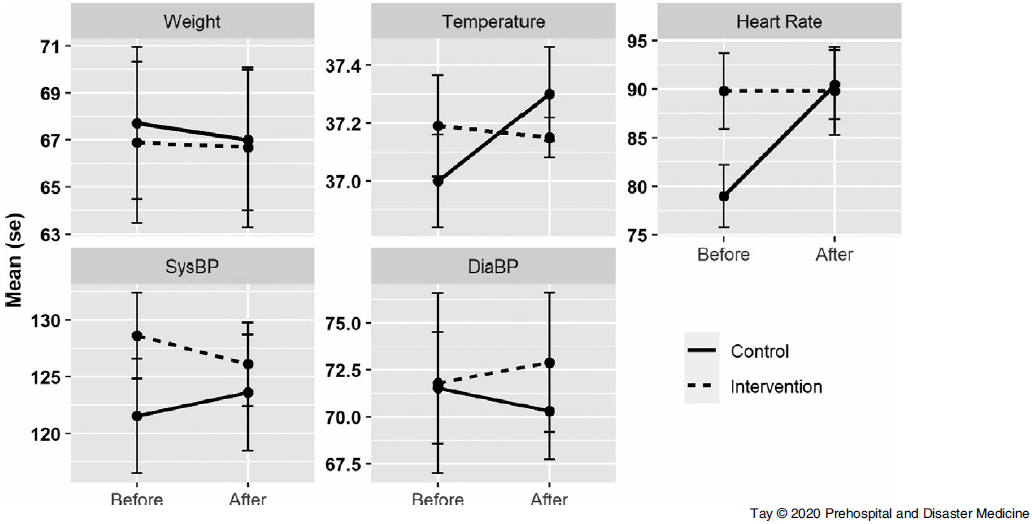
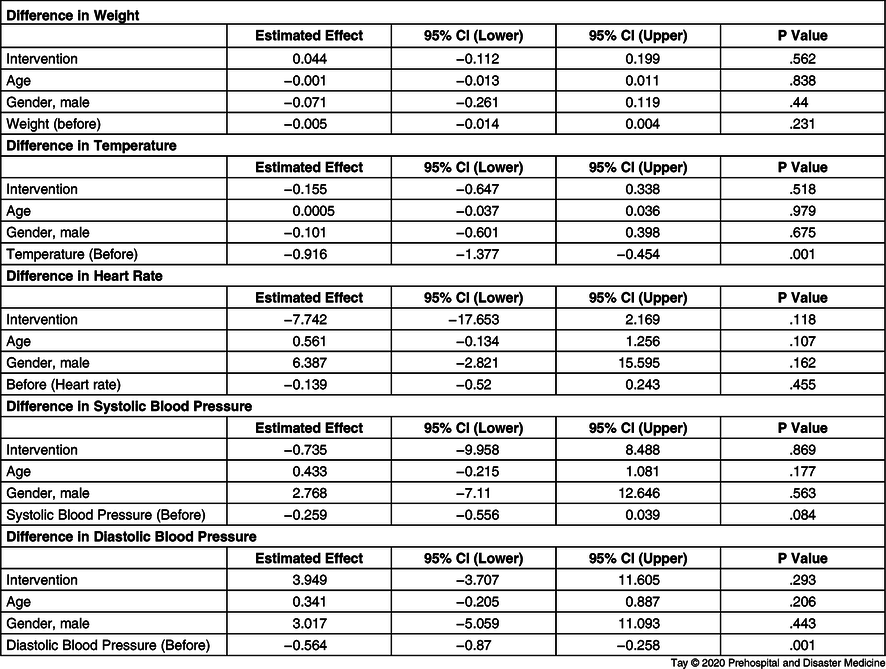
Trends in physiological measurement are seen in Figure 1. Participants in the intervention group showed a trend toward lower increase in body temperature and HR as compared to the control group, suggesting that the CarbonCool vest was successful in providing a cool microenvironment for PPE users. Linear regression for the effect of intervention with adjustment for age, gender, and baseline measurement was not statistically significant for all five variables. The estimated effect of the intervention for difference in before-after weight was 0.044 (95% confidence interval [CI], -0.112 to 0.199); difference in before-after temperature was -0.155 (95% CI, -0.647 to 0.338); difference in before-after HR was -7.742 (95% CI, -17.653 to 2.169); difference in before-after SBP was -0.735 (95% CI, -9.958 to 8.488); and difference in before-after DBP was 3.949 (95% CI, -3.707 to 11.605; Table 2). Difference of before-after temperature and HR were 0.3°C (32.5°F; SD = 0.8) and 11.5bpm (SD = 13.6) in the control group compared to 0.0°C (32.0°F; SD = 0.5) and 0.0bpm (SD = 6.4) for the intervention group (Table 1).
Trend of Mean Physiological Measurements (with standard error bar) of Participants Before and After the Recertification Exercise.

Linear Regression Showing the Effect of Intervention on Physiological Measurements Before and After the Decontamination Exercise, Adjusted for Age, Gender, and Baseline Measurement

Discussion
This study aimed to investigate the safety and effectiveness of the CarbonCool vest for body cooling in a decontamination recertification exercise, taking into account both the physiological measurements as well as the perceptual response by participants. There is potential for use of the cooling vest across a wide range of fields for professions with mandatory PPE use, such as in HAZMAT decontamination, fire fighters, or health care personnel.
The main findings from this study were the positive perceptual responses obtained from participants in the study. The CarbonCool vest was found to provide improved comfort for PPE users while remaining lightweight and easy to don. Although a number of personal cooling devices are available,Reference Shapiro, Pandolf, Sawka, Toner, Winsmann and Goldman27-Reference Bennett, Hagan, Huey, Minson and Cain29 use of these equipment are limited due to constraints such as greater weight or connection to external equipment.Reference Smolander, Kuklane, Gavhed, Nilsson and Holmér22 An ideal body-cooling device would be one that effectively cools the individual while not adding significant additional weight and causing further physical strain.Reference Smolander, Kuklane, Gavhed, Nilsson and Holmér22 It is also crucial that movement not be impeded to minimize disruption to job performance. This study demonstrated the practical feasibility and ease of use of the CarbonCool vest with PPE use, with participants reporting that the vest did not feel excessively heavy and mobility being unhindered.
The intervention group demonstrated a trend toward a lower increase in body temperature and HR after the decontamination exercise, although the results were not statistically significant. Other physiological measurements such as change in weight and blood pressure showed no significant difference between the control and intervention groups.
While a number of studies on other cooling devices demonstrated efficacy through significant changes in physiological measurements,Reference Grahn, Makam and Craig Heller9,Reference Cheuvront, Kolka, Cadarette, Montain and Sawka30 these were in devices that required external powering. In a study using a personal ice cooling system in PPE for HAZMAT operations under exercise stress, no significant difference was found in temperature or HR between the intervention and control groups, yet the intervention group had an increased endurance time of almost twice the duration.Reference Cadarette, Levine and Staab23 This suggests that physiological measurements and impact on work endurance may differ, and further studies should be carried out to determine the true effect of work endurance in the CarbonCool vest.
The results presented suggest that the cooling vest may help to reduce heat strain and also improve the subjective sensation of the individual while not compromising on mobility. Furthermore, the CarbonCool vest is reusable, thus providing an affordable alternative, especially in resource-limited regions.
Limitations
A number of limitations exist in this study. Firstly, as a pilot study, the sample size in this trial is intentionally small and therefore insufficiently powered to detect a statistically significant difference in patient-oriented clinical endpoints. Secondly, limitations imposed by ethics approval prevented the measurement of core temperature such as rectal temperature. More robust measurements could be obtained to ensure greater reliability. An example would be rectal temperature or monitoring of temperature at different time points of the activity. This would allow for a better understanding of the changes in measurements and how they are affected by the intervention.
Thirdly, the qualitative survey could be more directed with specific ratings for different components of the cooling vest. One example would be for participants to rate perceived exertion, as was done in a number of other studies on cooling vests.Reference Smolander, Kuklane, Gavhed, Nilsson and Holmér22,Reference Vallerand, Michas, Frim and Ackles31,Reference Chan, Zhang, Wang, Wong and Chan32 Performance during operational tasks was not measured, which may be impaired independently of physiological parameters. It was also not possible to blind the participants from the intervention, even with the use of sham cooling vests. Another limitation is that comparisons were made using physiological measurements obtained from a number of different individuals, thereby introducing more variability into the study. The authors intend to follow-up with a more valid crossover study subsequently.
While small, non-randomized trials on human volunteers with surface cooling devices in experimental settings yielded mixed findings,Reference Cheuvront, Kolka, Cadarette, Montain and Sawka30,Reference Lopez, Eberman and Cleary33 these studies reflect the efficacy of the specific device used rather than the concept of using wearable cooling devices, which have been shown to have a role in reducing thermal and cardiovascular strainReference Hasegawa, Takatori, Komura and Yamasaki34 in proof-of-concept studies.
Conclusion
This observational clinical implementation trial shows that the CarbonCool cooling vest is safe and tolerable in participants wearing PPE. Further trials with sample size powered to detect clinical outcomes are needed to assess the effect of the cooling vest on a subject’s endurance to heat stress.
Conflicts of interest/disclosure
All authors have no commercial or personal associations or any sources of support that might pose a conflict of interest in the subject matter or materials discussed in this manuscript. CarbonCool cooling vests used in the study were provided on loan by Global Healthcare SG (Singapore) and were returned after the exercise.