On October 29, 2012, Hurricane Sandy hit the northeastern US coastline, causing record-level storm surges. In New York, inundations due to storm tide ranging from 2 to 9 feet above ground level were prevalent along the coast of New York City, Long Island, and Hudson River Valley.Reference Blake, Kimberlain and Berg 1 A major disaster declaration for New York was made by the Federal Emergency Management Agency on October 30, and disaster recovery centers were opened in the Bronx, Kings, Nassau, Queens, Richmond, and Suffolk counties of New York on November 3. 2 - 4 Hurricane Sandy caused widespread devastation and costly damage. Fifty-three of the 117 hurricane-related deaths captured by the American Red Cross 5 occurred in New York, and the numbers of homes destroyed were estimated to be 305,000 in New York State with approximately 100,000 homes on Long Island severely damaged or destroyed.Reference Blake, Kimberlain and Berg 1 By January 2013, approximately $60 billion in funds were authorized by the US Congress to assist in the recovery. 6
Emergency department (ED) visits have been used in the past to examine the impact of natural disasters on health outcomes.Reference Blindauer, Rubin, Morse and McGeehin 7 - Reference Smith and Graffeo 14 Tracking hurricane-related ED visits is a complicated process with changing patterns throughout the course of the hurricane, from preparation to the immediate aftermath and then to recovery. For example, Smith et alReference Smith and Graffeo 14 reported a 46% drop in ED visit volume on the day of landfall of Hurricane Isabel followed by a marked increase during the 4 days immediately after landfall, with the largest complaint (57%) being minor trauma. Miller et alReference Miller, Kearney and Proescholdbell 10 found a 22.3% increase in injury-related ED visits during the week following Hurricane Irene in 2011 in comparison to the same reference week in 2010. Factors such as the intensity of the storms, other accompanying weather events (eg, heavy rainfall and other hurricanes), and locations of the direct exposure (eg landfall), also affect the ED visit volume and types of chief complaints that present to the EDs.Reference Lin, Hou and Fuh-Yuan Shih 9 , Reference Platz, Cooper and Silvestri 12
Geographically, Long Island is an overpopulated, suburban insular area with limited exit roads, which makes access to local urgent care a necessity in case of a disaster. In preparation for Hurricane Sandy landfall, Long Island EDs were staffed with additional personnel, with the view that EDs would probably be the only functioning structures dispensing health care on the island. Recent studies have assessed the impact of Hurricane Sandy on ED visits with a focus on urban areas such as New York City and on specific health outcomes such as carbon monoxide poisoningReference Chen, Shawn and Connors 15 and dialysis care.Reference Kelman, Finne and Bogdanov 16 These studies showed an increased number of ED visits for carbon monoxide-related accidents after Sandy, and increased use of the ED for dialysis-related issues both prior to and after the hurricane. However, the storm-related ED profile of the adjacent New York City urban area differs from that of Long Island.
In addition to physical impairment, natural disasters affect the mental health of residents and survivors.Reference Boscarino, Hoffman and Adams 17 - Reference Boscarino, Hoffman and Kirchner 21 A study conducted by the Red Cross on 18,823 residents between October 29 and November 20, 2012Reference Schreiber, Yin and Omaish 20 showed a high number of health care contacts for mental health issues after Sandy, with the highest number in Nassau County, Long Island. Direct interviews of 200 New Jersey Shore residents 6 month after SandyReference Boscarino, Hoffman and Adams 17 , Reference Boscarino, Hoffman and Kirchner 21 reported that 20% of those interviewed sought some mental health counseling, rates that are similar to what was observed after 9/11.
To our knowledge, no study has investigated the characteristics of Sandy-related ED visits in Long Island, despite the fact that the area was heavily affected by Sandy.Reference Bleyer 22 In addition, no study has investigated the rates of mental-health-related ED visits after Hurricane Sandy. This study aimed to examine the effect of Hurricane Sandy on Long Island residents’ ED visits both in terms of physical and mental health related-visits and to determine whether ED visits varied in areas where the impact of the storm differed in intensity. Through this investigation of changes in ED utilization associated with hurricanes, the study offers insights into improving emergency health care services for future storms.
Methods
Study Population
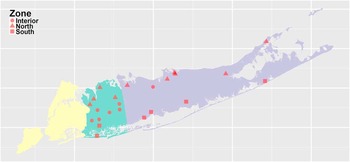
Individual-level de-identified data were extracted from the Statewide Planning and Research Cooperative System (SPARCS) from New York State ED visits from October 1 to December 2012 for residents of Nassau and Suffolk counties in Long Island, New York (Figure 1). SPARCS is a comprehensive all-payer data reporting system established in 1979 as a result of cooperation between the health care industry and government. 23 Age, sex, race, ethnicity, and insurance type are registered in the SPARCS data and were extracted for the present analysis. The study was approved by the Institutional Review Board of the Feinstein Institute for Medical Research.
Location of the Emergency Departments in Nassau and Suffolk Counties. Area of residence was divided into three 3 geographic zones: South Shore, North Shore, and interior.

Outcomes
The outcomes studied were change over time in the number of ED visits, overall and according to whether the visit was related to physical or mental health issues. Mental health visits (International Classification of Diseases, 9th revision [ICD-9] codes 290-319) were compared to the number of ED visits for physical health issues (ICD-9 codes other than 290-319).
Hurricane Sandy Exposure
SPARCS are administrative data sets and as such do not contain any additional specific information about hurricane exposure. Two surrogates of potential Hurricane Sandy exposure were constructed: (1) date of ED visit and (2) area of residence, divided into 3 geographic zones based on zip codes: (1) South Shore, (2) North Shore, and (3) interior area of Nassau and Suffolk counties. We hypothesized that the South Shore had the greatest and the interior areas had the least amount of Hurricane Sandy exposure.
Statistical Analyses
The dates of the ED visits were grouped into 4 periods: (1) pre-Sandy, October 1–Oct 28; (2) during Sandy, October 29; (3) post-Sandy I, October 30 to November 1; and (4) post-Sandy II, November 2–30. The unit of analysis was the individual visit, adjusted for dependency of repeated visits within each individual. The analysis of data after November 30, 2012, was also performed in an attempt to assess any long-term effects of Hurricane Sandy, but no significant variation in ED visits was observed after that date in comparison to the post-Sandy II period. Therefore, the analysis up to November 30 is reported here.
Descriptive trends of daily ED visits during the 4 periods were performed according to mental health and physical health primary diagnosis. Crude and adjusted prevalence ratios (PRs) were estimated by comparing ED visits in the during and post-Sandy periods with ED visits in the pre-Sandy period. Dependency of repeated measures within individuals may occur by having multiple ED visits during the periods. This was adjusted for by using a population-averaged Poisson regression model. Overdispersion of the distribution was examined and confirmed the equidispersion of the distribution. Specific primary diagnosis groups were ranked according to the 4 Sandy periods, and statistical differences were examined by chi-square test.
Results
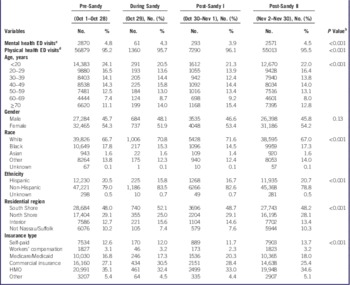
During the months of October and November 2012, a total 126,337 ED visits were recorded among the 23 EDs located in Nassau and Suffolk counties. ED visits for physical health diagnoses were slightly increased in the Post-Sandy I period (96.1%) compared with the pre-Sandy period (95.2%), whereas ED visits for mental health diagnoses were decreased in the post-Sandy I period (4.8%) compared with the pre-Sandy period (3.9%; Table 1).
Description of the Population Under Study According to Calendar PeriodsFootnote a

a Abbreviations: ED, emergency department; HMO, health maintenance organization; ICD-9, International Classification of Diseases, 9th revision.
b P value from Pearson chi-square test.
c Primary diagnosis (ICD-9: 290–319 [mental disorders]).
d Primary diagnosis (ICD-9: all codes except 290–319).
There were no significant differences in ED volume among periods on the basis of area of residence (North Shore, South Shore, interior area). An increasing trend in ED visits was observed in the post-Sandy I period compared with the pre-Sandy period with increasing age in the South Shore area and in white, non-Hispanic, and Medicare/Medicaid patients (Table 1).
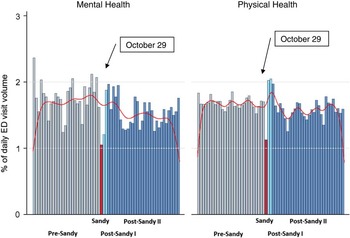
A significant drop in ED visit volume was observed on October 29 (the during-Sandy period) for both mental health (average, 61 visits per day versus 103 visits in the pre-Sandy period) and physical health diagnoses (average, 1360 visits per day versus 2031 visits in the pre-Sandy period) (Figure 2). No increase in ED visits was observed during the post-Sandy I and II periods for mental health diagnoses, whereas 399 more ED visits for physical health diagnoses were identified in the post-Sandy I period (average 2430 visits per day) compared with the pre-Sandy period (average 2031 visits per day).
Effect of Hurricane Sandy on Emergency Department (ED) Visit Volume For Mental Health and Physical Health Diagnoses. The 4 study periods were as follows: pre-Sandy, October 1–28; during Sandy, October 29; post-Sandy I, October 30 to November 1; and post-Sandy II, November 2–30.

When PRs were analyzed (Table 2), there was a decreasing trend of mental health visits in the post-Sandy I period (PR=0.79 and 95% confidence interval [CI]: 0.70-0.89) in both univariate and multivariable analysis. Both crude and adjusted PRs indicated an increase in ED physical health visits in the post-Sandy I period (PR=1.01; 95% CI: 1.01-1.02).
Crude and Adjusted Prevalence Ratios of Mental and Physical Health Emergency Department Visits According to Hurricane Sandy PeriodsFootnote a

a Abbreviations: CI, confidence interval; PR, prevalence ratio. Note: adjusted for age, gender, race, ethnicity, residential region, and insurance type.
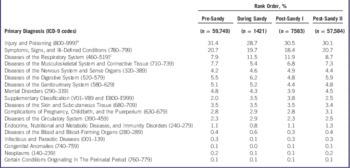
Specific ICD-9 groups for primary ED diagnoses were explored (Table 3). The category “injury and poisoning” was the top-ranked diagnosis group in all 4 periods, comprising roughly 30% of the diagnoses, without any clear temporal trend. The only notable diagnosis group that showed a positive trend in the post-Sandy I versus the pre-Sandy period was “diseases of the respiratory system” (4% increase). Six disease subgroups (ICD-9: 460-466, 470-478, 480-488, 490-496, 500-508, and 510-519) within “diseases of the respiratory system” were tested, but none of the subgroups showed significant trend changes between the pre-Sandy and post-Sandy I periods.
Rank Order of Primary Diagnoses According to Hurricane Sandy Periods (Sorted by Post-Sandy I)Footnote a

a Abbreviation: ICD-9, International Classification of Diseases, 9th revision.
b Top-ranked primary diagnosis.
c Significant increase (P<0.001) in the during Sandy and post-Sandy I periods compared with the pre-Sandy period.
Discussion
The results of the present analysis suggest that ED visits declined sharply on the day of Hurricane Sandy landfall, whereas they increased sharply in the following days, with an overall estimate of over 700 extra ED visits in the 2 days following the hurricane, after which visits slowly returned to the expected volume. This phenomenon has been observed in similar situations with Hurricanes Isabel,Reference Smith and Graffeo 14 Irene,Reference Miller, Kearney and Proescholdbell 10 Gloria, 24 and CharleyReference Platz, Cooper and Silvestri 12 and is likely due to a combination of factors limiting access to EDs, such as road impracticability, heavy rain and flooding making driving very dangerous, and limited or lack of public transportation. It is also possible that subjects with non-life-threatening health issues decided to endure the problem at home, given the treacherous weather conditions. In the days immediately following Sandy, however, the ED visits spiked, similarly to what was reported during the previously mentioned hurricanes.Reference Miller, Kearney and Proescholdbell 10 , Reference Platz, Cooper and Silvestri 12 , Reference Smith and Graffeo 14 , 24 The increase was reported to be due to excess minor traumas caused by cleanup activities,Reference Platz, Cooper and Silvestri 12 by attempts to repair and restore property,Reference Smith and Graffeo 14 and by the inability of local primary care physicians to open their practices and offer first aid services. The Primary Care Information Project (PCIP) at the New York City Department of Health and Mental Hygiene showed that practices in less affected areas returned to normal reporting patterns more quickly, whereas those in more affected areas did not resume normal data transmissions for a few months.Reference Sebek, Jacobson and Wang 25 The present analysis indicates that certain demographic characteristics (age, white race, non-Hispanic ethnicity) were associated with the trends in ED visits across the various Sandy periods; similarly, Medicare/Medicaid patients experienced an increase in ED visits compared with patients carrying other forms of insurance. A household survey from the 2004 Florida Hurricane Charley suggested that the hurricane exacerbated chronic medical conditions among individuals over the age of 60 years.Reference Platz, Cooper and Silvestri 12 Previous studies indicated that men are more likely than women to access the ED in the hurricane aftermath, possibly because they engage in recovery activities that cause traumasReference Blindauer, Rubin, Morse and McGeehin 7 or experience accidents such as intoxication from exposure to gasoline.Reference Kim, Takematsu and Biary 26
In an attempt to understand the mental health burden of Hurricane Sandy, we analyzed the ED visits for which a mental health code was reported separately. Our own survey studyReference Schwartz, Liu and Sison 27 and a survey conducted in New Jersey 6 months after Hurricane SandyReference Boscarino, Hoffman and Adams 17 indicated an increase in mental health issues after the hurricane, and an increased request for mental health support, whereas we report here a decrease in ED mental health visits immediately after Hurricane Sandy. It is possible that mental health support happened in a nonemergency setting and thus did not affect the ED visit rates immediately after the hurricane. Is it also possible that immediately after Sandy the focus was on recovery and basic survival (place to live/shelter, finances, food, protection of property, insurance/recovery, etc) and that once these issue were solved or at least under control, time and energy were devoted to mental health issues or alternatively that mental health issues took longer to surface. 28
When the main causes for an ED visit were analyzed, diseases of the respiratory system appeared significantly increased compared with the period preceding Sandy. It has been reported by PCIP that rates of bronchitis increased after Sandy compared with the 2 prior years.Reference Sebek, Jacobson and Wang 25 , 28 Although the concomitancy of the flu season cannot be discounted, it is possible that the presence of molding, house flooding, tearing away of damaged Sheetrock, and being displaced in poorly heated shelters may have contributed to the development of respiratory conditions. The frequency of coughing in the Queens and Long Island areas affected by Sandy was so prevalent that the term Rockaway cough (a coastal area adjacent to Nassau County) has been described in an online dictionary. 29
In addition, for determining the population needs and vulnerability profiles in the affected areas, the analysis of ED trends is useful for assessing the health resource needs during natural disasters and for predicting and planning ED staffing in case of future similar events. Studies such as the present suggest that the ED is likely to be “overstaffed” the day of the hurricane, but additional support is actually required in the days immediately following the event. The analysis of the disease categories heavily represented in the ED visits following the hurricane may also guide the choice of medical support needed during and after the natural disaster.
Limitations
There were several limitations to using ED data in an epidemiologic investigation: ED data do not represent the entire burden of the health impact of Hurricane Sandy. They only capture acute and emergency cases and do not capture any chronic or mild health effects. Additionally, the purpose of ED data collection is the assessment of health care quality, services, insurance coverage, and billing, not epidemiologic investigation; therefore the accuracy of the information may be low. For example, any misclassification of diagnosis can be problematic if the research focuses on a specific health outcome. In the present analysis, the data were used for surveillance purposes of the overall health effects of the hurricane instead of focusing on a specific outcome. Therefore, the accuracy of the ED data may have had a minimal impact on this study.
Conclusions
The present analysis of ED visits during Hurricane Sandy in Long Island suggests that the critical temporal window when ED resources should be increased is in the immediate aftermath of the hurricane. These findings also indicate that ED visits for respiratory diseases and visits among the older populations were critically increased after Sandy. The results, along with the particular geographic location of Long Island, underline the need for a real-time syndromic surveillance system. In addition, the findings reported here have concrete implications for organizing future disaster preparedness.
Acknowledgments
We thank Jonathan Amalfitano for facilitating data access and extraction.
Funding
This study was partially funded by CDC UO1 TP000573-001